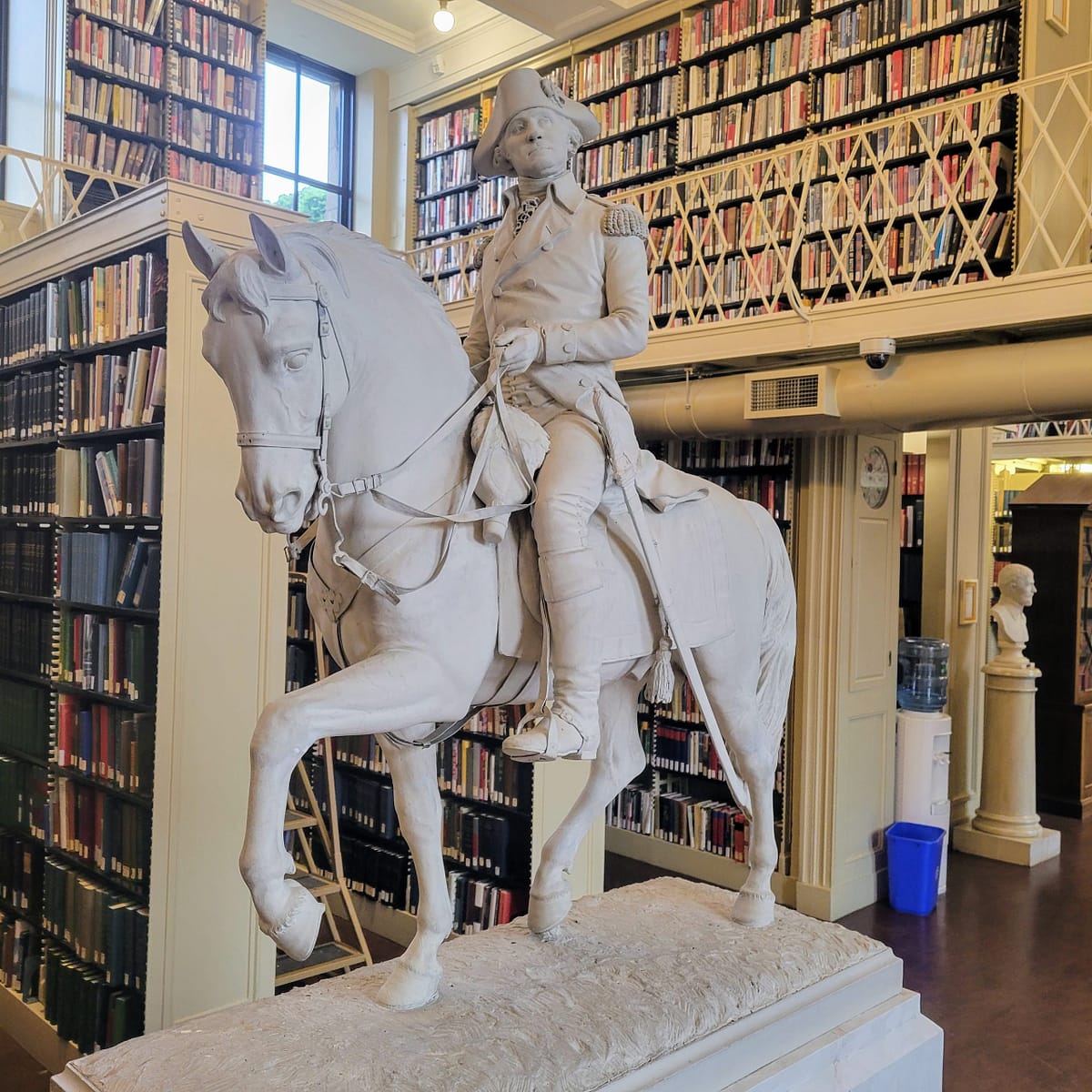
By George, I’m seeing double! Many have admired the Public Garden’s stately bronze George Washington on horseback, but did you know you can get even closer to George (and his trusty steed) at the Boston Athenaeum?
Sculptor Thomas Ball completed his plaster study for the equestrian statue in 1858, a year before the larger statue was commissioned.
07.31.2024
Only at the Athenaeum: Hawthorne’s friendly ghost
Nathaniel Hawthorne’s “The Ghost of Dr. Harris” is a tale of his experiences with the ghost of Reverend Doctor Thaddeus Mason Harris at the Boston Athenaeum.
As the story goes, Hawthorne claims to have seen Dr. Harris reading in the same spot in the Athenaeum, day after day, only later to have learned Dr. Harris had died days prior.
Hawthorne wrote the story for a friend, but it wasn’t published until Hawthorne passed himself. When we moved to 10½ Beacon Street, the ghost of Dr. Harris did not come along, although a portrait of him did – which you can see displayed on our first floor.
07.31.2024
Only at the Athenaeum: Ralph Waldo Emerson’s Excuse
Where’s Ralph Waldo Emerson? Ralph Waldo Emerson was a frequent visitor to the Boston Athenaeum, even as late as 1875.
Often accompanied by his daughter Miss Ellen Emerson, who carried his papers and books in her satchel, they would settle into chairs by one of the windows overlooking the Granary Burying Ground. Here, they would plan their day in the city, with Miss Emerson occasionally persuading her father to join her on social calls.
He declined often, saying there were things he needed to look up at the Athenaeum. Feel free to use the same excuse!
07.31.2024
Only at the Athenaeum: When Alexander Bell Rang In
Alexander Graham Bell gave his first public demonstration of the telephone at the Boston Athenaeum on May 10, 1876, for members of the American Academy of Arts and Sciences.
Bell wowed the audience by transmitting music tones over the telephone with a wire running from his office down the street. This demonstration was a ringing success indeed!
07.31.2024
Only at the Athenaeum: The Strangers List
The “Names of Strangers Introduced” at the Athenaeum is a unique and historically significant part of the library’s records.
Essentially a guest book, the list included notable figures such as senators, artists, writers, commanders, and one king: Samuel Morse (in 1837), Washington Irving (1832, 1851), Harriet Beecher Stowe (1856), Henry James (1849), William Makepeace Thackeray (1852), Horace Greeley (1869), and King Kamehameha III of the Hawaiian Islands (1850).
Strange days, indeed.
07.31.2024
Only at the Athenaeum: The Butler’s Mark
Have you ever noticed this distinctive handwriting on bookplates or book pockets? That’s the work of Gerald Frowd, a reading room assistant from 1946 to 1962. A private butler in his earlier years, Frowd had a meticulous hand. So, next time you see it, remember: the butler did it!
An example of the distinct handwriting of Geral Frowd, former reading room assistant.
05.08.2024
Folio Bistro opens June 25
Partnership with The Catered Affair launches street-level eatery to expand palates, the library and museum experience, and social connections to the Boston community.
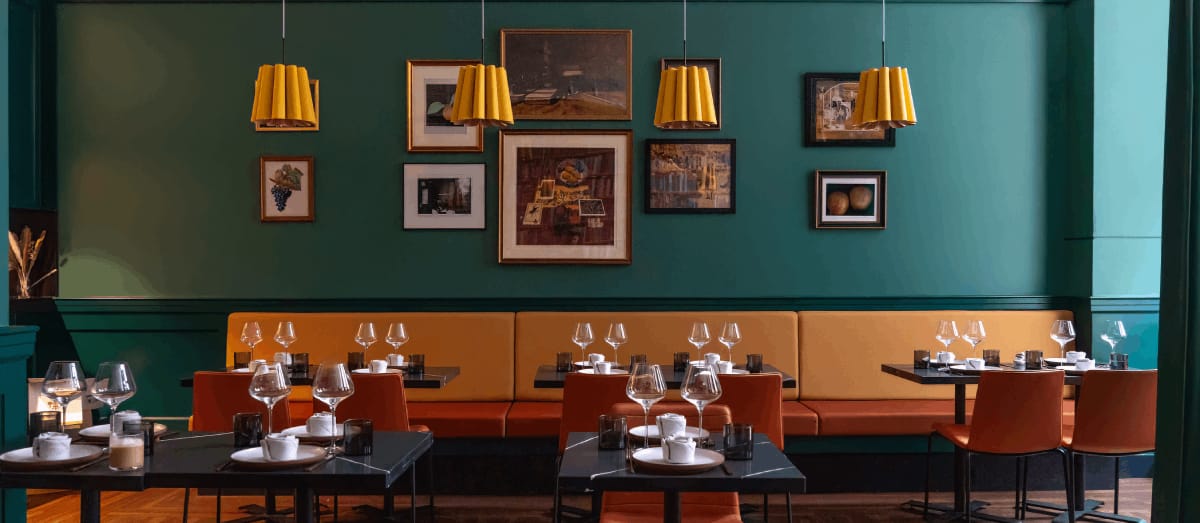
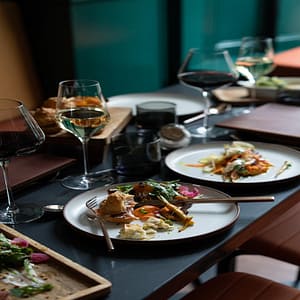
Today, the Boston Athenaeum announced the opening of its new street-level bistro, Folio, launched in partnership with The Catered Affair. Folio will serve as the newest social hub in Boston, inviting all curious food lovers to enjoy made-to-order shareable plates, lively conversation, and impeccable service. The opening date is Tuesday, June 25, 2024.
photos by @sambarracca
The opening of Folio marks the final installment in the Boston Athenaeum’s renovation and expansion intended to make the space more welcoming and inviting to the city of Boston. The restaurant is open to the public and offers visitors the enjoyment of the distinctive and unique setting of the Boston Athenaeum’s library, museum, and cultural center. The welcoming ambiance will be paired with European-inspired cuisine by Chef de Cuisine Peter Laspia, dozens of new and old-world wines, and craft cocktails – including a Boston Athenaeum branded signature cocktail, “Athena’s Ambrosia.”
“Folio represents an important moment for the Boston Athenaeum as we continue to open our doors to the city of Boston and invite everyone to connect with our community,” says Leah Rosovsky, Stanford Calderwood Director. “We hope our new restaurant will tempt members and visitors to join us at the Boston Athenaeum. Folio creates another way for everyone to experience our library and museum.”
Located at the Boston Athenaeum with a street-level entrance at 14A Beacon St., Folio offers clever libations paired with sophisticated bites welcoming residents, visitors, tourists, and Athenaeum members to dine with friends, coworkers, and family. Steps from the Boston Common, Freedom Trail, Massachusetts Statehouse, and downtown Boston; Folio adds a passion for culinary brilliance and exquisite service to complement the Athenaeum’s appetite for literature, history, art, and social connection.
The bistro will be open: • Tuesday – Thursday, 10 am – 8 pm • Friday – Saturday, 10 am – 5 pm
“Modeled after the ambiance and service of European bistros, Folio provides distinct hospitality in unexpected ways,” said Ken Barrett-Sweet, Vice President of Catering at The Catered Affair. “Guests enjoy craft cocktails, a unique wine list, and made-to-order shareable plates. Folio will quickly become a favorite gathering spot for the curious.”
Folio is the latest collaboration between the Boston Athenaeum and The Catered Affair, a state-of-the-art culinary event caterer serving the New England region for 44 years. Previously, the organizations announced a partnership positioning TCA as the exclusive onsite cuisine provider for events held at the Athenaeum.
With the launch of Folio at the Boston Athenaeum, The Catered Affair brings the relentless passion for culinary brilliance and exquisite service to a restaurant atmosphere that complements the Athenaeum’s dedication to year-round opportunities for social connections through book clubs, author talks, concerts, exhibitions, and more.
For more information on Folio and full menu details visit the Folio website and follow @folioboston on Instagram.
Published in Harvard Magazine, May 1, 2024 by Lydialyle Gibson
The two photographic albums at the center of the Boston Athenaeum’s current exhibit, “Framing Freedom,” are deceptively humble: small and squat, with worn leather covers and heavy metal clasps. But the albums, which belonged to nineteenth-century abolitionist Harriet Hayden, are rare and remarkable artifacts, containing dozens of carte-de-visite portraits that shed light on an influential corner of Boston’s anti-slavery movement and hint at a larger nationwide network of African American activists, artists, and politicians. The photographs also reveal a number of Harvard connections, including early black alumni and Hayden herself, who died in 1893 and bequeathed her entire estate to the University to establish a scholarship for black students at Harvard Medical School. That scholarship persists to this day.
By Arielle Gray Published on WBUR.com on April 24, 2024
Excerpt:
For many Black people of the diaspora, the archive can be a place of intrigue and frustration. Racism, sexism and colonialism have historically dictated who has been documented and in what ways. There are gaps in how many traditional archives record Black life. Sometimes, with luck, something is uncovered that provides depth and nuance beyond a name on a page. “Framing Freedom: The Harriet Hayden Albums,” on view at the Boston Athenaeum through June 22, does just that.
“Black history is often a part of the urban fabric, the nation’s fabric, but we don’t necessarily have evidence of those things,” says Makeda Best, who co-curated the exhibit. Through “Framing Freedom,” “we are able to visualize and materialize a sense of connection.”
This is the first major exhibition featuring the contents of two 19th-century photo albums owned by Black activist Harriet Hayden. Harriet and her husband Lewis Hayden self-emancipated from slavery in 1844 with their son Joseph and eventually made their way to Boston, where they settled in the then predominantly Black Beacon Hill neighborhood by 1849.
Part museum, part library, and part members club, the Boston Athenaeum has welcomed bibliophiles, art lovers, and other intellectually curious types since 1805. (A drafter of the Massachusetts constitution and President John Adams’s secretary were among its founders, and members since include Nathaniel Hawthorne, Louisa May Alcott, Harriet Beecher Stowe, and Ralph Waldo Emerson.) Today, its landmarked 1849 neoclassical headquarters in Beacon Hill—which unveiled a $17 million, historically sensitive restoration, renovation, and expansion in fall 2022—welcomes its 6,000-plus card-carrying members to check books out from its stacks, and it encourages the public to come in and check out what the place is all about, too. Walk right in and buy a ticket for access to the street-level main floor’s double-height Bayard Henry Long Room, hung with paintings by the likes of John Singer Sargent and Gilbert Stuart, as well as a gallery space that shows off temporary exhibitions of art, books, manuscripts and more, plus the Children’s Library, filled with toys and games in addition to books, of course.