
01.10.2011

Joshua Kendall

January 2011

By Noah Sheola

Freelance journalist Joshua Kendall is the author of The Man who Made Lists:  Love, Death, Madness, and the Creation or Roget’s Thesaurus and the co-author of three academic psychology books.  His articles have appeared in The Boston Globe, The Washington Post, Psychology Today, and many other publications. 

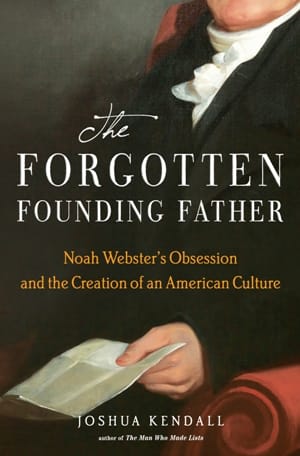
In his latest book Kendall takes on the life of American lexicographer Noah Webster.  The Forgotten Founding Father: Noah Webster’s Obsession and the Creation of An American Culture, will be published by Putnam/Penguin in April 2011. 

Like Roget’s, Webster’s is a household name though the life story of its author is relatively unknown.  Asked in a recent email to describe what he was surprised to discover about Noah Webster, Kendall responded:

I had assumed that the author of America’s first great dictionary was just a word-nerd.  I had no idea that he also hobnobbed with such luminaries as George Washington, Benjamin Franklin and Alexander Hamilton.  The breadth of his achievement also astonished me.   Little did I know that his speller — completed almost a half century before his American Dictionary —  would go on to sell a hundred million copies by the end of the 19th century.   Webster was a major figure in the history of American publishing who also edited New York City’s first daily newspaper.  And in his spare time, he wrote influential pamphlets on the key policy issues of the day and helped to found Amherst College.The Forgotten Founding Father: Noah Webster’s Obsession and the Creation of An American Culture

Born in New York City, Kendall received his BA from Yale before doing graduate work in comparative literature at Johns Hopkins University.  Kendall has won national journalism awards from Mental Health America and the American Psychoanalytic Association for his reporting on contemporary mental health issues. A member of the Boston Athenaeum for ten years, Kendall describes the library as “an invaluable resource for my books — particularly the two most recent ones on the wordsmiths, Peter Mark Roget and Noah Webster.  I’m obsessed with the obsessed, and it’s been a great place to pursue my own obsessions.” Joshua Kendall will speak at the Boston Athenaeum on April 14th, the official release date of The Forgotten Founding Father: Noah Webster’s Obsession and the Creation of An American Culture

Author’s website: Joshua C. Kendall

11.23.2010

Hannah Adams

November/December 2010

By Noah Sheola

Since its founding in 1807 the Boston Athenæum has counted many professional authors among its members.  Historian Hannah Adams (1755-1831) was the first.  Once among the most famous women in America, her name is somewhat obscure today.  Adams is well remembered at the Boston Athenæum however, where some of her letters, early editions of her books and her portrait by Chester Harding are proudly kept.

Adams wrote books on United States history and what we today call comparative religion.  She was almost entirely self-taught, achieving financial independence and the respect of her male colleagues without the benefit of a formal education or family connections.  Hannah Adams was born in Medfield, Massachusetts to Thomas Adams, a hapless farmer and sometime bookseller, and Elizabeth Clark.  Afflicted by chronic ill health, Adams spent her childhood reading the contents of her father’s ample library.  Living on the brink of poverty, the Adamses took in boarders, from whom Hannah learned the rudiments of Greek and Latin.  Before long she was doing her part to support the family by tutoring the young men of Medfield who aspired to the college education she could not obtain.   Drawing on her expansive reading, Adams began work on an exhaustive survey of Christian denominations, with the aim of publishing a kind of dictionary that would eschew the judgmental tone which, in Adams’s view, marred similar works then in print.    An Alphabetical Compendium of the Various Sects Which Have Appeared from the Beginning of the Christian Era to the Present Day was published in 1784.  In it Adams presents the tenets of various sects in the words of their own adherents, neither exalting nor discrediting any particular denomination.

Her subsequent work, A Summary History of New England (1799), became the basis for a bitter dispute with Jedidiah Morse, author of the hugely successful Universal Geography, when in 1805 Adams wished to publish an abridgment of her history for school use.  Morse was preparing a similar work and Adams felt that he was impinging on a market to which she had staked claim.  Morse, a Calvinist pastor, countered that he had every right to publish whatever he pleased and accused Adams’s Unitarian backers of instigating the affair to bruise his reputation in the context of an ongoing interdenominational spat.  While arbiters eventually determined that Morse owed her nothing, the moral victory belonged to Adams, for the public largely resented the pastor’s perceived indifference to the welfare of an aged woman of modest means. 

Indeed Adams’s income from book sales wavered from dismal to middling.  The quality of her scholarship, however, had earned her the respect and friendship of several prominent Boston intellectuals, most notably William Shaw and Joseph Stevens Buckminster.  These men would soon establish the Anthology Society, precursor to the Boston Athenæum, and become Adams’s lifelong allies and patrons, establishing in 1809 a modest annuity that would keep her out of poverty.   In 1810 Adams moved from Medfield to Boston where Buckminster granted her access to his private library and where she conducted research for her later works, A History of the Jews (1812) and Letters on the Gospels (1824).  In 1829 the trustees of the Boston Athenæum granted Adams borrowing privileges and access to the reading room, in essence a free membership.  Of this gesture Adams would write:

I now possessed, I should have thought it the height of earthly happiness. But I was now too far advanced in life to profit by the advantages I had gained. However, I was grateful, and happy. My friend William Shaw, Esq. gave me the liberty of frequenting the Athenæum. Amidst that large and valuable collection of books, I found an inexhaustible source of information and entertainment; and among other advantages, I found a few literary friends, in whose conversation I enjoyed ‘ the feast of reason and the flow of soul.

The Athenæum had only begun circulating its books in 1827, and Adams, contrary to some claims, was not the first woman allowed to use the library.  It should be stressed that while Athenæum policy never explicitly barred women, prevailing attitudes nonetheless rendered Adams and her female peers exceptional.  Because the complex history of women at the Athenæum resists casual summary here, the interested reader is urged to consult Barbara Adams Hebard’s excellent essay for the authoritative treatment of the subject (see references below).

It is customary in reference works to identify Adams as the first American woman to earn a living as a writer, or at least one of the first.  She is sometimes even cited as the first American of either gender to write professionally.  The distinction depends, as famous firsts often do, on semantics, the concepts of financial independence, income, and profession being subject to some debate.  Given her remarkable accomplishments, this kind of hair-splitting is unfortunate inasmuch as it distracts from a closer study of her life and work. 

Accounts of Hannah Adams usually emphasize her timidity, frailty, and modesty.  These traits are indeed confirmed (and often exaggerated) by the historical record, thus it is fascinating to contrast them with the audacity of her steadfast ambition.  Adams died in 1831, not long after completing her memoir, which Adams intended to be published posthumously as a source of income for her surviving sister.  She never married and had no children.  At the time of her death she had achieved an uncommon degree of renown, even celebrity.  She was duly afforded the honor of being the first person interred in Mount Auburn Cemetery. 

Selected Works:"Miss Hannah Adams." Engraving by John William Orr, c. 1850.

An Alphabetical Compendium of the Various Sects, which have Appeared in the World from the Beginning of the Christian Aera to the Present Day. With an Appendix, Containing a Brief Account of the Different Schemes of Religion Now Embraced Among Mankind. The whole Collected from the Best Authors, Ancient and Modern
Boston: B. Edes and Sons, 1784
TMBR (Appointment required)
2A .5Adl .3
Full text available on the Internet Archive

An Abridgment of the History of New-England: For the Use of Young Persons: Now Introduced into the Principal Schools in this Town
Boston:  Etheridge and Bliss, 1807
TMBR (Appointment required)
96 .Ad11
Full text available on the Internet Archive

A Dictionary of all Religions and Religious Denominations, Jewish, Heathen, Mahometan and Christian, Ancient and Modern: with an Appendix, Containing a Sketch of the Present State of the World, as to Population, Religion, Toleration, Missions, etc., and the Articles in which all Christian Denomination Agree
New York:  James Eastburn and Company, 1817
Rare Book (LC) (Appointment required)
BL31 .A3 1817
Full text available on Google Books

A Memoir of Miss Hannah Adams
Boston:  Gray and Brown, 1832
Rare Book (LC) (Appointment required)
CT275.A308 A3 1832
Full text available on Google Books

References:

Adams, O. F. Hannah Adams. The Christian Register. August 29, 1912.  827-829.

“Hannah Adams.” Dictionary of American Biography. New York: Charles Scribner’s Sons, 1936.

Gale Biography In Context. Web. 27 Oct. 2010.

Hebard, Barbara Adams.  “The role of women at the Boston Athenæum.”  Richard Wendorf (Ed.). Bicentennial Essays Hanover, NH:  University Press of New England, 2009. 69-97.

Herrmann, R. K. “Linking theory to evidence in international relations”  W. Carlsnaes, T. Risse, & B. A. Simmons (Eds.), Handbook of international relations.  London, England: Sage, 2002. 119-136.

Schmidt, G. D.  A Passionate Usefulness: The life and Literary Labors of Hannah Adams. Charlottesville: University of Virginia Press, 2004.

Wolff, K. Culture club: The Curious History of the Boston Athenæum. Amherst: University of Massachusetts Press, 2009.

09.28.2010

Nicholas A. Basbanes

October 2010

by Noah Sheola

Nicholas Basbanes is the author of eight books about books and those who collect them, write them, sell them, and care for them.  His 1995 debut, A Gentle Madness: Bibliophiles, Bibliomanes, and the Eternal Passion for Books, became a New York Times notable book of the year and was a finalist for the National Book Critics Circle Award in nonfiction.  His subsequent works have enjoyed similar success, to the chagrin of those publishers who deemed bibliography too esoteric a topic for popular nonfiction. 

Basbanes’ subjects range from the reading habits of Alexander the Great to the stranger-than-fiction crimes of notorious book thief Stephen Blumberg.  Equal parts raconteur and historian, Basbanes excels at crafting coherent narratives from disparate episodes of bibliographical lore and history.  In his more recent works Basbanes has reported on the future of printed books in the age of electronic media and documented the reactions of librarians, booksellers, readers, and collectors to the changing literary landscape. 

A Massachusetts native, Basbanes graduated from Bates College in 1965 and later completed a master of arts from Pennsylvania State University while serving as a naval officer in the Tonkin Gulf.  As literary editor of the Worcester Sunday Telegram and Gazette from 1978 until 1991, Basbanes held the enviable assignment of interviewing many of the world’s greatest living authors.  His most recent work, About the Author: Inside the Creative Process, gathers forty interviews from this period, including conversations with Margaret Atwood, Joseph Heller, Alice Walker, John Updike, Doris Lessing, and Kurt Vonnegut. 

Mr. Basbanes has been a member of the Boston Athenæum for twenty years.  In a recent email he wrote:

My Athenæum membership is one of my most treasured affiliations, essential to my work as an      independent scholar – I can’t imagine doing what I do without it—and with the ability now to  search such databases as JSTOR, Project Muse, and Early English Books from my home, truly indispensable.

It should be said that Mr. Basbanes’ holds in equally high regard the Athenæum’s unique collection of non-electronic resources, that is, books.  In the prologue to Patience & Fortitude Basbanes recounts the time he visited the Athenæum to consult a scarce book on the library of Samuel Pepys, the citation of which he needed to complete the manuscript for A Gentle Madness.  At the circulation desk Basbanes noticed from the blank card tucked in the rear pocket that he would be the first person to borrow this book which had sat on the shelves, apparently untouched, for over eighty years.  “You wonder who they bought these books for anyway,” remarked Basbanes to circulation librarian James P. Feeney.  “We got them for you, Mr. Basbanes,” Feeney replied. 

A 2008 recipient of a National Endowment for the Humanities fellowship, Nicholas Basbanes is currently putting the finishing touches on his latest book, a cultural history of paper and paper-making, to be published by Knopf.  The book is tentatively titled Common Bond: Stories of a World Awash in Paper.

Selected columns, essays, and author profiles by Nicholas Basbanes, as well as news and a travelogue, can be read at www.nicholasbasbanes.com.

Bibliography

All call numbers are Library of Congress (LC)

About the Author: Inside the Creative Process
Durham, NC:  Fine Books Press, 2010
PN452 .B35 2010
Temporarily Shelved at New Book Shelves

Editions & Impressions: Twenty Years on the Book Beat
Durham, N.C.:  Fine Books Press, 2007
Z4 .B393 2007

Every Book its Reader:  The Power of the Printed Word to Stir the World
New York: HarperCollins, 2005
Z1035.A1 B15 2005

A Gentle Madness: Bibliophiles, Bibliomanes, and the Eternal Passion for Books
New York: H. Holt and Co., 1995
Z992 .B34 1995

Patience & Fortitude: A Roving Chronicle of Book People, Book Places, and Book Culture
New York: HarperCollins, 2001.
Z4 .B395 2001

A Splendor of Letters: The Permanence of Books in an Impermanent World
New York: HarperCollins, 2003
Z4 .B395 2003

A World of Letters: Yale University Press, 1908-2008
New Haven: Yale University Press, 2008
Z473.Y32 B37 2008

References

Contemporary Authors Online, Gale, 2010. Reproduced in Biography Resource Center. Farmington Hills, Mich.: Gale, 2010.

08.31.2010

Jill McDonough

September 2010

By Rachel Jirka

Jill McDonough grew up in North Carolina, attended Stanford University, and received her MFA from Boston University.  The recipient of fellowships from the National Endowment for the Arts, the Fine Arts Work Center, the New York Public Library, and Stanford’s Stegner program, she has taught incarcerated college students through Boston University’s Prison Education program since 1999.  She is also affiliated with the Harvard Extension School, Stanford’s Online Writer’s Studio, UMass-Boston, and Grub Street, Inc.  Jill’s work appears in Slate and The Threepenny Review.  

We all remember exploring our parents’ bookshelves as youngsters.  At five-years-old, the name Ogden Nash, discovered among her parents’ books, gave Jill the impression of an “incantation in a foreign language.”  It was encounters with Ogden Nash that drew Jill to poetry.  Jill wrote poems because it was a way of constructing a problem, while at the same time discovering the solution.  As a youth, writing poetry also served a practical purpose; if bored in school, it was easier to write during class than doodle.

The first stages of Jill’s writing process are what she calls “flabby pages that don’t make any sense.”  She knows, however, that “gems” are hidden within, and so Jill sifts through the pages, writing and rewriting, until she finds ways to connect her gems.  Then it is typed up and becomes a first draft.  Jill is often influenced by her students, and by her research—it is a way to feel closer to “other times in real places.”

Jill’s first book of poems, Habeas Corpus, was published by Salt in 2008.  At the time, Jill had a fellowship with the Fine Arts Work Center in Provincetown, MA, and was researching shipwrecks and pirates in New England history.  Jill then turned to methods of execution during that period and discovered hanging, tarring, and gibbeting.  This research led to a general inquiry into the different ways people were executed over the years, and what thought processes were behind each stage in the evolution of execution.  The book is in sonnet form; Jill chose this particular form to maintain the tone she was looking for—respectful, but candid.  As she puts it, the sonnet is “too short; there’s no time to look away.”

Jill’s next book is called Humane Bodies, which tackles the history of medicine.  The poems have titles like “My History of CPR,” or “Vesalius,” or “Of Women’s Testicles.”  That last title came from a chapter in a 1684 anatomy book, Humane Bodies Epitomized by Thomas Gibson.  Gibson’s work gave Jill the title for her book, as well.  Gibson was using a different spelling of the word “human,” but the play on words makes for an interesting title.

When she isn’t writing or teaching poetry, Jill’s reading it.  She owns more books of poetry than any other genre, but she also enjoys literary fiction.  Jill is a supporter of the transitory approach to enjoying literature; she’ll buy up a bunch of titles from the Goodwill, or from a secondhand bookstore, and pass them on when finished.  She likes to have a stack of reading material around.  Among her favorite authors are Yusef Komunyakaa,  George Eliot, Evan Boland, and David Ferry.  Jill also admires writers who keep working despite obstacles, and she mentioned Todd Hearon and Paul Harding as two writers she particularly admired. 

Jill joined the Athenæum in 2001 after winning a fellowship, and the Athenæum played a role in the research she conducted for Habeas Corpus.  She ended up staying with the Athenæum because of Mary Warnement, whom she called the “human Google,” and because of the cheese.  The first Athenæum party Jill attended involved watching The Thin Man while enjoying “great cheese” and martinis.  To quote Jill, “who wouldn’t want to join that?”  Jill also expressed her admiration for Doug Caraganis, who “notices everything, and always has some terrific random tidbit to share.”  In addition, she can get more work done in two hours on the fifth floor than she can anywhere else.  “The real, secret bargain of the Athenæum,” she says, “is that time warp.”

Authors recommended by Jill:

Komunyakaa, Yusuf.
Neon vernacular : new and selected poems.
PS3561.O455 N46 1993

Eliot, George.
Collected poems.
PR4651 .J4 1989

Middlemarch : a study of provincial life.
PZ3.E43 Mi 1913

Ferry, David.
The odes of Horace.
PA6395 . F47 1997

Of no country I know : new and selected poems and translations.
PS3556.E77 O37 1999

By Jill McDonough:

Forgotten eyes : poetry from prison.
Tract (appointment required): F118 no. 11Habeas CorpusHabeas corpusPS595.C265 M32 2008

Jill’s poem, Accident, Mass. Ave., won the Pushcart Prize

08.02.2010

Amy Lowell

August 2010

By Rachel Jirka

Amy Lowell was born on February 9, 1874, to a wealthy and influential family in Brookline, Massachusetts.  She was the youngest of five children born to Augustus and Katherine Lawrence Lowell—themselves products of the booming cotton industry in Massachusetts.  Lowell’s education began at the family home in Brookline, where she was taught by a governess.  Between the ages of eight and twelve, Lowell attended a number of private schools in Brookline and Boston, where she was labeled something of a class clown.  Her formal education ended at age seventeen.  While her brothers were able to avail themselves of a Harvard education, Lowell did not have that opportunity herself.  Lowell instead experienced the social scene of her class, travelling to Europe in 1896, as well as attending parties and other entertainments.  Lowell continued her education privately, as she had access to her father’s library.  Lowell also frequented the Boston Athenæum, of which her great-great grandfather was a founder. 

The deaths of Katherine Lowell in 1895 and Augustus Lowell in 1900 compelled Lowell to take on the social responsibilities of her parents.  The Brookline public school system and the Women’s Municipal League are two of the many organizations that benefitted from Lowell’s efforts. In fact, the Boston Athenæum would not be in this present location were it not for Lowell’s desire to fight for just causes.  The Boston Athenæum considered a move from the Beacon Street site, an issue that Lowell vehemently opposed.  In protest, Lowell wrote a poem commemorating the Boston Athenæum; it was included in her first published collection, A Dome of Many-Coloured Glass (1912). 

Lowell turned to poetry in 1902, after seeing three plays which featured the actress Eleanora Duse.  Her first book of poetry was published in 1912 and received lukewarm reviews.  Lowell continued to work despite the criticism; however, in 1913 Lowell’s poetic style was reborn after encountering a poem signed “H.D. Imagiste.”  Influenced by H.D. (Hilda Doolittle) Lowell threw herself into the imagist style, a movement founded by Ezra Pound.  She became a forceful spokeswoman for the movement, and a falling out with Ezra Pound over the direction of Imagism resulted in Lowell becoming the movement’s leader. 

Beginning in the early 1920s, Lowell devoted herself to the poet Keats, publishing an extensive biography in 1925.  Lowell died of a stroke in May 1925 at the family home in Brookline.  After her death, Lowell won the Pulitzer Prize for Poetry in 1926.  The winning collection, entitled What’s o’clock, included the poem “Lilacs,” one of her best-known works.

Lowell was significant to American literary history because of the strength of her convictions and her drive to speak for that in which she believed.  She was a forceful voice for modern poetry in the early 20th century, and it is thanks to Amy Lowell that the Modernist movement developed in American literature and culture.

To read the Amy Lowell poem “The Boston Athenæum” (1903 / 1912) with wood engravings of the Library by Rudolph Ruzicka (1952) click here

Selected Works:

John Keats
1925
5E .K223 .l .2

What’s o’clock
1925
VEP .L9495 .w

Ballads for sale
1927
VEP .L9495 .b

The complete poetical works of Amy Lowell
1955
VEP .L9495 .co

Poetry and poets, essays
1930
XVEP .L952

Bibliography:

Amy: the world of Amy Lowell and the Imagist movement
Gould, Jean
1975
65 .L9497 .go

American aristocracy: the lives and times of James Russell, Amy, and Robert Lowell
Heymann, C. David
1980
CT215 .L68 H 49

Selected Letters:

The letters of D.H. Lawrence & Amy Lowell, 1914-1925
Edited by E. Claire Healey & Keith Cushman
1985
PR6023.A93 Z5336

Selected books illustrated by Rudolph Ruzicka (1883-1978):

Boston: distinguished buildings & sites within the city and its orbit as engraved on wood
With a commentary by Walter Muir Whitehill
1975
(Requires a Special Collections Appointment)

Boston Public Library: a centennial history
by Walter Muir Whitehill; illustrated by Rudolph Ruzicka
1956
Z733.B752 W5

Bible. Biblical drawings by Rudolph Ruzicka
With illustrative passages from the Holy Bible, selected by Ruth Hornblower Greenough
1951
(Requires a Special Collections Appointment)

The book of the homeless = Le livre des sans-foyer
Edited by Edith Wharton
1916
(Requires a Special Collections Appointment)


06.28.2010

Mary O’Donoghue

July 2010
By Rachel Jirka

Mary O’Donoghue grew up in County Clare, Ireland.  She is an award-winning fiction and poetry writer, and is also a professor at Babson College, where she teaches fiction, rhetoric, and literature classes.

Just as Mary was finishing her graduate work in Irish Studies at the National University of Ireland, Galway, she discovered writing.  She had always been drawn to writing, but kept putting off any exploration of the art.  She enrolled in an extracurricular writing class, and, by chance, chose poetry over fiction. When writing, Mary’s first inclination is not the keyboard, but rather she works her manuscripts out by hand.  Her writing process is structured, and she likens it to carpentry—putting pieces together to build a whole.

Mary has also worked on translating the poetry of a former teacher, Louis de Paor.  Translating Ag Greadadh Bas sa Reilig Clapping in the Cemetery in collaboration with de Paor was difficult yet rewarding; the conversion of one language to another was like working out a puzzle—searching for the perfect word in English to fit the precise meaning of the Irish.  At the same time, because Mary had a close connection with the poet, it was imperative to treat the language carefully in an attempt to capture the essence of the work.

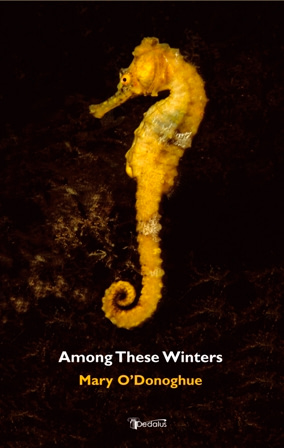
Book cover:  O'Donoghue, Mary. Among These Winters,Dublin: Dedalus, 2007.

The Athenæum has been lucky to have Mary as a member since the summer of 2006.  The Athenæum has served as a place to work, and Mary insisted that some of her best work has been done on the tables of the second and fifth floors.  Each floor offers a distinct work atmosphere.  While the hum of the second floor doesn’t distract her from her work, the fifth floor can be quieter in the evenings.

It was difficult for Mary to choose only a few of her influences, but she managed to put together a sizable list: David Ferry, Mavis Gallant, William Trevor, Anton Chekov, Tim Winton, Katherine Mansfield, Rachel Cusk, David Malouf, Robin Robertson, and Tomas Tranströmer.  The Athenæum has examples of many of these authors in its holdings.

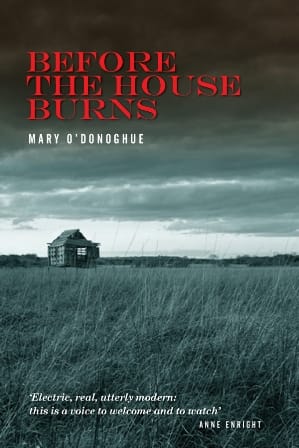
Mary’s first two collections of poetry, Tulle (published by Salmon Poetry) and Among These Winters (published by Dedalus Press), were published in 2001 and 2007, respectively.  Mary recently completed her first novel, Before the House Burns, which has just been published in Ireland with Lilliput Press.  There are plans to launch the novel in America.  Completing the first draft was the fastest she had ever worked, she said.  Mary began on July 14, 2008, and ended on November 9th of that year.  What began as a short story developed into a novella. The novella turned eventually into a novel when Mary discovered a larger structure within the world she was creating. Since the launch of her novel, Mary has been returning to poetry for the past few weeks, exploring stricter forms. 

Read the chapter “L. casei Immunitas” from the novel, Before The House Burns, as it was frist published in AGNI 70 (Fall 2009).

Selected Works:

Among These Winters
Dublin: Dedalus.
LC
PR6115.D66 A84 2007

Ag Greadadh Bas Sa Reilig:  Clapping In The Cemetery
By Louis de Paor; translations from the Irish by the author, with Biddy Jenkinson, Mary O’Donoghue and Kevin Anderson.
Indreabhán, Conamara: Cló Iar-Chonnachta.
LC
PB1399.D39 A6 2005

Tulle
Cliffs of Moher, Co. Clare, Ireland: Salmon Publishing.
LC
PR6115.D66 T85 2001

06.04.2010

Charles Ammi Cutter

June 2010

By Noah Sheola

Charles Ammi Cutter (1837-1903) was Librarian of the Boston Athenæum from 1868 until 1892.  His lifelong objective was the development of a classification system comprehensive of all human knowledge yet serviceable to the general user.  Though he died before completing the final schedules of his Cutter Expansive Classification, his ideas nevertheless formed the theoretical basis for the Library of Congress Classification system.  Though not a household name like his contemporary and sometime rival Melvil Dewey, Charles Cutter’s influence on the organization of modern libraries is virtually unsurpassed.  He not only laid the groundwork for the Library of Congress Classification but also popularized the view that library catalogs ought to cross-reference subjects with authors’ names and titles, a practice almost taken for granted today. 

The son of a Boston fish-oil merchant, Cutter embraced intellectual pursuits at an early age, entering Harvard College at fourteen and graduating third in his class. He attended Harvard Divinity School with the aim of becoming a Unitarian minister. During this time Cutter worked in the Divinity School library, eventually reorganizing the catalog to suit the organizational principles he was already formulating. In 1860 he joined the staff of the Harvard College library.  In 1868 Cutter became Librarian of the Boston Athenæum.

Reacting to perceived faults of his predecessors’ work, Cutter at once undertook a wholesale revision of the Athenæum’s catalog.  Published 1874-1882, the revised catalog included an open letter to the trustees which showcases Cutter’s acerbic prose:  

The making of it [the old catalog], I have been told, was entrusted to several young men.  They were intelligent and industrious; one of them, at least, has since made his mark in the world; but they had never had any instruction cataloguing, probably had never been trained even in accuracy of copying.  Sometimes they took the title from the back of the book, sometimes from the title-page, sometimes from the half-title, and sometimes, apparently, from their own imaginations.  They omitted freely, of course, and they altered the order of words for the purpose of omitting, and of the words which they retained they abbreviated the greater part to the verge of unintelligibility. . . The result, if it had been printed, would have been one of the most remarkable catalogues ever issued.  Of course, working so rapidly, these writers got over a great deal of ground; the worse they worked, the more they did, leaving a larger crop of errors for others to uproot, and the nearer the catalogue seemed to completion the farther off it really was.

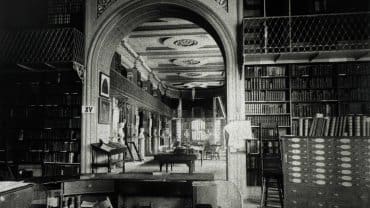
Boston Athenaeum Second Floor 1880

When finally completed, the elegance and utility of the revised catalog established Cutter as a rising star in his profession.  Impressed by his work, the U.S. Commissioner of Education asked Cutter to write an overview of his methodology for the upcoming Centennial Exhibition in Philadelphia.  The result was Cutter’s Rules for a Printed Dictionary Catalog (1876).  Cutter’s Rules went through four editions, serving as the go-to authority on the subject well into the twentieth century.  While attending the 1876 Exposition Charles Cutter and 102 other men and women signed a register establishing the American Library Association (ALA).  Cutter would contribute regularly to Library Journal, the official publication of the ALA, and serve as president from 1888 to 1889.  He also contributed literary reviews and bibliographical essays to the Nation, the New York Evening Post, and the North American Review throughout his career.

At the 1883 meeting of the ALA Cutter presented a paper entitled “The Buffalo Public Library in 1983.”  The sketch elucidates a utopian future for American libraries and famously anticipates the technological advances of the coming century, including inter-library loan, audio books, regional depositories, remote reference services and automated retrieval.   The full text of this prescient and humorous essay can be read here.

Cutter left the Athenæum in 1892.  After a brief tour of Europe, he was appointed Librarian of the Forbes Library in Northampton, where he would build a collection of 90,000 volumes almost from scratch, arranging the books according to his own Expansive Classification.  Cutter continued to refine the Expansive Classification system but died before completing its final schedules.  Today the Forbes Library and the Boston Athenæum both retain a version of it.  Charles Ammi Cutter died of pneumonia on September 6, 1903 and was survived by his wife Sarah Fayerweather Appleton and their two sons. 

Selected Works:

Catalogue of the library of the Boston Athenæum 1807-1871
Boston: Boston Athenaeum, 1874-82
LC:  + Z881 .B74

     A landmark achievement in library science and considered the best of its kind for decades.

Charles Ammi Cutter, library systematizer
Edited by Francis L. Miksa
Littleton, Colo.: Libraries Unlimited, 1977
LC:  Z674 .C87 1977

     Not only an excellent biographical reference but an anthology of Cutter’s most significant writings.

Rules for a dictionary catalogue.
Washington, Govt. Print. Off., 1889
Cutter:  XJK .C98 .2

     Cutter’s treatise signaled how libraries would be cataloged in the twentieth century.
     The Boston Athenæum has the earlier editions as well. 

References:

Cutter, C.A. (1874). Catalogue of the library of the Boston Athenæum 1807-1871. Boston: Boston Athenæum.

Cutter, C.A. (1883). The Buffalo public library in 1983. Papers and proceedings of the sixth general meeting of the American Library Association, held at Buffalo, August 14 to 17, 1883.

Cutter, C. A. (1904). Rules for a dictionary catalog. U.S. Bureau of Education: Special Report on Public Libraries–Part II. Washington: Government Printing Office.

Cutter, W.P. (1931). Charles Ammi Cutter.  Chicago:  American Library Association.

Miksa, F.L. (1977). Charles Ammi Cutter library systematizer. Littleton, CO: Libraries Unlimited, Inc.

Stromgren, P. (2007). Charles Ammi Cutter:Library systematizer extraordinaire.

04.24.2010

Jack Gantos

May 2010

By Mary Warnement

Jack Gantos is a regular patron and supporter of the Boston Athenæum. He considered joining when a young man, but his wages as a short order cook and valet parker (among other jobs) did not allow for extras, even though he thought our membership fees “fairly priced.” He found many congenial reading spaces in Boston and worked for many years in Bates Hall at the Boston Public Library but eventually had to look for a new haven in the face of rampant cell phone use. “I could tolerate the homeless and the mad, but the rude were just too much…So I went back up to the Athenæum and joined and have been delighted to find such a nourishing community.”

“When I stand on the outdoor balcony of the 5th floor and turn toward Park Street I can look into the window of Walter Lorraine’s office where he worked at Houghton Mifflin Publishers at #2 Park Street. In that office is where Walter agreed to publish my first book in 1975. I haven’t traveled very far but it is now 40 books later.”

The Boston Athenæum at 10 ½ Beacon Street is not far from Houghton Mifflin’s former home at 2 Park Street; however, the distance from his first book to his most recent can seem to stretch as far as the imagination, and Jack’s stretch seems infinite. The ability to write what people would want to read “from cradle to grave” is a rare one, but Jack Gantos possesses it. When you can barely turn the pages, you can laugh at the antics of Rotten Ralph, his feline creation. Once in school, you have the sympathetic company of Jack Henry and Joey Pigza. As you approach adulthood and grope to find your way, you can turn to Jack’s memoir of his own young adult self, Hole in My Life. Through it all, you will have the pleasure of enjoying his wit and extraordinary ability with words.

All of Jack’s quotations are from a brief memoir written as a response to our archivist’s call for members’ memories. He summed up his sense of belonging to this institution:

“Of course people go to a library to read books, but when you go there day after day you begin to read the other people as if they were books, too. And the reverse is just as true. But to be ‘read’ by such good readers results in the comfort of being well known.”

All members are welcome to submit memories on the Archive web page.

If you want to learn more about Jack’s biography and bibliography, you can check out his beautifully designed website. Then perhaps you can check out some of his books and get to know him really well.

02.25.2010

Walter Muir Whitehill

March/April 2010

By Mary Warnement

Walter Muir Whitehill (1905-1978) was Director and Librarian of the Boston Athenæum from 1946 until his retirement in 1973. He received his bachelors and masters degrees from Harvard and finished his PhD at the University of London in 1934 for his thesis on the architecture of medieval Spain, not published until 1941. In 1936, he became the assistant director of the Peabody Museum in Salem which he left in order to serve in the navy during World War II. After the war, he came to the Boston Athenæum where he found his home, a base from which he participated in, or, more accurately, led nearly every New England cultural institution or society, and became the epitome of a prolific author. David McCord’s unorthodox description of him presents a more interesting picture than conventional biography would and aptly introduces this necessarily abbreviated list of his many publications:

Any friend of Walter Whitehill is aware of certain things which he likes, dislikes, or abominates. He has obliged me—at my request—with a small but select list of these opposites. He likes beauty and clarity of language, brevity and punctuality; dislikes jargon and long-winded meetings. He likes the prose style of Samuel Eliot Morison and The Book of Common Prayer; dislikes the writing of educationists and liturgical experiment. He favors classical scholars, Egyptologists, medievalists; dislikes all “social scientists.” He likes Gibbon, saints, and nearly all dogs, dislikes C.P. Snow, reformers, nearly all “do-gooders.” He likes the view of mountains, but not climbing them; the streets of London and Copenhagen, but not a lake bordered by summer cottages. He likes music at home, Gregorian music, Mozart, Haydn & Co.; dislikes the Boston Symphony programs, unaccompanied polyphonic music, rock—which he generously calls rock music. He likes Chinese calligraphy, a mastery of technique, the architecture of A. Palladio, the sculpture of Bernini; dislikes paint slobbered on canvas, “self-expression,” the architecture of Le Corbusier, the sculpture of David Smith. He likes good book design and printing, dislikes (as I violently do) eccentric margins and unjustified lines. He likes staying at home; dislikes going to the opera or theatre. He likes books; dislikes television; likes clubs, a small dinner, eating at a table; dislikes most restaurants, cocktail parties, picnics and buffets; likes Naval officers; dislikes real estate promoters.

A bibliography speaks for itself; but the few scattered samples taken chronologically which follows will give the reader at least a notion of the spread of Walter Whitehill’s interests—interests by no means limited even to a dozen disciplines. [David McCord, “Walter Muir Whitehill,” Bulletin of Bibliography vol. 30, no 3 (1973): 114.] 

Selected Bibliography:
Classification followed by call number

Spanish Romanesque Architecture of the Eleventh Century
London: Oxford University Press, 1941
Cutter: UDHX .W587 .s

The East India Marine Society and the Peabody Museum of Salem; a sesquicentennial history
Salem, Mass: Peabody Museum, 1941
Cutter: U65Sa +P31 +zw

A Boston Athenaeum Miscellany: Catalogue of an Exhibition in Honor of the Visit of the Grolier Club on February 11, 1950
Boston, 1950
LC: + Z881 .B738

Augustus Peabody Loring, Jr., 1885-1951
Salem, Mass: Peabody Museum, c1952
Cutter: 65 .L8964 .w

In collaboration with Ernest Joseph King. Fleet Admiral King, a Naval Record
New York, W. W. Norton, 1952
Cutter: 65 .K5817

Portraits of Women 1700-1825.
Boston Massachusetts Historical Society, 1954
LC: N7634 .M3

Boston Public Library: A Centennial History Cambridge
Harvard University Press, 1956
LC: Z733.B752 W5

Boston: A Topographical History
Cambridge, Mass: Belknap Press of Harvard University Press, 1959
LC: F73.3 .W57 1959
(A second edition was published in 1963 and 1968, and a third edition appeared in 2000.)

Captain Joseph Peabody; East India merchant of Salem (1757-1844)
Salem, Mass: Peabody Museum, 1962
Cutter: 65 +P3125 +e

Boston in the age of John Fitzgerald Kennedy
Norman: University of Oklahoma Press, 1966
LC: F73.52 .W5

Dumbarton Oaks; the history of a Georgetown house and garden, 1800-1966
Cambridge, Belknap Press of Harvard University Press, 1967
Cutte: UGS6RG .D893 .w

Museum of Fine Arts, Boston: A Centennial History
Cambridge, Mass: Belknap Press, 1970
LC: N520 .W5

Boston Statues
Barre, Mass: Barre Publishers, 1970
LC: + F73.64.A1 W45

Massachusetts: A Pictorial History
New York: Scribner, c1976
Cutter: 964 +W587 +2

Palladio in America
Milan: Electa, c1976
Cutter: UF .P17 .pa

Boston Artists and Craftsmen at the Opening of the Twentieth Century
Baltimore: New England Quarterly, 1977
Cutter: 96 .7N42 (v.50)