I first met Barbara Lewis in the summer of 2019 when she asked if she could enroll in the Athenæum’s first professional development workshop for educators, “Primary Sources in the Classroom: Teaching the Civil War.” Lewis wanted to participate in the workshop as both a UMass Boston educator and as a writer—she was working on a play set in 1867 that depicts a meeting between Harriet Beecher Stowe, Mary Jane Richards, and Clarence Reeves.
My first impression of Lewis turned out to match my lasting impression: She is uncommonly creative, insatiably curious, and an outstanding role model for all lifelong learners. She excels at finding and creating opportunities for exploring her wide-ranging interests. And she is ready to learn with and from nearly everyone.
Lewis was born after World War II in New York City. She grew up—surrounded by family—in both South Carolina and New York. Her maternal grandparents and other extended family were in South Carolina, while her mother’s ten siblings were in New York after having been part of the Great Migration. Lewis grew to love the “fastness” of New York and the “slowness” of South Carolina.
Lewis attended a parochial school for girls of color in South Carolina run by the Oblate Sisters of Providence, an order of Roman Catholic nuns founded in Baltimore by four Haitian women and a French priest in 1828. For high school, Lewis was sent to a convent school run by the Presentation Sisters in Montreal. There she studied under a British system, learning European history, French, and Latin.
From Montreal, Lewis went on to Hunter College in New York. But her experiences through high school had left her feeling out of place. She came to view her education, particularly in French and Latin, as something she loved, but as something that set her apart from others.
“I was so very different from everybody else. In South Carolina, I spoke with a northern accent. I tried not to, but it was there. And so, I was an outsider there. And in New York I was an outsider. In Canada…I was the only black student there. So, I was an outsider everywhere. And even though I coped very well intellectually, I didn’t necessarily cope that well emotionally. So, when I left Canada…I stayed away from French for quite a while. I didn’t want to see myself as so different from everyone else. It took me a long time before I went back and got a master’s [at City University of New York] in creative writing. I chose translation and I translated a novel from French. That took me back. I was like, ‘Hey, I’ve got this, I might as well use it.’”
Lewis didn’t stop with the master’s in creative writing. She continued on at City University, earning a PhD in theater, which she describes as having been fun! She reveled in studying theater, literature, theory, and performance all over the world. After studying German as a second reading language for her doctorate, Lewis moved to Vienna for a month to develop her conversational skills, taking side trips to Zurich and Munich to hear different accents.
Her transition from student to faculty began at New York University, where she taught freshman English (which she describes as “a rite of passage for so many”). She spent a short time at the University of Kentucky, and then arrived in Boston 15 years ago to lead the William Monroe Trotter Institute for the Study of Black History and Culture at University of Massachusetts Boston. As an academic, Lewis has specialized in the work of August Wilson, Black female playwrights, and Francophone literature. Only after coming to Boston did Lewis learn through her research that her great-great grandfather, born in the Berkshires, volunteered for the 54th Massachusetts and fought in Company B.
But Lewis has not limited herself only to academic writing. She takes her creative writing seriously. She is constantly seeking new research opportunities, improving and refining her writing, and building her community of fellow creative thinkers and makers. She has participated in Company One’s PlayLab, taken classes at GrubStreet, and joined the Athenæum’s Writers’ Workshop. She became a Mudge Education Associate at last year’s Athenæum workshop for educators so she could conduct research with the BA’s Civil War-era materials to inform her play. She attends two different sewing/knitting book groups. And all of that before she retired from UMass Boston at the end of 2019!
Of course, retirement doesn’t mean free time for Lewis. It just means more time to become an ever-more formidable intellectual and creative giant.
01.25.2020
New Beginnings
Picture Books
Two White Rabbits by Jairo Buitrago ; pictures by Rafael Yockteng ; translated by Elisa Amado
(Children Picture Book BUITR)
“In this moving and timely story, a young child describes what it is like to be a migrant as she and her father travel north toward the US border. They travel mostly on the roof of a train known as The Beast, but the little girl doesn’t know where they are going. She counts the animals by the road, the clouds in the sky, the stars. Sometimes she sees soldiers. She sleeps, dreaming that she is always on the move, although sometimes they are forced to stop and her father has to earn more money before they can continue their journey. As many thousands of people, especially children, in Mexico and Central America continue to make the arduous journey to the US border in search of a better life, this is an important book that shows a young migrant’s perspective” — Provided by publisher.
“A moving tale about friendship, new beginnings, and cats” — Provided by publisher.
Going North by Janice N. Harrington ; pictures by Jerome Lagarrigue
(Children Picture Book HARRI)
A young African American girl and her family leave their home in Alabama and head for Lincoln, Nebraska, where they hope to escape segregation and find a better life.
Neville by Norton Juster ; illustrated by G. Brian Karas
(Children Picture Book JUSTE)
When a boy and his family move to a new house, he devises an ingenious way to meet people in the neighborhood.
As a baby grows in her mother’s womb, a soon-to-be big sister and her family spend nine months preparing for the newest member of the family to arrive.
When Hee Jun’s family moves from Korea to West Virginia he struggles to adjust to his new home. He can’t understand anything the teacher says, and even the sky seems smaller and darker. Hee Jun begins to learn English words and make friends on the playground. One day at a classmate’s house he sees a flower he knows from his garden in Korea: mugunghwa, or rose of Sharon. Hee Jun is happy to bring a shoot to his grandmother to plant a “piece of home” in their new garden.
While her parents are out to dinner, a bored Yasmin decides to try on some of her mother’s clothes, including her new shalwar kameez, which gets ripped–but with the help of Nana, Nani, and a glue-gun, the garment gets fixed, and Yasmin puts on an impromptu fashion show when her parents get home.
“Walt is not the tallest or the curliest or the pointiest or even the crunchiest. A confounded blade of grass searches for his ‘est’ in this hilarious story about growing up”–Provided by publisher.
Zenobia July, an excellent coder and hacker, investigates a mystery while wrestling with the challenges of a new school, a new family, and presenting her true gender for the first time.
After moving with her parents to Iowa, twelve-year-old Lucy discovers a mysterious notebook that can bring stories to life and which has a link to the 1914 disappearance of her great uncle.
Frustrated at her seeming lack of talent for anything, a young Taiwanese American girl sets out to apply the lessons of the Chinese Year of the Dog, those of making best friends and finding oneself, to her own life.
“Juana’s life is just about perfect. She lives in the beautiful city of Bogotá with her two most favorite people in the world: her mami and her dog, Lucas. Lately, though, things have become a little less perfect. Mami has a new hairdo and a new amigo named Luis with whom she has been spending a LOT of time. He is kind and teaches Juana about things like photography and jazz music, but sometimes Juana can’t help wishing things would go back to the way they were before. When Mami announces that she and Luis are getting married and that they will all be moving to a new casa, Juana is quite distraught. Lucky for her, though, some things will never change — like how much Mami loves her.”–Amazon.com.
“When Suzette comes home to Los Angeles from her boarding school in New England, she isn’t sure if she’ll ever want to go back. L.A. is where her friends and family are (as well as her crush, Emil). And her stepbrother, Lionel, who has been diagnosed with bipolar disorder, needs her emotional support. But as she settles into her old life, Suzette finds herself falling for someone new…the same girl her brother is in love with. When Lionel’s disorder spirals out of control, Suzette is forced to confront her past mistakes and find a way to help her brother before he hurts himself–or worse.” — From publisher’s website.
“Amanda Hardy is the new girl in school. Like anyone else, all she wants is to make friends and fit in. But Amanda is keeping a secret, and she’s determined not to get too close to anyone. But when she meets sweet, easygoing Grant, Amanda can’t help but start to let him into her life. As they spend more time together, she realizes just how much she is losing by guarding her heart. She finds herself yearning to share with Grant everything about herself, including her past. But Amanda’s terrified that once she tells him the truth, he won’t be able to see past it” — Provided by publisher.
01.03.2020
Dr. Philip E. Phillips
January 2020
Interview by Mary Warnement
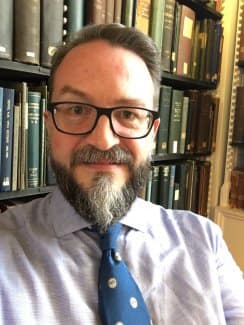
Philip Edward Phillips is Associate Dean of the University Honors College and Professor of English at Middle Tennessee State University, where he teaches medieval, early modern, and nineteenth-century American literature and directs the Honors Lecture Series. In 2008–2009, he held one of the Athenæum’s Mary Catherine Mooney Fellowships. His first and primary scholarly focus is on Boethius, but in recent years he has added much to the promotion of Edgar Allan Poe, in particular Poe’s connection to Boston. Phillips even contributed an article to a book edited by Kevin J. Hayes, who completed his own fellowship at the Athenæum at the same time Phillips did. The Poe Studies Association recently awarded its 2018 J. Lasley Dameron Award for an Outstanding Essay Collection on Poe to Phillips’s Poe and Place. Though he lives and works in Tennessee, Phillips has maintained a strong connection with the Athenæum.
Q: When and where were you born and raised?
PHILIP EDWARD PHILLIPS: I was born in 1969, in Arkansas, where I spent my early childhood until going away to Castle Heights Military Academy in Lebanon, Tennessee. So, I essentially grew up as a boarding student at a military school known for its strong academics. My maternal uncle had attended Heights in the early 60s, and I enjoyed my time there following in his footsteps. I took well to the military environment and held several leadership positions as a cadet. I also received encouragement from my teachers to pursue my interest in literature. My earliest engagement with the works of Edgar Poe date to my eleventh grade year at Heights, when I would often read his poetry, tales, and essays during afternoon study hall.
Q: Where did you attend college and graduate school?
PEP: I wanted to remain in Tennessee after my time at Heights, and I attended Belmont College (formerly Ward-Belmont Seminary, made famous by John Crowe Ransom’s “Blue Girls,” and now Belmont University), in Nashville, Tennessee. I had the good fortune to study Latin language and literature there with Virginia Cheney, who was in her eighties then, and long since retired from full-time teaching. She had such a passion for literature and such a dedication to teaching that she kept Latin alive and well at Belmont, and she offered me the opportunity to do advanced work in Roman history and literature under her direction. She inspired me then, and she continues to inspire me to this day. It was at this time, too, that I studied French at the Université Catholique de l’Ouest in Angers, France. Not only did my French improve, but I met students from all over the world while I was there. It really opened up the world for me. At Belmont, I also had the good fortune to study with many outstanding faculty members and was able to realize my desire to pursue an MA and PhD at Vanderbilt University. At Vanderbilt, I studied a wide range of literature but moved in the direction of sixteenth- and seventeenth-century British poetry under the direction of Laurence Lerner and Leonard Nathanson. Immediately following my graduation in 1996, I spent an additional year at Vanderbilt as a full-time Lecturer in the English Department.
Q: What was your first teaching job?
PEP: Facing a very difficult academic job market, I accepted a faculty position at Battle Ground Academy in Franklin, Tennessee, teaching senior AP English and introductory French. I remained there for two years, and I really enjoyed my students and daily interactions with other faculty members from various departments. Just when I thought this might become my career, Middle Tennessee State University advertised a tenure-track position for a Miltonist, I applied, and joined the faculty in 1999. At the time, my first book, John Milton’s Epic Invocations, was in production and was published in 2000. I have taught Milton on the undergraduate and graduate level for 20 years now, along with other courses, and I still enjoy returning to the poetry again and again, seeing it through the eyes of my students and seeing it again for myself at various stages of life. I was promoted to associate professor (with tenure) within five years, and then to professor five years after that. I’ve been involved heavily in graduate and honors education while at MTSU, and I am grateful to my chairs, deans, and provosts throughout the years as I have taken on a variety of research projects.
Q: Are you primarily an administrator now?
PEP: I am currently the Associate Dean of the University Honors College, in which capacity I have served for nearly eight years. I am a full-time administrator, but, like my dean, I remain very active in research, and I teach seminars in Milton, Poe, and Bibliography and Research Methods for the English Department occasionally and direct the honors lecture series (a one-hour class and an event open to the public), which focuses on a different topic every semester. In addition, I lead two honors study-abroad programs, one to Italy and one to Thailand.
Q: How did you find the Athenæum?
PEP: I discovered the Boston Athenæum in 2007 as I was looking ahead to a possible non-instructional assignment in 2008 when I could focus my attention on a project I had been considering for some time: Poe’s relationship to Boston, the city of his birth. At the time, the topic had not been explored sufficiently. In researching the history of literary Boston, I came across the Athenæum’s theatre database and was impressed with the library’s holdings in early nineteenth-century literature, including some works by or related to Poe. Despite budget cuts that eliminated non-instructional assignments at MTSU for a few years, I applied for and received a Catherine Mooney Fellowship from the Athenæum to work on Poe and Boston. What began as a book project ultimately became two articles, one on Poe’s tumultuous relationship with Boston for Lehigh University Press’s Deciphering Poe and a new discovery about the Odeon Theatre and another on Poe’s mother, Eliza Poe and the American Stage, for the Cambridge Poe in Context volume. In the process of doing that research, I fell in love with the Boston Athenæum and now consider it a second home. I enjoy researching and writing at the Athenæum and using it as a home base when exploring the city and visiting other libraries and archives in the Boston/Cambridge area.
Q: What appeals to you about the Athenæum?
PEP: The people, the atmosphere, and the collections, including the Rare Books Room and Prints Room. By people, of course, I mean the librarians and staff. This includes you [Mary], as well as Carolle Morini, Catharina Slautterback, Stanley Cushing, and Stephen Nonack. All of you have helped me in one way or another to locate items, make appointments to view rare materials, navigate the library itself (and its Cutter catalogue), offer advice on places to see and things to do in Boston, and even lend me a tie (Jimmy Feeney) for an event at St. Botolph Club. Also, while working at the Athenæum, I have met and become engaged in several conversations with fellow scholars and writers. It was because of my affiliation with the Athenæum that I first became involved with the Poe Foundation of Boston and served with Paul Lewis, Richard Kopley, and others on the committee that selected Stefanie Rocknak’s statue, Poe Returning to Boston, which was later installed in Poe Square on the corner of South Charles and Boylston in Boston. I never imagined I would ever be involved in a major public art project, especially one involving Poe and Boston, when I was younger and first encountering his works. Then there’s the elegant fifth floor of the library, where I enjoy working, and both the special and general collections, which are very strong in the nineteenth century. I even enjoy just browsing the shelves to see what I will discover. It is truly a scholar’s library.
Q: What were the great struggles of working on Poe and Place? The great joys?
PEP: Working on Poe and Place, on the whole, was a great pleasure in all respects. Of course, it grew out of my earlier work on Poe and Boston to become a work more broadly on Poe and the several places he lived and worked, the literary spaces he imagined and created, some places he claimed to have visited or places that claimed him for their own, as well as Poe’s philosophical and scientific understanding of the universe itself, one of expansion and contraction, that predated the Big Bang theory. It was a project that gave me the opportunity to introduce readers to Poe in a way that is both familiar and unique, and it gave the opportunity to work with Poe scholars I have come to know very well over the years through the Poe Studies Association. The contributors to the volume are the volume’s strength. Of the several collections of essays that I have edited or co-edited, this one was the most enjoyable.
Q: Any projects on the horizon you’re able to talk about here?
PEP: I have recently written an essay on anthologizing Poe’s poetry for a forthcoming collection edited by Emron Esplin and Margarida Vale de Gato for Lehigh University Press, and I am finishing an essay on Poe’s Ourang-Outang in “The Murders in the Rue Morgue” for a forthcoming collection edited by John Gruesser for Texas A&M Press. (I completed portions of both projects at the Athenæum.) When these projects are done, I plan to begin working on a book on Poe’s women that will build upon some of my previous research and give me the opportunity to expand that research into a new and interesting direction. One of my goals will be to examine the importance of key women—such as his mother, the mother of a childhood friend, a childhood sweetheart, his wife, his mother-in-law, Frances Osgood, Annie Richmond, and Sarah Helen Whitman, among others—in Poe’s life and art and to reach a wider reading audience perhaps unfamiliar with this side of Poe. Before undertaking that project, though, I will be busy organizing the program for the Poe Studies Association’s upcoming Fifth International Edgar Allan Poe Conference that will be held in Boston in April 2021.
Q: Your other major research project involves Boethius. Do you find points of comparison between him and Poe?
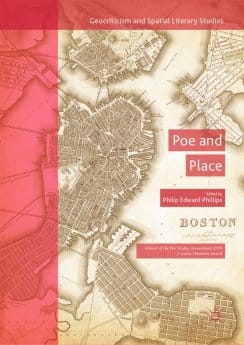
Poe and Place by Dr. Philip E. Phillips.
PEP: Admittedly, I have eclectic interests, and I have enjoyed the opportunity to expand my horizons beyond what I studied in graduate school many years ago. I often tell my own graduate students that the most important thing one can learn as a Master’s or doctoral student is how to learn, and how to educate oneself on a topic of one’s interest. It requires real honesty with oneself, and humility, to approach and attempt to cultivate an expertise on a particular subject. I have been interested in Poe, as I said, since I was in high school. But it was not until I had become pretty well established in my profession that I returned to Poe seriously, that is, as a scholar approaches a topic that requires a serious commitment both to the primary and secondary sources.
Q: Is it helpful to have shifted between very different periods and writers?
PEP: I have enjoyed teaching Milton over the years, and I have been pleased to direct the work of several graduate students in that area. My interest in Boethius emerged from my engagement with The Consolation of Philosophy in a Middle English Literature seminar at Vanderbilt, and my scholarship on Boethius was fueled by my love of Latin and my interest in classical influences on English poetry. So, yes, I think that shifting between different periods and writers keeps things interesting for me.
Q: You have helped establish Poe’s connection to Boston. Is there a similar importance in geographic place in the life of Boethius?
PEP: That’s a good question, one that could lead to yet another project on Boethius, for which I do not have time at the moment! But, yes, I do think that place is as significant for Boethius. My honors study-abroad course includes readings from Vergil, Boethius, and Dante, and the primary Boethius-related places are Rome (where the patrician Boethius served as consul and where he made his greatest contributions to the artes liberales) and Ravenna (where he served the Ostrogothic King Theodoric as his master of offices, was later accused of treason, and exiled to Pavia, where he wrote his Consolation while awaiting death). There is much more to say, of course. Studying works like the Consolation on location, visiting sites such as the Pantheon or the Mausoleum of Theodoric, putting oneself in the same physical spaces as the authors allows students to make connections, realizations, or associations they might not make when reading the works of literature or works about the authors. Being in a place associated with an author, like Poe in Boston, has helped me enormously in my work, especially in imagining what that place would have looked like or felt like in Poe’s time by retracing his steps along modern-day Federal Street or what used to be Carver Street while keeping in my mind the period maps I had consulted at the Athenæum.
Q: You have been involved in prison education. Is that at all connected to your Boethius studies?
PEP: I have taught the Consolation to high school seniors, to undergraduate and graduate students, and to inmates in three different correctional facilities in Nashville, Tennessee. My experiences sharing Boethius with inmates has been the most rewarding of all, I must say, because the Consolation resonates with them in a way it cannot with most other people. My incarcerated students understand what it means to be deprived of everything, even one’s humanity, justly or unjustly, by the correctional system. Boethius’s cries of despair and his efforts with the help of philosophy to transcend his condition and return to, or remember, the Good, resonate with many of them, and our conversations about that book, and the value of liberty, are among the most powerful and meaningful conversations I have ever had in any classroom. Even if the transcendence, or acceptance, affirmed in the Consolation does not result in Boethius’s physical release from prison, it does achieve the aim of the seven liberal arts to which its author dedicated his life: that is, to free the mind.
Selected writings, in reverse chronological order, all authored by PEP unless otherwise noted:
Remaking Boethius: The English Language Translation Tradition of The Consolation of Philosophy. Co-edited with Brian Donaghey, Noel Harold Kaylor, Jr., and Paul E. Szarmach. Tempe, Arizona: ACMRS/Brepols, 2019.
Poe and Place. Ed. Philip Edward Phillips. Geocritical and Spatial Literary Studies Series. New York: Palgrave Macmillan, 2018.
Vernacular Traditions of Boethius’s De consolatione philosophiae. Co-edited with Noel Harold Kaylor, Jr. Research in Medieval Culture. Kalamazoo, MI: Medieval Institute Publications, 2016.
Prison Narratives from Boethius to Zana. Ed. Philip Edward Phillips. New York: Palgrave Macmillan, 2014.
“Poe’s 1845 Boston Lyceum Incident Reconsidered,” in Deciphering Poe: Subtexts, Contexts, Subversive Meanings. Ed. Alexandra Urakova. Bethlehem, PA: Lehigh University Press/Rowman & Littlefield, 2013.
“The American stage” in Edgar Allan Poe in Context. Ed. Kevin J. Hayes. New York: Cambridge University Press, 2013.
A Companion to Boethius in the Middle Ages. Co-edited with Noel Harold Kaylor, Jr. Brill’s Companions to the Christian Tradition 30. Leiden and Boston: Brill Academic Publishers, 2012.
The Consolation of Queen Elizabeth I. Co-edited with Noel Harold Kaylor, Jr. Medieval and Renaissance Texts and Studies 366. Tempe, Arizona: ACMRS, 2009.
New Directions in Boethian Studies. Co-edited with Noel Harold Kaylor, Jr. Studies in Medieval Culture XLV. Kalamazoo, Michigan: Medieval Institute Publications, 2007.
John Milton’s Epic Invocations: Converting the Muse. New York: Peter Lang, 2000.
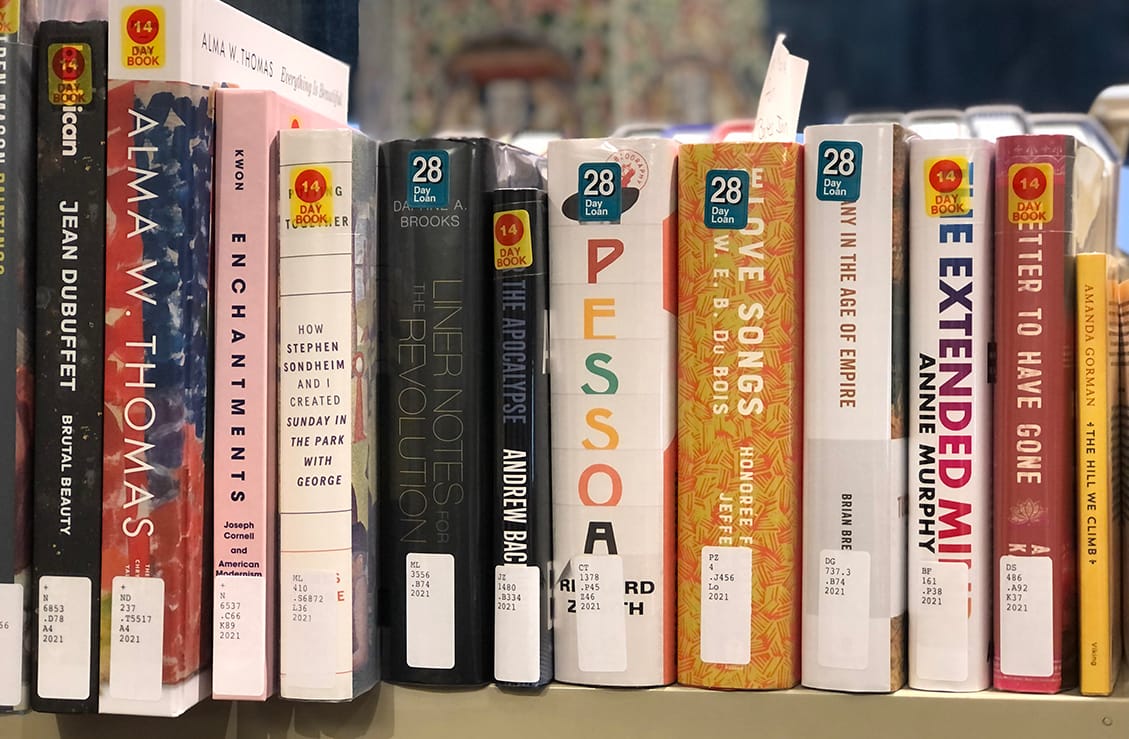
The main subject of The Library Book is the horrifying fire at the Los Angeles Central Public Library in 1986, when 400,000 books were totally destroyed, and 700,000 more damaged. This in itself would make a compelling book, but the author broadens her investigation of the fire, its investigation, the perpetrator, the importance of books and libraries in the world, and so very much more. Read the publisher’s description (not one exaggeration) at the link above, and you’ll be hooked.
I bought this for myself, wrapped it, and put it under the tree “from Santa.” Shh! Don’t tell my family. It’s absurd to work at the BA and buy a book, but I own most of this astounding writer’s other novels and I reread them sometimes, so I couldn’t resist. The story opens in 1913 Moscow, at a moment between two revolutions. A Russian-born Englishman and his three children have been abandoned by his wife. Things are not going to go well.
On cold winter days, some people love to stay warm and write. This modern and witty guide by Benjamin Dreyer is a great read for writers of all abilities. Dreyer covers numerous examples of writing from amateur writers to famous authors. Regardless of your prose, you will learn about grammar, punctuation, and more in a way that will leave you smiling and a better writer.
Hannah Sullivan’s debut collection, which won the T. S. Eliot Award, is three long poems that stand apart and together they are a compelling unity showing the complexity of being human.
The three poems are:
“You, Very Young in New York” which is a tender study of romantic possibility, disenchantment, and of innocence.
“Repeat Until Time” begins with a move to California, explores repetition, returning home as a young adult (what we take and what we leave behind)—a balance of the personal and philosophical.
“The Sandpit After Rain” explores the birth of a child and the loss of a father.
A brilliant haunting book that tells the story of one day, February 20, 1933. A meeting of 24 German leaders of industry and senior Nazi officials meet in secret during a harsh Berlin winter. Vuillard puts you in the room, sits you at the table, and feeds you the details with the stress of that fateful evening. There is a very good reason this book won the Prix Goncourt in 2017.
Have you read all of Patricia Highsmith’s books and found yourself craving a book with characters who remind you of Ripley and Greenleaf (outsider versus insider) with a touch of Gatsby? The Party is about a friendship that takes place at a fortieth birthday party. British society, champagne, drugs, glamour, new money, old money, and a secret between friends boils over. You’ll be able to feel the champagne fizz over the tension—thankfully.
The perfect novel to dive into on these cold, dark, winter days. In this first book of a trilogy, Pullman returns to the world of His Dark Materials to explore an alternative universe much like our own but with magic, witches, societies of scheming scholars, armored bears, and daemons. Those who loved His Dark Materials will revel in learning the origin story of Lyra Belaqua and the theocratic Magisterium that she fights against, while also being introduced to some compelling new characters. And for those who fall in love, volume 2 of the trilogy (The Secret Commonwealth) just came out so you won’t have to wait for the next installment! Best for a cozy afternoon beside the fire with your favorite cup of tea.
This collection of Harlem Renaissance classics is a definite must-read. Both individually and as a collection, these four powerful novels deserve to be read as powerful and enduring classics of American literature, from the African American perspective. Whether you enjoy realism, science fiction, mystery stories or historical fiction, there is something here for you!
Langston Hughes’s Not Without Laughter (1931), the poet’s only novel, an elegiac, elegantly realized coming-of-age tale suffused with childhood memories of Missouri and Kansas, follows a young man from his rural origins to the big city. George S. Schuyler’s Black No More (1931), a darkly comic satire founded on the science fiction premise of a wonder drug permitting blacks to change their race, savagely caricatures public figures white and black alike in its raucous, carnivalesque send-up of American racial attitudes. Considered the first detective story by an African American writer, Rudolph Fisher’s The Conjure-Man Dies (1932) is a mystery that comically mixes and reverses stereotypes, placing a Harvard-educated African “conjure-man” at the center of a phantasmagoric charade of deaths and disappearances. Black Thunder (1936), Arna Bontemps’s stirring fictional recreation of Gabriel Prosser’s 1800 slave revolt, which, though unsuccessful, shook Jefferson’s Virginia to its core, marks a turn from aestheticism toward political militancy in its exploration of African American history.
This title may sound like a self-help book, but although it is more a nature memoir, it may indeed help those who have resolved to improve themselves in the new year. Sy Montgomery writes a charming and searingly honest memoir of thirteen animals whose goodness has inspired her. “Good” isn’t a word many would choose to describe an ermine/weasel who kills a beloved hen, but Sy understands animals—that they kill to eat and to defend themselves. While she adores them, she doesn’t anthropomorphize them (too much). She knows they are other beings, especially the octopus who seemed “alien” to her and yet with whom she felt a shared connection. It’s a delightful reminder to respect our fellow creatures, whether human, furry (even a hard-to-love furry spider), or an inside-out skeletal sea animal.
Young, single mother Jane and her son Ziggy move into the seaside community of Pirriwee, where Jane befriends beautiful but reserved Celeste and vivacious but insecure Madeline on the day of kindergarten orientation. An incident between two children at orientation sets the ball rolling on a Rube-Goldberg-like series of events that lead to a death. Was it murder? An accident? And will Jane, Celeste, and Madeline divulge their secrets to find answers? Moriarty develops characters facing relatable challenges and strikes the right balance between a considered exploration of adult friendship and a fast-paced mystery.
If you, like me, find the melancholy of winter quite appealing to your inner angst-monster, pick up Ocean Vuong’s On Earth We’re Briefly Gorgeous as soon as you can. It’s the perfect book for those days when you take pleasure in the gloomy, dreary weather and walk the damp streets with some sad tune playing in your earbuds like your own personal soundtrack. Vuong explores his heartbreakingly beautiful relationship with his mother in the form of a letter she may never get to read. It’s a love poem wrapped in a memoir shot through with striking condemnations of racism, homophobia, and systemic oppression. A quick and intense read, this one leaves you with a chill that’s hard to shake.
12.05.2019
Families
Picture Books
B is for Baby by Atinuke; illustrated by Angela Brooksbank
(Children Picture Book ATINU)
“B is for Baby. B is for Brother. B is for going to see Baba! One morning after breakfast, Baby’s big brother is getting ready to take the basket of bananas all the way to Baba’s bungalow in the next village. He’ll have to go along the bumpy road, past the baobab trees, birds, and butterflies, and all the way over the bridge. But what he doesn’t realize is that his very cute, very curious baby sibling has stowed away on his bicycle.” —Provided by publisher
All Around Usby Xelena Gonzalez; illustrated by Adriana M. Garcia
(Children Picture Book GONZA)
Finding circles everywhere, a grandfather and his granddaughter meditate on the cycles of life and nature.
“When a teacher asks the children in her class to think about what makes their families special, the answers are all different in many ways —but the same in the one way that matters most of all. One child is worried that her family is just too different to explain, but listens as her classmates talk about what makes their families special. One is raised by a grandmother, and another has two dads. One is full of stepsiblings, and another has a new baby.” —Provided by publisher
Kevin feels excitement, pride, pleasure, and love as he spends an entire day working and playing with his father.
Mommy’s Khimar by Jamilah Thompkins-Bigelow; illustrated by Ebony Glenn
(Children Picture Book THOMP)
A young Muslim girl puts on a head scarf and not only feels closer to her mother, she also imagines herself as a queen, the sun, a superhero, and more.
Charlie and Mouse are getting ready for Mom’s birthday and things are not going exactly as planned… but with plenty of humor and imagination, they’ll prove that sometimes
Chapter Books
Anna Hibiscusby Atinuke; illustrated by Lauren Tobia
(Children PZ7.A858 Ann 2010)
Anna Hibiscus, who lives in Africa with her whole family, loves to splash in the sea and have parties for her aunties, but Anna would love to see snow.
“Seventh grader Estefania ‘Stef’ Soto is itching to shake off the onion-and-cilantro embrace of Tia Perla, her family’s taco truck. She wants nothing more than for her dad to get a normal job and for Tia Perla to be put out to pasture. It’s no fun being known as the ‘Taco Queen’ at school. But just when it looks like Stef is going to get exactly what she wants, and her family’s livelihood is threatened, she will have to become the truck’s unlikely champion. In this fun and multicultural middle grade novel, Stef will discover what matters the most, and ultimately embrace an identity that even includes old Tia Perla.” —Provided by publisher
“Priyanka Das has so many unanswered questions: Why did her mother abandon her home in India years ago? What was it like there? And most importantly, who is her father, and why did her mom leave him behind? But Pri’s mom avoids these questions—the topic of India is permanently closed. For Pri, her mother’s homeland can only exist in her imagination. That is, until she find a mysterious pashmina tucked away in a forgotten suitcase. When she wraps herself in it, she is transported to a place more vivid and colorful than any guidebook or Bollywood film. But is this the real India? And what is that shadow lurking in the background? To learn the truth, Pri must travel farther than she’s ever dared and find the family she never knew.” —Provided by publisher
Sistersby Raina Telgemeier; with color by Braden Lamb
(Children PZ7.T245 Si 2014)
“Three weeks. Two sisters. One car. A true story. Raina can’t wait to be a big sister. But once Amara is born, things aren’t quite how she expected them to be. Amara is cute, but she’s also a cranky, grouchy baby, and mostly prefers to play by herself. Their relationship doesn’t improve much over the years. But when a baby brother enters the picture, and later, when something doesn’t seem right between their parents, they realize they must figure out how to get along. They are sisters, after all.” —Provided by publisher
Seventeen-year-old Blade endeavors to resolve painful issues from his past and navigate the challenges of his former rockstar father’s addictions, scathing tabloid rumors, and a protected secret that threatens his own identity.
In the early 1960s in the Dominican Republic, twelve-year-old Anita learns that her family is involved in the underground movement to end the bloody rule of the dictator, General Trujillo.
“Perfect Mexican daughters do not go away to college. And they do not move out of their parents’ house after high school graduation. Perfect Mexican daughters never abandon their family. But Julia is not your perfect Mexican daughter. That was Olga’s role. Then a tragic accident on the busiest street in Chicago leaves Olga dead and Julia left behind to reassemble the shattered pieces of her family. And no one seems to acknowledge that Julia is broken, too. Instead, her mother seems to channel her grief into pointing out every possible way Julia has failed. But it’s not long before Julia discovers that Olga might not have been as perfect as everyone thought.” —Provided by publisher
“Zuri Benitez has pride. Brooklyn pride, family pride, and pride in her Afro-Latino roots. But pride might not be enough to save her rapidly gentrifying neighborhood from becoming unrecognizable. When the wealthy Darcy family moves in across the street, Zuri wants nothing to do with their two teenage sons, even as her older sister, Janae, starts to fall for the charming Ainsley. She especially can’t stand the judgmental and arrogant Darius. Yet as Zuri and Darius are forced to find common ground, their initial dislike shifts into an unexpected understanding. But with four wild sisters pulling her in different directions, cute boy Warren vying for her attention, and college applications hovering on the horizon, Zuri fights to find her place in Bushwick’s changing landscape, or lose it all. In a timely update of Jane Austen’s Pride and Prejudice, critically acclaimed author Ibi Zoboi skillfully balances cultural identity, class, and gentrification against the heady magic of first love in her vibrant reimagining of this beloved classic.” —Provided by publisher
“In Ed Young’s childhood home in Shanghai, all was not as it seemed: a rocking chair became a horse; a roof became a roller rink; an empty swimming pool became a place for riding scooters and bikes. The house his father built transformed as needed into a place to play hide-and-seek, to eat bamboo shoots, and to be safe. For outside the home’s walls, China was at war. Soon the house held not only Ed and his four siblings but also friends, relatives, and even strangers who became family. The war grew closer, and Ed watched as planes flew overhead and friends joined the Chinese air force. But through it all, Ed’s childhood remained full of joy and imagination.” —Provided by publisher.
“Vintage photographs and first-person accounts illustrate a comprehensive summary of the black experience, from roots reaching back hundreds of thousands of years, to the more recent history of African Americans.” —Provided by publisher
“Children can see how Carmen Lomas Garza captured the simple pleasure of a family eating watermelon on the front porch; how Kikugawa Eizan used curved lines to show the gracefulness with which a mother carries her young son; how John Singer Sargent depicted the flowerlike delicacy of two sisters as they light lanterns in a twilit summer garden; and how Winslow Homer showed a boy’s protectiveness of his younger brother in a dangerous situation. “How Artists See” is a series of interactive, inquiry-based books designed to teach children about the world by looking at art and about art by looking at the world.” —Provided by publisher
11.20.2019
John Greenleaf Whittier
December 2019
By Carly Stevens
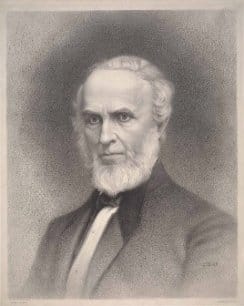
“America being what it is, and New England being what it is, it is hard to see how we could have managed to get along without Whittier.”-Edward Wagenknecht John Greenleaf Whittier was a renowned writer whose numerous works about Quakerism and abolition earned him a place among the esteemed Fireside Poets. Over his 84-year life, Whittier used his ability as a skillful writer to become a political activist and fight for the anti-slavery cause. He loved his family and demonstrated his commitment to his parents and siblings. Whittier’s high ambitions as a political activist and a dedicated Quaker, abolitionist, son, and brother are reflected in his poetry, essays, books, and pamphlets.
Whittier was born in 1807 to Abigail Hussey and John Whittier on a humble farm in Haverhill, Massachusetts. As a child, Whittier suffered from poor health and could not work on the farm. Instead, he spent his time reading and writing. Whittier mainly had access to Quaker texts that confirmed his belief in Quakerism. A family friend introducing him to the poetry of Robert Burns sparked his desire to become a poet. His dedication to his studies paid off when he was just 20. Unbeknownst to Whittier, his older sister Mary sent in a poem of his to the Newburyport Free Press. William Lloyd Garrison, the editor at the time, published the poem, starting Whittier’s career as a published poet. Whittier continued to write poetry and Garrison continued to publish it, beginning a lifelong friendship. Garrison saw potential in Whittier and strongly encouraged him to attend school to perfect his talents. Determined to attend a new academy in Haverhill, Whittier worked as a shoemaker, a teacher, and an accountant to pay for the tuition. Whittier enrolled in the academy as an already-published poet and quickly earned himself the reputation as a prodigy. Whittier’s career continued as a writer in editorial positions at The American Manufacturer and The Haverhill Gazette, but due to his poor health he needed to work from home. However, Whittier could not remain homebound for long. In the early 1830s, he quickly began establishing himself as an abolitionist.
Quakerism heavily influenced Whittier’s anti-slavery beliefs. The Society of Friends, the formal name of Quakers, were the first organization to take a collective stand against slavery in America. Whittier adopted the same passion for abolition. He traveled a great deal in his twenties lobbying for abolition and was often met with angry, violent, raucous crowds. He strongly believed in non-violent resistance and faced the mobs with composure. He demonstrated allegiance to the abolitionists through tactful and skilled literature such as the pamphlet Justice and Expediency (1833). Shortly after its publication, Whittier traveled to Philadelphia and participated in founding the National Anti-Slavery Society as a delegate. At just 26 years old, he was the youngest participant. Despite Whittier’s pacifism, he still fought back with great intellect and wit. In fact, when Pennsylvania Hall, an important abolitionist meeting house, was burned down by rioters, Whittier proved himself smarter than all. He disguised himself with a wig and long jacket and began to mingle with the mob. Before the fire destroyed the building he saved his own papers. At 26 years old, Whittier could outwit the best of them.
During this period of his life, Whittier’s poems focused entirely on the anti-slavery cause. Later in life, he reflected on his writings prior to Justice and Expediency and expressed disappointment in these poems. Whittier felt he was simply experimenting with poetry and he finally found his calling as an abolitionist writer. Whittier continued to write and travel to spread abolition beliefs. Around 1840, Whittier’s travel began to slow and he again worked from home as that was more suitable to his health.
In 1857 Whittier, along with Francis H. Underwood, Henry Wadsworth, Harriet Beecher Stowe, and fellow Athenæum members Ralph Waldo Emerson and Oliver Wendell Holmes, founded The Atlantic Monthly. The focus of the magazine was originally on entertaining essays. However, it quickly morphed into a publication focused on contemporary political issues, such as the anti-slavery movement. The Atlantic Monthly became Whittier’s main publisher for many years. The Atlantic has stood the test of time and remains a fine literary publication.
Snow-Bound: A Winter Idyl is Whittier’s most famous work. The poem was published in 1866 during a tumultuous time in Whittier’s life. In 1857, Whittier’s beloved mother Abigail passed away. Elizabeth, Whittier’s favorite sister, passed away in 1864 leaving his home empty. Whittier experienced a newfound sense of loneliness and loss. He wrote Snow-Bound in a period of grief and longing for the past. Snow-Bound was based on his childhood home in Haverhill, Massachusetts, and the home is open for visitation today. The poem also brought Whittier great financial security for the first time in his life. A year after Snow-Bound was published he wrote The Tent on the Beach, which was also received extremely well.
Whittier’s gentle nature and kindness extended to animals. He had many pets he loved dearly. Along with many cats and dogs, he had a pet squirrel named Friday, a bantam rooster, and a parrot named Charlie. Friday the Squirrel was known to sift through Whittier’s pockets and dishevel papers on his desk in search of nuts while Whittier worked. Charlie the Parrot nipped at anybody’s pants that rose above the ankle, ensuring their appearance remained tidy. Whittier was deeply saddened by Charlie’s passing. Shortly after, Whittier got a bantam rooster that would perch on his shoulder and loved being buttoned up in his jacket. Whittier even trained the rooster to wake up his niece by crowing in her room at the set time.
Whittier was 84 when he died on September 7, 1892. He spent the last years of his life in Danvers, Massachusetts at the Oak Knoll estate owned by his cousins. At Oak Knoll, he wrote poetry, advocated for political causes such as woman’s suffrage, and fed squirrels just as he had done all his life. Whittier visited his friends and when his health prohibited him he maintained relationships through letters.
John Greenleaf Whittier is remembered by those who knew him as a man of integrity, decency, and kindness. When he died, The Atlantic published a lengthy article written by George Edward Woodberry. About Whittier, Woodberry writes, “The secret of his vogue with the plain people is his own plainness. He appeals directly to the heart, as much in his lesser poems as in those which touch the sense of right and wrong in men with stinging keenness, or in those which warm faith to its ardor.”
You can explore more about the life of John Greenleaf Whittier and his poetry in the Athenæum’s collection.
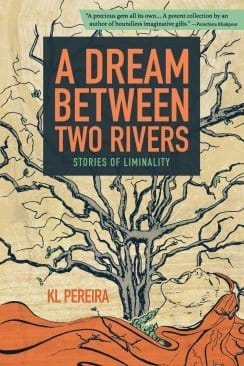
KL Pereira is currently one of our Cataloging department interns and is a graduate student at Simmons University. Her debut short story collection,A Dream Between Two Rivers: Stories of Liminality was published in 2017 by Cutlass Press.1
Pereira holds a BA from Bard College and an MFA from Goddard College. Since 2006 she taught creative writing at Grub Street. Pereira’s fiction, poetry, and nonfiction appear or are forthcoming in the British Fantasy Award winning anthology Year’s Best Weird Fiction volume 5, Shadows and Tall Trees volume 8, Literary Hub, LampLight,The Drum, Shimmer, Innsmouth Free Press, Mythic Delirium, Jabberwocky, and Bitch, to name a few. Pereira is working on a collection of short stories called Where Your Flames Bite My Thigh, written in the voices of historical and imagined women who have been accused of witchcraft, both those who have eschewed the term “witch” and those who have embraced it. She lives in a Victorian garret across from a haunted cemetery with her feline familiar.
Q: Where did you grow up?
KL PEREIRA: Down the street from Lizzie Borden’s house in Fall River, Massachusetts. My grandmother told me tales of Lizzie and her sister being locked in the basement, and I spent a lot of my childhood trying to peep in those windows and see the ghosts. Lizzie’s story and the mystery surrounding the murder of her father and stepmother was one of my first creepy obsessions—I had to know what happened! When my book A Dream Between Two Rivers came out, I was lucky enough to do a reading in the house and sleep over (it’s now a bed and breakfast). Not only did one of my dreams come true that night, I had some pretty spooky experiences!
Q: Do you remember when you first wanted to write?
KLP: I come from a long line of storytellers, so I’ve always been obsessed with telling tales; I can’t really remember a time when I didn’t want to write them down. Luckily, my parents and my teachers were very encouraging. As a child I wrote a lot of what would now be called fanfiction; when I didn’t like the way a story ended, or wanted it to go on, I’d simply write my own endings or continue the story. I even wrote a sequel to Bunnicula, which my mother luckily saved, but for some reason, no one ever sent it in to James Howe (the author of Bunnicula).
Q: What do you like about writing a short story and poetry? Are there challenges writing in both forms?
KLP: Short stories contain infinite possibilities in a concentrated amount of space. Unlike the novel, which can be any length, the short story must create a complete narrative within a certain word count. For me, the challenge (and the fun) is to discover what can be done—within, say, 1000 words, or 500 words—what is necessary to create a fantastic, confounding, compelling experience. Poetry is even more concentrated, with the emphasis on language and sound and image rather than narrative. For me, it’s not difficult to write in different genres, because I’ve always written in both, and in fact, I think it’s an advantage to be able to experiment with the intersections of poem and prose, to play with form in a way that explodes our notions of what certain literature can be.
Q: What was the best writing advice you received?
KLP: The best writing advice I have received is also the best writing advice I can give: follow your passions. If you’re not obsessed with the subject and form of your art, why do it? If you’re not obsessed with the subject and form of your art, you will not be productive, or what you do produce will not be meaningful to you (and how can your work mean anything to others if it holds no meaning for you first?). You must follow the paths that get you up at 2 a.m., that fling you down rabbit holes, that have you scurrying to the library to research for hours. Find the things that obsess you, and do not let them go.
Q: What authors do you enjoy reading?
KLP: I read everything, and right now I’m reading a lot of weird fiction by Laura Mauro, Georgina Bruce, and Michael Kelly, all authors published with Undertow Press; YA horror like The Sawkill Girls by Claire Legrand; and fantasy such as The Girl Who Drank the Moon by Kelly Barnhill. I’m eagerly awaiting the winter reading season, when I curl up with some Victorianesque epics like Fingersmith by Sarah Waters, and my favorite magical realist fairy tale inspired novels and stories by Helen Oyeyemi.
KL Pereira’s book, published by Cutlass Press.
Q: What made you want to become a librarian?
KLP: I truly love being in libraries, working with people and books, and preserving stories for many generations to come. I also believe that libraries are important egalitarian spaces that create support in and for the community. After working in education for many years, I wanted to find more ways to support and be a part of my community.
Q: Do you find working in a library beneficial to your writing?
KLP: It’s a boon to any writer to be surrounded by books. It’s especially beneficial to be able to work with people who love books and see their key importance in our lives. I am constantly inspired by my coworkers at the Athenæum, their passions, and the fascinating and strange stories in and of our collections.
Q: Have you cataloged anything in the Boston Athenæum collection that you think will one day show up in one of your works of fiction?
KLP: I’m very fortunate to have had the opportunity to catalog many amazing books! One book I can think of that sticks with me is a German biography from 1789 (Eigene Lebensgeschichte in vier Stücken by D. Anton Friderich Büsching) that was printed by a woman printer, something that wasn’t common in those days. The paper is handmade and the text itself is a beautiful fraktur style (German calligraphy). I can definitely see myself writing about this book and its creator one day.
Q: Is there any other information about your writing you would like to share?
KLP: Yes! An anthology that I am a part of, Year’s Best Weird Fiction, volume 5, just won the British Fantasy Award for this year! It’s an astounding and wonderful achievement, and I’m very lucky to have had the opportunity to work with the editors of this book, Michael Kelly and Robert Shearman. I’m also excited to be working on my next short fiction collection, and have finished both a poetry collection and a children’s book recently. Libraries are definitely featured!
Congratulations on the Year’s Best Weird Fiction award and best of luck with your writing and publications! I, and others, are looking forward to reading more works by you.1. Cutlass Press is the publishing arm of the independently owned bookstore Papercuts J.P. If you haven’t already visited, don’t delay any longer—you will find a lovingly curated roster of challenging and inspiring books by some of today’s most engrossing writers. And they put on events too! Find the listings here and support local business!
“La Música exists in many places —in the twang of a guitar, in the beat of a drum, even in the whistling wind and the morning bird’s son. She brings color and life wherever she goes, connecting people to a grand harmony. And in the town of Santa Cecilia, she is everywhere. When La Música discovers a boy with longing in his heart and no music in his home, she vows to help him find his passion.” —Provided by publisher
Follows a girl in the 1920s as she strives to become a drummer, despite being continually reminded that only boys play the drums, and that there has never been a female drummer in Cuba. Includes note about Millo Castro Zaldarriaga, who inspired the story, and Anacaona, the all-girl dance band she formed with her sisters.
Gabriella’s Songby Candace Fleming; illustrated by Giselle Potter
(Children Picture Book FLEMI)
A young girl finds music all around her as she walks about the city of Venice, Italy, and she shares her song with everyone she meets.
Imani’s Music by Sheron Williams; illustrated by Jude Daly
(Children PZ7.W668175 Im 2000)
Imani, an African grasshopper, brings music to the new world when he travels aboard a slave ship.
This well-known folk song is accompanied by a tribute from folksinger Pete Seeger, the musical notation, and a biographical scrapbook with photographs.
Mr. Putter’s neighbor, Mrs. Teaberry, decides that they should join a band, but finding the right one isn’t as easy as it sounds —for them or their pets.
Ballet Cat and her friend Butter Bear have practiced a dance to perform for an audience, but Butter Bear will need a lot of encouragement to try the super high leaps.
Twelve-year-old María Luisa O’Neill-Morales (who really prefers to be called Malú) reluctantly moves with her Mexican-American mother to Chicago and starts seventh grade with a bang —violating the dress code with her punk rock aesthetic and spurning the middle school’s most popular girl in favor of starting a band with a group of like-minded weirdos.
Lost in the Black Forest, Otto meets three mysterious sisters and finds himself entwined in a puzzling quest involving a prophecy, a promise, and a harmonica. Decades later, as the second World War approaches, the lives of three children —Friedrich in Germany, Mike in Pennsylvania, and Ivy in California —become interwoven when the very same harmonica lands in their lives. All the children face daunting challenges: rescuing a father, protecting a brother, holding a family together. Pulled by the invisible thread of destiny, their solo stories converge.
Clayton feels most alive when he’s with his grandfather, Cool Papa Byrd, and the band of Bluesmen —he can’t wait to join them, just as soon as he has a blues song of his own. But then the unthinkable happens. Cool Papa Byrd dies, and Clayton’s mother forbids Clayton from playing the blues. And Clayton knows that’s no way to live. Armed with his grandfather’s brown porkpie hat and his harmonica, he runs away from home in search of the Bluesmen, hoping he can join them on the road. But on the journey that takes him through the New York City subways and to Washington Square Park, Clayton learns some things that surprise him.
Leah Burke is an anomaly in her friend group: the only child of a young, single mom; her life is decidedly less privileged. She loves to draw but is too self-conscious to show it. And even though her mom knows she’s bisexual, she hasn’t mustered the courage to tell her friends —not even her openly gay BFF, Simon. When her rock-solid friend group starts to fracture in unexpected ways, it’s hard for Leah to strike the right note. And with prom and college on the horizon, tensions are running high. If only real life was as rhythmic as her drumming…
When two teens, one gay and one straight, meet accidentally and discover that they share the same name, their lives become intertwined as one begins dating the other’s best friend, who produces a play revealing his relationship with them both.
In a world where dragons and humans coexist in an uneasy truce and dragons can assume human form, Seraphina, whose mother died giving birth to her, grapples with her own identity amid magical secrets and royal scandals, while she struggles to accept and develop her extraordinary musical talents.
“A regiment of African American soldiers from Harlem journeys across the Atlantic to fight alongside the French in World War I, inspiring a continent with their brand of jazz music.” —Provided by publisher.
“When Esquire magazine planned an issue to salute the American jazz scene in 1958, graphic designer Art Kane pitched a crazy idea: how about gathering a group of beloved jazz musicians and photographing them? He didn’t own a good camera, didn’t know if any musicians would show up, and insisted on setting up the shoot in front of a Harlem brownstone. Could he pull it off? In a captivating collection of poems, Roxane Orgill steps into the frame of Harlem 1958, bringing to life the musicians’ mischief and quirks, their memorable style, and the vivacious atmosphere of a Harlem block full of kids on a hot summer’s day. Francis Vallejo’s vibrant, detailed, and wonderfully expressive paintings do loving justice to the larger-than-life quality of jazz musicians of the era.” —Provided by publisher
The latest adventure of the adorable bear created by Don Freeman as he chooses a Halloween costume, joins a window-painting contest, goes trick-or-treating, and bobs for apples.
A young girl wants to fly like a witch on a broom, and one special night, through enormous effort and with the help of her brother, her black cat, and an owl, she fulfills her dream.
When a witch loses her magic walking stick, which has been used over the years to grant hundreds of miserable wishes, she tricks a young girl into finding and returning it, with unexpected results.
Scared you! This little mouse thinks he’s the bravest animal around, but it seems that he’s not the only one … All the animals are keen to show off their bravery from the crocodile with his mighty jaws, to the tiger with her scary claws! But who will be the bravest of them all?
A little old lady who is not afraid of anything must deal with a pumpkin head, a tall black hat, and other spooky objects that follow her through the dark woods trying to scare her.
“An epic fantasy about a young girl raised by a witch, a swamp monster, and a Perfectly Tiny Dragon, who must unlock the powerful magic buried deep inside her.” —Provided by publisher
When a twelve-year-old evil genius tries to restore his family fortune by capturing a fairy and demanding a ransom in gold, the fairies fight back with magic, technology, and a particularly nasty troll.
In Brooklyn, nine-year-old Jax joins Ma, a curmudgeonly witch who lives in his building, on a quest to deliver three baby dragons to a magical world, and along the way discovers his true calling.
“You may think you know this story. There’s a young queen, about to be married. There are some good, brave, hardy dwarves; a castle, shrouded in thorns; and a princess, cursed by a witch, so rumour has it, to sleep forever. But no one is waiting for a noble prince to appear on his trusty steed here. This fairy tale is spun with a thread of dark magic, which twists and turns and glints and shined. A queen might just prove herself a hero, if a princess needs rescuing…” —Provided by publisher
“Thorn, a boy sold into slavery who must serve the royalty of Castle Gloom for a year and a day to earn his freedom, and Lilith Shadow, the 13-year-old ruler of Gehenna, who is forbidden to practice the magic that is her heritage, join forces to solve the murders taking place in Gehenna.” —Provided by publisher
“In the town of Fairfold, where humans and fae exist side by side, a boy with horns on his head and ears as pointed as knives awakes after generations of sleep in a glass coffin in the woods, causing Hazel to be swept up in new love, shift her loyalties, feel the fresh sting of betrayal, and make a secret sacrifice to the faerie king.” —Provided by publisher
“Melanie Tamaki is an outsider. She is unpopular at school. At home, where she and her loving but neglectful mother live in poverty, she has had to learn to take care of herself. Melanie is just barely coping. Everything changes on the day she returns home to find her mother is missing, lured back to Half World by a nightmare creature calling himself Mr. Glueskin. Soon Melanie has embarked on an epic and darkly fantastical journey to Half World to save her mother. What she does not yet realize is that the state of the universe is at stake…” —Provided by publisher
In 1645 in England, the daughters of the town minister successfully accuse a local healer and her granddaughter of witchcraft to conceal an out-of-wedlock pregnancy, but years later during the 1692 Salem trials their lie has unexpected repercussions.
In 1905 czarist Russia, an impoverished country girl Elena and the aristocratic Ekatrina meet and set in motion an escapade that includes mistaken identity, a monk locked in a tower, a prince traveling incognito, and the witch Baba Yaga.
“Twelve-year-old Sunny lives in Nigeria, but she was born American. Her features are African, but she’s albino. She’s a terrific athlete, but can’t go out into the sun to play soccer. There seems to be no place where she fits in. And then she discovers something amazing–she is a ‘free agent’ with latent magical power. Soon she’s part of a quartet of magic students, studying the visible and invisible, learning to change reality. But will it be enough to help them when they are asked to catch a career criminal who knows magic too?” —Provided by publisher
09.19.2019
Books About Climate
Children’s Library Intern Samantha Gill put together a book display on our changing climate. She extended the list beyond our holdings, including many books you can read as a family to understand the ecology of our planet.
Members: you can always request a book you can’t find at the Athenæum via our Interlibrary Loan service.
On Our Shelves
The Brilliant Deep: Rebuilding the World’s Coral Reefs by Kate Messner (Children’s Library Picture Book MESSN) This picture book, a Junior Library Guild selection, looks at the life of coral restoration pioneer Ken Nedimyer, from his early fascination with the ocean to his ongoing efforts to save and rebuild the world’s coral reefs.
If Sharks Disappeared by Lily Williams (Children’s Library Picture Book WILLI) This nonfiction picture book explores what would happen if sharks vanished from our planet.
Me…Jane by Patrick McDonnell (Children’s Library Picture Book MCDON) Holding her stuffed toy chimpanzee, young Jane Goodall observes nature, reads Tarzan books, and dreams of living in Africa and helping animals. Includes biographical information on the prominent zoologist.
When a giant octopus entangled in fishing line is washed ashore during a big storm and becomes stranded on the beach, a young boy and girl, assisted by various sea creatures, push and pull him back to sea. Includes endnotes on marine life, lighthouses, and items that wash up on beaches.
The Water Princess by Susan Verde (Children’s Library Picture Book VERDE) The story of one young girl’s quest to bring clean drinking water to her African village, based on the childhood experience of Georgie Badiel.
Other Readings
Bee & Me by Alison Jay
City Green by DyAnne DeSalvo-Ryan
Compost Stew by Mary McKenna Siddals
Galapagos Girl/Galapaguena by Marsha Diane Arnold
Here We Are by Oliver Jeffers
Hiking Day by Anne Rockwell
I Am Farmer by Miranda Paul
I Want to Go Green! But What Does That Mean? by Jill Dunn
Kate, Who Tamed the Wind by Liz Garton Scanlon
Life by Cynthia Rylant
Margarito’s Forest by Andy Carter
No One is Too Small to Make a Difference by Greta Thunberg
One Plastic Bag by Miranda Paul
Out of School and into Nature: The Anna Comstock Story by Suzanne Slade