
06.27.2013

Staff Book Suggestions Summer 2013

Pat Boulos
The Interestings: A Novel by Meg Wolitzer
(On order)

 A “sly” coming-of-age novel following the relationships (both competitive and romantic) of a group of teens who meet in 1974 at an arts camp.

Will Evans
The Member of the Wedding by Carson McCullers
(Library of Congress PZ3.M13884 Me)

The isolation, dissatisfaction, and intensity of adolescence is brilliantly captured by McCullers in her wistful and darkly comic tale of 12-year-old tomboy Frankie Addams during the waning days of summer in a small Southern town.

Jayne Giudici
The Lollipop Shoes (U.K.; U.S. edition is: The Girl with No Shadow) by Joanne Harris
(Library of Congress PZ4 .H313797 Lo 2007)

A little summer magic. A sprinkle of confection, a bit of bewitchment, and a dash of spice in The Lollipop Shoes returns us to the story of Vianne Rocher, Anouk and Roux, the characters that originally appeared in Harris’s Chocolat. The restless wind has blown them all to a new life in the Montmartre district of Paris. New adventures await! The saga continues in Peaches for Father Francis. I enjoy Harris’s off-beat characters and the flavor of her unusual storytelling, and of course there is France and chocolate!

Kristy Lockhart
City of Dark Magic by Magnus Flyte
(New Books, Library of Congress PZ4.F6496 Ci 2012)

This book is a fun and imaginative read, pure and simple, featuring an engaging female protagonist, a musicologist who hails from South Boston but ends up in the middle of a kind of mystery when she takes a project cataloging Beethoven artifacts in Prague for the summer. It will win over many mystery buffs, history buffs, classical music buffs, and fantasy buffs as it pays homage to each one while managing to spin a fantastic tale with a good dose of humor thrown in. It was impossible to put down from start to finish… perfect for a summer read.

Catherine McGrath
The Clue of the Whistling Bagpipes by Carolyn Keene
(Children’s Library, Library of Congress PZ7.K24 Clw 1965)

It may be that the last time you picked up a Nancy Drew mystery, Petula Clark was urging you “Downtown” and zip codes were still a novelty; and perhaps a little while later you thought you’d put the girl detective down for the last time.  Think again!  Nancy Drew in all of her incarnations from 1930, when she made her debut in The Secret of the Old Clock, through her no-longer-blonde but “titian-haired” years, can be counted on for clear thought, decisive action, an enviable wardrobe, impeccable manners, and a refreshing reluctance to search her soul for questionable motives.   A modern sleuth of the sensitive and tortured variety she is not, and this happily frees up her time for traveling to fascinating parts of the world and refusing to return to River Heights USA until she’s put a few dents in international crime.  In The Clue of the Whistling Bagpipes, Nancy chases villains in rented cars (while driving, carefully, on the left), deciphers codes, puts out wildfires, and pipes “Scots Wha Hae” to surprising effect—all while learning more about Scotland’s history, geography, and culture than a lesser person would in a whole summer’s holiday.  For a “PZ7” it’s a genuine ripsnorter, and one you needn’t be embarrassed to read in the train since, as you’ll soon discover, Nancy has friends everywhere!

Chloe Morse-Harding
Dummy by R. J. Wheaton
(Library of Congress ML3470 .T54 no. 85)

A very in-depth analytical history of one of the best trip-hop bands to ever come out of England.

Emilia Mountain
Eleanor & Park by Rainbow Rowell
(On order)

The delicious awkwardness of being sixteen. Punk rock. Mixed tapes. Trying father figures. Clueless moms. Discovering the humanity of others via comic books. This young adult novel provides plenty of serious social commentary, combined with jokes that will have you chuckling out loud on your commute. It also contains what is being hailed as the most intense hand holding scene in young adult literature—if not all literature. Still not convinced? It just won the 2013 Boston Globe-Horn Book Award for Fiction.

Anthea Reilly
Richard Ford
(Library of Congress PZ4.F69877)

Ford’s novels are always excellent. The latest is Canada.

Suzanne Terry
The Flavia De Luce mystery series by C. Alan Bradley
(Library of Congress PZ4.B79957)

Just the ticket for summer reading: a crumbling English country house, a dead body, and a wickedly precocious young sleuth. Meet Flavia de Luce, an eleven year old girl with an interest in chemistry—particularly poisons.  Flavia’s escape from the torments of her two older sisters is a Victorian chemistry lab that she inherited from her uncle, or a ramble in pursuit of clues on her bicycle which she has named Gladys. The books are for adults but could also be enjoyed by precocious eleven year olds! There are now six titles in the series (the first being The Sweetness at the Bottom of the Pie). Enjoy!

The Cuckoo’s Calling by Robert Galbraith    
(New Books, Library of Congress PZ4.G1475 Cu 2013)

A terrific debut crime novel by an author using a pseudonym, which makes it even more of a mystery! Set it London, it follows detective and wounded war veteran Cormoran Strike as he investigates a case, with the help of a new temp secretary who jumps into the case with enthusiasm and provides invaluable support. Hopefully the start of a series!

**News Flash!! The author is really J.K. Rowling, author of  the Harry Potter books!** 7/16/13

Peter Walsh
The First Thousand Years: A Global History of Christianity by Robert Louis Wilken
(On order)

This book has received positive reviews. It is a survey for general audiences, not specialists, and assumes no previous knowledge of Christian history, though it is clearly written from the point of view of a practicing Christian scholar. The text covers the major figures and developments in the early centuries of Christianity with special attention to the early eastern churches in Iran, India, and China and Christians living under Muslim rule, both topics not especially well covered in other histories of the Christian Church.

Mary Warnement
The Devil’s Cave by Martin Walker
(New Books, Library of Congress Classification PZ4.W183 Dev 2012)

Many of the non-fiction books I read sound like mysteries: Riddle of the LabyrinthTomb of Agamemnon, etc. I’m not ashamed of this coincidence. I enjoy reading mysteries and enjoy it all year long, but come summer, there’s something special about gobbling a good mystery. It’s often not about solving the crime. I knew that in 8th grade when the know-it-all nark in class disparaged my Trixie Belden mystery. “They’re so easy to solve, it’s not a challenge.” Duh, you can solve it by reading the synopsis on the back cover. I realized it was no wonder she had no friends; she didn’t understand that the characters–their thoughts, dreams, and relationships–were the source of pleasure. I am not sure if I am still looking for vicarious friendships, but I am looking for vicarious travel. If, like me, you wish you were in Europe right now, buy a ticket on the daydream airline (seats suitable for every budget). Martin Walker’s books about Bruno have it all. An intelligent author who knows French history and the region he writes about. Bruno, the detective, is a sensitive ex-soldier who makes his women gourmet dinner and breakfast and stays friends with all of them while foiling all criminals (petty and political). The latest, Devils Cave, is on the new book shelves; however, if you care about the relationships of these characters (and you know I think you should) start with Bruno, Chief of Police. There are a total of five in the series, enough to last the summer.

05.31.2013

Megan Marshall

June 2013

By Emilia Poppe Mountain

Megan Marshall was born in Oakland, California to a pair of city planners. At the age of five, her family moved to Pasadena into a home built by New Englanders in the 1920s.  Growing up in a center-entrance colonial with white clapboards and green shutters, surrounded by many generations of this family’s furnishings and books (including early editions of The Five Little Peppers and Little Women), Marshall found herself endlessly curious about the Northeast. Her interest in the private lives of famous figures began early as well. Every Thursday afternoon, she’d help her grandmother, the local children’s librarian, shelve books. Some of her favorite books in that library came from a series of biographies for children, which included figures such as Marie Curie and Amelia Earhart. Marshall has been drawn to libraries ever since and traces her comfort with the research process to this early exposure.

While she originally enrolled at Bennington College as a double major in literature and music (harpsichord), Marshall eventually longed for more urban surroundings. In 1974 she moved to Cambridge, where she worked as a clerk at the Harvard Book Store and as an editorial assistant to Jonathan Kozol. She later enrolled in the English program at Harvard, where she had the opportunity to study with poets Robert Lowell and Elizabeth Bishop and the eminent translator Robert Fitzgerald. For Marshall, poetry was a wonderful way to learn about writing because “each word had to speak and be useful.” All three of these professors had died by 1985; her mentors were gone, but she felt grateful to have had a window into their world. Believing that their dramatic lives and their creative work were somehow entwined, Marshall became even more attracted to the idea of biographical research and writing.

Marshall first learned about Elizabeth, Mary, and Sophia Peabody in one of Harvard’s first women’s history courses taught by Barbara Miller Solomon. At the time, Margaret Fuller was one of the great heroines of Second Wave Feminism and Marshall thought the three Peabody women, friends and contemporaries of Fuller, deserved to be better-known too. She spent two decades on the project only to find that by the time The Peabody Sisters: Three Women who Ignited American Romanticism was published in 2005, Fuller herself had been forgotten by the general reading public. Marshall believed Fuller was every bit as important as Emerson and Thoreau, and yet she lived in their shadows. 

Bookcover: Marshall, Megan. Margaret Fuller: A New American Life. Boston: Houghton Mifflin Harcourt, 2013.

Marshall suggests that Fuller, known in America as the greatest female intellectual of her day, did not maintain as powerful a reputation as Emerson and Thoreau because she wrote in a variety of styles, and rarely in the conventional essay form in which the two men excelled. Fuller was a travel writer, gender theorist, and investigative journalist; this type of writing isn’t usually taught in high school and college English courses. Marshall argues that for writers like Fuller and the Peabody sisters, biography is an ideal way to introduce readers to their unconventional lives and work. Marshall’s aim has always been not simply to address gender gaps in the historical record, but also to help the general reader understand concepts that were important to these women, such as Unitarianism, Transcendentalism and numerous reform causes. Readers of Marshall’s biographies get the chance to imbibe these ideas along with Marshall’s heroines.    

As a research assistant to poet and scholar Nadya Aisenberg, Marshall first came to the Boston Athenæum in the mid-1970s. She immediately perused the large selection of biographies and published letters on the new book shelves and remembers borrowing editions of the correspondence of F. Scott Fitzgerald and Flannery O’Connor. While not yet a biographer herself, she was starting to think about how one might use a collection of letters to learn something meaningful about their writers. Years later, she was thrilled to find that the Boston Athenæum had one of the few editions of The Christmas Eve: A Tale from the German published by Elizabeth Peabody in 1842, which was likely translated from the German by her mother.  (Both Elizabeth Peabody and Margaret Fuller were among the first Americans to teach themselves German in order to read the Romantic writers whose works were not yet translated into English). 

Marshall has returned to the Boston Athenæum numerous times to give public readings from her work and to introduce her students from Emerson College’s Writing, Literature and Publishing Department to our rich special collections. She finds that many of her students have been told to, “Write what you know,” which too often leaves them wandering aimlessly in their own personal narratives. “What I like to do is bring them into Boston’s great libraries and archives and expose them to stories from the past. Then they can write what they’ve learned.” One of her courses for graduate students in the MFA program is called “Sources of Inspiration: Archival research for writers.” Students are “let loose” in the archives and guided in identifying topics of interest and shaping narratives from the sources. 

Bookcover: Marshall, Megan. The Peabody Sisters: Three Women who Ignited American Romanticism. Boston: Houghton Mifflin, 2005.

Presently, Marshall has turned her biographer’s gaze back to the Peabody, Hawthorne and Mann families. She is particularly interested in Nathaniel Hawthorne’s older sister, Ebe, who never married and was a notorious recluse, as well as Nathaniel and Sophia’s daughters, Rose and Una. Marshall sees this project as “experimental.” Rather than constructing a typical narrative, she’ll be following the interwoven relationships of these families in the years preceding the Civil War until the end of the nineteenth century. Ultimately, Marshall feels it is inspiring to be reminded of the energy these figures had. “They were idealists who believed that society could be reformed to become kinder and more just. They were committed to their ideas and then to acting on them.” 

05.01.2013

Lydia Maria Child

May, 2013

By Tricia Patterson

Well-known abolitionist, activist, and author Lydia Maria Child was born in Medford, Massachusetts on February 11, 1802. She was the youngest of six children born to baker and real-estate operator David Convers Francis and his wife, Susanna Rand Francis. Growing up, her parents’ anti-slavery convictions and altruistic attitude towards the poor community surrounding them greatly influenced the young Maria. Intellectually, her older brother, Convers, made the greatest impression. However, the youngest child, she soon found herself alone in the house as her brothers and sisters moved away to marry or go to school. While her father was well-respected in Medford-on-the-Mystic, her mother was the real source of affection in Maria’s life, and when Mrs. Francis passed away from tuberculosis after Maria’s twelfth birthday, Maria found herself alone in the house with her emotionally distant father.

The neighborhood knew her as a portly little girl who spent most of her time reading instead of running around and playing. Her father was busy working and was not sure how to place the young Maria, as she seemed unfit for the seminary and also for a traditional lady-like upbringing. But it was not long before this solitary life with her father ended and her life changed again. In 1814, her father, worried about the financial pressure the War of 1812 had put on him, sold his bakery and their house, and Maria was sent to live with her sister Mary and her husband in Maine.

In Mary and Warren Preston’s home, she once again found happiness. She spent the next six years there attending school, helping them host parties, and assisting to raise her cousins. Meanwhile, she maintained her intellectual and literary correspondence with her elder brother, Convers, who had graduated from Harvard and become a Unitarian minister. At the age of eighteen, Maria left to teach in Gardiner, Maine. After three years of teaching, her brother Convers invited her to move in with him and his wife, Abby, and Maria made her way back towards Boston and Cambridge, where she would cultivate her intellectual career.

In Convers’ home, Maria enjoyed frequent visits from well-known intellectuals such as Ralph Waldo Emerson. Invited to participate in discussions, she nevertheless felt relegated to the role of a conversational ornament. In order to take action, in 1824, she opened up a girls’ school in Watertown. Then, soon after she had enrolled her first students, she published her first notable achievement: Hobomok.

Completed in six weeks, this book was initially noted as being written by “an American,” because women were not often openly publishing at the time. However, word quickly spread that Lydia Maria Francis was the author, and she found herself in the spotlight, quickly becoming Boston’s darling and a trend-setter for young females inclined to step outside their traditional roles. Within a year, she had written and published her second work, The Rebels, and solidified her position in the literary landscape of Boston.

Never regarded as an exceptional beauty, Maria did not lack for admirers during this period of her life. In 1826, she met idealistic lawyer and journalist David Lee Child, whom Maria found kind and gentle compared to some of the blue-blooded fops she had been socializing with. For over a year, she vacillated between her resolution to live a single life and her admiration for Child. In her diary, she wrote that, “he [was] the most gallant man that has ever lived since the sixteenth century and need[ed] nothing but a helmet, shield and chain armor to make him a complete knight of chivalry.” In September 1827, Child proposed to her, and after four hours of debate and discussion between the two lovers, she finally accepted. They were married one year later, in October of 1828.

Maria continued to publish regularly, and in 1832, she was given permission by the Trustees of the Boston Athenæum to use the library for free, a privilege Mrs. Child enjoyed for three years. It is not clear why this offer was not extended; the trustees’ minutes simply state: “Voted that the general permission heretofore given to Mrs. Child to use the Athenӕum be henceforth considered as terminate.” Many years later, Mrs. Child claimed her abolitionist views were the reason; however, the Boston Athenæum’s membership included many active abolitionists at that time.

In 1833, Maria published An Appeal in Favor of That Class of Americans Called Africans, one of the first major anti-slavery books in America. Her husband, David, was fiercely committed to the cause and supported her efforts, even though the infamy she incited with this publication severely damaged both his business and her own reputation. Not long after, in 1835, she published the History of the Condition of Women in Various Ages and Nations.

With their activist spirits in full swing, David Child travelled to Belgium to research the potential of beet sugar to change labor practices in the agricultural industry and thus end slavery. Maria remained in Massachusetts and lamented his absence for a year and a half. Their finances reduced by her unpopularity and his failing business, they had gone into debt to support his travel abroad and lost their house in Roxbury which forced her to live with relatives during his absence. They were homeless and virtually penniless upon his return.

In 1839, with financial help from Maria’s father, David bought a farm in Northampton, Massachusetts in order to enact what he had learned about sugar beet farming. Her father soon regretted his offer and complained often to friends and neighbors. Disturbed by this uneasy situation, Maria also found running a farm an unchallenging occupation for her intellect.  She could occasionally afford trips to hear her contemporaries Margaret Fuller or Emerson speak, but she regretting having to decline opportunities to be part of the delegation to the World’s Anti-slavery Convention in London because she could not afford to attend.

David was surprised in 1841 to be offered the position of editor for the National Anti-Slavery Standard in New York with a salary of $1,000 a year. This would have alleviated their financial troubles, but David would not abandon his beet venture. Then, a few weeks later, the same position was offered to Maria instead – at the same salary. The thought of financial freedom and intellectual stimulation – and no more beets – outweighed her reluctance to leave her husband’s side. While in New York, Maria published her popular Letters from New York. She also contributed articles and short stories to other magazines.

After the failure of his farming venture, David moved to New York but soon returned to Massachusetts to revive his law career. She and her husband were not reunited under one roof until she moved back to Massachusetts in 1852, and they settled in Wayland. She spent the rest of her career writing prolifically and pursuing her goals to promote abolition and women’s rights. Her husband passed away in September of 1874.

Six years later, on October 20, 1880, Maria died after suffering from rheumatism. She was buried in North Cemetery in Wayland, Massachusetts next to her husband. On her tombstone is written:

Lydia Maria Child

1802-1880

You Call Us Dead

We Are Not Dead

We Are Truly Living Now

Selected Works:

American Frugal Housewife: Dedicated to Those Who Are Not Ashamed of Economy. Rare books, appointment required: F 75 no. 2

Appeal in Favor of That Class of Americans Called Africans. Library of Congress Classification: E449 .C532 1996

Hobomok and Other Writings on Indians. Library of Congress Classification: PS 1293. A6 1986

Letters from New York. Cutter Classification: VE5 .C43

Philothea: a Romance. Cutter Classification: VEF .C4363 .p (offsite storage)

References:

Baer, Helene G. The Heart is Like Heaven: the Life of Lydia Maria Child. Philadelphia: University of Philadelphia Press (1964).

Hebard, Barbara Adams, “The Role of Women at the Boston Athenӕum.” In The Boston Athenæum: Bicentennial Essays. Boston: Boston Athenæum (2009).

Osborne, William S. Lydia Maria Child. Boston: Twayne Publishers (1980).

04.30.2013

Staff Book Suggestions Spring 2013

Patricia Boulos
The Lincoln Letter by William Martin
(New Books, Library of Congress PZ4.M38625 Li 2012)

“From William Martin, a New York Times bestselling author of historical suspense, The Lincoln Letter is a breathless chase across the Washington of today as well as a political thriller set in our besieged Civil War capital.  It is a story of old animosities that still smolder, old philosophies that still contend, and a portrait of our greatest president as he passes from lawyer to leader in the struggle for a new birth of freedom.” ―Amazon.com

David Dearinger
Edward St. Aubyn
(Library of Congress PZ4.S141)

Edward St. Aubyn is a contemporary British writer. He is best known for his “Patrick Melrose” novels published over the past twenty years. The five books in the series (Never Mind, Bad News, Some Hope, Mother’s Milk, and At Last) take the protagonist from the age of five into his forties. He struggles to overcome the destructive effects of his own dysfunctional, aristocratic, parents, acquires and overcomes a major drug habit, and finally pulls himself from the brink, grows up, and manages to raise his own family. (St. Aubuyn’s characterizations of Patrick’s own two young sons in Mother’s Milk, which was shortlisted for the Booker Prize, are amazingly insightful and inventive.)

Doesn’t exactly sound like this year’s feel-good read, right? But the series has the same fascination (and humanity) as great series from the past (e.g., The Forsythe Saga) and, thanks to the author’s piercing wit, is also hysterically funny (favorite scene: the country-house party that is viciously described in Some Hope).

It’s best to read the series in order: the Athenæum owns only the fourth and fifth novels in the series [PZ4.S141 Mo 2005 and PZ4.S141]. So find the other three (still in print in a new, single-volume edition), read them in a week, as I did, and then grab the Athenæum’s copies of the final two.

Will Evans
Vanity Fair: A Novel Without a Hero by William Makepeace Thackeray
Cutter Classification VEF .T323 .v

Even the most casual observer of 21st century culture might conclude that John Bunyan’s Vanity Fair, where the attraction of worldly pleasures hold sway, has been in constant operation since he first documented the Pilgrim’s Progress in 1678. The fair is certainly evident in Thackeray’s satirical account of Regency England of the same name, especially in that hilariously, transparent minx, Becky Sharp. No Christian pilgrim she! Fun, poignant, and timeless. 

Jimmy Feeney
Hollywood Unseen: Photographs from the John Kobal Foundation; with a forward by Joan Collins
(Library of Congress Large TR681 .A28 H65 2012)

Great photos of the “stahs.” Fun captions.  Easy reading.

Robert Kruse
The Round House by Louise Erdrich (New Books, Library of Congress PZ4.E66 Ro 2012)
Canada by Richard Ford (New Books, Library of Congress PZ4.F69877 Can 2012)

Erdich’s stunning book has everything that one wants in a novel–strong writing, superbly delineated characters ranging from teens with raging hormones to hilarious grandparents. There is pathos, extreme human frailty, pain and hilarity. And pulling it all together is the author’s uncanny ability to blend it all into an engaging, thought provoking work that transcends locale and nationality. Simply one of the best.

Canada starts out as a study of twins in Montana and their rather dysfunctional family life. Ford lays out what will happen early on so there are no major plot twists–you rather anticipate much of what occurs. Behind the action of the characters is a meditation on action and on how others’ actions can shape one’s life, and how one’s own actions, and inaction, can likewise be transformative. How Ford didn’t win another Pulitzer for this work baffles me. Instead, the committee awarded no prizes in 2012. Either of these books deserved it.

Kristy Lockhart
Good Girls Revolt: How the Women of Newsweek Sued their Bosses and Changed the Workplace by Lynn Povich
(New Book Shelves, Library of Congress HD6060.5.U5 P65 2012)

A fascinating close-up on a group of female journalists who filed a lawsuit in the 1970s that became pivotal in the fight for workplace equality. The book was immediately engaging in the way it focused on both the personal and professional implications for many of the women involved.

Carolle R. Morini
The Best American Short Stories
Library of Congress PZ1 .B4468 (Years 1978 – 2012)

Need a cure for your spring fever? Take a dose of PZ 1: short story collections.  The PZ 1 offers a variety of authors and time periods. Want to read short stories from the 1920s or 2012? Short mystery stories from the 1940s? American? British?  All of it?!   The PZ1’s are on 2G and it  is a section that is easy and fun to browse. 

Chloe Morse-Harding
A Train in Winter: An Extraordinary Story of Women, Friendship, and Resistance in Occupied France by Caroline Moorehead
(Library of Congress D802.F8 M667 2011)

Super detailed with great narrative.  Kind of depressing, but I suppose since spring is the season of hope, maybe it might be okay. Here is our catalog description:
“In January 1943, the Gestapo hunted down 230 women of the French Resistance and sent them to Auschwitz. This is their story, told in full for the first time–a searing and unforgettable chronicle of terror, courage, defiance, survival, and the power of friendship to transcend evil that is an essential addition to the history of World War II.”

Emilia Mountain
Wonder by R.J. Palacio
(New Books, Children’s Room, PZ7.P17526 Wo 2012)

A disfigured boy attempts to navigate the fifth grade with great humor and endearing sympathy for his teachers and classmates.

Tricia Patterson
The Museum of Innocence by Orhan Pamuk
(Library of Congress PZ4.P185 Mus 2009)

Since spring is the season of budding love, this is a great read for the coming months. A tormenting love story dappled with commentary on Turkish politics, society, and gender-relations. We even have the author’s book that acts as a visual supplement to this one; check ’em both out!

Suzanne Terry
Swamplandia! by Karen Russell
Library of Congress PZ4.R9635 Sw 2011

The story of an eccentric family that owns a struggling alligator–wrestling theme park in the Florida Everglades, Swamplandia! has been described as a novel in the style of both magical realism and Southern Gothic. Russell’s writing is wildly inventive, with flashes of quirky humor in the face of the downward spiral of the Bigtree family. Narrated by plucky 13-year old Ava, the plot follows the father and three motherless children as they get separated from one another in the murky swamp environment. Just enjoy the luscious original writing and don’t take the plot too literally.

Mary Warnement
Periodic Tales: A Cultural History of the Elements from Arsenic to Zinc by Hugh Aldersey-Williams  
(Library of Congress QD467 .A43 2011)

Anyone unlucky enough to be in the staff room during lunch while I read this book heard me rave about how much I enjoyed it. His subtitle surprised me because his introduction stated that he was not preparing anything encyclopedic; he may even have specifically said he wasn’t preparing an A to Z list. That said, I did not mind. His meandering seemed natural to me. Long ago, I considered becoming a scientist and enjoy reading science written for the general audience. If you too are a frustrated physicist or closet chemist—and there’s a fine insider joke on the best way to insult a chemist—you will no doubt enjoy this as well.

03.26.2013

James W. Bradley

April 2, 2013

By Emilia Poppe Mountain

James W. Bradley was born in Boston in 1947, the first son of Wesley and Barbara Bradley.  Since his father was a young medical doctor, they moved frequently (Newport, Rhode Island; Norfolk, Virginia; and Ann Arbor, Michigan) finally settling in Syracuse, New York.  Still, Bradley thinks of himself as a Bostonian and explains his interest in history from being “in the shadow of Francis Parkman” when he lived on Beacon Hill’s Myrtle Street.  He spent his childhood in “Iroquois country” as the kind of boy who loved to be outside, getting dirty and looking for rocks, fossils, and snakes. “One day I found an arrowhead,” he says, “and that was it.  I realized that whoever had made that arrowhead and the Onondaga people who lived on the nearby reservation were somehow connected.  And more than that, here were people who still lived on their own land and spoke their own language five hundred years after Europeans arrived in North America.  Clearly, they had figured out how to survive, even when faced with profound and traumatic change.  I wanted to understand how that happened.”  And so began an academic journey into history, anthropology, cross-cultural psychology, and archaeology that would result in dozens of publications about the history of the Northeastern United States, from the end of the Ice Age to the present.

Bradley received his BA in History from Allegheny College in western Pennsylvania in 1969.  Although he planned to attend graduate school, the Vietnam War forced other decisions.  Two years earlier, he had registered as a conscientious objector and therefore was required to perform alternate service.  This took him to Louisville, Kentucky where he worked in settlement house.  In 1970 he also married his college sweetheart, Margaret Kirkland Bradley, who gave up a medical research position at the Joselyn Diabetes Clinic in Boston to move to Louisville where the best job she could find was in a nearby meat packing plant.  Little did he know this would be the first step back to Boston. 

After Kentucky, they returned to Syracuse where both started graduate school.  James began studying American colonial history at Syracuse University but soon realized that his desire to study the interactions between the Iroquois and Europeans was limited by the historian’s traditional reliance on written texts, especially since the Iroquois relied on the spoken word, ceremony, and artwork to tell their own stories.  The Interdisciplinary Program in Social Sciences at the Maxwell School provided the answer to Bradley’s dilemma.  There he was able to work with archaeologists and cross-cultural psychologists as well as historians and put together a program that allowed him to study the Onondaga (the central nation of the Five Nations) from several different perspectives.

Evolution of the Onondaga Iroquois : accomodating change, 1500-1655 Publishing Details:Syracuse, N.Y. : Syracuse University Press, 1987.
The Bradleys completed their respective Ph.D. degrees in the spring of 1979, James from Syracuse University and Margaret from the Upstate Medical Center.  However, since only one of them had a job—Margaret had received a post-doctoral fellowship at the (then) Sidney-Farber Cancer Center—they moved back to Boston.  Bradley found a position doing archaeological survey work on Cape Cod for the National Park Service and then began to consult with the Massachusetts Historical Commission.  In 1981, he joined the staff of the MHC to direct a statewide survey of historical and archaeological resources.  It was during this project that he met and fell in love with the Boston Athenæum.  Director Rodney Armstrong had generously granted free reader cards to survey team members and Bradley spent much of the 1980s reading town histories on the fifth floor.  Part of this statewide survey involved photographing some of the state’s most outstanding buildings.  Nationally renowned photographer Jack Boucher from the Historical American Buildings Survey (HABS) in Washington, DC spent several months in Massachusetts.  The buildings he recorded ranged from Trinity Church in Boston to Shaker barns in Berkshire County.  The resulting exhibition of Boucher’s work, one that later travelled extensively around the state, opened at the Boston Athenæum in April 1989.

In 1990, Bradley took a very different position, as Director of the Robert S. Peabody Museum of Archaeology, located at Phillips Academy in Andover.  Here he faced very different challenges, finding ways to interest high school age students in archaeology and working with Native American people.  Shortly after he began, Congress passed the Native American Graves Protection and Repatriation Act (NAGPRA).  This law required museums to return any affiliated human remains, burial objects and sacred objects in their collections to the appropriate federally recognized tribe.  Since the R. S. Peabody’s collections were almost exclusively Native American, and much of the material had come from burials, compliance was not going to be simple.  Over the next eleven years, Bradley worked with tribes across the country to see this law enacted.  This meant consulting with tribes and other museums in order to find the best and most appropriate resolutions.  One such solution was a partnership with the Pueblo of Jemez that returned roughly 2,000 sets of human remains to the Pecos National Historical Park in New Mexico for reburial, the largest single repatriation to occur under NAGPRA.  Bradley believes that NAGPRA was about more than just compliance; it was an opportunity for archaeologists to build a new kind of relationship with the people they study, one built on mutual respect for each other and the different ways in which they understand the past. 

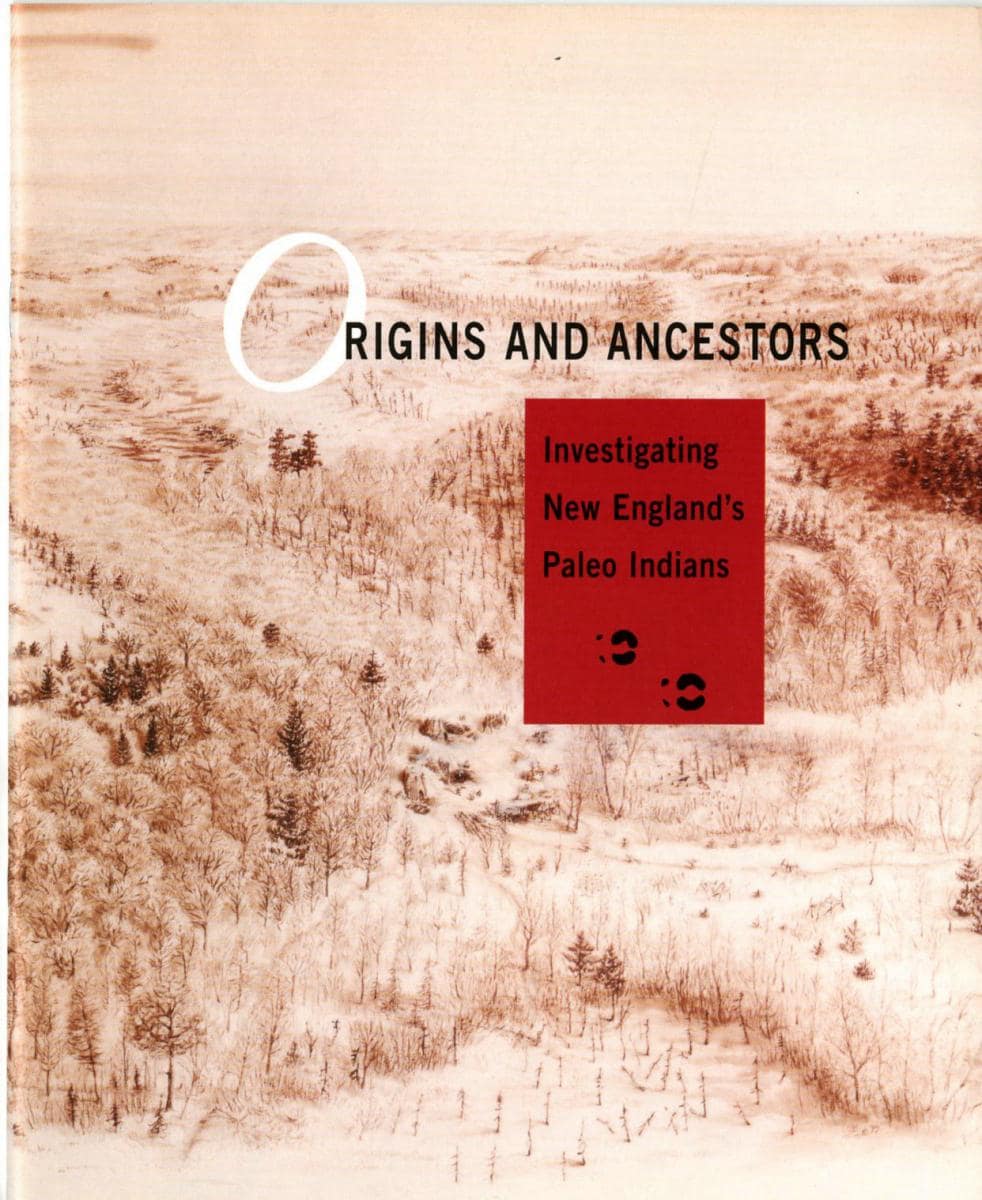
Book Cover: Origins and ancestors : investigating New England's Paleo Indians Andover, Mass.: Robert S. Peabody Museum of Archaeology, 1998.

In 2001, Bradley left Andover to establish ArchLink, a privately owned business that seeks to link archaeology with education and preservation.  As a consultant who has worked with museums, schools, tribes and government agencies, his aim is to “translate” the oftentimes technical and obscure language of archaeology into what his clients need.  The results include museum exhibition scripts and designs, preservation plans, and publications for a wide range of audiences.  This venture has, once again, made him a fixture on the Athenæum’s fifth floor.  “I love the Boston Athenæum for many reasons, but one is because scholarship is taken seriously here.  However, serious does not mean dull and dry.  This is a place where one learns in many ways: from the staff, from the other patrons, from unexpected discoveries.  It is that shared quality of learning that makes the Athenæum such a productive place to work.” 

In January of 2011, Bradley added to our own resources yet again with his lecture: Revisiting Wampum and other Seventeenth Century Shell Games.  Currently, he is completing the manuscript for a new book: Onondaga and Empire: An Iroquoian people in an Imperial Era.  This will be the sequel to his earlier book: The Evolution of the Onondaga Iroquois: Accommodating Change, 1500-1655 (1987) that ended with the arrival of resident French Jesuits in 1654.  The new volume will trace how the Onondaga dealt with their ever more encroaching imperial neighbors during the rest of the seventeenth century, concluding with the signing of successful peace treaties with both the French and English in 1701.  As always, Bradley hopes that his work will bring “a greater interest in and access to the Indian perspectives of our shared history.”

Selected Bibliography:

Archaeology of the Bostonian Hotel Site (1983)
Library of Congress Classification
+ F73.39 .A722

Before Albany: An Archaeology of Native-Dutch Relations in the Capital Region1600-1664 (2007)
Library of Congress Classification
+ F129.A347 B73 2007

Evolution of the Onondaga Iroquois: Accommodating Change, 1500-1655 (1987)
Library of Congress Classification
+ E99.O58 B7 1987

03.22.2013

Elouisa Goose Partridge, or, Auntie Partridge

April 1, 2013

By Chloe Morse-Harding and Tricia Patterson

Elouisa Goose Partridge, Auntie Partridge,  was born in Lowell, Massachusetts on March 3, 1791 to Cumbersome Ernest Partridge and Harriet Abyssinia Goose. Her mother was rumored to be a second cousin to Mary Goose, an alleged identity of the famous Mother Goose, and she instilled in her daughter a great reverence for the Mother Goose canon. In fact, Elouisa’s first words were reportedly, “Honk, honk.”

Growing up, she memorized all of the Mother Goose nursery rhymes and would recite them on command or – often – unprompted. It was around the age of twelve that her father began to encourage the young Elouisa to compose some original works, and she at once began her life’s work of writing nursery rhymes.

She began to study children’s literature at Simmons College, and at the ripe age of nineteen, Partridge had her first rhyme published in the popular quarterly Bib’n Bottle. The nursery rhyme, untitled as it were, was to be her most noted accomplishment.

Tweedle-dee-dee and
Twiddle-doo-dah
Ol’ Broadback Bertha
Has been whittled rawShe picked up some sticks
With a mind to abuse ‘em
And whilst carving the wood
Did she do somethin’ gruesome
Now Ol’ Broadback Bertha,
She only stacks wood
The trees taught her good.

Bathed in the glow of success, she dropped out of her studies to pursue a prospectively brilliant career in writing. It was during these years that she most frequented the Boston Athenaeum, often perusing the collection of children’s literature and always visiting the Mother Goose tombstone in the Granary Burial grounds.

However, she found the competitive world of nursery rhyme composition difficult to make a living in, and in 1822, at age the of 21, she accepted a marriage proposal from Henry Elijah Partridge, a distant relation of her father’s who owned a small but profitable farm in the Massachusetts countryside.

Partridge continued her writing from the farm, and found a small press to print off a few volumes of her nursery rhymes. Over the years she appeared sporadically in Bib’n Bottle and Cursory Rhymes, but she never recaptured the success of her initial publication. She became increasingly involved with work on the farm, taking up loom-weaving with great zeal. After her husband passed away of cholera in 1851, Partridge decided she wanted to run the farm business, and run it she did – into the ground. Less than five years later, she was forced to close the farm and moved back to Boston to be taken care of by her niece. She continued her work with weaving and writing until her death – on November 14, 1888 – from very, very old age.

03.04.2013

Ralph Waldo Emerson

March 2013

By Chloe Morse-Harding

“My book should smell of pines and resound with the hum of insects”–excerpt from Self-Reliance

Ralph Waldo Emerson (1803-1882) was born in Boston to parents William and Ruth Emerson.  Emerson’s name was derived from both sides of the family: Ralph was the name of Ruth’s brother, and Waldo was the maiden name of his great-great grandmother Rebecca.    William Emerson was a Unitarian Minister who preached at the First Church in the Back Bay neighborhood of Boston.  William was also a founder of the Boston Athenæum, and one of its first trustees. 

In May of 1811, just months after his eighth child was born, William passed away.  William was buried at King’s Chapel in the Cotton Tomb, named for John Cotton, a pastor of the First Church.  “Both men would live on in the descendants of William’s son, Ralph Waldo, and his wife Lidian Jackson, whose mother, Lucy Cotton, was a direct descendant of John Cotton.”  Shortly after, Ruth Emerson sold William’s library to the Athenæum.  Left alone to raise the family, Ruth worked as a maid and often took in borders. 

Emerson grew up very close to his mother and siblings.  He also developed a close relationship with his Aunt Mary Moody, his father’s sister; she “was the dominant influence of Emerson’s childhood and youth.”  Aunt Mary had an unbounded interest in theology, and it was she who taught Emerson (or Waldo, as he preferred to be called) “many of the aphorisms he in turn taught his own children,” such as the famous: “Always do what you are afraid to do.”

Emerson was educated at Boston Public Latin School, and then went on to attend Harvard College, passing the entrance exam at the young age of fourteen (although, his father William beat him by a year).  Emerson was thirtieth in his class, and was named Class Poet.  Upon graduation, he decided to delay his entrance to divinity school and taught for a few years at his brother William’s “school for young ladies.”  After about a year, Emerson realized he was “a hopeless school master.”  Perhaps it was that Emerson longed for a different environment.

All his life, “Emerson…found himself pulled repeatedly…into the world of Nature.”  And it was Aunt Mary who “coaxed Emerson into giving Nature’s bounty a try.”  Emerson was not as charmed by nature as his aunt had perhaps hoped, but when his family moved to a wooded area of Roxbury in May of 1823, Emerson was close enough to the school so that he could walk there.  After a few months of trekking through the woods back and forth to school, he quietly changed his ways.  The following month, in a letter to John Boynton Hill, Emerson wrote that “Nature makes a man love his eyes.” 

In 1825, Emerson had made enough money teaching so that he could attend Divinity School at Harvard.  In 1826, Emerson was sanctioned as a Unitarian Minister, and three years later he was ordained as a junior pastor with the Second Church in Boston.  Also that year, in September, he married Ellen Louisa Tucker.  Their marriage was brief, as Ellen passed away less than two years later.  The following year, Emerson resigned from the Second Church and toured Europe.  A month after he returned home, in November of 1833, Emerson delivered his first lecture, “The Uses of Natural History” at the Masonic Temple in Boston.  The following year, in 1834, Emerson met his future wife, Lidian Jackson.  After hearing a sermon he gave at the Twelfth Congregational Church, she remarked “’[t]hat man is certainly my predestined husband.’”  The new couple married shortly after and settled down in Concord, in a home they decided to name “Bush” where they lived for the next 47 years.  In 1836, Emerson published his essay Nature and helped to form the Transcendental club, which later published the journal The Dial.  Emerson continued to lecture and write essays and poetry for the rest of his life, including Self-Reliance in 1841. 

An avid writer, he was also an avid reader (perhaps too much so at some points) and was a lifetime subscriber to the Athenæum: “Ralph Waldo Emerson (serious and dignified) came from Concord every week; he would become absorbed in reading for hours, and then wander about the library asking if anyone had seen his daughter Ellen.”  In regards to the types of books that he read, the “record of books drawn by Emerson is unusually large and heterogeneous.”  He was known to take out authors such as Moore, Dryden, Holmes, Goethe, and George Eliot. 

Although, there were some people who knew Emerson that did not know many details about him.  When Emerson was nearing the end of his life, a reporter came in to the Athenæum to ask questions about him: what he read, what he wore, questions such as that.  Not knowing the gentleman was a reporter, the library attendant answered that “she did not notice his clothes, as she never got beyond his head, which always fascinated her, being bald in some spots.”

Emerson died on April 27, 1882 in his home due to pneumonia, and was buried at the Sleepy Hollow Cemetery in Concord.  He rests now amongst other literary giants like Louisa May Alcott, Nathaniel Hawthorne, and Henry David Thoreau.

Selected Works:

The collected works of Ralph Waldo Emerson (LC PS1600 .F71)

The complete sermons of Ralph Waldo Emerson (LC BX9843.E487 C66 1989)

Emerson’s library (Cutter :XI5 .Em34 .h)

Journals of Ralph Waldo Emerson, with annotations (Cutter 65 .Em37)

One first love; the letters of Ellen Louisa Tucker to Ralph Waldo Emerson (Cutter VE5 .Em295)

Parnassus (Cutter VEP .9Em3)

References:

Buell, L. (2003).  Emerson.  Cambridge, MA: The Belknap Press of Harvard University Press.

McAleer, J. (1984).  Ralph Waldo Emerson: Days of Encounter.  Boston, MA: Little, Brown, and Company.

“Ralph Waldo Emerson”.  Retrieved from http://www.online-literature.com/emerson/

Regan, M.J. (1927).  Echoes from the Past: Reminiscences of the Boston Athenæum.  Boston, MA: The Boston Athenæum.

“Sleepy Hollow Cemetery”.  Retrieved from http://www.concordma.gov/pages/concordma_cemetery/sleepy

Wendell, B. (1907).  The Athenaeum Centenary: The Influence and History of the Boston Athenaeum from 1807 to 1907 with a Records of its Officers and Benefactors and a Complete List of Proprietors.  Boston, MA: The Boston Athenæum.

02.23.2013

Staff Book Suggestions Winter 2013

Pat Boulos

The End of Your Life Book Club by Will Schwalbe
(Library of Congress RC265.5 .S39 2012)

This is the true story of the author and his mother, who start a “book club” that brings them together as her life comes to a close. Their conversations that are both wide-ranging and deeply personal, prompted by an eclectic array of books and a shared passion for reading. Not at all maudlin–uplifting and inspirational, in fact.

David Dearinger

Peter Lovesey (Library of Congress PZ4.L89914)
Ian Fleming (Library of Congress PZ4.F598)

British author Peter Lovesey’s mysteries, especially those featuring over-weight, cantankerous detective Peter Diamond (set in Bath), are very well written, funny, and with plots that will keep you chaired, curled, and blanketed through any snow storm. They have been published in this country as part of the Soho Crime Series, any volumes from which are worth investigating.

If light Brit-lit is your thing, you can always fall back on Ian Fleming’s James Bond novels, which read like water and give a somewhat different impression of the protagonist than has Hollywood. (The Bond of the books, for example, drinks [bonded] Old Grand Dad Kentucky bourbon as often as he drinks martinis, especially in the early books). Remember, though, that the Bond novels were written over fifty years ago and so include the occasional (and it really is only occasional) sexist, masochistic, and (sometimes) homophobic remark (the last despite Fleming’s rumored affair with Noel Coward, his neighbor in Jamaica). You can easily read any one of these books in a day and knock off the whole series by the time spring springs.

Jenny Desai

Queen of Fashion: What Marie Antoinette Wore to the Revolution by Caroline Weber
(Library of Congress GT865 .W37 2006)

Asked to match a famous person with a book that would be an appropriate gift, the novelist Hilary Mantel recently suggested that Kate Middleton, the Duchess of Cambridge and incubator of the British Royal family’s next heir, might benefit from reading Queen of Fashion: What Marie Antoinette Wore to the Revolution. This 2006 title by Caroline Weber sparked only positive reviews on publication, but now finds itself reborn at the center of a firestorm about royalty, public personae, and the role of the press. The book is more interesting than the current controversy: Weber carefully deconstructs Marie Antoinette’s affection for fashion, painting a tragic—and nuanced—portrait of a woman who ultimately was “eaten alive by her frocks,” and more style than substance.

Chianta Dorsey

The Wretched of the Earth by Frantz Fanon
(Cutter Classification  EKFC6 .F217 .E)

I have always been interested in colonialism and post-colonial theory. Luckily for me, Frantz Fanon is one of the most influential writers to contribute to both fields. Fanon’s most famous work analyzes the trauma, oppression and violence that results from colonization. The book was written at a time when Fanon was engaged in the Algerian War of Independence against France. It is not a light read but it reveals the fascinating experience of how colonized peoples became agents in their fight for liberty and freedom.

Jayne Giuduci

Death and the Maiden by Frank Tallis
(Library of Congress PZ4.T14754)

An intriguing mystery on a cold and snowy day can be such an indulgence, like a bite of a decadent piece of chocolate. The Dr. Max Libermann series by Frank Tallis should be on the menu. Set in fin de siècle Vienna Dr. Libermann and his friend Inspector Oskar Reinhardt set about solving, on occasion fairly gruesome, murders and fascinating plots twists. Along the way you taste the flavor of the extravagant Vienna life style overflowing with music and elaborate pastries. These stories are just a bit of fun for a winter’s day.

Andrew Hahn

Njál’s Saga, translated from the Old Icelandic with introd. and notes by Carl F. Bayerschmidt and Lee M. Hollander.
(Library of Congress PT7269.N4 E52 1956)

The 13th century Icelandic sagas are true classics of world literature and perhaps the best place to start is with Njál’s saga and the best time to start is during a cold New England winter.

The Sagas of Icelanders: A Selection
(Library of Congress PT7262.E5 S34 2000)

If you would like to continue on with your exploration of the sagas, this impressive volume contains many more, including The Saga of Greenlanders.

Monica Higgins

I suggest Isak Dinesen’s Winter’s Tales (Library of Congress Classification PZ3.D5833 Wi), and for true hilarity, The Secret Diary of Adrian Mole, Aged 13¾ by Sue Townsend (Library of Congress Classification PZ4.T751 Ad).

Marc Lavalle

Back to Blood by “the man in white,” Tom Wolfe (Library of Congress, PZ4.W8563 Bac 2012).

Catherine McGrath

The Daughter of Time by Josephine Tey
(Library of Congress PZ1 .U58 v.48)

Between the 1920s and the 1950s, Elizabeth Mackintosh (a.k.a. Josephine Tey) wrote a handful of popular mystery novels, and of these the most curious and most memorable is The Daughter of Time, which pits her detective, Inspector Alan Grant of Scotland Yard, against William Shakespeare. Laid up in hospital with a badly broken leg and painfully bored, Grant is persuaded by a friend to pass time by solving the mystery of a face: that of Richard III of England. Unfamiliar with the portrait of which his friend brings him a reproduction, but confident in his knack for reading characters in faces, Grant pronounces Richard’s face to be the face of a saint. Learning to his shock that he has been studying the portrait of an English king purported to have been a merciless killer and immortalized as the arch villain of Shakespeare’s Richard III, Grant persuades a young American scholar to join him in an investigation of the facts in the case of Richard’s reign. In the process the two happily turn “history” on its head. The Daughter of Time is a quick read bound to delight lovers of either history or the mystery novel, if perhaps not lovers of Shakespeare!

Carolle R. Morini

Middlemarch: A Study of Provincial Life by George Eliot
(Library of Congress PZ3.E43 Mi 1912; also available on Kindle)

Why else should you read Middlemarch? – besides knowing full well it is a classic and you find yourself left out of too many literary conversations – you can use is as an excuse for the entire month of March, for example: “no, I can’t go to so-and-so’s house this evening, help you move, give the cat a bath, shovel the drive, etc. because I have a date with George Eliot.” All grand reasons! After you finish the book you will have at your disposal many quotes to use on Facebook. Such as: “If we had a keen vision and feeling of all ordinary human life, it would be like hearing the grass grow and the squirrel’s heart beat, and we should die of that roar which lies on the other side of silence.”

Chloe Morse-Harding

Memoirs of a Geisha: A Novel by Arthur Golden
(Library of Congress PZ4.G6198 Me)

One of my favorite books. I think it is perfect reading for every time of year. The descriptions of the scenery and of the characters are incredibly vivid, especially of the title character Sayuri. Her journey to becoming one of the best known geisha in Japan during the mid-twentieth century is moving, and I will admit that I was floored when I realized the author was not a woman. Even if you have read it, there is always something new to discover. (I have read it more times than I care to count).

Emilia Mountain

The Raven Boys by Maggie Stiefvater
(Children’s Room, Library of Congress PZ7.S855625 Rav 2012)

Blue Sargent, daughter of the town psychic, has a always had a chip on her shoulder when it comes to the local boys’ academy Aglionby. And yet, she finds herself reluctantly adopted by a strange band of Anglionby history buffs when it seems their secret plotting has put one of them in great danger. Fantasy and fun aside, this young adult novel contains a serious examination of the often strained relationship between “town and gown.” The sequel, The Dream Thieves, is planned for September.

Tricia Patterson

She Came to Stay by Simone de Beauvoir
(Library of Congress PZ3.B3852 Sh)

Because no one can resist a sultry, existential love triangle. Also, the end of the book will really heats things up (which is great for a cold winter), but not in the way you’d expect!

Douglas Pollock

Mycophilia: Revelations from the Weird World of Mushrooms by Eugenia Bone
(Library of Congress QK605 .B65 2011)

Mycophilia surveys the new science in the field of mycology and “will open your eyes to the vast and bizarre world of fungi” and their role and relationships with others on Earth.

Suzanne Terry

Waiting for Sunrise by William Boyd
(Library of Congress PZ4.B7892 Wat 2012)

Moving from Vienna in 1913 to London’s west end, the battlefields of France and hotel rooms in Geneva, a novel about a British actor, Lysander Rief, who goes to Vienna for a psychological cure, falls in love with a dangerous woman, and becomes involved in espionage for the British intelligence service. This is a “literary thriller that genuinely thrills, a plot-driven novel assembled by a master of plotting.” (The Financial Times)

Peter Walsh

Freedom from Fear: The American People in Depression and War, 1929-1945 by David Kennedy
(Library of Congress E173 .O94, vol. 9)

Part of the Oxford American History series. A really interesting and detailed description of the Great Depression and the Roosevelt Administration, with many unexpected parallels with the present. So many current issues now were also issues that far back in American history.

Mary Warnement

Travels in Siberia by Ian Frazier
(Library of Congress DK756.2 .F73 2010)

I was tempted to write about this in the autumn but decided Siberia is a topic for the cold months of winter. In fact, Frazier did not travel to Siberia in winter until he felt, well into his project, that he had to experience Siberian cold in order to have any credibility, at least with his readers. This is travelogue, history, and memoir. I have long had a fascination with Russia, and I felt as if he wrote this with me in mind. But his own “Russia love” (as he calls it) was his driving force. The sheer size of Siberia merits attention. Look at a map, most of Russia is Siberia. Remember playing the game Risk? Frazier certainly noted the importance of Siberia there. Born and bred in Michigan, I thought I knew about lakes. (Michigan, in case you don’t know, is the “great lake state.”) His statement that Lake Baikul is the largest sent me first to the map, where its thin length compared poorly to any of my great examples, but when I checked my reference sources, I realized it is largest by volume. If you enjoy geography, adventure, travel, and eccentric examples of human behavior, I recommend this. It will put in perspective the amount of snow you recently shoveled.

01.31.2013

Rishi Reddi

February 2013

By Emilia Poppe Mountain

Rishi Reddi was born in Hyderabad, India to “adventurous” parents.  Her father was a physician and his work brought the family across the globe.   As a young girl, they moved to London, Los Angeles, Philadelphia, and many more places in between.  Feeling unsettled by the continual uprooting, particularly as an only child, Reddi remembers turning to books for comfort and calm.  Her mother encouraged her reading and also gave her a notebook where she wrote her first story.  (She vaguely remembers something about a princess and a fairy and a cave).  Works such as The Phantom TollboothMy Friend Flicka and The Outsiders were read and re-read.  She also enjoyed Greek and Norse mythology, as well as the legends of gods and goddesses from her Hindu upbringing.  By the time she was in high school in Wichita, KS, literature was clearly her preferred subject.

Despite her parents’ strong urging to enter medical school, in 1988, Reddi graduated from Swarthmore College with a degree in English. She decided to study law and earned a JD at Northeastern University.  But her creative writing impulse would not be vanquished. She later enrolled in Boston University’s Creative Writing program and in many other workshops, such as courses at Boston’s Grub Street creative writing center, extension school classes at Harvard, and an independent study at MIT. 

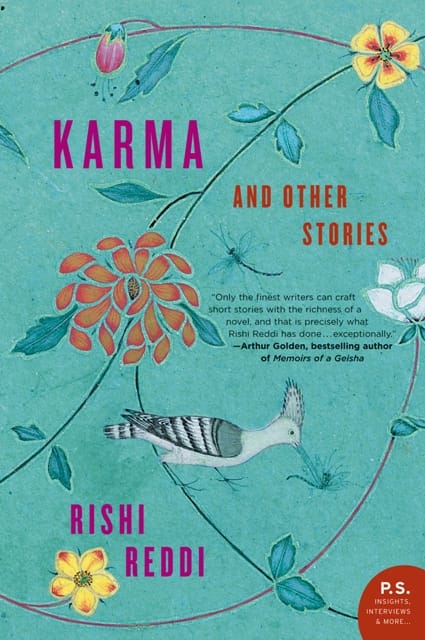
Bookcover for Karma and other stories by Rishi Reddi, 2007

Reddi continues to practice law to this day.  Indeed, many of the unusual cases she studied in law school serve as inspiration for her writing.  Brij Sharma’s 2001 suit against McDonald’s for allegedly putting beef fat in vegetarian French fries sparked “Justice Shiva Ram Murthy.” This title was included in The Best American Short Stories of 2011, edited by Michael Chabon, and broadcast on NPR’s “Selected Stories.”  The continued legal battles of the Fatal Light Awareness Program (FLAP) in Toronto to save the lives of migrating birds gave her the idea for “Karma.”  Similarly, the interracial marriage and citizenship cases of the early twentieth century provide the backdrop for Reddi’s forthcoming novel, West, set in the Imperial Valley of California. 

In Karma and other Stories, which won the PEN New England / L.L. Winship Award for Fiction in 2008, we intimately peer into the lives of Indian-American families.  We meet characters from many generations who are at various levels of comfort and reconciliation with their conservative upbringing and the temptations of American culture.  Reddi states that the relationships she created between these Boston and Lexington Indian-American communities were a way for her to imagine the community she never had growing up—a way  to artistically contend with the disappointment of having felt both different and alone for so many years.

Reddi joined the Boston Athenæum in 2003 at the recommendation of former archivist and friend, Lisa Starzyk.  She wrote much of Karma while sitting in the fifth floor reading room, and enjoyed meeting other authors in the Spiro Members’ Lounge.  The library was also a place where she could turn to Mark Twain, Toni Morrison and Edward P. Jones whenever in need of inspiration.

Reddi will be reading from her collection Karma and Other Stories on February 21st, from 6:30-9:30p.m. at the Peabody Essex Museum, where, in conjunction with the Tannery Authors Series, the Atrium will be transformed into the famous Samovar Café.

01.09.2013

Thomas William Parsons

January 2013

By Tricia Patterson

“O Time! whose verdicts mock our own/ The only righteous judge art thou/ That poor old exile, sad and lone/ Is Latium’s other Virgil now.”- Excerpt from “On a Bust of Dante”, Thomas William Parsons

Dentist, poet, and well-known translator of Dante, Thomas William Parsons, Jr. was born in Boston on August 8, 1819. He was the son of an English dentist of the same name, Dr. Thomas William Parsons. He grew up on nearby Winter Street and attended Trinity Parish and the Boston Latin School as a boy. While in school, he excelled in classical languages and made his first foray into classical translation with an attempt at Horace. However, Parsons dropped out just before he was done in 1834. Although his father had attended Harvard University for his M.D., the young Parsons opted not to study there at first, and in 1836, he and his father took off on a European voyage instead. It was on this journey that he first encountered Italy. Once there, he spent a few months under the roof of Signora Guiseppa Danti, and he recalled that it was “there, in the venerable Borgo Sant’ Apostolo, consecrated in my imagination by a verse of Dante’s… in the home of a learned lady who bore the name of the poet, [that I] became enamored of the Divina Commedia.” He began reading the Paradiso, memorizing stanzas, and translating small pieces of it. He would continue to develop such a passion for Dante that his most notable poetic success was his treatment of a translation of Dante’s Inferno. After returning home to Boston in 1837, he began following in his father’s footsteps and studied medicine at Harvard. Though he never completed his degree, he did practice dentistry and was often referred to as “Dr. Parsons.” Harvard eventually bestowed an honorary M.A. on Parsons in 1853. In 1840, at the age of twenty-one, Parsons became a proprietor of the Boston Athenӕum.  In his introduction to The Athenӕum Centenary, Barrett Wendell claimed that Parsons  “showed insatiable appetite for fiction and biography.” At the age of twenty-two, Parsons published his most famous original poem, “On a Bust of Dante” in the Boston Advertiser. This poem was anthologized in Henry Wadsworth Longfellow’s The Estray: A Collection of Poems and continued to be included in American poetry anthologies thereafter. Two years later, he published a few stanzas of Dante’s Divine Comedy, but although he would consistently work on this project, he would not publish full translations until over twenty years later.In 1857, he married Hannah Maria Allen, whom he often referred to endearingly as Annie. She was a cultured lady from his social circle who had previously printed some small volumes of his verse. In 1872, he published a general collection of poetry, The Shadow of the Obelisk and Other Poems. Other than a few collections of poems, much of his work circulated only within an intimate circle of friends, within which they were treasured. He also published often in leaflets, newspapers such as the Boston Evening Transcript, and magazines such as The Atlantic.

The shadow of the obelisk : and the other poems / Thomas Williams Parsons. London : Hatchards, 1872.

While Parsons was greatly respected by many of his contemporaries, including Ralph Waldo Emerson and Oliver Wendell Holmes, he was often characterized as more in tune with a time and place other than his own, probably resulting from his interest in Dante, the Middle Ages, and his strong Anglophilia. This perhaps contributed to the fact that he was more rigorous in his translations of Dante than he was prolific in the production of his own poetry. In 1863, Henry Wadsworth Longfellow published Tales of Wayside Inn, in which he explained the identity behind some of the key characters including the “Poet”, based on Parsons. Longfellow shared his interest in studying Dante and succeeded in publishing the earliest complete American translation of the Divine Comedy, but Parsons beat him by becoming the first American to issue a translation of the Inferno. Parson’s translation of Purgatorio was published posthumously.  Austin Warren, Professor of English at the University of Iowa, demonstrates Longfellow and Parson’s differences in their approaches to translation when comparing their translations of three stanzas: “Longfellow translates line by line. Parsons, collecting the sense, rearranges it, reducing nine verses to eight. He feels free to alter and to add.” Thomas William Parsons divided his time in  later years between the English countryside and the environs of Boston. In 1881, after twenty-four years of marriage, his wife Hannah passed away. He privately circulated four poems in her honor to his friends. Among them was “Into the Noiseless Country”: 

“Into the noiseless country Annie went,

Among the silent people where no sound

Of wheel or voice or implement – no roar

Of wind or billow moves the tranquil air:

And oft at midnight when my strength is spent

And day’s delirium in the lull is drowned

Of deepening darkness, as I kneel before

Her palm and cross, comes to my soul this prayer,

That partly brings me back to my content,

‘Oh, that hushed forest! – soon may I be there!'”

Eleven years later, on September 3rd of 1892, Parsons died from apoplexy during a stroke. He was found dead in a well in Scituate, Massachusetts, where he had been staying with his sister and being cared for by a nurse.

Selected Works:

The Divine Comedy of Dante Aleghieri. Boston and New York: Houghton, Mifflin and Company, 1893.

(Cutter: VIP .D2 . Ep)

Poems. Boston and New York: Houghton, Mifflin and Company, 1893.

(Cutter: VEP .P25 .2)

The Shadow of the Obelisk and Other Poems. London: Hatchards, Piccadilly, 1872. (Cutter: VEP .P25 .s)

Works Cited:

Boston Athenaeum. The Athenaeum Centenary: The Influence and History of the Boston Athenaeum from 1807-1907. Boston: The Boston Athenaeum, 1907.

Boston Evening Trascript (Boston, MA) Obituary of Thomas W. Parsons. September 6, 1892.

Hovey, Richard. Seaward: An Elegy on the Death of Thomas William Parsons. Boston: D. Lothrop Company, 1893.

Warren, Austin in Letters by T.W. Parsons, edited by Haraszti, Zoltan. Boston: Trustees of the Public Library, 1939.