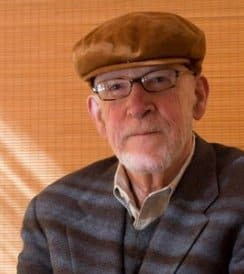
David Ferry is an American poet and translator, Sophie Chantal Hart Professor of English, Emeritus, Wellesley College and “Distinguished Visiting Scholar,” Suffolk University. His numerous honors include the Ingram Merrill Award for Poetry and Translation (1993), the Library of Congress Rebekah Johnson Bobbitt National Prize for Poetry (2000) and the Poetry Foundation’s Ruth B. Lilly Poetry Prize for lifetime achievement (2011). He is also a Fellow of the American Academy of Arts and Sciences.
Ferry was born in Orange, New Jersey in 1924. He graduated from Columbia High School in Maplewood-South Orange New Jersey, and played the piano, which taught him a great deal about the metrical line in poetry.
The English Department at Amherst College, where he began undergraduate coursework in the summer of 1942, had a profound influence upon him, especially professor Reuben A. Brower (of eventual Humanities 6 fame). Ferry was drafted into the Army Air Force in World War II early into his college career. After returning from the war and completing his degree in 1948, he entered a doctoral program at Harvard, which eventually culminated in his book The Limits of Mortality: An Essay on Wordsworth’s Major Poems (1959). In 1952, he became a professor at Wellesley College, where he met his wife, Anne Davidson, who later went on to teach and write at Harvard University and Boston College. Under the name Anne Ferry, she was the author of many distinguished books, among them Milton’s Epic Voice: The Narrator in Paradise Lost, The “Inward “Language, The Title to the Poem and By Design: Intention in Poetry. They had two children, Elizabeth Ferry, now an anthropologist at Brandeis University and Stephen Ferry, a photojournalist.
Ferry began writing poetry in the 1950s. His first book of poems, On the Way to the Island, was published in 1960 by Wesleyan University Press. Strangers: A Book of Poems (1983), Dwelling Places: Poems and Translations (1992) and Of No Country I Know: New Poems and Selected Translations (1999) were published by the University of Chicago Press. After retiring from Wellesley in 1989, Ferry’s translation career began. Gilgamesh: A New Rendering in English Verse, was a finalist for the Nation Book Critics Circle Award. Since then, he has translated the Odes and the Epistles of Horace and the Eclogues and Georgics of Virgil. He is now at work on a translation of Virgil’s Aeneid.
Two new books of poems will appear in 2012: Bewilderment: New Poems, and Translations, from the University of Chicago Press, and On This Side of the River, from the Waywiser Press (UK).
Eclogues of Virgil: A Translation LC PA6807.B7 F47 1999
Gilgamesh: A New Rendering in English Verse LC PS3556.E77 G55 1992
Odes of Horace LC PA6395 . F47 1997
Of No Country I Know: New and Selected Poems and Translations LC PS3556.E77 O37 1999
On the Way to the Island: Poems Cutter VEP .F418 .o
03.29.2012
Lloyd Fairsoap
April 1st, 2012 by Noah Sheola
Though once a rising star in American literature, author Lloyd Fairsoap (1842-1911) is undeservedly obscure nowadays. A poet, essayist, and novelist, Fairsoap is well remembered at the Boston Athenæum, where his original manuscripts and early editions of his books are proudly kept today. Fairsoap became a proprietor of Boston Athenaeum in 1889 and wrote some of his best-loved novels in the second-floor reading room.
Lloyd Fairsoap was born in Boston in 1842 to Stephen Fairsoap, a marine agent, and Ada (Poole) Fairsoap. Raised in a household that valued intellectual achievement, Fairsoap entered Harvard College at sixteen, where he benefitted from sitting immediately behind the young Oliver Wendell Holmes Jr. during exams.
During his senior year, with the advent of the Civil War, Fairsoap joined the Union Army, rising to the rank of spittoon-polisher and fighting in the Peninsular Campaign under General McClellan. After the war Fairsoap applied himself to literary endeavors. His essays appeared in The Presentiment and The Harbinger and he regularly wrote humorous verse for the Sunday edition of the Boston Oracle. In 1867 Fairsoap married Lucy Poniard of the accomplished French violist Anton Poniard and herself a conservatory-trained soprano of some note.
Fairsoap published several novels in the 1880s and 1890s, the best known of which, The Island Proviso (1893), was described by George Bernhard Shaw as “singularly mawkish” and “turgidly plotted.” A fixture among Boston socialites, Lloyd Fairsoap was notorious at gatherings, owing to his quick wit, ribald charm, and an inordinate fondness for herring. Following an orgy of herring consumption that was astonishing even by Fairsoap standards, the celebrated novelist succumbed to a surfeit of brine, dying in the early morning of April 2nd, 1911 at his home in Boston. He was duly interred in the Fairsoap family plot at Mount Auburn Cemetery.
02.29.2012
Ola Elizabeth Winslow
March 2012
By Noah Sheola
Fifth Floor,
December 15, 1970
Dear Second Floor,
Your invitation for tea on Thursday, December 17th raises the happiest of anticipations. I’ll surely be right there at three o’clock. Thank you and thank you again. Yours truly, Elizabeth Winslow
Handwritten note from Ola Elizabeth Winslow. Collection of the Boston Athenæum.
Ola Elizabeth Winslow was an author and historian best known for her Pulitzer Prize winning biography of the eighteenth-century theologian Jonathan Edwards. A proprietor of the Boston Athenæum from 1951 until her death in 1977, she is still fondly remembered by Athenæum members and staff alike.
Born in Grant City, Missouri, to William Delos Winslow, a banker, and Hattie Elizabeth Colby, Winslow grew up in California. She attended Stanford University, earning a bachelor’s degree in 1906 and going on to teach English at a private girls’ school. In 1909 Winslow accepted a position teaching English at the College of the Pacific (now University of the Pacific), then located in San Jose. After completing a master’s degree from Stanford in 1914, Winslow became Professor of English at Goucher College, in Baltimore. She taught at Goucher for the next thirty years, during which time she completed a doctorate in English from the University of Chicago. Her 1922 dissertation was titled “Low Comedy as Structural Element in English Drama from the Beginnings to 1642” and was published by the University of Chicago Libraries in 1926.
Winslow’s next book was an anthology titled Harper’s Literary Museum: A Compendium of Instructive, Entertaining and Amusing Matter Selected from Early American Writings…(1927). Whereas the title page of this book reads “designed” by George Boas and “compiled” by Ola Elizabeth Winslow, it should be understood that Boas, a philosophy professor at Johns Hopkins, did little more than act as Winslow’s literary agent. Though Winslow’s early work is today consigned to obscurity, her next book was an immediate success, providing the basis for her long and distinguished career. Winslow had long aspired to write an intellectual history of Jonathan Edwards, but, upon learning that Harvard professor Perry Miller was himself at work on a similar endeavor, Winslow yielded the topic to the better known Miller and wrote a biography of Edwards instead. Published in 1940, Jonathan Edwards, 1703-1758: A Biography was awarded the Pulitzer Prize in biography, securing her reputation as an assiduous scholar and gifted writer.
In 1944 Winslow was appointed professor of English at Wellesley College, where she would teach until 1950, residing in faculty housing near campus. The move represented a kind of homecoming for Winslow, her west-coast upbringing notwithstanding, for her ancestry dates back to the Mayflower, and as a specialist in colonial New England she had long felt an affinity for the region. From 1950 to 1962 Winslow was lecturer at Radcliffe College’s winter seminars, the seasonal employment permitting her to spend time in London conducting research at the British Museum for her study of Pilgrim’s Progress author John Bunyan. Publishedin 1961, John Bunyan, was a finalist for the National Book Award.
Now writing full-time, the ensuing years were the most prolific period of Winslow’s career, owing to her indomitable work ethic and, just perhaps, the writer’s sanctuary she found on the fifth floor of the Boston Athenæum, of which she had been a share-holder since 1951. By the 1960s Winslow had become one of the better known habitués of the library, her presence well documented in the Athenæum archives. She now spent most of her time in Maine however, having bought a farmhouse in Sheepscot with her Pulitzer Prize earnings. She returned to Boston each November to spend the winter near her favorite library, renting a modest apartment at 4 Chestnut Street.
In the winter of 1970 Winslow befriended fellow author and Athenaeum member Edward Clark, professor of English at Suffolk University. Clark has written up his recollections of his friendship with Winslow in a brief, unpublished memoir titled An Athenæum Friendship, which has served as primary source for the present biographical sketch. Clark recounts how his pleasant conversations with Winslow evolved into “a daily ritual,” involving collegial discussion and clandestine doughnuts. Clark’s memoir relates many details of Winslow’s winters in Boston, including the particulars of her weekly routine. On Saturdays she ran errands and shopped and on Sundays attended the First Unitarian Church on Marlborough Street. On Monday morning she was at the Athenæum as soon as the doors were open, promptly claiming a table on the fifth floor where she wrote until noon. For lunch she favored tea and an egg-salad sandwich at a neighborhood shop. She would buy a plain doughnut to share with Mr. Clark, whom she now called Ed, he in turn addressing her as Elizabeth. When Edward Clark met Winslow she was working on a book on the Boston small pox epidemic of 1721. It would be her final work. Published in 1974, A Destroying Angel: The Conquest of Smallpox in Colonial Bostonwas dedicated to Dr. Blake Cady, who had operated on her following a diagnosis with breast cancer. While Winslow ultimately survived cancer she was nonetheless near the end of her long life. In 1977 Winslow, who never married and had no children, died in Damariscotta, Maine. Reflecting on her Athenaeum friendship with Edward Clark, she included him in her will, leaving him “my small antique walnut table, my large square carpeted stool, and one floor lamp, and also my share in the Boston Library Society (now the Boston Athenæum).”
Selected Works:
Jonathan Edwards, 1703–1758 (1940) Meetinghouse Hill, 1630–1783 (1952) Master Roger Williams (1957) John Bunyan (1961) Samuel Sewall of Boston (1964) Portsmouth, the Life of a Town (1966) Jonathan Edwards, Basic Writings [ed.] (1966) John Eliot: Apostle to the Indians (1968) “And Plead for the Rights of All”: Old South Church in Boston, 1669–1969 (1970) A Destroying Angel: The Conquest of Smallpox in Colonial Boston (1974).
References:
Clark, Edward (2011). An Athenæum friendship. Unpublished manuscript. Gale, Robert L. (1999). “Ola Elizabeth Winslow” In American National Biography. New York; Oxford: Oxford University Press. “Ola Elizabeth Winslow.” (2001). Contemporary Authors Online. Detroit: Gale. Gale Biography In Context. Web. 22 Feb. 2012. “Ola Elizabeth Winslow.” Dictionary of American Biography. New York: Charles Scribner’s Sons, 1995. Gale Biography In Context. Web. 22 Feb. 2012.
02.01.2012
Sukie Amory
Sukie Amory wears several hats at Amory Architects, where she collaborates with staff on interiors and gardens and blogs on various topics in landscape and design. She is also a frequent contributor to HORTUS, a British garden journal owned and edited by David Wheeler, whom Amory met in 2007 on a tour of private Belgian gardens. (You can read the current issue of HORTUS on the second floor).
Amory jokes that hers was perhaps an unlikely upbringing for a garden writer. As a young child in the 1950s, her family moved from Norfolk, Virginia to Chicago, where her parents threw themselves into the civil rights movement. She remembers her mother dressing her in her Sunday best to march with Dr. Martin Luther King. Her father, an Episcopal priest, assisted Malcolm X in his lawsuit to allow Korans in jails and established the first halfway house for men coming out of prison. She remembers him being in jail himself for weeks during the Freedom Rides in Jackson, Mississippi and receiving a Black Panther escort when Chicago burned after Malcolm X’s assassination
Certainly, as a young urban woman, she would never have thought that someday she would be writing about an estate garden in the Ukraine designed by a Polish count for his Greek mistress or lilacs in Duxbury or elm trees and Olmsted. Nor would she have thought she’d be spending all of her spare time reading up on Persian water features or how to overwinter agapanthus. Back then, her heart was set on working for a metropolitan opera company. She studied English and German literature at Harvard/Radcliffe and British theater history at the University of London, eventually working for the Cambridge (UK) Music Festival and the centennial Bayreuth Festival. Upon returning to Boston, she worked for Sarah Caldwell’s Opera Company and later the Massachusetts Council on the Arts and Humanities.
And yet, something in her mother’s stories of running wild through a white-flowered garden on a farm outside of Richmond, VA must have made an impression.Looking back, Amory finds her memories of visiting relatives in Tidewater Virginia and up in the Blue Ridge Mountains have as much of the feeling of “home” as does the bustle and grit of Chicago. The setting which was to have the greatest impact on her aesthetically was her paternal grandfather’s shade garden on the Lafayette River in Norfolk, which she describes as having been “a cool haven of magnolias, crabapples, crepe myrtles, loblolly pines, boxwood and ivy.” It was the perfect spot to muse upon of her favorite line of garden poetry from George Herbert: “Annihilating all that’s made/ To a green thought in a green shade…”
In 1988, Amory and her husband, architect David Amory, established the firm Amory Architects. They were working on their own particularly ragged fixer upper in Brookline when she happened to attend a lecture at the Arboretum where the speaker declared that, in Britain, even the ugliest council flat could be transformed with a tiny allotment of roses and vines. Amory went straight to work transforming the Brookline property with a front cottage garden and a rear shade garden inspired by the one kept by her grandfather. The finished product turned out so well that it was featured on the cover of Globe Magazine and in Outside the Not So Big House.
Amory first walked into the Boston Athenæum in the summer of 1974 where she and other college students spent a sweltering season under the benevolent supervision of former director Rodney Armstrong, checking Cutter call number shelf lists against books in the Drum. She says they marveled over finds such as an original Martin Luther tract with charge cards and chortled over early catalogue entries like: Women—see Social problems. Recently, she’s been able to enrich her garden writing with great finds in our rare book collection, such as an early edition of Thomas Whately’s Observations on Modern Gardening, an influential book that Thomas Jefferson had in his pocket when he and John Adams went on a tour of British gardens—around the same time that Catherine the Great was having it translated into Russian. Images from our collections also appear in her Winter 2010 HORTUS article, “Our Burnished Stomping Ground: The Public Garden, Boston.”
Amory is quick to point out that not all garden writing is about palaces and country estates. In the Summer of 2010, Amory wrote a piece for HORTUS entitled “The Gift: A WPA Garden in Virginia” about the Azalea Gardens that grew into today’s Norfolk Virginia Botanical Garden and the African American women who endured miserable working conditions to bring it to fruition. The article was particularly moving for Amory to write, not only because it involved her hometown but also because it enabled her to discuss gardens with the spirit of social justice bequeathed to her by courageous parents. Designed for “gardeners who read, and readers who garden,” the HORTUS Winter 2012 issue includes Amory’s article “Pilgrim Lilacs: ‘Making Poetry Out of a Bit of Moonlight,’” as well as an article by Athenæum author Judith Tankard on the best American gardening books of the past 25 years. Amory is currently writing on Isabella Stewart Gardner as a gardener and the new greenhouses and plantings at the newly reopened museum for HORTUS Summer 2012. David Wheeler will publish her piece on the Arnold Arboretum in four installments in 2013, allowing her to cover its swashbuckling plant hunters of the last century to today’s cutting edge research on tropical and temperate forests across Asia as well as beloved local traditions like Lilac Sunday.
01.12.2012
Thomas Russell Sullivan
January 2012 By Noah Sheola
“One hurries through Pemberton Square, oppressed by the swollen bulk of the Court-House and its dependencies where the lawyers make skyward for light and air in rushing elevators, to come upon the Athenaeum crowded by domineering neighbors, that having despoiled it of dignity seem to be elbowing it away.” Thomas Russell Sullivan, Boston New and Old (1912)
Novelist and dramatist Thomas Russell Sullivan was born November 21, 1849 at Boston to the Thomas Russell and Charlotte Caldwell (Blake) Sullivan. His great-grandfather James Sullivan had been Governor of Massachusetts and the first president of the Massachusetts Historical Society. The elder Thomas Russell Sullivan had been a Unitarian minister in Keene, N.H., before moving to Boston and becoming a schoolmaster. Sullivan attended Boston Latin School and aspired to go on to Harvard College. Both of his parents died by the time he was fourteen, however, and Sullivan was forced to support himself rather than attend college. He took on a series of office jobs, eventually becoming a bank teller. As a clerk for the Bowles Brothers firm, Sullivan lived in Paris and London from 1870 to 1873, cultivating an appreciation for fine arts and especially the theatre. With the failure of Bowles Brothers in 1873, Sullivan returned to Boston, working for Union Safe Deposit Vaults of Lee, Higginson & Company by day and writing original plays at his Charles Street residence by night. By 1880 Sullivan’s plays, including both originals and adaptations of French comedies, were regularly staged at the Boston Museum, a Tremont Street venue which showcased natural history specimens as well as theatrical performances from 1846 to 1903.
In 1885 Sullivan published his first novel, Roses of Shadow, a sentimental romance which soon earned him local renown as a promising literary talent. Soon after, Richard Mansfield, then among the most famous actors in America, befriended Sullivan and suggested he adapt Robert Louis Stevenson’s latest bestseller, The Strange Case of Dr. Jekyll and Mr. Hyde. Mansfield would take on the dual title role himself. Sullivan’s adaptation, titled Dr. Jekyll and Mr. Hyde, premiered at the Boston Museum on May 9, 1887. The Boston reviews were favorable, and after some revisions the production traveled to New York in September and to London the following year.
The London production of Dr. Jekyll and Mr. Hyde will forever be associated with the series of unsolved murders attributed to Jack the Ripper. The show opened just days before the first of five horrific murders in London’s Whitechapel district. Just as more recent critics have blamed horror movies and video games for acts of violence, London tabloids immediately cited Mansfield’s portrayal of the depraved Mr. Hyde as a factor in the Ripper slayings. Letters to newspapers on both sides of the Atlantic posited that Jack the Ripper was surely a real-life Jekyll and Hyde, a seemingly respectable member of society, perhaps a doctor, leading a double-life as a serial murderer. At least one theatergoer became convinced that Mansfield himself was the killer, and tipped off the London police accordingly. The publicity made Mansfield famous, but show attendance waned as many Londoners deemed the play to be in bad taste. Mansfield soon closed the production and revived one of the romantic comedies on which he had built his career, returning to America not long after. The actor was never seriously under suspicion by any official investigation. Nevertheless, with Dr. Jekyll and Mr. Hyde looming so prominently in the Ripper mania of the London tabloids, it is perhaps inevitable that Mansfield is so often remembered in this dubious context.
Though the London production had proved a disappointment, Sullivan was sufficiently encouraged by the critical response in Boston to quit his day job. Now regarded as Boston’s leading dramatist, Sullivan was at last able to earn a living as a writer. He collaborated with Mansfield once more in 1891, writing Nero, in which Mansfield played the Roman emperor. The playwas a critical and financial failure and the ever volatile Mansfield had become impossible to work with. Jekyll and Hyde would prove to be Sullivan’s only major theatrical success. Though Sullivan’s career in the theatre had come to an end, he would remain a respected figure in Boston’s literary community on the basis of his novels and short stories.
Sullivan became a proprietor of Boston Athenaeum in 1889 and was elected to the board of trustees in 1909. He also served as vice president of the Tavern Club from 1886 to 1908, and socialized at the club almost nightly. In 1899 Sullivan married Lucy Wadsworth (1869-1947), daughter of the accomplished ophthalmologist Dr. Oliver Fairfield Wadsworth. Sullivan had known Dr. Wadsworth since at least 1893, when he consulted the doctor after losing sight in his left eye.
Thomas Russell Sullivan died on June 28, 1916 at his home in Boston. A eulogy written by Henry Cabot Lodge was published in the annual proceedings of the Massachusetts Historical Society shortly thereafter, Sullivan having joined the society just two months prior. He was interred in the Sullivan family plot at Mount Auburn Cemtery, to be joined by Lucy upon her death in 1947. The Sullivans had no children.
Thomas Russell Sullivan is, admittedly, an obscure and minor author. His novels and stories are seldom read, and his sole theatrical triumph forever overshadowed by the stature of Robert Louis Stevenson, the original creator of Jekyll and Hyde. Sullivan did, however, leave behind a legacy of perhaps greater significance than his literary endeavors. Portions of Sullivan’s diary were published in 1917 as Passages from the Journal of Thomas Russell Sullivan, providing historians with a trove of anecdotes and observations relevant to the study of Boston society in the 1890s. Quotations from Sullivan’s journal appear with some regularity in the work of Walter Muir Whitehill and other historians seeking to evoke Sullivan’s time and place. Sullivan’s manuscripts, personal papers, and letters are kept at the American Antiquarian Society, Harvard University, and the Boston Athenaeum. Along with published diary excerpts and his final published work, Boston New and Old (1912), the written record of Sullivan’s life represents an important resource for understanding the theatre scene and literary life of Boston in the late nineteenth century.
Image courtesy of the Massachusetts Historical Society. Collection of the Boston Athenaeum.
Danahay, M. A., Chisholm, A., & Sullivan, T. R. (2004). Jekyll and Hyde dramatized: The 1887 Richard Mansfield script and the evolution of the story on stage. Jefferson, N.C: McFarland & Co., Publishers.
December Meeting. Samuel Abbott Green; The Periodization of History; History at Harvard College in the ’70’s; Letter of Richard Oswald; Thomas Russell Sullivan M. A. De Wolfe Howe Proceedings of the Massachusetts Historical Society , Third Series, Vol. 52, (Oct., 1918 – Jun., 1919), pp. 44-84
October Meeting, 1916. Gifts to the Society; Thomas Russell Sullivan; Letters of John Stuart Mill, 1865-1870; Letter of Elkanah Lane, 1839; George Harris Monroe Edward Stanwood Proceedings of the Massachusetts Historical Society , Third Series, Vol. 50, (Oct., 1916 – Jun., 1917), pp. 1-36
Proceedings of the Massachusetts Historical Society , Third Series, Vol. 67, (Oct., 1941 – May, 1944), pp. 581, 583-654
Table gossip. (1888, Jan 29). Boston Daily Globe (1872-1922), pp. 13-13. Retrieved from http://search.proquest.com/docview/493657368?accountid=35416
Sullivan, T. R. (1917). Passages from the journal of Thomas Russell Sullivan, 1891-1903. Boston: Houghton Mifflin company.
12.01.2011
Liza Ketchum
December 2011 ByEmilia Poppe Mountain
Liza Ketchum was born in Vermont to Martha Graham dancer, Barbara Bray Ketchum, and historian, Richard M. Ketchum. As a child, she created an imaginary world for herself and spent many hours composing stories about it. Both parents encouraged her creative interests, and her father would illustrate the stories she and her brother wrote about their stuffed animals.
Ketchum studied creative writing at Sarah Lawrence College as an undergraduate and received her Master’s in Education from Antioch University Graduate School. In 1969, she spent a year in England studying some of that country’s progressive education models. These models encouraged creativity and the exploration of learning through a child’s strengths and interests. She later co-wrote a book about British primary education (Children Come First) and opened a pre-school in Marlboro, Vermont, where she was able to implement many of the techniques she had studied.
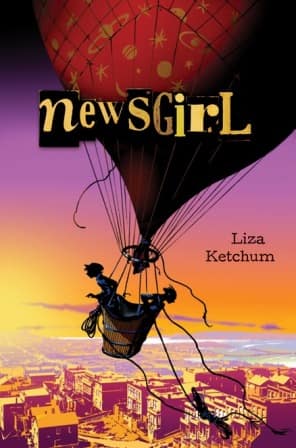
At one point, children’s writer and friend Katherine Leiner commented, “Since you teach children and you like writing—why not write for children?” Ketchum took that suggestion and coupled it with her love of history. She remembers that when she was young, history was taught on the following topics: Ancient Greeks and Romans, Wars, and famous American white men. Her books have sought to address what was omitted by considering, for example, what it might have been like to be a half-Pequot, half-Anglo farm boy in Vermont just after the Revolutionary War (Where the Great Hawk Flies, winner of the Massachusetts Book Award); a surfer teen who doesn’t fit the cultural mold of his straight, male peers (Blue Coyote); orphans travelling from Illinois to Kentucky who faced the very real dangers of indentured servitude (Orphan Journey Home); and the experience of young entrepreneurs during the California Gold Rush (Newsgirl). Other books include non-fiction titles focused on ordinary people who have accomplished extraordinary things. She is currently working on a novel that explores the adventurous, popular side of Vaudeville, as well as the prejudice and challenges faced by African American performers. Many of her plots are inspired by her personal genealogical research.
Ketchum’s father gave her the gift of a Boston Athenæum membership many years ago. She was living in Vermont at the time but took advantage of our book mailing program. She loves Virginia Woolf and lately has been reading a lot of Jim Harrison. She greatly admires young adult books by Gary Schmidt, Ellen Levine, M.T. Anderson, all teaching colleagues as well as members of her writing groups. For comfort and inspiration, she turns to the poetry of Mary Oliver, and when she needs to be completely diverted, she enjoys the mysteries of P.D. James and Donna Leon. Ketchum relies on the Boston Athenæum’s collections for research as well as for pleasure. A favorite title is John David Borthwick’s Three Years in California. She found both his gold rush stories and original art inspiring and was able to use some images in her non-fiction book, The Gold Rush. As a part of our Bicentennial series in 2007, Ketchum, along with M.T. Anderson, Irene Smalls, and Rebecca Doughty, read aloud from children’s books written by Athenæum members from the past. Ketchum’s choice was Barbara Cooney’s Miss Rumphius.
Today, Ketchum lives in Massachusetts and teaches writing for children and young adults through Hamline University’s low-residency MFA program in St. Paul, MN. She has recently completed a new novel that takes place in Boston in 2004 and is about “death, war and baseball.” She enjoys talking baseball with members of the library’s staff and confesses to having purchased satellite radio for the family car so that she and her husband can listen to Red Sox games on the road. To learn more about Ketchum see her website.
Selected Bibliography:
Blue Coyote. Simon & Schuster Books for Young Readers, 1997 Library of Congress Classification, Children’s Library PZ7 .K488 Bl
Gold Rush; Based upon the Public Television series; with an introduction by Ken Burns and Stephen Ives. Boston: Little, Brown, 1996 Library of Congress Classification, Children’s Library +F865 .K4 1996
Into a New Country: Eight Remarkable Women of the West. Boston: Little, Brown, 2000 Library of Congress Classification, Children’s Library F569 .K45 2000
Newsgirl. New York: Viking, 2009 Library of Congress Classification Children’s Library PZ7 .K488 New 2009
Orphan Journey Home. Illustrated by C.B. Mordan. New York: Avon Books, 2000 Library of Congress Classification, Children’s Library PZ7 .K4888 Or 2000
Where the Great Hawk Flies. New York: Clarion Books, 2005 Library of Congress Classification, Children’s Library PZ7 .K488 Whe 2005
11.03.2011
Colonel Thomas Wentworth Higginson
November 2011 By Casey Pellerin and Noah Sheola
Thomas Wentworth Higginson (1823 – 1911) was a proprietor of the Boston Athenaeum, the author of numerous books on American literature and history, and a social reformer who championed the causes of women’s suffrage, the temperance movement, and the abolition of slavery. As a Union colonel in the Civil War Higginson commanded the 1st South Carolina Volunteers, the first federally authorized regiment of African-American soldiers. Higginson is also remembered as one of the “Secret Six”, half of whom were proprietors or frequenters of Boston Athenaeum, who funded the radical abolitionist John Brown. In later years Higginson would also gain renown as the literary mentor and publisher of Emily Dickinson.
Born in Cambridge to Stephen Higginson Jr. and Louisa Storrow, Higginson came from a well-to-do family, his father having been a successful merchant and his grandfather a member of the Continental Congress. Higginson graduated from Harvard College in 1841 and from Harvard Divinity School in 1847, the same year he married Mary Elizabeth Channing. A Unitarian, Higginson accepted a ministry in Newburyport where his outspoken support for women’s suffrage, labor rights, and the abolition of slavery soon proved too radical for the conservative community. He was asked to resign after two years. In 1852 Higginson became pastor of the Free Church in Worcester after an unsuccessful bid as the Free Soil party candidate in the Third Congressional District of Massachusetts.
In the 1850s Higginson worked tirelessly for the temperance movement, women’s suffrage, and the abolition of slavery, nominating Lucy Stone and Susan B. Anthony to serve on the committee on credentials at the 1853 World’s Temperance Convention in New York. He joined the Boston Anti-Slavery Vigilance Committee and befriended fellow abolitionists Wendell Phillips and Theodore Parker. In 1854 Higginson was arrested as he participated in the attempt to free escaped slave Anthony Burns from the Boston Courthouse. Following the John Brown’s failed uprising at Harpers Ferry in 1859, newspapers revealed that Higginson and fellow abolitionists Samuel Gridley Howe, Theodore Parker, Franklin Benjamin Sanborn, Gerrit Smith, and George Luther Stearns, had provided much of the financial backing for Brown’s actions. The “Secret Six” had adopted a no-questions-asked attitude towards Brown, whom they admired as a righteous crusader against slavery. The operational details of the conspiracy were likely known only to Brown and his immediate family.
With the advent of the Civil War, Higginson joined the Union Army and in November 1862 accepted a request from Brigadier General Rufus Saxton to become colonel of the First South Carolina Volunteers, a regiment consisting of slaves freed by the Union army. Higginson thus had the distinction of commanding the first federally authorized African-American regiment. Colonel Higginson’s military career ended in 1864 following a bout with malaria. Colonel Higginson memorialized his war years in the book Army Life in a Black Regiment (1870).
After the war Higginson applied himself to literary endeavors. His poetry appeared in The Present and The Harbinger and he contributed regularly to the Sunday edition of the Boston Globe, the Nation, and Woman’s Journal. Higginson published several works of history and biography, one novel, and a text on flowers. In 1879, two years after the death of his first wife, Higginson married Mary Potter Thacher, with whom he would have two daughters. Now residing in Cambridge, Higginson served two terms as a Republican representative to the Massachusetts legislature before an unsuccessful bid for Congress as a Mugwump Democrat in 1888 (the Mugwumps were Republicans who changed parties to protest the Republican presidential candidate James G. Blaine).
While a prolific author in his own right, Higginson is best known in literary circles as the friend and editor of Emily Dickinson. Higginson’s correspondence with Dickinson dates from 1862 when she sent him four of her poems in response to a piece Higginson had written in the Atlantic Monthly, in which he had offered encouragement to young writers. Higginson praised Dickinson’s work but advised her against seeking publication too soon. The two met for the first time in 1870 and maintained frequent correspondence until Dickinson’s death in 1886. Dickinson’s first volumes of poetry were published in 1890 and 1891, co-edited by Higginson and Mabel Loomis Todd. While Higginson and Todd were typical of nineteenth-century editors in freely moving stanzas and amending spelling as they saw fit, modern critics blame them nonetheless for altering Dickinson’s original intent. As a result, subsequent editions of Dickinson’s work have privileged her manuscripts.
Colonel Higginson died on May 9th, 1911 at Cambridge. He received a military funeral, his casket draped in the worn Union flag of the First South Carolina Volunteers. Between 1886 and 1891 Colonel Higginson had been a proprietor of the Boston Athenaeum. A 1902 feature of the Boston Sunday Herald featured a photograph of the second floor reading room (see below), noting the chairs where sixteen notable authors preferred to study and write, among them Colonel Higginson.
Selected Works:
The Afternoon Landscape: Poems and Translations. New York: Longmans, Green, and Co.,1889. Cutter Classification: VEP. H533
Army Life in a Black Regiment. Michigan State UP, 1960. Cutter Classification: 9549.H535.2
Atlantic Essays. Boston: Lee and Shepard, 1882. Cutter Classification: VE3.H533
Book and Heart: Essays on Literature and Life. New York: Harper & Bros., 1897. Cutter Classification: VE3.H533.b
A Book of American Explorers. Boston: Lee and Shepard, 1877. Cutter Classification: B21.H53
Carlyle’s Laugh, and Other Surprises. Boston: Houghton Mifflin, 1909. Cutter Classification: XVE.H533
Common Sense About Women. Boston: Lee and Shepard, 1882. Cutter Classification: DY.H53
The Complete Civil War Journal and Selected Letters of Thomas Wentworth Higginson. Ed.Christopher Looby. Chicago: U of Chicago P, 2000 Library of Congress Classification: CT275.H528 A3 2008
English History for American Readers. New York: Longmans, Green, 1893. Cutter Classification: 8E.H533
Harvard Memorial Biographies. Cambridge: Sever and Francis, 1866. Cutter Classification: 664.H26
Henry Wadsworth Longfellow. Boston: Houghton Mifflin, 1902. Cutter Classification: 65.L862.h
History of the United States from 986 to 1905. New York: Harper & Bros., 1905. Cutter Classification: 95.H53.2
Margaret Fuller Ossoli. Boston: Houghton Mifflin, 1884. Cutter Classification: 65.Os7.h
The Nonsense of It: Short Answers to Common Objections Against Woman Suffrage. Boston: American Woman Suffrage Association. Broadside – Appointment Required: Bro. 1.277
The Procession of the Flowers, and Kindred Papers. New York: Longmans, Green, 1897. Cutter Classification: IW.H53
A Reader’s History of American Literature. Boston: Houghton Mifflin, 1903. Cutter Classification: XW5.H53.r
Short Studies of American Authors. Boston: Lee & Shepard, 1880. Cutter Classification: XW5.H53.s
Tales of the Enchanted Islands of the Atlantic. New York: Macmillan Co., 1898. Cutter Classification: VEL.9H53
Young Folk’s History of the United States. Boston: Lee and Shepard, 1875. Cutter Classification (Off-site storage): VEJ.H53.y
References:
“Col. Higginson is Laid at Rest.” Boston Globe 13 May 1911: 1.Edelstein, Tilden G. Strange Enthusiasm: A Life of Thomas Wentworth Higginson. New Haven, Yale UP: 1968. Print.
Higginson, Mary Thacher. Thomas Wentworth Higginson: The Story of His Life. Boston: Houghton Mifflin, 1914. Print.
Jones, Howard Mumford. Introduction. Army Life in a Black Regiment. By Thomas Wentworth Higginson. Michigan State UP, 1960.
Wineapple, Brenda. White Head: The Friendship of Emily Dickenson & Thomas Wentworth Higginson. New York: Alfred A. Knopf, 2008. Print.
09.30.2011
Dan McNichol
October 2011 By Emilia Poppe Mountain
Dan McNichol “grew up in the dirt” of Bryn Mawr, PA. He played in the sand with Tonka trucks and blocks, and when he got older, worked for his father’s firm, the D.J. McNichol Construction Company. On the McNichol side of the family, he comes from at least five generations of Irish road builders. At this point, he believes road dirt is in his DNA.
Given his background, it’s not surprising that while many grumble when they hear the words big and dig in the same sentence, McNichol thinks it was “the most exciting thing in the world” to have been in the middle of a city torn asunder by cranes and construction vehicles. He had been studying the Big Dig from afar in his White House appointed position at the Department of Transportation, so when he was offered a position to be one of the spokespeople for the Big Dig, he couldn’t have been happier.
After years of answering questions for the BBC, The Discovery Channel, The New York Times, and other news and education agencies, McNichol found himself identifying less with the politics of the Dig and more as its historian and storyteller. The Big Dig (2000), a book he was required to leave his job in order to write, not only tells the story of tunneling and construction techniques but of the poor residents who lost their neighborhoods, an island with Native American artifacts used as a dumping ground and later a park, quiet but creative engineers, “black mayonnaise,” razor blades, rats, and of course, politicians—some eager and some reluctant to move forward. The book also contains stunning images. Of the photographer Andy Ryan, McNichol commented “Andy and I were joined at the hip during the project” and marveled at Ryan’s uncanny ability in capturing the exact shot he was hoping to have for the book.
McNichol’s second book, The Big Dig at Night (2001) was conceived one evening while walking his dog, Emma. There in the darkness, he saw a man named Stephen SetteDucati taking pictures of workers at a construction site, and the wheels in his brain began to turn. He realized that he had yet to fully document the most dangerous, and perhaps most interesting aspect of the Big Dig—the night shift. McNichol especially enjoyed the artistic element of this particular book and all of “the lights and shadows” to which SetteDucati was originally drawn.
His third book, The Big Dig Trivia Quiz Book (2002), was an amusing factoid project, and even more amusing was seeing the book beside Big Dig calendars and candy bars at large bookstores. His fourth book was The Roads that Built America: The Incredible Story of the U.S. Interstate System (2003). When asked how he managed to acquire so many wonderful historic images for the book, McNichol responded that he was amazed at how many “road history buffs” wanted to help him. His art director used many Corbis and Getty images, but while doing research at the National Road Museum, National Archives and Federal Highway Administration, the Eisenhower Presidential Library, and other libraries and historical societies, staff were always eager to find materials for him, as if helping him tell the story stemmed from some patriotic higher calling in which all wanted to take part.
McNichol has many construction heroes, his two favorites being President Eisenhower and John Louden Mcadam. It was the latter who brought him to the Boston Athenæum for the first time so that he could take a look at the 1819 edition of Remarks on the Present System of Roadmaking. It’s wasn’t long before McNichol became a regular in the 5th floor reading room. When he needs to take a break from his technical writing, he often turns to Irish writers like James Joyce and Leon Uris. His absolute favorites, however, are Hemingway, Kerouac and Steinback, who all knew something about travel and the road. “I can’t help it,” McNichol remarked. “I’m road-centric. Construction centric.” Steinbeck, who worked for the roads in his youth, even features in McNichol’s fifth book, Paving the Way: Asphalt in America (2005).
Today, McNichol has his sights set on roads outside the U.S. “Romans mistakenly get credit for building the first significant road-net. But, it was the Chinese who developed the first major road-system with its many Silk Road trade routes.” Every year McNichol and his Chinese born wife, Dr. Jin Ji, spend a month in the Central Nation [China], while he studies China’s rapid infrastructure development. McNichol muses about the concentric circles of the world’s road-making:
“Roadways began making their way into history with the Chinese Silk Roads which first connected Eastern and Western cultures. The Romans improved on the Silk Roads when they built their fabled 50,000-mile network spreading across Europe. The British helped launch the American Industrial Revolution with Macadam’s flexible road pavements that became the first pavements used in the US. Highway paving was mechanized to an art form during the construction of the Eisenhower Interstate System. Completing the circle, the Chinese are modeling their new superhighways, I call the ‘interprovincial System,” from specifications taken from the US Interstate System. My research has gone full circle, around the world and back to where it began – China.”
For the latest news on Dan McNichol’s work, one may visit his website.
08.31.2011
Norma Farber
September 2011 By Casey Pellerin
Norma Farber, children’s book author, poet, and accomplished singer, was born in Boston on August 6, 1909, and died on March 21, 1984. During those years, she published six books of poetry for adults and eighteen books for children, with many more children’s books published posthumously. She attended Girls’ Latin School, and she earned her Bachelor’s from Wellesley College in 1931 and her Master’s from Radcliffe College in 1932. She married Dr. Sidney Farber, founder of what became the Dana-Farber Cancer Institute, in 1928.
Farber began writing poetry while at Girls’ Latin School and began publishing her poetry in local newspapers and magazines, such as the Boston Globe, in the 1950s. Her first book of poetry for adults, The Hatch, was published by Scribner in 1955. Farber’s wrote in a variety of formats, including lyric poetry and sonnets. Critics have praised Farber’s poetry for its energy, originality, and bold use of alliteration, drawing favorable comparisons to the work of Gerard Manley Hopkins.
Her poetry earned her the Golden Rose Award from the New England Poetry Club in 1958, and numerous awards from the Poetry Society of America. After her death, the Norma Farber First Book Award, awarded annually by the Poetry Society of America, was established to recognize a first book of poetry published by an American poet.
Farber began writing for children in the late 1960s. Her first children’s book, Did You Know It Was the Narwhale? was published in 1967. Of recurrent themes in her children’s books Farber wrote in a short autobiography:
It dawned on me a while ago that I have two obsessions (in my children’s books): the alphabet, and Noah’s Flood. … Alphabet poems and stories enchant me because these twenty-six letters are the warp and woof, the living texture of our spoken and written communication. I just can’t celebrate the English language loudly enough.
Her numerous alphabet books include As I Was Crossing Boston Common, which was awarded the Children’s Book Showcase Award and was a finalist for the National Book Award in 1976, I Found Them in the Yellow Pages, and This is the Ambulance Leaving the Zoo. Each features the alphabet in different ways – a turtle describes the exotic animals he sees being paraded through the Boston Common, each beginning with a letter of the alphabet, in the first, while the second, appropriately printed on yellow paper, lists various services and business found under each letter of the alphabet, with illustrations for each making the yellow pages’ entry come to life. This is the Ambulance Leaving the Zoo is written as a series of events and places, in rhyme, creating a fun nonsense story. At the end, though, the story is repeated in reverse, with each letter of the alphabet getting a line.
As for her second “obsession,” Farber soon branched out from writing solely about Noah’s Flood in Did You Know it Was the Narwhale?, Where’s Gomer?, and How the Left-behind Beasts Build Ararat, to include the story of Jonah and the Whale and the birth of Jesus in her collection of published works.
Other children’s books by Farber include There Goes Feathertop!, a retelling of “Feathertop” by Nathanial Hawthorne. She wrote nonsense stories, such as There Once Was a Woman Who Married a Man, which tells the tale of a woman’s varied attempts to coax her silent husband into speaking, and children’s poetry, such as Never Say Ugh! to a Bug. Six Impossible Things Before Breakfast (1977), inspired by a quote from Through the Looking Glass by Lewis Carroll, is a collection of four poems and two short stories, with drawings by six different illustrators, including Tomie De Paola. Farber was also noted for her collaborations with illustrators Marc Brown (I Found Them in the Yellow Pages) and Arnold Lobel (As I Was Crossing Boston Common).
Two works that stand out among her later works are How Does it Feel to be Old? (1979) and Mercy Short: A Winter Journal, North Boston, 1692-93 (1982). Mercy Short, is a young adult novel about an indentured servant who believes she’s been bewitched. Set during the Salem Witch Trials, the story is based on actual events and includes Cotton Mather as a character. In How Does it Feel to be Old?, Farber answers the question put to her by her granddaughter. Told from a grandmother’s perspective, How Does it Feel to be Old? has been lauded as a lighthearted yet serious meditation on aging and mortality.
Norma Farber was a prolific writer, with a zest for the fun and absurd, and a deep appreciation for literature that comes through in all of her writings. Summing up her willingness to take on unfamiliar subjects, Farber wrote in an autobiographical sketch, “I should admit that I can be tempted, even in my seventies, to undertake new and difficult assignments. I welcome a challenge, a dare! Love to try something I’ve never tried before, especially if it seems to be way beyond me.”
Selected Bibliography:
Adult Poetry: A Desperate Thing, Marriage is a Desperate Thing. Boston: Plowshare Press, 1973. Library of Congress Classification PS3556.A6 D4
Something Further: Poems. Ann Arbor, MI: Kylix Press, 1979. Library of Congress Classification PS3556.A6 S6
Poets of Today. Vol. 2. New York: Scribner, 1955.
Children’s Poetry: Small Wonders: Poems. New York : Coward, McCann & Geoghegan, 1979. Children’s Library PZ8.3.F224 Sm
Never Say Ugh! to a Bug. New York: Greenwillow Books, 1979. Children’s Library PZ8.3.F224 Ne
When It Snowed That Night. New York: HarperCollins, 1993. Children Picture Book Children Picture Book +FARBE
Alphabet Books: As I Was Crossing Boston Common. New York: E.P. Dutton, 1973. Children’s Library PZ8.3.F224 As5
I Found Them in the Yellow Pages. Boston: Little and Brown, 1973. Children Picture Book Children Picture Book +FARBE
This is the Ambulance Leaving the Zoo. New York: Dutton, 1975. Children Picture Book Children Picture Book +FARBE
Children’s Books:
Biblical Stories: A Ship in a Storm On the Way to Tarshish. New York: Greenwillow, 1977. Children’s Library PZ8.3.F224 Sh
How the Hibernators Came to Bethlehem. New York: Walker & Company, 1980. Children’s Library PZ7.F2228 Ho 1980
How the Left-behind Beasts Built Ararat. New York: Walker & Company, 1978. Children’s Library +PZ8.3.F224 Ho
Other Children’s Books: How Does it Feel to be Old? New York: Dutton, 1979. Off-site Storage +HQ1061.F37 1979
Mercy Short: A Winter Journal, North Boston, 1692-93. New York: E.P. Dutton, 1982. Children’s Library PZ7.F2228 Me 1982
Six Impossible Things Before Breakfast: Stories and Poems. Reading, MA: Addison-Wesley, 1977. Children’s Library PZ7.F2228 Si
There Goes Feathertop! New York: E.P. Dutton, 1979. Children’s Library PZ8.3.F224 Tg
There Once Was a Woman Who Married a Man. Reading, MA: Addison-Wesley, 1978. Children’s Library PZ8.3.F224 Th
Three Wanderers From Wapping. Reading, MA: Addison-Wesley, 1978. Children’s Library PZ7.F2228 Ti
References:
Loer, Stephanie. “Children’s Spring Review: From exuberant nonsense to lyricism.” Boston Globe. ProQuest Historical Newspapers Boston Globe (1872-1979). Web. 11 June 2011.
“Norma Farber.” Contemporary Authors Online. Detroit: Gale, 2000. Gale Biography In Context. Web. 11 June 2011.
“Norma Farber.” Major Authors and Illustrators for Children and Young Adults. Gale, 2002. Gale Biography In Context. Web. 11 June 2011.
“Norma Farber, 74, Is Dead; Author of Books for Children.” New York Times 23 March 1984: D15.
Wheelock, John Hall. Introductory Essay: The Fourth Voice of Poetry. Poets of Today. Vol. 2. New York: Scribner, 1955.
07.28.2011
William Kuhn
August 2011 By Emilia Poppe Mountain
William Kuhn first heard of the Boston Athenæum at the Royal Archives while researching Victorian courtiers. Apparently, one Henry Ponsonby had written to his mother from Boston in May 1863 that “All the public libraries of the town have reading rooms for ladies, and Mary has considerable thoughts of turning Bostonian …” Certainly something for which Boston can be proud! Kuhn said he felt immediately at home at the Athenæum, with staff and members greeting him with a friendly “Hi Bill!” in almost no time at all.
Kuhn’s first three books addressed his interest in explaining why England didn’t abolish the Monarchy along with France and the United States—especially when the throne was held by a woman. Why would a nation with the most sophisticated democracy in Europe and whose leaders prided themselves on rationalism maintain a conceivably “irrational” attachment to a royal female figure? Kuhn theorized that Britain ensured democratic stability by including the monarchy in the constitution, thus lending the government a sense of historical stability. It was a paradox to be sure, but one that seemed to work. Furthermore, while people understood on some level that the Queen was not actually making the day to day decisions about their political future along with Parliament, their emotional attachment to her created an attractive theater of government that kept them interested in politics.
Kuhn’s interest in British Royals originated from a sabbatical his father took to study in London, when Kuhn was just eleven years old. At first, the thought of leaving his birthplace in Columbus, Ohio was rather traumatic. Indeed, he remembered collapsing against his refrigerator in abject misery. And it got worse. Upon moving to England, he learned he was no good at cricket, didn’t know a thing about British history, and that the entire country spoke with a funny accent. However, when an essay he wrote on the Thames River was selected for performance by a student in the drama program, he enjoyed for the first time the writer’s complete sense of joy at seeing his work become more than just words on a piece of paper.
The idea for Kuhn’s first book, Democratic Royalism: The Transformation of the British Monarchy, 1861-1914 (1996), came from meeting an anthropologist who made the comment that everyone is his field was interested in the rituals of so-called “primitive cultures.” Wouldn’t it be interesting, the anthropologist asked, to read something about the rituals of so-called “civilized” societies for a change? Kuhn’s second book, Henry and Mary Ponsonby: Life at the Court of Queen Victoria, was inspired by a group of letters he found at the Royal Archives written between a husband and wife who had served Queen Victoria. The letters were hilarious and irreverent, and yet somehow still managed to be loyal and detached. Kuhn’s third book, The Politics of Pleasure: A Portrait of Benjamin Disraeli (2007), was conceived after a series of Anti-gay incidents occurred at Carthage College where he was teaching history. It struck him that there were many figures in history that had to negotiate unusual sexual identities, Disraeli being a prime example. One wouldn’t expect a two-time Victorian prime minister to have dressed in Byronic outfits as a young man or to have written a slew of novels featuring feminine and flamboyant men. Yet somehow, Kuhn found that Disraeli’s refusal to live up to conventional standards made others live up to his.
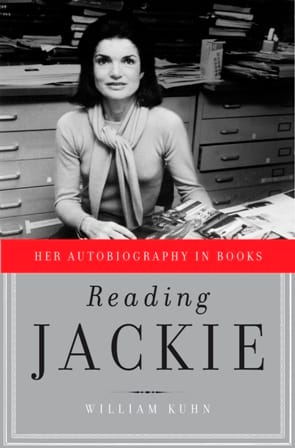
While Kuhn looked at Disraeli’s early novels to see whether they could be made to speak for Disraeli himself, in Reading Jackie: Her Autobiography in Books (2010), Kuhn explored how a collection of books could be made to yield information about the person who put them together. Kuhn asserts that Jackie didn’t simply edit books: she chose subjects and authors, encouraged certain writers and helped shape the texts as they were being written, making the works equally revealing about her as a person. Moreover, she was a voracious and eclectic reader. She read and edited works on historic building preservation, fairy tales, European royals and Tiffany, but also rock & roll music, sensual, drug-addicted ballerinas, Indian courtesans and witchcraft—hardly what one imagines after viewing the wispy-voiced fashion icon give that famous televised tour of the White House.
The success of Reading Jackie has meant that Kuhn can now focus on his writing full-time. “It’s been an incredible privilege to be able to come to the Boston Athenæum in the morning, go up to the fifth floor and sit down in one of those bays and start working.” Another great boon of Reading Jackie’s success has been Kuhn’s opportunity to branch out into the world of “American royals.” He is currently at work on the fifth floor exploring the social circles of Isabella Stewart Gardner, John Singer Sargent and Henry James.









![[Norma Farber, WGBH Radio Drama]. Photograph.](https://ml1bu7iavnet.i.optimole.com/w:auto/h:auto/q:mauto/f:best/https://bostonathenaeum.org/wp-content/uploads/2022/03/normafarber_wgbh_radio_drama_0.jpg)