
06.22.2023

Staff book suggestions for Summer 2023
Emily Cohen

I don’t know what kind of summer it’s going to be but I can tell you I am in my nostalgia era and I welcome you to join me down on Sesame Street!

Sunny Days: The Children’s Television Revolution That Changed America by David Kamp
(Library of Congress Classification PN1992.8.C46 K36 2020)

Kamp’s 2020 book tells the history of Sesame Street, as well as the other shows of the time: Mr. Roger’s Neighborhood, The Electric Company, Schoolhouse Rock!. I’ve always enjoyed Kamp’s dependable and entertaining style. Whether he is talking about sun-dried tomatoes in The United States of Arugula, or in Sunny Days speaking to Marlo Thomas about Free to be You and Me, Kamp is never lacking for sources.

Street Gang: The Complete History of Sesame Street by Michael Davis
(Library of Congress Classification PN1992.77.S43 D38 2008)

HBO (AKA “Max”) released a documentary in 2021, Street Gang: How We Got to Sesame Street, which like most great movies, starts with a book, Street Gang: The Complete History of Sesame Street by Michael Davis, published in 2008. It’s a beautiful creation story of what people can do and how impactful inclusivity can be for children and adults everywhere. I’m not just talking about in front of the camera when it comes to seeing people who look like you—which is extremely important—but also about the amount of time and effort provided by educators to create content that would engage children and then get feedback from the kids to see what worked and what didn’t.

While I recommend both these books, I would say the audio book of Street Gang is especially enjoyable because it is read by Caroll Spinney. Did you know that he modeled Oscar the Grouch’s voice after the NYC cab driver who took him to his audition? Okay, no more spoilers.

Now let’s all sing… “Who are the people in your neighborhood, the people that you meet each day.”

Will Evans

Tenant of Wildfell Hall by Anne Brontë
(Library of Congress Classification PZ3 .B79 Te)

Why is Anne relegated to a footnote in the Brontë story? While I have long appreciated the works of her sisters, especially Charlotte’s Villette, I had assumed that Anne’s work was inferior to that of her siblings, given the relatively meager attention she receives. My assumption proved groundless. Devoid of the Gothic window dressing of the older Brontës, Anne’s The Tenant of Wildfell Hall offers a frank, uncompromising, and emotionally charged portrait of marital abuse and the corrosive effects of alcoholism, themes that are sadly contemporary. In Anne’s telling, this story could be written today and still ring true, if the formal manner of discourse were removed (Not that I’m suggesting such a measure! Revisiting nineteenth literature offers a reminder of how richly expressive the English language can be). Come out from the shadow of your sisters, Anne!

Last Night at the Telegraph Club by Malinda Lo
(Library of Congress Young Adult PZ7 .L6 Las 2021)

I don’t often dwell in YA territory. Being many years removed from that demographic and a bit world weary, a genre that I perceived to be teeming with disaffected teens, dystopian societies, and death offers little appeal. How surprising then to find a YA novel of historical fiction with an emotionally resonant story. Malinda Lo’s Last Night at the Telegraph Club concerns Lily Hu, a Chinese-American teenager growing up in San Francisco’s Chinatown of the 1950’s. Lily’s life is complicated by her sense of obligation to adhere to the suffocating code of conduct dictated by her tradition-bound family and a desire to partake in the alluring world that lies beyond the boundaries of Chinatown. Lily’s increasing self-awareness about her sexual identity adds to her internal conflict. This is one of the best works of queer literature I have read. Lo perfectly captures the emotional stew of giddy anticipation, fear, guilt, and desire that accompanies coming to terms with being a gay teen.

Shay Glass

Moon Pops by Heena Baek
(Library of Congress Classification Children Picture Book + BAEK)

On a night so hot the moon melts from the sky, Granny Wolf catches the liquid melted moon, pops it in her fridge, and makes glowing moon-sicles for her neighbors. The story is loosely based on a Korean folktale and illustrated with striking photographs of lit three-dimensional collages. This quirky picture book is perfect for staying up past your bedtime on a magical summer night.

Rachel Jacobe

The Summer Book by Tove Jansson
(Library of Congress Classification PZ3.J27 Su 2008)

A short and sweet series of vignettes that are simultaneously heartwarming and heartbreaking. And, as the title implies, it’s perfect for summer!

Anna Kelly

Black Cake by Charmaine Wilkerson
(Library of Congress Classification PZ4.W6835 Bla 2022)

Black Cake is a story about family, love, and sacrifice that is told from the perspective of multiple characters spanning decades. When Benny and Byron’s mother dies, the estranged siblings are left with just an audio recording from their mother and a black cake. As the siblings listen to the recording, they realize how little they know about their mother, and just how many secrets their family, and they themselves, harbor. Wilkerson takes the reader on a journey around the world with complex, deep, and intriguing characters who must make tough choices to protect themselves and the ones they love.

Carolle Morini

A Few Collectors by Pierre Le-Tan; translated from the French by Michael Z. Wise
(Library of Congress N5200 .L48 2022)

I truly enjoyed this little book. A wonderful way to discover artists, collectors, and designers that I had not heard about and Pierre Le-Tan’s drawings are a true delight.

Zoe Palmer

Convenience Store Woman by Sayaka Murata
(Library of Congress PZ4 .M9739 Co 2018)

This is the story of Keiko, a woman who has worked in a convenience store for her entire adult life and is perfectly satisfied in what others see as a dead-end job. She is befuddled by her friends’ and family’s desire for her to be “normal.” Keiko’s frank narration delivers refreshingly sharp observations about conventional expectations and experiences outside of societal norms; this is a quick read that prompted me to consider my biases about the modern workforce and life’s trajectory.

Leah Rosovsky

Old Filth by Jane Gardam
(Library of Congress PZ4.G218 Ol 2006)

Jane Gardam is a novelist who deserves to be much better known in the US. Old Filth is the first novel of a trilogy where the same stories are explored from different perspectives. “Old Filth” is the nickname of a successful former judge returned to England from Hong Kong. The novel is highly readable and a terrific portrait of a fascinating character.

Revenge of the Librarians by Tom Gauld
(Library of Congress PN6737.G38 R48 2022)

This short book of cartoons is designed to appeal to all readers. You will laugh out loud as you peruse its pages.

Jessica Schweber

All Systems Red by Martha Wells (through Network Effect)
(Available on cloudLibrary)

Network Effect by Martha Wells
(Library of Congress PZ4 .W4595 Ne 2020)

SecUnit is meant to be a mindless security bot whose every action is controlled by its owner corporation, but after “accidentally” becoming self aware and disabling its control module, it decides to assert its independence mainly by streaming intergalactic soap operas during mission downtime. SecUnit must balance a desire to avoid any and all earnest social interactions while hiding its illegal autonomy, and making sure none of the hapless humans under its protection are harmed by planetary threats or sinister plots.

The Cloisters by Katy Hays
(Library of Congress PZ4.H282 Cl 2022)

Set in NYC in the steaming heat of summer, The Cloisters follows Ann Stilwell, a young, would-be curatorial assistant who has moved to the city from middle America expecting a new start at the Met. Disaster seems imminent when she discovers her position is no longer available, but she is swept up instead into the gothic Met Cloisters. If you are in the mood for August in NYC, and deadly museum intrigue, this is the summer read for you.

Kate Smails

Sharp Objects by Gillian Flynn
(Library of Congress Classification PZ4.F64875 Sh 2006)

I’m sure some folks are already familiar with this novel (or perhaps the fabulously done HBO miniseries based on it), but my summer reading rec is Sharp Objects by Gillian Flynn. Reporter and unreliable narrator Camille returns to her tiny Missouri hometown in the hopes of a much-needed success story, covering a series of mysterious murders that cut much closer to home than she originally realizes. The slow-burn gravity and depth of the unfolding plot are as tangible as the summer mugginess and heat that stifle the narrator almost as much as her hypochondriac mother and the weight of her own past. This book kept me hooked through the shocking (sometimes graphic) discoveries and mundane humid porch moments alike; it’s balanced right on the precipice of imagination. My jaw hit the floor upon reaching the final plot twist of this novel, a twist that still makes me shudder. Whether you’ve seen the miniseries or cannot wait until after you’ve read the novel to do so, add Sharp Objects to your summer reading list!

Mary Warnement

Kairos by Jenny Erpenbeck, (translated by Michael Hofmann)
(Library of Congress Classification IN PROCESSING)

I’ve been eagerly awaiting the translation of Erpenbeck’s latest novel, and it appeared June 6. The author was born in East Germany and described the changes that occurred after the collapse of the Berlin wall as emigrating without packing a bag: her country moved rather than her. This novel begins in the mid-1908s when a 19-year-old meets an established, married, middle-aged author. Their romance is set against all that comes next. I have only started the book but recommend it unreservedly.

A Chateau Under Siege by Martin Walker
(Library of Congress Classification IN PROCESSING)

My second recommendation is one for the end of summer, because it will not be published until August 29. If you have not met Bruno Chief of Police—and if you enjoy mysteries fueled by eccentric characters and descriptions of good food—then you will want to start this series. Not everyone shares my need to read a series in order, but I strongly suggest you do for this one. Good thing you’ve got plenty of time before this appears on our shelves. I promise, I’ll give members first dibs.
05.02.2023

Staff book suggestions for Spring 2023

Emily Cohen

Over My Dead Body: Unearthing the Hidden History of America’s Cemeteries by Greg Melville
(Library of Congress Classification GT3203 .M44 2022)

When I think of spring, I think of all the beautiful walks I have taken in the cemetery, Mount Auburn Cemetery in Cambridge to be exact. As someone who grew up in New York City, I avoided cemeteries, held my breath as I passed them and knew I didn’t want to end up in one.

The author does a lovely job explaining what makes Mount Auburn Cemetery a great place to visit and includes the history of several cemeteries around the country (and their European and Egyptian influences.) The histories are as different as each cemetery, but they all start from a place of necessity. Melville doesn’t shy away from the discrimination, segregation, or the influence of the “multibillion-dollar Death Industrial Complex,” but he also writes about these sacred places with respect and appreciation. This made for an enjoyable read… though I still plan on being cremated.

The Tao of Pooh by Benjamin Hoff, Narrated by Simon Vance
(Available on cloudLibrary)

I am not recommending this book to learn about Taoism. I just know that I listen to it whenever I want to stop overthinking, like a nostalgic meditation app. It is narrated by Simon Vance and when I say narrated, I mean he does all of the voices! Piglet, Eeyore, Rabbit, and of course Pooh. It’s as sweet as honey. I’ve been enjoying this one with special pleasure!

Will Evans

Confessions of a Bookseller by Shaun Bythell
(Library of Congress Classification Z330.6.W54 B98 2019)

Bythell, a used book dealer in a village on the west coast of Scotland, chronicles the peculiarities and frustrations of his trade. Less confessional than wry, the entries reveal his singular nature, equal parts grumpy resignation and hail-fellow-well-met affability. Among the more vexing issues he contends with are the mercenary practices of Amazon; the notoriously thrifty Scots (and American tourists!) that willfully remain ignorant of the concept of profit margins; an eccentric staff and faulty technology, both of whom determinedly act contrary to their boss’s wishes; and obliquely referenced but moving details of a disintegrating romantic relationship. The additional details of village life and descriptions of the countryside (Bythell is a fisherman, of course) further fueled my passion for all things Caledonian.

Table Two by Marjorie Wilenski
(Library of Congress Classification PZ3.W6482 Ta 2019)

It’s the summer of 1940. England is licking its wounds over Dunkirk, and the Battle for Britain rages in the sky. Into this theater of war steps Anne Shelley-Rice, a carefully brought up young woman in newly reduced circumstances, who moves to London to enter the workforce for the first time like thousands of other women. She finds translation work at a large ministry concerned with foreign intelligence, where she is stationed at table two (of the title) along with a dozen other women translators from all levels of society. One tablemate, Elsie Pearne, a clever and efficient woman of a certain age that’s universally despised for her acid tongue and imperious manner, unaccountably takes Anne under wing. As a romance with a recuperating member of the RAF begins to blossom for Anne, Elsie’s increasing demands upon their friendship start to chafe. Meanwhile, the Luftwaffe shifts its focus to the London Blitz, and the realities of war begin to literally hit home.

Published in 1942, Wilenski’s only novel convincingly captures the uncertainty of the times and the impact of the war on societal norms, an endlessly fascinating topic for me. Additionally, the subtext of Elsie’s obsession with Anne could easily have been heavy handed, given the intolerance of the times, but Wilenski purposefully renders Elsie a sympathetic character by including her backstory. This is one of the more remarkable works among the canon of mid-twentieth century British women writers.

Small Things Like These by Claire Keegan
(Library of Congress Classification PZ4.K2537 Sm 2021)

Set in an Irish village in the not-too-distant past during the weeks leading up to Christmas, this work would seemingly be more suitable as a winter recommendation. But great writing transcends seasons, and this novella lives up to all the praise heaped on it by the critics. It’s been some time since I felt this emotionally engaged with a character, but Keegan’s Bill Furlong demands your empathy. A solid, loving family man and fair business owner by all outward appearances, who inwardly lives a haunted, questioning existence. When faced with a situation that demands moral action, Furlong evokes a discomforting mixture of admiration and fear due to the certainty he’ll do the right thing despite the damning consequences. Keegan needs to write more!

Shay Glass

Snow Rabbit, Spring Rabbit: A Book of Changing Seasons by Il Sung Na
(Library of Congress Classification Children Picture Book + NA)

This is a sweet, simple picture book with minimal text that’s wonderful to read with very young children. When winter comes, Rabbit and all her friends react in different ways: some fly away from the cold, some grow thick woolly coats! But the seasons keep changing, and soon the snow melts and flowers bloom. The illustrations use different patterns and textures on top of line drawings to evoke snowflakes and flowers, and the rabbit is adorable, with rosy cheeks and teeny tiny whiskers.

Anna Kelly

A Madness of Sunshine by Nalini Singh
(Available on cloudLibrary)

The remote coastal town of Golden Cove is characterized by a rugged landscape and a tight knit community, both of which may be much more dangerous and unforgiving than anyone could have imagined. When a local young woman goes missing, the town police officer and an estranged local must sift through the secrets and lies that come to light to figure out what happened to her, along with the three women who disappeared years ago without a trace. Are these disappearances a mere coincidence, or is there something, or someone, much more sinister at play? A Madness of Sunshine is a slow-building and suspenseful tale of light and darkness, of loyalty and betrayal, of twists and turns. The alternating character viewpoints and flashbacks create a multi-layered story that pulls the reader in and is supplemented by an intricate description of the stunning yet unforgiving environment. If readers are patient enough to endure the slow initial chapters, they will be rewarded with answers to their questions and unimaginable reveals. I listened to the audiobook, available on cloudLibrary, and thought the narrator, Saskia Maarleveld, did a wonderful job with pacing and accent.

Carolle Morini

Portrait of an Unknown Lady by María Gainza; translated from the Spanish by Thomas Bunstead
(Library of Congress PZ4.G143 Po 2022)

Empty Wardrobes by Maria Judite de Carvalho; translated from Portuguese by Margaret Jull Costa; introduction by Kate Zambreno
(Library of Congress PZ4.C331 Em 2021)

Memories of the Future by Siri Hustvedt
(Library of Congress PZ4.H9759 Me 2019)

All three of these books will have you thinking about art, collecting, creating, and memory in different ways. Each book is clever, thoughtful, and insightful.

Elizabeth O’Meara

The Spinning Heart by Donal Ryan
(Library of Congress PZ4.R9876 Sp 2013)

Queen of Dirt Island by Donal Ryan
(Library of Congress PZ4.R9876 Qu 2023)

One of our members introduced me to the Irish writer Donal Ryan and I immediately tore through his books. I just love his prose and his characters. The writing is spare and elegant and I particularly love how he plays with structure in his books. Queen of Dirt Island is a story of four generations of women living together in Ireland and it’s impressive how each chapter is no longer than two pages but incredibly satisfying. I would recommend any of his six novels.

Zoe Palmer

Koshersoul: The Faith and Food Journey of an African American Jew by Michael W. Twitty
(Library of Congress TX724 .T85 2022)

This is an exploration of African-American and Jewish culture through the common essential touchstone of food. Twitty, a culinary historian, recounts different aspects of Jewish and African-American culture and identity and how they intersect with or differ from each other, providing opportunities for exchange and understanding. His anecdotes both resonated with me and illuminated some of my blind spots, and I’m eager to research more (perhaps through his first book, The Cooking Gene, also in the Athenæum’s collection). The book also includes delicious recipes like West African-inspired brisket, stuffed kashered crab, and peach kugel.

Leah Rosovsky

The Bangalore Detectives Club by Harini Nagendra
(Library of Congress PZ4.N146 Ba 2022)

The heroine of this mystery is a young, brilliant Indian woman who moves to Bangalore in the 1920s to marry. She solves two murders while building a real partnership with her new husband.

Books as History: The Importance of Books Beyond Their Texts by David Pearson
(Library of Congress Z4 .P43 2008)

John Buchtel recommended this wonderful exploration of books as historical objects. The lavish illustrations helped me understand Pearson’s (and John’s) fascination with every aspect of the creation and life of a book.

Jessica Schweber

Sweet Bean Paste by Durian Sukegawa (translation by Alison Watts)
(Available on cloudLibrary )

Who can resist the combination of cherry blossom season, Japanese sweets, and intergenerational friendships? A cook with a blemished past and unfulfilled dreams of becoming a writer befriends an elderly woman with her own troubled history. This charming novel explores the redemptive power of friendship and personal growth.

Oh William!: A Novel by Elizabeth Strout
(Library of Congress PZ4.S9186 Oh 2021)

I picked up this book because I’d noticed many of our members had done the same—it is one of our most checked out books of the past year, and I can understand why. The novel is delightfully narrated by the protagonist Lucy, who ostensibly wants to tell us about her inscrutable ex-husband’s recent spate of bad luck. The story simultaneously delves into her own past, and her family’s past and present relationships, examining the ways these relationships have grown or remained unchanged over time, for better or worse.

Mary Warnement

The White Lady by Jacqueline Winspear
(Library of Congress Classification PZ4.W7855 Wh 2023)

Perhaps like me you expected a new installment in the Maisie Dobbs series in March and was disappointed to see that for the first time in many years, Winspear did not add a title as usual. Nevertheless, I admire the author enough to trust her. At first, some similarities between some characters in The White Lady and Winspear’s Maisie Dobbs series gave me pause, but this story came into its own. Her thoughtful lead character—coping and calm and competent—is a relief to spend time with. This heroine’s origin story differs from Maisie’s in the structure of its telling. Here, Winspear goes back and forth in time; whereas in Maisie, she stuck to strictly chronological. I shouldn’t have been surprised to read her lead is based on a true woman. The White Lady probably influenced Maisie more than the other way ’round.

03.09.2023

Staff Book Suggestions Winter 2023

John Buchtel

Meetings with Remarkable Manuscripts by Christopher De Hamel
(Library of Congress Classification Z106.5.E85 D44 2016)

Have you ever wondered what it’s like to go to Trinity College, Dublin, and ask to turn the pages of the Book of Kells in person? Christopher De Hamel, one of the world’s leading experts on medieval manuscripts, is one of a handful of people who has ever had that opportunity. With wit and insight he tells the story of that remarkable book, and of 11 more of the most famous illuminated manuscripts in the world. His personable, engaging prose sparkles like the burnished gold leaf that illuminates these books’ painted pages. Along the way, he makes new discoveries that could only be made by an actual physical examination of such manuscripts as the Codex Amiatinus—the earliest surviving complete one-volume Latin Bible, and the Hours of Jeanne de Navarre—one of the most spectacular illuminated manuscripts ever produced. Every book I’ve ever read by De Hamel has been wonderful; I’ve been enjoying this one with special pleasure!

Will Evans

Shy by Mary Rodgers
(Library of Congress CT275 .R6283 Sh 2022)

Shy tells the story of Mary Rodgers, the oldest daughter of composer Richard Rodgers (of Broadway titans Rodgers and Hammerstein fame) and his wife Dorothy. Spoiler alert: Richard and Dorothy were not good parents, or even nice people. They had little confidence in their daughter’s abilities, and they freely dispensed their low opinion of her. But Shy is more than an autobiographical vendetta in the Mommie Dearest mold. In a brutally candid, conversational tone (much of the book was dictated), Rodgers keeps the focus on her journey. In doing so she offers an absorbing description of the East Coast creative class of the period, among whom she doggedly pursues a career as a Broadway composer, notwithstanding the long shadow cast by “Daddy”. She achieves modest success in that field (notable her Once Upon a Mattress, a star-making vehicle for a young Carol Burnett) and would go on to have encore careers in children’s literature and philanthropy. Rodgers dishes plenty of dirt along the way (Was Arthur Laurent the most hated man on Broadway? Also, after having suffered an abusive marriage to a closeted gay man, Rodgers seriously contemplated a romantic relationship with BFF and Hammerstein protégé Stephen Sondheim, an idea endorsed by Sondheim’s therapist!). I enjoy a good dish as much as anybody, but the social history documented here is equally intriguing. Rodgers’s life seemly jumps from one social injustice or cultural hot-button issue to another: antisemitism, alcoholism, women in the workplace, women working in a male dominated field, working mothers, soft parenting, domestic abuse, homosexuality, prescription drug abuse, mental illness, the mainstreaming of therapy. Rodgers suffered, experienced, or bumped up against it all, yet she endured, and her triumph makes for an engaging read.

The Old Boys by William Trevor
(Library of Congress PZ4 .T8163 Ol)

In English public-school parlance (which is in fact private school) an “old boy” is any alumni of the school, be they 17 or 70. The old boys referenced in William Trevor’s title fall into to the latter age bracket, a group of septuagenarians that form some sort of governing board for their alma mater. An election for a new leader approaches, an occasion for some to seek vengeance for wrongs suffered decades ago. Trevor offers a fun cast of characters that include the entitled blowhard and his long-suffering wife, the quiet, embittered outsider, a pair of eccentrics that answer want ads out of boredom, all of whom seek refuge in their old boy identity with a tenacity that suggests they just walked off the cricket field and are heading to maths. They also all share a fear of death, some in a more self-aware fashion than others. Another remarkable (and enjoyable) feature of this book is the language Trevor put in the mouths of the old boys. The characters speak the Queen’s English with laser-like precision, expressing themselves in complete sentences that leave little room for ambiguity. It’s as though they inhabit a Trollope novel of the 1860s instead of 1960s London. While these absurdly exacting exchanges might signify the class and age of the old boys, their comic fastidiousness suggests that Trevor mocks those that cling to the past out of distaste for the present and fear of the future.

Your Table is Ready: Tales of a New York City Maitre D’ by Michael Cecchi-Azzolina
(Available as an audiobook on cloudLibrary)

Equal parts Goodfellas, Kitchen Confidential, and a social history, Cecchi-Azzolina’s autobiography chronicles his journey from a young punk on-the-make in his crime infested Brooklyn neighborhood to his career as a maitre d’hotel at some of the finest restaurants in Manhattan (or the world), namely the River Cafe and James Beard recipient, Le Coucou. Cecchi-Azzolina has a good story to tell. With dreams of stardom he crosses the East River in his early twenties, but like many a would-be actor, he resignedly waits tables until his big break materializes. Nevertheless, he quickly realizes his street-smarts will serve him well in the restaurant industry, and he begins to bluff his way up the food chain. In the course of his narrative, he outlines the fascinating dynamics of front-of-the-house operations. He also name-drops a lot, reciting a catalog of A-listers from the entertainment, sports, finance, and society pages. New York City also has a starring role in this story. The years of urban decay that plagued the city in the 1970s serve as a fitting backdrop or nurturing environment for Cecchi-Azzolina’s debauched lifestyle of that period. The sudden advent of the ‘80s financial boom ushered in the era of the pinstriped Wall Street heavyweights, financial kingpins who handed out c-notes like they were business cards. Accordingly, Cecchi-Azzolina’s own fortunes and morals rise, achieving the exalted post of maitre d’hotel at the aforementioned world-class restaurants. Cecchi-Azzolina’s also relates with genuine feeling the onslaught and subsequent devastation of the AIDS epidemic that decimated the New York restaurant and theater worlds he inhabited.


I would not have likely picked up this book myself. It was forced upon me by my book group, chosen mainly on the merit that it was under 300 pages (One of their steadfast rules!). After initial resistance largely born out of confusion (I’m not sure why, but I imagined we were to be regaled with anecdotes of a cosmopolitan, Upper East Side eatery), I gradually became disarmed and abandoned my snobbery to enjoy the earthy narrative. Also, uncharacteristically for a book group selection, I listened to the audiobook, and in doing so I unwittingly became captivated to a degree that I’m sure I would not have achieved by reading the book. Cecchi-Azzolina reads with the measured cadence of a trained actor, but his Brooklynese adds a note of endearing humility to his tale that would have come across as bravado on the printed page.

Carolle Morini

The Hero of This Book: A Novel by Elizabeth McCracken
(Library of Congress PZ4.M13186 He 2022)

Wonderfully written—witty and introspective.

When We Cease to Understand the World by Benjamin Labatut; translated from the Spanish by Adrian Nathan West
(Library of Congress PZ4.L137 Wh 2020)

Excellent work. It will haunt you well after you finish.

Leah Rosovsky

Snow Country by Yasunari Kawabata
(Library of Congress Classification PZ3 .K1775 Sn)

This short book, by a Nobel Prize winning Japanese author, takes place at a hot spring in a rural town popular for hiking and skiing. It tells the story of a doomed love affair between a wealthy Tokyo intellectual and a geisha. The book combines mesmerizing descriptions, particularly of the natural world, with characters sketched in quick brushstrokes.

Fortune Favors the Dead by Stephen Spotswood
(Library of Congress Classification PZ4 .S765 Fo 2020)

I loved this mystery, the first of a new series. The main characters are female versions of Nero Wolfe and Archie Goodwin written with much flair and wit. There is a great plot and lots of stylish dialogue. I can’t wait to get my hands on the next two novels!

Jessica Schweber

Kindred by Octavia Butler
(Library of Congress Classification PZ4 .B98666 Ki 2003)

Watching a commercial for a new television show based on this book inspired me to read Octavia Butler’s novel Kindred. The time-traveling narrative highlights slavery as a nexus event, the effects of which ripple through American history and continue to impact the present. An exciting, thought-provoking, and emotional read as relevant now as it was in 1979 when it was first published.

Norse Mythology by Neil Gaiman
(Library of Congress Classification PZ4 .G1414 No 2017)

I bought this book as a holiday gift for my sibling and couldn’t resist reading before gifting it. The winter weather is a good match for Norse mythology and Gaiman’s prose revives these ancient tales while keeping the original feel of the stories.

After reading this, I now feel an urge to compare to Gaiman’s source materials which, happily, are also available at BA!

The Prose Edda by Snorri Sturluson, translated from the Icelandic
(Cutter Classification VCYL .Ed21 .E .b)

The Elder or Poetic Edda by Edda Sæmundar
(Cutter VCY .8V69)

Mary Warnement

The Posthumous Papers of the Manuscripts Club by Christopher De Hamel
(Library of Congress Classification ND2900 .D44 2022)

I enjoyed his first thick book Meeting Remarkable Manuscripts, about his studying iconic medieval illuminated books, and I’m looking forward to settling in on the love seat with his follow-up about the collectors of those books over the centuries. This seems like it would pair well with a reread of Umberto Eco’s The Name of the Rose, or maybe Josephine Tey’s Daughter of Time.

11.14.2022

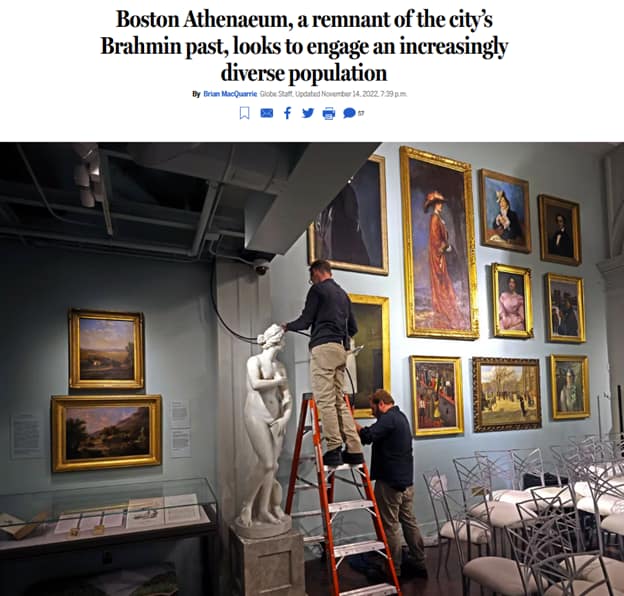
Boston Athenaeum, a remnant of the city’s Brahmin past, looks to engage an increasingly diverse population

Published in The Boston Globe, November 14, 2022

Boston Athenaeum, a remnant of the city’s Brahmin past, looks to engage an increasingly diverse population

By Brian MacQuarrie Globe Staff, Updated November 14, 2022, 7:39 pm

Excerpt: Sitting catty-corner from the State House, the landmark Boston Athenaeum can resemble a grand survivor of a bygone era, a remnant of the Brahmin past amid the shiny high-rises and sweeping demographic changes that mark the 21st-century city.

Busts of stolid, studied men cast an inanimate gaze upon members of the private library as they read in absolute silence. Row upon row of books from a 500,000-volume circulating collection — as well as 100,000 rare books, maps, and manuscripts, and 100,000 works of art — offer a vast well of options for research and reflection.

But behind the walls of this 215-year-old institution, something else is afoot, and it’s not limited to the Athenaeum’s renovation and expansion into an adjacent building. The venerable institution is looking to broaden its programming, engage more of the city’s increasingly diverse population, and even be more transparent about its own history.

Read the full article in The Boston Globe.

11.01.2022

Boston Athenaeum Set to Complete Revitalization of its Landmark Building in the Heart of Boston

Red doors, entrance to the Boston Athenaeum

Adding new space creates significant opportunities for enhanced programming and future growth

The Boston Athenaeum is entering a new chapter.

After 16 months of construction to revitalize and expand its 1849 landmark building in the heart of Boston, the Athenaeum will re-open its iconic red doors to members and visitors on November 15.

The transformational changes not only enhance the classic beauty of the building but also add space for more programs and events, more varied art, more places for reading and research, more opportunities for connection, and, soon, a brand-new street level cafe.

“This is a tremendously exciting time for the Athenaeum,” said Timothy Diggins, president of the Boston Athenaeum.  “Our renovation and expansion preserve all of the best of the traditional Athenaeum experience, but open up spaces for listening to music, enjoying our huge art collection, reading, attending lectures, meeting with friends, or having a bite to eat. We invite everyone to come in and see how much we have to offer to the cultural and intellectual life of the city and New England.”

The Boston Athenaeum is a unique combination of library, museum, and cultural center. It is one of the country’s oldest and most distinguished independent libraries, with a circulating collection of over half a million books, from works published in the 1800s to the latest best sellers. Special collections include active research holdings of 100,000 rare books, maps and manuscripts, and 100,000 works of art, from paintings and sculpture to prints and photographs.

In addition to access to the library’s five galleried floors, members enjoy a year-round schedule of cultural programming, including author talks, gallery exhibitions, concerts, speakers, book clubs, and social gatherings.

“We are a member-supported organization that anyone can join,” said Leah Rosovsky, the Athenaeum’s Director.  “We welcome readers, writers, academics, researchers, historians and artists from all walks of life, united in their curiosity about literature, culture, art, ideas and the world. While the Athenaeum is steeped in strong traditions, our focus on sparking important conversations and the continuous acquisition of knowledge keep us firmly attuned to changing times.”

As the Athenaeum upgraded its landmark building, it also re-envisioned how its collection is presented and interpreted to reflect a more expansive view of American art and history. “We want to give our members and visitors deeper engagement with a wider range of work from our collection,” said John Buchtel, Curator of Rare Books and Head of Special Collections.  “That means bringing forth a diverse selection of artwork in a wider range of media, including more work by and of women and people of color, and looking at the works in our collections with fresh eyes.”

In 2021, the Athenaeum was awarded a grant from the Terra Foundation for American Art to support the reinstallation of artwork in the Henry Long room on the first floor.  “Re-Reading Special Collections” will be on view when the Athenaeum re-opens on November 15.

Also, on view for the first time at the Athenaeum’s re-opening:

  • A newly commissioned mural by Ekua Holmes, a lifelong resident of Boston’s Roxbury neighborhood, visual artist and Caldecott Award winning children’s book illustrator, will be installed in the Children’s Library.   Her new collage will depict children of diverse backgrounds and create a welcoming dynamic and inclusive space for the Athenaeum’s youngest readers.
  • The opening exhibition in the newly located Norma Jean Calderwood Gallery will be Materialia Lumina/Luminous Books, which showcases a selection of outstanding contemporary artists’ books created by some of the world’s most accomplished makers over the past twenty-five years. The Athenaeum is one of three venues for this international exhibition, along with Stanford University Libraries and the Klingspor Museum in Offenbach, Germany.
  • The Athenaeum recently acquired a rare painting by the acclaimed nineteenth-century artist Robert S. Duncanson. Born in upstate New York in 1821 to free Black parents, Duncanson was a leading American landscape painter, regardless of race, in the years before and after the American Civil War.

In addition to renovations and enhancements at its long-time home at 10½ Beacon St., the Athenaeum also increased its footprint by approximately 12,000 square feet by expanding into an adjacent building at 14 Beacon St.  The architect for the revitalization project is Annum Architects, formerly Ann Beha Architects, a national leader in preservation, adaptive reuse and contemporary design for historic settings.  Ann Beha FAIA is the Design Principal.

“Architecture has always played a starring role at the Boston Athenaeum, a place as unique, inspiring and relevant today as it was a century ago,” said Beha. “We first immersed ourselves in the Athenaeum’s history and its evolution over many years. We wanted our design to celebrate that architectural journey and move it forward. This new chapter renews historic resources, adds welcoming spaces, integrates technology, and confirms that the Athenaeum is a place for everyone.

Planning for the renovation and expansion, the Athenaeum solicited its members’ voices, asking what improvements they most desired. As a result, the Athenaeum will have:

  • A new Children’s Library, reimagined to inspire the youngest readers, under six, and moved to provide better access for families.
  • A new Norma Jean Calderwood Gallery that’s more open, more inviting, better lit, and more conducive to experiencing the varied exhibitions and art from the collections.
  • A 40-seat street level café – the Athenaeum’s first — for members and visitors, to enliven the connection to the community. With an opening planned for winter 2023, the café will be operated by The Catered Affair, the Athenaeum’s exclusive event caterer.
  • The new Leventhal Room, a showcase space extending the Athenaeums first floor, with sweeping views over the Granary Burying Ground and comfortable places to read and talk.
  • A new Study Center to offer members, researchers, school field trips and special docent tours better engagement with the Athenaeum’s collections.
  • New “Living Rooms” on the fourth floor, inviting spaces for members, with unbeatable views of the Boston skyline.
  • A renovated lobby that is lighter, brighter and more welcoming.
  • More nooks and alcoves for reading, writing or quiet reflection.
  • Integrated technology throughout; web, Zoom, and IT connectivity and resources.

The Athenaeum will celebrate with a series of events including a special reception for members in January, 2023 and an open house for the entire community in April, 2023.

For a full calendar of events, to register for a tour or purchase a day pass, or to become a member, please visit:   bostonathenaeum.org

———————————-

Founded in 1807, the Boston Athenaeum is a unique combination of library, museum and cultural center. The Athenaeum’s present home at 10 ½ Beacon St., designed by Edward Clarke Cabot, opened in 1849 and was named a National Historic Landmark in 1965. One of the country’s oldest and most distinguished independent libraries, the Athenaeum’s circulating collection includes over half a million books, from works published in the 1800s to the latest best sellers. Special collections include active research holdings of 100,000 rare books, maps and manuscripts, and 100,000 works of art, from paintings and sculpture to prints and photographs. Members, visitors and the community enjoy a year- round calendar of cultural programs – – book talks, exhibitions, concerts, speakers, social gatherings and other opportunities for connection. The Athenaeum is a member-supported not-for-profit institution that everyone is invited to join.   Bostonathenaeum.org

Contact:  Alex Boonstra
aboonstra@denterlein.com

10.11.2022

Liber Chronicarum, Nuremberg, 1493

Hartmann Schedel, Nuremberg 1440 – ? 1514, Liber chronicarum Nuremberg, Anton Koberger, 1493.
47 x 33 cm. Pigskin binding, stamping, corner bosses, repaired clasps, rebacked. Some marginalia Inscribed on title page, in at least two different hands: “1589. ”Athenæum purchase, Bromfield Fund, 1847.

The Liber chronicarum, also known as the Nuremberg Chronicle, is one of most celebrated books to be issued during the early years of printing, mainly because of its 1,809 glorious images. Hartmann Schedel (1440-1514), a doctor and scholar in Nuremberg, wrote this history, beginning at the Book of Genesis and continuing through biblical and Roman history to his contemporary history of Nuremberg, leaving blank pages for the reader to fill in before ending his text with the Apocalypse. Though he considered himself a humanist and used many Latin classical sources, Schedel followed the medieval tradition of copying from various sources, many of which we can trace because much of his library remained intact and is in the Bayerische Staatsbibliothek in Munich.

An amazing amount of information is known about the making of the Nuremberg Chroniclebecause contracts and exemplars survive. The main contract was dated December 29, 1491; the work began, however, with agreements made during 1487and1488. Two merchants, Sebald Schreyer (1446-1520) and Sebastian Kammermaister (1446-1503), subsidized the undertaking and contracted the two artists Michael Wolgemut (1434-1519) and Wilhelm Pleydenwurff (d. 1494) to split the proceeds. Albrecht Dürer (1471-1528) was apprenticed to Wolgemut and was also involved in this massive project. Exemplars were the manuscript layouts with sketches to show the arrangement of texts and images to the printer, Anton Koberger (c. 1440-1513). There were two exemplars for the Nuremberg Chronicle, one for the Latin version written by Schedel and another for the German translation by George Alt (c. 1450-1510). The Latin edition was finished on July 12, 1493, and the German on December 23, 1493. There are 800 extant copies of the Latin edition and 408 of the German. It has been estimated that a bound and colored copy cost six guilders.[1]

In 1847 the cornerstone was laid with ceremony for the new building at 10½ Beacon Street, and in that year the Boston Athenæum purchased its Liber chronicarumin Latin with proceeds from the Bromfield Fund, established as an endowed book fund just the previous year. Its binding is pigskin. The design consists of figures in stamped, rectangular boxes and differs on the front and back. At some point it was re-backed, indicating that the material covering the spine was replaced, and there are corner bosses and two metal clasps with leather hinges (repaired). So much paper was needed that Koberger had to use many sources, all of which contained different watermarks. Interestingly, however, he did not use any paper from Nuremberg’s paper mills.[2]There are some hand-lettered initials, and the woodcut illustrations have been colored. Not all copies are colored, however: some were done by the printer, some later by the bookseller or at the purchaser’s behest. The Athenæum’s copy was colored by hand before binding, because there is no sign of color transferred to the opposite page.[3] However, it is clear that the Library’s copy was rebound, because the pages were cut at some point, as evidenced by the abrupt ending of marginalia on many pages. Previous ownership of this copy is unknown. There is no coat of arms stamped on the cover or any of the pages. There is a handwritten note, dated 1589, on the index title page; however, if anyone is named, it is not decipherable.

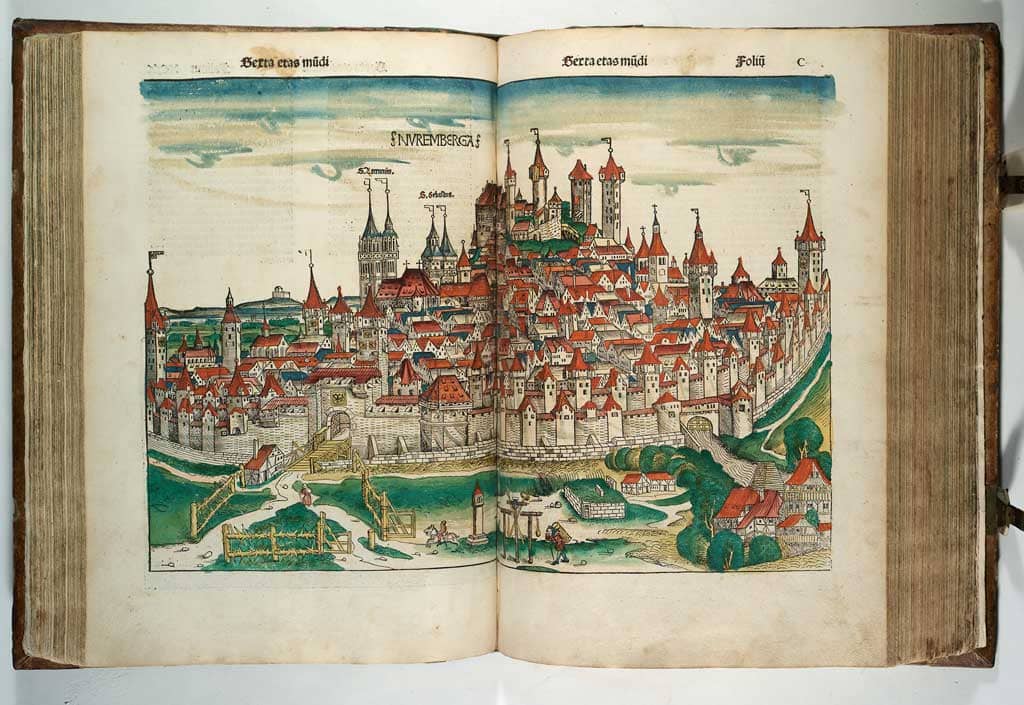
The depiction of Nuremberg is the only two-page, text-free spread of a town in the Nuremberg Chronicle, which features over 100 town images from only 53 woodcuts. Clearly, not all were accurately portrayed, but Nuremberg’s importance as an imperial city, with a vibrant merchant and intellectual class, was realistically shown, from the labeled spires of the churches of St. Sebald and St. Laurence to the many other architectural features such as the castle, towers, city gate, and bridge, as well as the paper mill in the bottom right corner.[4]

Image 1: Hartmann Schedel, Nuremberg 1440 – ? 1514, Liber chronicarum Nuremberg, Anton Koberger, 1493.
47 x 33 cm. Pigskin binding, stamping, corner bosses, repaired clasps, rebacked. Some marginalia Inscribed on title page, in at least two different hands: “1589. ”Athenæum purchase, Bromfield Fund, 1847.

Mary E. Warnement, from, Stanley Ellis Cushing and David B. Dearinger, eds., Acquired Tastes: 200 Years of Collecting for the Boston Athenæum (2006): 70-72. Copyright © The Boston Athenæum.

[1] Adrian Wilson, The Making of the Nuremberg Chronicle (Amsterdam: Nico Israel, 1976), 42, 46, 60-61, 199, 237, 238.
[2] Ibid., 188.
[3] Susan Dackerman, Painted Prints: The Revelation of Color in Northern Renaissance & Baroque Engravings, Etchings, & Woodcuts (University Park, Pennsylvania: Pennsylvania State University Press, 2002), 104.
[4] Stephan Füssel, ed., Chronicle of the World: The Complete and Annotated Nuremberg Chronicle of 1493(Cologne: Taschen, 2001), 649.

10.11.2022

The Bloody Massacre

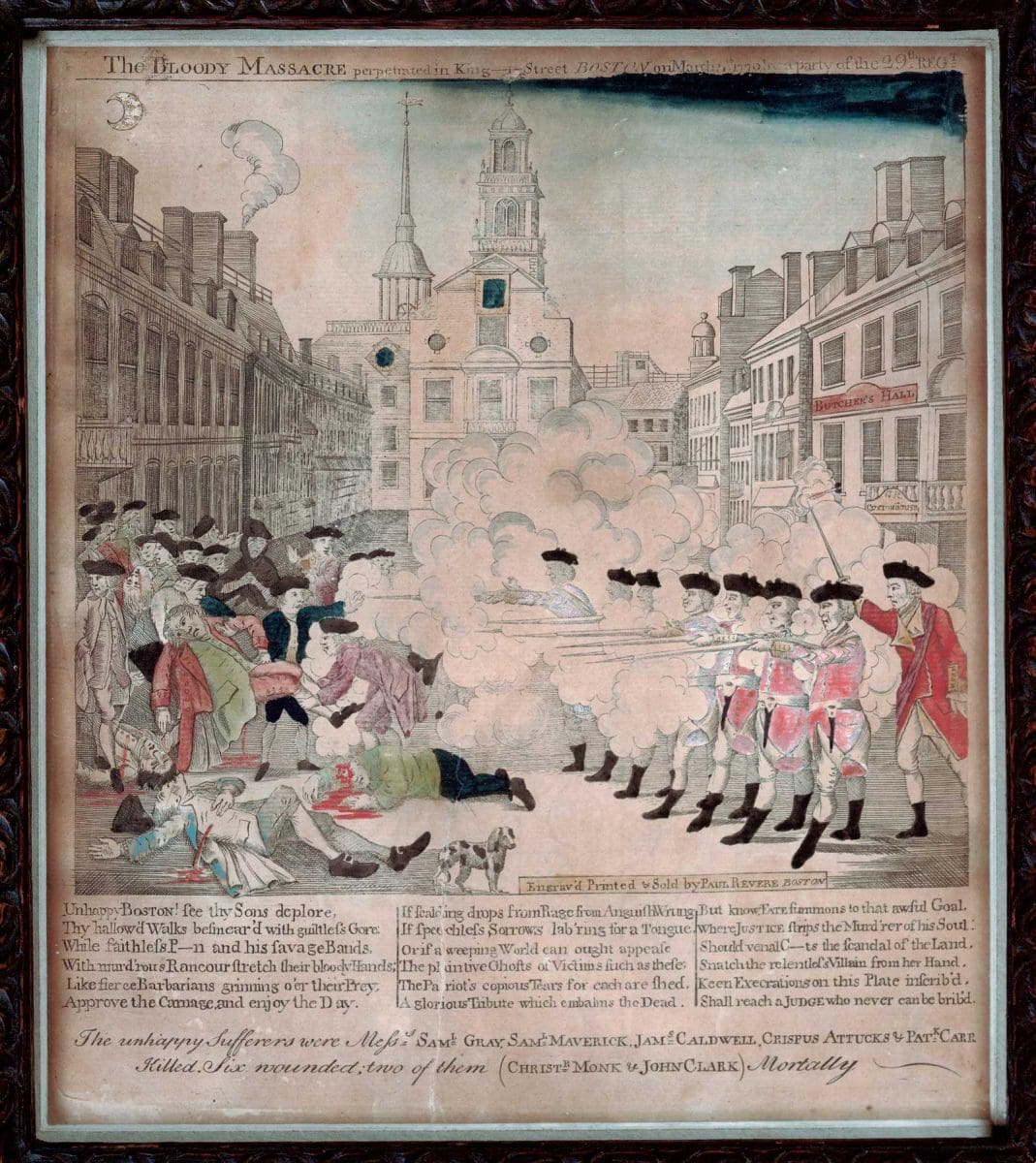
Paul Revere’s famous engraving The Bloody Massacre, more frequently referred to as the Boston Massacre, is a work that sheds much light on how Revere combined his entrepreneurial skills with his patriotic fervor.  He was a businessman, a family man with many children, and a patriot. He was also an engraver; but he was not one who created original works. Instead, he engraved works whose genesis came from the ideas of others. His Bloody Massacre, while clearly one of his best-known prints, had its beginning in the mind of Henry Pelham (1749-1806), an artist, engraver, and half-brother of the painter John Singleton Copley (1738-1815).

It appears that Pelham engraved his own version of the Massacre and lent Revere some version of it, from which Revere made his engraving, adding at the top his title and at the bottom a heroic couplet and the names of those killed or who were expected to die. He advertised the sale of the prints on March 26, 1770, three weeks after the Massacre and a week before Henry Pelham began selling copies of his own version. On March 29 Pelham wrote to Revere accusing him of acting dishonorably and taking credit for work Pelham himself had done. We do not know if Pelham ever sent the letter, but it is clear that he felt Revere had taken an unpublished work and, without permission, made the engraving and sold copies under his own name. Pelham advertised the sale of his engraving, The Fruits of Arbitrary Power, or the Bloody Massacre, on April 2, 1770, one week after Revere had advertised his.

As a piece of propaganda, The Bloody Massacre was designed to elevate a tragic incident into a politically motivated calamity and agitate the colonists’ negative view of the British occupation of Boston. Colonists had already been subjected to various taxation laws passed by the British Parliament to cover the costs of the French and Indian War and to help defray the costs of the ongoing security that the British continued to provide for the colonies. The Boston citizenry had been an irritant to the British Government and as the radical element became more vocal, Britain sent troops to occupy Boston in 1768. Tensions mounted quickly, and confrontations between the citizens and the soldiers increased dramatically over the next several years. The eventual result, in 1770, was the Boston Massacre.

Both Revere and Pelham portray an unarmed group of slightly more than twenty citizens who are fired upon at close range by seven British soldiers under the command of Captain Thomas Preston, who is shown ordering his men to fire their weapons. The soldiers are lined up in front of the Customs House and are depicted shooting directly into a crowd of citizens. In his version, Revere added the name “Butcher’s Hall” to the front of the Customs House to make clear his own opinion of the event.

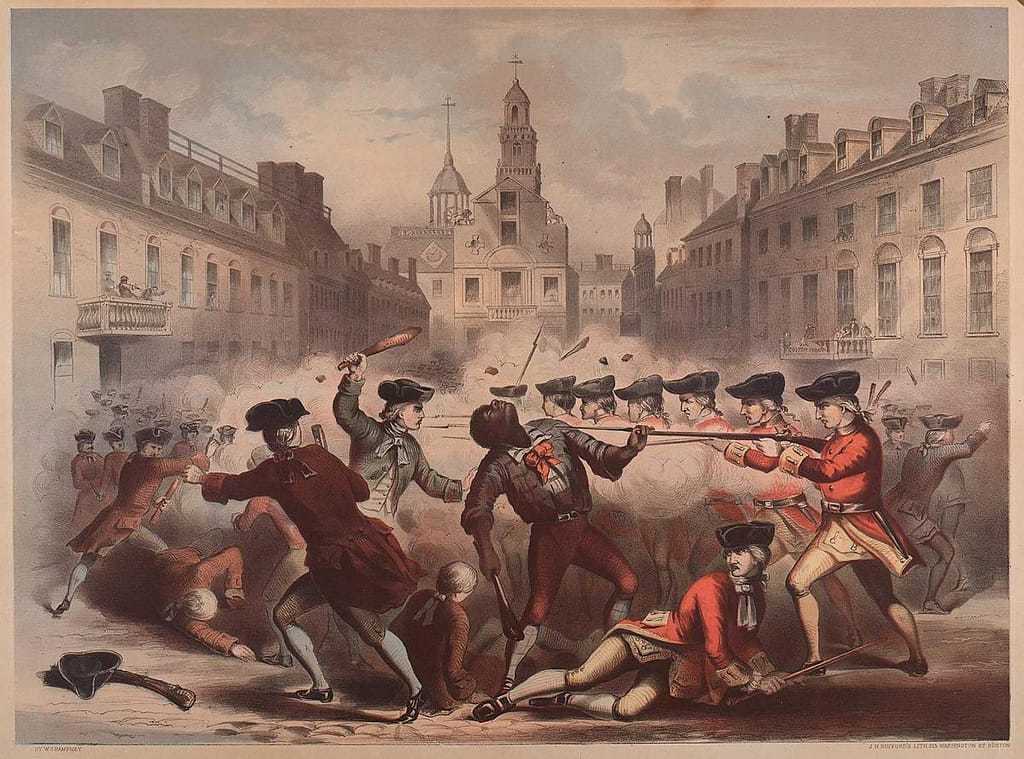
Although one of the first people killed in the Massacre was Crispus Attucks, who was of African and Native American descent, no one who fits that description appears in any contemporary print of the incident. The earliest known depiction of Crispus Attucks as a person of color participating in the Boston Massacre is in an 1855 drawing by William L. Champney (fl. 1850-1857), which J. H. Bufford made into the chromolithograph Boston Massacre, March 5th 1770. 

First Image: Paul Revere. Boston, Massachusetts 1735-1818 Boston, Massachusetts. The Bloody Massacre perpetrated in King Street Boston on March 5th 1770, by a party of the 29thRegt., 1770. Hand-colored engraving, 10 ½ x 9 1/8 in. Gift of Mr. and Mrs. Robert Saltonstall, 1972.

Second Image: William L. Champney. (fl. 1850-1857). Boston MassacreMarch 5th, 1770. Boston, Published by Henry Q. Smith, 1856. Chromolithograph, 17 ¾ x 24 in.

Tom Gearty from, Stanley Ellis Cushing and David B. Dearinger, eds., Acquired Tastes: 200 Years of Collecting for the Boston Athenæum(2006): 296-298. Copyright © The Boston Athenæum.

10.04.2022

Barb Brouillette

Barb Brouillette, photo courtesy of Barb Brouillette.

October 2022

Interview by Kayla Smith

Born and raised on the Jersey Shore, Barb Brouillette graduated cum laude from Columbia International University, with a Bachelor of Science in Logic and Philosophy. For nearly 20 years now she has been a Boston area resident working in the insurance industry by day, pursuing various personal passions by night.

Brouillette has lovingly nurtured the tenet that it’s never too late to explore one’s curiosities, wasting no time in putting them into action. A lifelong learner, seasoned cellist, solo traveler, and designer of themed European experiences, she has recently welcomed feature screenwriting into her world.

Mainly self-educated through books, scripts, movies, and podcasts, Brouillette completed her first screenplay in 18 months, before submitting to various competitions for judge scores and critique notes. She is now in the feedback rewrite stage.

On a cloudy afternoon, tucked away in one of the many private spaces in the Boston Athenæum, we were lucky enough to be able to speak with a member who recently wrote her very first screenplay. As it is with a great number of those who now call the Athenæum a home away from home, Brouillette hadn’t heard of the library until walking by one day with a friend who pointed it out to her. Before the week was over, Barb had joined the ranks of a select group of Bostonians who are brought together not only by the awe-inspiring architecture and design of the building, but also by their deep love and appreciation for reading, learning, and sharing knowledge with others.

Brouillette spent countless hours writing, revising, and rewriting her screenplay within our institution, considering spots like the silent fifth floor and the Art Department to be sacred spaces. When asked to discuss her favorite locations in the library, Brouillette (like many members before her) gave away a few special locations, but kept the most important and well-loved to herself.

“It’s never too late to try something new…”

BARB BROUILLETTE: I started dreaming up some of these ideas long before COVID, but I figured I’d take the opportunity during the quarantine period, which provided a lot of good solitary time to put the project in motion.

A screenplay is meant to be a map…a blueprint. It’s not really meant to be overly flowering narrative, it’s meant to be very succinct in action descriptions, and as much as I love this format it’s not without strict industry guidelines. It has to be a certain number of pages, for each genre, a certain font, a specific format. Even when you can’t be too narrative in your action description, you can still be creative and selective in your word choice and order, so that you’re making suggestions to the camera. You can’t really make camera or lighting suggestions, editing ideas, or music choices in there—that’s for the professionals and they know what they’re doing. I’m just here to tell a story. You can be creative with how you suggest things so that the camera might have a certain focal point.

A screenwriter’s main goal is a tricky one: to give the audience the same vision that you have. The tricky thing is that a script is ultimately meant to be seen and not read, which causes you to approach it differently.

Q: Can you take us through your writing process for this project?

BB: I have never done anything formal before, never done any kind of writing project. This was my first ever. I haven’t taken any classes on it. I’m fully self-educated through books and scripts. It took about 18 months, but it took two things: learning how to write a screenplay, and then after that, actually writing the screenplay.

Maybe the next story I do will be different, but this one is a crime thriller that takes place in Oxford. The main character is a musician whose instrument is being hunted down. She isn’t sure why until the end of the story.

At first I wanted to do this project only for myself, known only to me. The more I got involved, and the more I got attached to my characters, the more interested I was to receive feedback on my script. So, I entered competitions in an attempt to see an unbiased opinion on my work. I just wanted to get judge scores and critique back, wanted to manage my expectations and see where I was.

[When we spoke to Brouillette, she had just gotten her manuscript back from a few different competitions, and with it, feedback.]

“…if we only do what is comfortable, what is life?”

A theme of the script is that living to meet others’ expectations is not living. We have to be our authentic selves, instead of what others want to pressure us into being.

The rewrite process was difficult—there are so many different ways to go about doing a rewrite, and for this project it was better for me to go back and focus on one thing at a time (characterization, storytelling, etc) rather than rushing to put it all together at once.

Q: Why start writing now?

BB: I started the cello at 29 years old…I knew I wasn’t going to be a concert soloist, but I wanted to see how far I could go with it. Doesn’t have to be a big, thriving career, but I’ve played with different orchestras and thoroughly enjoy my time.

This screenplay has been so much work, but I have been having the best time! It’s like putting a puzzle together. I love problem solving.

Q: What are some favorite scripts you’ve read?

BB: Alien, Sideways, and Chinatown are strong examples of what a screenplay should be. They’re well paced, everything has a purpose in the script, they have an even read (the page has a lot of white), succinct action sequences, and there are lovable/relatable characters for the audience to get to know and share some commonalities with.

Q: What are you reading now?

BB: I’m reading Directed By James Burrows—if you’re a fan of Cheers, Friends, Will & Grace, you’re gonna have seen that name hundreds of times. I’ve always had a creative crush on James Burrows…not only is he a genius with what he does and knows how to get the most out of his actors, he is also a very welcoming presence. He is an approachable person who wants to foster a collective effort, which seems an admirable quality for directors.

After writing the screenplay, I feel as though I am a much different viewer of movies and television. I feel as though I’m paying a lot more attention to the credits. I think I just take for granted so much that when we look at a final work, it looks like it just came together so naturally, when really there was so much involved! Big choices, little choices, everything that comes together just makes the end result look effortless. All those little details make a scene impactful (or not).

08.25.2022

Staff Book Suggestions Autumn 2022

Dan Axmacher

(Library of Congress Classification PZ3.C13956 Co)

I recently finished Italo Calvino’s Cosmicomics, a delightful little collection of short stories that play out across millennia. The immortal narrator Qfwfq recounts a series of situations and stories from his various lives and incarnations, exploring human relationships and foibles on a cosmic scale. This one was a real treat. Available as an audiobook on cloudLibrary.

(Library of Congress SH383.2 .D65 2007)

Next, I’m plummeting back down to Earth and into the sea: I’ve just started Leviathan, Eric Jay Dolin’s historical account of the American whaling industry. I’m only a few chapters in, but so far it’s been interesting to see how the growth of the whaling industry was so closely intertwined with the growth of the United States from its earliest days. It doesn’t hurt that the subject matter pairs perfectly with some of these gloomy New England autumn days. Available on cloudLibrary as both an audiobook and ebook.

Emilie Barrett

(Library of Congress PZ4.H134 Ot 2020)

For those of us who love Jane Austen, The Other Bennet Sister by Janice Hadlow is a deeply interesting delve into the characterization of the forgotten Bennet sister, Mary. Through a journey of self-discovery and romance, Mary must throw off the false expectations and wrong ideas that have combined to obscure her true nature and have prevented her from what makes her happy, and undergo an evolution in order to finally find fulfillment in her life. Hadlow’s prose is a beautifully written accompaniment to Austen’s original work and keeps in the spirit of the characters we originally loved in Pride and Prejudice, while adding additional layers of intrigue, lovability, and disdain to many of the characters we did not get to know as well.

John Buchtel
Chief Inspector Gamache series by Louise Penny

(Library of Congress PZ4 .P4275)

John Buchtel has gotten hooked on Louise Penny’s Chief Inspector Gamache series, with its rich cast of characters, delightful sense of humor, and insight into the art world, the world of libraries and books, and especially into human nature. Not to mention a protagonist who is both truly noble and deeply human, and a setting that will make you want to pack your bags for the Québec countryside as soon as you can: the idyllic, Brigadoon-like village of Three Pines. The first four books are each set in one of the four seasons, starting with the autumnal Still Life. Some titles are available on cloudLibrary.

Jacqueline Chambers

(Library of Congress PZ4 .B1275 An 2020)

This extremely funny and heartwarming novel is sure to make you laugh and cry! Quirky characters abound, and seeing how these strangers grow and come together through a bizarre situation is delightful. 

Will Evans

(Library of Congress PZ3 .T1626 Mak)

Unfolding during the years just prior to WWII, the Makioka sisters are the last in a line of a once powerful and wealthy family in the Osaka area of Japan. The story primarily centers on the family’s attempts to find a suitable husband for the third oldest sister, Yukiko, an emotional reticent woman on the verge of spinsterhood, and the rebellious (read: often Western) behavior of the youngest sister, Taeko, who is forbidden to marry until her older sister has done so. While the plot concerns the two younger sisters, it’s through the eyes of the second oldest sister Sachiko—a happily married woman with genuine love and concern for her younger siblings—that we experience the story. 

Tanizaki serialized the story during the war, and he presents in microcosm what must have been cataclysmic societal shifts happening in Japan at the time. Many of the characters, especially Sachiko and her husband Teinosuke, exhibit wistful longing for the past, while we witness the transgression of tradition, patriarchy, and obedience to elders in the form of Taeko’s actions. The tone, period, and setting made this a compelling read for me, and I was fascinated by customs it outlined, especially around marriage. 

(Cutter Classification VEF .Sh165 .fo)

Does time erode one’s culpability for a wrong committed long ago? Isobel Bracken, the foolish gentlewoman, becomes convinced it does not. A sentimental, kind-hearted widow, Isobel is determined to right a wrong she enacted in her youth by means of an extraordinary, grand gesture. Her prickly brother-in-law and solicitor Simon steadfastly tries to thwart Isobel’s efforts to provide restitution for what he considers a very venial sin.

Like her contemporary Stella Gibbons, Margery Sharp is a shrewd observer of the comic and unremitting Englishness of the British. Available as an ebook on cloudLibrary.

(Library of Congress PZ4 .L6775 Sh 2005)

Octogenarian Nikoli, an eccentric Ukrainian emigre living in the English countryside, has married buxom, blond Valentina, who recently arrived from the Ukraine with an expired green card, a “gifted” school-aged son, and a volatile personality. Seeing through Valentina’s obvious charms and even more obvious motives, Nikoli’s daughters Vera and Nadezhda set aside their troubled history with father and each other to free the smitten old man from the clutches of his new wife.

This book careens from humor, pathos, and human cruelty, and it may be off-putting to some (it depicts elder abuse among other travesties). Nevertheless, the sometimes frustrating, comic, awkward, and joyful experience of caring for an aging parent depicted here rang true for me. Additionally, the enlightening snippets of Ukrainian history told through the family’s history and Nikoli’s treatise on tractors (which gives the book its title) provide some insight to current events. Available as an ebook on cloudLibrary.

Leah Rosovsky

(Library of Congress PZ4.O8336 Th 2020)

Four friends, living in a retirement village in England, solve murder mysteries in their spare time. The series is delightful, witty, and surprising. Available as both an ebook and audiobook on cloudLibrary.

(Library of Congress CT275.Z386 A3 2021)

Michelle Zauner comes to terms with her mother’s death by writing about their shared obsession with food. It’s a lively memoir that alternates between humor and pain. And, the descriptions of Korean food are mouth watering! Available as both an ebook and audiobook on cloudLibrary.

Emily Schuman

(Library of Congress TX357 .S23 2022)

A fascinating look at the history of foods and the impact of mass farming. It’s made me think about how to buy and support the local farms and ecosystem both from an environmental and a health perspective. 

Jessica T. Pinkham Schweber

(Library of Congress PZ4 .W74728 Se 2021)

The author of this book weaves several generations of Dakota women’s stories together within her main character’s life experiences of trauma, love, and loss. It was both personally and historically compelling. Available as an audiobook on cloudLibrary.

(Available as an ebook on cloudLibrary)

This reader is not always a fan of murder mysteries, but I was delighted by Tursten’s somewhat ethically challenged protagonist Maude, an octogenarian who will not be pushed around.

Graham Skinner
His Majesty’s Dragon by Naomi Novik (volume 1 of the Temeraire series)

(Available through cloudLibrary on both audiobook and ebook)

Dragons and the Napoleonic Wars! What else is there to say? Aside from dragons, I became enamored with the historic fantasy fiction novel and the friendship between the dragon Temeraire and the at first reluctant Captain Will Laurence, who makes a decision between seafaring and becoming part of the Aerial Corps. There is an amazing cast of characters, humor, and friendship that Novik’s writing style captures and is so deeply engaging that I am now three novels into the series.

Mary Warnement

(Library of Congress PS3556.A314 Z46 2017)

Suggesting a book to fall in love with for everyone is a tall order! I have an author to recommend: Anne Fadiman has written on a variety of topics, and her book of essays Ex-Libris is my favorite book to give, but more recently she wrote a biography of her father. Also available as an audiobook on cloudLibrary.

(Library of Congress PZ4.S52645 Gu 2008b)

If you haven’t discovered it or you’re a fan of rereading, I recommend returning to the charming world in The Guernsey Literary and Potato Peel Pie Society. Available both as an ebook and as an audiobook on cloudLibrary.

Murder on the Vine by Camilla Trinchieri

(Library of Congress On order for the Athenæum)

And finally, something new, a book set in October during the wine harvest season in Tuscany, currently available as an ebook on cloudLibrary. Maybe you want to read the series in order, in which case get Murder in Chianti, also available as an ebook and as an audiobook on cloudLibrary.

08.22.2022

Eva L. Elasigue

Eva L. Elasigue, photo courtesy of Eva L. Elasigue.

Summer/September 2022

Interview by Carly Stevens

Eva L. Elasigue is a science fiction fantasy author living in the Pacific Northwest. Her debut work is the trilogy Bones of Starlight, a fantasy space opera. The third volume, Greater Beyond , is currently being serialized. You can keep up with her on her main Facebook page, “Eva L. Elasigue,” or her side group, “ELE:Mentation.” Her Instagram is @primal.spiral and her Twitter is @primalspiral.

Q: Can you tell me about your background, both personal and academic?

EVA L. ELASIGUE: I’ve always lived somewhere along the Pacific Northwest coast in the areas between San Francisco and Seattle, but I have traveled widely including Europe, Central America, Australia, and the Philippines. As a writer, I was recognized and accelerated early as a child. I tested well, won a youth state medal in California, got involved in local arts, and had a couple of small pieces published. My college career started in creative writing, shifted to arts and humanities, then biopsychology, and ended in biology, with some hired research done in genetics and native plants.

After finishing college, I landed a full time writing gig for the contract furniture industry, writing articles, editing, and researching. This was good, but ultimately not quite what I wanted to be doing. After that, I went on a soul searching journey that put me on small farming homesteads and in the backcountry where I gained familiarity with natural building, wildcrafting, and bush lore. I returned to civilization doing wholesome, grounded work in renovation and market retail. That is when I turned back to writing. This time, a really big idea was ready for me, and I decided I was ready for it. I began Bones of Starlight, the fantasy space opera trilogy that I’m now concluding. This has since taken me to worlds beyond in creativity, through conventions and festivals. I’ve run concurrent projects in mixed media visual arts and poetry, and I enjoy movement and music. I’ve personally bonded with a snake, a cat, and a dog, and lived with humans and farm menagerie. I’m spiritually and secularly curious, happily queer, and blended heritage Filipina-American.

Q: What books have you written and what are you currently working on?

ELE: The two novels I’ve released are part of the trilogy Bones of Starlight: Fire Within, and Abyss Surrounding. The third, Greater Beyond, is concluding now in online serialization. These three are a unified story about the turn of an age in an alternate universe intergalactic empire with fantasy aliens—sometimes concept heavy, other times campy and magical. The main character is a Scion Princess, and the ensemble is assembled from all kinds of folks from all over, who discover surprising and profound connections as they do their parts in the turn of the change.

Q: Can you talk about your writing process? Does it vary from book to book or topic to topic? Has the pandemic affected your process?

ELE: I operate differently for different projects, though I have been on this main trilogy for a while. The trilogy novels ironed out their progression eventually, where I write first, second, and third drafts in parts by turn, which have serialized steadily online at bonesofstarlight.com. If I get the chance to work on other projects in the trunk, I suspect I will approach them each in a unique fashion, because my assortment of ideas belong in differing subgenres. Poetry for me is more like the occasional strike of lightning, though I enjoy offering typed poetry concepts for events.

The pandemic was something I had to get through. I had by then become a social writer, thriving on continued relevance and awareness in receptive communities, so it was a matter of innovating and hanging in there.

Q: What do you hope readers will get from your books?

ELE: Deep reflections, inspiring notions, some smiles and laughs, and perspectives of a beautiful and bigger world filled with imagination. Maybe also newfound relation to others who are like yet unlike them, and some added understanding of self and life. I believe this is what fiction in general offers us, particularly in speculative fiction, and what the reader finds depends on what they really need.

Q: How did you find the Athenæum?

ELE: I was accompanying my family on a tour, and the Athenæum wasn’t actually a stop but while we were standing there I noticed the door. I stepped aside for a moment to peek in and take a brochure. I was fascinated.

Q: Did the Athenæum’s collections inform your research?

ELE: Sure, yes. I’ve enjoyed deep random browsing at the Athenæum, both in the catalogs and different departments. I’ve been into Special Collections, perused the vintage card catalogs, and chosen many different places to sit and inquire into the shelves.

Q: Do you have a favorite spot to do work?

ELE: I was directed to the Seminar Room on 1G for a good place to use my typewriter, which is a sometime companion for drafting my novels. I really appreciate that openness to make a little studious noise, and it’s an empowering space. I also enjoy the quiet and sunny fifth floor desks, making some tea and stepping out on the balconies.

Q: What are some of your favorite books? I know it’s a tough question. name as many as you like.

ELE: I connect to genre, literary, and graphic novels, and I am passionate about fiction but also interested in research. J.R.R. Tolkien’s Lord of the Rings was pivotal. I have also resonated with Ursula K. LeGuin’s Earthsea and more, Shakespeare, Douglas Hofstadter’s Gödel, Escher, Bach , Hermann Hesse’s Demian , Little, Big by John Crowley, Tad Williams’s Memory, Sorrow, and Thorn trilogy, The Hitchhiker’s Guide to the Galaxy , the Sandman series, and so much more.

Q: What are you reading right now?

ELE: Poems for Other People’s Lovers, by Jeremy Brownlowe the Typewriter Troubadour; We Were Dreamers, an immigrant superhero autobiography by Simu Liu; and the Binti trilogy, by Nnedi Okorafor.