
06.16.2021

Staff Book Suggestions Summer 2021
John Buchtel

Come in out of the hot sun and cool off with one of these big books while learning about one of the most important treasures in the Athenæum’s collection, the Nuremberg Chronicle of 1493:

The Making of the Nuremberg Chronicle by Adrian Wilson

(Cutter Classification :X7Z //K796 //w)

A richly illustrated in-depth history of the most extensively illustrated early printed book. An experienced book designer and printer himself, MacArthur grant recipient Adrian Wilson tells the story through the lens of the astonishing survivals of early contracts, sketches, and layouts for the massive 1493 publication. He argues persuasively that some of the sketches may have been done by a young Albrecht Dürer.

Chronicle of the World: The Complete and Annotated Nuremberg Chronicle of 1493 by Hartmann Schedel

(Library of Congress Classification Lg Z241 .S3413 2001)

A complete full-color facsimile of a stunningly hand-colored copy of the German edition of the most extensively illustrated early printed book, with a well-researched introduction in English by Stephan Füssel, director of the Institute for Book Studies at the Johannes Gutenberg University in Mainz, Germany.

The Nuremberg Chronicle: A Pictorial World History from the Creation to 1493 by Ellen Shaffer by Hartmann Schedel

(Cutter $7T //Sch2 //zs)

A limited edition fine-press book that tells the story of the Nuremberg Chronicle. Some of its content has been superseded—but it includes an original leaf from the 1497 piracy! N.B. As this item is part of our Special Collections, it doesn’t circulate, but one can view it by way of a research appointment.

Jacqueline Chambers

The Secret Keeper by Kate Morton

(Library of Congress PZ4.M9056 Sec 2012)

The Forgotten Garden by Kate Morton

(Library of Congress PZ4.M9056 Fo 2009)

Kate Morton is one of my favorite writers. Her novels center around family histories, generational mysteries, and the indelible bonds of women. Both The Secret Keeper and The Forgotten Garden were wonderful reads, and I could not put either book down even as the hours ticked on and my eyes strained to remain open late into the night! I love the way her stories span over many generations and locations, and you become deeply invested in her flawed and beautiful characters. 

Carolle Morini

Lyrical and Critical Essays by Albert Camus. Edited and with notes by Philip Thody. Translated from the French by Ellen Conroy Kennedy.

(Cutter Classification VF3 .C1573 .l .E)

If you have read his fiction and have a hankering for more Camus in your life, check out his essays—you will not be disappointed.

Looking At Pictures by Robert Walser. Translated from the German by Susan Bernofsky

(Library of Congress N7445.4 .W325 2015)

Take a read of these short unique pieces about art, artists, and life before you head to the museums and galleries. The perfect size for travel.

Derek Murphy

Fiction in the Archives: Pardon Tales and their Tellers in Sixteenth-Century France by Natalie Zemon Davis

(Library of Congress PQ613 .D38 1987)

This was one of those fortuitous discoveries for which the Athenæum’s stacks are so well-suited. The title caught my eye while I was looking for another book, and the first sentence of the preface cemented my interest: “For years I have been reading sixteenth-century letters of remission for crimes, dutifully taking notes on names and acts, while chuckling and shaking my head as though I had the Decameron in my hands.” In sixteenth-century France, some citizens convicted of certain crimes were given the chance to plead their own case, telling the story of their crime in hopes of a pardon. These stories were typically transcribed to be reviewed by the king or his chancellery. Many of these documents survived in the archives, and they give a rare insight into the voices of the common people of the time. The author shares several entertaining examples of these pardon tales, and considers what they can tell us about the ways people of that time and place lived and told stories.

Anthea Reilly

Paris in the Present Tense by Mark Helprin

(Library of Congress PZ4 .H478 Pa 2017)

Any novels by Mark Helprin—He is a delight to read—writes as though he is composing a fantastic symphony.

Death at the Château Bremont by M.L. Longworth

(Library of Congress PZ4.L8591 De 2011)

M.L Longworth mystery series set in Aix-en-Provence—charming and good for fast reading.

Collected Stories by Shirley Hazzard

(Library of Congress PZ4 .H4316 Co 2020)

Shirley Hazzard Short Stories—excellent writer as usual.

Allegorizings by Jan Morris

(Library of Congress PR6063.O7489 A79 2021)

Her final book—essays on her life, another excellent read.

Kaelin Rasmussen

Do Androids Dream of Electric Sheep? by Philip K. Dick

(Library of Congress PZ4.D547 Do 1996)

Like many of us, I have seen the film Blade Runner (at least two cuts of it, anyway). Until now, however, I had not read the book upon which it was based. Though in general I quite enjoy dystopian science fiction of yesteryear, I had always avoided Philip K. Dick’s 1968 classic Do Androids Dream of Electric Sheep?, thinking “Been there, seen that.” I have now changed my mind and recommend the book on its own merit. The apocalyptic, noir-ish flavor of the book will be familiar to movie fans, but there is so much more there. Rick Dekard’s hunt for renegade artificial humans is fraught with huge ideas about the nature of human emotion, intelligence, perception, and empathy, and alongside, the small, sharp uncertainties and petty urges of everyday life. In other words, the good stuff. While I was not pleased with the stereotypes embodied in the women characters, a not unexpected flaw, I still enjoyed the skillful world-building, the exciting story, and the troubling possibilities of this surprising novel. Plus, science fiction makes great summer reading!

Leah Rosovsky

A Month in the Country by J.L. Carr

(Library of Congress PZ4.C3118 Mo)

This beautiful short novel tells the story of a shell shocked World War I veteran, Tom Birkin, who spends a summer just after the end of the war in the English countryside. Birkin has been asked to restore a medieval mural that has been uncovered in a small local church. The book poses questions about love, memory, place, and art especially as part of the process of recovery. It’s deeply moving and deeply enjoyable.

Deacon King Kong by James McBride

(Library of Congress PZ4.M11865 De 2020)

Set in New York City in the fall of 1969, the novel starts when one of the deacons of the local Baptist church shoots a young man dealing drugs in the Brooklyn project where they both live. McBride is an amazing storyteller and creates vivid portraits of a large cast of characters and their overlapping lives. The novel is alternately painful, gripping, and very funny.

Carly Stevens

Waiting for the Night Song by BA Member Julie Carrick Dalton

(Library of Congress PZ4 .D149 Wa 2021)

Three Mothers: How the Mothers of Martin Luther King, Jr., Malcolm X, and James Baldwin Shaped a Nation by Anna Malaiki Tubbs

(Library of Congress E185.96 .T83 2021)

I detest the summer months. To cope, I throw myself into books to pretend I’m anywhere but Boston during the grueling heat and humidity. In my mind, nothing can transport you out of the heat better than a thriller. Waiting for the Night Song by member Julie Carrick Dalton fits the bill perfectly. I also like to throw in some nonfiction to keep my brain in tip-top shape. Three Mothers by Anna Malaiki Tubbs is an engrossing read that asks readers to reexamine the legacies of Berdis Baldwin, Alberta King, and Louise Little in order to understand a mother’s role in resistance and activism.

Mary Warnement

The Library of the Dukes of Burgundy, edited by Bernard Bousmanne & Elena Savini

(Library of Congress + Z814.L53 L53 2020)

A book about books always catches my eye, and the fifteenth century is my favorite period, so how could I resist this. These rulers took their impressive collections with them as they travelled from stronghold to stronghold. If you are familiar with a medieval illuminated book, then it was probably owned by one of these dukes. This is an over-sized book but manageable. A brief introduction explains the history of the dukes and the region they ruled. A short chapter from the conservators highlights repairs made—or not—with excellent photographic illustration, as is the case for the catalog entries. These books now reside in the Royal Library of Belgium (KBR) and the book accompanies an exhibition in a newly designed space to showcase their amazing collection. If the history doesn’t interest you—and some of the translations are a little uneven—you can jump ahead to the catalog entries for these gorgeous books. If you’re ready to start thinking about packing your bags again for travel, just think what these ducal households had to consider when packing their libraries.

Blood and Roses: One Family’s Struggle and Triumph During England’s Tumultuous Wars of the Roses by Helen Castor

(Library of Congress DA245 .C3687 2006)

My second recommendation also focuses on the fifteenth century, told through a family’s letters, which have the “immediacy of an overheard conversation.” My commutes for a month were enlivened by Castor’s story of their survival, discovery, publication, rediscovery, and republication, which interested me as much as the history itself. The Pastons are well known among medievalists, but if this isn’t a period you know much about, you’ll learn much and no doubt be shocked at the level of upward social mobility. Castor writes well and not only simplifies the complicated political and family history. If you want to know about the inspiration for Shakespeare’s Falstoff, this is good for that too.

Three Hours in Paris by Cara Black

(Library of Congress PZ4 .B626956 Th 2020)

And now for something completely different, to prove I am not (only) a history geek. Mystery lovers may know Cara Black’s Aimée Leduc series set in modern Paris. This standalone thriller is set primarily on one June day in 1940. The first chapter opens with a bang, and you can’t imagine how it can keep it up; however, then comes the twist and the thrill is there till the end. A great summer read.

Hannah Weisman

While Justice Sleeps by Stacey Abrams

(Library of Congress PZ4.A165 Wh 2021)

As a fan of political soap operas—er, dramas—on television, Stacey Abrams’s newest novel is the perfect summer read. Although I haven’t made it to the end yet, I’m deeply invested in whether Supreme Court Justice Howard Wynn will survive his coma, whether his bright law clerk Avery Keene will determine whether the Justice’s cryptic message to Keene forewarns a legitimate national security threat, and whether President Stokes will play a role in ending the Justice’s life. Abrams’s story rolls along at a pleasant clip, making it easy to enjoy on the beach or on the front porch with a summer beverage.
04.22.2021

Susan Barba

June 2021

Interview by Carolle Morini

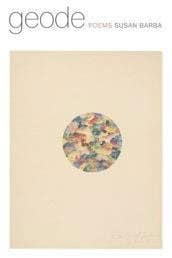
Susan Barba is the author of two poetry books: Fair Sun (2017) and geode (2020). Her first book was awarded the Anahid Literary Prize and the Minas & Kohar Tölölyan Prize, and geode was a finalist for the New England Book Awards. She has received fellowships from MacDowell and Yaddo, and her poems have been translated into Armenian, German, and Romanian. She works as a senior editor for the New York Review of Books. Barba’s literary guide to American wildflowers will be published by Abrams Books in the fall of 2022. We conducted this interview over email.
 
Q: How have you been doing this past year?  Has your writing shifted with the shutdowns? 

SUSAN BARBA: It’s been a challenge of course, but I’ve found new paths, new ways of doing things. I usually write when I’m away from home, somewhere, anywhere alone. This past year, out of necessity I’ve learned how to write in the midst of—work, family, remote schooling. I would have thought it impossible in the past, and at first it seemed that way to me—but because there was no alternative, I either had to figure out how to write in the midst of it or I wasn’t going to write at all—it wasn’t a conscious decision, I just found a way. It’s been a revelation for me.

Q: Good for you (and for us) for finding a way to continue writing. Do you remember when you first learned about poetry? 

SB: Yes, it was with me from the beginning—my mother read nursery rhymes to me and my grandfather would recite Armenian poetry by heart. The lullabies that were sung to me, the psalms and hymns I heard and sung in church, A Child’s Garden of Verses by Robert Louis Stevenson: these were some of my earliest encounters with poetry.

Q: Poetry really was with you from the beginning—it is a part of you. What is it about poetry that draws you to the form? 

SB: The silences, the music, the aptness of metaphor, the compression and the expansion of language, the urgency of the occasion, all of which allow poetry to communicate the essential, that which ordinary language can’t communicate.

Q: I agree with your thoughts. I can imagine that being an editor, a poet, and a writer has many benefits and maybe some inherent difficulties. Would you like to speak about each? 

SB: Yes, all the reading—it’s a strain on the eyes! I just saw the eye doctor and had to get stronger prescription reading glasses because my eyesight is deteriorating. But in all seriousness, being an editor and reading for work does help my own writing because of the depth and breadth of the reading, the engagement with language that editing requires, the attention to what will make the writing the most efficacious and most memorable. I heard a wonderful reading by the Palestinian poet Najwan Darwish, who is also an editor-poet, and who said, “I am so tired from all my work, I am like an athlete who is constantly working out: I am in tip-top shape from all this reading I do!” He referred to us poet-editors, as “Atlases who create.” A terrific image.

Q: Oh, that is a wonderful image! All your reading must be immensely fruitful. Keep the stronger reading glasses on order. What is the best and/or worse writing advice you received?

SB: It was probably one and the same—the professor who warned us creative writing kids in college that we should only set out to be poets if we truly could not imagine living otherwise. At the time I didn’t understand what he meant, and I thought of it as discouragement, but now I understand. It means that you will write if you have to, if that kind of excavation of the self and of sense is necessary to you, and if it is, then you should heed it and do what’s hard. 

Barba's Fair Sun from 2017

Barba’s Fair Sun from 2017.

Q: That truly does make sense—it is a fair warning and unveils the hard truth of the work one must do. Are there particular writers you admire or return to? 

SB: Yes, many poets and many prose writers too. I especially love essays by poets, artists, science writers. To name more than a few of those writers: Emily Dickinson, William Carlos Williams, Hannah Arendt, Osip Mandelstam, WH Auden, Eghishe Charents, Anna Akhmatova, George Oppen, Joseph Brodsky, Svetlana Boym, Natalia Ginzburg, Elizabeth Hardwick, Agnes Martin (her writings on art), Tove Jansson, Robin Wall-Kimmerer, Annie Dillard, Arthur Sze—I could go on and on! 

Q: What a fun list of writers and artists. Is there a line of poetry that you wish you wrote, or rather, repeats in your mind? 

SB: This past year whenever I’d go out walking, these lines by the mystic Julian of Norwich kept running in my head: “All shall be well, and all shall be well, and all manner of things shall be well.” It’s a mantra whose repetition was healing for me, especially last spring, as I’m sure it has been for many since the fifteenth century when she wrote what was the first book (in English) by a female author.

Q: Those lines are fantastic and so relevant for any time, but especially for us this past year. I am sure Julian of Norwich had good reason to write them in the fifteenth century. Any particular journals or periodicals you enjoy reading—besides the New York Review of Books?

SB: Yes, the Review certainly! And also, The Paris ReviewThe Hudson ReviewRaritanLana Turner Journal, the New Yorker intermittently (I just can’t keep up with every issue), and Appalachia Journal.

Barba's geode from 2020.

Barba’s geode from 2020.

Q: The reading piles grow and grow—books, journals, online journals and articles…it never ends, for better or worse. What are you currently reading?  

SB: I just finished Anne Truitt’s Daybook, which is a journal of her life as an artist. It’s a brilliant book about making art and making a life concurrently.

Q: That sounds good to me. As we head into spring and then summer, do you have a summer reading list? 

SB: I have readings lists—lists for work and lists for pleasure. On the latter are The Shadow King by Maaza Mengiste whom I just heard give a beautiful reading, David Copperfield (to read with my son), Inger Christensen’s essays in The Condition of Secrecy, the graphic novel This Woman’s Work by Julie Delporte, and In Memory of Memory by Maria Stepanova.

Q: What a great list! Mengiste’s book is on my list too, but now I have more to add. Any upcoming projects you would like to tell us about?

SB: I’ve been compiling a literary guide to American wildflowers, which Leanne Shapton is illustrating and which will be published by Abrams Books in the fall of 2022. It’s been a great joy, learning about wildflowers and selecting texts about them that represent a long-held appreciation of these at-once threatened and resilient flowers and their representation in our culture. I’m also excited about a book I acquired for NYRB that will be out in the spring of 2022, Letters to Gwen John by the British painter Celia Paul (whose beautiful Self-Portrait we published last fall). 

Q: I look forward to the American wildflowers book and the Celia Paul book sounds wonderful. Self-Portrait is indeed a beautiful book! How did you learn about the Athenæum

SB: Through David Godine, a brilliant friend, bibliophile, and member of the Athenæum.

Q: Godine publishes great books. Any last thoughts? 

SB: Thank you Carolle, it’s been a pleasure! Long live the Athenæum.

04.22.2021

Dr. Robert T. Osteen

May 2021

Interview by Carly Stevens

Dr. Robert T. Osteen wrote textbooks and academic articles during his career in surgical oncology. Since his retirement, he has shifted gears and published a collection of poems, Zero to Five Knots and a Book, and a history book, Festina Lente: Charting the Mediterranean 1814–1824. On an April afternoon, Dr. Osteen and I chatted on Zoom about his projects since retirement and his future research including his next book, tentatively titled Surgery Under Fire. Our conversation is edited for brevity and clarity.

Q: Can you tell us about your academic background?

DR. ROBERT T. OSTEEN: I was an undergraduate at Dartmouth where I majored in philosophy, knowing that I was going to medical school. I went to medical school at Duke where I had two years as a surgical resident. Then, I was in the Air Force for two years during the Vietnam War doing research there. After that, I went to the then Peter Bent Brigham in Boston for completion of the residency training and also to do more of the research I had been doing while I was in the Air Force. I finished the residency at the Brigham where I joined the faculty and spent the rest of my career doing surgical oncology. As part of being an academic surgeon, you write a lot of books, papers, that kind of thing. When I retired, I didn’t need to do professional writing anymore and I was free to do whatever I wanted to do.

Q: What have you written since you retired? 

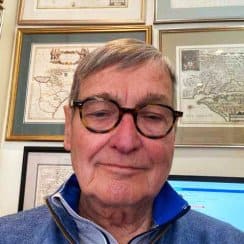
RTO: I collected antique maps for years. It’s too bright behind me, but I’m surrounded by antique maps. I also sail and as a sailor, I like to know where I am. It’s one of the requirements to avoid running into things. That combined with a book that came out by Dava Sobel about John Harrison’s invention of the chronometer inspired me to ask if people were interested in the invention of an accurate watch, maybe they would be interested in what you did with one once you had it. One of the first things that was done with it was to chart the Mediterranean by this naval officer,William Henry Smyth. This was something I knew virtually nothing about when I started. I had to learn all sorts of things along the way in order to write the book. It took several years to do it. 

The Athenæum played a significant role. It had some books that were useful for learning one of the techniques for measuring longitude that was developed about the same time as the chronometer. The technique used the angles between the moon and a fixed star. Two separate clocks, if you will. So, the tables for how to calculate longitude from those observations were made about the same time as the chronometer. I decided I needed to learn how to do that. Since no one had done it since 1850 or so, there were no contemporary works on how to measure longitude from the angle between the moon and a fixed star. But the Athenæum had a book that had been written in 1784 about how to do it, so I spent several months in the rare book room trying to understand the peculiar printing and the fairly complicated mathematics involved in doing this. The Athenæum was very helpful with this project. 

Q: And did you figure out how to do it? 

RTO: I’ve learned how to do it and it’s utterly worthless, but at least I could write about it from a position of understanding how difficult it is to do. 

Q: Can you talk about the book you’re working on right now?

RTO: I just finished a book about surgery in the Second World War. My father was an anesthesiologist who volunteered in November of 1942 and went overseas. While he was away he wrote about 300 letters home, which I used as a basis for exploring the surgical issues that they encountered, how they dealt with them, what was known at the time, what was not known, what was learned, and so on. 

Q: Can you talk about some of the struggles and some of the joys of writing such a personal story?

RTO: Let’s start with saying that most of my life I’ve written not only nonfiction but textbooks. They are a different entity in that you are not trying to tell a story. You are describing a set of facts and you are describing it to people who are pretty familiar with what they are looking for. In writing history like this, you are trying to tell a story. The problem is making it interesting. In the case of my father’s letters, there’s medical information that’s not familiar to everyone, so not using jargon and thinking deeply about how far into the weeds I need to go is important. There is also the issue of confusing family myths with what actually has happened. I do not want to embellish things unnecessarily or relay family myths that I can’t verify. The other part of it is I had to look at some relationships, for instance, what my mother’s role in all of this was and how she viewed it. None of this was something we ever talked about, but I had to do some introspection while being careful not to over interpret things or statements that were hard or impossible to verify or that were not adequately documented as speculation.

Q: What do you hope readers will take from this book?

RTO: There’s not been a lot written for the lay public about the surgical treatments and surgical issues of the Second World War. There are some that are well known, for instance, the problems with procuring blood. There was a Blue Ribbon Commission before the war started to decide how to treat patients who have a significant amount of blood loss. They concluded that plasma, that is blood free of red blood cells, is just as good as whole blood. That is absolutely wrong. 

This was also when they first started to question whether white soldiers could accept blood from Black donors. The Red Cross actually hemmed and hawed about whether they would even use Black donors at all. The first policy was to mark the units to indicate whether they had come from a white or Black donor. This was despite the fact that all of science said it did not matter. The only thing that matters is blood type. Skin color doesn’t make a bit of difference. As far as I can read from my father’s letters, it didn’t make any difference to him. Somebody who was bleeding to death needed blood from whatever sort of donor there was. I remember him talking about it and saying that this was utter foolishness, but it was prevalent at the time. I do believe that it was a debate that went on and on and actually hindered the war effort. 

Q: How has the pandemic affected your writing process or your research process? Has it helped or hindered it in any way? 

RTO: My opportunities for leaving the house were limited, so I put together a book of poetry. I’d written poems over several decades, and I had them on the computer. I put them together and published them in lieu of getting out and doing any of the footwork that I needed to do for the next project I’m working on. It was a wonderful opportunity to edit and reread a bunch of stuff written over the years. That was great fun.

Then, I started a new project which is to look at King Philip’s War in Southeastern Massachusetts. We have a summer house down in South Dartmouth, and there are loads of King Philip’s War sites around there. I’m trying to put together a collage of snapshots that would allow people to come up with a picture of what life was like and what the country looked like at the time. I need to be out and able to travel around and talk to people to do that, so I spent the pandemic just reading books and taking notes. I have a stack of index cards over there, which is the start, at least. Getting the data together for this project probably takes a couple of years. 

Q: You write textbooks, poems, and history. How does your writing process differ for each one?

RTO: The textbooks are a little easier for me because I’ve done more of that. It’s just a matter of knowing everything there is to know about the subject. It usually amounts to several hundred references. Once you have got it in order as to what you want to say, which is very straightforward, there’s a formula that essentially every textbook uses and you just plug it in. 

For the two histories that I’ve finished, I’ve done a similar sort of thing and I just take notes. I read, I try to learn as much as I can about it, and I take notes on index cards in the oldest fashion way you can possibly do it because I couldn’t figure out a way to do it on the computer that was either time saving or useful. I just end up with a stack of several hundred index cards that I then put in order according to roughly where I think chapters are going to be, take each one of those and sort them out by paragraph, and then try to get something on paper. 

Regardless of what I’m doing, whether it’s poetry, a textbook, or history, just getting something on paper is the first maneuver, without worrying about sentence structure or much of anything else. Then, I rearrange it in the order that I wanted and, as I said, textbooks tend to be pretty formal, whereas the order of how you do history is much more important and also not as prescribed. Chronologically turns out to be the easiest way to do it. I’ve fought that at times, but usually given up and just ended up with chronological order. Once it’s on paper, you start reorganizing things and then there are multiple efforts at editing. 

One of the things I learned early on about textbooks is that it’s really hard to write a sentence that means exactly what you want it to mean. Writing something really clearly and easy to understand is hard, and so I would write something I thought was pretty close to finished, put it away for a week, come back and read it again, and think ‘God, that’s not what I meant. It could mean several things. That’s not how I want it.’ With non-fiction, textbook kind of writing, it’s really key to get the sentence to mean exactly what you want. The additional problem is to make clear when you’re filling in something that you can’t document, or when you are making an assumption, because you don’t have a letter or a fact somewhere that you can use to document it.  

Q: What are you reading right now?

RTO: I’m reading almost exclusively stuff on King Philip’s War. One of the last lighter books I read was Dirt: Adventures in Lyon as a Chef in Training, which is this story written by Bill Buford, editor at the New Yorker, who decided he wanted to learn how to be a French chef. He got a part time internship at a restaurant in Washington, D.C. where this innovative chef has a salad he made to look like a flower pot. Apparently the hardest thing about the salad was the creation of the dirt. That was the source of the name, and then he goes off to Lyon to learn the origins of French cooking. It’s a wonderful story and very well written.

If you’re interested in getting a copy of Dr. Osteen’s books, please contact him at Robert_Osteen@dfci.harvard.edu.

03.10.2021

STAFF BOOK SUGGESTIONS SPRING 2021

John Buchtel

The Butterfly Effect: Insects and the Making of the Modern World by Edward D. Melillo

(Library of Congress SF517 .M45 2020)

The Fly Trap by Fredrik Sjöberg; translated from Swedish by Thomas Teal

(On order)

In anticipation of the daffodils’ emergence and the awakening of their pollinators, John Buchtel’s thoughts took an entomological turn as he prepared his March 29th Curator’s Choice presentation on “Bugs!” (Check out the video on our Vimeo page, if you missed it!) From the new book shelves, John commends two books on his six-legged theme to us. In The Butterfly Effect: Insects and the Making of the Modern World (New York: Alfred A. Knopf, 2020), Edward D. Melillo, professor of history and environmental studies at Amherst College, tells the fascinating story of the impact on human culture of such insect products as silk, shellac, and cochineal (John’s presentation included not only stunningly beautiful rare illustrated entomology books, but also exquisite examples from our collection of these three insect products, and more besides!). John also gives his highest recommendation to Fredrik Sjöberg’s The Fly Trap (New York: Pantheon, 2015). In a lyrical translation from the Swedish by Thomas Teal, Sjöberg’s memoir is as much about the beauty of art and nature, the mania for collecting in general, and the influence our predecessors have on our intellectual curiosity in the present, as it is about one man’s obsession with the study of rare hoverflies on a remote Swedish island.

Carolle Morini

Nightshade: A Novel by Annalena McAfee

(Library of Congress PZ4 .M11192 Ni 2020)

London, NYC, art, artists, creativity, poisonous plants…death. What else could you ask for? And a good guide for what not to plant in your home garden.

Costalegre by Courtney Maum

(Library of Congress PZ4.M452 Co 2019)

Costalegre is inspired by the relationship between Peggy Guggenheim and her daughter, Pegeen. It is set in 1937, war on the horizon, art and artists to save, artists to know, art to create and adolescence to through—written in a diary style by the teenage girl.

Lisa Muccigrosso

A Lyttel Booke of Nonsense by Randall Davies

(Cutter Classification VEA .D285)

I’ve got A Lyttel Booke of Nonsense on my bench in the lab. In 1912, Randall Davies took medieval woodcuts and composed limericks to go along with them. It’s definitely a fun little diversion.

Kaelin Rasmussen

The Narrative of Arthur Gordon Pym, from The Works of Edgar Allan Poe

(Cutter VE .P753 .3)

Now that spring is in the air and hope springs anew, many of our thoughts turn to wistful plans for the misty future. How about a nice sea adventure novel to put you in the mood…? No. Wait. That’s a different book. This book is Edgar Allan Poe’s version of a boy’s adventures on the high seas: Nantucket-born Arthur Gordon Pym, a romantic lad in his late teens, imagines that a whaling journey to the South Seas sounds like good fun. But his parents say no, so naturally he and his best friend, son of the ship’s captain, hatch a plan to get him on board in secret. What could go wrong? Pretty much everything. Poe’s plot is gruesome, his prose filled with his wonderful dark urgency. It’s a novel of the nineteenth century, with the nineteenth-century novel’s troubling portrayal of people of color from a white perspective, which I read as an exercise in identifying and thinking about how those troubling ideas are still with us today.

Anthea Reilly

In Farleigh Field by Rhys Bowen

(Library of Congress PZ4.B7839 Inf 2017)

Death Comes for the Archbishop by Willa Cather

(Library of Congress PZ3.C2858 De 1999)

The Lying Life of Adults by Elena Ferrante

(Library of Congress PZ4 .F356 Ly 2020)

Collected Stories by Shirley Hazzard

(Library of Congress PZ4 .H4316 Co 2020)

Memoir from Antproof Case by Mark Helprin

(Library of Congress PZ4.H478 Me)

The Splendid and the Vile by Erik Larson

(Library of Congress DA566.9.C5 L37 2020)

Why I Don’t Write and Other Stories by Susan Minot

(Library of Congress PZ4 .M6652 Wh 2020)

The Dutch House by Ann Patchett

(Library of Congress PZ4.P294 Du 2019)

Please Stop Helping Us by Jason Riley

(Library of Congress E185.86 .R55 2014)

All authors are equally excellent in their own ways. I will not go into windy explanations why I read these books.

Graham Skinner

Drive Your Plow Over the Bones of the Dead (Prowadź swój pług przez kości umarłych) by Olga Tokarczuk

(Library of Congress PZ4.T6465 Dr 2019)

Once again Olga Tokarczuk captures my heart with this wonderful philosophical treatise wound in William Blake and draped in a whodunit. The main character Janina, an animal-rights activist, satirizes hunters, minor politicians and hypocritical priests and follows her astrological analysis while speaking on age and her life throughout the novel. Tokarczuk paints an amusing and enrapturing picture that reflects much of her earlier novel Primeval and Other Times while focusing on such an enigmatic and charming protagonist. 

Mary Warnement

Vincent’s Books: Van Gogh and the Writers Who Inspired Him by Mariella Guzzoni

(Library of Congress ND653.G7 G94 2020)

A book about books and an artist’s love of books, beautifully illustrated. This screams fresh start and spring to me, and I hope to many of you book and art lovers out there. In 2009, Van Gogh’s letters were published in print and they are free online (not only in full but actually more extensive than the print volumes). Guzzoni has plumbed these for Van Gogh’s reactions to what he has read (and he read extensively in four different languages) to inform her biography focused on the influence reading played in Van Gogh’s life and art. Page after page of color illustrations (ephemera, book covers, his paintings as well as other art that influenced him) are a feast for the eye. Another treat for this reader, a ribbon bookmark! From a university press no less. I wish the captions included the institution where the painting resides rather than forcing one to look in the list of acknowledgments at the back, but that’s a minor quibble, especially when other books simply provide a list of credits unconnected to specific captions. The penultimate chapter, about his paintings of people reading, is a particular pleasure.

Hannah Weisman

In the Garden of Beasts: Love, Terror, and an American Family in Hitler’s Berlin by Erik Larson

(Library of Congress E748.D6 L37 2011)

Larson takes his readers through pre-war Berlin through the eyes of the professorial US Ambassador to Germany William E. Dodd and his vivacious daughter Martha as they come to realize the catastrophe befalling Germany, Europe, and the world. The book was particularly compelling to me after having seen the United States Holocaust Memorial Museum’s exhibition Americans and the Holocaust, because both the book and the show delve into the complexities of which American officials knew what about Hitler’s intentions and what they did with that information. Larson treats his subjects and topic with the respect and seriousness they deserve, but writes in a style that helps move the reader through the material without feeling weighed down by the subject.

02.25.2021

Maisie Houghton

March 2021

Interview by Rebecca Johnston

On a chilly day in January, I joined Maisie Houghton over Zoom for a warm and illuminating conversation about her book Pitch Uncertain, finding one’s voice in writing, and life in quarantine. A graduate of Radcliffe College, Houghton published her memoir in 2011 and currently has begun working on poetry, with several poems published in a variety of journals. Because of her fond memories of visiting the Athenæum as a child, Houghton renewed her membership when she moved back to Boston with her husband, served on the Board of Trustees, and has since become a trustee emerita.

Please tell us a little about Pitch Uncertain.

MAISIE HOUGHTON: People say to me, “Oh, I read your autobiography!” Which is so silly. It’s not an autobiography. It’s the story of growing up. Fifteen years out of my early life and my childhood, growing up in Cambridge right after World War Two had ended. There’s a chapter where I describe meeting and marrying my husband fresh out of Radcliffe—you know, I swore I’d never be a June bride, and there I was married—and that’s where the story ends. It’s always fascinating to me to think that’s 15 years—yes that’s a chunk of time, but it’s not amazingly long. But when you think of a child growing from age five to age 20, that is a big span of growing up and learning and discovering the world around you.

Q: How did you go about writing this story about your own life?

MH: I told this story because I had been working on another book, a biography of the American actress Ruth Draper who was the premier monologist on the American stage; she had great success and she was knighted in England. I knew Draper when she was in her early 70s and I was about ten or 12, as we went to the same summer community on an island in Maine. Much, much later in life I became fascinated with her and wanted to write a biography of her—and I did. Start to finish. Had an agent, showed it to publishers. Of course, no one wanted to publish it. They said, “You’re unknown, she’s unknown.” Which I disagreed with, because people in the theater world highly respect Ruth Draper. But one editor did say to me, “What does interest me in the manuscript is the story of Maine and your sisters and you, three little girls growing up together in the summers in Maine, and that’s where we meet Ruth Draper. You should write something about that—but of course you probably don’t want to do that because you’re so set on this biography of Ruth Draper.”

So I came home, and I was irritated, and I thought, “Damn it, I’m going to just write this story.” I had been taking a memoir class in New York City, which was built for people over 50 who don’t consider themselves writers. Which was me, really. And so I wrote! I put together some sketches, and then I began to piece them together as [the teacher] said, “Put them together like pieces of a fan.” The book isn’t, “I was born and then I went to kindergarten and then first grade,” I don’t do it that way. It’s just what stood out to me, 50 years later, about my childhood.

This took a long time to find the right publisher. Everybody said “You should just self-publish it,” but I was determined not to do that. Then I met Jock Herron, who has this esteemed and wonderful small publishing firm in Cambridge called TidePool Press. I love the name, which they said is because, “you never know what comes up in the wash.” They’re interested in doing, what is the word, “small”—not War and Peace length books—but also and particularly about people’s lives. I met Jock because my son was a friend of his. He said, “My mother has this manuscript,” and Jock tells the story that his heart sank because he thought everybody has a story but not everybody has a book. Thankfully for me, he did publish it, and now it’s been ten years that it’s been out. Everybody can remember different parts of their childhood—and even though mine was extremely sheltered and certainly white privileged, it would seem to exclude whole other stories of lives—I think anyone can identify with stories and anxieties, the learning experiences of growing up.

Q: What are you going to write next? Do you have any upcoming projects?

MH: The book came out, and everybody said, “Well, now what are you going to write?” And I thought, well, now I’m going to do the Great American Novel. And…that’s too much, too hard, I decided.

So, I had a friend who was taking a poetry class at the Cambridge Center for Adult Education, and she showed me some of her poems. I liked the idea that I could write in—as Robert Frost said, “Free verse is playing tennis with the net down.” And so I began! I joined the group in Cambridge. A group leader encouraged the class to send in poems and said it’s important that you show your work, that you send it for publication, and I thought, “Oh, I don’t care about that, I’ve published a book, I’m just doing this for myself.” But some poems were submitted, and they began to be published. It’s not that I sit down everyday and work on poems, it’s much more of when the mood hits me. My poems are really just about my life and circumstances, and not even really so much lockdown poems. It’s more about family life. And now in the pandemic, my husband and I live in an apartment in Boston, and it’s a very quiet life. Totally different. We moved back here about ten years ago. For me, growing up in the 40s and 50s in Cambridge was a very different experience than Boston. Boston was not the lively, vibrant city that it is now. It was much more the last, sad gasp of the WASP and the literary WASP community. And my parents hadn’t grown up here, they were all from New York, and we never—I think we came to the dentist in Boston and that was about it. Now it’s been fun to discover a much livelier Boston.

Q: Speaking of the pandemic—what have you found inspirational in this time? Have you written more? What have you been spending your time doing?

MH: When the lockdown in Boston first began, the New York Times to which I subscribe said, “Everybody must write in how you’re spending your time, and what’s changed in your life.” There was one little letter that I cut out, because I like to make collage and I was making a pandemic collage, and it said in tiny print, “My wife and I are in our 80s, and we never go out anyway, so not much has changed.” That’s kind of the way my life is. But I’m extremely spoiled in that I have two kids, and my son lives in Beacon Hill, he and his wife and his daughters. So that gives me much more of a feeling of not being cut off from regular life.

Q: How else are you occupying your time in quarantine?

MH: The thing is I’m a tremendous reader. And you know it’s wonderful to have lots of time to read. When the pandemic started, I read the third or the fourth volume of the Hilary Mantel series. And now I’m also in a reading group, and the sort of subgroup of the reading group, we just have started, we’re attempting Joyce’s Ulysses. We have a very gifted teacher who is a scholar of Joyce. In addition to the published version, he has recommended the annotated Ulysses, which was done by a very brilliant professor many years ago at Williams, and so I have the two books side by side when I’m reading so that I can look up.

Q: Speaking of books, how did you discover the Athenæum? And what do you enjoy about it? 

MH: Though I said earlier we never went to Boston, we did go to the Athenæum. My mother was a friend of Walter Muir Whitehill. The Athenæum was always very welcoming, it seemed to me, to children. In the summer, because we would have these long summer vacations, we would be in Maine, and we were given summer reading lists from our school. These wonderful packages would arrive from the Athenæum, I can still see them wrapped up in brown paper.

When I moved back here to be near our son and his band of young daughters, I was getting settled and I thought, what will I do this afternoon? And I realized I could walk up to the Athenæum because I live in Back Bay, and it’s a lovely walk up the hill. And so I became a member.

Then I was on the board for a brief time. As interesting as that was, I realized I am not really suited to board life. So I am not on the board any longer, but I’ve always had a strong interest in the Athenæum, and your new director is someone my husband and I met through Harvard connections. We were very happy to hear that she had been chosen as the new director. Obviously the Athenæum is such a beautiful building and it has wonderful collections of books, but I know they’re looking to get away from the old-guard Boston.

The Athenæum is my lending library. There are many, many outlets for scholars here. It’s a great resource for the general reading public. I used to take my grandchildren to the reading on Saturday mornings.

Right now, they’re doing a children’s story time on Facebook Live. 

MH: Yes, they realize how important it is for kids. I remember there was a small branch of the Cambridge Public Library quite near where I lived. And the fun of being able to walk by one’s self, have your own library card, it was always a big part of my reading life.

Q: What books were you reading as a child? 

MH: Well, certainly, Little Women. My oldest sister and I were utterly fascinated by that. It was a great treat, we would be driven to Concord to visit the actual house. It meant a great deal. And, of course, which character do you model yourself on or do you most identify with? One of the characters is named Amy, and now in reading biographies of Louisa May Alcott, I realized that she changed her mother’s maiden name. In actual life, Mrs. Alcott was from the May family, and that “Amy” was changing that name slightly.

There were a lot of family stories too, you know. There was a series about a family called the Moffats, and there was another wonderful series about the Melendy family, “The Four Story Mistake.” And I was reading, you know, as an adult, children’s literature and how often—in fact, practically always—that the parents are absent, maybe one parent or sometimes both—preferably both—are dead, and they’re raised by some great uncle. There was an English series about theater called “Theater Shoes” or “Ballet Shoes” about a family of English children, brought up by a great uncle, but they had a devoted governess. And then there was E. Nesbitt, who had another family with either two children or four children, but it always seemed to be a prerequisite that the parents were nonexistent, or they’d gone on a long trek.

Q: Let’s go back to your book, because I was struck by how it’s such a personal story. Was it challenging to write? 

MH: When the book was part of TidePool and either just published or about to be published, Jock Herron said, “It’s a book about your parents.” I was taken aback by that because I thought that it was me, me, me, I, I, I. Then I realized he was right. When the book was published, both my parents were dead. And so unconsciously, I was able to publish it. Because, as my older sister said to me when I was telling her this story, and I asked, “Do you think our parents would be upset by this book?”, she said, “Are you kidding? They’d be horrified.” They were of that very discreet, private generation. But I’m very frank about the fact that it wasn’t a happy marriage but they stuck together.

But as far as writing the book, I mean I don’t really talk about my sisters much, it’s much more me. And then the experience with Ruth Draper. I think there was only one family that I changed the name of, just to very thinly disguise. But it’s my world. The people that appear in the story, mostly my family relations, were all dead by the time the book came out, so that did make it much easier. I have two sisters, one sadly died, but my oldest sister said right from the start, “I see things differently, but I support you,” and she was extremely helpful in lending family photographs and correcting technical mistakes. She never said, “You can’t tell this story.”

That’s such good support. And that was a really cool part of the book too, the pictures from throughout your childhood. 

MH: I never thought about having pictures because I didn’t even know the book would ever see the light of day. But when it was picked up by TidePool, Jock had a very sympathetic and able colleague who helped put together the actual presentation of the book and she asked right away, did I have any photographs? Fortunately, I come from a family that took lots of the box brownie type photographs. So there were pages she could sift through, and my sister lent me at least five or six photograph albums. Then Ingrid Mach went through them all. It was interesting because she chose with an eye to the story—not like, this is a nice picture of Uncle Edwin, or this shows my mother looking pretty or something. It was much more to identify parts of, or to relate parts of, the story.

It brings to mind what you said earlier about it being a very relatable story. That’s certainly what I felt in reading it, and the fact that the pictures are just of everyday life fits that.

MH: Right, right. That was Ingrid, the credit goes to her.

Q: One final question, because we like to ask about education too: do you have any favorite takeaways or favorite lessons from those classes you mentioned earlier?

MH: Before I started thinking about writing a biography of Ruth Draper, my husband was in a terrible automobile accident. It was never a question of life and death, but it was a long recovery. He spent a lot of time in hospitals for special surgery and lots of rehab. Anyway, that was a chunk of our lives, and when he began to be fine and go back to work, I suddenly thought, “I don’t want to go back to the life that I had before, this is a clean slate now.” And then I found out about this class at the West Side Y, which was in my neighborhood in New York. The teacher was very adept. She would give the assignment: write about a radio you remember from your childhood, or write about whether your family had a car…you know, specific things—and that would prompt all these memories that began to flood out of me! The first assignment was to write about a car that had associations with your childhood, and I wrote, “my father was the car.” And now that line is in the memoir today. That class was a wonderful bedrock. The teacher was very gifted and she gave us all—certainly gave me—confidence, by saying,  “Yes, you can write.” And she didn’t say, “This is how you do it,” she respected each person’s voice.

Selected Works:

Pitch Uncertain: A Mid-century Middle Daughter Finds Her Voice (Cambridge, Mass: TidePool 2011)

Lucky Stones: Poems (Cambridge, Mass: TidePool 2024)

02.02.2021

Dr. Winston Langley

February 2021

Interview by Hannah Weisman

On the morning of the inauguration, as the country buzzed with anxiety and excitement, I had the privilege of spending a calm and contemplative hour with Dr. Winston Langley, a scholar of human rights and international organization, as well as a Trustee of the Boston Athenæum.

Dr. Langley is professor emeritus of political science and international relations at University of Massachusetts Boston and senior fellow at the McCormack Graduate School for Policy and Global Studies. We spent our time together discussing his work as an author and editor. Our conversation is edited for brevity and clarity.

Q: What is your academic background?

DR. WINSTON LANGLEY: I was born in the Caribbean and so I began with British tutelage in the Anglican schools there, as well as Cambridge, England. But all of my degrees were completed in the United States. I came here for the last years of my undergraduate degree in biology, thinking I was going to medical school. But I had been exposed to German language and history, so I went to graduate school and pursued a master’s degree in diplomatic history. Then I went into international relations. And then later on when I was teaching, I picked up a law degree.

Q: What is your favorite thing about the Athenæum?

WL: I’d say three or four things, actually. The name itself suggests something—it’s not just a library in the general sense. It speaks to something deeper. I think human beings, like non-human nature, hold within them great wisdom—wisdom that becomes evident through meditation and interaction with others. And I think that’s a sense in which I see the Athenæum as symbolically important. Its architecture is also part of that symbolism. I like how it provides for meditative inquiry. I like the possibility of fellowship there. I like its respect for the past which brought it into being. I know many parts of it have been shifted and shared with other institutions. That a group of private persons came together and recognized this importance is something which I enjoy, as well.

Q: What are the primary topics and themes you address in your writing and editing?

WL: Intellectually and otherwise, I am committed to the idea of human species identity. Some of the specific areas to which I direct my attention are: human rights; models of world order—we live, for example, in what I would call the Westphalian model, based in the nation-state system, but there are others and I try to make inquiry about them; I’m interested in international political economy; and international organization.

There’s one other, but it falls into the human rights agenda. I happen to like poetry. One of the persons on whom I reflect is the National Poet of Bangladesh, Kazi Nazrul Islam. I have a book on him and have been moving deeper and deeper into his thinking. I think of him as the greatest human rights poet of the twentieth century. He never finished high school, but beyond doubt he was a genius. There are some wonderful translations and they’re very accessible.

Q: You have published books as both author and editor. What are the unique challenges and benefits of working as an editor and how does that process differ from being an author?

WL: In a sense an author, of course, is responsible for the conception, development, the processes of work, its conclusion, the responsibility to see that what’s being said is defensible—factually and otherwise, that others can rely on it for purposes of use, that it hopefully compensates the reader for the time used to consume it, and that it serves a purpose for the larger society.

I think one who seeks to edit a work that comes from others would seek to establish whether some of those features are present in the work of the contributors. It’s not always easy to determine that and it creates a problem in many ways because people have different values and those must be dealt with.

There is also the notion of dealing with multiple purposes. There’s an edited work that was just published by a colleague and me. He is from Turkey. He brings a body of experiences to the work that would be missing for myself. I [co-edited] a book on women’s rights in the United States and part of the purpose of that work was to link developments in the US to the broader human rights movement in the world. And my co-editor was Vivian Fox. The dialogue between us was quite enriching and found its way into the book. If I had gone about it by myself, quite a bit would have been missing. Her skill was in history, I’m more of an international relations person and the legal background helped. So, all of those features are part of a broad contribution that a single author may not be able to make.

Q: You touched on it a little bit, but are there specific benefits to working with collaborators. And are there specific challenges or drawbacks to having a collaborator over working independently?

WL: Yes. The drawbacks can be rather difficult. Sometimes a co-editor or co-author comes with a certain world outlook that she or he seeks to maintain despite what might be the emerging evidence. That creates problems. But they can be overcome by deep dialogue which can elicit mutual trust. Works have to be put in context. That takes quite a bit of meditation itself. So, the dialogue allows for that. I earlier mentioned the work on the book on human rights in Turkey. In this case the colleague is not just from Turkey, but is from a minority in Turkey, the Kurds, and he had a particular point of view. We had no problems because we have broad agreement on the normative structure that was being used to measure human rights compliance. We also had a series of court decisions by the European Court of Human Rights, so we had authors of decisions outside of ourselves with which to deal and to measure ourselves.

Q: You mentioned in the acknowledgments for While America Sleeps that some research had been done at the Athenæum. What kind of materials did you consult, or was it a matter of meditating in the space, as you mentioned before?

WL: At the Athenæum, the area that I used were the newspapers. I was seeking to update myself on reactions from different areas of the world to [Greta Thunberg]. Some of that was found in the Athenæum. I’ve yet to delve into some areas of the deep archives, but I’m moving in that direction.

Q: Since publishing While America Sleeps, have you seen evidence of the United States making any gains in the areas you cite in the book as problems?

WL: No. And I’ll say why. No, the first area, for example, deals with disarmament. Matters became worse under the outgoing president, Trump. The second area deals with international political economy and none of the changes that would be helpful to the US has come into being. The third focus is on ways in which race became the basis of identity in our country, in part to prevent the coming into being of social class, and some of the likely consequences that result from that historical cleavage. It has been made worse in many senses. The fourth deals with popular culture and education. As to the intellectual and moral development of individuals, certainly nothing has been done. The fifth is the environment. There seems to be some promise that the incoming administration may do some things. We’ll see. The sixth deals with world power and the seventh focuses on collective security. And nothing has been done, in either of these areas, to improve matters for the US or the world. Hopefully [the book will be] republished in February with the title While the US Sleeps, largely to correct some embarrassing spelling and other non-factual errors.

Q: Do you think the proposed solutions are still feasible?

WL: Yes. I’ll take, as an example, the environment. It is insufficient to address the global environment without seeking to elicit the collective response of the world. Secondly, the difficulty is a long term one. Because we are so far advanced in the destruction of the environment, any slip up in the efforts to correct the problem is only going to aggravate it. A massive curricular reordering in which non-human nature is seen differently by the public [is necessary], anything less is going to be damaging.

Nature is our first university, it is that which instructs us in every area. It is also our primary library, our Athenæum. It is our first hospital. It is our first wheat basket. If nature were suggested in this way, we’d see how indispensable it is to everything we do and the seriousness with which we ought to [treat it]. And that all living beings are communicating with us, as we are with them, in ways and languages that we don’t immediately know.

Q: Do you have any forthcoming projects that you can tell us about?

WL: I just finished a manuscript on The War Between the US and China. It may not be seen as hopeful, but it’s a rebuttable of Professor Graham Allison’s work, Destined for War. I’m suggesting that it’s not inevitable and that the reasons for his predictions of this suggested war are miscast. And there’s a [project] on moral courage that I’m working on with Kazi Nazrul Islam’s poetry in mind. He has a play entitled Truthfulness, on which I’m basing this work.

01.05.2021

STAFF BOOK SUGGESTIONS WINTER 2021

Carolle Morini

Intimations: Six Essays by Zadie Smith

(Library of Congress PR6069.M59 I46 2020)

A great collection of essays that speak to right now. Smith is always intelligent and interesting. This collection, like all her essays, will leave you wanting to craft the perfect essay yourself.

The Vanishing Half by Brit Bennett

(Library of Congress PZ4 .B4665 Va 2020)

This novel is on my top five “books read list ” in 2020. Beautifully written and thought provoking. Bennet creates a world that you will not easily forget and her characters, months after you read it, will continue to be a part of your thoughts. It is clear why this novel is on everyone’s list. 

Lartigue: The Boy and the Belle Époque by Louise Baring

(Library of Congress TR140.L32 B37 2020)

If you just want to smile and look at fun photographs then this is the book for you. Utterly charming, engaging and lively. With this book in hand you’ll feel like you’ve found a long lost friend.

Bearden’s Odyssey: Poets Respond to the Art of Romare Bearden; edited by Kwame Dawes and Matthew Shenoda, with a foreword by Derek Walcott

(Library of Congress PS591.N4 B36 2017)

A fine collection of poetry responding to Bearden’s art. The fantastic group of poets within this slim volume will have you lingering the artistic alleys of the mind.

Derek Murphy

What I Talk About When I Talk About Running: A Memoir by Haruki Murakami

(Library of Congress CT1838.M87 A3 2008)

I first came to Murakami through his novels—wonderful and bizarre postmodern (perhaps metamodern?) stories about disaffected middle-aged jazz enthusiasts cooking pasta, meeting talking cats, and falling through portals in wells. Recently I’ve taken up running, and this contemplative and self-effacing meditation on the hobby has given me solace on days when it’s too cold to go running myself.

Elizabeth O’Meara

The Searcher by Tana French (also available as an audio book from CloudLibrary)

(Library of Congress PZ4.F872735 Se 2020)

This is the latest book from Irish crime fiction writer Tana French. And another success for me. She’s best known for her Dublin Squad series, which I recommend, but her most recent is a standalone book. In interviews she has talked about how this book was influenced by John Ford’s western The Searcher. French’s book is also about the search for somebody and a man struggling to come to terms with his previous life and what he has always believed was his moral code. The bare bones outline of the plot—that a retired Chicago police officer moves to a small rural village in the west of Ireland and is asked to find out what happened to a missing teenager—does not do any justice to the world French creates.  Read it and enjoy The Search.

Mary Warnement

Arctic Dreams: Imagination and Desire in a Northern Landscape by Barry Lopez

(Library of Congress QH84.1 .L67 1986)

I’m taking an unusual step and recommending two books I’ve only just started, both perfect for the season. I discovered Barry Lopez just days before he died. The first pages of his Arctic Dreams: Imagination and Desire in a Northern Landscape mentions Kalamazoo, MI, a city not far from where I and my parents grew up (Perhaps you know it from the song or more recently from the Pfizer plant producing a vaccine). That connection wasn’t why I picked up the book or why I turned the page again and again, but connections are important this year. Arctic Dreams won many awards, most notably the National Book Award in 1986. A natural history classic. Poetic, intelligent, informed consideration of a landscape and its inhabitants. 

Snow by Marcus Sedgwick

(Library of Congress PR6069.E316 S66 2016)

I admire many of Little Toller’s publications, both its classic reprints and its new list. It is small but its authors have garnered a lot of attention and major awards. How could I resist sharing this meditation, as multifaceted as a flake (and its beautiful cover) for my winter recommendation.

Hannah Weisman

The Dutch House by Ann Patchett

(Library of Congress PZ4.P294 Du 2019)

The Conroy Family has occupied my attention for the last several days as I make my way through The Dutch House. I typically shy away from anything that includes the “wicked stepmother” trope, but Patchett’s telling of Danny and Maeve Conroy’s experiences taps into themes of belonging, identity, and familial love, and loss in a sensitive and thoughtful way. Patchett cleverly uses the extravagant house the Conroy siblings were raised in as a character, adding dimension to the siblings’ stories. 

01.04.2021

Jane G. Austin

January 2021

By Carly Stevens

Was the author of Emma and Pride and Prejudice a member of the Boston Athenæum? Unfortunately, no—although we would have welcomed her happily into our plush red chairs. Austen, an English novelist, and Austin, an American novelist, are two very different women. Jane Austen, with an E, is widely remembered, whereas Jane Austin, with an I, is known by few. Here we share some information on the life and career of Jane G. Austin, with an I.

Jane G. Austin was a prolific nineteenth-century author. Over the course of her life Austin published 23 novels and numerous short stories. Austin, a Boston Athenæum member, was well known in New England’s literary community. She was described as sociable and generous, often opening her home to gatherings and giving advice to novice writers. She forged friendships with other prominent authors, such as Louisa May Alcott, Julia Ward Howe, Nathaniel Hawthorne, and Ralph Waldo Emerson. Jane Goodwin took the Austin name when she married her husband, Henry Austin, in 1850. Nothing is written on Austin’s thoughts about the striking similarities between her name and Jane Austen’s, but one can imagine it must have been rather annoying. The inclusion of her maiden initial in her publications shows an attempt to distinguish herself. 

Mary Jane Goodwin was born to Isaac Goodwin and Elizabeth Hammatt on February 25, 1831, in Worcester, Massachusetts. The themes present in Austin’s writing came from her entire family’s interest in writing, genealogy, and history. Her brother, Hon. John A. Goodwin, authored The Pilgrim Republic. Her father, Issac Goodwin, was a well known lawyer, dedicated genealogist, and antiquarian. Her mother, Elizabeth Hammatt Goodwin, was a poet and song-writer. Unfortunately, Mr. Goodwin died when Austin was only two years old. After the death of her husband, Mrs. Goodwin moved the family to Boston and sent Austin to private schools to receive an education. From a young age, Austin was a dedicated and meticulous student. She showed an interest in history and writing. When Austin was a child, she was enraptured by stories of her ancestors told to her by her mother. Her long career began in her teenage years. Short stories started as a hobby for Austin, but eventually she began publishing her stories in magazines under pen names. Austin put her career on hold at the age of 17 when she married Henry Austin and raised her three children, Rose Standish Austin, Le Baron Loring Austin, and Lilian Ivers De Silva. 

After a 13-year hiatus, Austin began writing and publishing again. Her serialized novels and short stories appeared in magazines such as Harper’s MonthlyThe Atlantic, and Putnam’s MagazineCipher was first published in Galaxy and was met with glowing reviews. It’s rumored Austin’s dear friend, Louisa May Alcott, collaborated with her on this novel. Later publications of Cipher are dedicated to “My Dear L,” which is believed to be Alcott. Austin’s works have repeating themes stemming from her family’s history and her personal life. They revolve around New England history and often featured her ancestors. Austin’s mother first told her of Dr. Francis LeBaron, who eventually became the focus of one of her best known novels, Dr. Le Baron and His Daughters. Austin’s deep connections to New England were rooted in Boston and Plymouth. Austin lived most of her life in Boston in Beacon Hill, but spent time in Concord after she first married, where her friendship with Alcott began. Austin’s reputation solidified with historical romances based on her relatives in the Plymouth Colony. Austin also dabbled in novels for children including her first published novel, Fairy Dreams; or, Wanderings in Elf-Land. She published other historical novels, but she found her greatest success in the stories she wrote about pilgrims. Betty Alden, the First Born Daughter of the Pilgrims had a large sale and Austin’s obituary in The New York Times notes, “[Betty Alden’s] first edition sold before it was off the press.” 

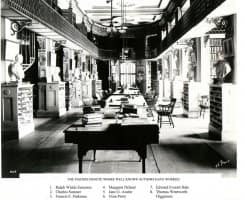
Historic shot of the second floor.

A historic shot of the second floor, where Austin once worked.

Austin wrote with great dedication. Her routine was strict. Constantly enriching her knowledge, she woke up early and devoted her mornings to writing or studying pilgrim history. A member and later a proprietor, Austin was a fixture at the Boston Athenæum. She even had a desk set aside for her in the building. Her regular spot in the Athenæum is noted in a 1902 article by the Sunday Herald. She spent her time on the second floor at the far end of the Long Room by a window. The window has since been replaced with a door to the drum and the space she once occupied is marked by a statue of Nathaniel Bowditch. Her time working was spent meticulously researching her family’s genealogy and adding to the notes left behind by her father. In the little time she was not writing, Austin spent her time with her family and friends. She spent her summers in Plymouth and returned to Boston in the winter. Austin’s social life was full. She and her husband often entertained writers at their home in Boston. 

Austin is remembered as “instinctively gracious, ” and a “woman of great tact.” In her final years, Austin continued researching and writing with the same veracity as always. A biography published the year before she died reads, “those who know her give her a warm place in their affections. Her home is with a married daughter in Roxbury, although she passes a part of the Winter in Boston, and every summer she finds herself ready to return to Plymouth, where she constantly studies not only written records, but crumbling gravestones and oral traditions.” Austin died on March 30, 1894 at the age of 63.

Selected Works:

Betty Alden
Dr. Le Baron and His Daughters
Nameless Nobleman
The Shadow of Moloch Mountain
Standish of Standish

References:

“Jane G. Austin” Current Literature: A Magazine of Record and Review. vol I, (July–December 1888)”
Jane Goodwin Austin.” Dictionary of American Biography. New York, NY: Charles Scribner’s Sons, 1936.
“Jane G. Austin” The New York Times, March 31, 1894.
“Jane G. Austin” A Woman of the Century. Buffalo, New York: Moulton. 1893.
National Cyclopædia of American Biography., s.v. “Jane Goodwin Austin.” New York: James T. White & Company. 1896.
 Willard, Francis E., and Mary A. Livermore. American Women: Fifteen Hundred Biographies, revised edition, s.v. “Jane G. Austin.”  New York, Chicago, Springfield, Ohio: Mast, Crowell, & Kirkpatrick, 1897. 

12.04.2020

Staff recommendations from 2020 Holiday Pop-up Bookshop

Daniel Axmacher

Fathoms: The World in the Whale by Rebecca Giggs
The City We Became by N.K. Jemisin

Bruno Faria

Agua Viva by Clarice Lispector
Borges: Selected Poems by Jorge Luis Borges
Desert Solitaire: A Season in the Wilderness by Edward Abbey

Adriene Galindo

Dog Songs by Mary Oliver
This Changes Everything: Capitalism vs. The Climate by Naomi Klein
Writers and Their Cats by Alison Nastasi

Sam Gill

Saturday by Oge Mora
Tiny T Rex and the Impossible Hug by Jonathan Stutzman
The Tea Dragon Society by Katie O’Neil
Planet Omar: Accidental Trouble Magnet by Zanib Mian
Children of Blood and Bone by Tomi Adeyemi
Children of Virtue and Vengeance by Tomi Adeyemi

Andrew Hahn

Every Grain of Rice: Simple Chinese Home Cooking by Fuchsia Dunlop
On Food and Cooking: The Science and Lore of the Kitchen by Harold McGee
The Man Who Ate Too Much by John Birdsall

Michael Jugenheimer

Diet for a Small Planet by Frances Moore Lappé
Calypso by David Sedaris
Inside of a Dog by Alexandra Horowitz
A People’s History of the United States by Howard Zinn

Carolle Morini

Border Lines: Poems of Migration, edited by Mihaela Moscaliuc and Michael Waters
African American Poetry: 250 Years of Struggle & Song, edited by Kevin Young
Pride and Prejudice: The Complete Novel with Nineteen Letters from the Characters’ Correspondence, Written and Folded by Hand

Kaelin Rasmussen

Binti: The Complete Trilogy by Nnedi Okorafor
Afterlife by Julia Alvarez

Graham Skinner

The Plant Messiah by Carlos Magdalena
Dry Store Room No. 1 by Richard Fortey
The Falcon Thief by Joshua Hammer

Mary Warnement

Metropolis by Philip Kerr
Field Guide to Dumb Birds of North America by Matt Kracht
The Mystery of Henri Pick by David Foenkinos

11.23.2020

Jessica Kent

December 2020

By Carly Stevens

Are you looking for everything there is to know about the literary community in Boston? Then the Boston Book Book blog is the site for you. Jessica Kent started the Boston Book Blog in 2012 and has been managing the site ever since. In addition, Kent works as a scribe at Harvard Business School, enjoys creative writing, and runs her own book club. Kent’s work as a writer, website manager, and literary enthusiast is a reflection of what she loves: writing, history, and Boston.

Kent was born in Albany, New York, and her love for reading and fascination with all things Boston and history started young. “When you’re in Albany,” Jessica says, “you’re either the New York City people or the Boston people. We were always the Boston [and] Cape Cod people.” She continues, “I grew up as a reader, but didn’t really notice I was a reader. I grew up watching my dad sit in his lounge chair every evening after dinner and read.” Kent dabbled in fiction and knew in high school she wanted to be a writer. After graduating high school, she moved to Boston for the first time when she started college. She graduated from Emerson College with a Bachelor of Fine Arts in Writing, Literature, and Publishing with a concentration in Creative Writing and worked as a bookseller for about ten years. However, her desire to be a writer always remained. Not fully satisfied with the literary community in Albany, she moved back to Boston in 2012.

That same year, she started the Boston Book Blog. “When I got out here I had an apartment in Somerville. My window overlooked the city in the distance. I remember sitting down and saying, ‘Okay, I’m going to find out everything that is going on in the local literary community.’” After searching the internet she came up empty. Kent was shocked to find that a city like Boston with a blossoming literary community did not have a single place to go to become immersed in all things literary. There were bits and pieces of information about local events, but no single place someone could go to view everything. So, she started it—the Boston Book Blog was born. “I collect all the local literary events into one master calendar. I have over 100 websites that I check.” In the early days the blog ebbed and flowed, but continuous support from the community encouraged her to keep at it. She’s focused on making connections and building rapport. The pandemic caused Kent to shift the focus of the website to conducting more author interviews, promoting local authors, and just trying to get the word out. During the COVID-19 shutdown in Boston, “it was depressing that first month, because there was nothing to post.” After a while, “it was really cool to see the local community starting to figure out virtual events.” For Kent, “it’s neat to see so many more people being able to log into virtual events than could fit into a bookstore.” The Boston Book Blog “is still a one woman operation, though I’ve fooled many people. It’s cool because I know a lot of people and a lot of people know me, but it’s tough because if I don’t do it then it doesn’t get done.” If you’re interested in keeping in touch with the Boston Book Blog, you can sign up for their newsletter here.

Along with the blog, Kent runs a book club affectionately called the Brew Pub Book Club. “It actually started as a Moby Dick book club when I was doing my Master’s, and I said to all my friends, ‘Guys, I gotta go through this for the next year, if you wanna read it, now is the time to do it.’” The initial thought was to read Moby Dick over the course of a summer, while Kent was working on her ALM in English from Harvard University, but that plan fell through rather quickly. At their first meeting, nobody read the assigned pages. “We ended up taking nine months to go through it,” Kent says. “We met every two or three weeks at a bar in Harvard Square. There were three others and I bought them little gifts at the end.” After finishing Moby Dick, the group continued to meet and decided it should be a “real” book club that read more than just Moby Dick. The club mostly reads fiction, although they don’t shy from non-fiction. Kent is serious about reading and makes sure the participants are, too.  “A lot of folks that I mention it to are like ‘oh yeah I’m in a book club, we drink wine, we don’t really read the book.’” For Kent’s club, “this is English class over dinner.” In her experience, “the folks I’ve had in my book club really like that. They really like digging in and pulling it apart.” The Brew Pub Book Club has moved to Zoom, which Kent welcomes. She enjoys opening up the opportunity to friends who don’t live locally. Kent notes the club is a bit “all over the place” with their book selections. Here is a sampling of just some of the titles they’ve read: Celeste Ng’s Little Fires Everywhere,  Carmen Maria Machado’s Her Body and Other Parties, Madeline Miller’s Circe, and The Girl with all the Gifts by M. R. Carey. At the time of our conversation, the club was reading Paul Tremblay’s The Cabin at the End of the World. “He’s a local author I’ve heard great things about.” If you’re interested in starting a book club, I recommend Kent’s article, “How to Startand Sustaina Successful Book Club.

Kent is currently querying a novel called Reconstructing Lasky. For this novel Kent drew on inspirations from her trips to Cape Cod during her childhood. “We used to vacation on the Cape and there was this old World War II Liberty ship that they dragged to Cape Cod Bay and left for target practice back in the fifties and sixties and then just left it to rot.” On her family’s trips to Orleans in the eighties and nineties they would go to a beach on the bay side where you could view the ship in all its glory. “It became a piece of local legend and local folklore.” The premise for the book came to Kent while she imagined the people who might have served on the ship. The novel takes place around Josh, a Freedom Trail player, a Revolutionary War reenactor, and the grandson of one of the men who served on the ship. At the start of the novel, Josh’s grandfather passes away and Josh goes to the Cape to begin going through his grandfather’s possessions. He eventually discovers a narrative his grandfather left him about his time in World War II. The novel grapples with nostalgia, history, and how the past influences and shapes the present, themes that are apparent in Kent’s writing. Aside from locale there are certain themes Kent returns to. “I love history, nostalgia and how history impacts us.” Josh, the character in her novel, has a moment where he walks along the Freedom Trail and remarks on how the past and present continue on in parallel. “I feel that way about Boston. It’s probably why I love it. You can stand on a street corner and be like ‘who stood here?’ Our past affects our future and we are all kind of living the past and the present in parallel.”

Kent, an Athenæum member since 2017, “wants to give a special shout out to the New England Seminar Book Club,” one of the BA’s many discussion groups. “That has been my main plug into the Athenæum.” Kent wanted to get involved with the discussion groups and her interest in Boston literary history drew her to the New England Seminar. “The leader, her name is Peg, just welcomed me in. I had read the book and there are a lot of passionate people who are very vocal in that group whom I absolutely love. I remember at one point during the group Peg sensed I wanted to say something and she kind of put her hand up to the other people to give me space to contribute. I’ve gone pretty much every month since then.” Kent enjoys stopping by the Athenæum and seeing her peers from the group. If you’re interested in joining the New England Seminar or any one of our other discussion groups you can visit this link for more information.

You can find the Boston Book Blog at www.bostonbookblog.com, or on Twitter and Instagram @bostonbookblog. Her personal website is www.jessicaakent.com if you’re interested in reading some of her short stories and other freelance work. If you are in the Athenæum, you might find her on the ffth floor, first alcove to your right, surrounded by old Puritan books and a wonderful view of Park Street and the Granary Burial Ground.