
04.05.2016

Robert Allison

April 2016

By Alyssa True

Robert J. Allison says there are worse things to be considered than a Boston historian. Originally moving for college and for Boston’s favorable gender imbalance, he has spent over three decades here. Since obtaining his doctorate from Harvard in the history of American civilization in 1992 and while teaching college courses on the subject, Allison has written or edited several books about Boston and Massachusetts, as well as eighteenth-century American history. He is the president of the South Boston Historical Society, vice president of the Colonial Society of Massachusetts, a fellow of the Massachusetts Historical Society, and a member since 1993 of the Athenæum. About Boston he says, “The city is a fascinating place.” 

His almost 90 year old mother, however, still somewhat holds his vocation against him. In the acknowledgements of The American Revolution: A Concise History and The American Revolution: A Very Short Introduction, Allison writes that his mother “who hates history” took him to Morristown where a “quick glimpse of a white wig and a Continental uniform” inspired his drive for historical research. He explained that while the trip was purely for his entertainment, his mother did not hate history so much as she hated the way it was taught. “I think it really is a case of a time when you were supposed to memorize dates and memorize names,” he said.    

Allison’s career path took a detour when he dropped out of college in the 1970s after his older brother died. He had gone to University of Wisconsin-Madison to study history and get away from his parents, but started questioning the practicality of his major. He was working as a dishwasher and thought, “I can keep working as a dishwasher and get a degree in history and then probably still [be a dishwasher], or I could become a cook and not get a degree.” So he became a cook, working in hotels in New England and Florida before ending up in Phoenix. Summers are slow for Phoenix’s hotel business so he spent time in used book stores, looking for anything interesting. Allison found Bernard Bailyn’s Pamphlets of the American Revolution and his Ideological Origins of the American Revolution, and called the latter a “revolutionary” book for him. In his acknowledgements in The Crescent Obscured, he credits Bailyn and his book for setting him back on track: “From a second-hand copy of Ideological Origins of the American Revolution I learned that ideas matter, that what people think makes a difference, and I decided to finish college. On the day I bought that book, I became a student of history.” Allison later worked with Bailyn as a graduate assistant, which he considered “really a lesson in how you go about writing and how you go about researching.” 
  
Years of cooking did not directly benefit Allison’s writing except for being able to multitask and “reduce, reduce, reduce” something to a purer form: “You can do the same thing, perhaps, by putting more stuff in, but it is stronger if you get the flavor by taking out what is unnecessary.” Allison—whose titles often contain “concise,” “short,” and “very short”—never really enjoyed writing but enjoyed the challenge of putting something into as few words as possible. “People are busy,” he said. “People want to know the story, want to know what’s interesting about it.” He wrote in an email that he starts off with a question to answer and then spends time researching to “find out the stories, the people.” After writing it all down, it’s “rewrite and rewrite to put what you have written into a coherent form.” Allison is always aware that his work is not for his own enjoyment: “One also has to remember that someone is going to eat whatever you are dishing out. In writing or teaching, you do have to be conscious of your audience.”

Allison has taught at Suffolk University since 1992, where he is now the chair of history. He also teaches at Harvard Extension School and has created two online courses on colonial American history and the U.S. Constitution. At the Extension School, he won the Petra T. Shattuck Excellence in Teaching Award in 1997. Suffolk awarded him the Outstanding Faculty Award in 2007 and 2010 and its Student Government Association honored him with their Distinguished Faculty Award in 2006. Though he considers it misleading to “make the past into the present,” Allison tries to make students understand how issues in the 1770s are valid today: “There isn’t anything more important than understanding how government is structured and how we organize government because it has so many implications for us.”  

Allison understands the particular interest people have in the city where they live. His favorite thing about teaching in Boston is taking students to sites and telling them what happened. In his acknowledgments for Short History of Boston, he wrote about the interest even of his two sons: “I can only hope this book will help them better understand their hometown.” He also said his mother in New Jersey, who does not have colonial American ancestry, enjoys her “least favorite subject” when there’s a good story, like hymnal wadding at the Battle of Springfield:  “It’s something you learn to cherish in the place where you are, the stories of where you are.”

Allison’s Athenæum affiliation began after he tagged along on a special tour for Suffolk’s History Society given by retired English professor and Athenæum member Stanley M. Vogel. He enjoys the friendliness (“much friendlier than any other library”) and the quiet to do work: “It’s a great place to spend time with the great minds.” Allison credits the Athenæum, and especially Curator of Prints & Photographs Catharina Slautterback, in his books and says it’s a great place to look at pictures as well as research. “And it’s because you come here to the Boston Athenæum and you can really find such great images that are unexpected,” he said. He also said the “best comments” in his Short History of Boston and Short History of Cape Cod were about images that were nowhere else. But it isn’t all just research. Allison enjoys both classic and contemporary novels for fun and has read Trollope, Thackeray, and Richard Russo. He is also currently enjoying Decline and Fall of the Roman Empire. Of the many books he’s consumed at the Athenæum, he says: “I wouldn’t venture to guess a percentage, but it’s probably more fun than research.”

Selected Works

American Revolution: A Concise History (Library of Congress Classification E208.A425 2011)
American Revolution: A Very Short Introduction (Library of Congress E208.A425 2015)
Crescent Obscured: The United States and the Muslim World, 1776–​1815 (Library of Congress DT197.5.U6 A45 1995)
Revolutionary Sites of Greater Boston (Library of Congress F73.37.W454 2005)
Short History of Boston (Library of Congress F73.3.A45 2004)
Stephen Decatur: American Naval Hero, 1779–​1820 (Library of Congress CT275.D411 A44 2005)

02.24.2016

Gamaliel Bradford

March 2016

By Alyssa True

Gamaliel Bradford (1863–1932), the fourth of this name, was a prolific author and biographer. Since childhood, he dreamed of being a writer, but failed to thrive until he switched from fiction to biography. In the April 27, 1932, issue of the Nation, he’s quoted thusly: “I should prefer to write great novels, but we do what we can, not what we should like.”

Charles Knowles Bolton, long-time librarian of the Athenæum, memorialized Bradford for the Massachusetts Historical Society in 1933 and expounded on the latter’s enjoyment of the Athenæum’s “warmly human influence.” Recorded in volume 65 of their Proceedings, Bolton said Bradford, just as his father before him, sent a “barrel of apples to the staff” every year at Christmas.

Bradford, according to Bolton, mentioned the Athenæum in his book Quick and the Dead. Bolton also said that Bradford researched his biographies at the Athenæum: “He always favored the purchase of source material for the study of character, and it did not matter if the ideals of people so pictured were utterly at variance with his own. In his sonnet to Sainte-Beuve he referred with approval to him who could
‘pray with saints yet press the sinner’s hand.’”

But Bradford also used the collections for his own enjoyment. A fan of detective novels, Bradford once said, “There is nothing so soothing as murder.” Bolton recounted an interaction between Bradford and a trustee:

E.M.P.: Here is a book for Mr. Bradford. It is called Murder for Profit.
G.B.: No. I prefer Murder for Pleasure.

Selected Works

As God Made Them: Portraits of Some Nineteenth-century Americans
Cutter Classification 65 .9°B72 .a 

Biography and the Human Heart
Cutter 65 .9°B72 .b 

Damaged Souls
Cutter 65 .9°B72 .d 

Darwin
Cutter 5E .D255 .br 

D. L. Moody: A Worker in Souls
Cutter 65 .M771 .b 

Elizabethan Women
Cutter 7BE6 .B728 

Lee the American
Cutter 65 .L516 .bq 

The Letters of Gamaliel Bradford, 1918–1931
Cutter VE5 .B724 .b 

Pageant of Life [poems]
Cutter VEP .B722 

Portraits of American Women
Cutter 65 .9WB72 .2 

The Quick and the Dead
Cutter 5 .B729 .q 

Saints and Sinners
Cutter 5 .B729 .s 

Unmade in Heaven: A Play in Four Acts
Cutter VED .B723

02.01.2016

Elizabeth Bacon Custer

February 2016

By Adriene Galindo

All Americans know the story of Custer’s Last Stand. What they may not know is that this is in part due to efforts by Custer’s wife to exonerate and immortalize him as an American hero. As they say, behind every great man is a great woman.

Elizabeth Bacon Custer was born in Monroe, Michigan in 1842. She faced tragedy early on, losing three siblings before age eight and her mother at 12. But “Libbie” had an adaptable and resilient nature, which would prove advantageous while marching with her husband’s troops years later. After her mother died, Elizabeth moved to Grand Rapids to live with her aunt. She returned to Monroe to attend boarding school at the Young Ladies’ Seminary and Collegiate Institute, and continued her schooling at the Young Ladies’ Institute in Auburn, New York, graduating valedictorian.

While other recent graduates of the Young Ladies’ Institute may have been considering potential suitors, Libbie was an independent spirit and not particularly inclined to marry: “If no one ever comes that I love then I shall be a ‘spinster,’ but to be one from necessity and one from pleasure are different things.” Even after the young George Custer made his interest in her quite clear, she did little to encourage him and felt he was too persistent. Romance soon developed, however, and they married in 1864.

With the Civil War still ongoing, the early stages of their marriage saw them frequently apart. When Custer was away, Elizabeth devoted her time to singing his praises to military officers, senators, and President Lincoln himself, but found accommodations near his campsites when she could. George Custer “found it hard,” he wrote his sister Lydia Ann, to keep her away from camp, for “she likes the army as well as I do.” He soon asked Libbie to join him at camp and found her equal to roughing it with army soldiers.

Sensing that the men resented her presence and determined not to show weakness on these long marches, Elizabeth adhered to the same grueling standards as the men. She even elected to live in a tent when proper housing was offered to her. She considered this time a learning experience, and took the opportunity to improve her riding skills. George Custer wrote to her father: “She thinks nothing of mounting upon a girthless saddle upon a strange horse and setting off at such a gait that even some of the staff officers are left behind.” This was a remarkable achievement since she rode sidesaddle. In fact, she was the only army wife to accompany the cavalry. Libbie delighted in the adventure the army provided; upon seeing a former suitor, she remarked, “What a humdrum life I had escaped by not marrying him…”

The adventures they shared together ended all too soon, however. News of Custer’s death arrived in June of 1876, but Elizabeth refused to fall victim to her grief. Despite coping not only with the loss of her husband but with accusations that he disobeyed direct orders, she knew she “had to live—a hero’s widow—to the end of my appointed time, worthily.” She spent the time immediately following Custer’s death by volunteering at the hospital and tending to the wounded. Adding to her burden, she soon became the sole caretaker of her poor and elderly in-laws. At the same time, payment on the property she had owned with Custer was due, along with an $8,500 loan. Perhaps as a testament to the kindness and charity Libbie was known for, fellow veterans chipped in to alleviate her financial strain, as well as that of other army wives.

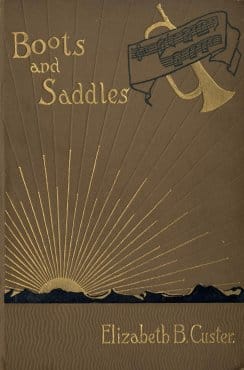
In 1877, determined to move past her grief and start a new life for herself, Elizabeth set off for New York City, where she found a position as a secretary for the Society of Decorative Arts. Two years later, plans were being made to commission a statue of Custer that would stand at West Point. At no point in the planning stages was she consulted. She was dismayed that the widow of a war hero should be ignored, and found fault with a statue that bore little resemblance to the Autie she knew. She did not attend the unveiling ceremony. Her message was received loud and clear by all in attendance. In 1884, she succeeded in having the statue permanently removed. Shortly after, she finally began work on her own memorial to the General, her book Boots and Saddles. As in life, Elizabeth continued to defend her husband’s actions even after his death; the book answered Custer’s detractors who blamed him for the events at Little Bighorn.

Although some critics argued the book was more hero-worshipping than factual, most found the book entertaining and admired Elizabeth’s spirit and devotion to her husband. For her, more important than the reviews were the letters she received from other army wives and widows. Her book “made my country feel that I belong to them.” Her second book, Tenting On the Plains, also contained glowing descriptions of Custer’s deeds and received similar praise. Elizabeth’s final book was published in 1890. The narrative focused on Custer’s encounters with the Indians of the West prior to the fatal battle of Little Bighorn. Her biographer Shirley Leckie describes Elizabeth’s treatment of the Indians in Following the Guidon as heavily prejudiced: “Elizabeth presented Indian women as beasts of burden, exploited by their husbands. By contrast officers were romantic, chivalrous, and affectionate…” The Custers’ former black servant Eliza also featured in the story, depicted as having become more civilized and appreciative since working for the family.

All the publicity Libbie received from writing about life with her famous husband afforded her the opportunity to take her stories on the road. She began a lecture circuit in Concord, Massachusetts the same year her final book was published. She often faced unsympathetic audiences (like those in Cambridge), but regularly won them over with her good humor and charm.

Elizabeth’s sense of adventure and devotion to her husband never waned in the 57 years after his death. She continued writing articles and stories about Custer’s life and traveled to such far-off places as Switzerland, Japan, Germany, India, Egypt, France, China, and Russia. Libbie died in 1933 just before her ninety-first birthday.

Her problematic idealization of her husband and their life together aside, Elizabeth showed the country that women could hold their own, and that their support was valuable to the war effort. In the words of an unnamed contemporary of Custer, “…I am satisfied she was the best General of the two.”

References
“Elizabeth Bacon Custer is born in Michigan,” history.com,
http://www.history.com/this-day-in-history/elizabeth-bacon-custer-is-born-in-michigan

Leckie, Shirley A. Elizabeth Bacon Custer and the Making of a Myth. Norman: University of Oklahoma Press, 1993.

12.18.2015

Liz Covart

January 2016

By Amanda McSweeney-Geehan and Liz Covart

Your background, personal and academic?

I am a native New Englander and a historian of early America. I am a Bostonian by birth and I spent most of my childhood in Bedford, New Hampshire. After high school, I moved west to State College, Pennsylvania, where I attended Pennsylvania State University (B.A. History with honors and distinction). In 2004, I moved further west to Davis, California to study early American history with Pulitzer Prize-winning historian Alan Taylor at the University of California, Davis (M.A. and Ph.D. History).

After Davis, I lived in Albany, New York for five years so I could research and write my dissertation, “Collision on the Hudson: Identity, Migration, and the Improvement of Albany, New York, 1750–1830.” My dissertation (and first book project) explores how the people of Albany, New York created first Dutch, then British, and finally American identities.

Honestly, I went to grad school with the thought that my dissertation topic would center on New England. Instead, I investigated the post-Revolution New England migration into New York State (1783–1830) in an effort to answer a question I posed to Alan (a Maine native) during my second week in California: Why does everyone outside of New England assume that New York is part of the region? The short answer: 700,000 to 800,000 New Englanders migrated to New York after the Revolution and built new, New England towns on the lands they settled. Culturally, much of New York resembles New England.

In 2012, I returned to Boston with my partner Tim Wilde and our two mini-schnauzers Thatcher and Sprocket. We reside in the South End.

What drew you to focus on early American history?

I attribute my love for early American history to four factors:

First, as a New Englander, I grew up surrounded by vestiges of our early American past.

Second, my parents took my brother and me on cultural vacations. We spent many school vacations visiting museums and historic sites around New England and the United States.

Third, I read a lot of nonfiction. My parents gave my brother and me an allowance in books instead of cash. Many of the books I purchased, or borrowed from the library, centered on early American history. I remember thinking in high school that I would one day read beyond the revolutionary and early republic periods of United States history, and I have, but those early periods are still my favorite. They are the periods I keep coming back to and the eras I will spend my career researching and writing about.

Fourth, my ancestors helped forge the United States. Some of them settled in New Netherland during the seventeenth century and several fought in New York and New Jersey regiments during the War for Independence. My ancestry doesn’t drive my research, but knowing I had ancestors who lived through the tumultuous and exciting times of the revolutionary and early republic periods makes my research more interesting to me.

What brought you to the Athenæum and how has working here affected your scholarship?

The Boston Athenæum has a reputation for being a great and inspiring place to work. I joined because of that reputation and because I needed a library with great interlibrary loan services. My study of early American history often leads me to request obscure antiquarian and specialist titles or borrow microfilm from historical societies and research libraries. The Athenæum always procures the records I need. In fact, Kristen, the ILL specialist, saved me an expensive trip to the New York Public Library by locating the records I needed at a different institution with interlibrary loan privileges.

What differences have you found in presenting your work in a digital format as opposed to print?

I believe that people love history and that if historians grant them convenient access to our scholarly world then people will take an interest in our work and become advocates for it. This is the reason I started tweeting and blogging about history and why I created Ben Franklin’s World: A Podcast About Early American History. Social media and podcasts provide the convenient access to history that non-historians seek.

There are many advantages to presenting scholarly history in a digital format; two stand out.

First, well-researched history can reach more people if presented through social media than if offered in a book or academic article. For example, many historians publish their work through academic presses. On average, those presses publish 400–450 copies of a history book during its first print run. It takes many historians months to sell out their first print run. Alternatively, when historians present the ideas contained in their books and articles on Ben Franklin’s World, people download and listen to their ideas 3,000–4,000 times in the first week their episode airs and that number is growing.

Second, podcasts and social media humanize historians. The intimacy of podcasts and the egalitarian nature of social media encourage people to reach out and connect with historians when they wouldn’t otherwise.

Most podcast listeners listen to their favorite shows on the go. Listening involves placing earbuds in their ears or connecting their smartphones to their car stereo systems. For the next 25–60 minutes, it’s just the listener, their favorite podcast host, and the host’s guest. This intimate listening experience allows listeners to form a relationship with podcasters even if the listener and host have never met. Listeners e-mail hosts, connect with them on social media, and as a result historians get to engage with their fellow history lovers and have real conversations about history, historical thinking, and life.

The only disadvantage I have found in presenting scholarly history digitally is that to do it well takes time away from my book projects. I don’t regret this tradeoff. I will finish my books, many of which will be written and refined at the Athenæum.

The future of the relationship between social media and academics, as you see it?

We will see universities and their departments producing more podcasts, digital magazines, and curated social media feeds. We may even start to see university-sponsored digital networks wherein a group of schools partner to produce and promote high-quality articles, podcasts, and videos based on the work of their scholars. The value of this, especially for government-funded institutions, is that this digital and mobile content will enrich people’s lives and add to their knowledge. In turn, those who consume university-produced media will become advocates for scholars’ work and help schools overcome funding cuts.

Right now academia is fixated on repurposing lecture content for Massive Open Online Courses or MOOCs. This content is not native to the web and social media. With so much content on the internet, there is a movement by digital companies and internet entrepreneurs to curate high-quality content for their customers. A good example of this would be Slate or Amazon. These companies provide video, news, music, and podcast content of reliable quality to their users in exchange for a yearly membership fee—Slate Plus and Amazon Prime. Academic and academic-like institutions will eventually come around to this model because it is a powerful way to enrich the knowledge of society and foster respect and advocacy for particular institutions. Of course, I am a historian. My expertise is in the past, not the future, so I may be wrong.

What are some of your favorite podcasts or social media accounts to follow? (Historical or otherwise)

Aside from Ben Franklin’s World, I like to listen to a lot of different podcasts, most of which have nothing to do with history. I love Serial, the podcasts from Gimlet media (Start-Up, Reply All, and Mystery Show), and I like a lot of independent podcasts in the business, podcast, and tech categories. Among my favorites: Podcast Junkies, Exponent, The Feed from Libsyn, ShePodcasts, and the BizChix podcast.

In terms of social media accounts, I love Twitter. I follow individual historians and the accounts of my favorite history blogs and organizations. If you love early American history, you should check out The Junto: A Group Blog on Early American History (@thejuntoblog), Boston1775.net (@Boston1775), the Omohundro Institute of Early American History and Culture (@OIEAHC), the African American Intellectual History Society (@AAIHS), Borealia: A Group Blog on Early Canadian History (@earlycanada), The Way of Improvement Leads Home (@JohnFea1), and the Massachusetts Historical Society (@MHS1791).

Take us through the process of creating an episode of Ben Franklin’s World.

Much more than people think. New episodes of Ben Franklin’s World release every Tuesday. Each week, I have three shows in production. Each episode takes between 12 and 20 hours to produce; the difference in time depends on whether the episode will feature a discussion about a book.

After I invite an historian to be a guest on the show, I read their book or article, or research their historic site or institution, prepare questions, interview the historian, listen to the raw interview and make edits and notes for my audio engineer, draft show notes and a custom intro and outro for the episode, record the custom intro and outro, listen to the final version of the episode to ensure high-quality sound and that the episode doesn’t require additional editing, tag the episode with metadata, upload the episode to my audio hosting service (Libsyn), edit and post the show notes or blog post for the episode, create a custom graphic to advertise the episode, and then promote the episode on social media when it releases.

I read every book discussed on the show cover-to-cover. Preparation for book-based episodes takes almost as long as the interview and post-production work combined. The prep time is worth it, though, because it allows me to have a great, in-depth conversation with an author about the history and ideas in their book. This in-depth approach is part of why Ben Franklin’s World has been so successful.     

Favorite Athenæum memory?

Drinking whiskey in the Henry Long room. As someone who appreciates and frequents libraries and archives, drinking whiskey in the Athenæum felt like a forbidden activity. Yet, it was fun.

11.23.2015

John Phillips Marquand

December 2015

By Alyssa True

John Phillips Marquand (1893–1960) ultimately became known for his satires of the New England upper class and their traditions. He spent adulthood trying to regain his place among the deeply rooted and financially comfortable that he felt he lost early in his life. Many of his novels featured characters based on himself or relatives from Newburyport, including Wickford Point, H.M Pullham, Esquire, and the Pulitzer Prize winner The Late George Apley. He wrote about Boston for LIFE in 1941, “[I]ts past and its present make a perfect unity, I believe, than has been achieved by any other city in America.”

He, however, was born in Delaware. His father, Phillip Marquand, had a job as a civil engineer at the American Bridge Company in Wilmington. His mother, Margaret Fuller, was the niece of the transcendentalist writer of the same name. Marquand did not have much respect for this branch of the family, commenting later: “Like many other Fullers including her father, she was an intellectual snob, imbued usually with a Puritanical self-righteousness, and utterly devoid of humor.” Instead, Marquand was most influenced by his father’s maternal branch, The Curzons. Once Phillip Marquand lost most of his fortune in 1907 and euphemistically “engaged in various lines of work” across the continent for the next six years, John Phillips Marquand was left in the care of his maiden Curzon aunts in Curzon’s Mill in Newburyport. The shy, solitary Marquand carried scars from this disruption throughout his life.

Harvard simultaneously accepted and rejected Marquand, a middle class boy from a middlebrow public school. Though he originally paid for boarding school in New York, Marquand’s father’s later unemployment exiled his son to Newburyport High School, where Marquand languished as he repeatedly failed Harvard College’s entrance exams. Once Marquand matriculated, both literary and final clubs snubbed him and the Harvard Crimson declared him out of the “competition because he does not know how to write.” His rejection by the literary Signet Society still pained the future best-selling novelist enough that his characters in 1939’s Wickford Point are similarly rejected from the Vindex Club, with his unconnected Joe Stowe predicting, “Yes, they’ll be sorry someday.” Marquand found a home on the staff of the Harvard Lampoon,yet the young man’s continuing misery drove him to finish Harvard in three years.

His fiscally unstable adolescence led Marquand to pursue the most practical path: “I selected writing because it was the only lucrative endeavor in which I was any way qualified.” He first embarked on a career in journalism (beginning at the Boston Transcript, then the New York Tribune), then in advertising (at J. Water Thompson), ultimately switching to fiction at the Saturday Evening Post. Success came almost immediately. From 1922 to 1940, Marquand sold around 100 short stories. His spy series for the Post about a Japanese detective named Mr. Moto turned into a popular series of novels and several movies starring Peter Lorre. Apley became a play and a feature film. Despite gaining some prestige through his satirical novels, Marquand never earned the same recognition as the “greatest” writers of the Lost Generation. Continuing to write for the rest of his life, Marquand’s already strong sense of bitterness increased. His insecurity was not unfounded: many of his novels, though best-sellers and Book of the Month Club selections in their time, were out of print by the beginning of the twenty-first century.

Though he had a steady income, Marquand, like his father, was unable to be a steady presence in his children’s lives. Marquand’s marriages to Christina Sedgwick (1922–1935) and Adelaide Hooker (1937–1958) ended in divorce. Himself an only child, Marquand had five children with his two spouses. His desire to distance himself from his wives strained his relationships with the younger Marquands. The last line of his last novel Women and Thomas Harrow is especially telling: “In the end, no matter how many were in the car, you always drove alone.”

The author’s relationship with the Athenæum extended almost half of his lifetime. He became a proprietor of the Athenæum in 1928 when he was joining clubs in Boston as a somewhat successful writer and Sedgwick in-law. Marquand references the Scruples Room of the Athenæum in Apley when the title character reacts to his daughter’s dinnertime discussion of Freud by planning to suggest the controversial psychoanalyst’s works “be put into the Locked Room.” John Phillips Marquand owned share number 459 until his death in 1960.

References

Bell, Millicent. Marquand: An American Life. Boston: Little, Brown, 1979.Hamburger, Philip. J.P. Marquand, Esquire, a Portrait in the Form of a Novel. Boston: Houghton Mifflin, 1952.Marquand, J.P. “My Boston: A Note on the City by its Best Critic.” LIFE. March 24, 1941, 68–70.Spaulding, Martha. “Martini-Age Victorian.” The Atlantic. May 1, 2004. Accessed November 24, 2015. http://www.theatlantic.com/magazine/archive/2004/05/-martini-age-victorian/302954/.Warren, Charles. Harvard College, Class of 1889: Fiftieth Anniversary Report. Cambridge, MA: 1939.Wendorf, Richard. The Boston Athenæum: Bicentennial Essays. Boston: Boston Athenæum, 2009.Yardley, Jonathan. “John Marquand, Zinging WASPs With a Smooth Sting.” The Washington Post. February 23, 2003. Accessed November 24, 2015. http://www.washingtonpost.com/wp-dyn/articles/A32907-2003Feb19.html.

Selected Works

B.F.’s Daughter (Library of Congress Classification PZ3.M34466 Bf)Black Cargo (Library of Congress PZ3.M34466 Bl)Four of a Kind (Library of Congress PZ3.M34466 Fo)Haven’s End (Library of Congress PZ3.M34466 Ha)Last Laugh, Mr. Moto (Library of Congress PZ3.M34466 La)The Late George Apley (Library of Congress PZ3.M34466 Lat 1937)Life at Happy Knoll (Library of Congress PZ3.M34466 Li)Lord Timothy Dexter of Newburyport, Massachusetts, first in the East, first in the West, and the greatest philosopher in the western world (Cutter Classification 65 .D52 m)Melville Goodwin, USA (Library of Congress PZ3.M34466 Me)Ming Yellow (Library of Congress PZ3.M34466 Mi)Mr. Moto is So Sorry (Library of Congress PZ3.M34466 Mim)Mr. Moto’s Three Aces (Library of Congress PZ3.M34466 Mis)No Hero (Library of Congress PZ3.M34466 No)Point of No Return (Library of Congress PZ3.M34466 Po)Prince and boatswain (Cutter RSI .C54)Repent in Haste (Library of Congress PZ3.M34466 Re)Second Happiest Day (Library of Congress PZ3.M34466 Se)Sincerely, Willis Wayde (Library of Congress PZ3.M34466 Si)Stopover: Tokyo (Library of Congress PZ3.M34466 St)Thank You, Mr. Moto (Library of Congress PZ3.M34466 Th)Think Fast, Mr. Moto (Library of Congress PZ3.M34466 Thi)Timothy Dexter, Revisited (Cutter 65 .D52 .ma)Warning Hill (Library of Congress PZ3.M34466 Wa)Wickford Point (Library of Congress PZ3.M34466 Wi)Women and Thomas Harrow (Library of Congress PZ3.M34466 Wo)

11.03.2015

Christopher Morgan

November 2015

By Mary Warnement

Orchestra Morphing
Chronograph Mitres
Reprograms inch hot
Charter romps ho
Monograph retch sir
Preaching storm rho
Resorting march hop

Christopher Morgan would never need to resort to an online anagram generator as I did to create the above list of nonsensical re-orderings of the letters of his name. An avid puzzle-maker, he has enjoyed travelling the world for the International Puzzle Party and his upcoming lecture at the Athenæum, Alice in Wonderland and Lewis Carroll’s Games and Puzzles: The Surprising Connection, showcases his strengths in untangling twisted literary, biographical, and gaming problems.

Morgan fondly recalls that in the late 1950s and early 1960s he would go to his high school library before school started to read Scientific American, in particular the recreational mathematics columns of Martin Gardner, “who made math fun.” In 1960, Gardner also published the first edition of his annotation of both Alice’s Adventures in Wonderland and Through the Looking-Glass (which has been translated, reprinted, and appeared in new editions), another delight for the young Morgan who gobbled up Alice’s Adventures in one day when he was about eleven. Morgan was born in Glasgow, and his parents immigrated to the United States when he was five. (He has no accent except when he visits Scotland, although he admits the locals are not fooled.)

He received a BS in Electronics Engineering from Manhattan College and an MS in Computer Science from Rensselaer Polytechnic Institute. His career began in high tech; he got his start in aerospace doing design at Pratt & Whitney. In the 1970s, he became interested in computer-generated music just as a friend of his sold a couple articles to BYTE, a magazine about computers. He pitched an idea to them for a new magazine; instead, they offered him the position of senior editor.

Morgan recalls meeting Steve Jobs and Steve Wozniak when he went to Silicon Valley to interview them upon the release of Apple I, which he recalls cost the memorable price of $666.66. They tried to convince him to buy one for himself; of course he would have had to supply his own keyboard, monitor, and cassette. Morgan declined. The Henry Ford Museum recently purchased one for its collection at a cost exceeding $900,000. Now, of course, Morgan wishes he had said yes.

He had done technical writing in his previous jobs, but embarking on a new career in publishing was a big change. This occurred as the field of computer science, his magazine’s subject, was on the brink of explosive growth, and his bibliographic interests have only grown too.

What Morgan loved most about Lewis Carroll’s fiction were the crazy creatures inhabiting a bizarre, intriguing world that was not a friendly place. The irrational character of the books (and characters) have a randomness that appealed to him. In Looking-Glass in particular, Morgan said, “the rules are insane and make no sense.” Both books are games: in Adventures, it’s cards; in Looking-Glass, chess. Lewis Carroll himself was a living paradox; he did not want to be recognized by his given name Charles Lutwidge Dodgson. He was mischievous but proper. Three years ago, after seeing him perform magic tricks, the Lewis Carroll Society approached Morgan about editing volume five Games, Puzzles, and Related Pieces of its series The Pamphlets of Lewis Carroll. Institutions across the world are celebrating the one hundred fiftieth anniversary of the publication of Alice in Wonderland: to name a few, the British Library, New York University, the Morgan Library, New York Public Library, Grolier Club, and the University of Texas at Austin. Morgan has spoken at those last two; he is a member of the Grolier Club in New York, “a fellowship of men and women devoted to books and the graphic arts.” Morgan’s collection of books and puzzles includes a miniature Alice. He belongs to the Ticknor Society in Boston, “a fellowship of book lovers,” and this group introduced him to the Boston Athenæum. His training grounded him in proper research methods. For instance, Morgan spent time in special collections looking through many issues of the magazine Punch while researching an illustration Carroll asked John Tenniel to create for a puzzle book. He has also enjoyed many serendipitous moments in the stacks at the Athenæum; while perusing James Atherton’s book on James Joyce, he discovered another fan of Carroll’s puzzles, for Finnegan’s Wake is full of word games. Once, he brought family from Ireland to visit and after walking through the Drum they did not wish to leave. Morgan cherishes the ability to browse the circulating collection at the Athenæum. The fifth-floor reading room is a favorite spot for him to write, but he also loves the periodical tables on the second floor, which offer both browsing and study space.

Morgan considers himself a generalist, a proud jack of all trades. He hopes to address this, somehow, in his next book project. Like the pleasures and advantages of browsing, he promotes the benefits of letting ideas gestate. Researching and then letting the brain rest, allowing the subconscious to work in the background. Then, you are ready to create. Morgan loves writing because it looks as if you are doing nothing, yet that is deceptive. The same sort of paradox, perhaps, that he sees in Lewis Carroll, if not an outright puzzle. Morgan shared a delightful puzzle involving a bookworm with me; I will not include a spoiler by sharing it now. He speaks here later this month and, I am sure, could be persuaded to repeat it.

References

Christopher Morgan, ed. Games, Puzzles, and Related Pieces vol. 5. The Pamphlets of Lewis Carroll. New York: Lewis Carroll Society of North America, 2015.Christopher Morgan. Wizards and their Wonders: Portraits in Computing. New York: ACM, 1997.

09.29.2015

Henry Wadsworth Longfellow

October 2015

By Amanda McSweeney-Geehan

Though he is most strongly associated with Massachusetts, Henry Wadsworth Longfellow was actually born in Portland, Maine in 1807. The second oldest of eight children, he was known as a bright child and an avid learner. From early on, he dreamed of becoming a professional writer and created various writing projects with a childhood friend. He semi-anonymously published his first poem in the Portland Gazette at the age of 13 and was heartbroken when he overheard his father ridicule it in conversation with another man. But that didn’t prevent him from continuing to strive to be a poet.

As a teenager, Longfellow attended Bowdoin College alongside his older brother Samuel and fellow future-Athenæum member Nathaniel Hawthorne. The three graduated in 1825 and in 1826 Longfellow began a three year trip through Europe in order to acquaint himself with its literary masters and cultures. His time there allowed him to become fluent in seven different languages and absorb the influences of a wide range of European literature, from the classics to the modern. Though his passion remained literary, his mastery of foreign languages prepared him for what would be his first career: professor of foreign languages first at his alma mater, Bowdoin College, and later at Harvard University. Though he loathed his situation at Harvard, he remained at the position for 15 years as his literary career took off.

About a year after starting at Harvard, Longfellow, his wife Mary, and some friends traveled to Europe. The trip turned tragic when Mary suffered a miscarriage and died while overseas. Longfellow had her body sent home for burial and remained in Europe, hoping to find some solace. He seemed to find it in the company of the Appleton family, Boston Brahmins whose daughter Fanny would become his second wife years later.

Fanny’s initial rejection of Longfellow’s love is seen as a potential catalyst for the bulk of his most productive period. He’s known for both his poetry and prose, with his most famous works including the autobiographical novel Hyperion and poems including “Evangeline: A Tale of Acadie” and those collected in Tales of a Wayside Inn. He took inspiration from sources ranging from cosmopolitan Europe to the most rural and unknown parts of America. His poetry was beloved internationally and Longfellow became a celebrity while still working full time at Harvard.

Hyperion is among Longfellow’s earliest works and is based on his experiences in Europe. It tells the story of a young man traveling through Germany after the death of a dear friend. The main character, Paul Fleming, is a thinly veiled Longfellow and the object of his unrequited love is a clear stand-in for Fanny Appleton. Fanny herself noticed this and was unimpressed. Many reviewers were equally unimpressed with the book for various reasons, but it remains an essential part of Longfellow’s canon.

After seven years of persistent wooing, Fanny finally relented and married Longfellow. They had six children together, five of whom survived into adulthood. The family lived in the now-iconic Craigie house in Cambridge and by all accounts were very happy, with Longfellow’s group of intellectual friends and confidants gathering there and Longfellow becoming more and more celebrated in both literary and mainstream circles.

Tragedy struck in 1861, however, when Fanny was killed in an accident at home. While sealing envelopes with hot wax, she set fire to her dress and was severely burned. Longfellow tried to use his own body to put out the flames without success. Fanny died the next day and Longfellow had permanent scarring on his face, which he later kept covered with his famous beard.

Longfellow was never quite the same after Fanny’s death. His creative output slowed significantly and he began focusing his energy more on translations than original works. He primarily worked on translating Dante’s The Divine Comedy and published his version in 1867. However, some of his most famous poems come from this era of his life. Among these are the poems in the collection Tales of a Wayside Inn.

Tales of a Wayside Inn is strongly reminiscent of Chaucer’s The Canterbury Tales. A group gathers at an inn in Sudbury, Massachusetts on a crisp autumn night. There, they trade stories in the form of poems. Like he did with Hyperion 20 years earlier, Longfellow based the characters on existing people, including the American poet Thomas William Parsons and famed Norwegian violinist Ole Bull. The inn is also a real place, situated about 20 miles from Longfellow’s home in Cambridge. The characters tell their stories by firelight, with occasional interludes. As with Longfellow’s previous works, the topics of the poems are drawn from a variety of historical sources. By far the most famous of the collection is “The Landlord’s Tale,” also known as “Paul Revere’s Ride,” a romanticized depiction of a then little-known Revolutionary War figure.

Despite his partial retreat from public life, Longfellow remained beloved by the people of Cambridge and beyond. It was during this time that he was an active member of the Boston Athenæum. His home became a tourist destination and he often greeted visitors personally. For his seventy-second birthday in 1879, the children of Cambridge presented him with a chair carved from the tree depicted in his poem “The Village Blacksmith.” The tree had been cut down and rather than let the wood go to waste, it was used to honor the poet.

Longfellow died about three years later after a brief illness. The nation went into mourning, with bells chiming in Cambridge and tributes coming from esteemed members of the literary world. However, after his death, his reputation took a hit with critics coming forth to condemn his works and style. Despite these attacks, he remained an integral part of popular culture and his influence has continued to be felt over the years. In 1892, the owners of the How Inn in Sudbury, the basis for Tales of a Wayside Inn, renamed their inn Longfellow’s Wayside Inn, which remains its name to this day. Longfellow also has a bust in Poet’s Corner of Westminster Abbey, the only non-British figure to be honored in this way. And in more recent times, he has been the subject of postage stamps, songs, and novels. It seems that, despite whatever changes have and will come to American literature, Longfellow will always remain an essential figure.

References

Henry Wadsworth Longfellow. Maine Historical Society. http://www.hwlongfellow.org/

Inn History at a Glance. Longfellow’s Wayside Inn. http://www.wayside.org/

LONGFELLOW. (1882, Mar 25). Boston Daily Globe (1872–1922) Retrieved from http://search.proquest.com/docview/492437309?accountid=35416

08.19.2015

David McCord

September 2015

By Amanda McSweeney-Geehan

“In Boston when it snows by night/ They clean it up by candlelight./ In Cambridge, quite the other way./ It snows and there they leave it lay.”—David Thompson Watson McCord, 1940.

Poet and essayist David Thompson Watson McCord was born in New York City in 1897. He spent the first part of his childhood in Princeton, New Jersey, then moved to Oregon at the age of 12. There, he lived outside Portland on his uncle’s farm. The farm was on the edge of the wilderness and it was there, as he says, he learned “poetry is rhythm, just as the planet Earth is rhythm; the best writing, poetry or prose—no matter what the message it conveys—depends on a very sure and subtle rhythm.” Through his interactions with nature and a routine of Bible reading with his grandmother, McCord developed a love of rhythm and language.

As a young man, McCord returned to the East Coast in order to attend Harvard University. He concentrated in physics and intended to become a physicist. He graduated with a Bachelor of Arts in 1921 and a Master in Chemistry in 1922. Though his focus shifted toward writing, he always kept his passion for physics and astronomy and it was visible in his work. After graduating from Harvard, he remained connected with the school, first becoming editor of the Harvard Alumni Bulletin. Then, beginning in 1925, he spent the next 40 years as the executive director of the Harvard Fund Council, where he became famous for his skill at fundraising. He raised millions of dollars for Harvard, building a web of friendships and intricate networks over the years. In return, Harvard awarded him their first honorary degree of Doctor of Humane Letters in 1956.

Upon retiring from the Fund in 1964, McCord began to focus primarily on his writing. He wrote numerous books in a variety of styles and subjects, but was best known for his children’s poetry. He taught some courses at Harvard and traveled to schools around the Boston area, teaching young children about poetry. When he passed away in 1997, at the age of 99, tributes and memorials poured out of every corner of America’s press and literary scene. This was particularly true of his adopted home in Boston.

Part of what makes McCord’s poetry—especially his children’s poetry—fresh and funny despite the years is his absolute refusal to talk down to his audience. When asked about his work, McCord is quoted by the New York Times as saying, “Whatever may be said about this small but graceful art, three things should be remembered: good poems for children are never trivial; they are never written without the characteristic chills and fever of a dedicated man at work; they must never bear the stigma of I am adult, you are child.” This belief is reflected in several collections of verses featuring the many trials and triumphs of childhood. His works were nominated for a number of prestigious awards, with two collections (The Star in the Pail and One at a Time, the latter of which is a part of the Athenæum’s collection) nominated for the National Book Award in 1976 and 1978. Several of his poetry collections are available in the Athenæum’s Children’s Library.

While McCord is best known as a poet, he is also celebrated for his essays. Among the highlights in the Athenæum’s holdings of McCord’s work is his collection About Boston: Sight, Sound, Flavor & Inflection. Originally published in 1948, then reissued in 1964, About Boston contains essays detailing Boston past and present. McCord’s eye for detail makes each essay a charming snapshot of life in Boston during the time in which it was written. The topics vary from the natural history of the Charles River to classical music in Boston and each piece provides a brief, friendly immersion.

Among his many local memberships and fellowships, David McCord was a longtime member and trustee of the Athenæum, which he claimed “combines the best elements of the Bodleian, Monticello, the frigate Constitution, a greenhouse and an old New England sitting room.” His contributions to American poetry are vast and unforgettable, as is his connection here.

References

Burns, M. (1997). ‘The last hello and the first goodbye’: David McCord, 1897-1997. The Horn Book Magazine.David McCord, Fundraiser, Poet, Dies at 99. (1997, April 17). The Harvard University Gazette.McCord, D. (1964). About Boston: Sight, Sound, Flavor & Inflection (2nd ed.). Boston, MA: Little, Brown, and Company.A Periodic Celebration. (1998). The College Pump.Van Gelder, L. (1997, April 16). David McCord, 99, Prolific Poet Who Won the Hearts of Children. The New York Times.

07.20.2015

Nathaniel Bowditch

August 2015

By Adriene Galindo

More than 200 years after its initial publication, The New American Practical Navigator is still considered by many to be “the seaman’s bible.” Affectionately nicknamed “the Bowditch” for its original author Nathaniel Bowditch, the guide revolutionized navigation techniques, which at the time were complex and often ignored by less skilled mariners—much to their detriment. Bowditch’s approach corrected many errors to the book’s predecessor The New Practical Navigator by John Hamilton Moore, added information, and simplified Moore’s language so even sailors with minimal education could understand it.

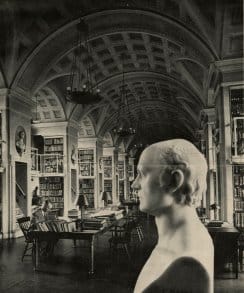
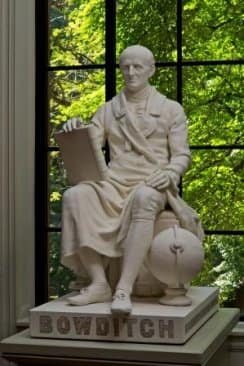
Bowditch, whose likeness looks out over the second-floor Long Room (read about the sculpture here), was born in Salem, Massachusetts on March 26, 1773 to parents Mary and Habakkuk, a cooper. The family was not wealthy, and Bowditch was forced to leave school at the age of ten despite his obvious interest in and aptitude for mathematics. Once withdrawn from school, Bowditch began an apprenticeship at Ropes & Hodges (a company that sold shipping supplies and equipment) where he worked as a clerk. Though he wasn’t formally enrolled in school during that time, he managed to teach himself algebra, calculus, physics, and Latin.

Having finished his apprenticeship, Bowditch set off for the first of five voyages, completing his final expedition as shipmaster. During these journeys between 1795 and 1803, Bowditch began developing his own methods for determining longitude, the skill taught in Hamilton’s Practical Navigator, the skill necessary for sailors to learn. Bowditch’s own methods improved upon Hamilton’s, and as he taught his techniques to his fellow shipmates he began revising Hamilton’s standard text. The first two revised editions were published in 1799 and 1800, and The New American Practical Navigator, which markedly deviated from the original, was published in 1802 by Edmund Blunt of Newburyport, Massachusetts.

After Bowditch’s last voyage to Sumatra, he settled down at the age of 30 to married life with his second wife—he had become a widower while at sea and returned home to marry his cousin Mary—and took up the post of president of the Essex Fire and Marine Insurance Company of Salem until 1823. He then worked as an actuary for Massachusetts Hospital Life Insurance Company of Boston, where he remained until his death in 1838.

Though his feet remained planted firmly on land for the rest of his life, Bowditch continued his revisions of the Navigator and wrote extensively on the subject of celestial mechanics. He was offered professorships many times but refused, preferring to remain in the insurance industry and study independently. In recognition of his many contributions to the field, Harvard College presented the legendary navigator with an honorary Master of Arts, and in 1816 made him an honorary Doctor of Laws. In 1867, the U.S. government purchased the rights to “the Bowditch” and continues to publish the title, revising to accommodate technological advancements.

Bowditch’s eulogy, given by the Salem Marine Society, affirms what both admirers of Bowditch the man and followers of Bowditch the book still know to be true: “As long as ships shall sail, the needle point to the north, and the stars go through their wonted courses in the heavens, the name of Dr. Bowditch will be revered as of one who helped his fellowmen in a time of need, who was and is a guide to them over the pathless ocean, and of one who forwarded the great interests of mankind.”

Nathaniel Bowditch is buried in Mount Auburn Cemetery in Cambridge. His Salem home is a National Historic Landmark.References

Bowditch, Nathaniel. The New Practical American Navigator: An Epitome of Navigation. (Bethesda: Paradise Cay Publications, 2002).

Britannica School, s.v. “Nathaniel Bowditch.” http://library.eb.com/levels/youngadults/article/317889 (accessed June 20, 2015).

Kalkstein, Molly E. “The World According to Bowditch.” Naval History 17, no. 2 (April 2003): 42. America: History and Life with Full Text, EBSCOhost (accessed June 20, 2015).

Lardas, Mark N. “The Navigator.” American History 37, no. 5 (December 2002): 22. Academic Search Complete, EBSCOhost (accessed June 18, 2015).

Thornton, Tamara Plakins. “The ‘Intelligent Mariner’: Nathaniel Bowditch, the Science of Navigation, and the Art of Upward Mobility in the Maritime World.” New England Quarterly 79, no. 4 (December 2006): 609-635. Academic Search Complete, EBSCOhost (accessed June 18, 2015).

USS Constitution Museum. “The American Practical Navigator, by Nathaniel Bowditch.”http://www.ussconstitutionmuseum.org/proddir/prod/496/56/ (accessed 18 June, 2015).

06.17.2015

Susan Playfair

July 2015

By Arnold Serapilio

Overview

New York Stock Exchange. Groundfishing in New England waters. Sculpture. Contract interior design. Arbitrage. Cranberries. When I think of my conversation with Susan Playfair, what strikes me is just how eclectic is her curriculum vitae. Cranberries, she writes in her newest book, America’s Founding Fruit: The Cranberry in a New Environment“can be boiled in sauces, baked in a pie, frozen in sorbet, dried in cereal or salads, pulverized in capsules, even served smoked.” I will have to fight the urge to metaphorize Susan’s professional versatility into a tart red berry. The facts are more compelling anyway.

Experience

New York Stock Exchange, Wall Street1965–1968
  • Worked for a semi-retired financier in an office on the 53rd floor of 40 Wall St, “with views of both rivers. It was quite palatial.” The boss specialized in arbitrage—the process of buying and selling stocks priced unequally in different markets for profit—and in working as his assistant, learning the ropes was inevitable.
  • Lived in New York City, decided it was not a good long-term fit: “I’d been in the city for five and a half years at that point. New York, when you’re in your early twenties, is very exciting, and I had this café society strange group of creative friends. But, five years, for me—suddenly I just realized I was ready for a different quality of life. It was summer, and my commute down to Wall Street was always in hot hot hot subways, and these men in their business suits would try to push me out of seats, and I thought, ‘This stinks. This is crazy, I could be by the water, or swimming. What am I doing here?’”
  • Unconsciously prepared for next foray into finance. Of unplanned study of arbitrage: “I suddenly had this niche understanding. When you’re younger you haven’t planned to move from this career to that career but suddenly it makes sense.”
Goodbody & Company, Boston1970–1971
  • Became the first female registered financial broker at the fifth largest stock brokerage in the country. “I began calling these brokerage firms and ask if they would consider me for a training program. Most of them, I never even got past the secretary. But this particular firm put me in touch with the manager. I said, ‘Would you consider hiring a woman for your training program?’ He said, ‘Absolutely not.’ Which could never be said today, but he felt totally free saying that.” Tenacious, insisted on leaving contact information, and sure enough, days later received a phone call from Goodbody’s top producer (i.e., the employee most profitable to the company) who was based in Boston and needed an assistant. “Only if I can get in the training program,” was her response, and in that manner it was decided.
  • What was it like being the only woman broker in the office? Was she regarded as an interloper in this Boys’ Club? Constantly kept outside the entrance to the treehouse? Not quite. “It was sort of a game for him, I think. He was very supportive, and the younger brokers thought, ‘This is sort of a lark. We don’t have any women brokers in Boston, so why not?’”
  • The industry was, at this point, pre-computerization, so all records of trades had to be taken down by hand and physically kept track of. Without efficient infrastructure in place to manage the ever-increasing volume of trades, the work grew increasingly expensive. For some firms, conditions were untenable, and they collapsed. Goodbody was one of those firms.
  • Though the firm (and the family who started it) went out of business, the customers did not. “At that time, a clear understanding existed among brokerage firms that they had a duty to protect the public in order to maintain the integrity and existence of the stock market. Without a feeling of confidence in the market, the public wouldn’t invest in it.”
Gloucester Engineering, Gloucester MA1971–ca.1974
  • Designed and supervised construction for the interior of the new offices the company was building.
  • Served as Director of Public Relations after aforementioned project was completed.
  • Received gift membership to the Boston Athenæum from Boston architect and family friend Ed Bullerjahn. Instantly fell in love with the space and to this day misses the exotic plants that used to adorn the fifth floor, found them beautiful and inspiring.
Interaction, Cohasset1982–1999
  • Again putting to good use skills acquired from previous employment, co-founded a design collaborative. An architectural firm and a space planning firm were the other interested parties.
  • Took over as sole owner
Vanishing Species: Saving the Fish, Sacrificing the Fisherman1999–2003
  • While making plans to renovate a barn in Cohasset (the first floor of which was being used to run Interaction as a sole proprietorship), stumbled upon a man up on a ladder at a nearby house doing construction. Told him about her own project and what she was hoping to accomplish. “About two weeks later someone walked in my house out of the blue. I heard this big belly laugh and this person saying ‘I never thought I’d be in this building again.’” It turns out the man had pitched hay in that barn, growing up. He helped with the renovation. The whole thing’s pretty Flannery O’Connor.
  • He was also a retired fisherman, and on lunch breaks would fondly recall stories of his fishing heyday. When his son—who at the time was a co-owner of one of the last fishing boats to fish out of Boston—arrived to do some painting, “he [the son] began talking about this incredibly—as he saw it—over-regulated industry where he couldn’t do anything. So here were these diametrically opposed stories” from one generation and the next.
  • Intrigued by both the stories she’d been told and the reading she’d done about the disappearance of the fish, needed to know more. The men introduced her to fishermen in other ports and soon she was going out on boats and getting words on the page; the research had begun in earnest.
  • What were the great joys of writing this first book, the great struggles? “The most arduous part is trying to find a publisher. Trying to find a publisher is a nightmare. But I really enjoyed both the writing and the interviewing, and with both these books I’ve really liked the people that I’ve been interviewing. I gain a lot of respect for them. Meeting them, getting to know them better, getting to know the industry better.”
America’s Founding Fruit: The Cranberry in a New Environment2008–2014
  • Walked, as a child, the cranberry bogs that great-grandfather owned. “In the town where I grew up [Duxbury, though she was born in a hospital in Plymouth, MA – ed.] we had quite a few people who worked for Ocean Spray, who lived around us, so I got used to this world of cranberries.”
  • Started, as an adult with connections to scientists through husband’s work, thinking about the future of the cranberry as it related to global climate change, and as with her first book, wanted to learn more.
  • How do you summon the discipline from within yourself to complete a book? “Something that was very helpful to me was, Toni Morrison gave a talk, and [to this point] she said you start by looking at how your particular body works within a day. What’s your diurnal cycle? When are you at your best? Are you at your best at five in the morning? Are you at your best at midnight? I thought, ‘I’m really at my best at about three in the afternoon. So I’ve found that if I can just discipline myself to at three o’clock have done whatever I have to do that’s essential that day, from then on I give myself three hours, and I can work within that three hours without buying groceries, doing laundry. That’s the only way I find anything gets written.”

Education

Bard College, Red Hook NY1958–1962

Attended Bard expecting to study writing under Ralph Ellison. Due to scheduling conflicts, however, Ellison turned out not to be available, so she left the writing major and took up sculpture, graduating with a degree in fine arts.

She also spent two years studying at Parsons School of Design.

Skills

Insuppressible curiosity that stretches in many directions; moxie; design savvy; total commitment to a project; focus; enthusiastic conversationalist and professional communicator; writing that is descriptive and delectable, like this, from her latest: “The temperature is seventy-three degrees. Morning clouds have disappeared to allow the sun to highlight a wash of red berries on indigo blue water.”

The take-away

To live well is to learn everything you can. To stay mindful, curious, and focused on a task until the job is done. Susan Playfair lives well. I have my inspiration.ReferencesPlayfair, Susan.Vanishing Species: Saving The Fish, Sacrificing The Fisherman. Hanover: University Press of New England, 2003.Playfair, Susan. America’s Founding Fruit: The Cranberry In A New Environment. Lebanon: University Press of New England, 2014.http://www.susanplayfair.com/