
11.22.2017

Cullen Murphy

December 2017

By Mary Warnement

“Edit this, trim it all down.” Cullen Murphy opened with this advice about how to handle the transcript of his interview—welcome words from a respected author and editor—as we sat down to chat in my office about his latest book, Cartoon County: My Father and His Friends in the Golden Age of Make-Believe. Murphy is currently editor-at-large at Vanity Fair, which he joined in 2006. Before that, he spent two decades as managing editor of The Atlantic Monthly, and on the side, starting in 1979, he wrote the comic strip Prince Valiant, a 25 year collaboration with his father John Cullen Murphy, who had succeeded Hal Foster as illustrator of the strip. Murphy’s book is an evocation of a now-vanished world, when scores of the country’s top comic strip artists lived and worked a few miles from one another in Connecticut. As Murphy put it when we spoke, “Fairfield County, with its large concentration of cartoonists in the mid-twentieth century—my father centrally among them—is the locus of my book.” Cartoon County ranges widely—where did cartoonists get their ideas? what were their ideas? were they funny in person? could they draw?—and is held together throughout by a son’s loving portrait of a father.

Born in New Rochelle, New York, in 1952, Cullen Murphy was raised in Cos Cob, Connecticut—the eldest of eight Murphy children. He attended Catholic grammar school and enjoyed the two years when his parents “moved the whole family, just on a lark” to Dublin, Ireland, for his seventh and eighth grade years. In 1974, Murphy graduated from Amherst College. He now chairs its board of trustees. Murphy credits Amherst with, among other things, “one of my most influential jobs—a truly intensive education” on the Amherst Student, the undergraduate newspaper. After graduation, Murphy worked at Change: the Magazine of Higher Learning and The Wilson Quarterly. He wrote for the Atlantic Monthly before joining the staff and remained there until shortly before the magazine’s offices moved to Washington D.C. His wife, Anna Marie, whom he met at The Wilson Quarterly, is the deputy editor of Boston College magazine. They have three children.

The Athenæum has Cullen Murphy to thank for its select holdings, primarily from the twentieth century, of archival material from The Atlantic. Anyone interested can discover this archive’s finding aid in the online catalog and make an appointment to study it in the Arthur and Charlotte Vershbow Special Collections Reading Room.

Murphy had discovered the Athenæum when he first moved to Boston. “I was lucky enough to fall in with some people who knew the Athenæum well,” he recalled. “I was drawn to the Athenæum immediately—who wouldn’t be? It’s an extraordinary resource, both for its holdings and for the physical space it occupies. And it’s in the very heart of the city. I wrote one of my books up on the fifth floor, and have researched others here.” He loves exploring in the drum stacks as much as he enjoys the view of the trees from the main reading room.

We debated the merits of views from different floors in this historic landmark building. He recalled observing the red-tailed hawks nesting in a cornice overlooking the Granary Burying Ground, and he admired my second-floor office window view still shrouded by a thick canopy of leaves in November—a consequence of thermal peculiarities in the neighborhood—before we turned to the topic of his new book.

Q: What was your biggest challenge while writing Cartoon County? It had to be quite different when the subject is your father rather than ancient history, as with Are We Rome.

The biggest challenge was finding the right tone—in the middle ground between distance and sentiment. The world I am trying to describe is gone and so is my father—so distance is inevitable, and indeed is part of the story: something vanished and irretrievable lies beyond the membrane. And yet too much distance can feel cold—and the subject matter is in fact very warm to me: my life was intimately bound up with what I’m writing about. It would be easy to err in the other direction—to become too personal, in a way that readers might find hard to take. I had been toying with the idea of writing a book of this kind ever since my father died, in 2004, and was waiting for a moment of emotional balance to assert itself. One summer day, three years ago, I had an idea for how to start the book, and found that, as I started writing, I was in the right place (I hope).

Q: What sort of review do you think your father would give Cartoon County?

Well, I have one small clue. Two decades ago, I wrote an article about him and the artwork he did in the Pacific during World War II—it was for American Heritage magazine and was abundantly illustrated. My father didn’t read it until it came out, and when he called me he was in a fine mood and said, “Most people don’t get to read their own obituaries.” In other words, he was tickled. My father loved the cartoonists’ world that he was a part of, was rightly proud of his own achievements, and was conscious of the fact that the cartoonist community as he knew it was slowly fading. He would have liked knowing that it was being preserved in memory somehow. As for what I write specifically about him as a person—as a character—I suspect he would have found himself torn between embarrassment and enjoyment: not a bad place to be.

Q: He was drawing when you were young. Did you doodle or color in his works?

I never did that. There were a lot of kids in our family and he had a little drawing table in the studio for the children. All of us would sit there at the mini drawing table doing our own work. I never defaced any of his.

Q: Are you the only sibling who worked with your father?

No, my sister Meg [Mairead Nash] was also intimately involved in the strip. I’m the oldest, she’s the youngest. She did all the lettering and all the coloring. Lettering is one of those under-appreciated arts. Nowadays you can buy computer fonts that look like real comic strip lettering, and they’re good enough, but they don’t look like what a master would make. My sister Meg was extremely good.

Q: Were the children of your father’s friends at that same table in the studio? Were you friends with them?

With some of them. There were a number of other cartoonists who had families, sometimes even large families. Mort Walker, who is still alive, and who did Beetle Bailey and other strips, had six children, and we would see them. The children of other cartoonists pretty much had the same experience we had. There were real commonalties. One is that your father—and it was almost always a father—worked at home. Nobody else’s did. So he was always around. Second, your father was doing no visible work. I mean, we knew on some level that in fact he was working, but it looked like fun rather than work. Probably the most important thing is that all of these people were living by their wits. They weren’t hired by a company and told that this is your job and here’s how you do it. Come in every day and do that. They had to be thinking all the time about what is it that they were creating, how to do it over the next week. It was an unusual way of putting a life together, at least at that time, when many other people in the same neighborhoods in Connecticut were working for corporations, banks, and Madison Avenue, and children didn’t see their fathers until their fathers came home. It took a while before you began to understand how unusual this was. And it was something very special, something to be cherished.

Q: You work as an editor. When you step into the other side—as a writer—how’s it work? Are you your own editor?

Throughout my life I’ve been an editor and a writer, so the nature of that dynamic is pretty well known to me and I see it from both sides. This may be wishful thinking, but I’m probably not a troublesome writer for an editor, and probably not a troublesome editor for a writer. I had a wonderful editor at FSG (Farrar Straus Giroux) named Jonathan Galassi, who is the editor in chief there. He is very shrewd and had some terrific advice on the macro level. He’s also a very smart line editor. It was an educational experience working with him, so I’m deeply grateful to Jonathan for that. As well as for signing up the book.

Q: Would you ever write about your life as an editor?

No. I prefer to be outer-directed in what I write. Even in this book, which seems to be a memoir, the substance is not about me. I’m just the set of eyes that is viewing. It’s my father, it’s his friends, it’s this world that I saw—that’s the subject.

Q: Do you take much of a breather, or do your projects overlap?

I tend to work on many things at once. It’s fun to jump from one task to another. If you’re doing the same thing all the time, it can become a little bit stale. When you have the freedom to move from one endeavor to another, it makes everything that you turn to seem fresh.

Q: So what are you working on now?

I have two books under way with Farrar Straus. Right now I’m in the middle of research on the fountains of Rome—how and why Rome came to be the city with more fountains than any other. It’s a tale that begins in antiquity, gathers force in the Renaissance, and ranges over topics like the environment, urban and papal politics, art history. There’s even a lost manuscript that plays a crucial role.

Down the road I plan another book about “how to edit yourself,” because it’s very hard to get the perspective on your writing that fresh eyes have—eyes that aren’t your own. And more and more people are writing, even if it’s only for their families and themselves.

Q: Two books about Rome? Why Rome?

I love the city of Rome. I love the history of it, the art, the feel of it as a social space, and I go back there frequently. A friend, who had never been there before and went for the first time, came back, and was going on and on about the fountains. That was a classic case of someone seeing with fresh eyes something that I was taking for granted. So I thought about the idea of doing a book on the fountains, and it turns out there’s an interesting back story. Why, during the Renaissance and the Baroque period, did the city suddenly embark on the greatest effort at fountain-building the world has ever seen?
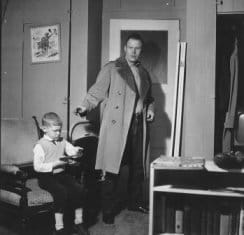
Murphy as a child, photo courtesy of Cullen Murphy

Murphy as a child, photo courtesy of Cullen Murphy.

Q: Have you worked in any of the libraries in Rome?

The Vatican Library. For the fountains of Rome book, I wanted to look at and eventually reproduce original design drawings of fountains as well as engineering plans for sixteenth-century waterworks. The Vatican Library has a lot of this—they’ve even produced a wonderful book of Bernini drawings, about six inches thick, including designs for fountains and monuments that were never built. Most of us know the famous statue of the obelisk on top of the elephant, but Bernini had other ideas for what to do with that obelisk which he made designs for and are fun to look at. Anyway, many of the original Bernini drawings are preserved at the Vatican Library, and so I made a point of going there and seeing them for myself. Librarians in white coats brought them out in stiff folders and laid them out for viewing.

We ended our conversation by repeating our shared appreciation of the view from the window. Murphy hopes to return to the Athenæum when he writes the fountains book. I asked how working at the Vatican Library compared to the Athenæum, where visitors frequently feel overwhelmed. He said, “You don’t have to surrender your passport when you enter the Athenæum.”

Selected Works

Atlantic Monthly Press, Archive, ca. 1866–​2003 (Mss. .L738) Rubbish!: The Archaeology of Garbage (Library of Congress TD793.3 .R38 1992)Just Curious: Essays (Library of Congress AC8 .M895 1995)Word According to Eve: Women and the Bible in Ancient Times and Our Own  (Library of Congress BS680.W7 M87 1998)Are We Rome?: The Fall of an Empire and the Fate of America (Library of Congress E169.1 .M957 2007)God’s Jury: The Inquisition and the Making of the Modern World (Library of Congress BX1713 .M87 2012)Cartoon County: My Father and His Friends in the Golden Age of Make-Believe (Temporarily shelved at New Book Shelves CT275.M8639 M87 2017)

10.26.2017

Stephen Davis

November 2017

By Kaelin Rasmussen

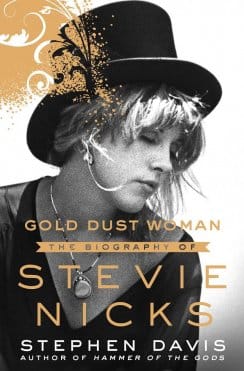
Stephen Davis started his writing career in music journalism. Now he writes biographies of rock stars. Wikipedia will tell you he is “perhaps America’s best-known rock biographer.” Led Zeppelin, The Rolling Stones, Fleetwood Mac, Aerosmith, Guns N’ Roses, Carly Simon, Bob Marley, Jim Morrison…any of those ring a bell? His newest bookGold Dust Woman, is about Stevie Nicks, and will be released on November 21.

A longtime resident of Milton, he has been a member of the Athenæum for over 30 years. When we spoke in early October, he shared some BA memories, his fondness for typewriters (“I’ve got my father’s 1940 Corona, it’s like this tall, and, you know, ‘tap-tap-tap.’ My children think I’m insane.”), and also some of his experiences as a bestselling author, all with a good, ready dose of dry humor.

Q: Tell us about your background, where you were born and raised, etc. And how did you get into writing biographies?

A: Born and raised in New York City, went to a private academy in Philadelphia, had five years of Latin, and I came here, to Boston University, in 1965, and I’ve never left. I started my career writing. I was the editor of the BU News, which at the time was the largest student newspaper in the country—this was in 1967, ’68, ‘69. Couldn’t really go to class because we were going to demonstrations every day. I burned my draft card on the steps of the Arlington Street Church, 50 years ago, like, this month, November, October, with all my friends. Several thousand people burned our draft cards. Then when it was time to be drafted later on, I had to tell them that I didn’t have my draft card anymore.

But anyway, I graduated in 1969. I wrote the first story on the first front page of what was then called the Cambridge Phoenix, which then became the Boston Phoenix. I was the music editor of the Phoenix, a weekly paper in Boston. There were so many students. Each issue was 500 pages, in ten sections…they were amazing, and unwieldy. Then I became music editor of Rolling Stone, and then started writing for The Boston Globe, and The New York Times.

And then an editor at Doubleday saw an article I had written about Bob Marley, before anyone had heard of Bob Marley, and commissioned me and my photographer friend, Peter Simon, to go to Jamaica and write a book about reggae and the politics in Jamaica and the Rastafarians and ganja, all that stuff we kinda liked anyway—and that’s where my pathetic career begins. And this book was published 40 years ago this month, called Reggae Bloodlines, and this led to several other books about Jamaica. I worked with Bob Marley on his memoirs, and then he died and I finished them. And I left Rolling Stone and started working with rock bands.

I had this wonderful literary agent who said, ‘All of these rock bands are gonna have legends, and someone’s gonna have to be the guy who writes the legends.’ And so I started touring with Led Zepplin, Rolling Stones, and spent ten years doing that and working with all the big bands, Fleetwood Mac and Doors, and all that stuff. I’ve published 19 of these things so far…

You hear a lot of talk in my business that rock is dead. ‘Rock’n’roll will never die,’ but now these aren’t the same stories as the rock stories. Rock is like an ‘ism’, it’s like an artistic movement, like modernism or surrealism, and Rock-ism is kinda over. But on the other hand, it’s spawned the biggest audience of its kind in history. I mean, Zepplin sold 200,000,000 albums; Fleetwood Mac, over 100,000,000. There are religions on the planet that don’t have as many people as in the rock audience. So that’s why I’ve been so lucky, to be the guy telling these stories to this enormous planetary audience. My books get translated into Urdu, and Chinese piracies, Arabic, and Korean—Bob Marley just came out in Korean—and Hammer of the Gods is in 20 different languages…and some of the material in, like, the Bulgarian editions is stuff that I didn’t write, they just throw it in there to bring the story up to date. So I’ve been very lucky to have this audience. But I think we’re in the last years of this audience. I don’t think that many people want to read about Lady Gaga, Katy Perry, or whoever the bands are today. There have already been about ten books about U2. It’s amazing that Stevie Nicks is getting such great reviews. She’s still around, she’s 69 years old, and she’s going out on tour with Fleetwood Mac for the next two years. But these are the last days of this, so I’m gonna have to switch to, like, horticulture or some other topic. I’ll figure out stuff to do.

Q: How did you find your way to the Athenæum? What about it appeals to you?

I had a friend whose father was a proprietor, and when I was working on the Bob Marley material in the early ‘80s, he said, ‘You should go to the Boston Athenæum because they’ll have all this stuff on Jamaica that no one else has,’ and it’s true. This library has Long’s history of the island of Jamaica. You have to go to the rare book room. They have all this incredible stuff, you’d have to go to the British Library in King’s Cross in order to get as good early, early Jamaican stuff…so I joined the library. Back then it was two or three recommendations I had to get people to write, to prove I wasn’t a book thief. Which is a lie [laughs]. And it was amazing. This was in the days of Rodney Armstrong, several directors ago, and he didn’t believe that the library should be air conditioned or climate controlled—and you could ask Mr. Feeney about this, he remembers this—sometimes on hot summer days, a directive would go out, a memorandum, mimeographed, saying, ‘Everyone go home at three today because we don’t want anyone to die.’ And so if you were coming to return a book in July, the entire staff would be coming out of the library, staggering out, drenched in perspiration, literally streaming with sweat because the library was so hot!

I use the library all the time. It’s hard to park, though. I don’t take advantage of the book mailing because I like coming here so much, you know, because Milton is so boring. And to come up to Beacon Hill is a cool thing. The library has been, really, an important part of my career. As a guy who writes rock books, it hasn’t been all that germane, but the thing about my books is I try to bring in all the other stuff that is the background, like with Long’s history of Jamaica, to find out where it’s all coming from.

Also, the serials and periodicals are really important, because Tom can lay his hands on all sorts of esoteric stuff, from way back…unfortunately he won’t let me take them home [laughs]. It’s okay, it’s a library, I’ve become used to this.

Gold Dust Woman book cover

Davis’s new book, published in November 2017.

Q: What about your newest book?

My new book is called Gold Dust Woman, a biography of the singer Stevie Nicks from Fleetwood Mac. It covers the period from her birth in 1948 to 2017.

It’s gotten rave reviews in the trades…it got a star in Publisher’s Weekly…which is a good thing, and a very good review in Kirkus, and now we’re waiting for Library Journal, if it still exists [ha]. It’s the big three. If you do very well in those, odds are that the librarians—how many thousands of towns out there in this country and how many thousands of librarians?—so of my 19 books, I think five have been NYT bestsellers. You can tell pretty early on because when the orders start coming in from the libraries in Kansas, Montana, whatever, there’s hundreds of them. That’s the way they do the bestsellers list, they look at libraries, they look at Amazon, the independent bookstores, all that.

I have this ritual when I’m in New York, where I go to the St. Patrick’s Cathedral, St. Andrew’s Chapel, and I throw in like 50 bucks in the little thing, and I light about ten candles and I go, ‘Please, please, one more bestseller!’

All readers are writers, even if you don’t write. I will say to the younger writers—it’s the old Robert Graves joke—that the only thing that an old writer can do for a young writer is die. You can’t teach this stuff, you either have it or you don’t, so I’m prepared to die. As soon as someone wants to come up and do what I do, I’m gonna retire.

10.18.2017

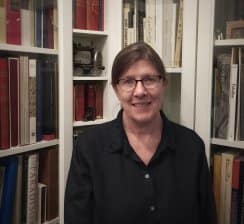
Dr. Heidi Gearhart

January 2018

Interview by Arnold Serapilio

Dr. Heidi Gearhart discovered the Boston Athenæum as a teenager when her mother brought her on an impromptu trip to Boston for an informal tour of historic sites. She was taken with the atmosphere of the first floor reading spaces. ‘Those big red chairs, and looking out onto the graveyard. I just loved it.’ She went on to obtain a Bachelor in Arts from Pomona College, a Master in Art History from Tufts University, and a PhD in History of Art from the University of Michigan. Then, after several years of moving around the country and the world for various academic and professional pursuits, she landed back in Boston to teach at Assumption College, where she is currently Assistant Professor of Art History​.

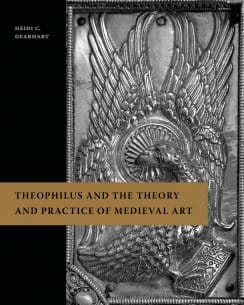
Gearhart and I sat down to discuss her first book, Theophilus and the Theory and Practice of Medieval Art, an exploration of twelfth-century German monk Theophilus’s rare treatis​e On Diverse Arts—and also the excitement of the highs and lows of the writing process, and the new project on her horizon.​

DR. HEIDI GEARHART: I grew up in Marblehead, and I went to college out in California. I studied studio art, and mathematics. Then I bounced around for a number of years: I worked in L.A., I lived in Italy. I came back here to get a master’s at Tufts. I ended up at Ann Arbor for my PhD. I got into art history because I decided I really like art but I don’t actually like doing it. I don’t like sitting there and mixing paint, say. [laughing] I loved writing in my journal about what I would do—that’s what I liked. 

Q: Taking it in is what moves you—

HG: Thinking about what art could be. At this stage—thinking about what art has been over thousands of years, right, and we’re sitting here at the edge of it looking back—what is there to do now? I was really obsessed with that question. How do you do something that is worthwhile at this point in time? That was more interesting to me than actually sitting down and doing it.

Q: I’m curious about the mathematics connection because there are other members who seem to have this dual aptitude for math and art. I don’t know whether it speaks to a larger pattern. What was your background in math?

HG: I just always liked it so I just kept taking it. In some ways it has correspondences to writing. I like the beauty of numbers. I like that there are patterns. I like the abstraction. And there are some parallels to the way I think, in terms of art history. In terms of process, when you’re doing a math proof, it’s like a puzzle. You’re trying to make the pieces work, and sometimes you go down one path and you get stuck. ‘But all my logic was sound!’ and yet you get to a stopping point. Writing is like that. You go down these paths and you get stuck but you have to go down there, and then you come back up and you finally find the right path and all the pieces fit and it’s this amazing, gorgeous thing.

Q: Is that how it happened with this book?

HG: Yes and no. I think writing is a whole bunch of small instances of that—and lots of dead ends. I wouldn’t say that as a whole it was that way. It was such a big project that happened over such a long period. 

I was first introduced to the topic of this book, this twelfth century art manual, in grad school. It started out as thinking about who artists were in the Middle Ages, and using Theophilus’s manual to think about artistic practice during that time. I looked at all the manuscript copies of that text. There are 25 of them and they’re all over Europe, so I went and looked at every single one and tried to figure out, How is this book read? How was it understood in the Middle Ages? So that was the dissertation, finished in 2010. In 2011, I started working on this book.

Q: When you were doing your dissertation, were you thinking the whole time that you would eventually expand it to book proportions?

HG: I had hoped to. In academic art history that’s the goal. If you get an academic job you’re expected to come out with a book in six years. You hope that it will turn into a book—and that it won’t be that hard to turn it into a book—famous last words, right? I decided I would talk about what the values were of art-making in the twelfth century. What did artistic work mean? What did it mean to be somebody making something in the medieval period, particularly in a monastic context? Because there is this idea that work and learning are part of your spiritual exercise. Theophilus is trying to make art-making part of the spiritual world.

Q: Is writing a love of yours or a means to an end?

HG: I really enjoy it. I enjoy the process. It’s hard, but I enjoy it. I like all aspects of it. I like when you’re writing just to write, to get something out. And then there’s this whole long process of going back and endless editing and figuring out, What am I actually trying to say? It suits me somehow. I would write all the time if I could. 

Q: And your writing is primarily research-based, right?

HG: Right.

Q: So you have that whole other layer of—if I had to pull from sources to put something together I would never be able to stop the research portion and begin writing. How do you negotiate that balancing act? Is that a challenge for you?

HG: There is this point where you have to just cut yourself off and write. And know that you can fill in holes. I’ve found you don’t always know what you need until you’re writing, so it actually is good to start writing sooner than later.

I was writing an article about an altar-piece, and I thought I was writing about aspects of material—it has this inscription on it that says it’s made of this much gold and this much silver. And it turns out that altar-piece, which was from Germany, is a lot like altar-pieces that were being made in Denmark. But if I had just kept on going with the strain of research that I thought I was doing, about materiality—what I really need to know is how this piece works with other pieces. So then I had to go and look at Danish altar-pieces.

Q: What were some of the great joys and struggles of this writing process?

HG: I had one chapter that was really difficult—I had to rewrite the entire chapter. And at that point it had already gone through peer review and wouldn’t again.

Q: When you delivered the first version were you feeling that part was off?

HG: I knew I had struggled with it. One of the nice things about writing is that when an argument works it doesn’t feel difficult or convoluted. When you have a really clear argument, it makes sense. It will unfold, and the pieces fit, and you’re thinking clearly. Getting to that point is horrendous. That’s the struggle, right? But somehow, I have this gut feeling about what something is at the beginning. Then I go on this roundabout path, and at the end of the day I end up pretty close to where I started—but it’s more clear. I enjoy taking a step back and thinking, What am I actually trying to say? With that chapter, I was trying to make the argument more complicated than it needed to be. And in making it more complicated than it needed to be, it was weaker. 

Q: There’s this tendency to get as much out of you and onto the page, but simplicity always seems to be the way to go. When I write drafts, I usually end up cutting most of it.

HG: But that’s not a bad thing. I have to go through that process. I wonder whether there are people—you hear stories about somebody who’s such a clear, brilliant thinker that they just sit down and—

Q: You hear those stories, but is that all [bunk]? I’ve never actually met anyone who has copped to that.

HG [laughing]: Me neither!

Q: Rewriting and reassessing what it is you were trying to say in the first place, for me, is the actual work.

HG: Right, right. I think for most people, writing is really hard work. I enjoy the work—but it’s really time consuming, it’s really slow, and it’s hard.

I remember talking to someone when I was writing my dissertation. I was in Germany at the time. He’s an American professor and was there giving a lecture. I was really in the middle of the dissertation writing and just suffering, suffering to no end [laughing]. I said, ‘This is so awful, does it get easier?’ He said, ‘It gets easier. The dissertation is the hardest, but it gets easier.’ OK. Great. Gets easier. So I finish the dissertation and I work on the book. And I actually just saw him last spring at the medieval conference when this book came out and I said, ‘You told me it gets easier!’ And he said, ‘I did? I lied.’ [laughing]

Q: He probably didn’t want to push you over the edge!

HG [laughing]: He saw that I was going to lose it. He said, ‘It doesn’t get easier, it just gets harder.’

Theophilus and the Theory and Practice of Medieval Art

Gearhart’s new book, published in 2017.

Q: Harder as in busier? Or more daunting?

HG: My optimistic thought is that the longer you do this and the more practice you get, the easier it gets. Because I’ve been through the process now a couple times I understand the process better, so I deal with it better. ‘OK. Here I am in a dead end, step away, calm down, start again.’ Or, ‘Just keep on going.’ 

What I think gets harder—and I don’t know, I’m just speculating in thinking about the new book—

Q: Audience expectation?

HG: Possibly audience expectation, although—well, that is something to worry about—

Q: No. Don’t go down that road! Not worth it! [I’m sorry I even mentioned it, in retrospect]

HG: What I’m thinking of is similar in that, the longer you’re in the field, the more you know. Which is good, because you have more to say. But that also means you know all the problems with any kind of argument. You can see all the different sides. If I talk about how artists are remembered, for example—what does that actually mean? Who is doing the remembering? How are they remembering? That turns into self doubt. It’s a different kind of self doubt. When you’re younger, it’s, ‘Can I do it?’ Now I have less self doubt about that. I can get it done. Will it be solid? As good as I want it to be? Maybe that’s what he meant, when I saw him last spring. You just can see too many sides of the argument.

Q: Couldn’t that ultimately be leveraged as a strength? If you’re able to incorporate it into your work without going insane, you have anticipated and preempted a detractor’s arguments?

HG: Ideally, yes. But there’s also the fear of muddling it. When you’re younger—students see things with fresh eyes because they don’t have all the noise. They can look at something and see it in a new way, and ask a new question that was right there all along. 

Q: Are you able to talk about your current project?

HG: I’m looking at how artists in the Middle Ages were remembered. Who gets remembered? Women don’t get remembered. Lay people—their names aren’t often remembered. A monk will be remembered because he’s part of the system in which they are remembering people. This whole project is looking at the structures of memory and what that tells us about art-making in the Middle Ages. What it meant for an abbey to have something a particular person made. Whether that person was real doesn’t matter so much. What I’m interested in is what that story did for them, why they needed that story to be the way it was.

My favorite story, there’s an abbot who’s trying to build a church, so he hires these stonemasons to come to the abbey to build. He says, ‘While you’re here at the abbey, you can’t eat pork.’ So, the masons go out into the woods and cook a pig. The story goes that a little dove comes to the abbot and tells him, ‘Go out into the woods and you’ll find all your stonemasons.’ He goes into the woods, finds the stonemasons, and tells them, ‘I told you not to eat pork while you’re working on the church.’ He tries to convince them of how it’s good for their soul—this is all in a monastic chronicle, mind you. Finally, he says ‘I’m not going to pay you unless you stop eating the pork and come back to work.’ And the story ends—[here her vocal delivery is ironic]—’And the masons were pricked to the heart, and they decided to go back to work!’

It shows you, number one, that even if you’re a lay person working for the church, you’re expected to behave according to the rules of that abbey. Number two, it’s a tacit acknowledgment of the fact that at the end of the day, the stonemasons a) want to eat pork, and b) want to get paid. So what I’m trying to do is tease out, What can we tell about what matters to these people in art-making through these stories?

I like having a puzzle in my head, that’s just the way I am. I like having something to stew on. I like books for that. They let you think about something for a long time. After [the first book] was done, I wanted to think about the next book. I wanted to have something bigger, more encompassing. I’d rather have that new puzzle to stew on.

Q: That’s a healthy instinct, just forge ahead.

HG: This is why I believe in over-writing. Just write. Some path that you went down that ended up being a dead end could be useful for something else. Things come around. I try to trust in that. And that gives me hope not to worry and not to be too precious. The word to teach in Latin is docere, which is to lead. My Latin teacher said, ‘My job is only to help you put things in order. It’s already in your head.’ All your dead ends, all your discarded ideas—they just haven’t found a place yet. They’re still there. They just need a place to live.

09.11.2017

Dr. Sheila Cordner

October 2017

By Arnold Serapilio

“We seem a bit obsessed with the Victorian period today.”

Dr. Sheila Cordner is commenting on the recent uptick in the exploration of the Victorian period in American pop culture. Cordner suggests there may be something about the structure of the era that resonates—a comfort to the rigidity that scratches us right where we itch, before adding, “We love seeing characters who break out of that structure. Particularly female characters, who learn to thrive even in situations where they’re facing so many obstacles.” Perhaps the media centered on the Victorian time is a reflection of, and a way to transfigure, a shared anxiety in our society.

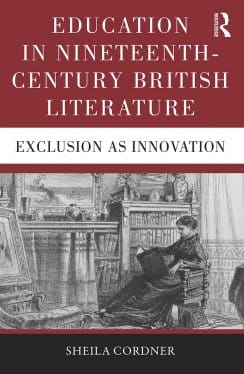
Cordner grew up in Westchester County, New York, in a house full of books, leaving home for undergraduate work at Smith College with an enduring appreciation for literature. At Smith she majored in English and spent a year at Oxford. It was during this year that she fell in love with writing and independent research. Classes demanded only an hour or two of her time per week; the rest she spent ensconced in quiet, self-directed study. She earned her masters in English and Comparative Literature at Columbia while working for Columbia University Press (acquiring a love for publishing along the way), and attributes her drive to write books, in part, as a result of meeting so many professors passionate about their own writing projects. That passion was contagious, and while pursuing her PhD in English Literature at Boston University, she began work on a dissertation that would ultimately become her new book Education in Nineteenth-century British Literature: Exclusion as Innovation, though at the time, concrete plans to expand and publish were not yet concrete. Cordner spoke at the Victorian Literature and Culture Seminar at Harvard University, the Huntington Theatre Company in Boston, and the Jane Austen Society of North America’s Massachusetts chapter, and presented her work at numerous national and international conferences. Before pursuing university teaching and academic writing, she worked in the public relations department at Carnegie Hall and at Columbia University Press in New York, and taught at Dana Hall School and Phillips Academy Andover in Massachusetts. She currently teaches in the humanities at Boston University.

Cordner was pleased to find, upon completion of her book, an infectious jones for all things Victorian in America and abroad. “It doesn’t always happen to scholars to discover the world at large is interested in the subject they’ve been working on. It was thrilling.” Even more thrilling is the fact that she has an engaged and enthusiastic audience for her book, that it appeals across demographics. In fact she describes the positive feedback, from within educational circles and from without, as the great joy of the whole process. The great struggle? Keeping herself from pursuing the myriad tangents of interest that unfurled before her as she immersed herself in research.

“I met my editor at a conference I attended in Venice. We were sitting in this piazza. She had read one of my other essays that I’d published in another book and asked if we could meet at this conference. It was a very wonderful first meeting.” Prior to the book’s publication in England and New York in 2016, Cordner rewrote and revised much of the text at the Boston Athenæum. A friend had once shown her around the building and Cordner was struck by the atmosphere. When she knew she needed a quiet place to finish her book, she signed up for membership and made her way to the fifth floor to work undisturbed, aligning herself with a Boston writer’s tradition that spans centuries and genres alike. Mornings are when the writing gets done, and research is for afternoons.

Cordner's book cover

Cordner’s new book, published in 2016.

In her book, Cordner unpacks a history of traditional education models in nineteenth century Britain, and the ingenuity that some prominent figures—including Jane Austen, Elizabeth Barrett Browning, and Thomas Hardy—leveraged to forge their own path in the face of an exclusionary system. She traces how these well-known authors, excluded from Oxford and Cambridge because of their gender or social class, carved out their own path of rigorous independent learning. Cordner set out to write a book that could be readily understood and enjoyed by both experts and non: “As an academic and professor, one of my main goals is to make these great works of literature more accessible.” That the book has been so well-received is a testament to her lucid and compelling prose.

Having researched Victorian education extensively, Cordner is surprised at how relevant the concerns of the time are to today’s discourse. “It strikes me how so many of these debates are still ongoing.​ Standardized testing, for example. I was interested in the Victorian period because this was when education was made accessible to the masses for the first time in Britain’s history. It wasn’t until 1870 that Parliament passed legislation paving the way for a universal education system. You picked up a Victorian periodical [then] and I guarantee you there’d be some reference to these education debates. It was such a hot topic of conversation and people were so troubled by it. ‘What will happen if we give the masses education? We want to give them just enough to keep them out of the pubs, but not enough to get them to overturn the rigid class structure.’” What have we inherited, good or bad, from these older approaches? What are the echoes? Cordner mentions standardized testing and the attendant limitations, but in the positive column, there is a push to emphasize the value of independent learning, and imaginative, innovative thinking, thanks to the ground work laid down by Austen et al.

This December Cordner will present at the Boston University Women’s Guild, discussing the current fascination with the Victorian Era.​ She has some projects on the horizon, among them a new book in the works about how Victorian children’s literature responded to education reform. Keep your eyes peeled! 

08.29.2017

John Fiske

September 2017

Interview by Kaelin Rasmussen

This month’s Athenæum Author is local writing teacher John Fiske. In June, he sat down with me for an informal conversation about himself, his new book (his first), and what he likes best about being a member of the Athenæum.

Mr. Fiske was born in Boston, has lived in the area his whole life, and now lives in Beverly. He has a BA in history from Trinity College in Hartford and a Master in education from Lesley University. Currently, he teaches English composition at the college level at Bunker Hill Community College in Charlestown. Many of his students are non-native English speakers.

He has been a member of the Athenæum for 14 years, but he has known about us since the late 1970s. At first, he told me, he thought one had to be part of “some sort of privileged, exalted class” to join. He was pleased to discover this was not the case.

Since becoming a member, he has felt a strong connection between the Athenæum’s collections and his work as an educator.

Q: What appeals to you about the Athenæum​ and being a member here?

A: It’s all about literacy, and books, obviously. And given what I do in the classroom, which is to promote literacy, the two just make perfect sense. I really enjoy the collections here, they’re better and different than at a public library. There’s a little bit higher level here, and what’s more, it’s quiet ]laughs]! The Athenæum just connects to what I do in the classroom. And I know I’ve taken books out of here to use in the classroom.

We also spoke about his new novel, Titan’s Gold, and he described to me how he got the idea for the book, the process of writing it, and some of his real life inspirations.

First, a brief summary of Titan’s Gold: it is a science fiction story based on a classic what-if. It is a fact that the NASA/ESA probe Huygens landed on the surface of Titan, Saturn’s largest moon, in 2005. But what if Huygens had discovered evidence of alien life in the form of a derelict spacecraft? The plot is built around designing, planning, and executing a mission (privately funded) to find and salvage this derelict, and bring it back into Earth’s orbit where it can be examined by a team of scientists. In the course of investigating, the team finds evidence that this abandoned alien craft might hold the secrets behind the building of the Egyptian pyramids. But there are others who want the secrets, too, making for an exciting ending that leaves the reader wanting more. Mostly, it’s a fun story, as Mr. Fiske summed it up for me: “That’s what Titan’s Gold is, it’s just fun!”

Not all the action takes place in outer space. Titan’s Gold also has some local color. The characters spend time at MIT, and readers will readily recognize several Cambridge landmarks. And Mr. Fiske’s own experience as a private pilot informs some of the action, including his experience as an observer at the Mt. Washington Wave Camp, where they do glider flights down the mountain!

Q: Tell me a little bit about Titan’s Gold.

A: Titan’s Gold came to mind not long after the European Space Agency craft Huygens landed on Titan. The idea was, what would be the reaction, what would happen if NASA found a spacecraft on another planet? And I tinkered around with it. I tried writing some preliminary chapters, and I got nowhere, for a long time. I could not figure out what the story was. And then in October 2015, I saw the movie The Martian…when I was walking out of the theater, I could feel things starting to move. I decided that the story should be about a very fundamental act, and the fundamental act would either be a chase, a fight, a rescue, or something like that. The Martian was about a rescue, that’s a very basic, human thing to do. So I thought about having the story centered around a basic human act, so the story is about recovering something, bringing something back. And then—I don’t know why this happened—but I was driving with a neighbor…and this whole thing about the pyramids rushed into my head…some people really actually do believe [laughs] the pyramids were built by aliens! From there I said, alright, I know where this is going, I know what I’m going to do. And I started to get to work, and I realized I needed to see the pyramids, so I went there. I visited the pyramids twice—there was nobody there. I was standing there all by myself, and I thought, this is pretty cool! And once I got back I really just put my head down and wrote and wrote and wrote. A lot of junk. I went through probably five drafts, and then I knew I was ready for it to be read professionally. You’ve got to have another reader, you can’t rely on your own reading. So I found a reader through GrubStreet, met with [her], and she said I should be proud of what I’d done, she said she loved it. And I didn’t make any effort to find a publisher. So by the end of March or April of this year I published it myself, it’s available on Amazon, and I’ve done a few publicity events.

Q: What was your great joy in writing the novel? And your great struggle?

A: Joy and struggle. The joy is I just like to write. It’s fun, it’s easy for me. The struggle was typical writerly stuff. Just solving problems, whether it’s point-of-view problems, or timeline problems, and keeping that stuff straight. But the joy is, you know, telling my story, telling a story, getting my words—expressing myself, getting my idea out there. I think it’s a good idea, and I hope people latch onto it.

Q: Do you have any projects coming up—​like a sequel to Titan’s Gold—​that you’d like to talk about?

A: I’m working on the sequel. I know exactly what it’s going to do. There’s going to be a little bit of romance, which is going to be fun. There’s going to be another somewhat vague ending…You know Titan’s Gold was a little vague at the end?

Q: [laughs] There were some things, yeah, that I was wondering about!

A: And I left Titan’s Gold the way it is so that there’s a lot of room for questions, people’s minds can invent stuff, and I want that. I don’t want to be closing off the imaginations of others. The sequel, which will be called Egyptian Gold, is going to end at the Great Pyramid of Khufu. I can’t wait to do it, it’s going to be so much fun to write.

07.26.2017

Laura Davidson

August 2017

By Mary Warnement

“It was the making of me,” said Laura Davidson, about encountering medieval illuminated manuscripts in the British Library (then located within the British Museum). Awed by these books, she returned repeatedly during her week-long visit to admire and study these treasures on display.

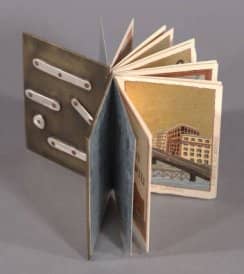
Davidson has loved making books since childhood. Born in Indiana and raised in Michigan, Laura attended Michigan State University, where she followed her two older sisters until realizing that an art school suited her better. She considered going to Cleveland but ultimately chose the Kansas City Art Institute, where she received her BFA. She had thought she would become an illustrator of books, but in searching for the best academic fit she found the most amenable and inspiring mentors by choosing a major in fiber. That spirit of finding her way expresses the sum of Davidson’s life and work. Her final requirement for the degree involved paper-making, which she has not done since graduation; however, the many materials she uses—paper, pencil, watercolor, gold leaf, silver point, copper, vinyl, and so many others, too many to list—illustrate her method; she knows what she wants to make and finds a way to do so, not necessarily using the traditional method. As an example of her ingenuity, Davidson wanted illuminated pages in her work, so she developed her own method for Fort Port Illuminatedan artists’ book now among the Athenæum’s special collections.

Her parents have supported her decision to live a life of creativity—creating and supported by creating—even though many parents would have cringed at the risk of making a living by one’s art. Her father travelled to Kansas City with her when she chose art school; he said he would have liked to attend too. After graduation, she accompanied her parents to Italy where her father was facilitating the use of computer design in car manufacture. She slept on a cot in her parents’ hotel room and was so inspired that later she “kickstarted” her own return to Italy by letting anyone who had ever shown any interest in her work know that if they gave any amount to help her travel, she would in turn give them a drawing. When she first arrived in Boston, she put her art school education in fibers to good use by painting fabric for payment. She would paint silk in the morning, and then work on her own pursuits. (Another artist would then make then the fabric into a dress.)

She had studio space—which occasionally was living space—in the area where she eventually settled into an artists’ cooperative. Her parents visited and stayed with her, even in her early, unconventional studio. She could tell they wondered at her living arrangements, but they did not criticize.

Her works are among the holdings of world-class institutions such as Harvard University, the Library of Congress, Michigan State University, as well as other universities. The Athenæum holds an impressive number of Davidson’s works, but her first interaction gave her mixed messages. In the mid-1980s, she submitted an item for a show but after its acceptance, she dropped it off only to receive a call informing her it had subsequently been rejected and must be picked up. However, that would not be the last word: almost a decade later, Joan Nordell, director of development at the time, was also a collector, and she met Davidson at an exhibition at Harvard’s Houghton Library. That connection brought Davidson back into the Athenæum’s orbit so that she applied for and received a 1996–1997 Mary Catherine Mooney Fellowship to study the Athenæum’s Nuremberg Chronicle as inspiration for her own artistic works. The arrival of a child created new priorities, but as her daughter has grown, Davidson has found time to return to the building.

She enjoys listening to podcasts as she walks up the hill from her Fort Point Studio where she and her partner Gabrielle, a potter, have lived for over 25 years. Davidson claims her time at the Athenæum “fortifies” her. Here she enjoys studying large art books, too large to carry home, in the quiet and contemplative spaces. This allows her to winnow her own collection of large art books to those most essential to her work and pleasure, to find inspiration everywhere—through travel, in great works of art as well as ephemera—and to make her own way.

Fort Port Illuminated

Photo courtesy of Laura Davidson.

Selected Works

5 Cities Walking [art original]. Boston, Mass.: Laura Davidson, 2006.​Almost Home. Boston, Mass.: Laura Davidson, 2014.​Barred Owl [graphic]. Boston: Printed by Laura Davidson, 2015.Boston Treasure [art original]. Boston  Laura Davidson, 2010.Eastern Screech Owl [graphic]. Boston: Printed by Laura Davidson, 2015.Endangered Neighborhood [graphic]. Boston: Printed by Laura Davidson, [1995].Etui Portable Necessities copy #7Flora and Fauna [graphic]. Boston, Mass.: Laura Davidson, 2008.Fort Point Illuminated [art original]. Boston : Laura Davidson, 2006.Gay Authors [graphic]. Boston, Mass., 2015.Ideal City. Boston, Mass.: L. Davidson, 1997.L. Frank Baum & OzMy Mr. Darcys: An Appreciation. Boston, Mass.: Laura Davidson, 2009.Owls Illuminated. Boston, Mass.: Laura Davidson, 2014.Read Art Calling Card [graphic]. Boston: Printed by Laura Davidson, 2012.State House – Boston [graphic]. Boston: Laura Davidson, [ca. 1998].Time, Space and Sea. Boston, Mass.: L. Davidson, 1996.Travelogue. Boston, Mass.: L. Davidson, 1993.Tunnel Vision: The Big Dig View from my Studio Window on the Corner of “A” and Wormwood Streets in Boston, MA.  Boston, Mass.: L. Davidson, 2001.Useful Knowledge. Boston, Mass.: L. Davidson, 1998.WanderlustWormwood Street – Boston [graphic]. Boston: Laura Davidson, 2015.

06.23.2017

Julius Aboyneau Palmer, Jr.

July 2017

By Nicole Critchley

Julius Aboyneau Palmer, Jr. spent his early years as “a roving blade” working as a merchant sailor and captain.1 Palmer was born March 1, 1840, to Julius Aboyneau Palmer, a jeweler and politician, and Lucy Manning Peabody, who bore eight other children. This native Bostonian crossed the Pacific Ocean four times, went around Cape Horn and the Cape of Good Hope, sailed the Mediterranean twice, and spent periods in South America, Japan, and the Hawaiian Islands. He briefly lived in San Francisco before returning to Boston. He mastered many languages, speaking and writing in French, Spanish, Italian, and Portuguese.

Eventually Palmer settled down and turned to writing and lecturing. One can imagine the Athenæum’s ambiance suiting this pursuit. He wrote as a contributor on various current topics for many periodicals, including the Boston Transcript Company (“A trustworthy, clean, and interesting family newspaper”) and the Boston Globe.2 Many of his fictional stories were nautical in nature. Palmer’s experiences as a sailor were just one aspect of his passion for the outdoors. He was a member of the Athenæum as well as the Boston Marine Society, Massachusetts Horticultural Society, Appalachian Mountain Club, and the New York American Shipmasters Association.

Being a “professed fungus eater,” he stalked mushrooms on the Common as one of the founding members and first president of the Boston Mycology Club in 1895.3 Mushrooms and amateur mycology were growing in popularity at that time. Within two years the club had 430 members.4 Palmer published articles about their properties in medical journals and newspapers. Many focused on what made fungi poisonous, and on his own experiments eating them. In a letter to Charles Peck, an authority on fungi, Palmer recalled an inconclusive chicken dinner of a potentially psychoactive variety, calling it “very sweet and good.”5 Palmer rejected British mycologist Miles Joseph Berkeley’s theory that the alkalinity of mushrooms is what made them toxic. He also theorized one could be poisoned by the absorption of toxins through the skin.

Palmer first lived in Pemberton Square, Boston—an area just north of the Athenæum that was eventually torn down to make way for the new court house. He moved farther away to the top (third) floor of Number 10 on Broad Street for the last period of his life. During his travels, he observed that many people lived in the same part of the city in which they worked. There he had a telephone, and according to one Boston Globe article about him, he twice used it to save his building from fire. It is also noted that he owned a beautiful piano that used to belong Josie (Helen Josephine) Mansfield.6

In December 1893, the Boston Transcript Company commissioned Palmer to go to Honolulu “for the purpose of ascertaining the facts in regard to the revolution which was inaugurated on the 17th of January of that year.”7 During that visit, he interviewed Queen Liliʻuokalani as well as officials in the Provisional Government, which had overthrown her. Palmer wrote many telegraphs detailing his observations supporting the Queen and the Hawaiian people. When Queen Liliʻuokalani visited the U.S. in 1896 to 1897, Palmer acted as her personal secretary, which put him into the public eye; their relationship was construed as a romantic one by one news article.8 She mentioned Palmer in her memoir, writing that his “reputation as a man of unblemished honor and integrity, recommended him to me…I have found Captain Palmer to be well informed on all matters relating to Hawaii, whether in those earlier days when he visited the Islands under the monarch, or since 1893 under the rule of the Provisional Government.”9 He used his connections to organize meetings for her with officials, including President McKinley, for whose inauguration she received an invitation. Palmer witnessed the signature of her official protest to the treaty annexing Hawaii. His extensive journalistic work informed his later published books.

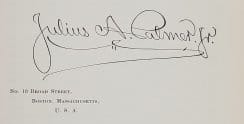
Julius A Palmer signature

Julius A Palmer’s signature.

Palmer died January 11, 1899, in Boston, and is remembered most for his acquaintance with Queen Liliʻuokalani—which garnered considerable public interest—and also as a gentleman scholar with diverse interests in steam engineering, nautical navigation, and mushrooms.

1. “HOMES AMID TRAFFIC’S ROAR.” Boston Daily Globe (Boston, MA 1872–1922), Dec. 23 1894.2. Julius A. Palmer, Jr. Memories of Hawaii and Hawaiian Correspondence. Boston: Lee and Shepard, 1894.3. Julius A. Palmer Jr. About Mushrooms: A Guide to the Study of Esculent and Poisonous Fungi. Boston: Lee and Shepard, 1894: 17.4. Elio Schaechter, “In the Company of Mushrooms: A Biologist’s Tale.” Cambridge MA: Harvard University Press, 1997.5. David W. Rose, “The Poisoning of Count Achilles de Vecchj and the Origins of American Amateur Mycology.” McIlvainea 16, no. 1 (Spring 2006): 37–55.6. Mansfield was a contemporary famous for having one wealthy lover murder the other.7. Palmer, Memories of Hawaii8. “Julius Aboyneau Palmer’s Story.” Boston Daily Globe (Boston, MA 1872–1922), Sep 12, 1897.9. Liliuokalani, Hawaii’s Story by Hawaii’s Queen. Boston: Lee and Shepard, 1898.

Selected Works

About Mushrooms: A Guide to the Study of Esculent and Poisonous Fungi​ (Cutter Classification JE .P18​)
Memories of Hawaii and Hawaiian Correspondence​ (Cutter EBU .P18)
One Voyage and its Consequences​ (Cutter :VEF .P184 .o)

References

Conant, Jennie F. “The Boston Mycological Club.” Rhodora 2, no. 17 (May 1900): 93–95.”Homes Amid Traffic’s Roar.” Boston Daily Globe (Boston, MA 1872-1922), Dec. 23 1894.”Julius A. Palmer Dead.” Boston Daily Globe (Boston, MA 1872-1922), Jan. 14, 1899.”Julius Aboyneau Palmer,” Ancestry.com, accessed May 16, 2017. “Julius Aboyneau Palmer,” FamilySearch.org, accessed June 13, 2017.Liliuokalani. Hawaii’s Story by Hawaii’s Queen. Boston: Lee and Shepard, 1898. Palmer, Julius A., Jr. About Mushrooms. A Guide to the Study of Esculent and Poisonous Fungi. Boston: Lee and Shepard, 1894.Palmer, Julius A., Jr. “HINTS FOR YOUNG YACHTMEN.” Boston Daily Globe (1872-1922): 1. Aug 11 1907.Palmer, Julius A. Jr.  Memories of Hawaii and Hawaiian Correspondence. Boston: Lee and Shepard, 1894.Rojo, Heather Wilkinson. “Who was Julius Palmer?” Nutfield Genealogy, February 2, 2012.Rose, David W. “The Poisoning of Count Achilles de Vecchj and the Origins of American Amateur Mycology.” McIlvainea 16, no. 1 (Spring 2006): 37–55.Schaechter, Elio. “In the Company of Mushrooms: A Biologist’s Tale.” Cambridge MA: Harvard University Press, 1997.Yachting Notes.” Boston Daily Globe (Boston, MA 1872-1922), Feb. 20, 1888.​

05.01.2017

Marjorie Lyle Crandall

March 2017

By Mary Warnement

Marjorie Lyle Crandall published one book, Confederate Imprints: A Check List Based Principally on the Collection of the Boston Athenæum (1955); however, her one effort was considered “monumental” by a contemporary reviewer. It was also called  “pioneering” by those assessing her computer-assisted successors in the 1980s who also put her “fine example” in a class with Charles Evans, pre-eminent bibliographer who published American Bibliography in 14 volumes between 1901 and 1934.  

Crandall was born in 1900 in Malden where she lived most her life. Her father James L. Crandall hailed from New Bedford, Massachusetts. Her mother Carrie A. (Stuart) Crandall was born in English-speaking Canada, St. Johns, New Brunswick. She was, unusually for that period, eight years his senior. They lived in Malden, and he worked as a civil engineer.

Crandall attended Smith College, where she graduated Phi Beta Kappa in 1922. The Smith College Archive holds 85 letters that Crandall wrote home to her parents. During her four years there, she was an assisting managing editor on The Weekly Board and played on the cricket team. Her participation in both La Societé Française and El Club Español, the French and Spanish clubs, no doubt relates to her later affinity for traveling to foreign countries.

She started working at the Boston Athenæum in 1923 as a classifier. She went on to become a cataloguer, then reference librarian. In 1933, her salary increased to $42 a week (approx. $2,184 a year), at a time when the Librarian earned $4,000 a year. When Librarian and Director Elinor Metcalf resigned in February 1946, Marjorie was appointed Acting Librarian at a salary of $300 a month until Walter Muir Whitehill, the permanent replacement, started in July 1946 when Marjorie became Assistant Librarian.

The Athenæum started collecting Confederate Imprints soon after hostilities ended in 1865. Trustee Francis Parkman had agreed to travel south to Richmond with a friend seeking news of family. Parkman was a respected historian, and he shared his vision to preserve printed material from that south that might otherwise have been lost in the chaos of war and its aftermath. His fellow trustees on the Library Committee voted to extend him $500 for purchases during his trip. He bought books, pamphlets, and newspapers, including the Richmond Examiner in full from February 1861 to the end of the Confederacy for $325 more, for which he was reimbursed later.

The librarian William F. Poole pursued further purchases to extend the collection. He used personal and professional connections as well as advertisements in publications. By the autumn of 1865, Poole lamented having inspired expectations of high payment in the Richmond area, but he looked throughout the South. Poole explained the Athenæum’s aim in a September letter [quoted in Crandall’s introduction]:

“What you call ‘the smaller fry of ballads, songs, speeches, and sermons’ is precisely the fry we would tote into our net. We are willing to pay for anything of this sort. Everything printed at the South during the war that goes to illustrate the state and action of the southern mind we desire to preserve in the Boston Athenæum.”

Gifts followed as well. There was critical assessment; they did not collect just any old thing—for instance, autographs were not sought or accepted. Poole was most strenuous in his collecting efforts in 1865 but pursued items until he left in 1868 to become librarian of the Cincinnati Public Library. Acquisitions on a smaller scale continued every year, until 1944 when the Athenæum acquired a whopping 1,500 more items from the collection of Raymond Sanger Wilkins who had started collecting in the 1920s; when he was named to the bench of the Massachusetts Supreme Judicial Court, he knew he no longer had time to devote to his collection. 

Confederate materials were cataloged as other items added to the Athenæum’s collections, but given its specialized nature and unexpected location—who expects to find Confederate printings in Yankee Boston—a separate publication devoted to the subject became a goal. In 1917, the Athenæum published Confederate Literature, a List of the Books and Newspapers, Maps, Music, and Miscellaneous Matter printed in the South during the Confederacy, now in the Boston Athenæum. Charles Baxter worked at the Athenæum from 1903 to 1912, then he became librarian of Blackstone Memorial Library in Branford, CT. James M. Dearborn worked at the Athenæum from 1912 until he retired in 1949. He was, at one point, “Order Department Head” or Head of Acquisitions. James Ford Rhodes wrote the introduction. Rhodes was an Ohio industrialist-turned-historian who made his fortune and moved to Boston in order to find better libraries. In the early twentieth century, he published a multi-volume history of the United States. He was a proprietor at the Athenæum from 1890 until his death in 1927. In 1918, he published A History of the Civil War 1861–​1865 that won the Pulitzer Prize. This 1917 list, as its title carefully calls it, was known as Baxter & Dearborn (though the two never collaborated) and was not considered exhaustive even when it first appeared. “Better than nothing” would be an adequate description of its reception.

After 1944’s increase to the Confederate Imprint Collection, the Athenæum decided it was time to update its published bibliography of the collection. In 1947, librarian Whitehill sought input from southern librarians and scholars in order to improve the revision. Whitehill first engaged a scholar, Hedwig Schleiffer, with funds from trustee Donald McKay Frost, to start organizing the materials, but then chose Assistant Librarian Crandall to take charge of the project. He helped established the criteria for inclusion. The bibliography would include Confederate Imprints (exclusive of newspapers and periodicals):

1. owned by the Athenæum

2. listed in the Union Catalogue of the Library of Congress

3. reported to the Athenæum by their owners (that is, in private collections)

4. listed in selected modern bibliographies

Only the Athenæum’s holdings of newspapers and periodicals would be listed and only those works printed in the Confederate States during the life of that government. Therefore, items of Confederate sentiment from border or union states were not included. Nor were items from Confederate States before a state seceded or after it capitulated.

Crandall began her work on the Confederate Imprint checklist in summer 1947. She worked alone except for typing assistance from Evelyn Coker (on staff) and help with one section by Richard B. Harwell of Emory University who had researched the collection and shared ideas with Whitehill. Harwell’s specialty was sheet music, and he completed that section (volume 2, Part III). She worked for three years to prepare her list, and the printer began to return galley proofs in 1951. Crandall shared these with seven other libraries who were able to confirm entries but in the process, they also added entries. This improved the final product with the price of delaying its completion for several more years.

Whitehill and Crandall wanted to create a useful bibliography that would serve as a helpful reference work but also serve as inspiration to researchers. The catalogue is arranged by subject. Author access is in the index. The first volume includes official publications of the Confederate States of America listed by branch and department, then by state. The second volume is organized by subjects meant to describe life in the Confederacy.  

The Athenæum sponsored similar projects publishing, in 1897, a catalogue of the Washington Collection and, in 1938, a catalogue of the books of John Quincy Adams deposited at the Athenæum (which are now back at the Stone Library in Quincy, MA). Both of these catalogues were undertaken by scholars not on staff.

Crandall resigned in November 1953. She did agree to stay on, part-time, and see this book through publication. The 1954 Annual Report outlined the Athenæum’s appreciation for her work:

The foregoing record of her services gives a very feeble idea of her notable efficiency in them all, with a number of other activities such as the immediate charge of the personnel, pensions and maintenance of the building. We shall miss her greatly, although she is continuing on a part-time basis to see final through the Press the Catalogue of Confederate Literature which she has found time to compile among her many other services. Certain of her duties are being assumed by the Director, and many of the others will be performed by Ebenezer Gay, who was appointed Executive Officer on November 15, 1954.

Her publication was not the final word. It had not been a complete census of all libraries, and by the 1980s, with computers allowing easier collaboration and manipulation of data, a new project was undertaken and published in one large volume in 1987. The authors credit Crandall in their subtitle:

 Confederate Imprints: A Bibliography of Southern Publications from Secession to Surrender {Expanding and Revising the Earlier Works of Marjorie Crandall & Richard Harwell}.

T. Michael Parrish and Robert M. Willingham, Jr., also included Harwell because he had followed her book with a supplementary book More Confederate Imprints. The 1987 publication became known as P&W, and the numbered entries now act as call numbers in the Athenæum’s collection.

No biography or even obituary of Marjorie Lyle Crandall was written. We have few clues to know how she lived. Smith College holds 85 letters she wrote home to her parents while matriculating. She lived most of her life in Malden but also lived in Lexington by 1955 and again in 1958. In 1960 she was in Back Bay. She died in Brookline in 1974. The Boston Globe used to list attendance at Symphony Hall, and we can see that she enjoyed musical performances. She was known for enjoying travel, and Ancestry.com contains her 1960 travel visa to Brazil. The directories indicate she worked for the Christian Science church after leaving the Athenæum; she published some articles in the Christian Science Sentinel and that travel visa listed her occupation as copy editor. The Athenæum’s archive holds a few more tantalizing clues. For example, librarian Charles Knowles Bolton kept a ledger of staff-related instructions and memos among which is one penciled from her, informing the librarian not to attract a mouse onto the table with cheese. There are letters to her from colleagues traveling by ship to Europe in which they mention flirting with the ship’s captain. The 1930 census mentions that her sister is also a librarian and that the family had a radio. Hardly the sources to inspire a full-length book, but Marjorie Lyle Crandall’s work at the Athenæum has helped every researcher who has passed through the red door’s at 10½ to study the US Civil War and quite a few who were never able to make the trip but knew of the Athenæum’s rich holdings because of her concerted efforts. References

Calvin Elliker, review of Confederate Imprints: A Bibliography of Souther Publications from Secession to Surrender, by T. Michael Parrish and Robert M. Willingham, Jr., Notes 57.3 (2001): 555.

Charles N. Baxter and James M. Dearborn, Confederate Literature, a List of the Books and Newspapers, Maps, Music, and Miscellaneous Matter printed in the South during the Confederacy, now in the Boston Athenæum, 1917.

Marjorie Crandall, Confederate Imprints: A Check List Based Principally on the Collection of the Boston Athenæum (1955).

Stanley F. Horn, review of Confederate Imprints, by Marjorie Lyle Crandall, Civil War History 2 (1956): 119-120.

Thomas W. Richey and Glenna R. Schroeder, review of Confederate Imprints: A Bibliography of Souther Publications from Secession to Surrender, by T. Michael Parrish and Robert M. Willingham, Jr., Georgia Historical Quarterly 73 (Spring 1989): 200.

T. Michael Parrish and Robert M. Willingham, Jr., Confederate Imprints: A Bibliography of Southern Publications from Secession to Surrender {Expanding and Revising the Earlier Works of Marjorie Crandall & Richard Harwell}. 1987

04.13.2017

Ellen F. Mason

May 2017

By Kaelin Rasmussen

Her name does not appear on the title page of any book on the Athenæum’s shelves, but Ellen F. Mason deserves her place among the ranks of the “Athenæum Authors.” She is all but forgotten today, but in her time she was known to her friends as an author, philanthropist, civic leader, trustee, and staunch advocate of women’s education. She worked steadily throughout her life to improve educational opportunities for women, and was part of a community of wealthy, socially prominent, and intellectually engaged New England women working to the same end.

Ellen Francis Mason was born in Brookline on June 24, 1846, daughter of wealthy Boston merchant Robert Means Mason and Sarah Ellen Francis. Robert Means Mason was the son of U.S. Senator Jeremiah Mason, and he had a successful career as a partner in several merchant firms of Boston, the final being Mason & Lawrence.1 Sarah Ellen Francis was the youngest daughter of another prominent Boston merchant, Ebenezer Francis. The couple married in 1843, and several years after that, Jeremiah Mason died, leaving his son a sizable inheritance.

The young family was thus very wealthy, but the years of the 1850s and 1860s were not entirely happy ones. The Masons spent much of this time away from Boston, traveling often for Mrs. Mason’s health, and eventually settling in Europe, where they passed the years of the Civil War. Of the six children born in that period, three died in childhood. Mrs. Mason died in 1865,2 and after her death, Mr. Mason returned to Boston with his three surviving daughters: Elizabeth (“Bessie”), who would go on to marry Robert Charles Winthrop, Jr.; Ida Means; and Ellen Francis.3

In 1861, Robert Means Mason had purchased an impressive home on Beacon Hill for his family, 1 Walnut Street. This famous house had originally been designed by Charles Bulfinch and built in 1804, and had had several well-known owners since, including John Phillips (1770–1823) and Thomas Lindall Winthrop (1760–1841), who made some substantial renovations. Robert Mason and his daughters finally took up residence there in 1866.4  The family also had a mansion on Rhode Island Avenue in Newport, where they spent their summers, a practice that was just becoming fashionable at the time. Robert Means Mason died suddenly in 1879, having caught pneumonia while on a trip to Florida.5 In his will, he left the Walnut Street house to his three daughters, and the Newport “cottage” to Mason outright.6 Mason and her younger sister Ida (born 1856) were both unmarried, and they lived together in these two homes, Boston in the winter and Newport in the summer, for the next 50 years.

Robert Means Mason was a Proprietor of the Boston Athenæum, and upon his death, his share (#458) passed to Ida Mason.7 It is easy to imagine the two Mason sisters walking the few short steps to the Athenæum. They were certainly well-known and well-regarded in Boston society. Mason left behind no letters or diaries, like many women of the time, so information about her personality and life comes from other, more widely disseminated sources. For example, the young Sarah Orne Jewett (1849–1909) claimed close friendship with Mason. Jewett’s letters and diaries have been made available in a comprehensive database, The Sarah Orne Jewett Text Project.8 In an entry for Easter 1872, she writes, “One thing about my Boston visit which I think I shall remember longest—is my knowing Ellen Mason better. I have always fancied her very much.” She mentions “dear Miss Mason” in her letters with fondness, seemed to enjoy their conversations on many topics.9

It was around the time of Sarah Orne Jewett’s early diary entries that Mason participated in the founding of an organization that would give many women educational opportunities previously unavailable to them. Mason and her peers could afford to hire tutors and had ample time to pursue higher education independently, but without those advantages it was extremely difficult, even impossible, for the average woman. With this in mind, Anna Eliot Ticknor founded the Society to Encourage Studies at Home in 1873. The Society, often called SH, was one of the first correspondence schools in the United States, run by women (on a volunteer basis) and open to all women who were committed to a course of independent study, for a yearly fee of $2.00. The founding committee included: Anna Eliot Ticknor (Secretary and Treasurer), Mrs. Louis Agassiz, Elizabeth C. Cleveland, Lucretia Crocker, Ellen W. Gurney, Katharine P. Loring, Ellen F. Mason, Elizabeth W. Perkins, Mrs. Ticknor, Anna’s mother, and Samuel Eliot, who served as chairman.10 In the first term, there were six volunteer correspondent teachers and 45 students in seven states; by the time of Anna Eliot Ticknor’s death in 1897, there were hundreds of teachers and thousands of students. Ticknor and the others envisioned a program that would be accessible to women of all backgrounds and economic circumstances.11

Students were admitted to one of six departments: history, science, art, French literature, German literature, English literature. The correspondents assigned the students readings, and the students were then tested on those readings, much like a modern college take-home exam. The SH also maintained a lending library of texts supporting the curricula, books that traveled all over the country and back to Boston with amazingly few lost or damaged, including expensive art books with accompanying plates and scientific mineral samples. Most of the yearly fee the students paid went toward the costs associated with shipping library books. In this way, all the students had access to necessary textbooks without having to bear the cost.

While Ticknor actively avoided advertising and publicity, the SH grew steadily in the 1880s and 1890s. It offered not only instruction, but also guidance, criticism, and sympathy to a student body that ranged from teachers seeking professional development to wives and mothers busy with domestic responsibilities. As one student put it, “My first knowledge of the Society came at a time of much perplexity, when circumstances rendered a collegiate course impracticable, and its equivalent was difficult to find. Intellectual study and the stimulus of other minds, without publicity or absence from home, was very desirable for me, and possible under no other system.”12 Mason served as head of the Society’s French department from 1873 to 1878. Ida Mason, too, became involved in the Society—she was Librarian from 1881 to 1887.13

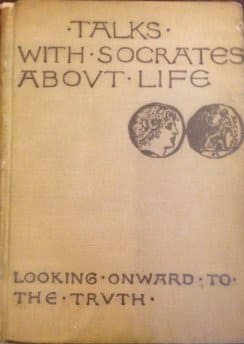
In the midst of this and her other pursuits, Mason evidently found time to devote to her own studies, especially Classics. In 1879, Charles Scribner’s Sons published a volume of her translation of some selections from Plato, Socrates: A Translation of the Apology, Crito, and Parts of the Phaedo of Plato. The translation was anonymous, though her identity was known by 1880,14 and her work carried the endorsement of a glowing introduction by Harvard Greek professor W.W. Goodwin. This was followed by three more volumes of Plato selections: A Day in Athens with Socrates (1883), Talks with Socrates About Life (1886), and Talks with Athenian Youths (1890). The Athenæum has copies of three of these books with publishers’ cloth bindings designed by Sarah Wyman Whitman.

Mason’s selected translations proved extremely popular and went into several editions. There is also a possibility that Ida Mason collaborated in this well-received work.15 To quote one favorable review, from the New York Times: “We have carefully compared the present translations with Jowett’s, Whewell’s, Victor Cousin’s and others, and they seem to us to convey more of the original tone of the Greek, and at the same time to be more in harmony with modern style than any of those famous versions.”16 This review established that her command of the Greek was equal if not superior to that of her formally educated male contemporaries. Her ability to render her translations into good English was also considered top-notch.

This latter quality is also telling because it conveys the accessibility of her translations, both as an introduction to life in ancient Athens and to the most famous of Plato’s works: “The translator is deserving of the warm thanks of all who have not had the advantage of what is called a liberal education, for placing within their reach a volume that contains the essence of writings that the scholar has toiled after. It is a model translation in every respect, and one that can be easily read and understood.” One might detect a hint of condescension in the words “within their reach” and “easily read and understood,” as if the complexity of the original must naturally be simplified for the beginning (female?) reader of Plato.

On the other hand, it is easy to imagine Mason writing for precisely that audience, those who, without the “advantage” of years of classroom recitation and irregular Attic Greek verb conjugation, still wanted to engage with some of the most foundational texts of Western philosophy and literature. And study them further, if so inclined. It is not clear how Mason acquired her knowledge of ancient Greek. The fact that Professor W.W. Goodwin of Harvard’s Greek department wrote the introductions to all four of her books is significant, but although he did give private instruction to female students,17 there is no evidence that he was her tutor.

Mason’s involvement with the cause of women in higher education would continue for the rest of her life. One particular moment stands out: on May 22, 1882, an organization was formed called The Society for the Collegiate Instruction of Women, “whose purpose was to promote the education of women with the assistance of the instructors in Harvard University.”18 Two of the signers of that original agreement were Professor Goodwin and Ellen F. Mason. Its formal name was rarely used; it was commonly known as “Harvard Annex,” and would later become Radcliffe College.19 Mason remained associated with Radcliffe well into the 1900s, and she is listed as an Associate (trustee) in 1914.20

When Ellen F. Mason died on April 28, 1930, her estate was valued at approximately $5,000,000. Her money, according to The Boston Globe, was “left largely to charitable and altruistic purposes,”21 so as to benefit institutions in Boston and throughout the country.​ She was well-known in Newport, too, where she was president of the Civic League for many years. Those familiar with Rhode Island Avenue will recognize Mason’s distinctive mansion (rebuilt in 1901 after a fire destroyed the one her father had built) as the current home of the St. Michael’s Country Day School.22 While one could hope for an account of her life or some parts of it in her own words, the record as it stands shows that she was widely known for her generosity, philanthropy, and life-long commitment to improving educational opportunities for women, as well as furthering her own studies. It is entirely possible the Athenæum’s collections, only a stroll away from her Beacon Street home, helped her in all these pursuits.

Book cover: Talks with Athenian Youths

Book cover, photo courtesy of Kaelin Rasmussen. 

1. Winthop, Robert C., Jr. “Memoir of Robert Means Mason,” Proceedings of the Massachusetts Historical Society 18 (1880–1881): 302–317, 304. 12. Memoir, Autobiography, and Correspondence of Jeremiah Mason: reproduction of the privately printed edition of 1873. (Kansas City: Lawyers International Publishing Co.), 473.3. Jeremiah Mason, 4734. Holly, H. Hobart. “Aldrich Center: One Walnut Street, Boston, Mass.” Accessed April 21, 2017. http://www.aldrichcenter.org/aldrich/file/Long_History.pdf.5. Winthrop, “Robert Means Mason,” 315–66. Lippincott, Bertram, III. “The Mason Sisters of Newport,” Newport History 75 (2006): 31–54.7. Boston Athenæum, The Boston Athenæum Centenary: The Influence and History of the Boston Athenæum from 1807 to 1907 (Boston, Mass.: The Boston Athenæum, 1907), 149.8. “The Sarah Orne Jewett Text Project.” Accessed April 21, 2017. http://www.public.coe.edu/~theller/soj/sj-index.htm.9. “Sarah Orne Jewett Diaries 1871-1879: 1 May 1871–28 December 1879.” Accessed April 21, 2017. http://www.public.coe.edu/~theller/soj/let/soj-diary-1871.html.10. Society to Encourage Studies at Home. Society to Encourage Studies at Home. (Cambridge, Mass.: Riverside Press, 1897), 13.11. Society to Encourage Studies at Home, 2.12. Society to Encourage Studies at Home, 62.13. Society to Encourage Studies at Home, 185.14. Library Journal 5 (1880): 54.15. “Mrs. Ellen F. Mason,” Boston Globe, April 29, 1930, 6.16. Plato. A Day in Athens with Socrates, trans. Ellen F. Mason (New York: Charles Scribner’s Sons, 1883), publisher’s advertisements at end.17. Kaledin, Eugenia. The Education of Mrs. Henry Adams (Philadelphia: Temple University Press, 1981), 203.18. Kaledin, 207.19. “Radcliffe College,” Wikipedia, last modified March 23, 2017, https://en.wikipedia.org/wiki/Radcliffe_College.20. Harvard University. Harvard University Catalogue, 1914–15 (Cambridge, MA: Harvard University. 1915), 842.21. “Mason will leaves millions to public,” Boston Globe, May 16, 1930, 6.22. Day, Jeff. St. Michael’s Country Day School History, accessed April 21, 2017, https://issuu.com/smcds/docs/history_of_smcds.

Selected Works

Plato. A Day in Athens with Socrates. trans. Ellen F. Mason (Cutter Classification VP .P5 .9d)
Plato. Socrates. trans. Ellen F. Mason (TBMR VP .P5 .9m)
Plato. Talks with Athenian Youths. trans. Ellen F. Mason (TBMR VP .P5 .9t)
Plato. Talks with Socrates About Life. trans. Ellen F. Mason (TBMR VP .P5 .9ta)

04.05.2017

Christopher Minty

April 2017

By Carolle Morini

Tell us about how you first became interested in Americana History and about your education.
I have a BA, with First Class Honours, and a Ph.D. from the University of Stirling, Scotland. During my eight years at Stirling, I wrote an undergraduate thesis on medicine in Georgia and North Carolina in the Civil War and a doctoral dissertation on the origins of loyalism in New York City prior to the American Revolution, both of which are available in Stirling’s library. Before going to university, in 2006, I was interested in American history largely thanks to my father, who introduced me to Ken Burns’ s The Civil War, a nine episode documentary miniseries broadcast on PBS in September 1990. After I started my undergraduate studies, my interest only grew from there. In 2008, my father and I went on a tour of Civil War sites, visiting Antietam, Gettysburg, and Harper’s Ferry, among others. Toward the end of our mini-tour, I attended a small lecture by James McPherson, author of Battle Cry of Freedom (1988), at Princeton University.
 
What makes The Adams Papers exciting to you?
Working at The Adams Papers at the Massachusetts Historical Society is unique. Unlike most founding-era projects, a majority of the Adams documents we work with are held at the Society. David McCullough, author of the Pulitzer Prize-winning John Adams (2001), called the Adams Family Papers at the Society “a national treasure.” The collection comprises over 300,000 pages of manuscript material for the three generations of Adamses who were almost always a feature of public life from the American Revolution through the Geneva Arbitration of 1871–1872. The main body of the archive contains the public and private correspondence, diaries, and other papers of Presidents John Adams (1735–1826) and John Quincy Adams (1767–1848) as well as the diplomat Charles Francis Adams (1807–1886). Their wives, Abigail Adams (1744–1818), Louisa Catherine Adams (1775–1852), and Abigail Brooks Adams (1808–1889), recorded their own lives and those of their families in voluminous correspondences. Altogether, the collection offers multiple insights into nearly every aspect of early American history from the mid-eighteenth century onward. If something was happening, it’s likely that at least one of the Adamses had something to say about it!
 
Do you find a connection between the American Revolution and Scotland’s vote for independence?
Well, kind of. In the build up to the American Revolution many colonial Americans felt that Parliament didn’t represent their interests. When taxes were introduced after the French and Indian War (1754–1763), many believed they were having money taken out of their pockets without receiving the full benefits of parliamentary representation, thus the phrase “no taxation without representation.” In modern-day Scotland, many feel that Westminster doesn’t represent their interests, either. If you look at a political map of the United Kingdom and how the House of Commons is made up, Scotland is almost entirely yellow (for the Scottish National Party) and England is largely made up of blue and red (for the Conservative Party and Labour Party, respectively) with other colored dots across England, Wales, and Northern Ireland representing the Liberal Democrats, Green Party, DUP, Sinn Féin, Independents, and Plaid Cymru. Although there are many differences between then and now, the fundamental similarity is that many Scots don’t think Westminster represents their interests, largely because however its MPs vote, they can be easily outvoted. Thus you can have a situation where Scots feel marginalized.
 
What projects are you currently working on?
Obviously, volume 13 of the Adams Family Correspondence! The almost 300 letters in volume 13 were written between May 1798 and September 1799, a difficult time for President John Adams. From Quincy, a severely ill Abigail Adams wrote frequent letters to Philadelphia and received wonderfully readable responses from son Thomas Boylston and John’s newly appointed secretary and future founder of the Boston Athenæum, William Smith Shaw. The letters in volume 13 attest to John’s popularity in the wake of the XYZ Affair, but they also chronicle passage of the Alien and Sedition Acts and the Kentucky and Virginia Resolutions, which cloud Adams’s presidential legacy in spite of his successful navigation of the Quasi-War with France. Altogether, it’s a great volume! In particular, William Smith Shaw’s correspondence with Abigail Adams and Thomas Boylston Adams is particularly interesting. Outside of the Adams Papers, I am also revising my dissertation for publication and working on an edited volume on the Revolutionary War correspondence of Myles Cooper. Finally, I am finishing off an article on John Adams’s journey to Philadelphia in the summer of 1774.

Do you have a favorite Adams? 
Thomas Boylston Adams, John and Abigail’s youngest son. His letters are full of personality, wit, candor, and imagination.

What historians (or authors) do you admire?
I aspire to write like Joanne Freeman (Yale), John Cassidy (The New Yorker), and Jill Lepore (Harvard and The New Yorker). If I could be as productive as Alan Taylor (Virginia), who apparently writes for four hours each day, that would be nice, too.

Do you have a favorite book?
Two of my favorite books of the last few years are Jessica Choppin Roney’s Governed by a Spirit of Opposition (2014) and Andrew Beaumont’s Colonial America and the Earl of Halifax (2014). I am currently reading, and thoroughly enjoying, Jennifer Van Horn’s The Power of Objects in Eighteenth-Century British America (2017).

Why do you like being a member of the Athenæum?
Amid the hustle of central Boston, the Athenæum offers a peaceful respite for contemplation and a perfect venue for writing. I’ve found the fifth-floor Long Room is the perfect spot for me to settle down and write for two, three, or even four uninterrupted hours. I also have great admiration and respect for the Athenæum’s staff, many of whom have contributed to volume 13 of the Adams Family Correspondence. Several people went above and beyond in helping answer my sometimes-obscure questions, the result of which was a truly fabulous illustration of a Boston Library Society lending record for Daniel Greenleaf, a friend of the Adamses. I also have deep admiration for those in Advancement, whose work is invaluable to the Athenæum’s short- and long-term future.

Christopher Minty

At Hampton Court Palace​, photo by Heather Lonks

Minty Publications

Adams Family Correspondence, vol. 13 (coming the the BA shelves soon)

“‘Of One Hart and One Mind’: Local Institutions and Allegiance during the American Revolution,” Early American StudiesVolume 15, Issue 1, Winter 2017.  Journal on the 2nd floor.   

 “Republicanism and the Public Good: A Re-examination of the DeLanceys, c. 1768–1769,” New York History. Volume 97, Number 1. Winter 2016. 

“A List of Persons on Long Island: Biography, Voluntarism, and Suffolk County’s 1778 Oath of Allegiance,” Long Island History Journal, Volume 24, Number 2, December 2015.