
12.18.2018

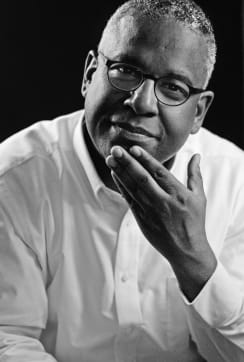
Clennon L. King

January 2019

Interview by Mary Warnement

Clennon L. King is an award-winning Boston-based journalist, historian, and documentary filmmaker. Born to a prominent civil rights family in Albany, Georgia, King was inspired by his father, the late C.B. King, an attorney who represented civil rights demonstrators, including Dr. Martin Luther King, Jr. (no relation) during the 1961–1962 Albany Movement.

King graduated from The Putney School in 1978, earned a degree in English from Tulane in New Orleans, studied law briefly at University College London, and then pursued film studies at New York University’s Graduate School of Film and Television. His early career included a three-year stint as a special assistant to Dr. King’s top aide, Atlanta Mayor Andrew Young. King also served as the City of Atlanta’s film bureau chief and government-access TV station manager under Atlanta Mayor Maynard Jackson.

King left the public sector to delve into journalism in earnest, reporting as an on-air TV reporter for network affiliates in Dallas (KXAS), Atlanta (WSB), Miami (WSVN), Jacksonville (WTLV/WJXX), Mobile (WALA), and Boston (WGBH). He has also contributed to The Boston Globe.

His awards include an Emmy® nomination from the National Academy of Television Arts and Sciences’ Suncoast Chapter, a regional and national Edward R. Murrow, and a National Association of Black Journalists’ news award. King’s reporting on race has also been recognized by Columbia University’s Graduate School of Journalism.

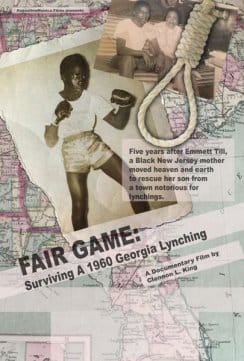
King is the father of two adult sons, Crawford and Jordan, and resides in Roxbury, Massachusetts, home to his company, AugustineMonica Films. King founded his video production house in 2002, and in addition to producing fundraising and marketing videos for area nonprofits, the house also has to its credit three diversity program offerings. His first was the award-winning documentary “Passage at St. Augustine: A 1964 Black Lives Matter Movement That Transformed America,” which was presented at the Putney School, Vermont, in 2016. King’s second, the 65-minute documentary entitled “Fair Game: Surviving a 1960 Georgia Lynching,” premiered last August at Martha’s Vineyard Strand Theatre in Oak Bluffs. The third offering is a slideshow-lecture MLK’s Boston Years,” providing a granular look at Dr. Martin Luther King, Jr.’s New England years. 

Q: What is the meaning of your company’s name, AugustineMonica?

CLENNON L. KING: It bothers me how arbitrary society is about what stories it tells. So, when I discovered that the oldest city in the U.S. was named for a black preacher who was a fourth-century African bishop before becoming a saint, I decided to tell that story by using my company name. At the same time, I wanted to salute Augustine of Hippo’s mother, Monica, an African mother, for whom the California city, Santa Monica, is named. Worth noting as well is that my first documentary takes place in St. Augustine, Florida. I wanted to share this hidden history that speaks to the greatness of Black people.

Q: Did your mother have any influence on your career?

CLK: Indeed. What I thank my late mother Carol Johnson King for most is how she protected my freedom of expression growing up, sometimes much to the irritation of my father and siblings. I can hear her saying, “Let him express himself.” She was good about that. On the other hand, she was a Cleveland, Ohio native who earned her college degree in early childhood education and lived and raised her children in the deep South. For all the reasons above, Mom was a stickler about correcting my diction, grammar, and dialect, even in the presence of childhood friends. While embarrassing, her direction helped cut a clean path to what became a fulfilling career in communications, journalism, and visual storytelling.  

Q: Why did you abandon your law studies? 

CLK: The short answer is my heart wasn’t in it. Add to that that I was also a poor reader—and by extension, student—who found it far easier to learn by talking with people than by reading books. Don’t get me wrong. I had a dream of practicing law with my legendary Dad and was awestruck by his mastery of language, his love of the law, and commanding presence inside hostile Southern courtrooms. But that was his path, not mine. So, when I found out, during my first year of law school, that I had been passed over for an internship with ABC World News Tonight with Peter Jennings in the London Bureau because I was in law school and not pursuing journalism actively, I knew I had to make a choice. When I got back stateside, I did.      
ragfdfag

Movie poster for Fair Game.

Q: How did you find out about the Athenæum?

CLK: In 2011, I think I was doing research on Elizabeth Peabody, a Massachusetts native who founded America’s first kindergarten. Since she also inspired the name of the settlement house I used to work for in Somerville as the director of marketing and development, I wanted to find out as much as I could about her, as it might be important to would-be donors. In my quest, I was directed to the Athenæum. Once I found out it wasn’t open to the public and that you had to be a member, I knew I wanted in. Given that my profession as a journalist and filmmaker often requires extensive research, I resolved I would buy a membership as soon as I could. And six years later, I did.

Q: What appeals to you about the Athenæum?

CLK: What appeals to me most are the out-of-print volumes, city directories, and the archival maps you can’t find anywhere else. It’s a researcher’s heaven.

Q: What were the great struggles of working on your documentary? The great joys?

CLK: The truth is my documentary, “Fair Game: Surviving a 1960 Georgia Lynching” was ‘in the can’ by the time I bought a membership to the Athenæum. But the challenge was to find a place to edit the film, uninterrupted. With just six months left to complete the documentary before it was to premiere on Martha’s Vineyard, I was under the gun. I found the solitude I was looking for on the Athenæum’s fifth floor. The natural light. The surroundings. The quiet. Being able to hear my thoughts. It was a short ride from my home in Roxbury. I could edit on my laptop from 9 a.m. to 8 p.m., take walks on Beacon Hill and just work, in the name of meeting my deadline. Doesn’t get much better than that.

Q: Any projects you’re working on now?

CLK: There is an interesting story. I was recently doing research to make changes to an online video quiz I wrote and produced entitled “MLK’s Boston Years.” Specifically, I was trying to determine the exact Beacon Hill address of Dr. Martin Luther King, Jr.’s future wife, Coretta Scott, who, in the fall of 1951, had just arrived in Boston. Her landlord, as it turns out, was a Boston Cabot, who agreed to rent Scott a room and provide her breakfast, so long as she assumed housemaid duties—cleaning rooms, scrubbing floors, sweeping stairwells, and doing laundry. As a struggling music education major at the New England Conservatory of Music, she agreed to the terms and performed the requested duties for three months, before moving to Massachusetts Avenue in Boston’s South End. That’s where she met a young Boston University divinity student who happened to live three blocks away. And the rest, as they say, is history. As for the exact address where Scott lived, her fifth floor room was located at 1 Chestnut Street, a six-minute walk from the Athenæum. In fact, back in November, I took a break from working here, walked over, and knocked on the door, where the current residents were nice enough to give me an impromptu tour of Scott’s former digs. It doesn’t get much better than that.

Q: How often are you asked if you are related to Martin Luther King, Jr.?

CLK: Often. I don’t mind it, only because there was a relationship between our families because of our respective roles in the Civil Rights Movement.

On Thursday, February 7, 2019, at 5:30 p.m., see a showing of Clennon King’s documentary Fair Game: Surviving a 1960 Georgia Lynching.

There will also be a showing at Georgia Tech. Click here for more information.

11.28.2018

Lynne Byall Benson

December 2018

Interview by Kaelin Rasmussen

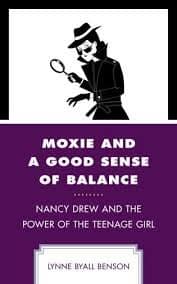
Lynne Byall Benson, part time resident of the fifth floor, has a new book coming out in December 2018, called Moxie and a Good Sense of Balance: Nancy Drew and the Power of the Teenage Girl. Nancy Drew has been around for more than 80 years and has changed a great deal—sometimes what was considered appropriate at the time—challenging the sphere of her gender. In her book, Lynne offers an analysis of this classic character as a proto-feminist role model for young women through the decades.

Q: Tell us a little about yourself.

Lynne Byall Benson: I was born in a suburb of Cleveland, Ohio—Lakewood, Ohio—grew up in a neighboring suburb, Rocky River. I was there most of my life. I went to the University of Kentucky for undergraduate school, got a bachelor’s degree in English, did a whole lot of things in between, and then eventually went back to school for a master’s and a PhD from Cornell University.

So in between I worked. I was a development officer at Cornell, I worked in the corporate sector, and right now I’m a professor in Women’s, Gender, and Sexuality studies at UMass Boston, and I also am an adjunct professor in the English department at Bunker Hill Community College.

Q: What made you decide to go back to school?

LBB: Well, I guess in the first place, we were in Ithaca, New York [laughs], and, you know, what else do you do! But at the time I was a development officer, I was Director of Alumni Affairs for the College of Human Ecology, and I was taking courses as I was working through the employee degree program. And then I got offered a fellowship, and I was able to quit my full time job and become a full time student. It’s something that I always wanted to do…it was always in the back of my mind, but I had this opportunity and I really had to take advantage of it. And it was wonderful. I loved every minute of it!

Q: How did you find the Athenæum?

LBB: When we moved to Boston, I was writing my dissertation. My research materials were at the Schlesinger Library, very accessible. However, once I started writing, my husband felt I needed a place to go, as opposed to just going upstairs to my office in our house. So, in 2000, he gave me a membership to the Athenæum, and eventually we joined as a family, just the two of us, and we’ve been active members ever since. We love the programs, and as I said I wrote my dissertation here, up on the fifth floor. I wish I could spend more time up there, but unfortunately I’m working now, so I don’t have the time that I’d had before.

Q: What appeals to you about the Athenæum?

LBB: I love the programs. My husband and I both love the programs…it’s just a wonderful place, it truly is one of the gems of Boston, but in my particular case, it was the energy up on the fifth floor. You know you’re not supposed to talk, you’re not supposed to use cell phones, it was the way to get away. Everybody up there is working very intently and very seriously, so that energy inspired me. Plus, I met a group of really cool women, and we were all working on different projects, and we would confer with each other in the members’ lounge. We’re still friends and in touch to this day, even though we don’t see each other very often…That was back when the Athenæum used to do teas on Wednesday afternoons, and I really miss that because it was a chance to get to know other people.

Q: What was the subject of your dissertation?

LBB: My dissertation was about the Deans of Women at the coeducational institutions of the progressive era, and my research materials were their conference proceedings. They had every single year, except for, I think, 1928 and 1932 at the Schlesinger, so I was very fortunate that everything that I needed was in one place…And [the staff] were wonderful, they were just fantastic.

Q: Why don’t we talk about your new book?

LBB: My book is Moxie and a Good Sense of Balance: Nancy Drew and the Power of the Teenage Girl. It’s essentially an analysis of Nancy Drew. I have felt for a long time that she can be portrayed as a feminist role model, but the Nancy Drew that I feel is the strongest proto-feminist role model is the Nancy Drew from when she was first created in 1929. That’s really what the book is about, and I also look at what was happening in society that contributed to her popularity. I really enjoyed writing it, it was a labor of love. It actually started out as a conference paper about eight years ago, at a girls’ studies conference at SUNY Cortland in upstate New York. I thought I’d done Nancy Drew, but then I kept going back to Nancy Drew and finding more and more ways to look at her. I refined my chapters, presented them as papers, got feedback…it’s a really long process to write a book as relatively short as this is! But I’m very happy with the result, and I hope other people will be, too. 

I also take a look at the 21st century version of Nancy Drew. I look at some modern female detectives, like Veronica Mars and Jessica Jones, and I think it’s really important to present not only Nancy Drew but these other women as role models, especially in the light of the Me Too movement. I think young women need feminist role models to look up to and get inspiration from.

Q: Nancy Drew spans a lot of decades!

Moxie and a Good Sense of Balance: Nancy Drew and the Power of the Teenage Girl

Benson’s new book, published in 2018.

LBB: She does, and I spent a lot of time reading Nancy Drew throughout the decades [laughs]. My mother introduced me to Nancy Drew when I was about nine years old, she gave me her copies. I should have followed up on this story that she and my grandmother used to always talk about. Mildred Wirt Benson, who was one of the Carolyn Keenes—Carolyn Keene is a pen name, as I’m sure most people know—her first husband was a reporter for the Associated Press, and they lived in Cleveland, in Lakewood, Ohio, where I was born and where my mother grew up. She and my grandmother always used to tell this story about how there was this lady that lived next door to them that was always on the typewriter, and they told me that it was Carolyn Keene! I should’ve just followed up on that to see if it was actually true, but it was fun to think about anyway. I’ll be disappointed if it’s not true. But Mildred Wirt Benson really did live and work in Cleveland, and I credit her with coming up with the Nancy Drew that I admire the most: intelligent, independent, gutsy, brave, but lady-like at the same time.

Q: Tell us a little bit more about your writing process, the struggles and joys of writing.

LBB: It really is hard to find time, especially because of my teaching schedule. I try to carve out little bits and pieces, but I do most of my writing in the summertime because my teaching load isn’t as heavy, and I have the time to come here and work. I actually wrote most of the Nancy Drew book upstairs on the fifth floor. It’s too hard to work at home because there’s always procrastination—oh, I have to do the laundry, oh, I have to make the beds, oh, I have to walk the dog, I have to get a cup of tea—so to look upon writing as your job, you get here (to the Athenæum) and it’s your mission. But it’s a struggle to find the time. I think once you get in the groove, you know, there’s nothing like it. I really enjoy it. Once I get going.

Q: Any new projects you’re working on that you’d like to share with us?

LBB: I have a project that’s been simmering for a while. When I was Director of Alumni Affairs for the College of Human Ecology, it had been the former College of Home Economics at Cornell, and it was one of the first colleges of home economics in the land grant system. I’ve been very much interested in the development of home economics as an academic field for opportunities for women, and I actually wrote my master’s thesis about the history of home economics at Cornell. What I found is that in the curriculum of home economics, home economics majors had to spend time when they were seniors in a practice house or a practice apartment. There were maybe five or six students with a faculty advisor, and they had to demonstrate their ability to put together a household budget, stay within that budget, clean the house properly, essentially demonstrate that they knew the “household arts” as we tend to think of home economics. In the 1920s, at least at Cornell, introduced into that scenario was a baby. A real baby! From the 1920s to the 1950s, the directors of the college had arrangements with the social service agencies nearby, would sign a contract, and they would have a baby in this practice home for the semester. Each student had to take a turn being mother of the week and taking care of this child. To me, it’s a fascinating story, and I want to tell the story. Not only at Cornell, but this became part of the home economics program at other land grants. I want to do a little digging around and tell the story, without any judgment because when I tell this to people they are absolutely horrified at the idea, but on the other hand, at least in the case of Cornell, during the time when these children were in these apartments, part of that time was during the Depression and many people couldn’t afford to keep their children because they couldn’t afford to feed them properly. Once these children, if they were orphans, came through the Cornell program, they were well-nourished and on their way to being well-adjusted, so they were highly sought after by adoptive parents. It strikes people now as being really, really strange, but back then I don’t think it was considered all that unusual. I think the faculty involved really felt they were doing a service for the benefit of the kids. I’ve just started having conversations with publishers, so we’ll see what happens.

I do love to write, and again, my challenge is just finding the time to do it, but I also love the research. I did some of my research in secondary sources in women’s education here, downstairs in the basement where they have the Cutter women section. I really loved digging around there. I was in the Children’s Library a lot with Nancy Drew, too. I think you really have to have a passion for looking and seeking archival material, and I love to do it, that is one of my joys. And also, of course, finishing the project!

10.01.2018

Dan Breen

October 2018

Interview by Mary Warnement

Dan Breen was born in Framingham, Massachusetts but grew up in Atlanta, Georgia. He went to the University of Wisconsin-Madison for his undergraduate studies, and he holds a law degree from the University of Georgia and a doctorate in American history from Boston College. He has taught law at Brandeis University since 1998 and became a full time instructor in the Legal Studies program in 2015. We talked about his lifelong passion for history, his love of Boston, legal definitions for the word “chicken,” the fun of coining new words, and unguilty pleasures. Dan will speak in November about the Athenæum’s first librarian William Smith Shaw and his connection to an important legal case. Read more to hear how Dan found his way to the Boston Athenæum.

Q: How did you choose Wisconsin-Madison?

DAN BREEN: I first went to Wake Forest but decided I wanted to go somewhere completely different, somewhere I had no experience with and that was UW Madison. I knew I wanted to major in history and I knew they had a good program. My first day up there was right before my first day of class, I’d never been up to Wisconsin. But I never regretted it, I just loved it there.

Q: There’s a lot more snow in Wisconsin than Georgia.

DB: And I was not used to it, of course. So, I would be on campus, and I would duck into buildings whenever I could. It took me forever to get to class because I was going building to building to building on the way, just to warm up.

Q: You didn’t even have a winter coat when you got there?

DB: Yes, well, my mother made sure not only that I had a winter coat but also long johns. I think I was the only one in Wisconsin wearing long johns. Everyone was like, what the hell are you doing? Like, this isn’t Minnesota!

Q: And you chose to study history.

DB: I knew at an early age. Even when I was in elementary school, I would always try to check out the kids’ books on history. My family had a subscription to the Literary Guild, which may still be around, I don’t really know, but they would always get books every month, and there would be history books, and I would sneak a read while they were looking at their own books.

Q: What did your parents do?

DB: My father was a lawyer. My mother had a few odd jobs here and there, but she mainly stayed at home.

Q: Were you one of her odd jobs?

DB: Hah! That’s right. She was always reading something, they both were readers; and I always wondered what they were doing.

Q: You were an only child?

DB: No, my sister and my brother were more or less the same way. My brother got a doctorate in mathematics. He works at the American Mathematical Society in Providence, which luckily is not that far away. My sister ended up working in a library down in Georgia.

Q: And did your parents stay in Georgia?

DB: They did, and eventually they went to Florida.

Q:  Georgia wasn’t hot enough?

DB: No! They went to Florida and to me it’s unbearable. Right outside of Tampa, where it’s in the 90s all the time. Strangely enough, it’s never been 100 degrees in Tampa which my father never ceases telling me. Still, I was especially happy that they didn’t need me to mow the lawn. They have a service to do it. If I had to mow the lawn I don’t think I’d be looking forward to those visits.

Q: After getting your BA in history from Wisconsin, you returned to Georgia for the JD.

DB: Then I practiced law in Atlanta, and I decided to get a doctorate to become a full time academic because much like Shaw, the founding librarian of the Athenæum, I didn’t take much to the practice of law. I really didn’t like it very much.

Q: But isn’t there a bit of history in practicing law? Discovering precedents?

DB: There’s a lot of history involved in it. And that really is what I took to a great deal because behind every case there’s a story. Usually somebody who’s in trouble for some reason, and there’s nothing uninteresting about that. I would spend a lot of time reading the case I was supposed to, but then I’d spend time browsing these other case reports that I found more interesting. Clients probably liked that I couldn’t bill those hours, but of course the firm didn’t. I loved the academic aspects of the law, and when I went to Boston College, I wrote my dissertation on a judge I came to admire.

Q: I saw his name in your dissertation subject, the pragmatic jurisprudence of Henry J. Friendly. What a name for a judge.

DB: Yes, his family name in German was Freundlich, but that became Friendly.

Q: What made you write about him?

DB: In law school, a lot of the cases I really liked were written by him. He had a real flair and a very keen intelligence. Looking for a dissertation topic, I needed something that no one had ever written on, with a lot of sources, and I found that he had plumped all of his boxes of stuff at Harvard Law School. Nobody had really gone through it; it was all there waiting for me. Day after day after day, I went to the law library and the very helpful staff there in special collections would bring out these boxes of very badly organized material that I went through. The case that I especially liked, that I’d first read in law school, was a famous contracts case when Friendly had to decide whether a chicken was really a chicken.

Q: So, what’s the German word for chicken?

DB: Huhn.

Q: Isn’t that the word for dog?

DB: Huhn, not Hund.

Q: I was thinking hähnchen meant chicken. Let’s look it up….there are several different words. Maybe one’s a young chicken.

DB: There, it says cockerel, a male chicken.

Q: You never know where conversations in the Athenæum will take you.

DB: We’re taking the proper spirit for approaching legal cases. Friendly really should have been named to the Supreme Court, but unfortunately the only window he could have been appointed was during Nixon’s presidency, when he needed to recommend a southerner. Friendly was from New York.

Q: Friendly must have attended Harvard Law because he gave his papers to them?

DB: Yes, he never talked about it, but he had the highest GPA in Harvard Law School’s history. He surpassed Louis Brandeis, whose law clerk he was. The two of them enormously respected each other.

Q: Brandeis University must love you knowing so much about their namesake.

DB: Well, I don’t know how much they know about my knowledge of him, but I do teach a class at Brandeis on Louis Brandeis, and as far as I know, it’s the only class anywhere just on him.

Q: Did Brandeis write much other than legal briefs?

DB: Louis Brandeis did not; he had it in him to write a book but he never quite did. He wrote essays on all sorts of topics. Henry Friendly also wrote many articles and many of them are in a Brandeisian vein, but many of them are not. It’s good to sort of tease out the influence.

Q: Brandeisian, that’s a good word, too.

DB: I think I’m the only one who pronounces it that way. If you go to campus they’ll say Brandeizian.

Q: Brandeizian. I think your way sounds better.

DB: Yeah, I think my way’s better, too.

Q: I’ll try to coin that. Of course I’ll include it in this interview and post it online…

DB: Find a way every single day to use that word at the library…It will spread. For example, this is a very Brandeisian cup of tea.

Q: Yes! Done. I’m assuming Brandeis went to Harvard Law as well.

DB: Yeah, Brandeis is interesting. He did go to Harvard Law School but he had never gotten an undergraduate degree because his high school education in Germany was so great he didn’t really need one. My own father attended Suffolk. Like me, he was a transfer student but he transferred from the University of Maine. He was a city kid who grew up in Lynn. He had gotten accepted to the University of Miami down in Coral Gables but at the last minute he decided he would go to Maine.

Q: Which is quite different, as different as Wisconsin from Georgia.

DB: Yes. He met my mother who grew up in Maine.

Q: Even after he left for Suffolk he stayed in touch with her?

DB: They were married when he was a junior but she had graduated so he went to Suffolk to finish his degree. Much to my grandfather’s unhappiness. He didn’t think it was a good idea to get married so young to somebody without a degree. They lived in the West End in a place that was pretty dilapidated and depended upon my great aunt and uncle to bring them food from time to time.

Q: So, your father got a law degree, then moved to Georgia. You got a law degree, and found your way back to the cold weather.

DB: There’s just something about Boston, and now my wife and I could never leave.

Q: Did you meet her in Boston?

DB: I met her in Atlanta. She was going to university and I was out, practicing law. We had met down there, but then we didn’t see each other again, until she moved up here and went to BU as a graduate student. We met again up here by happenstance and that’s when we began dating. She’s a fellow mostly-southerner, from South Carolina, and she also loves Boston. We like the cultural and historical attractions here. It’s an old city with a federal tradition; it’s cutting edge as far as technology and young people go.

Q: How did you find the Athenæum?

DB: For some reason, I had never come in here when I was studying at BC in the late nineties and early aughts. But it turned out that my brother’s friend from college had a father who was an artist and he had an exhibition here in 2005. The name of the artist is Dee. We’d just come to see the exhibition, and, like everybody, I was overwhelmed by the beauty of it. I couldn’t believe that I had never been in. I spent two years thinking I should join, I should join, and kept talking about it, never thinking it was the right time to join, and by 2007 when I was researching my current interest, I decided I had another reason to join which was to access the special collections. That’s when we joined. I think it was 2007.

Q: I can remember you coming into the special collections room day after day.

DB: I was researching this famous murder case. The case of Thomas Oliver Selfridge who was charged with manslaughter for cutting down the son of a political opponent on State Street. There’s my interest in law as well as Boston history.

Q: Sounds like quite a salacious kind of story.

DB: It is a salacious kind of story! And that eventually produced the article that’s coming out in the North End Historical Association Review in November.

Q: And is that what you’re going to be speaking about here at the Athenæum?

DB: I’m going to be speaking about William Shaw, who was involved in another way to all of these events. He was a Federalist, a friend of Thomas Oliver Selfridge, who was charged with manslaughter. One of his great enemies, who was an enemy to all Federalists in Boston, was this newspaper editor named Benjamin Austin. It was Benjamin Austin’s son who was killed by Selfridge.

Q: Oh wow. Was Shaw involved in the murder trial at all?

DB: No, in effect, by then he had abandoned the practice of law. I’ll talk about why I don’t think he would’ve been a terribly good lawyer. He had studied law, eventually got a wonderfully plush job as a clerk for the district court, where he didn’t really have to do anything, and he devoted his time to building up the Athenæum. He was at the beginning of his work as a clerk when the murder trial began. The lawyers Selfridge hired to represent him were paragons of the Boston Bar, like the great Christopher Gore, who would eventually become governor.

Q: So he had connections. Did they secure his acquittal?

DB: They prevailed, yes. It was not a very close vote, although it was a sensational and very interesting trial. The defense was that Selfridge could reasonably feel that his life was in danger. The man approached, threatening him with a cane and under the reasonable assumption that he was in fear of his life, he opened fire which became the “stand your ground” defense, which is very controversial, especially in Florida. That’s why that case is really important these days.

Q: Absolutely. The chicken one is probably more intriguing, but this one carries a little more weight.

DB: One of the great things about the Athenæum is that you preserve the newspapers from the early nineteenth century where all the commentary was about this case.

Q: I imagine it was depicted very different in Austin’s own newspaper.

DB: Very different! There were seven newspapers at that time, five were Federalist, two were Republican. In the Republican papers Selfridge is depicted as a monster who was out for blood the moment he stepped out into the street, even before Austin attacked him with a cane. They talk about this recent graduate from Harvard with so much potential. The Federalist papers said he was defending himself when some guy with a cane came after him. If I were just looking at these articles online I would miss a lot. There’s just something about browsing here that is a treasure, a wonderful, wonderful resource.

Q: Seeing the context of where it is on the page also matters because you get the experience of what the original reader would have had instead of just the article pulled out of context. And it’s great that you can see it here without just seeing it on microfilm which allows you to experience it as it was originally.

DB: Yes, and there’s real flavor because your eyes stray off to see things that you otherwise wouldn’t if you were just looking at it online.

Q: The murder was in…

DB: 1806. The day was often referred to as Black Monday. August 4. I mean, it happened in broad daylight right on State Street and it entered Boston lore. It’s not much talked about today, but it should be.

Q: Speaking of what should be, do you enounter frustrations while researching?

DB:  One of the frustrating things is, Selfridge left hardly any letters behind. Probably he instructed his wife to burn them, he died young. He stayed in Boston but wasn’t really quite the same again after all this. He never prospered.

Q: Have you read the Shaw papers here in our collection?

DB: I have. I’ve actually gone through them pretty thoroughly. There are some really funny things in there that I’ll be talking about in November. He was quite a character. A bit cantankerous and forgetful at times.

Q: I look at the Gilbert Stuart portrait of him and think, “was he having a bad day?”

DB: My understanding is that he really didn’t want a portrait of himself. His friends more or less insisted they raise the money for Stuart to do it, and I think he’s looking as though he didn’t want to be sitting for a portrait.

Q: It’s nice to bring these people to life because you walk by that portrait every day and may pay no attention to it whatsoever.

DB: I’ve got some ideas about Shaw that I think make him especially relevant today. I think the thing that Shaw liked about the idea of the reading room that became the Athenæum is what I like about the Athenæum, and that’s the experience coming across those newspapers and things unexpected that you never expected to see—the sheer beauty of this space makes you want to come here and spend time here and that makes you come across things you never otherwise would if you were in a big academic library. It’s very complete but there’s not anything especially lovely about it. You go get what you need and then you go. But here, you browse and you find things purely by luck, like John Norwich’s history of the Byzantine Empire. I looked through it just browsing and checked it out and I’ve been devouring it all summer. I just love it. And if I hadn’t done that, if I hadn’t just been browsing that day, I never would have known there was an emperor Michael the Drunkard, so I’ve been reading about Michael the Drunkard, and I never would have known there was a Theophylact the Unbearable if I hadn’t been here in this beautiful place.

Q: One of the joys of working here is helping people find things they aren’t necessarily looking for. It’s one of the great pleasures.

DB: Yeah, and that’s the thing that’s always appealed to me. That’s why I would waste so much time at my law firm reading all of these cases that I shouldn’t read. All I could think was: they’re not going to like this. But here, it’s just an unguilty pleasure.

08.09.2018

Nicole Collins

August/September 2018

Interview by Dani Crickman

LGBTQ activist, music aficionado, and journalist Nicole Collins found her way to the Athenæum by way of an interest in Latin and has been volunteering in Reader Services since August 2016. Born in Morristown, New Jersey, and raised in the suburbs of Chicago, Nicole moved to Boston in 2016 and graduated from Brookline High School in 2018. She will attend Carleton College in Northfield, Minnesota.

In our interview, Nicole spoke with her characteristic blend of amiability and ironic humor about the pleasures and pitfalls of journalistic writing.

Q: What sort of writing do you do?

NICOLE COLLINS: I write for The Rainbow Times, which is a Salem-based LGBTQ newspaper. I was grateful to find them because when I started there, I was struggling to come out to people as trans. I went by Nick and had a thick goatee and it was difficult to come out to anybody. The Rainbow Times was one of the first groups of people I came out to, and they were super welcoming and that was awesome. I’ve been writing for them as an intern since January, and I’ve written a couple articles each month. 

I also write for Sound of Boston, which is the biggest music blog in Boston. I’ve always been passionate about music, but only recently, since April, have I been listening to music to critique it and think about it critically. I decided, why not combine music and journalism? And it’s one of my favorite things I do. 

Q: What are the most exciting stories you’ve covered, or things you’ve gotten to do as a journalist?

NC: For The Rainbow Times, one of the most exciting things was covering “Gays Against Guns at the March for Our Lives.” It was timely and it got the go-ahead to be a much longer article. The people I interviewed for it were responsive. Those are the most fun articles, when people actually respond to me and say “let’s get this article going.”

Another was the first story I covered. My first day at The Rainbow Times, the first murder of a trans woman in the US in 2018 was reported in Massachusetts. It was an important article and super urgent, so I put off a lot of homework to write it, but it was worth it. It was a respectful and meaningful article. I think it was one of the best ones out there, too, because The Rainbow Times writes longer articles rather than short briefs like The New York Times writes, and we got quotations from friends and family whereas The New York Times got statements. I was proud of that.

I’ve only done a few things for Sound of Boston so far. One of the best things about it is that they get you concert tickets if they get the OK from the producer or label. I recently got to go see the Punch Brothers, one of my favorite bands. I went to the desk and said, “I’m a journalist,” and they gave me these special press passes, and it was the coolest thing. It was fun to be given the leeway to write pretentiously about music and get to go to a concert for free. 

Q: Do you think pretention is inherent to writing?

NC: I think so. Talking to other people about music, they’ll describe it as “catchy” and “good,” but you can’t write like that in a publication. In order to get anywhere with a music review, you have to say pretentious things, like the music is “inspired” or “curious” or “benevolent.” I hate that, but it’s the way you have to go. It’s better once you embrace it. I write much better and more quickly now that I don’t think twice about whether something sounds pretentious. At least a little pretentiousness is required to write meaningful stuff.

Q: What do you see yourself writing in the future?

NC: More journalism. I hope to continue writing articles because I love it. And I’d love someday to work a fast-paced Reuters-type job where you go in 9 to 5 and you’re constantly writing little briefs. That sounds awesome to me. Writing for Rolling Stone is one of my career goals. I hate publications that assign numerical ratings to music. It’s sort of like clickbait in a way, when they give a numerical score. You can’t quantify how good music is like that. But for Rolling Stone, you write about the good parts of the music, give a summary of what’s going on, and then you leave it so people can decide for themselves whether they like it. 

Q: How would you describe your approach as a journalist?

NC: I’ve been told I’m way too positive when I do music reviews. I think that’s a good thing, though—that’s one of the better things to have wrong with your reviews. My approach is essentially being honest but being positive; it’s possible to be both. People are too negative nowadays, and I think there is always a good way to focus on the positive.

And with regard to other journalism: do your research. There’s too much fake news out there. And be respectful, especially when someone dies. News is too fast these days.  

I’m glad that I’m familiar enough with it now that I can look at what I’m doing objectively and say “this is bad about journalism, this is good about journalism, and this is what I can do to improve,” instead of being too intimidated to change anything.

Q: What do you find most satisfying about journalism?

NC: At first it was just seeing my name in the byline. That’s what a lot of people say. I was talking to this other journalist who is 15 years in and he said “Whenever I see my byline, it’s exciting.” I don’t really find that that exciting anymore. It hasn’t even been a year, so maybe that’s an issue.

There’s a point when you’re writing an article when you realize that you know what you’re doing and this article is going to come together. You start working on the article and you’re completely intimidated because you’re thinking, “I need to get this done, I need to get this done, I’m super stressed,” and then you write maybe a paragraph or two and it starts to come together and it’s, “I’ve got it, this is going to come together,” and you write it and it comes together. It all goes easily from there.


07.05.2018

Arda Cataltepe

July 2018

Interview by Nicole Collins and Dani Crickman

Arda Cataltepe, a rising senior at Weston High School, won first place in the 2018 Massachusetts State National History Day competition and placed as a finalist in the national competition in the individual senior website category for his project “The Room Where It Happens: The Compromise of 1790.” At the state competition, Arda was also awarded the Boston Athenæum Prize for exceptional use of primary sources. This award introduced him to the Athenæum, where he has been able to use the collections to continue his research on this topic.

Arda’s additional research has included looking at primary source materials from the Henry Knox collection: “I was able to look at a book from 1790, published by the US government, of all the Acts for two years. And I thought that was just really cool. It was easy to do and it was a great experience.” Arda also made use of secondary source materials that were difficult to find elsewhere.

Q: Can you describe your project?

ARDA CATALTEPE: The theme this year was “conflict and compromise.” I decided to talk about the Compromise of 1790, which was the dinner party between Hamilton, Jefferson, and Madison. I like US history a lot, and I was into Hamilton: The Musical and I’d read Alexander Hamilton by Ron Chernow. When I saw this year’s theme, I knew this was going to be the perfect opportunity to focus on a subject I was already interested in. I did the project as an independent study with my AP US History teacher.

Q: Have you done any projects like this in the past?

AC: In ninth grade, I had to do a National History Day (NHD) project in the individual website category as part of Honors World History. That was my introduction to NHD. The theme that year was “exploration, encounter, and exchange,” and my project focused on the negative consequences of the Congo Free State ruled by King Leopold II. I talked about how it created horrible conditions for the native population and how the Europeans’ mindset of racial superiority contributed to those atrocities.

Q: What were the struggles working on this project?

AC: One of the struggles was the word limit: 1200 words. When I did the project in ninth grade, it was more for the class, less for NHD. The teachers didn’t really give the class a word limit, so we all wrote a lot. I was in the same mindset when I approached the project this time, and after I was done typing everything up, I looked at it and it was three times the word limit. It was tough to cut it down because I had a lot to say about this topic. But I was able to do it by using more quotations from primary sources, which didn’t count toward the word count.

Another struggle was reconciling the different interpretations of this topic. One journal article that I read argued that the Compromise of 1790 didn’t actually influence the end result of the Residence Act that put the capital in DC, and the Funding Act that put into practice Hamilton’s plan for the federal government to assume state debt. That article undermined my initial argument, so I had to dig in, find a lot of sources, and see what evidence they gave. Eventually I concluded that the compromise was very influential, but that was a tricky spot when I was conducting my research.

Q: What were the highlights?

AC: One of the most significant highlights of the project was getting to interview Professor Kenneth R. Bowling of The George Washington University about the Compromise of 1790. He authored numerous sources that I used in my project and helped settle any doubts in my mind about the compromise’s importance.

Other significant highlights were putting everything together and creating the website, incorporating music from Hamilton, and looking at primary sources, especially at the Athenæum. And how much I learned about the deal and all its nuances. I really think I know a lot about this topic because of all the research I’ve done. It’s not the most well-known topic and it’s not taught in school.

Q: What draws you to the subject?

AC: I think this period of US History—post ratification of the Constitution—is compelling: the political interactions between the founders, the issues of that time, how they molded the new government. It was a critical juncture in US History. There was no precedent for anything that was happening, and I found how the founders dealt with these issues very interesting. The Compromise of 1790 is at the center of that. It resolved some of the most contentious issues at that time, and set the nation’s course from there.

Q: Is this something you’d like to pursue as a career?

AC: I could see myself majoring in US history. I have a lot of interests, so I’m not really sure in terms of a career. In college, I’ll look to take classes and see where it goes from there.

Q: Any plans for similar projects in the future?

AC: We’ll see. I don’t know what the topic is for next year, but if it’s something I can relate to this area then I might do another NHD project.


05.10.2018

Robert Fieseler

June 2018

Interview by Graham Skinner

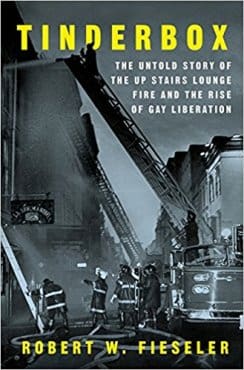
This month’s Athenæum Author is local writer Robert Fieseler. In May, he and I sat down to talk about his life, the Athenæum, and his book Tinderbox: The Untold Story of the Up Stairs Lounge Fire and the Rise of Gay Liberation (Released: June 5, 2018).

Q: Where were you born? Raised?

ROBERT FIESELER: I was born in Chicago and raised in Naperville, IL, a middle-class suburb located about thirty miles southwest of the city. Throughout the ’80s and ’90s, aka my childhood, Naperville was basically the heart of conservative Christendom—ten minutes from Wheaton College, a social incubator that gave the nation Billy Graham, Dennis Hastert and Michael Gerson (the Bush II speechwriter who coined the term “Axis of Evil”). Demographically, the town was about 90 percent white and overwhelmingly Republican, although it was going through a long and somewhat fraught process of diversification and “purple-ization.” Naperville also boasted award-winning public libraries and enviable public schools, but I didn’t know enough at the time to appreciate them or take advantage.

I was a defiant sort of B student with an attitude who resisted a lot of the middle-class myth-making and self-congratulation. A lot of my anger stemmed from being closeted gay in a place where there were no role models, and homosexuality was mostly lumped in with the rest of the moral vices, those unsayable behaviors that people engaged in privately but publicly condemned. In my public high school, we were encouraged by “motivational speakers,” a.k.a. Christian ministers holding forth at mandatory student assemblies, to take virginity pledges so that our future marriages wouldn’t fail because they were unsanctified in God’s eyes. Because I was closeted, and the idea of faking my way through heterosexual intercourse was terrifying to me, I gladly took the pledge, which bought me time and cloaked in morality my abstaining from a behavior that I never desired to begin with. In a prior generation, a scared boy like myself may have attempted to join the priesthood for the same purpose… I look back now and am grateful for my upbringing, but I also see how I was held back by it. All dreams worth having tended to be hedged and clipped in that environment into some sort of “backup plan.”

The only way to make it out interesting is if you resisted the tendency towards homogenization, preparation for a white collar career, or agreed to be called a freak. Growing up, I didn’t have the bravery to be a freak, so I walked a careful line of sneering at the system while meeting expectations in big gestures, like being the lead in the high school musical or a first chair trumpet in band. Yet, since you’re only an artist when the entire world has told you that you are not, I think the way that I clashed with my hometown played some role in making me what I am.

Q: Invading your private life more, what is your educational and work experience?

RF: I was a public school kid from pre-K straight through undergrad. I had some of my best teachers when I was young, including a second-grade teacher named Mrs. Pederson who “published” my first book at Maplebrook Elementary (by published, I mean stapled together my construction paper drawings) and a fifth-grade teacher named Karen Randolph. Mrs. Randolph was the first person who ever told me that I should write a novel because she was sure I had something to say. I graduated decently but not impressively high from my class at Naperville Central High School in 1999 and went to the University of Michigan, Ann Arbor, where I majored in English and studied a lot of history. In retrospect, a Big Ten school was the utterly wrong choice for me. I completely vanished among the crowd, but I was still living to satisfy other people’s expectations at that point.

Honestly, I don’t remember a ton from my undergrad years, which were consumed by a painful “coming out” journey. I woke up every morning and put on the invisible mask of my heterosexual persona. It was exhausting in that nobody really knew me. My grades became lackluster, and some weeks I barely even made it to class. I tried to be as “bro” as I could. I joined a fraternity as a dare to myself. Eventually, I became vice president of that brotherhood, a really excellent group of guys, and kind of had a breakdown because I was lying to everyone and just couldn’t sustain the act. I remember my fraternity brothers being so sweet to me. They kept asking what was wrong. I’m sure they would have opened their arms to make room for me in their worlds and reaccepted me into the fold, but at the time I couldn’t even say the words “I’m gay” to myself. And I needed to move on or…well, move on or die inside a falsehood that was strangling me.

My third year at Michigan was lonely, but I did find the one program I got anything out of at that school: the New England Literature Program, called NELP for short. It’s a spring-term writing course at a camp on Lake Sebago in Maine. You temporarily live there among an intentional community of writers and read New England authors: Thoreau, Hawthorne, Emerson, Dickinson, etc. You also keep a journal and contemplate bigger life questions. The whole process isolates the mind and allows for introspection into who you are and what you really want. I came out of the closet at NELP. It saved my life. It started my life. It was as if from age 6 to age 21, I’d been imprisoned in a tower inside my brain by some sort of evil oppressor, and here I was returned to the control room of that six-year-old boy who once smiled so much in pictures. I had been such a happy little kid. I can only describe the experience as euphoric.

Q: What about grad school?

RF: After a long break from school and a corporate career, I changed gears and enrolled in the part-time program of the Columbia University Graduate School of Journalism in 2011. This was the first time I probably ever applied myself to my education, and it couldn’t have happened at a better time or in a better setting. My classmates were brilliant, and most are now incredibly successful. The value of such a network is incalculable. I also met my Dumbledore there, or if you prefer my Aristotle, my mentor professor, who I still speak to regularly.

I graduated pretty high in my class at Columbia in 2013. When you graduate with high honors at the Columbia J-School, you qualify for awards or to be valedictorian, which is what happened in my case. I graduated co-valedictorian that year, which I’m sure continues to serve as a bragging point for my Midwest parents at barbeques. I’m joking, but also not really. Following that incredible turn of events, which felt like a personal version of Gryffindor winning the House Cup in the first Harry Potter, I had a small but significant window where I could do something cool with what had just happened to me. A couple of opportunities developed, and one was a book project, which would involve writing about a gay rights tragedy down in New Orleans. It was for a publisher that was eager to explore the idea and an editor that would be amazing to work with, and so I left a corporate career to pursue the book.

Q: Tell me about Tinderbox.

RF: Tinderbox is a work of history about the Up Stairs Lounge fire, which was the largest mass murder of gay Americans in U.S. history until the 2016 massacre at Pulse in Orlando. After Pulse, actually, the Up Stairs Lounge became revived in national memory and cited as an historic antecedent, a past exemplar of violence striking the gay community that I believe helped the public grieve and process the shock of the Pulse murders in a way that was immediate. Somehow, photos and stories of the Up Stairs Lounge fire helped people recognize that an extraordinarily terrible event had occurred in Orlando, which needed to be memorialized nationwide. And was.

It’s interesting, because neither of those things happened after the Up Stairs Lounge fire in New Orleans—an intentional arson fire at a gay bar that claimed 32 lives on the night of June 24, 1973. The Up Stairs Lounge, in 1973, was neither treated as a significant event nor was it memorialized by a nation all too eager to move on. Move on, rather than acknowledge and mourn “gay deaths” at a time when homosexuality carried great stigma.

The book asks three primary questions:1. What set the stage for this tragedy?2. What transpired on that night to end so many lives?3. How did this disaster, ignored as early as its one-year anniversary, develop a legacy? 

Attempting to answer these questions has been the greatest honor of my life.

Q: Here we are at the Athenæum. How did you find out about us?

RF: My partner, come fiancé and now husband, was accepted to the School of the Museum of Fine Arts in Boston with a scholarship in 2014. They really wanted him. At the time, we were living in Brooklyn, and of course I said we’re moving, you have to go for this. I was still in the midst of researching the book in New Orleans, and so my life became divided pretty distinctly along a new geography: New Orleans was devoted to interviewing and archival digging, and Boston was now devoted to writing and advancing what was then a book “proposal”—hopefully, to the stage where the publisher offered me a book contract.

First, I tried writing the proposal in my apartment and…cabin fever is real, man! As many walks as you take, the walls start creeping in. It can really get lonely and listless. For years in my twenties, I went to a corporate office every morning and absolutely despised the routine. When I left that world, I thought, “I’m never doing this again!” But then I started to see the benefits of exercising your mind in a place that’s physically separate from where you eat dinner, laugh and sleep.

I tried the Boston Public Library. I liked it, but I couldn’t have a coffee with me. That was a problem! Also, I couldn’t bring my dog to work when I felt like it, and I’d find myself missing Chompers, my little terrier, throughout the day. The subject I was wrestling with every time I put on my mental armor to enter the arena and do battle with my book was quite serious. I was imagining my way into an arson. The Up Stairs Lounge fire was, in fact, a notoriously unsolved crime, and many of men killed within that bar existed in a deeply closeted society.

There was a range of injustices that my brain had to attempt to wrangle into narrative form, and…either as a psychological or spiritual relief, you just want to have nice things around you as consolation. Books, coffee, bright windows, smart people, dogs. You want to be in an environment that can support or sometimes counter your darkest interrogations. So, I did research involving cooperative workspaces. They all seemed very expensive and “tech bro” orientated. “Tech bros” tend to be very sweet. Many are strong LGBT+ allies, but I couldn’t see myself engaging with them regularly on a literary level.

My proposal went to contract, meaning that the book received a green light from a publisher, around the time I heard about the Boston Athenæum. I initially bristled because the Athenæum is a private membership library, and I’m the nephew of a famous blue-collar historian in Pittsburgh. I thought the public library is good enough for me, if it’s good enough for the general public, but then I came here once. I was like, “Oh! I could bring my…oh it has such conducive energy.” Every little corner looks like the Restricted Section in Harry Potter, or a more intimate version of the Bodleian Library at Oxford, or the place at Trinity College where you can see the Book of Kells. The Athenæum is one of those great castles of the mind, those iconic structures. I felt I could get some work done in this building. So, I applied knowing full well I was probably going to write the book here, which I did.

Q: You already touched on this a bit, but what do you like about the Athenæum​?

RF: You get to interact with brilliant people every day. Passionate writers, critical readers, deep thinkers. A certain cadre of ink-stained wretches, which of course I say lovingly. Most say hi or nod whenever you walk into a room. They’re happy to see you each morning. One member, whom I met while nervously scoping out spaces on the fifth floor, suggested I try a special corner of floor three, and she was right. That nook became my favorite place to create. And there are always other members working on fascinating projects. They’re fun to talk with, whether it be someone who’s super literary (seeming to read a book a day), or working on their master’s degree, or grooving on a new book proposal or an advertising campaign.

It’s indescribably encouraging to hear about their research and, in turn, be able to share some progress of what I’m doing. I mean, I can only talk about my book so much to friends and family before they’re like, “ENOUGH!” A lot of writing occurs in isolation, and so you can feel a bit disconnected from daily life if you don’t find compatriots. Fortunately, I found a collective boost from working side by side like-minded folks at the Athenæum. It’s beautiful here, a facility that not many other cities would be able to maintain. It’s one of those quirky institutions that you just couldn’t replicate, part of the lineage of what makes Boston so special and so important.

Fieseler's new book, Tinderbox.

Fieseler’s new book, Tinderbox.

Q: What were the great struggles of working on Tinderbox?

RF: I mean, you’re not supposed to talk about this as a nonfiction writer or as a journalist, but I’ve decided I’m going to. It’s such a gift to be able to do what I do for a living, to be able to tell these vital stories. But there’s also a price to whatever story you tell in that you take on the consequences of what you learn. A former Columbia J-School professor of mine called it, “Collecting ghosts from your characters.” Those who do not face those ghosts, as writers and journalists, tend to fall off a mental cliff. They become alcoholics or have terrible divorces or worse. It’s important that the reality of “ancillary trauma” for writers, of the psychological transfer from subject to author, story to storyteller, be acknowledged in public so that writers and journalists can seek the appropriate help and speak more nakedly about this phenomenon.

When you’re interviewing people who’ve experienced severe trauma—in the case of my book, a sudden and catastrophic fire in close quarters that consumed human beings—there’s an incalculable amount of anxiety and pain. A lot of that pain remains unsettled or unacknowledged in present time. As a consequence, some may literally or proverbially slam the door in your face when you come asking questions. Some sources, you’ll go years dancing around with emails and texts before they’re ready to sit down and talk because they’re frightened of their memories. And when you’re writing nonfiction, it’s critical that you do get important voices to sit down and relate their experiences.

As a queer person working on this specific topic, I naturally empathized with the sources I met, gay men who had lived through the fire in the 1970s. Early on, I had to develop a sense of “inner check” against those natural sympathies, so that I did not end up writing a piece of activism when I set out to write a piece of history. So I did not imitate Michael Moore when I wished to be more like Errol Morris. It took a lot of restraint and balancing and rebalancing on the page to make sure that what I presented was fair and true to the context of a period in which something occurred. I had to frequently go back and ask myself, “Wait, what would be considered moral in this situation? What was common sense? Who would I likely be in this crowd?” Those are tough questions to answer honestly, as a gay man who remembers how the closet and homophobia functioned in his own life. But I also didn’t want to go too far and equivocate something that wouldn’t have actually been acceptable in, say, 1973.

Then, because the book is about a gruesome fire, I had to face this inevitable nightfall of imagining myself inside scenarios of gore and gruesomeness, cruelty and inaction, things a healthy brain avoids because it conflicts with one’s ability to smile in the mirror or kiss your husband as he leaves in the morning or have a happy day. At the end—and this surprised me—but even letting go of this story was very difficult. I got so used to living with the lightness and darkness of “homosexuality in the early 1970s” that handing over the final manuscript and walking away from the book involved tears.

Q: What were the great joys?

RF: There were many. The true privilege of this book, for me, was being able to enter a lost gay world, and not in a nostalgic way. I got to meet many of the men who had lived in a manner erased by time and capital-H History and the AIDS crisis, who lived hard lives even before a fire struck their favorite bar on the night of June 24, 1973. Open-eyed, through a wealth of primary source documentation, I got to see what early gay culture was like—when “gay” was a new word and the Gay Liberation movement was in its baby stage and much of homosexual culture celebrated its blue collar and hyper-masculine origins.

It was as if someone had sat me in a time machine and transported me to the beginnings of queer culture as it spilled into the open. I spent the first act of my book exploring these unique and idiosyncratic, nuanced and surprising lives, and I came to admire these men deeply because they made a choice to be themselves at a time when it really meant something, when no one celebrated their being different and being homosexual had vast consequences. I had so many beautiful interviews with something like fifty to eighty gay men that changed my life and reframed my default picture of human nature. I would never, ever take back those moments.

Q: Any projects on the horizon you’re able to talk about here?

RF: Oh God, I’m supposed to be working on my second book proposal. But I’m what they call a “monotasker.” I don’t know how anyone juggles a second project while launching another book. There will be four or five smaller stories about Up Stairs Lounge history that go along with Pride Month and the 45th anniversary of the fire, which occurs June 24, 2018.

I also have a novella-length nonfiction story that’s not related to the Up Stairs Lounge, which was accepted a year and a half ago, and I have to finish. I can’t talk precisely about the second book, but it relates to the diversification of the suburbs. I’m utterly consumed with the way that Northern segregation operated in middle-class white communities and the way that “nice” whites fought integration into the late 1960s. I also want to write about women’s reproductive rights at some point, but I don’t have a project yet.

04.27.2018

Lesego Malepe

May 2018

By Mary Warnement

“Where I come from, names have meaning,” Lesego Malepe explained to me during our conversation in my office. Lesego means, “a blessing,” and I wager anyone who has met her would feel it is an apt name. She knew from early on it was a beautiful name, chosen by her parents because after three sons, a daughter had finally arrived. Her neighborhood friends also used Setswana names, although when she first went to school she was surprised to learn her playmates answered the teacher’s roll call of other names—English names—and they seemed surprised she did not have a special, official name for while at school. Later she accosted her mother, “Why don’t I have a school name in English like other children?” Avoiding her daughter’s irritated question, her mother advised she ask Ntate, her father, which she did when he returned from work. He was patient, explaining that since she was Setswana-speaking it made sense she have a Setswana name. She accepted his explanation but doubts lingered. “Everybody in class has a special school name, an English name.” Her father expanded, “You are special, not like other kids; you are blessed, as your name suggests.” But wanting to be like others, she continued to argue until her father found a compromise, “You find me a white kid named Lesego, or another Setswana name, and then maybe I’ll give you her white name as a middle name.” Lesego replied, “Ntate, you know white children don’t have Setswana names.” “That’s right,” her father said, “So why would you want to adopt a foreign name?” As Lesego walked away her father added, “Ngwanake, (my child), when you are older, you will thank me.” Lesego relaxed and relented. By the time she was in high school, she knew Ntate had been right, and she is forever grateful to her parents for giving her this name.

Lesego was born in Pretoria, South Africa, the fourth of five children. All her siblings were brothers. Her parents prayed for a girl after the first three (much older) brothers. She and her younger brother Kabelo (“a gift”) were very close; one uncle declared the pair “a gang.” She recalls bicycling recklessly with Kabelo until someone told their mother, who took the bikes away. When she was four years old, Lesego’s family and community were forcibly removed from Kilnerton in Pretoria and their houses and businesses confiscated without compensation to make way for whites. The community was moved to a new black township, Mamelodi, which is where she grew up.

The youth center at her church was a gathering place, but her childhood’s real home away from home was the library, where the librarian imparted to her not just a love of books but of libraries themselves. The township of Mamelodi (within Pretoria) offered the benefits of a qualified librarian who would have books ready for children when they walked in the door. He recommended Hemingway, and Steinbeck’s Of Mice and Men, books beloved to her to this dayA dedicated professional, he kept the library open later than its advertised hours so that teenagers would have a safe place to congregate. At the time, she did not appreciate how extraordinary his gift was. Mamelodi shielded her and her peers from the worst of white South Africa, something the parents appreciated while they went to work and shop in the wider—or whiter—world. 

Lesego’s mother Hilda Mhlabasi taught fourth and fifth grades, and father Adam Tsele Malepe was an academic who taught Setswana at the University of South Africa, where Lesego could attend tuition free. Of course, like most teens becoming adults, being seen with her father was anathema, but his job allowed her to graduate free of student loans. She majored in political science, a subject she chose in an attempt to understand current events in her country. Her young, idealistic self could not comprehend the incarceration of young people like her brother, who at 18 years old was sentenced to life in Robben Island. The head of the political science department was a decent, kind, and professional man who set a tolerant tone in the all-white department where she thrived. Lesego applied for a Fulbright, and her professor supported her application with enthusiasm.

In 1978, she used her Fulbright Scholarship to attend Boston University with its African Studies Center (ASC), where she completed a Ph.D. in political science with her dissertation Convergence versus Divergence: Political Change in South Africa. Her other choice was Berkeley, but she chose Boston because its location on the east coast of North America made travel home easier than if she lived in California. Title VI funds the ASC as a National Resource Center at BU to promote language and area studies. “I had the time of my life at BU and can’t think of a thing I would change. It was smooth from beginning to end, but there’s no end, I will always be connected to BU.”

Lesego flourished in that community of scholarship and sociability. While at BU, she learned about the Boston Athenæum from others and found another congenial place to write, study, and think. BU holds an excellent collection of materials related to her scholarship, and she tends to go there for academic research. Over the years, she has written op-eds for various newspaper including the San Francisco Chronicle, the Baltimore Sun, and USA Today. She taught political science at Wheaton College in Norton, MA, before turning to creative writing full-time. She has always incorporated fiction into her teaching and found that literature allows students to connect emotion to facts in a way that a textbook cannot. The Athenæum has become “my creative place,” a space conducive to writing fiction, in particular short stories. “The whole building is charming, and the staff is helpful and professional. The atmosphere is just right.” Her favorite spots include the fifth-floor terrace (which opened last month after what seems a very late-coming spring), the second floor, and the third floor. Growing up in a large family means she was acclimated to background noise, and she therefore enjoys the ambient sounds surrounding her on the quiet (as opposed to silent) floors. She also loves writing on trains and regrets that flying to Washington, DC is now cheaper as well as faster.

Working in the Athenæum, she translated into English a prize-winning Setswana novel, Not My Brother’s Keeper by Sabata-Mpho Mokae. She has also completed a translation of a Setswana youth novella by the same author who teaches creative writing at the Sol Plaatje University in Kimberley, South Africa. She has started a collection of personal essays and a memoir about her father. Winnie Madikizela-Mandela died recently, and though Lesego has not done many op-ed pieces since her recent focus on writing and translating fiction, she wanted to take on this challenge. Journalism requires a rapid response, so when she came home late to find the message, she knew would have to compose a 700-word essay quickly, that night. When we chatted, she told me that Nelson Mandela’s well-known name was not his given one; he received an English name at school. His given name was Rolihlahla, which literally translates as “pulling the branch of a tree” but colloquially means “a troublemaker.” I see why Lesego says names have meaning where she comes from. She received a repeat invitation from the Turkey Land Cove Foundation to its artists’ retreat on Martha’s Vineyard this spring, which allows her to focus solely on her writing in yet another lovely setting.

And yet Lesego did much of this work on the fifth-floor terrace. She enjoys seeing her fellow members, and though she herself prefers moving around the building and settling in various spots, she finds comfort in observing her friends’ routines. “The right people, in their usual spaces.” If she plans to travel, she knows to alert the regulars so that they do not worry at her absence. She loves that different times and days also offer different vibes. Those who come on Saturdays differ from the weekday group—then she likes to work on the second floor, near the reference librarian Elizabeth O’Meara. On Wednesday evenings, she knows she’ll find certain people on the third floor. The Athenæum community provides a window into human dynamics that Lesego enjoys watching and joining. Home is still South Africa but also Boston.

Selected Works

Matters of Life and Death (2005)Reclaiming Home: Diary of a Journal through Post-Apartheid South Africa (2018)

04.25.2018

Donald Kelley

April 2018

By Danny Norton

Donald Castell Kelley was born April 29, 1928, to Dorothy and Joseph Kelly in Boston, Massachusetts. Kelley studied at the Museum School of Fine Arts, Boston, where he trained in painting as a distinguished pupil. While there, he won the Bartlett Traveling Scholarship, which allowed him to study abroad, thus inspiring a lifelong passion. He also traveled courtesy of the US government during the Korean conflict, although he probably found little time to appreciate the local culture and art. He gained considerable experience during his travels and returned to earn a formal education from the Yale University School of Art and Architecture. He graduated in 1960 with a master’s degree in fine art.

In 1967, Kelley began his curatorial career as gallery director at the Boston Athenæum. Here, he revitalized interest in the library’s long legacy of displaying art. He organized an impressive array of frequent displays, some of which became traveling exhibitions in partnership with other institutions. The annual report recounts some of Kelley’s efforts with colleague Jack Jackson.

“In October they crowded the exhibition room with the Evelyn Coker Collection of Valentines, in honor of the fiftieth anniversary of Miss Coker’s joining the staff of the Athenæum. By an imaginative use of garlands and festoons of blue crepe paper they turned the whole room into the simulation of an enormous Valentine.”

Kelley also wrote a catalog on a collection that has since grown to become one of the Athenæum’s renowned signature collections. Artists of the Book was a traveling exhibition sponsored by the New England Foundation for the Arts and shown at the Athenæum in the summer of 1988. Kelley published other catalogs for Athenæum exhibitions, but he was also an artist in his own right. His studies had concentrated on painting, but he took up printmaking in later life. The Athenæum holds several works by him, and his work appears in the Boston Public Library, the Museum of Fine Arts, Boston, and many private collections. Local galleries continue to carry his works, and Galatea Fine Art includes an artist’s statement:

“Empathy lies at the heart of my figure drawings; I try to communicate directly through feeling. For example, when I am drawing or painting a representation of the body, I imagine myself within that body.”

In 1993, Kelley retired from the Boston Athenæum. He died March 16, 2018, in Chelsea Massachusetts.

02.28.2018

Ray Anthony Shepard

March 2018

Interview by Dani Crickman

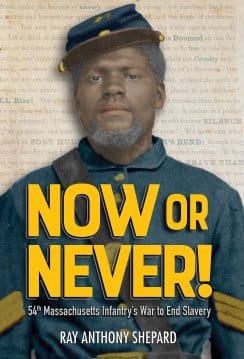
Ray Anthony Shepard’s first book, Now or Never! 54th Massachusetts Infantry’s War to End Slavery, was published in October 2017. Shepard describes the book as “the story of two black Civil War soldiers whose battlefield dispatches documented the regiment’s battle against Northern white racial arrogance as they fought the Confederacy’s attempt to establish an independent slave empire. George E. Stephens and James Henry Gooding answered Frederick Douglass’s call: ‘through Massachusetts we can get our hands on treason and slavery.’”

Dressed in the uniform that the soldiers of the 54th would have worn, Shepard delivered a dynamic presentation on Now or Never! to a rapt Athenæum audience in November 2017. Afterward, Shepard answered my questions about the book, its impact and reception, and his inspiration and research process.

RAY ANTHONY SHEPARD: I was born in Missouri, a state that benchmarked the path to Civil War, in a family whose grandparents and great-grandparents were enslaved. I grew up on the flat Nebraska prairie, the state from which Stephen Douglas notched another benchmark toward bloody disunion. I attended a junior high school named after the abolitionist poet John Greenleaf Whittier and graduated from high school in a town reluctantly named after the slain president. It’s not surprising that after years of teaching American history and developing history textbooks at Houghton Mifflin, I have launched an encore career writing stories about the lives of little-known but extraordinary African Americans who tipped the scales toward justice and equality.

Q: Why did you write this book?

RAS: I wanted to find a way to tell the story of how difficult it was for the country to free itself from human slavery and the economic gains of enslaved labor. When I worked at Houghton Mifflin, then located a few doors from the Athenæum, I passed the Shaw Memorial twice a day. Often I would stop to admire the artist’s realistic portrayal of the soldiers’ facial features and how Saint Gaudens showed these free men of the North’s unwavering courage and pride as they offered to sacrifice themselves to liberate enslaved African Americans. It urged me to retell their story.

Q: When you first conceived of the project, did you know you would focus on Gooding and Stephens?

RAS: I wanted to tell the story of the 54th through firsthand accounts. When I started I knew of Robert Gould Shaw’s personal letters and James Henry Gooding’s letters published in the New Bedford Mercury. A few months into the project I became aware of George E. Stephens through Boston-based scholar Donald A. Yacovone’s research and transcriptions of Stephens’s letters. With nearly 100 wartime dispatches from Stephens and Gooding I was able to tell the story of the “glory” regiment from the viewpoint of two African American soldiers. It was something that had not been done before and I felt it was worth doing.

Q: What did your research process involve?

RAS: Tons of reading primary and secondary sources, and of course being a member of the Boston Athenæum I always had a wonderful spot to read and think. Site research, however, is as valuable as archival sleuthing. To help me better describe the scenes in the book, I visited every place I wrote about. If the reader is able to see and smell what James Henry Gooding felt when he entered the Confederate hellhole of Andersonville, it is because I walked through the gate of that barren prison and imagined the open latrines used by 13,000 prisoners. I imagined the filth, disease, and depression that overwhelmed Gooding. In my writing, I tried to share that experience as if the reader, too, were entering a death camp.

Q: Was there information that was particularly challenging to find, or notably absent? 

RAS: George E. Stephens wrote about the importance of the stories his father shared about life in Virginia at the time of the Nat Turner Revolt. But young Stephens didn’t write any of the details of those stories. I wish he had. Whatever they were, they led him to become determined and articulate, a brave soldier and writer who risked enslavement and death to help liberate 4,000,000 from America’s slave camps.

Q: Did your experience in educational publishing inform your approach to writing this book?

RAS: I have had the honor and good fortune of being a teacher, a schoolbook editor, and a teacher trainer. I am now even more blessed to publish a book about slavery, race, and emancipation. To show that the end of slavery was not a generous act of the North, but an unintended consequence of the Civil War—a war that took the lives of 315,000 Confederate soldiers, most of whom never owned a slave; of 435,000 white Union soldiers, few of whom thought slaves were worth the sacrifice; and the lives of 65,000 black Union soldiers who fought in the last two years of the war and who barely registered in our memory. It took 800,000 lives to end slavery, but it wasn’t enough blood to wash away the underlying cause—a racial hierarchy built on the soft bed of racial arrogance.

Now or Never! book cover

Now or Never!, published in 2017.

Q: Why did you decide to write this book for a young audience?

RAS: My first goal was to tell a good story, one that engages readers from 12 to 80. Underneath that effort lies my effort to show readers the critical role that free and literate African Americans played in the Civil War—saving the Union from slavery. (75 percent of military-aged Northern black men served in the Union Army.) It’s a story missing from school history curricula and one that leaves a knowledge gap in most adults’ understanding of our country’s history.

Q: What do you hope readers will take away from reading Now or Never!?

RAS: That the purpose of the Emancipation Proclamation was to fill depleted Union ranks by enlisting free African Americans to help liberate slaves who Abraham Lincoln had declared free. The success of the 54th encouraged the enlistment of 180,000 black soldiers and gave the Union a manpower advantage over the Confederates, who had more African Americans, but dared not arm them to defend their own enslavement. Yet even though the Union needed these men, there were restrictions: the regiments would be comprised of blacks but led by white officers. The War Department promised equal pay; however, after the regiment left Boston for Confederate battlefields the government reneged on its promise and ruled that African Americans were to be classified as manual laborers and paid half the rate of white soldiers. In protest, the soldiers and officers of the 54th refused all pay and fought and died for 18 months without pay. The stance of the Massachusetts 54th and 55th pressured Abraham Lincoln’s administration to restore equal pay. It was a heroic sacrifice greater than their charge on Fort Wagner.

Q: The book has received some stellar recognition, including starred reviews from Kirkus and School Library Connection and a place on Kirkus and the New York Public Library’s “Best Books for Teens 2017” lists. What’s been the most gratifying response you’ve received since the book’s publication?

RAS: It’s not often that someone my age, closer to 80 than 70, succeeds in launching an encore career. I’m grateful for the support I received from my wife, especially.

Q: What are you working on next? 

RAS: I’m in the beginning research stage for a group biography of the African Americans who attacked Harper’s Ferry in 1859.

01.30.2018

Thomas Bailey Aldrich

February 2018

By Dani Crickman

“Thomas Bailey Aldrich always seemed like a judge, so serious and dignified that one could not imagine him writing that extremely funny book, ‘The Story of a Bad Boy’” (34), writes Mary Jane Regan in Echoes from the Past; Reminiscences from the Boston Athenæum (1927). Others remember him differently: witty, affable, and youthful in his conversations with friends, though aloof with strangers and reticent about public speaking.

Though not as well known today as some of his contemporaries, Thomas Bailey Aldrich was a prominent literary figure of the late nineteenth century, praised by Nathaniel Hawthorne and emulated (though not without critique) by Mark Twain. Given the societal position and literary fame Aldrich achieved in his lifetime, his involvement in the Athenæum is perhaps unsurprising. When he joined, the library would have already housed many of his works on its shelves. Aldrich became a proprietor in 1884, three years into his tenure as the editor of The Atlantic Monthly, working out of an office just down the road at No. 4 Park Street with a view of the Old Granary Burying Ground.

How did Aldrich come to be this man of letters, remembered as the sometimes-somber creator of comedic tales? Born in Portsmouth, NH in 1836, Aldrich was the son of a businessman whose work took them to New Orleans for much of his childhood. At 13, he was brought back to Portsmouth to prepare for entry to Harvard, but abandoned those plans when his father died, leaving the family without adequate finances.

At sixteen, Aldrich moved to New York City to work as a clerk in his uncle’s office, where he took advantage of any break in the day’s work to pursue his own writing. He lived in the company of other writers and poets and began to publish poems and short stories. After the publication of a particularly well-received poem, “The Ballad of Babie Bell,” he acquired work first as a literary critic and then as an editor, and he had published his first collection of poems by age 19. He left New York to serve as a Civil War correspondent briefly, but returned to the city in 1862 and continued to work as an advisor for a publishing company until meeting his wife, Lilian Woodman. In 1865, they moved to Boston, where Aldrich became editor of the Every Saturday, a publication devoted to foreign literature, produced under the auspices of the publishing company owned by fellow Athenæum proprietors George Ticknor and James Fields. Aldrich appears to have made a happy home in Boston, settling in on Beacon Hill and praising the city for its “intellectual atmosphere” and “full-blooded readers.”

It was at this stage of life, contemplating boyhood and fatherhood in anticipation of the birth of his twin sons, that Aldrich wrote what proved to be his most impactful work, The Story of a Bad Boy. Set in Portsmouth, the semi-autobiographical novel chronicles the pranks and adventures of childhood. Tom’s hijinks stood in contrast to the moral tales dictating proper conduct that reigned as the standard for children’s literature. The Story of a Bad Boy is generally thought to be the first realistic depiction of childhood in American literature, and it provides telling insight into the culture of mid-nineteenth century white boyhood, both in its glorification of disobedience and in its subordinate treatment of non-white people and girls. The Story of a Bad Boy offered to the US what Thomas Hughes’s Tom Brown’s Schooldays had offered to England a decade before and began the “bad boy book” subgenre of American children’s literature, commonly typified by Mark Twain’s Adventures of Tom Sawyer and Adventures of Huckleberry Finn.  

Published over the course of the first months of 1869 in the children’s serial Our Young Folks (a publication of the former Ticknor and Fields; at this time, Fields, Osgood, & Co.), The Story of a Bad Boy garnered wide popularity. Our Young Folks increased its subscribers by several thousand while the story ran, and once it was published in book form in 1869, it quickly went through 11 reprints. (The “Story of Bad Boy” in its original serialized form is available in the Athenæum’s special collections, and well worth a look.) Aldrich, who’d long sought to establish himself first and foremost as a lyric poet, gained an international reputation as a humorist.

After the dissolution of the Every Saturday in 1874, Aldrich spent his next five years free from work, writing and touring Europe and spending time with his wife and children. Aldrich became the editor of The Atlantic in 1881 and held the position for nine years before retiring. Under his leadership, the magazine saw a decrease in social and political commentary, and a bias toward traditional forms and subjects, reflective of Aldrich’s taste for what constituted praiseworthy literature. Among the writers whose work Aldrich published during this time were Sarah Orne Jewett, Charles Egbert Craddock (Mary Noailles Murfree), and perhaps most notably, Charles W. Chesnutt, the first African American writer to gain a foothold in the US publishing industry.

Aldrich spent the last 17 years as a self-described “man of leisure and letters,” continuing to write and publish novels and volumes of short stories and poetry. One of these, “The Unguarded Gates,” continues to be contentiously discussed in classrooms for its exclusionary argument against immigration. Aldrich also published “Old Town by the Sea,” a tour of Portsmouth, in 1893.

Aldrich died in 1907, with the quotable last words: “In spite of it all, I am going to sleep; put out the lights.” He was buried in Mount Auburn Cemetery. Apart from the writing he left behind, he is also remembered through the Thomas Bailey Aldrich House Memorial in Portsmouth, which preserves as part of the Strawbery Banke Museum Aldrich’s grandfather’s home—the setting of The Story of a Bad Boy.

from The Life of Thomas Bailey Aldrich

From Greenslet’s The Life of Thomas Bailey Aldrich.

References

“Aldrich, Thomas Bailey (1836–1907).” The Vault at Pfaff’s: An Archive of Art and Literature by the Bohemians of Antebellum New York. Lehigh University, 2017. Accessed 17 Jan. 2018.

Goodman, Susan. “Thomas Bailey Aldrich: Guardian at the Gate.” Republic of Words: The Atlantic Monthly and Its Writers, 1857–​1925. Hanover: University of New England Press, 2011, pp. 142–150.

Greenslet, Ferris. The Life of Thomas Bailey Aldrich. Boston: Houghton Mifflin, 1908.

Regan, Mary Jane. Echoes from the Past; Reminiscences of the Boston Athenæum. Boston: The Boston Athenæum, 1927.

Rideing, William H. “Thomas Bailey Aldrich.” Many Celebrities and a Few Others. Garden City: Double, Page, & Company, 1912, pp. 131–140.

“Thomas Bailey Aldrich House.” Strawbery Banke Museum. Strawbery Banke, 2016. Accessed 17 Jan. 2018.