11.20.2019

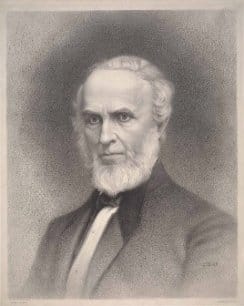
John Greenleaf Whittier

December 2019

By Carly Stevens

“America being what it is, and New England being what it is, it is hard to see how we could have managed to get along without Whittier.”-Edward Wagenknecht John Greenleaf Whittier was a renowned writer whose numerous works about Quakerism and abolition earned him a place among the esteemed Fireside Poets. Over his 84-year life, Whittier used his ability as a skillful writer to become a political activist and fight for the anti-slavery cause. He loved his family and demonstrated his commitment to his parents and siblings. Whittier’s high ambitions as a political activist and a dedicated Quaker, abolitionist, son, and brother are reflected in his poetry, essays, books, and pamphlets.

Whittier was born in 1807 to Abigail Hussey and John Whittier on a humble farm in Haverhill, Massachusetts. As a child, Whittier suffered from poor health and could not work on the farm. Instead, he spent his time reading and writing. Whittier mainly had access to Quaker texts that confirmed his belief in Quakerism. A family friend introducing him to the poetry of Robert Burns sparked his desire to become a poet. His dedication to his studies paid off when he was just 20. Unbeknownst to Whittier, his older sister Mary sent in a poem of his to the Newburyport Free Press. William Lloyd Garrison, the editor at the time, published the poem, starting Whittier’s career as a published poet. Whittier continued to write poetry and Garrison continued to publish it, beginning a lifelong friendship. Garrison saw potential in Whittier and strongly encouraged him to attend school to perfect his talents. Determined to attend a new academy in Haverhill, Whittier worked as a shoemaker, a teacher, and an accountant to pay for the tuition. Whittier enrolled in the academy as an already-published poet and quickly earned himself the reputation as a prodigy. Whittier’s career continued as a writer in editorial positions at The American Manufacturer and The Haverhill Gazette, but due to his poor health he needed to work from home. However, Whittier could not remain homebound for long. In the early 1830s, he quickly began establishing himself as an abolitionist.

Quakerism heavily influenced Whittier’s anti-slavery beliefs. The Society of Friends, the formal name of Quakers, were the first organization to take a collective stand against slavery in America. Whittier adopted the same passion for abolition. He traveled a great deal in his twenties lobbying for abolition and was often met with angry, violent, raucous crowds. He strongly believed in non-violent resistance and faced the mobs with composure. He demonstrated allegiance to the abolitionists through tactful and skilled literature such as the pamphlet Justice and Expediency (1833). Shortly after its publication, Whittier traveled to Philadelphia and participated in founding the National Anti-Slavery Society as a delegate. At just 26 years old, he was the youngest participant. Despite Whittier’s pacifism, he still fought back with great intellect and wit. In fact, when Pennsylvania Hall, an important abolitionist meeting house, was burned down by rioters, Whittier proved himself smarter than all. He disguised himself with a wig and long jacket and began to mingle with the mob. Before the fire destroyed the building he saved his own papers. At 26 years old, Whittier could outwit the best of them.

During this period of his life, Whittier’s poems focused entirely on the anti-slavery cause. Later in life, he reflected on his writings prior to Justice and Expediency and expressed disappointment in these poems. Whittier felt he was simply experimenting with poetry and he finally found his calling as an abolitionist writer. Whittier continued to write and travel to spread abolition beliefs. Around 1840, Whittier’s travel began to slow and he again worked from home as that was more suitable to his health.

In 1857 Whittier, along with Francis H. Underwood, Henry Wadsworth, Harriet Beecher Stowe, and fellow Athenæum members Ralph Waldo Emerson and Oliver Wendell Holmes, founded The Atlantic Monthly. The focus of the magazine was originally on entertaining essays. However, it quickly morphed into a publication focused on contemporary political issues, such as the anti-slavery movement. The Atlantic Monthly became Whittier’s main publisher for many years. The Atlantic has stood the test of time and remains a fine literary publication.

Snow-Bound: A Winter Idyl is Whittier’s most famous work. The poem was published in 1866 during a tumultuous time in Whittier’s life. In 1857, Whittier’s beloved mother Abigail passed away. Elizabeth, Whittier’s favorite sister, passed away in 1864 leaving his home empty. Whittier experienced a newfound sense of loneliness and loss. He wrote Snow-Bound in a period of grief and longing for the past. Snow-Bound was based on his childhood home in Haverhill, Massachusetts, and the home is open for visitation today. The poem also brought Whittier great financial security for the first time in his life. A year after Snow-Bound was published he wrote The Tent on the Beach, which was also received extremely well.

Whittier’s gentle nature and kindness extended to animals. He had many pets he loved dearly. Along with many cats and dogs, he had a pet squirrel named Friday, a bantam rooster, and a parrot named Charlie. Friday the Squirrel was known to sift through Whittier’s pockets and dishevel papers on his desk in search of nuts while Whittier worked. Charlie the Parrot nipped at anybody’s pants that rose above the ankle, ensuring their appearance remained tidy. Whittier was deeply saddened by Charlie’s passing. Shortly after, Whittier got a bantam rooster that would perch on his shoulder and loved being buttoned up in his jacket. Whittier even trained the rooster to wake up his niece by crowing in her room at the set time.

Whittier was 84 when he died on September 7, 1892. He spent the last years of his life in Danvers, Massachusetts at the Oak Knoll estate owned by his cousins. At Oak Knoll, he wrote poetry, advocated for political causes such as woman’s suffrage, and fed squirrels just as he had done all his life. Whittier visited his friends and when his health prohibited him he maintained relationships through letters.

John Greenleaf Whittier is remembered by those who knew him as a man of integrity, decency, and kindness. When he died, The Atlantic published a lengthy article written by George Edward Woodberry. About Whittier, Woodberry writes, “The secret of his vogue with the plain people is his own plainness. He appeals directly to the heart, as much in his lesser poems as in those which touch the sense of right and wrong in men with stinging keenness, or in those which warm faith to its ardor.”

You can explore more about the life of John Greenleaf Whittier and his poetry in the Athenæum’s collection.​

Further Reading:Complete Poetical Works of John Greenleaf Whittier (Cutter Classification VEP .W614 .1882 .2)Poetical Works of John Greenleaf Whittier (Cutter VEP .W614 .1871)Snowbound: A Winter Idyl (Cutter VEP .W614 .sn)Tent on the Beach and Other Poems (Cutter VEP .W614 .t .2)

References:Burton, Richard, John Greenleaf Whittier (Boston: Small, Maynard & Company, 1901.)Pickard, Samuel T., Life and Letters of John Greenleaf Whittier (Boston and New York: Houghton, Mifflin and Company, 1894.)Underwood, Francis H., John Greenleaf Whittier: A Biography (Boston: James R. Osgood and Company, 1884.) Wagenknecht, Edward. John Greenleaf Whittier: A Portrait in Paradox (New York: Oxford University Press, 1967.)Woodberry, George Edward. “John Greenleaf Whittier.” The Atlantic Monthly. November issue. (1892).

10.28.2019

KL Pereira

November 2019

Interview by Carolle Morini

KL Pereira is currently one of our Cataloging department interns and is a graduate student at Simmons University. Her debut short story collection, A Dream Between Two Rivers: Stories of Liminality was published in 2017 by Cutlass Press.1

Pereira holds a BA from Bard College and an MFA from Goddard College. Since 2006 she taught creative writing at Grub Street. Pereira’s fiction, poetry, and nonfiction appear or are forthcoming in the British Fantasy Award winning anthology Year’s Best Weird Fiction volume 5, Shadows and Tall Trees volume 8, Literary Hub, LampLight, The Drum, Shimmer, Innsmouth Free Press, Mythic Delirium, Jabberwocky, and Bitch, to name a few. Pereira is working on a collection of short stories called Where Your Flames Bite My Thigh, written in the voices of historical and imagined women who have been accused of witchcraft, both those who have eschewed the term “witch” and those who have embraced it. She lives in a Victorian garret across from a haunted cemetery with her feline familiar.

Q: Where did you grow up?

KL PEREIRA: Down the street from Lizzie Borden’s house in Fall River, Massachusetts. My grandmother told me tales of Lizzie and her sister being locked in the basement, and I spent a lot of my childhood trying to peep in those windows and see the ghosts. Lizzie’s story and the mystery surrounding the murder of her father and stepmother was one of my first creepy obsessions—I had to know what happened! When my book A Dream Between Two Rivers came out, I was lucky enough to do a reading in the house and sleep over (it’s now a bed and breakfast). Not only did one of my dreams come true that night, I had some pretty spooky experiences!

Q: Do you remember when you first wanted to write?

KLP: I come from a long line of storytellers, so I’ve always been obsessed with telling tales; I can’t really remember a time when I didn’t want to write them down. Luckily, my parents and my teachers were very encouraging. As a child I wrote a lot of what would now be called fanfiction; when I didn’t like the way a story ended, or wanted it to go on, I’d simply write my own endings or continue the story. I even wrote a sequel to Bunnicula, which my mother luckily saved, but for some reason, no one ever sent it in to James Howe (the author of Bunnicula).

Q: What do you like about writing a short story and poetry? Are there challenges writing in both forms?

KLP: Short stories contain infinite possibilities in a concentrated amount of space. Unlike the novel, which can be any length, the short story must create a complete narrative within a certain word count. For me, the challenge (and the fun) is to discover what can be done—within, say, 1000 words, or 500 words—what is necessary to create a fantastic, confounding, compelling experience. Poetry is even more concentrated, with the emphasis on language and sound and image rather than narrative. For me, it’s not difficult to write in different genres, because I’ve always written in both, and in fact, I think it’s an advantage to be able to experiment with the intersections of poem and prose, to play with form in a way that explodes our notions of what certain literature can be.  

Q: What was the best writing advice you received?

KLP: The best writing advice I have received is also the best writing advice I can give: follow your passions. If you’re not obsessed with the subject and form of your art, why do it? If you’re not obsessed with the subject and form of your art, you will not be productive, or what you do produce will not be meaningful to you (and how can your work mean anything to others if it holds no meaning for you first?). You must follow the paths that get you up at 2 a.m., that fling you down rabbit holes, that have you scurrying to the library to research for hours. Find the things that obsess you, and do not let them go.   

Q: What authors do you enjoy reading?

KLP: I read everything, and right now I’m reading a lot of weird fiction by Laura Mauro, Georgina Bruce, and Michael Kelly, all authors published with Undertow Press; YA horror like The Sawkill Girls by Claire Legrand; and fantasy such as The Girl Who Drank the Moon by Kelly Barnhill. I’m eagerly awaiting the winter reading season, when I curl up with some Victorianesque epics like Fingersmith by Sarah Waters, and my favorite magical realist fairy tale inspired novels and stories by Helen Oyeyemi.

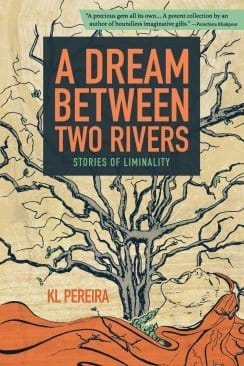
KL Pereira's book, from Cutlass Press

KL Pereira’s book, published by Cutlass Press.

Q: What made you want to become a librarian?

KLP: I truly love being in libraries, working with people and books, and preserving stories for many generations to come. I also believe that libraries are important egalitarian spaces that create support in and for the community. After working in education for many years, I wanted to find more ways to support and be a part of my community.

Q: Do you find working in a library beneficial to your writing?

KLP: It’s a boon to any writer to be surrounded by books. It’s especially beneficial to be able to work with people who love books and see their key importance in our lives. I am constantly inspired by my coworkers at the Athenæum, their passions, and the fascinating and strange stories in and of our collections.

Q: Have you cataloged anything in the Boston Athenæum collection that you think will one day show up in one of your works of fiction?

KLP: I’m very fortunate to have had the opportunity to catalog many amazing books! One book I can think of that sticks with me is a German biography from 1789 (Eigene Lebensgeschichte in vier Stücken by D. Anton Friderich Büsching) that was printed by a woman printer, something that wasn’t common in those days. The paper is handmade and the text itself is a beautiful fraktur style (German calligraphy). I can definitely see myself writing about this book and its creator one day.

Q: Is there any other information about your writing you would like to share?

KLP: Yes! An anthology that I am a part of, Year’s Best Weird Fiction, volume 5, just won the British Fantasy Award for this year! It’s an astounding and wonderful achievement, and I’m very lucky to have had the opportunity to work with the editors of this book, Michael Kelly and Robert Shearman. I’m also excited to be working on my next short fiction collection, and have finished both a poetry collection and a children’s book recently. Libraries are definitely featured!

Congratulations on the Year’s Best Weird Fiction award and best of luck with your writing and publications! I, and others, are looking forward to reading more works by you.1. Cutlass Press is the publishing arm of the independently owned bookstore Papercuts J.P. If you haven’t already visited, don’t delay any longer—you will find a lovingly curated roster of challenging and inspiring books by some of today’s most engrossing writers. And they put on events too! Find the listings here and support local business!

09.13.2019

Dr. Elvira Basevich

October 2019

Interview by Arnold Serapilio

Dr. Elvira Basevich grew up in Brooklyn in a small immigrant community “far from the lights and glitter of Manhattan.” Her parents emigrated from the Soviet Union in the late 1980s, and Basevich—one of five children—was born along the journey. “I’m an in-between person. I grew up in this ethnic niche in Brooklyn. My father never learned to speak English. In some ways, I’m a New Yorker; I have that comportment and self-identity. But in other ways I never quite felt like I fit into not just New York City, but America.” 

As a teenager, Basevich discovered the work and ideas of Jean-Paul Sartre and Simone de Beauvoir and has pursued philosophy ever since. She earned her BA from Hunter College, CUNY, and her Ph.D. from The Graduate Center, CUNY, having defended her dissertation in 2017. Previously she was an Assistant Professor of Philosophy at the University of Michigan; currently she is an Assistant Professor of Philosophy at the University of Massachusetts, Lowell. 

Her first book, Du Bois: The Lost and the Found, is forthcoming from Polity in 2020. 

Q: What was it about New York or America at large that didn’t jibe with your identity?

EB: It wasn’t so much it didn’t jibe, it was more my trying to figure out a plausible narrative for how I, and my family, fit into the country. I think where I grew up and where I was educated played a big role in positioning that question for me as an important one.

Q: Your mother came to America from the former Soviet Union, right?

EB: Yes, my parents came to the United States. My mom was a refugee, and I was born along the way. I think that was a big part of my “in-between” feeling. I took that feeling up in a really big way in my work, in my education, and in my writing—it’s all connected with my family history.

Q: When did your parents tell you that piece about yourself, that you were born along their journey to America?

EB: No one’s asked me that! When did they tell me? I think it is so bound up with my sense of self that I must have been very, very young. 

Q: So you’ve lived with that as long as you can remember?

EB: Definitely. I can’t remember a moment in my childhood where it wasn’t salient, where we weren’t talking about it. My mom would sometimes jokingly call me her “little Austrian baby,” as if she just found me on the side of the road or in a bus station. Her humor about it had a tinge of sadness. And there were odd little things to remind us of it, like the only photograph taken of us that year is her holding me for a travel document photograph. 

Q: You mentioned that in-between feeling informed your work. Was it this sense of self and reconciling your surroundings that drew you to W.E.B. Du Bois?

EB: It’s always interesting to think about these kinds of questions because there are so many different explanations for why we do the work we do. The one that most readily comes to mind is that I was trying to figure out a way I could fit into this country and have a positive role to play. So much of Du Bois’s work is thinking about, “What can Americans hope for? Can we hope for justice in light of a profoundly imperfect past? And how can white European immigrants join the country ‘responsibly,’ that is, without perpetuating or condoning the injustices of the past?” That kind of tension, that kind of problem, really spoke to me. Du Bois poses a challenge to America to look at itself—and the world—from the perspective of those who are systematically excluded from it, especially by having understanding and compassion for the black historical experience.

There’s a version of being an American that makes sense to me, and it’s one that’s bound up with the question, “How can we make this a better place?” For me, the only plausible version of national or personal identity explicitly asks everyone to stand in solidarity with those who are excluded for no reason.

Q: I can’t say I consciously delved into the journey of self-discovery until about five or so years ago. But it sounds like you’ve been living with it your whole life.

EB: Ironically, there are some advantages to being a displaced person. [laughs]

Q: Because it propels you into this thoughtful headspace?

EB: In a way, you have to take up these abstract philosophical questions about self, identity, and responsibility, and then it becomes bound up with this question of survival, “How can I go forward and just exist?” You can’t, if you don’t have answers to those questions. And often times we live a life where those answers are already given to us—they’re pre-formulated by our immediate context. Well, you rip away that context and you’re left with a person who’s truly just wondering all the time and doesn’t know what to do. There’s no question in my mind I wouldn’t have become a writer, and I wouldn’t have become a philosopher, if those things didn’t happen to my family.

So then this question of, “Why Du Bois,” right? How did I come to do this? I think Du Bois just raises these global questions of who I am and where I come from that, in a way, asks the seemingly impossible: for us people to forge together some kind of moral community. I find it both a very difficult challenge but also very comforting to have an answer.

Q: So philosophy—based on listening to you talk—seems like a predisposition from birth, basically, but when did you lock into it as a structured study? When I say “when” I mean abstractly speaking, where were you at in your mind?

EB: Where was I? I was somewhere in Coney Island with my best friend at the time…I guess I was 14, 16, and we would spend a long time thinking about feminism, and our families. At some point existentialism came up and I started reading really ferociously—Sartre and de Beauvoir and all those folks, that school. But at the time I didn’t really know philosophy was a discipline. I had no sense that you could do a Ph.D. in philosophy, that it could be your life. In college I began the academic study of philosophy.

Q: You write poetry as well. What was it about the medium that compelled you to that creative expression?

EB: I just thought it was so beautiful. The first few poems I read I was so impressed by the ability to represent some feature of the human experience so accurately. I was a kid, and it resonated: a stranger, this person I never met, told me something about the way I experienced the world that I felt was true and authentic. I thought it was a kind of magic that we could do that with words. I do love novels a lot, and I think the writing I do draws inspiration from that. It’s very narrative-oriented, and there tends to be a heroine driving the story forward in some way. There is something just about the form of poetry that I really like that I think is really hard to do, and I like that challenge. 

Q: Do you know what the magic is, or is the joy in not knowing and just chasing it in your work?

EB: I think truth is magic. Each medium, from philosophy—especially moral philosophy—to poetry, is going to give you a conception of truth. For me, at least, a part of what I really like about it is it’s my handprint on the world. A way of saying, “I was here, I saw this, I met that person.” 

Q: You have a blurb on your website under the poetry section in which you mention you are an optimist at heart. How durable is your optimism?

EB: Extremely. [laughs]

Q: Does that come naturally or did you strive to cultivate that?

EB: For me, it’s about the resilience of the human spirit. What is it rational to hope for? I will always believe hoping for the goodness of others and the possibility of justice in the world is a rational thing to hope for. And, something we should be optimistic about, because it’s precisely our shared optimism for that end that could realize it! So long as we give up that attitude, we create the world that we fear, which is a world that’s oppressive, where we’re unhappy, where other people don’t see us. 

Being optimistic is part of our resilience, of our capacity to see the world for what it is, with its deep imperfections, and yet still be able to imagine a different one. And that requires such a measure of strength—but for me, that is what sustains good art, good poetry. It’s the fountainhead for our moral imagination that allows us to hope for a better world against all odds.

Q: For anyone struggling with remaining optimistic, what’s a practical way to help them build their resilience? 

EB: It comes down to: Who are you? What do you believe in? In the best possible world, what will you be doing in it? [laughs] 

And if you think there’s a good answer to that—any kind of answer, even, at all—then you would need some kind of optimism to realize it, right? You would need the strength to move forward. There is no practical solution. It’s the hardest thing to do. It requires a commitment to live through a life fully, and that is extremely hard because there is no hand holding. And that can be terrifying. 

When we have these kinds of crises or moments of uncertainty we figure out who we are—and we can surprise ourselves. You surprise yourself with your own strength, or your own faith.

Q: Is there any practical or substantive difference between hope and optimism, or is that just semantics?

EB: I wouldn’t say hope and optimism are different in kind. But I do think our attitudes toward them can have different scopes. I’ve found it easier to have hope and optimism in some general sense. One can move through life with a sense of hope, for example, that not only does one have a purpose, but that one’s purpose can somehow eventually be vindicated in the world—that others really see you for who you are or that the world you believe in will be realized a little more from something you’ve actually done.

But in the day to day it can be a slog, and practically, a form of extreme arrogance to expect understanding and vindication, as if we can really trust the shape of our lives to accommodate our desires and expectations. I’ve found that nurturing hope and optimism on a small scale can be hard, when faced with fear and doubt about specific relationships and projects. So I’m really big about celebrating the small victories: nurturing new experiences and friendships, completing a solid writing day, trying to actually say to others how you feel and what you think. And that for me is exhilarating and makes me feel like all things considered I’ve done all I can.

Q: Are you this contemplative about each action in your day to day, or do you rely on your habitual mind?

EB: Ha! I always think about that. I probably do do too much deep thought, where I could lay off a little bit with the intentional living. [laughs] But no, I’m a big fan of habit too. I think it’s good to have routines, things we don’t think about, to quiet the mind. I’m actually trying to do more of that kind of stuff—things that aren’t intentional living.

Q: How did you find the BA?

EB: I was living in Michigan and trying to find the best libraries in Boston because I knew I was going to be living here and I found this place through my online research.

Q: Let’s talk about writing process: what works for you; how you got to a place where you found something that works for you; do you write at certain times of the day, certain days of the week; do you have to be completely caffeinated, do you have to be completely sober—how did you find the magic formula? 

EB: A big part of that magic formula, for me, is being in a library I like, that’s quiet. I’m a morning person, so if I’m in the library first thing that tends to create a state of mind in which I end up being very productive. And I treat work like a 9–5 job. What’s nice about that is you stop thinking, “Do I feel like writing?”—there’s always that question of how you feel about whether you want to write—you just need to cultivate a good habit around it. With time, you stop thinking about it on this meta level: “Should I keep doing it? Do I feel like doing it? Am I good at it?” It just becomes a part of your day to day—and also in a fundamental, unthinking way, a part of who you are in your life. That’s where I am at now.

Q: Does Du Bois: The Lost and the Found use your dissertation as a jumping off point, or expand upon it?

EB: Not really…half my dissertation I’ve already published, as articles. Most of the book is trying to present, in a very broad way, in as clear language as possible, “Who’s Du Bois as a person? What are the big pieces of his political philosophy? Who are the people that he fought in his life—what are the big polemics he had?” So much of it is already written, which I’m really happy about. I think, when did I write this? I don’t remember! Isn’t that crazy? [laughs]

Q: How do you know when to pause the research and dig into the writing? How do you reinforce your own parameters?

EB: Forcing yourself to stop reading. I’ve learned that reading is probably one of the sneakiest forms of procrastination. What I’ve done the last couple days, in finishing up, is skim major secondary sources, just to make sure I’m not missing any big pieces, but otherwise I ask myself, “Do I really need to keep reading this? No, I don’t? Close it. Write.”

Q: What were the great joys of working on this book?

EB: Writing with a sense of humor about really dark things. That is my favorite. It occurred to me that I was doing this when I was defending my dissertation. My favorite comment from one of my readers was, “It’s about slavery, but you’ll laugh.” I’m very jokey and sarcastic in my day to day banter, so it was such a pleasure to know that somehow without even realizing it, that came through in the writing. 

You have to present information that is so dark. You have to represent the point of view, “What were these white people thinking? How did they justify what they were doing?” So to bring the absurdity of their actions to light through humor… [sardonically] “They thought this was a good idea?” 

This is something I want to hone, and I think that’s probably the most fun I’ve had. There are times when I’m re-reading what I’ve written and I laugh out loud and wonder, “Is this a little too salty?” And then I think, it’s my first book, and people will know this is the way I’m going to write it. This is the tone I’m going to use. 

You need the humor, frankly, otherwise it’s just hard to get through, and it’s hard to make sense of as a person. So much violence, so much unspeakable violence, and ordinary people were doing this, who were motivated to do it because they thought it was a good idea, and that is fundamentally absurd in such a deep way. 

I’ve written fiction that to me was very serious and sad, but then people have read it and thought it was funny and cute. Finding that balance…

EB: I think it’s a good thing to press toward. If you’re going to talk about something really serious and dark, like loneliness, or racial trauma, or violence—of course we’re all going to have mistaken approaches. And I think the worst one is to try to elicit self-pity or sympathy in ways that are beyond the point, right? In my case what I’m writing about is a moral injury to somebody’s sense of personhood. As a writer I want to think about, “How can we use language to elicit the moral recognition from somebody else that it is a moral injury?” That in fact it ought never to have happened. Humor can be a really effective way of expanding our judgment.

For me, a part of it comes out of this Soviet Jewish experience. I grew up with lots of anecdotes about just horrible things, and they were all really funny! One expression my mother said a lot, “You have two options: you can either laugh or cry.” The other is, Хоть головой об стену бейся, or, “Might as well bang one’s head against a wall.” 

When I was writing my dissertation, I didn’t mean for it to be funny, so now I ask myself how I can be more conscious of trying to hone that and make it readable. Because otherwise you’re just reading a book that’s a kick in the gut. But I think it’s necessary, because it’s about the truth. It’s about what happened in the United States, and Du Bois’s political thought.

Humor is so disarming, some of the best books or movies—there’s some hilarious moment, and then they stick the knife in, you know?

EB: Yeah!

And then you feel all the more vulnerable. That’s an opportunity for resilience right there, letting yourself be vulnerable.

EB: And we can always laugh. No one can take away your sense of humor.

Q: I’m pumped to read this! Are you able to talk about your time volunteering at Rethink?

EB: It is a student-run volunteer organization, largely based in New York City. It was essentially a bunch of grad students, mostly from Colombia, in philosophy. We would organize conversations with people. We didn’t really have a curriculum. I worked with women and girls who were victims of domestic violence as they were trying to transition out of these relationships. We partnered with a local nonprofit who gave us the space to meet, and we talked about things like, “What’s beauty? What’s propaganda? What’s hope?” And then just let the conversation happen. Sometimes one of the facilitators would intervene, but other than that it was just people talking about a concept. 

It really tests you as a teacher. It tests your patience, it tests your skills, but you really see the power of a concept. 

There were times when one of the women would stand up and hug another woman just to have the opportunity to be together, or to start crying. You talk about an idea, but what ideas are supposed to do, if they’re adequate, is to make sense of your experience. And if your experience has been very dark and difficult, just to have the opportunity to verbalize a thought, to verbalize your experience in a thought—very powerful. And something that is just infinitely more powerful if there are many people in a room who are there with you, bearing witness. 

[Basevich’s first book of poetry, How to Love the World is now available for purchase online from PANK. And look out for Du Bois: The Lost and the Found coming soon from Polity. We will update this feature as publishing details emerge.]
08.19.2019

Fritz Holznagel

September 2019

By Elsa Vernon

Have you seen a tall gent about the Boston Athenæum, usually donned in a handsome vest and shepherding a group of wide-eyed visitors through the building? If so, you have come into contact with an Emmy award winner, a victor of Jeopardy!’s Tournament of Champions, a Boston Athenæum docent, an author, and all around good guy—otherwise known as Fritz Holznagel. 

Fritz was born in 1961 in a small town just outside Portland, Oregon. He remembers his childhood fondly and to this day feels a deep connection to the Pacific Northwest. He received a Bachelor of History degree from Willamette University, but rather than pursuing an academic career he began working at Will Vinton Studios (now Laika, LLC), an independent film studio specializing in Claymation™. Fritz has always had a knack for writing and this skill allowed him to rise through the ranks at the studio. He started developing scripts for the studio’s children’s shows and CBS specials, and eventually won an Emmy for his work on the CBS TV special, A Claymation Easter, in 1992. 

Fritz made the transition from West Coast to East Coast in 1998, when he began working for Lycos, an early search engine company based out of Waltham, MA. He joined the company during the boom of the dot-com world, but, unfortunately, the “dot-com-bubble,” as it came to be known, burst in 2000 and the company “went south,” to use Fritz’s terminology. In spite of the burst, he landed on his feet and since then has worked extensively for Google, while also maintaining a robust freelance career, primarily in writing.

Concurrent with his career path—and at times intertwined with it—Fritz’s naturally curious mind and talent for soaking up fun facts, historical details, and the like have paved the way for some unique opportunities. For instance, an early iteration of his freelance career was writing questions for such popular computer learning games of the 1990s as Where in the USA is Carmen Sandiego?. Perhaps more sensationally, Fritz’s aptitude for trivia landed him on Jeopardy! five times, of which he won four rounds. In 1995, he was invited to Jeopardy!’s Tournament of Champions—and won. He is proud of his win but also modest, and says there were lucky breaks in the questions—though one could argue his examples of “lucky break questions” are as bewildering as any other question one could be asked on Jeopardy!. Regardless, it was quite the boon for him to win and he considers it a life changing experience, one that transformed his conception of himself. Plus, it is a fantastic “calling card,” as he puts it. The Athenæum has benefitted from his experience on Jeopardy! as well, with Fritz serving as Trivia Master in our annual Trivia Night events, which commenced in 2016. 

On the subject of the Athenæum, how did Fritz discover 10½ Beacon? Similar to other members, by simply walking by the bright red doors. Upon entering, Fritz was thrilled by the Athenæum’s rich history, inspired by the fifth floor with its views and coveted seats, and grateful for the assistance of the reference librarians. In short order, he became a member and a docent. He loves the sharing aspect of being a docent, while also noting that it is an easy job since “delights are everywhere.”

And, indeed, it is at the Athenæum, on the fifth floor, that Fritz has done much of his writing, including his book, The Ultimate Droodles Compendium: The Absurdly Complete Collection of all the Classic Zany Creations of Roger Price (2019). His greatest joy working on this project was learning about the book’s subject, Roger Price (1918–1990), an American humorist and creator of MadLibs and Droodles—silly drawings with even sillier explanations. Fritz has been a fan of Price and his Droodles since he was a boy and he credits Price with introducing him to the hilarity of absurdist humor. The project was not without struggles—Price’s life was not well-documented, and he was estranged from his family for much of his life. Thus, Fritz had to piece together disparate bits of information into a cohesive whole. Still, Fritz enjoyed the project immensely and was happy to learn more about a childhood idol. 

When not writing books, working at Google, doing freelance work, or hosting trivia nights at the Athenæum, Fritz can be found watching old movies with his wife, hanging out with Jeopardy! pals, crafting cocktails, and taking trips home to the West Coast. He is contemplating another book project, but prefers to keep mum on this for now as it is still in the early, contemplative stages—but stay tuned. 

08.12.2019

Justine Chang

August 2019

Interview by Robert Sanford

Artist Justine Chang joined me in the Boston Athenæum’s Daniel J. Coolidge Seminar Room for a conversation about Philadelphia, photography and writing, and her position as Boston Literary District’s first-ever Writer-in-Residence. After beginning her academic career as a biology student, a serendipitous event led Justine to pursue photography. Justine uses her personal experiences and family history as well as the experiences of the communities she engages with to reflect personal narratives and stories. Although communities and people can share events together, Justine acknowledges and is inspired by each person’s ability to create their own fiction.

Between July 15 and August 15, Justine will live in an apartment provided by Emerson College, within the Boston Literary District, and will receive a one-year membership to the Boston Athenæum.

Q: When and where were you born and raised?

JUSTINE CHANG: In the suburbs of Philadelphia. Our house was very close to Valley Forge National Park, where George Washington and his troops spent one winter. We used to find salamanders and antique silverware in the riverbeds and tried very hard to get lost in the woods.

Q: Did growing up in Philadelphia lead you to studying biology?

JC: I would visit the Tredyffrin Public Library to look at encyclopedias and study animals and leaves I found at Valley Forge National Park. I think my childhood growing up next to a beautiful park made me more interested in biology. Even now—I was in the basement the other day and you have a whole shelf of tree books and things about the desert and astronomy. I can just get lost in things like that for hours and I am still very interested in that.

Q: From biology to photography is a big jump. How did that come about?

JC: I had been studying biology for two years and then I met my photography professor who introduced me to Barthes, Berger, and the darkroom.

Q: Had you worked in any other medium?

JC: Not really. I had done some sketches and other things but no formal education in the arts.

How fortuitous.

JC: The fact that I met that professor, he just recognized something. When I developed my first roll of film and made a contact sheet, he just straight out asked me, “What do you think about switching your major?”

Q: Really? Did you have to think about it for very long?

JC: He wasn’t expecting me to decide on the spot or anything, he just wanted to work on it together. He helped me put together a portfolio for art schools, and over time I saw more clearly that this was the direction I wanted to take.

Photography has always allowed me to unlearn what I think I know, or make the familiar strange. It keeps me from being too sure of myself, and I think writing allows me to do this in a different way. I can question the meaning of a word I think I know, and it opens up new topics to investigate, new avenues of possibility. My English professor at RISD would challenge us to do this to the most basic of words, and it really changed the way I thought about language and photography. Once I started applying this to Korean, I found the possibilities grew even more.

Q: It’s crazy how life works. I bet you never thought you’d be a Writer-in-Residence at Emerson.

JC: No! When I found out my jaw dropped and I couldn’t believe it. I am still very much in the beginning stages of writing. I am working on publishing my first piece and this month has been an amazing time to work on that. I did incorporate a lot of writing with my photographs but I think a lot of it was experimental and I’m still trying to figure that out. Writing does something for me that photography doesn’t, and I’m trying to incorporate that more, the images and the words.

Q: Is this a new challenge or next step for you, combining the two? Or are you just focusing on writing?

JC: It’s something I’ve always wanted to do. I have always been writing, but it has always been private and very personal. It wasn’t until I started sharing my writing with my photographs that I was seeing the impact it would have and it was very empowering.

I am basing my writing on what I know about my personal history, family history, as well as oral histories I’ll get from the community around me. What I have been finding out is that you hear many different versions of the same thing. The details will all be slightly different but the gist of the story is the same. In some people’s memories the person is a man or sometimes it’s a woman. That just fascinated me, how that could change like that, and there is no way to fact check these things. Even those events are based on a kind of reality. Each of us has a fiction we hold from our own experience.

It’s amazing how you never get the same story.

JC: I think that’s beautiful, how they’re all different.

Q: What appeals to you about the Athenæum?

JC: Whenever I arrive in a new city, I pin all of the libraries closest to me on a map. It has been such a pleasure exploring the ones in Boston, and as the Writer-in-Residence for the Boston Literary District, I feel so lucky to have access to such a rich resource as the one here at the Athenæum.

There is something about walking through the doors and entering another world, tucked away from the city’s busy streets. It’s the perfect place to read and write without distraction. I absolutely love how there are reading chairs in nearly every corner.

My favorite is the red chair on the fourth floor gallery.

JC: I have a favorite nook too! I feel so lucky to be able to walk over here whenever I want, because all of the clutter in life falls away and I am able to focus. I don’t always come in with a direction for what I want to do, but I could spend hours discovering new things. The building is like a good book in that it rewards exploration.

Q: Do you really use pins to mark the libraries in a new city?

JC: Yes!

I love that.

JC: I’ve been traveling a lot, and access to libraries and archives is very difficult when you don’t know the language. You need to have a guide to help you navigate, especially because what I am looking for has not always been documented. Most recently I was in two different deserts, and I learned that you need to turn to people, such as shepherds and weavers, in places where few or no books are being written. 

Q: What are some of the great struggles of your current piece? And the great joys?

JC: The struggle occurs on days when my urgency to speak and write is diminished by other things. Language is assertive, and it is often difficult not to hide from it in uncertain silence. The joys, for me, are in the learning. Working on my current piece has taken my research to fascinating places, and I’ve discovered stories and archival materials I never would have had the opportunity to find otherwise. There is a poetry in these materials that is a delight to uncover.

Q: Can you share with us what you are working on now?

JC: I am currently working on shorter pieces as additions to a collective history both understood and misunderstood through the lens of language. There are elements brought in from Korean, Chinese, and English dictionaries, and in a way, I think we each retain our own personal dictionary that can be a mix of all of these, and more. I look at how this has been passed down, and how malleable it is. For instance, my own name was changed after my grandmother discovered an alternate meaning in the dictionary that she did not find to be good.

06.26.2019

Dr. James McNaughton

July 2019

Interview by Carolle Morini

James McNaughton is an Associate Professor of English at the University of Alabama. Dr. McNaughton’s work examines the intersections among history, politics, and modernist aesthetics. Twentieth-century Irish writing, British and Irish poetry, and international modernisms are his specialties. You can read some of his work in Journal of Modern Literature and Modern Fiction Studies.

Samuel Beckett and the Politics of Aftermath was published by Oxford University Press in October 2018. During his sabbatical, 2015–2016, he toiled away on the fifth floor for many days. When the book was released, I was fortunate to attend Dr. McNaughton’s talk at Boston University and catch up with him. This spring, as the book hits our new book shelves, I wanted to reconnect and ask him some questions about his research and interests. 

Q: Some background, if you don’t mind. Talking with you I hear an accent that is not completely the American South. Where were you born and raised? What is your educational background?

DR. JAMES MCNAUGHTON: When I emigrated to Atlanta from Dublin in secondary school, my accent was already mostly fixed. I’ve let go of saying “yis” and freely use “y’all”; I rarely call anything “banjaxed” aloud anymore, even though I’m sure it is the right word for these times! I graduated from UGA and from there to Michigan for a master’s and PhD in English.

Q: When were you first introduced or interested in Beckett? Being from an Irish family, was Beckett part of your youth, your upbringing, or did you discover him later on?

JM: I discovered Beckett later. A former professor and current friend, Adam Parkes, gave me a copy of Beckett’s The Complete Short Prose as a parting gift for graduate school. We read “From an Abandoned Work” together over drinks. I was taken by the narrator’s “awful English,” that wry way Beckett courts failure on the syntactical level, cultivates artfully bad writing to illuminate so much. I could have read Waiting for Godot in high school, but it wasn’t until then, later on, that Beckett’s work hit me. 

Q: What is it that initially attracted you to Beckett and his place in history?

JM: Gosh. I became attracted to Beckett’s work because his writing has so much damn integrity. By integrity I don’t just mean that he rejects simple answers, even ones he entertains personally. I mean how, like few other writers, Beckett confronts us with the thorough degradation of the subject in modernity, even as he exposes how literature, philosophy, history, journalism, even language itself, are ill-equipped to come to terms with this outcome. His critique is often appallingly funny. Until he stills even our laughter. I like the honesty of that experience.

I also recognized a scholarly need. Some of the main interpretations of Beckett’s work misread or ignore his specific critique of the culture and politics of his time. Beckett was deeply affected by the pervasive legacy of European colonialism, the rise of Nazism, the consequences of Stalinism, for instance. His writing is profoundly diagnostic and richly original. He is not the apolitical writer he has been taken to be. Biography itself cautions against it. Beckett came of age during a revolution in Ireland; he worked closely with Joyce; he spent seven months touring Nazi Germany, which experience led him to vow to put himself at the service of France should war break out; he had a close friend who died after imprisonment in a concentration camp.

But it is the writing, more than biography, that I focus on. Beckett’s early work is often sophisticated political satire. And in specific and thoroughgoing ways his writing reworks Nazi propaganda, Holocaust survivor accounts, and even debates over what should count as genocide. What is most strange is that Beckett gets at all this by ironically performing art as a failed project. Narrators or characters try to cover up or transcend atrocity: Beckett has them fail. Characters want to forget history or become forgotten. But as their stories fall apart, humanity’s history of erasing “undesirable” people reappears. A more horrible world is steadily brought to mind.

Q: Where did you travel to research this book? What libraries and archives did you use?

JM: Beckett’s main archival collections are held in the Harry Ransom Center, Austin, in Trinity College, Dublin, and at the University of Reading, in England. Actually, that last collection is housed in the Museum of English Rural Life, which means you have to pass through a room of old farm equipment to get to the manuscripts. Threshers and mangles: maybe that’s the right equipment for the archives! I spent weeks, over repeated trips in each of the collections. I also spent time, as you know, at the top of the Athenæum, writing the last chapter in the high calm and light of that wonderful vaulted room. There’s a lot of dignity and concentration possible at those tables for one. My wife Mary would usually be writing a few tables away. She’s a professor of creative writing at Babson College outside Boston.

Q: What surprised you with the research? Did you uncover different conclusions or find new areas of focus that you did not expect?

JM: When I first went to the archives, I had no idea what to expect. Going was part of the ritual of scholarly seriousness, to witness how drafts and translations took shape, to read unpublished letters. The bounty was staggering: censored stories, vocabulary notebooks, 600-page-long diaries kept in Germany, and folders of unpublished letters. Some of that material has since begun to be published. The story, “Echo’s Bones,” which I write about in the book, appeared with Faber a few years ago. Many of Beckett’s letters, though far from all, have been published by Cambridge. And there is a big digital manuscript project underway to map Beckett’s drafts, which will take decades longer to finish. From these trips emerged my sense of Beckett’s struggle to develop an aesthetic in the face of 1930s politics. You see Beckett following Hitler’s speeches carefully, hanging out with banned Jewish art collectors, listening in dry disbelief to his Nazi landlord, struggling himself at times to preserve art from politics, but coming away with an obligation to explore that relationship. You learn from letters that Beckett was an avid newspaper reader and that those newspapers, though often considered irrelevant to literary research, often hold the political language Beckett’s works play against. I didn’t expect to find any of that. Also, did you know that Beckett is a skillful doodler of the most intricate figures?

Q: What did you wish to find in the archives that did not exist? We all have experienced research disappointments and wish something was in that folder in that box but, sadly, doesn’t exist.

JM: There’s a danger, particularly alive in Beckett scholarship, of thinking that we can only write about a literary work’s range of meaning, if the Author, capital A, wrote about that connection somewhere in drafts, as if the literary work is bound by what the author intends, as if Beckett recorded everything he thought. This problem is made trickier because, when Beckett does write about politics, whether Irish, Nazi, French, or Russian, he uses joke, understatement, aside, and irony. He hates pedantry. Sometimes it’d be nice if he dished up some of our modern, recognizable outrage, so that you can say—here, lookit—Beckett said so simply and directly. But he doesn’t much go for self-satisfied expression.

Q: From what I understand, Beckett wrote in French. Did he write in other languages? Did this cause any confusion during your research?

JM: When reading Latin, Beckett sometimes took notes in Latin; he records phrases and passages in German, since he learned that language too; and he translates in and out of French. Beckett’s handwriting, even in English, is hard to divine. Sometimes, you have to hold it at a distance, change the angle, try again, read it aloud, change the angle, try it again. When he suddenly switches into phrases from another language, your arms don’t feel long enough and sometimes the only angle left is nudging the scholar next to you to ask them what they think.

Q: Is there a chapter or idea you worked on that you are most fond of, or a part of your book you wish you had more pages for?

JM: I’m particularly proud of the last chapter on Beckett’s Endgame.

Q: Do you have a particular work of Beckett’s that you return to more often? Not necessarily a favorite work (though it could be a favorite), but a work that you find yourself in conversation with more often than others?

JM: Beckett’s works operate in a series; so they loop back to old questions with different answers, often against a history that has gotten worse. The Three Novels illustrate this wonderfully; they are, I think, his soaring achievement.  

Q: Why do you think the work of Beckett has been so lasting? What do you think is the attraction to his work?

JM: I don’t know exactly. The question of art and endurance is a fraught one, isn’t it, and not always premised on sustained relevance, originality, or force. I think that Beckett’s work has a truth content deeply connected to its unwillingness to resolve profound contradictions we face: that the language we use to understand suffering inevitably takes us away from it; that reason which should free us can also destroy nature and ourselves; that needed aesthetic rebellions are also impotent and already a tool of those in power. Beckett is also pretty good at tailoring the contradictions to his audience: En Attendant Godot appears to perform attentisme, the slang term for those French who refused to take sides during WWII, waiting instead for the arrival of outside salvation. It loses that specific satire in English, but constellates around other meanings to do with the persistence of imperial racism, even when imperialism, as figured in Pozzo and Lucky, is exhausted. There’s something for everyone!

Samuel Beckett and the Politics of Aftermath, Oxford University Press

Samuel Beckett and the Politics of Aftermath, courtesy Oxford University Press.

Q: Do you have a particular performance of a Beckett play that stays with you? Is there a play you’ve seen multiple times and will continue to see whenever on stage? What do you learn from each new performance?

JM: I saw Waiting for Godot in London, headlined with Patrick Stewart and Ian McKellen as Didi and Gogo. A few years later, in 2017, I saw it put on by the Druid Theater in Galway. Both performances were stunning. The London performance played up the vaudevillian physical humor, the bowler hat swaps, the comic routine, the absurdity. The Druid version, which was also funny, vested the performance in pauses and looks that communicated, how do I say it, a profound and moving sense that the catastrophe of meaning was historical, that the “charnel house” around the characters was also a weighty impingement of real killing and cultural failure. This Lucky (played by Garrett Lombard) snatched desperately at the air when the words he’s given to understand his situation—Lucky’s nonsense speech is part eugenics and part imperial celebration of “flying dying sports”—suddenly become physical and fail him in fraudulence. I came away thinking it might have been better had the Irish audience seen the English version and the English audience seen the Irish one.

Q: If someone never read Beckett before, what title do you think they should begin with? Do you assign his work to your students? What is their response, generally speaking?

JM: I think I’d tell them to start with the “Beckett on Film” series, which presents all of Beckett’s plays on film. It’s four discs, available if you still rent discs. I might start with Happy Days. I teach a class called Beckett/Not Beckett, where for each Beckett work, I match him with someone he is not—George Orwell, Agatha Christie, Primo Levi, and so on. It lets the students see the genres Beckett reworks.

Q: If not Beckett who would fill in the blank:  ________ and the Politics of Aftermath?  

JM: Mary just said it should be “Prince.”

Q: Are you willing to speak about your next project? Anything you are excited about researching next?

JM: I’ve finished up an essay this week on the Irish collage artist Seán Hillen. And I’m working this summer on some other articles. I’m researching a second book on Beckett that takes the project forward from where I stopped.

Q: When you are not reading Beckett, teaching, or doing other research, what do you like to read? Any contemporary authors you enjoy?  Any beach reads you’re looking forward to tackling from your “to-read pile?” Are you a person who reads big works in the summer or do you relax with a mystery or light biography? Maybe you forgo all reading and watch television.

JM: On the last long flight in May, I read Christos Ikonomou’s Good Will Come from the Sea. Archipelago Books publishes superb contemporary fiction in translation, and I read from this list for pleasure. My summer reading is a mixed bag. I just read Sabrina, a graphic novel by Nick Drnaso. I’m also reading Theodor Adorno’s Lectures on Kant’s Critique of Pure Reason, partly to see how he structures a lecture series for his students and partly to learn how he performs immanent critique. I’m also reading Identity: The Necessity of a Modern Idea by Gerald Izenberg which is a superb intellectual history of identity politics.

Q: Any last thoughts?

JM: Thanks!

06.04.2019

Dr. Gesa E. Kirsch

June 2019

Interview by Mary Warnement

Gesa E. Kirsch is a professor in the English and Media Studies department of Bentley University, where she also co-founded the Women’s Leadership Institute (now the Gloria Cordes Larson Center for Women and Business). Her most recent publication was More Than Gold in California: The Life and Work of Dr. Mary Bennett Ritter. Kirsch edited the long out-of-print memoir of this doctor and advocate for women’s rights in the late nineteenth and early twentieth century. Ritter was one of two women attending Cooper Medical College (now Stanford Medical School) and earned her degree in 1886. She practiced in Berkeley for 20 years and became Dean of Women Students at the University of California Berkeley.

Acknowledging the thrills along with the frustrations of research, Kirsch admitted shock at what proved to be her greatest challenge in this project to share with a twenty-first century audience the story of Dr. Mary Bennett Ritter: finding a publisher willing to reprint her memoir. Kirsch offered her manuscript to University of California Berkeley, where Ritter had been a major figure.

GESA KIRSCH: You would think that the UC press would have an interest in publishing their own history.

MARY WARNEMENT: Yes, you would.

GK: They were not interested in their own history. I was very happy to find a publisher who was willing to specialize in women in the west. It was my first trade book. I usually do university presses. They turned it around fast, did nice advertising, and distributed it in museums and historical societies. Yeah, it was just stunning.

Ritter herself may not have been surprised. Kirsch’s dedication page calls out Ritter as a pioneering spirit in her thanks to Cindy Melter, great-grandniece, who is “forging a path for women software engineers in Silicon Valley” today. Kirsch had the pleasure of connecting with many who had a connection to Ritter and who see that there is still a need for advocacy for women in medicine and science today.

Kirsch grew up in Lüneburg, Germany, about an hour south of Hamburg. Her father was a country teacher—there were no academics in her family—yet she was drawn to advanced study. She moved to southern California in her late teens where she earned her undergraduate degree in English from the United States International University (now Alliant International University), San Diego and her doctorate in English and American literature from the University of California, San Diego. Professorships at Wayne State University in Detroit, the University of Illinois, Urbana-Champaign, and now at Bentley University, have been accompanied by many invitations from other institutions, such as Syracuse, the University of New Hampshire, the University of California, Santa Barbara, and the University of Louisville.

GK: [I spent my] last year of high school, then I went to college there, and I got my PhD at UC San Diego. I spent ten years in San Diego and now I spend my summers in Santa Barbra—I have a connection there at the university.

MW: Very nice. What brought you to Boston?

GK: A job at Bentley University but also family and friends. We actually decided to move to Boston and then look for work.

MW: You found Boston and you found Bentley. How did you discover the Athenæum?

GK: A good friend and colleague was a member and took me. She loves libraries. She took me to all the beautiful libraries of Boston. She showed me the Burns Library at Boston College and the Boston Public library, but the Athenæum was her favorite.

I love the sun and the beach so I do miss it sometimes. We have that here but the winters are too long. I was just telling a few people that this rainy spring reminded me of Northern Germany. The Athenæum has beautiful light and beautiful spaces. I use it a lot to do my creative writing and thinking.

MW: Do you have a favorite spot?

GK: You know, it varies. I’m often on the fifth floor; right now I’m trending towards the second and third.

MW: Speaking of trends, I notice a lot of your work focuses on gender studies. When did you get interested in that?

GK: Probably starting with my dissertation. I was looking at a writer’s sense of audience and there were a lot of gender issues that popped up. Not surprisingly that’s been in line with interests of mine. Certainly something I bring to my work at Bentley. In the program I team teach, I bring issues of ethics, gender, and diversity to the discussion.

MW: Team teaching. Is that something you enjoy?

GK: I enjoy it. It’s very rare. It’s an unusual gift, really, that Bentley allowed us to do that. My colleague and I continue to do that even though the program we started no longer exists. We get invited to various universities around the world and sometimes bring people to Bentley.

Kirsch celebrated the joys of research. Bentley supports travel for research, and Kirsch benefits from having relationships in the southern California area where she does some of her research. She was especially delighted by two discoveries that also revealed kindnesses.

GK: One of the joys was finding a drawing of Ritter at the Bancroft Library that was not indexed. Through the advice of the archivist—I was telling him my story and as you know, librarians are good listeners, like yourself—I was just telling him about her and her relation to Berkeley, and he knew this was the period when artists were commissioned to draw Californians. [Ritter] was a well-known Californian; that’s why in particular I was miffed when the [university] turned me down. He just went physically to the collection and searched and found it, and I have this reproduction of a charcoal drawing that I would have never found if he hadn’t been on duty that day.

MW: And you hadn’t talked about it.

GK: The other discovery was the gravesite of Ritter and her husband. I met a man on staff at Berkeley at the historical society of Berkeley. Nobody at UC Berkeley knew where they were buriedI mean, can you believe this? It’s a big system and nobody knew, so this man himself researched and found her.

Another fun thing was one story that was completely out of the blue in this internet age. I was working very intensely in Berkeley, researching days and nights, and I get an email completely out of the blue from [Ritter’s] great-grandniece…

MW: Oh, fantastic!

GK: Which I had no contact or information at all with her and she said, “I was googling my Aunt Mary and I saw you.”

I was able to connect with her. I never met her in person, but she looked at her materials and found a book for me. The book came from her aunt so this is like three generations removed. It was just fun and also as a researcher, I wanted to do the right thing for their family. It’s their family not mine. I write about ethics a lot so this brought it home. It was wonderful to acknowledge these people in my edition.

MW: The three of them in your dedication. [Deborah A. Day, archivist, Scripps Institution of Oceanography; Ruth Bennett Cody, niece to Dr. Ritter; and Cindy Melter, great-grandniece to Dr. Ritter].

GK: Who have gotten me excited about her work.

MW: That’s fantastic!

GK: So that was the lovely story of archival adventure.

MW: You can be thorough and scientific, but there’s nothing like serendipity.

GK: Yes, I edited a book on that topic. It’s called Beyond the Archives. You may have a copy of it, it was published in 2008 [Yes, the Athenæum does; scroll down for link]. It was a great pleasure to edit because we had all these wonderful stories like we’ve been telling here, and interdisciplinary stories from many people.

MW: Wonderful. Do you have a new project in the works?

GK: Yes, it’s coming directly out of this journal I discovered called The Woman’s Medical Journal, published starting at the turn of the last century. It was founded in 1893 and ran until 1956 as a research journal by, for, and with women physicians in mind. The research articles and treatment plans are very interesting, but all around the margins of the journal there’s announcements, news, and miscellaneous information. It really was a print-based social media platform, which is very hard to find [for that time]. Announcements of women doctors, where they got their degrees, where they were moving, where they were opening their practices. And they also warn of hostile institutions that would not let women practice, what cities and states were more progressive, where women could go and apply for fellowships, even which hospitals would support women’s internships. I’m working with two scholars out in Santa Barbara. We’re undertaking a digital humanities project, doing some mappings just to see the patterns. Now we’re in the middle of this. Finding exclusionary practices was troubling. While these women publishing in this journal were clearly aware of the exclusion and sexist practices of the medical profession, there were very few women of color included. I was just reading about the segregated medical history in this county; there’s a whole separate national medical association that was founded by and for African American physicians who published their own journal. That’s a troubling line obviously that I’m thinking about, how to write about these women who were so engaged. They mentored each other, supported each other, shared work, and yet it makes me think about my blind spots. What will someone looking at my work 20 or 50 years from now see?

Select BibliographyBeyond the Archives: Research as a Lived Process, edited by Gesa E. Kirsch and Liz Rohan (2008 )More than Gold in California: The Life and Word of Dr. Mary Bennett Ritter, edited by Gesa Kirsch (2017)

04.25.2019

Sara Georgini

May 2019

Interview by Carolle Morini

I first met Sara back in 2009 when she was a BU graduate student researching here at the Athenæum. Since then it has been a pleasure following her career and talking with her about all sorts of subjects. Her book, Household Gods: The Religious Lives of the Adams Family, published by Oxford, was recently published and I wanted to ask her a few questions about this interesting project. Be sure to pick up her book and follow her on Twitter: @sarageorgini.

Q: Where were you born and raised?

SARA GEORGINI: Brooklyn, New York.

Q: Ah, a fellow New Yorkerno wonder we get along!  What is your educational background?

SG: As an undergraduate, I studied print journalism at Boston University. It was a pleasure to return there and earn my doctorate in history.

Q: What is your day job?

SG: My Massachusetts Historical Society career began a decade ago in the Library, and I jumped at the chance to join the Adams Papers editorial project staff. I am series editor for The Papers of John Adams. As a public historian, I’m passionate about ensuring preservation of and access to primary sources like the Adams Papers. I also write about #vastearlyAmerica for Smithsonian.

Q: So we missed the chance to work together at MHS by a couple of years. How did you find the Athenæum?

SG: I found it via a mix of friends, (very) old and new! The nineteenth-century Adamses’ letters and diaries record many borrowing trips to the Athenæum stacks, as well as happy hours spent lingering over their finds. I wanted to recapture some of that exploratory spirit as I tracked their reading habits for Household Gods. In turn, that led me to conduct historical research at the Athenæum and to attend some excellent public programs. Through the good grace of several present-day friends and colleagues, I found a way to voice my support by becoming a member.

Q: What is it about the Athenæum that appeals to you?

SG: It is truly a scholar’s retreat, nestled in the city center. Plush seats, sweeping views, richly lined bookshelves: every floor combines to inspire the historian’s craft. Beyond the wealth of research resources, though, I think the institution’s greatest prize lies in its gracious and knowledgeable staff. When you walk into a private library, especially one loaded with rare books and fine art, you’re never sure how friendly or clubby it will be. The Athenæum staff are the heart and soul of this place. Take any busy Saturday. I see them welcome history fans, scholars, and Freedom Trail visitors of all ages and stages—and I’m deeply grateful to belong to a community like that.

Q: What were the struggles of working on Household Gods: The Religious Lives of the Adams Family?

SG: Writing Household Gods, which explores the Adams family’s religious history from the Puritans to the Progressives, meant keeping up a breakneck pace with three centuries of American history and culture as it happened. I worked hard to give each generation its due, showing how the family used ideas of faith and doubt to make decisions great and small. One of the major struggles lay in producing a tight narrative, while pausing to interpret different religious practices and beliefs as the Adamses encountered them. I aimed for a lively blend of biography and intellectual history, a story that captured their ideas in action. Trying to sit beside people from the past and chart all the places their minds turned—during a pivotal era in history—was a battle on the page. So I began every chapter with an Adams on the road, which mirrored my choose-your-own-adventure approach to research. Leaping into such a generous landscape turned out to be a real blessing. You can start reading the book anywhere, and you’ll be on the main path.

Q: The great joys?

SG: Like the Adamses, I love to write and travel. I tried to walk through the same liturgical worlds they did by exploring churches in Massachusetts, New York, Washington D.C., London, and Paris. Matching up what they wrote with the sensory impact of a worship space was an amazing gift. One of the best trips I took was to All Hallows Barking parish near the Tower of London, where Louisa Catherine Johnson married John Quincy Adams. Blinking up, I could map reference points from my research onto every pew, window, and wall. Below in the crypt lay Archbishop William Laud, who triggered the Puritan Adamses’ flight to America. Ahead was the altar that Charles Francis Adams wept at in the 1860s, reflecting on his parents’ wedding day. Just beyond the pulpit, the Tower’s long shadow thickened and twisted. Here was the corner of the seventh-century church smashed in the Blitz, heralding a world war prophesied by Charles’s son Brooks. Learning how to overlay what I read with the place I saw: that was a joyful lesson.

Q: Any surprises?

SG: It’s often said that we tell old stories to get new ones. Going in to Household Gods, I thought that the big turning points we use to study and teach this period would show up as big moments in the religious lives of the Adamses. Instead, I learned that when it comes to American religion, local history can be epic. It’s a small-town scandal, not a star revivalist, that turns John Adams’s steps away from a life in the pulpit. I pivoted, rejiggering my timeline and sources, because the family saga suddenly arced in so many unique ways. It was an excellent reminder that reading sources is the hardest thing we do. The act of writing history is always a risk, and, yes, a rush.

Q: In your opinion, what makes the Adamses relevant to today? And what about them do you find compelling?

SG: They were lifelong students of government. They were fierce cultural critics who thought and wrote freely about what American citizenship should be. From generation to generation, the Adamses constantly ripped up and rebuilt themselves, trying to reconcile private sentiments with public service. Drawing on ideals of Christian citizenship, they managed a major political brand. All of that came at a great cost. We might look at them and think about questions swirling today: how do you balance party politics and celebrity? What is the role of religion in a democracy?

For more than a century, the Adamses lived at the heart of political power. They struggled with the fame and the focus that came with that role. The family left us an honest and unabashed chronicle of what it felt like to start a revolution, to lead a republic, and to endure a civil war.  

Q: Do you have a favorite Adams? I always had a soft spot for Charles (the apple of Abigail’s eye).

SG: Well, here is a question to shipwreck on, as it changes from week to week and letter to letter. Right now, I’m intrigued by how Abigail Adams evolved her political thought. Long before women won the right to vote, Abigail learned to navigate the republic’s party rifts and found a way to write herself into the national saga. As a public figure, Abigail Adams remade the role of First Lady in provocative and productive ways. She was a revolutionary in her own right. She acted as John Adams’s one-woman cabinet. She cultivated a deep, diverse pool of correspondents, including luminaries like Mercy Otis Warren, Thomas Jefferson, and Benjamin Rush. Her prose is brisk and firm. Yet she can throw her perspective gloriously wide, summing up world events with newsy charm. When you meet Abigail Adams in the archive, you’ll think: “Tell me more.”

Q: What is your writing process? How long did it take you to research this book?

SG: It’s been a ten-year adventure. I worked full time at the Adams Papers while earning my Ph.D. at BU. Household Gods was the dissertation that I honed during many desk lunches, late nights, and too-early mornings. I learned about research, writing, and project management from my fellow editors and hard-working colleagues at the Historical Society. Joining a #BookSquad crew of area historians who were also facing major deadlines certainly boosted both my accountability and my pace. As for process, I’m happy to write anywhere and everywhere. I like to edit in the mornings, when I’m a little less caffeinated and a lot more ruthless with the text. Generally, I save new writing for the evening, so that the day ends in creation.

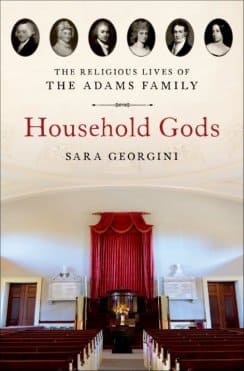
Household Gods (cover) by Sara Georgini

Household Gods by Sara Georgini, photo courtesy of Oxford University Press.

Q: An editorial morning sounds amazing and I love the idea of ending the day in creation. Do you have a favorite book in fiction and/or non-fiction? Favorite author?

SG: The play’s the thing! Between research bouts, I dip in and out of reading drama in Spanish or French, to sharpen my foreign-language skills and to refine my narrative approach. We historians need to think about character development, plot lines, and which voices you hear first, last, or not at all, in a story. I weathered Corneille in the winter, but now that Boston’s spring gardens are unfurling their best, it’s time for a little Voltaire. I’m fascinated by early Americans who used dramatic culture to investigate social issues, and by the stories that a city sings to itself onstage. No spoilers, please: I just began reading Voltaire’s Zaïre, which British soldiers staged a version of at Faneuil Hall when they occupied Boston during the Revolutionary War. Good Athenæum readers, bring on your nonfiction recommendations! I’ve been savoring two science picks: Elena Passarello’s Animals Strike Curious Poses and Steve Brusatte’s Rise and Fall of the Dinosaurs.  

Q: Any projects on the horizon you’re able to talk about here?

SG: Happily, plenty of new research questions bubbled up while writing Household Gods. I’m grateful to the kind folks I meet at book talks who tell me rich family histories of religion and cultural change. Here’s one topic that keeps tugging at me: Where did early Americans go to talk about power, and what did they say? I’ve been digging into the colorful and less-chronicled history of state constitutions, curious to learn more about how colonists became citizens. Since the nation’s founding, Americans have made nearly 150 state constitutions, and then changed them over 12,000 times by amendment. Such civic engagement! My research appraises the role of state constitutions in declaring rights, preserving liberties, and framing government for the revolutionaries who built the republic. Like many of his peers, John Adams was emphatic that, in his “political creed, the word liberty is not the thing; nor is resentment, revenge, and rage, a constitution, nor the means of obtaining one. Revolutions perhaps can never be effected without them.” The second president’s passion for good government mirrored that of a generation caught between independence and ideals. But what is the story of, say, Abigail’s Constitution?

Between 1776 and 1861, the age of revolutions blossomed into an age of constitutions, with people fighting to make change at the local level. They gathered in conventions—to debate constitutional legacies, to advocate for women’s rights, and to give voice to African-American citizenship—in powerful political displays that reshaped their relationships with local authority. State constitutional conventions, especially, served as roads to reform. I’m working on a new intellectual and cultural history, showing how American women and men evolved into modern constitutional thinkers. Spanning the era from the Declaration to disunion, I focus on how “we the people” made—and remade—state constitutions, often struggling to define liberty and law.

02.28.2019

Anna VQ Ross

March 2019

by KL Pereira

Poet Anna Ross joined me in the Deborah Hill Bornheimer Room on a blustery February afternoon to chat about poetry, motherhood, and vulnerability. Cozy in our deep red leather chairs overlooking the chill of the slate stones of the Granary Burial Ground, we discussed the importance of time, space, silence for writing, and of course, her fantastic work. 

On the cusp of her second book, Ross, a Connecticut native who now lives with her family in Dorchester, had a lot to say about how the Boston Athenæum fosters writers and their creative processes. Introduced to the Athenæum by poet and friend Jill McDonough, Ross says: “As soon as we got to the quiet room on the fifth floor, I knew I had to have a membership. I run into writer friends like Jill, Daphne Kalotay, you. It feels like a writing residency. We are here to support each other and to work.” Creating community for writers is something that Ross is passionate about; she co-organizes a monthly series in Dorchester at the Home.stead Cafe called Unearthed Song & Poetry.

We discussed Ross’s writing, from revising on the subway while studying at Columbia University with Lucy Brock-Broido, to diving deeply into the extreme vulnerability of motherhood in her more recent poetry. The duality of being a mother and an artist isn’t lost on Ross, or in her poems. Ross deftly draws the irrevocable teetering dance of motherhood and artistry—which often support yet borrow time and energy from each other—with a clear eye that is not afraid to dwell in emotion.

After our conversation, I was so inspired by Ross and her poems (which have garnered a Massachusetts Cultural Council Poetry Fellowship) that I composed a portrait poem of Ross, a form Ross uses frequently in her work. 

Hawk, Mother: A Portrait of Anna Ross

Words fly like birds of prey around the fifth floor walkup
at the top of the world, the roost of raptors, coupletted nestlings.

Some-day mother rides the train with soon-to-be poems
Flying wheels beat rhythm like hearts, like wings. 

What is later birthed is not just one thing. Girl, fox,
smaller moons, and other invasive species: 

Early motherhood is a series of disconnections
where being just one animal is impossible. 

Yet what is vulnerable glides and keers under Montana, Brazil, finally
Boston skies, scavenging different words for self. 

And what holds is both feather-soft and slate-carved:
Mother, hawk.

01.31.2019

Desiree Taylor

February 2019

Interview by Hannah Weisman

As my conversation with Desiree Taylor came to a close in a cozy JP Licks on a chilly January evening, Desiree shared her primary goal and motivation for her work as an educator: “Ultimately, the goal is LOVE.” And after spending the evening together, I can attest that there is no other message you can take from getting to know Desiree and her work.

Desiree is an independent educator in Greater Boston and works specifically with adult audiences through programs at libraries, community centers, retirement communities, and other cultural organizations. She frames history through story, focusing on telling American history through the African American experience. Her scintillating intellect, warm personality, and willingness to discuss uncomfortable topics candidly create an environment conducive to learning and contending with new or challenging ideas. 

Q: When and where were you born and raised?

DESIREE TAYLOR: I was born and raised in Dallas, Texas, in 1972—just five years after the Supreme Court ruled against anti-miscegenation laws in the Loving v. Virginia case. Growing up, I didn’t know a thing about this case. But once I studied history in college, a lot of what I went through growing up made sense. The fact that just five years before half-black half-white me came into the world, police officers arrested a couple for breaking racial integrity laws says a lot about the period in which I was born. As a biracial child I represented wrong thinking to a lot of people. Growing up where and when I did, as who and what I am, meant it was impossible to go through life unencumbered by questions of race and how it affects society.

Q: What has shaped your work as an independent educator?

DT: So many things have contributed to my thoughts about education. Challenging social thoughts about race and what that has meant for my personhood has meant that, from a young age, I was practiced in questioning authority and was hesitant in accepting prevailing ideas at face value.

I completed an independently designed undergraduate major in religion, gender, and the arts at UMass Boston. The major was rooted in the question, “What are three things that impact everybody’s life?” The school was highly diverse by every possible standard, from educational background and social economic status, to gender identification and racial makeup. I loved it. That independence and diverse environment led me to earn both a master of education in curriculum and instruction and a master of arts in American studies at UMass Boston.

As far as socioeconomic background, I was born poor and then as I was growing up, things went downhill! It might sound odd, but I’m quite proud of my economic background. I’m not proud that I went through it—I think poverty is an injustice and a crime against humanity—but what I’m proud of is the strength of the human spirit I witnessed.

People in all parts of society need places to come together to talk and think. I’ve participated in a lot of great conversations among marginal populations, but unlike folks who get to write their thoughts down and have them preserved, read, respected, and talked about, when the sun comes up these conversations from the margins are gone like Cinderella’s pumpkin carriage. It’s disempowering when one’s thoughts are fairy-tale like, never affecting the real world in concrete ways.

So that is one of my focuses as a scholar and storyteller: I research issues, people, and social events and then break them down into stories that are about us, real people in the real world. And these stories are just as wild—wilder even—than made-up ones. And I love offering these programs to organizations where an entire community has a chance to come together and participate, so everyone can hear and add their voice and experience to these stories. And the community can reflect on how the issues affect individuals and diverse groups. And then change can happen, has a way to happen, if need be.  

Q: Your work explores American history and culture specifically through the lens of African American history. Why is this approach important?

DT: I focus on the African American experience, but present it as the history of all of us. We sometimes get alienated from certain histories because they’re not “ours.” My approach is not just, “let’s look at African American history in the US,” but instead, “let’s look at history in the US using an African American lens.” It makes history personal.

And the African American lens is a good one to use to see the beginnings of a people called “Americans,” because the African American story includes one of the first experiences on US land where a population undergoes a sharp severance from what came before, and is required to start over without the aid of former customs, foods, beliefs, lifestyles, etc. And along with that severance comes a denigration of those things. Yet in that story there is the persistent struggle to assert and reintegrate what is diverse, unique, and worthy about that severed history back into not only the African American story, but into the larger American cultural story as a whole. This is something of a universal US-American struggle and quest. The putting up and knocking down of barriers to connecting past and present can be very well examined in the African American experience.

Q: What are the challenges to your approach to interpreting history?

DT: A major challenge I face with my work is time. How do I tell a story and make it personal in 60 minutes? I have seen keen eyes glass over above an hour. An hour is about the limit for programs where people are presented a subject that piques their interest, but they aren’t required to attend. I love to include the actual words of people from history when I can. So there’s a lot to fit into a little time.

Q: Every educator has a story about a situation they hadn’t anticipated. What’s your favorite moment of surprise?

DT: I’ll never forget a particular program participant in a community day program for seniors who seemed not to be engaged. I didn’t know this individual, so I had no way of knowing that he was hanging onto all parts of the conversation with a lot of interest. His physical disability masked his engagement. It goes to show you can never really judge what another person is getting out of your teaching or the art of your presentation.

By grace you sometimes find out, like I did on this occasion, that someone is taking something they can use from your teaching. And that’s what you hope for—because in the end, I do what I do to increase love in the world. Our societies can be cold and alienating places. Understanding is a major component to love. And if my work can help people understand themselves and our world on a deeper, richer level, then that’s all good.

You can find Desiree Taylor’s website here.