Was the author of Emma and Pride and Prejudice a member of the Boston Athenæum? Unfortunately, no—although we would have welcomed her happily into our plush red chairs. Austen, an English novelist, and Austin, an American novelist, are two very different women. Jane Austen, with an E, is widely remembered, whereas Jane Austin, with an I, is known by few. Here we share some information on the life and career of Jane G. Austin, with an I.
Jane G. Austin was a prolific nineteenth-century author. Over the course of her life Austin published 23 novels and numerous short stories. Austin, a Boston Athenæum member, was well known in New England’s literary community. She was described as sociable and generous, often opening her home to gatherings and giving advice to novice writers. She forged friendships with other prominent authors, such as Louisa May Alcott, Julia Ward Howe, Nathaniel Hawthorne, and Ralph Waldo Emerson. Jane Goodwin took the Austin name when she married her husband, Henry Austin, in 1850. Nothing is written on Austin’s thoughts about the striking similarities between her name and Jane Austen’s, but one can imagine it must have been rather annoying. The inclusion of her maiden initial in her publications shows an attempt to distinguish herself.
Mary Jane Goodwin was born to Isaac Goodwin and Elizabeth Hammatt on February 25, 1831, in Worcester, Massachusetts. The themes present in Austin’s writing came from her entire family’s interest in writing, genealogy, and history. Her brother, Hon. John A. Goodwin, authored The Pilgrim Republic. Her father, Issac Goodwin, was a well known lawyer, dedicated genealogist, and antiquarian. Her mother, Elizabeth Hammatt Goodwin, was a poet and song-writer. Unfortunately, Mr. Goodwin died when Austin was only two years old. After the death of her husband, Mrs. Goodwin moved the family to Boston and sent Austin to private schools to receive an education. From a young age, Austin was a dedicated and meticulous student. She showed an interest in history and writing. When Austin was a child, she was enraptured by stories of her ancestors told to her by her mother. Her long career began in her teenage years. Short stories started as a hobby for Austin, but eventually she began publishing her stories in magazines under pen names. Austin put her career on hold at the age of 17 when she married Henry Austin and raised her three children, Rose Standish Austin, Le Baron Loring Austin, and Lilian Ivers De Silva.
After a 13-year hiatus, Austin began writing and publishing again. Her serialized novels and short stories appeared in magazines such as Harper’s Monthly, The Atlantic, and Putnam’s Magazine. Cipher was first published in Galaxy and was met with glowing reviews. It’s rumored Austin’s dear friend, Louisa May Alcott, collaborated with her on this novel. Later publications of Cipher are dedicated to “My Dear L,” which is believed to be Alcott. Austin’s works have repeating themes stemming from her family’s history and her personal life. They revolve around New England history and often featured her ancestors. Austin’s mother first told her of Dr. Francis LeBaron, who eventually became the focus of one of her best known novels, Dr. Le Baron and His Daughters. Austin’s deep connections to New England were rooted in Boston and Plymouth. Austin lived most of her life in Boston in Beacon Hill, but spent time in Concord after she first married, where her friendship with Alcott began. Austin’s reputation solidified with historical romances based on her relatives in the Plymouth Colony. Austin also dabbled in novels for children including her first published novel, Fairy Dreams; or, Wanderings in Elf-Land. She published other historical novels, but she found her greatest success in the stories she wrote about pilgrims. Betty Alden, the First Born Daughter of the Pilgrims had a large sale and Austin’s obituary in The New York Times notes, “[Betty Alden’s] first edition sold before it was off the press.”
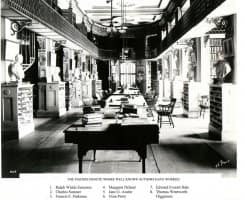
A historic shot of the second floor, where Austin once worked.
Austin wrote with great dedication. Her routine was strict. Constantly enriching her knowledge, she woke up early and devoted her mornings to writing or studying pilgrim history. A member and later a proprietor, Austin was a fixture at the Boston Athenæum. She even had a desk set aside for her in the building. Her regular spot in the Athenæum is noted in a 1902 article by the Sunday Herald. She spent her time on the second floor at the far end of the Long Room by a window. The window has since been replaced with a door to the drum and the space she once occupied is marked by a statue of Nathaniel Bowditch. Her time working was spent meticulously researching her family’s genealogy and adding to the notes left behind by her father. In the little time she was not writing, Austin spent her time with her family and friends. She spent her summers in Plymouth and returned to Boston in the winter. Austin’s social life was full. She and her husband often entertained writers at their home in Boston.
Austin is remembered as “instinctively gracious, ” and a “woman of great tact.” In her final years, Austin continued researching and writing with the same veracity as always. A biography published the year before she died reads, “those who know her give her a warm place in their affections. Her home is with a married daughter in Roxbury, although she passes a part of the Winter in Boston, and every summer she finds herself ready to return to Plymouth, where she constantly studies not only written records, but crumbling gravestones and oral traditions.” Austin died on March 30, 1894 at the age of 63.
“Jane G. Austin” Current Literature: A Magazine of Record and Review. vol I, (July–December 1888)” Jane Goodwin Austin.” Dictionary of American Biography. New York, NY: Charles Scribner’s Sons, 1936. “Jane G. Austin” The New York Times, March 31, 1894. “Jane G. Austin” A Woman of the Century. Buffalo, New York: Moulton. 1893. National Cyclopædia of American Biography., s.v. “Jane Goodwin Austin.” New York: James T. White & Company. 1896. Willard, Francis E., and Mary A. Livermore. American Women: Fifteen Hundred Biographies, revised edition, s.v. “Jane G. Austin.” New York, Chicago, Springfield, Ohio: Mast, Crowell, & Kirkpatrick, 1897.
11.23.2020
Jessica Kent
December 2020
By Carly Stevens
Are you looking for everything there is to know about the literary community in Boston? Then the Boston Book Book blog is the site for you. Jessica Kent started the Boston Book Blog in 2012 and has been managing the site ever since. In addition, Kent works as a scribe at Harvard Business School, enjoys creative writing, and runs her own book club. Kent’s work as a writer, website manager, and literary enthusiast is a reflection of what she loves: writing, history, and Boston.
Kent was born in Albany, New York, and her love for reading and fascination with all things Boston and history started young. “When you’re in Albany,” Jessica says, “you’re either the New York City people or the Boston people. We were always the Boston [and] Cape Cod people.” She continues, “I grew up as a reader, but didn’t really notice I was a reader. I grew up watching my dad sit in his lounge chair every evening after dinner and read.” Kent dabbled in fiction and knew in high school she wanted to be a writer. After graduating high school, she moved to Boston for the first time when she started college. She graduated from Emerson College with a Bachelor of Fine Arts in Writing, Literature, and Publishing with a concentration in Creative Writing and worked as a bookseller for about ten years. However, her desire to be a writer always remained. Not fully satisfied with the literary community in Albany, she moved back to Boston in 2012.
That same year, she started the Boston Book Blog. “When I got out here I had an apartment in Somerville. My window overlooked the city in the distance. I remember sitting down and saying, ‘Okay, I’m going to find out everything that is going on in the local literary community.’” After searching the internet she came up empty. Kent was shocked to find that a city like Boston with a blossoming literary community did not have a single place to go to become immersed in all things literary. There were bits and pieces of information about local events, but no single place someone could go to view everything. So, she started it—the Boston Book Blog was born. “I collect all the local literary events into one master calendar. I have over 100 websites that I check.” In the early days the blog ebbed and flowed, but continuous support from the community encouraged her to keep at it. She’s focused on making connections and building rapport. The pandemic caused Kent to shift the focus of the website to conducting more author interviews, promoting local authors, and just trying to get the word out. During the COVID-19 shutdown in Boston, “it was depressing that first month, because there was nothing to post.” After a while, “it was really cool to see the local community starting to figure out virtual events.” For Kent, “it’s neat to see so many more people being able to log into virtual events than could fit into a bookstore.” The Boston Book Blog “is still a one woman operation, though I’ve fooled many people. It’s cool because I know a lot of people and a lot of people know me, but it’s tough because if I don’t do it then it doesn’t get done.” If you’re interested in keeping in touch with the Boston Book Blog, you can sign up for their newsletter here.
Along with the blog, Kent runs a book club affectionately called the Brew Pub Book Club. “It actually started as a Moby Dick book club when I was doing my Master’s, and I said to all my friends, ‘Guys, I gotta go through this for the next year, if you wanna read it, now is the time to do it.’” The initial thought was to read Moby Dick over the course of a summer, while Kent was working on her ALM in English from Harvard University, but that plan fell through rather quickly. At their first meeting, nobody read the assigned pages. “We ended up taking nine months to go through it,” Kent says. “We met every two or three weeks at a bar in Harvard Square. There were three others and I bought them little gifts at the end.” After finishing Moby Dick, the group continued to meet and decided it should be a “real” book club that read more than just Moby Dick. The club mostly reads fiction, although they don’t shy from non-fiction. Kent is serious about reading and makes sure the participants are, too. “A lot of folks that I mention it to are like ‘oh yeah I’m in a book club, we drink wine, we don’t really read the book.’” For Kent’s club, “this is English class over dinner.” In her experience, “the folks I’ve had in my book club really like that. They really like digging in and pulling it apart.” The Brew Pub Book Club has moved to Zoom, which Kent welcomes. She enjoys opening up the opportunity to friends who don’t live locally. Kent notes the club is a bit “all over the place” with their book selections. Here is a sampling of just some of the titles they’ve read: Celeste Ng’s Little Fires Everywhere, Carmen Maria Machado’s Her Body and Other Parties, Madeline Miller’s Circe, and The Girl with all the Gifts by M. R. Carey. At the time of our conversation, the club was reading Paul Tremblay’s The Cabin at the End of the World. “He’s a local author I’ve heard great things about.” If you’re interested in starting a book club, I recommend Kent’s article, “How to Start—and Sustain—a Successful Book Club.”
Kent is currently querying a novel called Reconstructing Lasky. For this novel Kent drew on inspirations from her trips to Cape Cod during her childhood. “We used to vacation on the Cape and there was this old World War II Liberty ship that they dragged to Cape Cod Bay and left for target practice back in the fifties and sixties and then just left it to rot.” On her family’s trips to Orleans in the eighties and nineties they would go to a beach on the bay side where you could view the ship in all its glory. “It became a piece of local legend and local folklore.” The premise for the book came to Kent while she imagined the people who might have served on the ship. The novel takes place around Josh, a Freedom Trail player, a Revolutionary War reenactor, and the grandson of one of the men who served on the ship. At the start of the novel, Josh’s grandfather passes away and Josh goes to the Cape to begin going through his grandfather’s possessions. He eventually discovers a narrative his grandfather left him about his time in World War II. The novel grapples with nostalgia, history, and how the past influences and shapes the present, themes that are apparent in Kent’s writing. Aside from locale there are certain themes Kent returns to. “I love history, nostalgia and how history impacts us.” Josh, the character in her novel, has a moment where he walks along the Freedom Trail and remarks on how the past and present continue on in parallel. “I feel that way about Boston. It’s probably why I love it. You can stand on a street corner and be like ‘who stood here?’ Our past affects our future and we are all kind of living the past and the present in parallel.”
Kent, an Athenæum member since 2017, “wants to give a special shout out to the New England Seminar Book Club,” one of the BA’s many discussion groups. “That has been my main plug into the Athenæum.” Kent wanted to get involved with the discussion groups and her interest in Boston literary history drew her to the New England Seminar. “The leader, her name is Peg, just welcomed me in. I had read the book and there are a lot of passionate people who are very vocal in that group whom I absolutely love. I remember at one point during the group Peg sensed I wanted to say something and she kind of put her hand up to the other people to give me space to contribute. I’ve gone pretty much every month since then.” Kent enjoys stopping by the Athenæum and seeing her peers from the group. If you’re interested in joining the New England Seminar or any one of our other discussion groups you can visit this link for more information.
You can find the Boston Book Blog at www.bostonbookblog.com, or on Twitter and Instagram @bostonbookblog. Her personal website is www.jessicaakent.com if you’re interested in reading some of her short stories and other freelance work. If you are in the Athenæum, you might find her on the ffth floor, first alcove to your right, surrounded by old Puritan books and a wonderful view of Park Street and the Granary Burial Ground.
11.09.2020
Allison K. Lange, PhD
November 2020
By Hannah Weisman
On the day Allison Lange and I spoke on the phone, she was working on a lecture about Victoria Woodhull, the first woman to run for president in the United States, as part of a series of lectures on 12 important women in American history for The Great Courses. She said, “It feels incredibly fitting to think about a past presidential race while we’re thinking about our current one. She’s fascinating! So radical early on in her life…She was also a spiritualist and the first woman to edit her own weekly newspaper. She did so many cool things!”
And just as it felt fitting to Lange to be focused on Woodhull in this election season, so too did it feel fitting to me to be talking with Lange, who is a leading expert on the history of the women’s suffrage movement (and also does “so many cool things!”).
Like so many others, Lange had heard of the BA, but needed a little extra push to come through the door. That necessary push was a fellowship from the New England Regional Fellowship Consortium in 2012 to conduct research for her doctoral work at Brandeis University. She arrived at 10½ Beacon Street having previously earned her MA from Brandeis and her BA from the University of Georgia, both in history.
Lange dove headlong into the Athenæum’s collections, examining a wide range of visual materials such as prints, photographs, and illustrated advertising cards to understand the images of gender that people were encountering on a regular basis. Over the course of her research, she studied a published account of Susan B. Anthony’s trial for voting, which became one of her favorite items in the collection. “The BA’s copy is…signed by Susan B. Anthony. It shows how proud of it she was—she wasn’t ashamed. She was proud of her arrest for voting and happy to share it with her friends and activists.”
In 2017, Lange returned to the Athenæum as a Mudge Teacher Fellow to develop a bibliography of the BA’s collections related to women’s suffrage (and the case against it). Her bibliography has informed the subsequent work of BA fellows, interns, and staff.
But lest you think Lange is the BA’s in-house historian (we could dream!), she has extensive accomplishments beyond the walls of the Vershbow Special Collections Reading Room. She served as historian for the United States Congress’s Women’s Suffrage Centennial Commission, helping to shape the national conversation about the centennial into a broad discussion on voting rights and making historical research accessible to general audiences. Locally, she curated exhibitions related to the centennial of the Nineteenth Amendment at the Massachusetts Historical Society and Harvard’s Schlesinger Library, and has lectured at multiple venues, including at the Boston Athenæum. She teaches history at Wentworth Institute of Technology, helping her students understand how the past influences current events.
Lange’s research at the Athenæum and work promoting and teaching women’s history, specifically the history of the women’s suffrage movement, has enabled multiple organizations to create exciting projects, including the BA’s 2020 Primary Sources in the Classroom workshop for educators and (Anti)SUFFRAGE exhibition. Lange embodies the legacy of the suffragists she studies, laying groundwork for others to succeed.
08.13.2020
Alondra Bobadilla
September 2020
Interview by Daniel Berk
Alondra Bobadilla is Boston’s first ever Youth Poet Laureate. The selection process was a joint effort between the Mayor’s Office of Arts and Culture, the current Boston Poet Laureate Porsha Olayiwola, and the Boston Public Library, among other institutions. After holding preliminary applications in October 2019, Bobadilla was selected from a pool of ten semifinalists for her two-year term as Youth Poet Laureate. Bobadilla will work alongside Olayiwola in order to promote poetry and arts in Boston, particularly by connecting young people to each other through poetry. Hailing from Hyde Park, Bobadilla is currently a high school student and proud new member of the Boston Athenæum [And we are proud to have her on board! —ed.]. We are sure to hear much more from this talented poet in the future.
Q: How did you discover your passion for poetry?
ALONDRA BOBADILLA: I have always had a knack and an interest in writing, but I sort of “discovered” poetry randomly. I used to write a lot of songs and short stories, but I was looking for a style of writing I felt better suited me. I had that with music but I wanted to branch out. I believe I read a poem online somewhere and that’s how my interest came about, but I can’t quite point to a particular moment in time. I just know I was 12. From then on, I wrote poetry all the time. I didn’t write in particular styles, it was all free verse (before I knew what free verse really meant).
Q: What appeals to you about poetry?
AB: How similar it is to music. I was always interested in writing, but poetry flowed in a way prose did not. I could rhyme and put the words together like a song but without a melody, which was usually where I got stumped with song writing—pairing the words with a melody or a melody with the words. The rhythm was up to me. There were no rules. If I wanted to change it I could. This was completely open range and I loved that liberty to express what I pleased as I pleased to do so. I saw it at first as lyrics without music.
Q: What does your writing process look like?
AB: This question is always a funny one to me. I have no process! Prior to the outbreak, I got inspiration at random. I was always writing and my mind was consistently producing ideas. Even if I didn’t immediately write something down, I’d practice remembering to get back to it later. Whatever motivated me to write a poem, I simply went with that impulse. If I had to leave class to write, I would before I would forget (I took many “bathroom” trips) and I would stand or sit somewhere and let God guide the words. I have no idea how I never missed train stops or tripped or anything because when the words are flowing, I need to stay glued to the screen or paper or else I’ll lose it! I can only retain the words for a certain amount of time unfortunately since there is always something new pushing at whatever is currently at the forefront of my thoughts. Now, my “process” so to speak is a little more organized since I am not out as often. I take more inspiration from reading the plenty of books I have been sent since the beginning of the outbreak and I use them as tools to develop inspiration. I can write just as easily in noise as in silence. I don’t need to be comfortable. I don’t usually experience writer’s block.
Q: As a high school student yourself, how do you feel about the way poetry is being taught at the middle school and high school levels?
AB: I like how my school incorporated poetry as a method for projects. They didn’t necessarily teach us how to write styles of poetry, or the history, but they allowed that freedom of creativity, which was nice. But I wish that we had lessons on contemporary as well as historical poets and poetry styles. In middle school we had a lesson on poetry and prose but it was about Shakespeare and it felt so outdated and the students felt so disconnected from his work. Learning about these famous poets is important by all means but we need to tie the past to the present and show the students the evolution of poetry throughout time. What was once maybe an exclusive male-dominated art form is now accessible to wider varieties of individuals and poetry is widely returning to a more spoken platform, which really changes the way broader audiences respond to the style. Schools need to make poetry as accessible as the streets and other institutions do. We spend most of our time in school, at the very least resources to these programs can and should be provided. No excuses.
Q: What do you feel are some of your responsibilities as Boston Youth Poet Laureate?
AB: This question is intriguing. I have highlighted responsibilities (per the job role) but because I am the first, I am creating my own shoes instead of filling someone else’s. I feel a sense of responsibility on a personal level since before this position (and now more than ever while in the position) to make poetry accessible to everybody, but especially young people. I want them to find a safe space in poetry, and if not as an outlet, as a relatable space in which to listen if they don’t want to write themselves. I want this to become an art form that is embraced by the youth in Boston like they have embraced music. Poetry and music are relatives in my eyes and I want the youth to see that and have an appreciation for poetry in that manner. I want to cultivate opportunities and spaces to practice the art form and develop skills. And most of all I want my voice to be a mouthpiece for other people’s narratives that are largely ignored in civic conversations. Art has a place at the table and I want to encourage other artists to use their voices to engage civically and politically as well as to encourage and sustain the community through their creativity. Art is for the artist but also for the audience—and a variety of audiences at that.
Q: Do you feel that people’s perception of you changed after you were named the Poet Laureate?
AB: Yes, in a way. And no in other ways. People seeing me differently is inevitable. I believe strongly that through our actions we can influence the lens through which others see us. At school, I was known as “the poet” before I was ever the Youth Poet Laureate. The way my peers saw me never changed. They congratulated me yes, but I never changed my attitude. I remained the girl who walked the halls at odd hours, sat on the staircases, laughed too loudly and gave good advice. I was still just Alondra and I worked hard to stress that to those around me to avoid them seeing me any other way than who I was. People have tried, but I always redirected the conversation. After my time as the Youth Poet Laureate, I am still Alondra. Whatever your role, the work you did while under that name has nothing to do with the name itself but with the person who holds it. I am not a title. So I live my life in a way that is of course mindful of my position but even more mindful of myself. The Youth Poet Laureate is not an alter ego. Sometimes people have a tendency to make an identity out of a title. If I don’t do that, people most likely won’t treat me any differently. The way you show up is important. You can’t completely control how others respond to you, but by your choices you can succeed in influencing the responses.
Q: As you know, the BA is Boston’s oldest private library. What role, if any, have libraries played in your life as a student of literature?
AB: Libraries were my favorite places to be. Especially in elementary school. I loved just passing my hands over the bindings and reading all the titles, authors, and backgrounds. I remember I would ask my librarians all the questions in the world. A library was a place made for reading so I would take full advantage of that as a kid. I’d sit in a corner and let the time pass as I read and read and read. My librarians loved me so much that I could take more than two books at a time. So getting this membership at the BA was a blessing. I have not had that sort of luxury access to a library ever before and to have that now? It feels so special. The BA truly is such a special place.
Q: What is your favorite poem you’ve written?
AB: I have a lot of favorites! My spotlight poems usually change with the seasons I’m in. But as of now one of my favorites is a poem I wrote while on a mini vacation to Plymouth Beach. I was sitting on the sand as I wrote this, looking out at the ocean.
7/26/2020 10:11 a.m.
the mouth of your plyth
ocean draws back sand appearing to be the veins of the sea tracks like seal slither leading back to earth’s greatest wonder and slickest deception domestic surface becomes roaring waves in one blink an explosion of water atom to water atom iridescent blues to green to clear in cupped hands the sun kissed ocean becomes the enemy swallowing you whole with no trace of you left but clothing articles and jewelry passed from generations that one day a blessed swimmer will come to find in the treasure burrows of the floor
rocks leading to waters edge are everywhere like warning signs or maybe monuments of the ages homes to creatures only known to sand depths
its so inviting where sky blue meets it’s mirror image but just a step in and icy cold crawls up your legs to your spine to the the edge of your neck paralyzing beauty
this is not Boca Chica this is not palm tree coco delights or tropic drizzle and dry heat
this is the mouth of Americas plight pilgrims refuge and natives doom this costal graveyard decorated by cloud still God blessed for sun rises upon these waters and it rose upon every evil and every love held on this land
creation still loves us enough to rise on God’s command.
ocean draws back sand the veins of the sea
the arteries that pump back life into us caresses these tired eyes with a breeze.
07.30.2020
Christopher Bing
August 2020
By Samantha Gill
Considering himself a “political illustrator,” Christopher Bing’s career spans four picture books and countless political cartoons and illustrations showcased in such publications as The New York Times, The Wall Street Journal, and The Washington Post. Bing’s first published picture book, Ernest L. Thayer’s Casey At the Bat: A Ballad of the Republic Sung in the Year 1888, earned him the coveted Caldecott Honor in 2001. Imbued in his illustrations of every one of his four picture books is a staggering amount of research—research often done at the Boston Athenæum. Even the casual reader will notice how this research translates into rich, intentional detail that deepens the reading experience. I had the great pleasure of speaking with Bing about his life and art.
Born in New Mexico, Bing spent his childhood as a “corporate brat,” moving from New Mexico to Florida to Alabama following his parents’ job opportunities. He finally landed in Lexington, Massachusetts, where he graduated high school. Of his regional association and upbringing, Bing remarks, “I have definitely been, yes, a child of America as opposed to of the South or of the North. Lived in Alabama, really lived in the middle of nowhere. And on a river. And basically grew up at that point, you know, had the life of Huck Finn…we were one of the last houses down a mile long dirt road, which was off another dirt road which connected up to a highway that was only a two lane highway, which then led into town, which was another ten miles out. As soon as I got off the school bus, I’d be running towards the Tennessee River and all my clothes off and jumping in and really having the life of Tom Sawyer and Huckleberry Finn in the woods. It was great.”
Bing’s career as a political and picture book illustrator might have been predicted by his early interests. “I cannot remember a time I haven’t drawn or been drawing. Aside from reading, I really enjoyed drawing.” He remembers the works that sparked his imagination including classics like Twenty Leagues Under the Sea by Jules Verne and comics like Alex Raymond’s Flash Gordon. These passions were supported by his parents, who’re “both academics and my father was the head of the math department at Newton South. My mother was a social studies teacher at Brookline High. They were both very much into books and academics.”
After graduating high school, Bing took time to focus on what his future might hold. “I had a year off and then went to the Rhode Island School of Design. I didn’t actually intend to apply in my year off! I guess the best way of putting it is that I’m a very high-functioning Asperger and classrooms just were not structured for me and I’m definitely on the visual end of the spectrum more than the calculating or mathematical end. One day this application came in the mail. I don’t know where it came from. And it was, ‘do a set of drawings’ and I did…so OK. Here’s a challenge. We sat down and did it, and that was in the fall. Then in the springtime my mother called up crying, ‘When did you apply to RISD?’ And I said that I didn’t know I had applied! ‘Well, we got your acceptance.’ Wow. Wonderful. OK. Because I’d never gone down to do an interview. I’d never filled out forms. And I know that my parents didn’t apply for me. So there’s this wonderful individual out there somewhere who actually did all of the applications and everything. I feel kind of bad because there was a fifty dollar application fee. Very generous person. But it wasn’t my parents. And nobody ever came forward.”
This anonymous, benevolent act set Bing on the path to his distinguished career as an illustrator. After a brief attempt to join the Marines to fly planes, specifically a Harrier Jet, Bing built a career of drawing cartoons and other images for numerous publications. He also concentrated on nurturing his growing family of three children, two daughters and a son.
A devoted father, Bing loved reading to his children as often as possible, especially a family favorite, the Harry Potter series. While reading the books to his kids, Bing took particular joy in bringing the characters to life through distinct voices. After seeing Harry Potter and the Sorcerer’s Stone with his eldest two children, they exclaimed how the screen’s Hagrid was not up to Bing’s rendition of the character. “I couldn’t believe that my voice had had that much of an impact. I mean, I’m a visualist, so to me, it’s visuals that really make the marking. Just a great moment for me.”
Bing brings his visualist lens to his picture book illustrations infusing each image with a depth of meaning and detail that comes from dedicated research. This research brought him to the Boston Athenæum, where various resources helped bring realism and nuance to his second published book, The Midnight Ride of Paul Revere by Henry Wadsworth Longfellow. “Doing the research for The Midnight Ride of Paul Revere, I was looking at very old books and seeing how they were designed, how they were laid out. And there is a difference. I get so focused on designing the book that actually having a historic reference for them…I love sinking into research. When I contract out a book it’s for a year. The work itself really doesn’t take that long. The work is really about five to six months of just sitting down and taking the photo reference, canceling out everything, thinking through everything, and then making sure the design and the color are placed properly.”
As Bing discovers new information, he weaves important historical context into his art. “When I did the research for The Midnight Ride of Paul Revere, there was a freed slave who fought the Battle of Lexington named Prince Estabrook. There is a daytime image in my book, which is a key battle scene. On the left hand side of the page, you’ll see Prince Estabrook, a Black Minuteman, fighting back. It’s those details. The funny thing is, the vast majority of people will skim over it. They won’t see it. There were stories I read to my kids over and over again because they would say that I’m onto something. And I always wanted my books to be so entertaining that a kid could glom onto it.
Bing’s imagination and love of research work together beautifully to help produce layered, meaningful images that compliment and deepen the words on the page. Bing subscribes to the theory of another beloved illustrator. “I definitely live by Maurice Sendak’s philosophy of doing picture books. He says the text tells one story, the pictures should tell another. There should be things in the pictures that are not in the text and things in the text that are not in the pictures. And when you put those two together, you have a complete third.”
Attention to historical accuracy translates into subtle creative details. “When you’re looking at Casey at the Bat, it looks like a scrapbook, 1888, all the memorabilia.” The realism of these illustrations have led to some amusing confusion. In his first published work, Ernest L. Thayer’s Casey At the Bat: A Ballad of the Republic Sung in the Year 1888, an ersatz library card included in each copy prompted “a couple of calls from librarians laughing, saying that ‘when we opened up the book, we were trying to pull the line because we thought it’d actually gotten stuck in there.’ And I was like, yes, I did my job.”
Furthermore, Bing’s research helps him add positive representations of marginalized communities. “With Casey at the Bat, I found out that 1888 was the last year that Black baseball players were allowed to play with white ballplayers. Because in 1889, what we would consider the professional baseball leagues stopped signing up Black ballplayers and wouldn’t renew their contracts. In 1888, there was what is called a pitcher/catcher battery. This team pitcher and catcher were Black and they were really amazing. So, my pitcher and catcher in Casey at the Bat are both Black.”
Bing’s commitment to inclusion extends to the projects he hopes to publish in the future. One such idea is a visual and allegorical representation of the Bill of Rights featuring figures drawn from real-life dancers of varying backgrounds. The goal of this project is to present this founding document “in such a way that it would make it accessible to everybody.” This is just one of many projects Bing hopes to take on in the future. Other ideas include a meticulously researched imagining of Charles Dickens’s beloved novella, A Christmas Carol, as well as breathing new life into the folklore of Darby O’Gill, and secular illustrations for the beloved poem “The Night Before Christmas.”
Christopher Bing aims to layer his illustrations so that readers discover something new each time the book is read. Every reading will uncover a different dimension and deepen your understanding of the images, text, and overall story. Next time you open up a picture book consider how the illustrator conveys meaning. Bing spends the time and thought to “put several layers into it so that it’s not just a picture book. I’ve always wanted depth in my books that would have people coming back, and back, and back. I want my books to come off the shelves.”
05.12.2020
Danna Lorch
June 2020
Interview by Arnold Serapilio
Danna Lorch was immersed in a literary world from an early age. When she was nine, her father and mother Jim and Randy Weiss started a storytelling company that created and sold audio cassettes of classical literature and Greek mythology in northern California’s Bay Area where Lorch grew up. Many of her earliest childhood memories involved following her father to his storytelling performances or visiting bookstores and libraries.
As a teenager, Lorch’s parents enrolled her in the University of Virginia’s Young Writers’ Workshop, a summer program she attended during her high school summers. “For the first time I was around other kids like myself who thought it was a great idea to sit around quoting Sylvia Plath and other angsty things.”
Lorch has a master in peace studies from the University of Notre Dame, Massachusetts and a master in Middle Eastern studies from Harvard. A prolific interviewer and writer, she has chronicled arts and culture for over a decade, first in Jordan and Dubai (more on that below), and more recently here in Boston, where she currently is a freelance writer focusing mainly on New England art, design and architecture in addition to Middle Eastern art.
Anyone looking to connect with Lorch to ask questions, write together, or commission potential stories, can do so through her website, or on Instagram, @dannawrites.
Q: How did you find the BA?
DANNA LORCH: I was looking for interesting things to write about in Boston when I moved here. I connected with Maria and began to hear about the Hayden albums, then wrote that story for Smithsonian about the acquisition of the Hayden albums. Whenever I visited the Athenæum I found it to be charming and magical but also really grounding. That so many people who’ve done incredible things have walked through those doors and had great thoughts inside. And just being among so many older books and publications is really exciting for a writer! Especially after having been in the Middle East. There aren’t many older institutions in Dubai, the excitement of Dubai is that everything is new and developing.
To be in a historic part of Boston, in a historic library, with collections dating back hundreds of years is really very thrilling. I feel like I know everyone there, even though I’ve never spoken to them, do you know what I mean? I appreciate the industriousness with which people are dedicating themselves to their research or their writing here, and it propels me not to waste my time. I arrive and see that everyone is so focused and it forces me to be focused and take risks and be daring and go places I’ve previously been perhaps too fearful to go creatively.
Not to mention how much the Athenæum has come to mean to me in such short time. I also want to give a shout out to the librarians! One of the reasons I joined was because of the research opportunities. I find it tremendously helpful to be able to book an appointment with a librarian and have someone help you with your research tasks and offer ideas. As a writer, I can’t even say how much time that saves, how reassuring it is to know there is someone who can help you find obscure texts or resources.
Q: Everyone’s writing process is different. What does yours look like?
DL: It’s changed since I became a parent. Parenthood has forced me to be a lot less precious with my words. I have these boundaries of time and I can’t cross them: I can’t be late to the preschool pick-up, and once I get home I’m usually exhausted and can’t necessarily think very creatively at night. It’s changed the way I structure my time.
I try to have one to two major deadlines a week and then set aside one afternoon (this is pre-pandemic) to go to the Athenæum and write something I’m working on for myself. I’m really protective of that time.
In general, most of my work involves interviews. I write a lot for arts publications, so most of my work involves either going to see a space, or going to see an exhibition, or visiting an artist’s studio. I get a lot of energy and structure from that. I like to record an interview, transcribe it, and write immediately after the interview. I find that if I wait any amount of time, I lose the energy of that connection and then have to retrace that feeling. And, so much of writing is also what’s not said, so if you visit an artist’s studio, it is about looking, seeing what she has on her desk, or how her books are arranged, or listening to the music she’s been playing while she works on her most recent series, or noticing that there’s silence.
Post pandemic—whatever that means—is going to be really different, because so much of my writing comes from visiting other people and spaces [laughs].
Q: What are the great struggles of your writing projects? The great joys?
DL: The biggest struggle is always hitting “send” and submitting something to an editor. I almost always have this horrible feeling of loss. Second to that is this feeling that I’ve missed something, that the piece isn’t done.
Some of the best moments come with really great editors. There’s so much to be said for editors who ask insightful questions. I really appreciate editors who edit. Editing is a craft. The author’s job is to write the piece they’re commissioned to write—not to question it or to look back at it and think it’s not ready. That’s the editor’s job.
One lovely thing about being a writer who covers visual arts is the marriage of visuals with your text. When we’re children we get to read picture books that have these beautiful images. Then, as we become adults, somehow our books aren’t supposed to have visuals, like it demeans them or makes them seem less intellectual or academic. I feel privileged to get to write in response to and in dialogue with powerful visuals so often.
Q: How did you wind up living in the Middle East?
DL: It was the post-9/11 Bush era. The CIA was recruiting and wanted people from our class who spoke Arabic to just go and sit in State Department offices and dictate how the Middle East should be run. I considered diplomacy, but I didn’t think I should do that unless I actually spent some time in the Middle East, really seeing how people lived, listening to people and learning from their stories.
Q: Your instinct to want to live the experience before passing judgment on it—did it seem like you were alone in this approach?
DL: So many of the people I graduated with went straight into counter-terrorism having never once set foot in a mosque. They would go to these very elite language immersion programs during the summers and would socialize with a very distinct class of individuals in those countries, but maybe would miss the feeling of walking down the street and talking to the average person and really listening and learning.
While at Harvard I spent a lot of time doing research in mosques. Right out of grad school I got a job as a nonprofit manager in Amman, Jordan with the Canadian outfit Right to Play. My job was, basically, to help several thousand Palestinian refugee children play [laughs]. I hired a local staff and worked with UNRWA (United Nations Relief and Works Agency) and spent a crazy year and a half working in refugee camps trying to get this program off the ground.
During that time I met a friend who edited the magazine Viva. When I wasn’t in a refugee camp she would send me for these crazy spa appointments where I would have to review the spa facilities at, say, the Four Seasons Amman, or whatever. The cognitive dissonance between being in a refugee camp where people sometimes couldn’t even afford shoes, to going to the Four Seasons and having a gratis $300 seaweed wrap was really confusing.
That seems like a very jarring head space to constantly occupy. Being yanked between two extremes like that.
DL: It was jarring. It was exhausting. And it was confusing! There were many powerful lessons about that time. One of the most powerful was, I lived by myself and many of my colleagues were refugees themselves and lived in what we here would consider very impoverished circumstances. And yet, they felt like I was the impoverished one because I was alone, I was without my family, I was not married—
Different priorities.
DL: Totally different priorities—that was another thing that was quite jarring and fascinating about that time. I journaled a lot about this era, and I always thought I would write something larger about it.
When that ended, I worked for Operation Smile, another nonprofit and they sent me to Cape Town. I eventually got really burned out. Seeing that amount of suffering and poverty gets to you. I wrote full time for three months and started to get published. Then I fell in love with the man who’s now my husband. He was in Dubai so I moved there, thinking I’d get another nonprofit job, but none were very transparent. Plus most of the work involved heavy duty fundraising and development, which I had done previously, but it wasn’t what drew me to the nonprofit world. I loved sitting on a floor of a refugee camp listening to women tell their stories, helping to make those women feel heard. The idea of raising money in a non transparent way was depressing.
One day I was in an industrial area of Dubai called Al Quoz, where the art galleries are. I was at this compound called Alserkal Avenue, which now is really well-known, but at the time was still developing. It was a former marble factory that a generous patron of the arts had given over to creatives and gallerists at subsidized rental rates so they could have a community.
So I was there and had booked an interview with Syrian artist Tammam Azzam for my Jordanian friend’s magazine Family Flavours. Just before we did the interview, one of his photographs, “Freedom Graffiti,” went viral—it was all over CNN, the Wall Street Journal, the New York Times. He had superimposed Klimt’s The Kiss on a bombed out wall in Damascus which was where he was from. It had caught on as this message of hope and beauty during a really bleak time in the Syrian conflict. And I had the first interview with him since we’d already set up this time to speak! We were sitting in this little alley on this little bench and he’s chain smoking his cigarettes and the Ayyam Gallery phone inside is ringing off the hook. I realized then that this was the same thing I had done at the nonprofits: listening to people’s stories and bringing them to a wider audience.
The art scene happened to be rising in Dubai when I was there, and I became one of the first English writers to cover the art scene there and the Middle East at large. I started with blogging, then started writing for local publications, then regional publications and the newspaper, and then eventually international arts publications over the seven years I was there.
Q: I imagine living through all of this must change your worldview. Do you feel your brain is more wrinkled these days?
DL [laughs]:Right now, to me, the world actually feels larger than it has felt in a long time because borders have been clamped down due to the pandemic.
Previously though, I felt like the world was a village. Living in Dubai especially, where it’s so international and so cosmopolitan, and wherever you go you see people from so many different cultures all working together, in peace—that really is happening there. It just changed the way my brain works. But while it’s strange to now be in a place that isn’t terribly diverse, it’s also beautiful to come back to your own culture after being away for so long.
Now that I’m back here, so many times I mention having lived in the Middle East for many years, and the first thing people ask is, “Weren’t you scared?” I’m trying to get brave enough to write something about that, because I actually felt safer there than I do here, in many ways. The amount of welcome and graciousness that people gave me, as a foreign guest, was so overwhelming. The number of times people invited me into their homes, whether that was a grand home or a simple home. Also, in Dubai, we did not need to lock our doors at night. You would walk at night by yourself. If you left something at a restaurant it would not disappear.
Right now I am working on something about being a religious minority in a Muslim majority country. That’s what I’ve been doing on the fifth floor when I get brave enough to write.
Q: You’ve mentioned or alluded to creative bravery a few times. What does that mean to you specifically? Is it about forcing yourself to think really deeply about certain ideas and get lost in them? Is it simply the act of sharing your work with other people?
DL: I think there are two kinds of bravery. The first is commercial bravery. If you earn a living based off your writing you have to have so much courage to pitch things, and you have to be best friends with rejection. You can’t be too precious about sending your ideas out into the world and seeing someone ignore them or twist them or reject them. Knowing that may happen most of the time, the time your idea is accepted is exhilarating.
There’s also courage required to face down the blank page. Just the act of sitting down and forcing out that first draft is really the hardest part. When I start something I generally expect the first draft will be truly dreadful. Once I have something, even if it doesn’t feel right, I can start over, but that initial push is really frightening.
Q: Were there any particular rejections that were more formative or edifying?
DL: I don’t have a formal art history background; I do have a Middle Eastern studies background, though. When I first started writing, I didn’t really know how to approach arts publications and I didn’t really feel qualified, and I would get ghosted. So I started a blog. It was the days of the blog and I amassed quite a social media following. People were obsessed with social media in the Gulf. I don’t know if this is still the case, but while I was there the largest stats in the world for social media engagement came from the Gulf.
I think the way I initially got around rejection was by just publishing my own thoughts. I was really lucky that the gallerists and artists in the region took my work seriously and gave me space to interview really inspiring artists and creatives.
Q: Is it fair to say your experiences have made you more optimistic?
DL: I think so. Especially when I lived in Jordan, one of my projects was in Zarqa, where Zarqawi was from. I have really vivid memories of doing a teacher training with my staff and some really passionate UNRWA educators. Several of the women were fully covered, just their eyes showing. The men were mostly in traditional Islamic dress. I played children’s games with them—we were trying to figure out how we would teach their elementary school students some physical education concepts for the first time—and we laughed so hard trying to pretend to be little cars turning on our signals in a traffic jam. And how to help them, through play, learn about peace and human rights. I realized that everyone is the same, you know? I interacted quite a lot with members of various royal families in the Middle East and I don’t really see any difference in the way that people behave, or the way that people are, fundamentally. Everyone is the same.
04.16.2020
Jeanne McWilliams Blasberg
May 2020
Interview by Carolle Morini
The author Jeanne McWilliams Blasberg was born in 1965 in Philadelphia, PA, raised until high school in Westchester County, NY and then in Newport Beach, California. After graduating from Newport Harbor High School, she came back east to Smith College where she graduated in 1987 before working in finance for many years. Her first novel, Eden, came out in 2017 and her second novel, The Nine, was published in 2019.
Q: How are you doing during this quarantine?
JEANNE MCWILLIAMS BLASBERG: I am one of the lucky ones for sure. Even so, the need to quarantine hit me with shock, then frustration and anger, then sadness and now finally acceptance (as well as a good portion of worry). My family is making donations to those most in need through the Boston Resiliency Fund and I am trying to see the positive every day, making the most of the time and the fact that I am able to be home with my loved ones.
Q: What is your writing process? Are you finding it has changed now? If so, how are you adjusting?
JMB: I am a morning writer and the crazy thing is the quarantine allows, schedule-wise, for an ideal writing life. The worry and preoccupation with the future do not help with the writing life. To combat those distractions, I am grateful for a well-established meditation and journaling practice. I use both these tools for clearing my mind before sitting down to work on my fiction. Having no appointments outside the home means I can sit at my desk for long stretches. I have decided my work-in-progress must incorporate the present moment, so every day of the pandemic and the emotions that go along with it are being channelled into two of my characters’ development.
Q: What are you reading right now? Do you find your reading list or tastes have changed, being inside longer?
JMB: My reading over the past month has included: Devotion by Dani Shapiro, Fairyland by Alysia Abbott, Writers & Lovers by Lily King, and Severance by Ling Ma…I love memoir and contemporary fiction—and no, my taste hasn’t changed. I do have a couple of non fiction books about the brain and the body I am dipping in and out of, but basically I am using this time to tackle a very high TBR pile.
Q: What is your work experience?
JMB: After graduating from Smith College, I embarked on a career in finance, working as an investment banking analyst at The First Boston Corporation. While I worked primarily with numbers, I always had an interest in writing. After a stint on Wall Street, in the treasury and strategic planning departments at Federated Department Stores (later Macy’s), I wrote case studies at Harvard Business School before turning seriously to fiction. I’ve kept a journal throughout my life and was inspired by a pervasive theme in those journals around what it means to be a daughter and a mother as I wrote my first novel, Eden. I am a founder of the Westerly Memoir Project, which offers classes in memoir and community readings in Westerly, Rhode Island. I am also a board member of the Boston Book Festival. I am a student and board member of GrubStreet, one of the country’s preeminent creative writing centers, where I wrote and revised The Nine and am currently developing my next novel.
Q: Can you elaborate on the importance of being part of a writing group?
JMB: I have been fortunate to find a community of writers at GrubStreet as well as a writing group. Writing is a solitary pursuit, so having peers to offer feedback makes the work more efficient. I have found that accepting and using feedback is also a very important skill to cultivate.
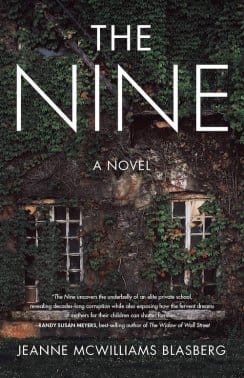
The Nine, She Writes Press, 2019, from website.
Q: What were the great struggles of working on Eden? The great joys?
JMB: Being my first novel, the great joys of Eden were that I would write and write with abandon and get lost in the characters and scenery. I loved the writing life and the important themes I was able to express in my fiction. The great struggle came when I first showed the behemoth of a manuscript to an editor and realized it would need to be rewritten—several times! You can say I learned the craft of novel writing on the job. I started taking classes at GrubStreet and went through multiple revisions. Eden took me ten years to complete. In the midst, I was even so discouraged that I started writing another book. That would later become The Nine, my second novel, which came out last August.
Q: Would you like to add anything about The Nine and the writing of it?
JMB: Whereas Eden is a multi-generational family saga, The Nine is a contemporary literary thriller with three main characters set over a period of five years. It is a suspenseful book with a scandal on a New England boarding school campus keeping the reader turning the pages, but the core theme is, again, about motherhood. Instead of mother and daughter, The Nine focuses on the mother/son relationship.
Q: How did you find the Athenæum?
JMB: I have lived on Beacon Hill for 25 years with my husband who has lived on the hill most of his life. We raised our three children on Hancock Street and then Chestnut Street. I first discovered the Athenæum through the children’s story time and children’s library. It was a weekly treat for all of us. The librarians even assisted my children with research papers over the years! When I stopped working outside the home, I used the Athenæum as a refuge—a place to sit and write as well as to borrow many books. I am an avid reader and I absolutely love the collection.
Q: What appeals to you about the Athenæum?
JMB: The environment is like no other. There is a sense of history and tradition and something about the seriousness of study, reading, and research that is contagious.
Q: Any projects on the horizon you’re able to talk about here?
JMB: Besides keeping up my blog, and writing book reviews, I am happily working on my third novel, which is set in contemporary New York City. Like my first two novels rich with biblical metaphor, this will be a modern retelling of the David and Bathsheba story. I had intended for this timeless story to be set against a #metoo backdrop and now, of course, it is set in the midst of a pandemic as well.
03.23.2020
Kathy Nilsson
April 2020
Interview by Carolle Morini
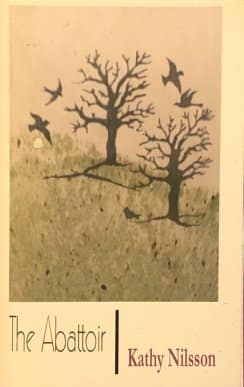
I first met Kathy Nilsson in the poet Lucie Brock-Broido’s poetry workshop in the early 2000s and I have been a fan of Nilsson’s poems ever since. From Poetry Foundation, “Nilsson earned a BA in English Literature from Mount Holyoke College and an MFA in poetry from the Bennington Writing Seminars. She has received fellowships from the MacDowell Colony and The New York State Writers Institute. Her poems have appeared in Ploughshares,Boston Review, Poetry Daily, Columbia, Volt, and other literary journals. Her chapbook, The Abattoir, was published by Finishing Line Press in 2008. Her manuscript, Black Lemons, was a finalist in the Tupelo First Book Award. The manuscript The Infant Scholar was selected for Honorable Mention in the Stevens Poetry Manuscript Competition sponsored by the National Federation of State Poetry Societies and was published by Tupelo Press in 2015. She is a recipient of the Poetry Society of America’s Robert H. Winner Award.” We conducted this interview by email in March 2020.
Q: Do you remember when you first learned about poetry?
KATHY NILSSON: My parents read poetry to me from children’s books. I studied English Literature at Mount Holyoke but it never occurred to me to write poetry. Only when I took Lucie Brock-Broido’s workshop in 1990 did it dawn on me that beautiful books by living poets sold at the Grolier Bookstore should be read and not just held as gifts.
Q: I understand you grew up in the Worcester area like the poet Stanley Kunitz. Did growing up there influence your writing in any specific way? Did you learn about Kunitz in school? Was he considered a local celebrity?
KN: I knew nothing about Kunitz until I went to a reading of his at Harvard long after I left home. His sadness as a kid was easy for me to place in Worcester because I had been sad as a child there.
Q: Is there a particular author you studied as an undergrad at Mount Holyoke College that you were influenced by?
KN: Poetry by Dickinson, Hopkins, Keats, Shakespeare, Milton and Plath (images of a red heart blooming through a coat—tulips like dangerous animals behind bars) made a deep impression on me. T.S. Eliot baffled me until I met Lucie.
Q: Would you like to talk about the MFA program at Bennington Writing Seminars? Any teachers you worked with that helped form the poet you are?
KN: I liked my teachers at Bennington—April Bernard, Liam Rector, Ed Ochester and Thomas Sayers Ellis.We were steeped in writing for two weeks which felt good when my son was little because I didn’t get out much. I loved summer as much as winter out in that bucolic setting.
Q: What is it about the medium you like? Or what is it about creating that you enjoy or simply cannot seem to get rid of?
KN: If I could I’d write a little novel, but it goes against my instincts to think in narrative lines. Writing poetry was a revelation. Marianne Moore said she wrote it on a clipboard while doing the wash. All of a sudden my interest in books on lobsters, Egyptian mummies, weather, eclipses, Brigitte Bardot and the Dictionary of International Slurs among others, all came together.
I started out as a painter at the Art Students’ League in New York so I understand Elizabeth Bishop’s real wish to be an artist and declaring it wasn’t by choice she wrote poetry, something like that. When a poetry critic told me the moment she realized she wasn’t a poet was when reading a line in a biography of one of the great poets in which he described his life as “the continuum of a dream” I burst into tears.
Q: What I admire about your writing is your use of subtle dark humor. Sometimes humor balances out the horrors of life. What do you think?
KN: My mother was very loose with the term “horse’s ass” while she was off paying a bill—while in the same department store my father would be looking for wands for his magic show. He used to say he’d retire to go on the road and saw my mother in half. Their first Christmas card before I was born was a cartoon with my father’s head superimposed on a stick figure of a magician—and my mother’s head superimposed on a silver platter.
Q: A fair number of animals make appearances in your poems. Do you think that some animals encapsulate and/or express particular emotions?
KN: In a way animals have it all over us humans in terms of endearment and sense. The longer I live with dogs and marvel from a distance at horses, donkeys, pigs, goats, ducks, the more I kind of wish I’d grown up in Romania where animals are still the mainstay of people’s lives. The older I get, the more I worry about them.
Q: I know you are a well read and curious person. I always like to know what you are reading. Who are some of the authors you read most recently? Any particular literary journals you like to read?
KN: On my table I keep books of poetry by Paul Celan, Wallace Stevens, Lucie Brock-Broido, Frank Stanford, Thomas James, Louise Gluck, Sylvia Plath, Franz Wright. I read poetry in the morning. Afternoons and evenings, I read fiction—Clarice Lispector, Bruno Schulz, Adalbert Stifter, Gerald Murnane. I love little novels—A Pale View of the Hills and Never Let Me Go (Ishiguro), November (Flaubert), The Left-Handed Woman (Handke), The Diving Bell and the Butterfly (Bauby), We Have Always Lived in the Castle (Jackson). I like reading literary journals to see what’s out there.
Q: Are there any books that you re-read? Any particular reason why?
KN: Trollope I read every day—all his novels—over and over—many times—so I can live in that century.
Q: I have often listened to the poems you recorded for the Poetry Magazine and Poetry Foundation website. How was that experience? I find I understand the poem better when I hear the author read it. What do you think is added to the work when hearing the voice of the poet?
The Abattoir, Finishing Line Press, Georgetown Kentucky, 2008, from website.
KN: I loved recording the podcast for Poetry Magazine. In a soundproof booth at WBUR I felt like Lady Gaga. Christian Wiman and Don Share had such different takes on my work it opened my eyes to the possibilities. I remember submitting those poems thinking—this is the best I can do—if they don’t take these they won’t take any, ever. Their insightful discussion of my poems made me feel ordained as a writer. I do love hearing the voice that goes with a writer—it’s like seeing inside them, being inside someone else’s head.
Q: The cover of The Infant Scholar makes me laugh and also it makes me want to cry—the baby is so adorable and also vulnerable. What made you think of this title and how did you decide on the cover?
KN: The baby on the cover of The Infant Scholar is my husband, Claes, from Sweden. He is one of the infant scholars, along with Richard Howard and Helen Vendler. I love smart babies and those who show vulnerability in their facial expressions. Claes’s baby picture plus the beauty of an old Swedish photograph—I had a visceral reaction to it. So did editors at Tupelo Press.
Q: Anything you would like to add about this collection of poems?
KN: The Infant Scholar took me 25 years to write, assemble and publish. It’s a good thing I wasn’t in a rush. Lucie kept reminding me about the importance of the first book.
Q: What is the best writing advice you received? Is there any advice you found to be simply unrealistic?
KN: What I remember most is Lucie Brock-Broido nipping me in the bud, telling me to put everything into a poem—no holding back—give yourself away, she would say. And her definition: a poem is an egg with horses in it (or a blue egg with two purple horses, as in the case of a toy my son John pulled out of a gumball machine at a supermarket one day many years ago which just might still be floating around Lucie’s office at Columbia University).
Q: If you were not a poet what would you be?
KN: If I were not writing poetry I might be incarcerated in one of the American prisons—or I’d be back tending sheep and counting them at night which is what I assume I was doing before I ever wrote a poem.
Q: Any upcoming projects you would like to tell the readers about?
KN: I’m finishing a second manuscript and sending out poems to literary journals. For the first time, after 30 years, I feel to some extent that finally I know what I’m doing. Writing for me is like taking a little black square of cloth and making a skirt for the Metropolitan Museum, or putting down equations and having them all come out right without really trying, or cutting whole trees out of a piece of gold foil from a chocolate bar. There’s something very mysterious about a finely written poem. Something that almost seems to have nothing to do with the author.
Q: Any last words?
KN: The best line of poetry ever: The world is gone. I must carry you—by Paul Celan.
01.28.2020
Barbara Lewis
February 2020
By Hannah Weisman
I first met Barbara Lewis in the summer of 2019 when she asked if she could enroll in the Athenæum’s first professional development workshop for educators, “Primary Sources in the Classroom: Teaching the Civil War.” Lewis wanted to participate in the workshop as both a UMass Boston educator and as a writer—she was working on a play set in 1867 that depicts a meeting between Harriet Beecher Stowe, Mary Jane Richards, and Clarence Reeves.
My first impression of Lewis turned out to match my lasting impression: She is uncommonly creative, insatiably curious, and an outstanding role model for all lifelong learners. She excels at finding and creating opportunities for exploring her wide-ranging interests. And she is ready to learn with and from nearly everyone.
Lewis was born after World War II in New York City. She grew up—surrounded by family—in both South Carolina and New York. Her maternal grandparents and other extended family were in South Carolina, while her mother’s ten siblings were in New York after having been part of the Great Migration. Lewis grew to love the “fastness” of New York and the “slowness” of South Carolina.
Lewis attended a parochial school for girls of color in South Carolina run by the Oblate Sisters of Providence, an order of Roman Catholic nuns founded in Baltimore by four Haitian women and a French priest in 1828. For high school, Lewis was sent to a convent school run by the Presentation Sisters in Montreal. There she studied under a British system, learning European history, French, and Latin.
From Montreal, Lewis went on to Hunter College in New York. But her experiences through high school had left her feeling out of place. She came to view her education, particularly in French and Latin, as something she loved, but as something that set her apart from others.
“I was so very different from everybody else. In South Carolina, I spoke with a northern accent. I tried not to, but it was there. And so, I was an outsider there. And in New York I was an outsider. In Canada…I was the only black student there. So, I was an outsider everywhere. And even though I coped very well intellectually, I didn’t necessarily cope that well emotionally. So, when I left Canada…I stayed away from French for quite a while. I didn’t want to see myself as so different from everyone else. It took me a long time before I went back and got a master’s [at City University of New York] in creative writing. I chose translation and I translated a novel from French. That took me back. I was like, ‘Hey, I’ve got this, I might as well use it.’”
Lewis didn’t stop with the master’s in creative writing. She continued on at City University, earning a PhD in theater, which she describes as having been fun! She reveled in studying theater, literature, theory, and performance all over the world. After studying German as a second reading language for her doctorate, Lewis moved to Vienna for a month to develop her conversational skills, taking side trips to Zurich and Munich to hear different accents.
Her transition from student to faculty began at New York University, where she taught freshman English (which she describes as “a rite of passage for so many”). She spent a short time at the University of Kentucky, and then arrived in Boston 15 years ago to lead the William Monroe Trotter Institute for the Study of Black History and Culture at University of Massachusetts Boston. As an academic, Lewis has specialized in the work of August Wilson, Black female playwrights, and Francophone literature. Only after coming to Boston did Lewis learn through her research that her great-great grandfather, born in the Berkshires, volunteered for the 54th Massachusetts and fought in Company B.
But Lewis has not limited herself only to academic writing. She takes her creative writing seriously. She is constantly seeking new research opportunities, improving and refining her writing, and building her community of fellow creative thinkers and makers. She has participated in Company One’s PlayLab, taken classes at GrubStreet, and joined the Athenæum’s Writers’ Workshop. She became a Mudge Education Associate at last year’s Athenæum workshop for educators so she could conduct research with the BA’s Civil War-era materials to inform her play. She attends two different sewing/knitting book groups. And all of that before she retired from UMass Boston at the end of 2019!
Of course, retirement doesn’t mean free time for Lewis. It just means more time to become an ever-more formidable intellectual and creative giant.
01.03.2020
Dr. Philip E. Phillips
January 2020
Interview by Mary Warnement
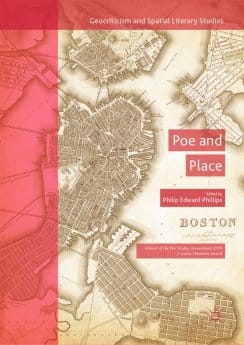
Philip Edward Phillips is Associate Dean of the University Honors College and Professor of English at Middle Tennessee State University, where he teaches medieval, early modern, and nineteenth-century American literature and directs the Honors Lecture Series. In 2008–2009, he held one of the Athenæum’s Mary Catherine Mooney Fellowships. His first and primary scholarly focus is on Boethius, but in recent years he has added much to the promotion of Edgar Allan Poe, in particular Poe’s connection to Boston. Phillips even contributed an article to a book edited by Kevin J. Hayes, who completed his own fellowship at the Athenæum at the same time Phillips did. The Poe Studies Association recently awarded its 2018 J. Lasley Dameron Award for an Outstanding Essay Collection on Poe to Phillips’s Poe and Place. Though he lives and works in Tennessee, Phillips has maintained a strong connection with the Athenæum.
Q: When and where were you born and raised?
PHILIP EDWARD PHILLIPS: I was born in 1969, in Arkansas, where I spent my early childhood until going away to Castle Heights Military Academy in Lebanon, Tennessee. So, I essentially grew up as a boarding student at a military school known for its strong academics. My maternal uncle had attended Heights in the early 60s, and I enjoyed my time there following in his footsteps. I took well to the military environment and held several leadership positions as a cadet. I also received encouragement from my teachers to pursue my interest in literature. My earliest engagement with the works of Edgar Poe date to my eleventh grade year at Heights, when I would often read his poetry, tales, and essays during afternoon study hall.
Q: Where did you attend college and graduate school?
PEP: I wanted to remain in Tennessee after my time at Heights, and I attended Belmont College (formerly Ward-Belmont Seminary, made famous by John Crowe Ransom’s “Blue Girls,” and now Belmont University), in Nashville, Tennessee. I had the good fortune to study Latin language and literature there with Virginia Cheney, who was in her eighties then, and long since retired from full-time teaching. She had such a passion for literature and such a dedication to teaching that she kept Latin alive and well at Belmont, and she offered me the opportunity to do advanced work in Roman history and literature under her direction. She inspired me then, and she continues to inspire me to this day. It was at this time, too, that I studied French at the Université Catholique de l’Ouest in Angers, France. Not only did my French improve, but I met students from all over the world while I was there. It really opened up the world for me. At Belmont, I also had the good fortune to study with many outstanding faculty members and was able to realize my desire to pursue an MA and PhD at Vanderbilt University. At Vanderbilt, I studied a wide range of literature but moved in the direction of sixteenth- and seventeenth-century British poetry under the direction of Laurence Lerner and Leonard Nathanson. Immediately following my graduation in 1996, I spent an additional year at Vanderbilt as a full-time Lecturer in the English Department.
Q: What was your first teaching job?
PEP: Facing a very difficult academic job market, I accepted a faculty position at Battle Ground Academy in Franklin, Tennessee, teaching senior AP English and introductory French. I remained there for two years, and I really enjoyed my students and daily interactions with other faculty members from various departments. Just when I thought this might become my career, Middle Tennessee State University advertised a tenure-track position for a Miltonist, I applied, and joined the faculty in 1999. At the time, my first book, John Milton’s Epic Invocations, was in production and was published in 2000. I have taught Milton on the undergraduate and graduate level for 20 years now, along with other courses, and I still enjoy returning to the poetry again and again, seeing it through the eyes of my students and seeing it again for myself at various stages of life. I was promoted to associate professor (with tenure) within five years, and then to professor five years after that. I’ve been involved heavily in graduate and honors education while at MTSU, and I am grateful to my chairs, deans, and provosts throughout the years as I have taken on a variety of research projects.
Q: Are you primarily an administrator now?
PEP: I am currently the Associate Dean of the University Honors College, in which capacity I have served for nearly eight years. I am a full-time administrator, but, like my dean, I remain very active in research, and I teach seminars in Milton, Poe, and Bibliography and Research Methods for the English Department occasionally and direct the honors lecture series (a one-hour class and an event open to the public), which focuses on a different topic every semester. In addition, I lead two honors study-abroad programs, one to Italy and one to Thailand.
Q: How did you find the Athenæum?
PEP: I discovered the Boston Athenæum in 2007 as I was looking ahead to a possible non-instructional assignment in 2008 when I could focus my attention on a project I had been considering for some time: Poe’s relationship to Boston, the city of his birth. At the time, the topic had not been explored sufficiently. In researching the history of literary Boston, I came across the Athenæum’s theatre database and was impressed with the library’s holdings in early nineteenth-century literature, including some works by or related to Poe. Despite budget cuts that eliminated non-instructional assignments at MTSU for a few years, I applied for and received a Catherine Mooney Fellowship from the Athenæum to work on Poe and Boston. What began as a book project ultimately became two articles, one on Poe’s tumultuous relationship with Boston for Lehigh University Press’s Deciphering Poe and a new discovery about the Odeon Theatre and another on Poe’s mother, Eliza Poe and the American Stage, for the Cambridge Poe in Context volume. In the process of doing that research, I fell in love with the Boston Athenæum and now consider it a second home. I enjoy researching and writing at the Athenæum and using it as a home base when exploring the city and visiting other libraries and archives in the Boston/Cambridge area.
Q: What appeals to you about the Athenæum?
PEP: The people, the atmosphere, and the collections, including the Rare Books Room and Prints Room. By people, of course, I mean the librarians and staff. This includes you [Mary], as well as Carolle Morini, Catharina Slautterback, Stanley Cushing, and Stephen Nonack. All of you have helped me in one way or another to locate items, make appointments to view rare materials, navigate the library itself (and its Cutter catalogue), offer advice on places to see and things to do in Boston, and even lend me a tie (Jimmy Feeney) for an event at St. Botolph Club. Also, while working at the Athenæum, I have met and become engaged in several conversations with fellow scholars and writers. It was because of my affiliation with the Athenæum that I first became involved with the Poe Foundation of Boston and served with Paul Lewis, Richard Kopley, and others on the committee that selected Stefanie Rocknak’s statue, Poe Returning to Boston, which was later installed in Poe Square on the corner of South Charles and Boylston in Boston. I never imagined I would ever be involved in a major public art project, especially one involving Poe and Boston, when I was younger and first encountering his works. Then there’s the elegant fifth floor of the library, where I enjoy working, and both the special and general collections, which are very strong in the nineteenth century. I even enjoy just browsing the shelves to see what I will discover. It is truly a scholar’s library.
Q: What were the great struggles of working on Poe and Place? The great joys?
PEP: Working on Poe and Place, on the whole, was a great pleasure in all respects. Of course, it grew out of my earlier work on Poe and Boston to become a work more broadly on Poe and the several places he lived and worked, the literary spaces he imagined and created, some places he claimed to have visited or places that claimed him for their own, as well as Poe’s philosophical and scientific understanding of the universe itself, one of expansion and contraction, that predated the Big Bang theory. It was a project that gave me the opportunity to introduce readers to Poe in a way that is both familiar and unique, and it gave the opportunity to work with Poe scholars I have come to know very well over the years through the Poe Studies Association. The contributors to the volume are the volume’s strength. Of the several collections of essays that I have edited or co-edited, this one was the most enjoyable.
Q: Any projects on the horizon you’re able to talk about here?
PEP: I have recently written an essay on anthologizing Poe’s poetry for a forthcoming collection edited by Emron Esplin and Margarida Vale de Gato for Lehigh University Press, and I am finishing an essay on Poe’s Ourang-Outang in “The Murders in the Rue Morgue” for a forthcoming collection edited by John Gruesser for Texas A&M Press. (I completed portions of both projects at the Athenæum.) When these projects are done, I plan to begin working on a book on Poe’s women that will build upon some of my previous research and give me the opportunity to expand that research into a new and interesting direction. One of my goals will be to examine the importance of key women—such as his mother, the mother of a childhood friend, a childhood sweetheart, his wife, his mother-in-law, Frances Osgood, Annie Richmond, and Sarah Helen Whitman, among others—in Poe’s life and art and to reach a wider reading audience perhaps unfamiliar with this side of Poe. Before undertaking that project, though, I will be busy organizing the program for the Poe Studies Association’s upcoming Fifth International Edgar Allan Poe Conference that will be held in Boston in April 2021.
Q: Your other major research project involves Boethius. Do you find points of comparison between him and Poe?
Poe and Place by Dr. Philip E. Phillips.
PEP: Admittedly, I have eclectic interests, and I have enjoyed the opportunity to expand my horizons beyond what I studied in graduate school many years ago. I often tell my own graduate students that the most important thing one can learn as a Master’s or doctoral student is how to learn, and how to educate oneself on a topic of one’s interest. It requires real honesty with oneself, and humility, to approach and attempt to cultivate an expertise on a particular subject. I have been interested in Poe, as I said, since I was in high school. But it was not until I had become pretty well established in my profession that I returned to Poe seriously, that is, as a scholar approaches a topic that requires a serious commitment both to the primary and secondary sources.
Q: Is it helpful to have shifted between very different periods and writers?
PEP: I have enjoyed teaching Milton over the years, and I have been pleased to direct the work of several graduate students in that area. My interest in Boethius emerged from my engagement with The Consolation of Philosophy in a Middle English Literature seminar at Vanderbilt, and my scholarship on Boethius was fueled by my love of Latin and my interest in classical influences on English poetry. So, yes, I think that shifting between different periods and writers keeps things interesting for me.
Q: You have helped establish Poe’s connection to Boston. Is there a similar importance in geographic place in the life of Boethius?
PEP: That’s a good question, one that could lead to yet another project on Boethius, for which I do not have time at the moment! But, yes, I do think that place is as significant for Boethius. My honors study-abroad course includes readings from Vergil, Boethius, and Dante, and the primary Boethius-related places are Rome (where the patrician Boethius served as consul and where he made his greatest contributions to the artes liberales) and Ravenna (where he served the Ostrogothic King Theodoric as his master of offices, was later accused of treason, and exiled to Pavia, where he wrote his Consolation while awaiting death). There is much more to say, of course. Studying works like the Consolation on location, visiting sites such as the Pantheon or the Mausoleum of Theodoric, putting oneself in the same physical spaces as the authors allows students to make connections, realizations, or associations they might not make when reading the works of literature or works about the authors. Being in a place associated with an author, like Poe in Boston, has helped me enormously in my work, especially in imagining what that place would have looked like or felt like in Poe’s time by retracing his steps along modern-day Federal Street or what used to be Carver Street while keeping in my mind the period maps I had consulted at the Athenæum.
Q: You have been involved in prison education. Is that at all connected to your Boethius studies?
PEP: I have taught the Consolation to high school seniors, to undergraduate and graduate students, and to inmates in three different correctional facilities in Nashville, Tennessee. My experiences sharing Boethius with inmates has been the most rewarding of all, I must say, because the Consolation resonates with them in a way it cannot with most other people. My incarcerated students understand what it means to be deprived of everything, even one’s humanity, justly or unjustly, by the correctional system. Boethius’s cries of despair and his efforts with the help of philosophy to transcend his condition and return to, or remember, the Good, resonate with many of them, and our conversations about that book, and the value of liberty, are among the most powerful and meaningful conversations I have ever had in any classroom. Even if the transcendence, or acceptance, affirmed in the Consolation does not result in Boethius’s physical release from prison, it does achieve the aim of the seven liberal arts to which its author dedicated his life: that is, to free the mind.
Selected writings, in reverse chronological order, all authored by PEP unless otherwise noted:
Remaking Boethius: The English Language Translation Tradition of The Consolation of Philosophy. Co-edited with Brian Donaghey, Noel Harold Kaylor, Jr., and Paul E. Szarmach. Tempe, Arizona: ACMRS/Brepols, 2019.
Poe and Place. Ed. Philip Edward Phillips. Geocritical and Spatial Literary Studies Series. New York: Palgrave Macmillan, 2018.
Vernacular Traditions of Boethius’s De consolatione philosophiae. Co-edited with Noel Harold Kaylor, Jr. Research in Medieval Culture. Kalamazoo, MI: Medieval Institute Publications, 2016.
Prison Narratives from Boethius to Zana. Ed. Philip Edward Phillips. New York: Palgrave Macmillan, 2014.
“Poe’s 1845 Boston Lyceum Incident Reconsidered,” in Deciphering Poe: Subtexts, Contexts, Subversive Meanings. Ed. Alexandra Urakova. Bethlehem, PA: Lehigh University Press/Rowman & Littlefield, 2013.
“The American stage” in Edgar Allan Poe in Context. Ed. Kevin J. Hayes. New York: Cambridge University Press, 2013.
A Companion to Boethius in the Middle Ages. Co-edited with Noel Harold Kaylor, Jr. Brill’s Companions to the Christian Tradition 30. Leiden and Boston: Brill Academic Publishers, 2012.
The Consolation of Queen Elizabeth I. Co-edited with Noel Harold Kaylor, Jr. Medieval and Renaissance Texts and Studies 366. Tempe, Arizona: ACMRS, 2009.
New Directions in Boethian Studies. Co-edited with Noel Harold Kaylor, Jr. Studies in Medieval Culture XLV. Kalamazoo, Michigan: Medieval Institute Publications, 2007.
John Milton’s Epic Invocations: Converting the Muse. New York: Peter Lang, 2000.