
04.25.2019

Sara Georgini

May 2019

Interview by Carolle Morini

I first met Sara back in 2009 when she was a BU graduate student researching here at the Athenæum. Since then it has been a pleasure following her career and talking with her about all sorts of subjects. Her book, Household Gods: The Religious Lives of the Adams Family, published by Oxford, was recently published and I wanted to ask her a few questions about this interesting project. Be sure to pick up her book and follow her on Twitter: @sarageorgini.

Q: Where were you born and raised?

SARA GEORGINI: Brooklyn, New York.

Q: Ah, a fellow New Yorkerno wonder we get along!  What is your educational background?

SG: As an undergraduate, I studied print journalism at Boston University. It was a pleasure to return there and earn my doctorate in history.

Q: What is your day job?

SG: My Massachusetts Historical Society career began a decade ago in the Library, and I jumped at the chance to join the Adams Papers editorial project staff. I am series editor for The Papers of John Adams. As a public historian, I’m passionate about ensuring preservation of and access to primary sources like the Adams Papers. I also write about #vastearlyAmerica for Smithsonian.

Q: So we missed the chance to work together at MHS by a couple of years. How did you find the Athenæum?

SG: I found it via a mix of friends, (very) old and new! The nineteenth-century Adamses’ letters and diaries record many borrowing trips to the Athenæum stacks, as well as happy hours spent lingering over their finds. I wanted to recapture some of that exploratory spirit as I tracked their reading habits for Household Gods. In turn, that led me to conduct historical research at the Athenæum and to attend some excellent public programs. Through the good grace of several present-day friends and colleagues, I found a way to voice my support by becoming a member.

Q: What is it about the Athenæum that appeals to you?

SG: It is truly a scholar’s retreat, nestled in the city center. Plush seats, sweeping views, richly lined bookshelves: every floor combines to inspire the historian’s craft. Beyond the wealth of research resources, though, I think the institution’s greatest prize lies in its gracious and knowledgeable staff. When you walk into a private library, especially one loaded with rare books and fine art, you’re never sure how friendly or clubby it will be. The Athenæum staff are the heart and soul of this place. Take any busy Saturday. I see them welcome history fans, scholars, and Freedom Trail visitors of all ages and stages—and I’m deeply grateful to belong to a community like that.

Q: What were the struggles of working on Household Gods: The Religious Lives of the Adams Family?

SG: Writing Household Gods, which explores the Adams family’s religious history from the Puritans to the Progressives, meant keeping up a breakneck pace with three centuries of American history and culture as it happened. I worked hard to give each generation its due, showing how the family used ideas of faith and doubt to make decisions great and small. One of the major struggles lay in producing a tight narrative, while pausing to interpret different religious practices and beliefs as the Adamses encountered them. I aimed for a lively blend of biography and intellectual history, a story that captured their ideas in action. Trying to sit beside people from the past and chart all the places their minds turned—during a pivotal era in history—was a battle on the page. So I began every chapter with an Adams on the road, which mirrored my choose-your-own-adventure approach to research. Leaping into such a generous landscape turned out to be a real blessing. You can start reading the book anywhere, and you’ll be on the main path.

Q: The great joys?

SG: Like the Adamses, I love to write and travel. I tried to walk through the same liturgical worlds they did by exploring churches in Massachusetts, New York, Washington D.C., London, and Paris. Matching up what they wrote with the sensory impact of a worship space was an amazing gift. One of the best trips I took was to All Hallows Barking parish near the Tower of London, where Louisa Catherine Johnson married John Quincy Adams. Blinking up, I could map reference points from my research onto every pew, window, and wall. Below in the crypt lay Archbishop William Laud, who triggered the Puritan Adamses’ flight to America. Ahead was the altar that Charles Francis Adams wept at in the 1860s, reflecting on his parents’ wedding day. Just beyond the pulpit, the Tower’s long shadow thickened and twisted. Here was the corner of the seventh-century church smashed in the Blitz, heralding a world war prophesied by Charles’s son Brooks. Learning how to overlay what I read with the place I saw: that was a joyful lesson.

Q: Any surprises?

SG: It’s often said that we tell old stories to get new ones. Going in to Household Gods, I thought that the big turning points we use to study and teach this period would show up as big moments in the religious lives of the Adamses. Instead, I learned that when it comes to American religion, local history can be epic. It’s a small-town scandal, not a star revivalist, that turns John Adams’s steps away from a life in the pulpit. I pivoted, rejiggering my timeline and sources, because the family saga suddenly arced in so many unique ways. It was an excellent reminder that reading sources is the hardest thing we do. The act of writing history is always a risk, and, yes, a rush.

Q: In your opinion, what makes the Adamses relevant to today? And what about them do you find compelling?

SG: They were lifelong students of government. They were fierce cultural critics who thought and wrote freely about what American citizenship should be. From generation to generation, the Adamses constantly ripped up and rebuilt themselves, trying to reconcile private sentiments with public service. Drawing on ideals of Christian citizenship, they managed a major political brand. All of that came at a great cost. We might look at them and think about questions swirling today: how do you balance party politics and celebrity? What is the role of religion in a democracy?

For more than a century, the Adamses lived at the heart of political power. They struggled with the fame and the focus that came with that role. The family left us an honest and unabashed chronicle of what it felt like to start a revolution, to lead a republic, and to endure a civil war.  

Q: Do you have a favorite Adams? I always had a soft spot for Charles (the apple of Abigail’s eye).

SG: Well, here is a question to shipwreck on, as it changes from week to week and letter to letter. Right now, I’m intrigued by how Abigail Adams evolved her political thought. Long before women won the right to vote, Abigail learned to navigate the republic’s party rifts and found a way to write herself into the national saga. As a public figure, Abigail Adams remade the role of First Lady in provocative and productive ways. She was a revolutionary in her own right. She acted as John Adams’s one-woman cabinet. She cultivated a deep, diverse pool of correspondents, including luminaries like Mercy Otis Warren, Thomas Jefferson, and Benjamin Rush. Her prose is brisk and firm. Yet she can throw her perspective gloriously wide, summing up world events with newsy charm. When you meet Abigail Adams in the archive, you’ll think: “Tell me more.”

Q: What is your writing process? How long did it take you to research this book?

SG: It’s been a ten-year adventure. I worked full time at the Adams Papers while earning my Ph.D. at BU. Household Gods was the dissertation that I honed during many desk lunches, late nights, and too-early mornings. I learned about research, writing, and project management from my fellow editors and hard-working colleagues at the Historical Society. Joining a #BookSquad crew of area historians who were also facing major deadlines certainly boosted both my accountability and my pace. As for process, I’m happy to write anywhere and everywhere. I like to edit in the mornings, when I’m a little less caffeinated and a lot more ruthless with the text. Generally, I save new writing for the evening, so that the day ends in creation.
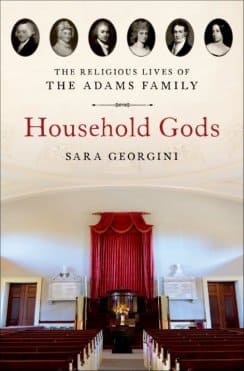
Household Gods (cover) by Sara Georgini

Household Gods by Sara Georgini, photo courtesy of Oxford University Press.

Q: An editorial morning sounds amazing and I love the idea of ending the day in creation. Do you have a favorite book in fiction and/or non-fiction? Favorite author?

SG: The play’s the thing! Between research bouts, I dip in and out of reading drama in Spanish or French, to sharpen my foreign-language skills and to refine my narrative approach. We historians need to think about character development, plot lines, and which voices you hear first, last, or not at all, in a story. I weathered Corneille in the winter, but now that Boston’s spring gardens are unfurling their best, it’s time for a little Voltaire. I’m fascinated by early Americans who used dramatic culture to investigate social issues, and by the stories that a city sings to itself onstage. No spoilers, please: I just began reading Voltaire’s Zaïre, which British soldiers staged a version of at Faneuil Hall when they occupied Boston during the Revolutionary War. Good Athenæum readers, bring on your nonfiction recommendations! I’ve been savoring two science picks: Elena Passarello’s Animals Strike Curious Poses and Steve Brusatte’s Rise and Fall of the Dinosaurs.  

Q: Any projects on the horizon you’re able to talk about here?

SG: Happily, plenty of new research questions bubbled up while writing Household Gods. I’m grateful to the kind folks I meet at book talks who tell me rich family histories of religion and cultural change. Here’s one topic that keeps tugging at me: Where did early Americans go to talk about power, and what did they say? I’ve been digging into the colorful and less-chronicled history of state constitutions, curious to learn more about how colonists became citizens. Since the nation’s founding, Americans have made nearly 150 state constitutions, and then changed them over 12,000 times by amendment. Such civic engagement! My research appraises the role of state constitutions in declaring rights, preserving liberties, and framing government for the revolutionaries who built the republic. Like many of his peers, John Adams was emphatic that, in his “political creed, the word liberty is not the thing; nor is resentment, revenge, and rage, a constitution, nor the means of obtaining one. Revolutions perhaps can never be effected without them.” The second president’s passion for good government mirrored that of a generation caught between independence and ideals. But what is the story of, say, Abigail’s Constitution?

Between 1776 and 1861, the age of revolutions blossomed into an age of constitutions, with people fighting to make change at the local level. They gathered in conventions—to debate constitutional legacies, to advocate for women’s rights, and to give voice to African-American citizenship—in powerful political displays that reshaped their relationships with local authority. State constitutional conventions, especially, served as roads to reform. I’m working on a new intellectual and cultural history, showing how American women and men evolved into modern constitutional thinkers. Spanning the era from the Declaration to disunion, I focus on how “we the people” made—and remade—state constitutions, often struggling to define liberty and law.

04.25.2019

Animals

Picture Books

Marta! Big and Small by Jen Arena with illustrations by Angela Dominguez

(Children Picture Book ARENA)

In this story that incorporates Spanish words, Marta explores the world of opposites and animals.

Count the Monkeys by Mac Barnett

(Children Picture Book + BARNE)

The reader is invited to count the animals that have frightened the monkeys off the pages.

One Day in the Eucalyptus, Eucalyptus Tree by Daniel Bernstrom with illustrations by Brendan Wenzel

(Children Picture Book BERNS)

Gobbled by a snake, a crafty boy finds a find a way out of his predicament by encouraging the snake to eat an increasing number of animals.

Turnip by Jan Brett

(Children Picture Book + BRETT)

Badger Girl is delighted to find the biggest turnip she has ever seen growing in her vegetable garden, but when the time comes to harvest the giant root, she is unable to pull it up without help from family and friends.

Adrian Simcox Does Not Have a Horse by Marcy Campbell

(Children Picture Book CAMPB)

“Adrian Simcox brags about owning a horse, and Chloe just knows he’s making stuff up … until she learns an important lesson in empathy.” —Provided by publisher

Surprising Sharks! By Nicola Davies

(Children Picture Book + DAVIE)

Introduces many different species of sharks, pointing out such characteristics as the small size of the dwarf lantern shark and the physical characteristics and behavior that makes sharks killing machines.

Maria Had a Little Llama by Angela Dominguez

(Children Picture Book + DOMIN)

In this bilingual version of the classic rhyme, set in Peru, Maria takes her llama to school one day.

Ducks Away! by Mem Fox

(Children Picture Book FOX)

One by one five little ducklings tumble off the bridge into the river below—and mother duck follows them.

Make Way For Ducklings by Robert McCloskey

(Children Picture Book Lg MCCLO)

Mr. and Mrs. Mallard proudly return to their home in the Boston Public Garden with their eight offspring.

Let Me Finish! by Minh Lê

(Children Picture Book + LE)

“A young boy wants to read his favorite books without interruption, but the creatures around him keep spoiling the ending!” —Provided by publisher

Hello Hello by Brendan Wenzel

(Children Picture Book WENZE)

In simple text, a set of animals, each one linked to the previous one by some trait of shape, color, or pattern, greet and interact with one another.

Beginning Readers

Tiger vs. Nightmare by Emily Tetri

(Children Picture Book TETRI)

“Tiger is a very lucky kid: she has a monster living under her bed. Every night, Tiger and Monster play games until it’s time for lights out. Of course, Monster would never try to scare Tiger–that’s not what best friends do. But Monster needs to scare someone … it’s a monster, after all. So while Tiger sleeps, Monster scares all of her nightmares away. Thanks to her friend, Tiger has nothing but good dreams. But waiting in the darkness is a nightmare so big and mean that Monster can’t fight it alone. Only teamwork and a lot of bravery can chase this nightmare away.” —Provided by publisher

Fox the Tiger by Corey R. Tabor

(Children Picture Book TABOR)

Fox decides to become a tiger because they are fast and sneaky, and soon, his other animal friends are joining in.

Days With Frog and Toad by Arnold Lobel

(Children’s Library PZ7.L7795 Day)

Frog and Toad spend their days together, but find sometimes it’s nice to be alone.

Chapter Books and Middle Grade

The Tiger Rising by Kate DiCamillo

(Children’s Library PZ7.D5455 Ti 2001)

Rob, who passes the time in his rural Florida community by wood carving, is drawn by his spunky but angry friend Sistine into a plan to free a caged tiger.

Mercy Watson to the Rescue by Kate DiCamillo

(Children’s Library PZ7.D5455 Me 2005)

After Mercy the pig snuggles to sleep with the Watsons, all three awaken with the bed teetering on the edge of a big hole in the floor.

The Wind in the Willows by Kenneth Graham

(Children’s Library PZ10.3.G76 Wi 1954)

“Friendly Rat, mild-mannered Mole, wise Badger, and kind—but conceited—Toad all live on the banks of the Thames. While Mole and Rat are content to go out in a row boat or travel the roads in a caravan, Toad prefers the excitement of motor cars. He’s already wrecked seven! While his friends try to keep him out of trouble, his passion for cars eventually results in his being caught and kept prisoner in the remotest dungeon of the best-guarded castle in all the land. Somehow, he has to escape and get home but what will he find when he gets there?” —Provided by publisher

Hoot by Carl Hiassan

(Children’s Library PZ7.H52 Ho 2002)

Roy, who is new to his small Florida community, becomes involved in another boy’s attempt to save a colony of burrowing owls from a proposed construction site.

The Beasts of Clawstone Castle by Eva Ibbotson

(Children’s Library PZ7.I11555 Bea 2006)

While spending the summer with elderly relatives at Clawstone Castle in northern England, Madlyn and her brother Rollo, with the help of several ghosts, attempt to save the rare cattle that live on the castle grounds.

Unusual Chickens for the Exceptional Poultry Farmer by Kelly Jones with illustrations by Katie Kath

(Children’s Library PZ7.J714 Unu 2015)

“Twelve-year-old Sophie Brown feels like a fish out of water when she and her parents move from Los Angeles to the farm they’ve inherited from a great-uncle. But farm life gets more interesting when a cranky chicken appears and Sophie discovers the hen can move objects with the power of her little chicken brain: jam jars, the latch to her henhouse, the entire henhouse…. And then more of her great-uncle’s unusual chickens come home to roost. Determined, resourceful Sophie learns to care for her flock, earning money for chicken feed, collecting eggs. But when a respected local farmer tries to steal them, Sophie must find a way to keep them (and their superpowers) safe. Told in letters to Sophie’s abuela, quizzes, a chicken-care correspondence course, to-do lists, and more, Unusual Chickens is a quirky, clucky classic in the making.” —Provided by publisher

Winnie-the-Pooh by A.A. Milne

(Children’s Library PZ7.M64 Win 1988)

The adventures of Christopher Robin and his friends, in which Pooh Bear uses a balloon to get honey, Piglet meets a Heffalump, and Eeyore has a birthday.

Dog Man by Dave Pilkey

(Children’s Library PZ7.P6314 Do 2016)

Dog Man, a crimefighter with the head of a police dog and the body of a policeman, faces off against his archnemesis Petey the Cat.

Charlotte’s Web by E.B. White

(Children’s Library + PZ7.W58277 Ch 1999)

“Some Pig. Humble. Radiant. These are the words in Charlotte’s Web, high up in Zuckerman’s barn. Charlotte’s spiderweb tells of her feelings for a little pig named Wilbur, who simply wants a friend. They also express the love of a girl named Fern, who saved Wilbur’s life when he was born the runt of his litter.” —Provided by publisher

Stuart Little by E.B. White

(Children’s Library PZ10.3.W584 St)

“Stuart Little is no ordinary mouse. Born to a family of humans, he lives in New York City with his parents, his older brother George, and Snowbell the cat. Though he’s shy and thoughtful, he’s also a true lover of adventure.” —Provided by publisher

Young Adult

The Golden Compass by Philip Pullman

(Young Adult PZ7.P968 Go 2006)

Accompanied by her daemon, Lyra Belacqua sets out to prevent her best friend and other kidnapped children from becoming the subject of gruesome experiments in the Far North.

Informational Books

Bonkers About Beetles by Owen Davey

(+ Children Picture Book DAVEY)

Did you know that the horned dung beetle can pull over a thousand times its own weight? With over 400,000 known species of beetles on earth, there are endless curious crawling creatures to discover! Shares information on different types of beetles.

Owen & Mzee: The True Story of a Remarkable Friendship by Isabella Hatkoff, Craig Hatkoff, and Dr. Paula Kahumbu with photographs by Peter Greste

(Children’s Library QL737.U57 H38 2006)

“This book has been adapted from the original e-book, Owen and Mzee, … which was first launched on the WNBC New York Five O’Clock News, April 29, 2005, as part of the Tribeca Film Festival.” —Provided by publisher

The Brilliant Deep: Rebuilding the World’s Coral Reefs by Kate Messner with illustrations by Matthew Forsythe

(Children Picture Book MESSN)

Looks at the life of the coral restoration pioneer Ken Nedimyer, from his early fascination with the ocean to his ongoing efforts to save and rebuild the world’s coral reefs.

Reptiles and Amphibians by Simon Mugford

(Children’s Library + QL644.2 .M84 2007)

Describes various reptiles and amphibians, with color photographs.

Sea Otter Heroes: The Predators that Saved an Ecosystem by Patricia Newman

(Children’s Library QL737.C25 N49 2017)

“Marine biologist Brent Hughes discovered a surprising connection between sea otters and sea grass at an estuary in northern California. Follow science in action as Hughes conducts the research that led to this major discovery.” —Provided by publisher

Camp Panda: Helping Cubs Return to the Wild by Catherine Thimmesh

(Children’s Library + QL737.C27 T477 2018)

From the Sibert medal winning author of Team Moon and the bestselling Girls Think of Everything comes a riveting, timely account of panda conservation efforts in China, perfect for budding environmentalists and activists.

03.29.2019

Poetry

April is National Poetry Month! Celebrate with these picture book poems and poetry collections.

Picture Books

Bronzeville Boys and Girls by Gwendolyn Brooks, illustrated by Faith Ringgold

(Children’s Library + PS3503.R7244 B76 2007)

A collection of poems that celebrate the joy, beauty, imagination, and freedom of childhood.

Thirteen Moons on Turtle’s Back: A Native American Year of Moons by Joseph Burchac

(Children’s Library + PS3552.R794 T47 1992)
Celebrates the seasons of the year through poems from the legends of such Native American tribes as the Cherokee, Cree, and Sioux.

Soul Looks Back in Wonder illustrated by Tom Feelings, poems by Maya Angelou, et al.

(Children’s Library PS591.N4 S58 1994)

Artwork and poems by such writers as Maya Angelou, Langston Hughes, and Askia Toure portray the creativity, strength, and beauty of their African American heritage.

Lizards, Frogs, and Pollywogs: Poems and Paintings by Douglas Florian

(Children’s Library + PS3556.L589 L59 2001)

A collection of humorous poems about such reptiles and amphibians as the glass frog, the gecko, and the rattlesnake.

Dear Hot Dog by Mordicai Gerstein

(Children’s Library PS3557.E733 D43 2011)

Collects poems celebrating everyday activities, including drifting off to sleep, lying in the warm sun, and eating spaghetti for dinner.

Forget-Me-Nots: Poems to Learn by Heart selected by Mary Ann Hoberman, illustrated by Michael Emberley

(Children’s Library + PS586.3 .F675 2012)

“With personal introductions by former Children’s Poet Laureate Mary Ann Hoberman—as well as her own time-tested tips and tools for memorization and recitation—and vivid illustrations by Michael Emberley featuring his trademark wit and lively characters, Forget-Me-Nots includes more than 120 works from both classic and contemporary poets, from childhood favorites to lesser-known treasures.” —Provided by publisher

Hoofbeats, Claws, & Rippled Fins: Creature Poems edited by Lee Bennett Hopkins, illustrated by Stephen Alcorn

(Children’s Library PS595.A5 H66 2002)

Inspired by Stephen Alcorn’s magnificent animal portraits, popular poet and noted anthologist Lee Bennett Hopkins commissioned thirteen poets to craft verses to match the eloquence of this art. The resulting celebration of art and nature captures the subtle intensity and striking textures of a renowned artist’s relief-block prints in a unique homage to the power, mystery, and beauty of the natural world.

Are You An Echo?: The Lost Poetry of Misuzu Kaneko by Misuzu Kaneko

(Children’s Library PL832.A598 A6 2016)

Are You An Echo? resurrects the work of Misuzu Kaneko and brings the gentle grace of her poems to a new generation.” —Provided by publisher

Read, Read, Read! by Amy Ludwig VanDerwater

(Children Picture Book +VANDE)

“Twenty-three poems capture the joys of reading from that thrilling moment when a child first learns to decipher words to the excitement that follows in reading everything from road signs to field guides to internet articles to stories. These poems also explore what reading does, lyrically celebrating how it opens minds, can make you kind, and allows you to explore the whole world.” —Provided by publisher

With My Hands: Poems About Making Things by Amy Ludwig VanDerwater

(Children Picture Book +VANDE)

“The short and lively poems in this collection explore many different forms of creativity and the excitement and satisfaction that each one brings.” —Provided by publisher

Poetry Collections

Doodle Soup: Poems by John Ciardi

(Children’s Library PS3505.I27 D6 1985)

Thirty-eight poems, mostly humorous, by the well-known poet.

Beastly Boys and Ghastly Girls by William Cole

(Children’s Library PN6110.C4 C618)

“A collection of humorous poetry about naughty, ill-mannered, even cruel, boys and girls.” —Provided by publisher

The Poet Slave of Cuba: A Biography of Juan Francisco Manzo by Margarita Engle

(Children’s Library PS3555.N4254 P64 2006)

Juan Francisco Manzano was born in 1797 into the household of wealthy slaveowners in Cuba. He spent his early years at the side of his owner’s wife, entertaining her friends. His poetry was his outlet, reflecting the beauty and cruelty of his world. Written in verse.

The Forgetful Wishing Well: Poems for Young People by X.J. Kennedy, illustrated by Monica Incisa

(Children’s Library PS3521.E563 F6 1985)

Seventy poems deal with the challenges of growing up, curious beasts and birds, city life, and other subjects both realistic and fanciful.

To The Moon and Back: A Collection of Poems by Nancy Larrick, illustrated by Catherine O’Neill

(Children’s Library PS586.3 .T6 1990)

Sixty-six poems by dozens of English and American authors are full of rhythm and movement and suitable for reading aloud.

A Wreath For Emmett Till by Marilyn Nelson

(Children’s Library PS3573.A4795 W73 2005)

“In a profound and chilling poem, award-winning poet Marilyn Nelson reminds us of the boy whose fate helped spark the civil rights movement. This martyr’s wreath, woven from a little known but sophisticated form of poetry, challenges us to speak out against modern-day injustices, to ‘speak what we see.’” —Provided by publisher

Salting the Ocean: 100 Poems by Young Poets selected by Naomi Nye, illustrated by Ashley Bryan

(Children’s Library PS591.S3 S19 2000)

“There are 100 poems in this book by 100 poets who wrote their poems when they were in grades one through twelve. These poets are not famous. You have not read their poems before. These poets live anywhere. They are now dentists and dancers and teachers and students and construction workers. They write with fire. They could be you.” —Provided by publisher

The New Kid On The Block by Jack Prelutsky

(Children’s Library PS3566.R36 N4 1984)

Humorous poems about such strange creatures and people as Baloney Belly Billy and the Gloopy Gloopers.

Wet Cement: A Mix of Concrete Poems by Rob Raczka

(Children’s Library PS3618.A346 A6 2016)
“Who says words need to be concrete? This collection shapes poems in surprising and delightful ways. Concrete poetry is a perennially popular poetic form because they are fun to look at. But by using the arrangement of the words on the page to convey the meaning of the poem, concrete or shape poems are also easy to write!” —Provided by publisher

Cornflakes: Poems by James Stevenson

(Children’s Library PS3569.T4557 C67 2000)

A collection of short poems with such titles as “I Can’t Move Mountains,” “Junkyard,” and “Greenhouse in March.”

02.28.2019

Anna VQ Ross

March 2019

by KL Pereira

Poet Anna Ross joined me in the Deborah Hill Bornheimer Room on a blustery February afternoon to chat about poetry, motherhood, and vulnerability. Cozy in our deep red leather chairs overlooking the chill of the slate stones of the Granary Burial Ground, we discussed the importance of time, space, silence for writing, and of course, her fantastic work. 

On the cusp of her second book, Ross, a Connecticut native who now lives with her family in Dorchester, had a lot to say about how the Boston Athenæum fosters writers and their creative processes. Introduced to the Athenæum by poet and friend Jill McDonough, Ross says: “As soon as we got to the quiet room on the fifth floor, I knew I had to have a membership. I run into writer friends like Jill, Daphne Kalotay, you. It feels like a writing residency. We are here to support each other and to work.” Creating community for writers is something that Ross is passionate about; she co-organizes a monthly series in Dorchester at the Home.stead Cafe called Unearthed Song & Poetry.

We discussed Ross’s writing, from revising on the subway while studying at Columbia University with Lucy Brock-Broido, to diving deeply into the extreme vulnerability of motherhood in her more recent poetry. The duality of being a mother and an artist isn’t lost on Ross, or in her poems. Ross deftly draws the irrevocable teetering dance of motherhood and artistry—which often support yet borrow time and energy from each other—with a clear eye that is not afraid to dwell in emotion.

After our conversation, I was so inspired by Ross and her poems (which have garnered a Massachusetts Cultural Council Poetry Fellowship) that I composed a portrait poem of Ross, a form Ross uses frequently in her work. 

Hawk, Mother: A Portrait of Anna Ross

Words fly like birds of prey around the fifth floor walkup
at the top of the world, the roost of raptors, coupletted nestlings.

Some-day mother rides the train with soon-to-be poems
Flying wheels beat rhythm like hearts, like wings. 

What is later birthed is not just one thing. Girl, fox,
smaller moons, and other invasive species: 

Early motherhood is a series of disconnections
where being just one animal is impossible. 

Yet what is vulnerable glides and keers under Montana, Brazil, finally
Boston skies, scavenging different words for self. 

And what holds is both feather-soft and slate-carved:
Mother, hawk.

02.28.2019

Travel Through History

Historical Fiction set in the U.S.

Picture Books

Smoky Night by Eve Bunting, illus. by David Diaz

(Children + PZ7.B91527 Sl 1994)

When the Los Angeles riots break out in the streets of their neighborhood, a young boy and his mother learn the values of getting along with others no matter what their background or nationality.

Henry’s Freedom Box by Ellen Lavine, illus. by Kadir Nelson

(Children Picture Book + LEVIN)

A fictionalized account of how in 1849 a Virginia slave, Henry “Box” Brown, escapes to freedom by shipping himself in a wooden crate from Richmond to Philadelphia.

Mirandy and Brother Wind by Pat McKissack, illus. by Jerry Pinkney

(Children Picture Book + MCKIS)

To win first prize in the Junior Cakewalk, Mirandy tries to capture the wind for her partner.

Baseball Saved Us by Ken Mochizuki, illus. by Dom Lee

(Children PZ7.M71284 Bas 1993)

A Japanese American boy learns to play baseball when he and his family are forced to live in an internment camp during World War II, and his ability to play helps him after the war is over.

Jazz Day by Roxane Orgill

(Children + PS3615.R45 J39 2016)

“When Esquire magazine planned an issue to salute the American jazz scene in 1958, graphic designer Art Kane pitched a crazy idea: how about gathering a group of beloved jazz musicians and photographing them? He didn’t own a good camera, didn’t know if any musicians would show up, and insisted on setting up the shoot in front of a Harlem brownstone. Could he pull it off? In a captivating collection of poems, Roxane Orgill steps into the frame of Harlem 1958, bringing to life the musicians’ mischief and quirks, their memorable style, and the vivacious atmosphere of a Harlem block full of kids on a hot summer’s day. Francis Vallejo’s vibrant, detailed, and wonderfully expressive paintings do loving justice to the larger-than-life quality of jazz musicians of the era.” —Provided by publisher

The Gardener by Sarah Stewart

(Children Picture Book + STEWA)

A series of letters relating what happens when, after her father loses his job, Lydia Grace goes to live with her Uncle Jim in the city but takes her love for gardening with her.

The Other Side by Jacqueline Woodson, illus. by E.B. Lewis

(Children Picture Book + WOODS)

Two girls, one white and one black, gradually get to know each other as they sit on the fence that divides their town.

Chapter Books

Sophia’s War by Avi

(Children PZ7.A953 Sq 2012)

In 1776, after witnessing the execution of Nathan Hale in New York City, newly occupied by the British army, young Sophia Calderwood resolves to do all she can to help the American cause, including becoming a spy.

Serafina and the Black Cloak by Robert Beatty

(Children PZ7.B3806 Se 2015)

“‘Never go into the deep parts of the forest, for there are many dangers there, and they will ensnare your soul.’ Serafina has never had a reason to disobey her pa and venture beyond the grounds of the Biltmore estate.There’s plenty to explore in her grand home, although she must take care to never be seen. None of the rich folk upstairs know that Serafina exists; she and her pa, the estate’s maintenance man, have secretly lived in the basement for as long as Serafina can remember. But when children at the estate start disappearing, only Serafina knows who the culprit is:a terrifying man in a black cloak who stalks Biltmore’s corridors at night. Following her own harrowing escape, Serafina risks everything by joining forces with Braeden Vanderbilt, the young nephew of the Biltmore’s owners. Braeden and Serafina must uncover the Man in the Black Cloak’s true identity…before all of the children vanish one by one. Serafina’s hunt leads her into the very forest that she has been taught to fear. There she discovers a forgotten legacy of magic, one that is bound to her own identity. In order to save the children of Biltmore, Serafina must seek the answers that will unlock the puzzle of her past.” —Provided by publisher

Lucky Broken Girl by Ruth Behar

(Children PZ7 .B3978 Lu 2018)

In 1960s New York, fifth-grader Ruthie, a Cuban-Jewish immigrant, must rely on books, art, her family, and friends in her multicultural neighborhood when an accident puts her in a body cast.

The Watsons Go To Birmingham 1963 by Christopher Paul Curtis

(Children PZ7.C94137 Wat 1995)

The ordinary interactions and everyday routines of the Watsons, an African American family living in Flint, Michigan, are drastically changed after they go to visit Grandma in Alabama in the summer of 1963.

Raymie Nightingale by Kate DiCamillo

(Children PZ7.D5455 Ra 2016)

“Raymie Clarke has come to realize that everything, absolutely everything, depends on her. And she has a plan. If Raymie can win the Little Miss Central Florida Tire competition, then her father, who left town two days ago with a dental hygienist, will see Raymie’s picture in the paper and (maybe) come home. To win, not only does Raymie have to do good deeds and learn how to twirl a baton; she also has to contend with the wispy, frequently fainting Louisiana Elefante, who has a show-business background, and the fiery, stubborn Beverly Tapinski, who’s determined to sabotage the contest. But as the competition approaches, loneliness, loss, and unanswerable questions draw the three girls into an unlikely friendship—and challenge each of them to come to the rescue in unexpected ways.” —Provided by publisher

Stella by Starlight by Sharon M. Draper

(Children PZ7.D78325 St 2015)

“When the Ku Klux Klan’s unwelcome reappearance rattles Stella’s segregated southern town, bravery battles prejudice in this New York Times bestselling Depression-era ‘novel that soars’ ( The New York Times Book Review) that School Library Journal called ‘storytelling at its finest’ in a starred review. Stella lives in the segregated South—in Bumblebee, North Carolina, to be exact about it. Some stores she can go into. Some stores she can’t. Some folks are right pleasant. Others are a lot less so. To Stella, it sort of evens out, and heck, the Klan hasn’t bothered them for years. But one late night, later than she should ever be up, much less wandering around outside, Stella and her little brother see something they’re never supposed to see, something that is the first flicker of change to come, unwelcome change by any stretch of the imagination. As Stella’s community—her world—is upended, she decides to fight fire with fire. And she learns that ashes don’t necessarily signify an end.” —Provided by publisher

It All Comes Down to This by Karen English

(Children PZ7.E699 It 2017)

“This middle grade coming-of-age novel set in Los Angeles in the summer of 1965 is narrated by Sophie, a precocious, sheltered twelve-year-old. But when her family becomes the first African Americans to move into their upper middle-class neighborhood and riots erupt in nearby Watts, she learns that life—and her own place in it—is a lot more complicated than it had seemed.” —Provided by publisher

Esperenza Rising by Pam Muñoz Ryan

(Children PZ7.R9553 Es 2000)

Esperanza and her mother are forced to leave their life of wealth and privilege in Mexico to go work in the labor camps of Southern California, where they must adapt to the harsh circumstances facing Mexican farm workers on the eve of the Great Depression.

When You Reach Me by Rebecca Stead

(Children PZ7.S80857 Wh 2009)

As her mother prepares to be a contestant on the 1980s television game show, “The $20,000 Pyramid,” a twelve-year-old New York City girl tries to make sense of a series of mysterious notes received from an anonymous source that seems to defy the laws of time and space.

P.S. Be Eleven by Rita Williams-Garcia

(Children PZ7.W6714 Ps 2013)

The Gaither sisters are back in Brooklyn, where changes large and small come to their household as they grow up during the turbulent 1960s.

Wolf Hollow by Lauren Wolk

(Children PZ7.W8339 Wo 2016)

“Twelve-year-old Annabelle must learn to stand up for what’s right in the face of a manipulative and violent new bully who targets people Annabelle cares about, including a homeless World War I veteran.”—Provided by publisher.

Front Desk by Kelly Yang

(Children PZ7.Y21255 Fr 2018)

“Mia Tang has a lot of secrets. Number 1: She lives in a motel, not a big house. Every day, while her immigrant parents clean the rooms, ten-year-old Mia manages the front desk of the Calivista Motel and tends to its guests. Number 2: Her parents hide immigrants. And if the mean motel owner, Mr. Yao, finds out they’ve been letting them stay in the empty rooms for free, the Tangs will be doomed. Number 3: She wants to be a writer. But how can she when her mom thinks she should stick to math because English is not her first language? It will take all of Mia’s courage, kindness, and hard work to get through this year. Will she be able to hold on to her job, help the immigrants and guests, escape Mr. Yao, and go for her dreams?” —Provided by publisher.

Young Adult

Chains by Laurie Halse Anderson

(Young Adult PZ7.A54385 Ch 2008)

After being sold to a cruel couple in New York City, a slave named Isabel spies for the rebels during the Revolutionary War.

A Northern Light by Jennifer Donnelly

(Young Adult PZ7.D7194 No 2003)

In 1906, sixteen-year-old Mattie, determined to attend college and be a writer against the wishes of her father and fiance, takes a job at a summer inn where she discovers the truth about the death of a guest. Based on a true story.

New Boy by Julian Houston

(Young Adult PZ7.H823 Ne 2005)

As a new sophomore at an exclusive boarding school, a young black man is witness to the persecution of another student with bad acne.

Burn Baby Burn by Meg Medina

(Young Adult PZ7.M5128 Bu 2016)

“Nora Lopez is seventeen during the infamous New York summer of 1977, when the city is besieged by arson, a massive blackout, and a serial killer named Son of Sam who shoots young women on the streets. Nora’s family life isn’t going so well either: her bullying brother, Hector, is growing more threatening by the day, her mother is helpless and falling behind on the rent, and her father calls only on holidays. All Nora wants is to turn eighteen and be on her own. And while there is a cute new guy who started working with her at the deli, is dating even worth the risk when the killer likes picking off couples who stay out too late? Award-winning author Meg Medina transports us to a time when New York seemed balanced on a knife-edge, with tempers and temperatures running high, to share the story of a young woman who discovers that the greatest dangers are often closer than we like to admit—and the hardest to accept.” —Provided by publisher

The Hired Girl by Laura Amy Schiltz

(Young Adult PZ7.S37535 Hi 2015)

“Fourteen-year-old Joan Skraggs, just like the heroines in her beloved novels, yearns for real life and true love. But what hope is there for adventure, beauty, or art on a hardscrabble farm in Pennsylvania where the work never ends? Over the summer of 1911, Joan pours her heart out into her diary as she seeks a new, better life for herself because maybe, just maybe, a hired girl cleaning and cooking for six dollars a week can become what a farm girl could only dream of—a woman with a future. Inspired by her grandmother’s journal, Newbery Medalist Laura Amy Schlitz relates Joan’s journey from the muck of the chicken coop to the comforts of a society household in Baltimore (Electricity! Carpet sweepers! Sending out the laundry!), taking readers on an exploration of feminism and housework, religion and literature, love and loyalty, cats, hats, bunions, and burn.s” —Provided by publisher

01.31.2019

Desiree Taylor

February 2019

Interview by Hannah Weisman

As my conversation with Desiree Taylor came to a close in a cozy JP Licks on a chilly January evening, Desiree shared her primary goal and motivation for her work as an educator: “Ultimately, the goal is LOVE.” And after spending the evening together, I can attest that there is no other message you can take from getting to know Desiree and her work.

Desiree is an independent educator in Greater Boston and works specifically with adult audiences through programs at libraries, community centers, retirement communities, and other cultural organizations. She frames history through story, focusing on telling American history through the African American experience. Her scintillating intellect, warm personality, and willingness to discuss uncomfortable topics candidly create an environment conducive to learning and contending with new or challenging ideas. 

Q: When and where were you born and raised?

DESIREE TAYLOR: I was born and raised in Dallas, Texas, in 1972—just five years after the Supreme Court ruled against anti-miscegenation laws in the Loving v. Virginia case. Growing up, I didn’t know a thing about this case. But once I studied history in college, a lot of what I went through growing up made sense. The fact that just five years before half-black half-white me came into the world, police officers arrested a couple for breaking racial integrity laws says a lot about the period in which I was born. As a biracial child I represented wrong thinking to a lot of people. Growing up where and when I did, as who and what I am, meant it was impossible to go through life unencumbered by questions of race and how it affects society.

Q: What has shaped your work as an independent educator?

DT: So many things have contributed to my thoughts about education. Challenging social thoughts about race and what that has meant for my personhood has meant that, from a young age, I was practiced in questioning authority and was hesitant in accepting prevailing ideas at face value.

I completed an independently designed undergraduate major in religion, gender, and the arts at UMass Boston. The major was rooted in the question, “What are three things that impact everybody’s life?” The school was highly diverse by every possible standard, from educational background and social economic status, to gender identification and racial makeup. I loved it. That independence and diverse environment led me to earn both a master of education in curriculum and instruction and a master of arts in American studies at UMass Boston.

As far as socioeconomic background, I was born poor and then as I was growing up, things went downhill! It might sound odd, but I’m quite proud of my economic background. I’m not proud that I went through it—I think poverty is an injustice and a crime against humanity—but what I’m proud of is the strength of the human spirit I witnessed.

People in all parts of society need places to come together to talk and think. I’ve participated in a lot of great conversations among marginal populations, but unlike folks who get to write their thoughts down and have them preserved, read, respected, and talked about, when the sun comes up these conversations from the margins are gone like Cinderella’s pumpkin carriage. It’s disempowering when one’s thoughts are fairy-tale like, never affecting the real world in concrete ways.

So that is one of my focuses as a scholar and storyteller: I research issues, people, and social events and then break them down into stories that are about us, real people in the real world. And these stories are just as wild—wilder even—than made-up ones. And I love offering these programs to organizations where an entire community has a chance to come together and participate, so everyone can hear and add their voice and experience to these stories. And the community can reflect on how the issues affect individuals and diverse groups. And then change can happen, has a way to happen, if need be.  

Q: Your work explores American history and culture specifically through the lens of African American history. Why is this approach important?

DT: I focus on the African American experience, but present it as the history of all of us. We sometimes get alienated from certain histories because they’re not “ours.” My approach is not just, “let’s look at African American history in the US,” but instead, “let’s look at history in the US using an African American lens.” It makes history personal.

And the African American lens is a good one to use to see the beginnings of a people called “Americans,” because the African American story includes one of the first experiences on US land where a population undergoes a sharp severance from what came before, and is required to start over without the aid of former customs, foods, beliefs, lifestyles, etc. And along with that severance comes a denigration of those things. Yet in that story there is the persistent struggle to assert and reintegrate what is diverse, unique, and worthy about that severed history back into not only the African American story, but into the larger American cultural story as a whole. This is something of a universal US-American struggle and quest. The putting up and knocking down of barriers to connecting past and present can be very well examined in the African American experience.

Q: What are the challenges to your approach to interpreting history?

DT: A major challenge I face with my work is time. How do I tell a story and make it personal in 60 minutes? I have seen keen eyes glass over above an hour. An hour is about the limit for programs where people are presented a subject that piques their interest, but they aren’t required to attend. I love to include the actual words of people from history when I can. So there’s a lot to fit into a little time.

Q: Every educator has a story about a situation they hadn’t anticipated. What’s your favorite moment of surprise?

DT: I’ll never forget a particular program participant in a community day program for seniors who seemed not to be engaged. I didn’t know this individual, so I had no way of knowing that he was hanging onto all parts of the conversation with a lot of interest. His physical disability masked his engagement. It goes to show you can never really judge what another person is getting out of your teaching or the art of your presentation.

By grace you sometimes find out, like I did on this occasion, that someone is taking something they can use from your teaching. And that’s what you hope for—because in the end, I do what I do to increase love in the world. Our societies can be cold and alienating places. Understanding is a major component to love. And if my work can help people understand themselves and our world on a deeper, richer level, then that’s all good.

You can find Desiree Taylor’s website here.

01.31.2019

Black History Is Now

Picture Books

Brothers of the Knight by Debbie Allen, illus. by Kadir Nelson

(Children Picture Book + ALLEN)

In this contemporary retelling of the fairy tale “Twelve Dancing Princesses” from the Brothers Grimm, an African-American reverend in Harlem endeavors to discover why the shoes of his twelve sons are worn to pieces every morning.

Baby Goes to Market by Atinuke, illus. by Angela Brooksbank

(Children Picture Book + ATINU)

Join Baby and his doting mama at a bustling southwest Nigerian marketplace for a bright, bouncy read-aloud offering a gentle introduction to numbers.

Last Stop on Market Street by Matt de la Pena, illus. by Christian Robinson

(Children Picture Book + DELAP)

A young boy rides the bus across town with his grandmother and learns to appreciate the beauty in everyday things.

When’s My Birthday? by Julie Fogliano, illus. by Christian Robinson

(Children Picture Book +FOGLI)

Children excitedly discuss the details of their upcoming birthdays.

Thank You, Omu! by Oge Mora

(Children Picture Book + MORA)

When the aroma of Omu’s homemade stew fills the air, her neighbors arrive, one by one, for a taste until all is gone except for her generous spirit.

Mommy’s Khimar by Jamilah Thompkins-Bigelow, illus. by Ebony Glenn

(Chidlren Picture Book THOMP)

“A young Muslim girl puts on a head scarf and not only feels closer to her mother, she also imagines herself as a queen, the sun, a superhero, and more.”

Pecan Pie Baby by Jacqueline Woodson, illus. by Sophie Blackall

(Children Picture Book WOODS)

When Mama’s pregnancy draws attention away from Gia, she worries that the special bond they share will disappear forever once the baby is born.

The Day You Begin by Jacqueline Woodson, illus. by Rafael Lopez

(Children Picture Book + WOODS)

Other students laugh when Rigoberto, an immigrant from Venezuela, introduces himself but later, he meets Angelina and discovers that he is not the only one who feels like an outsider.

Middle Grade

The Crossover by Kwame Alexander

(Children’s Library PZ7.A3771 Cr 2014)

“In this middle grade novel in verse that’s Love That Dog meets The Watsons Go to Birmingham meets Slam, twelve-year-old twin basketball stars Josh and Jordan wrestle with highs and lows on and off the court as their father ignores his declining health.”—Provided by publisher

Hurricane Child by Kheryn Callender

(Children’s Library PZ7.C1333 Hu 2018)

Born on Water Island in the Virgin Islands during a hurricane, which is considered bad luck, twelve-year-old Caroline falls in love with another girl—and together they set out in a hurricane to find Caroline’s missing mother.

Mango Delight by Fracaswell Hyman

(Children’s Library PZ7.H98 Ma 2017)

“When seventh-grader Mango Delight Fuller accidentally breaks her BFF Brooklyn’s new cell phone, her life falls apart. She loses her friends and her spot on the track team, and even costs her father his job as a chef. But Brooklyn’s planned revengesneakily signing up Mango to audition for the school musical—backfires when Mango not only wins the lead role, but becomes a YouTube sensation and attracts the attention of the school’s queen bee, Hailey Jo. Hailey Jo is from a VERY wealthy family, and expects everyone to do her bidding. Soon Mango finds herself forced to make tough choices about the kind of friend she wants to have . . . and, just as important, the kind of friend she wants to be.” —Provided by publisher

The Parker Inheritance by Varian Johnson

(Children’s Library PZ7.J6355 Pa 2018)

Twelve-year-old Candice Miller is spending the summer in Lambert, South Carolina, in the old house that belonged to her grandmother, who died after being dismissed as city manager for having the city tennis courts dug up looking for buried treasure—but when she finds the letter that sent her grandmother on the treasure hunt, she finds herself caught up in the mystery and, with the help of her new friend and fellow book-worm, Brandon, she sets out to find the inheritance, exonerate her grandmother, and expose an injustice once committed against an African American family in Lambert.

The Season of Styx Malone by Kekla Magoon

(Children’s Library PZ7.M2722 Se 2018)

“Caleb Franklin and his big brother Bobby Gene have the whole summer for adventures in the woods behind their house in Sutton, Indiana. Caleb dreams of venturing beyond their ordinary small town, but his dad likes the family to stay close to home. Then Caleb and Bobby Gene meet new neighbor Styx Malone. Styx is sixteen and oozes cool. He’s been lots of different places. Styx promises Caleb and Bobby Gene that together, they can pull off the Great Escalator Trade—exchanging one small thing for something better until they achieve their wildest dream. But as the trades get bigger, the brothers soon find themselves in over their heads. It becomes clear that Styx has secrets—secrets so big they could ruin everything—and Caleb fears their whole plan might fall apart. In this madcap, heartwarming, one-thing-leads-to-another adventure, friendships are forged, loyalties are tested … and miracles just might be possible.” —Provided by publisher

As Brave As You by Jason Reynolds

(Children’s Library PZ7.R333 As 2016)

“When two brothers decide to prove how brave they are, everything backfires—literally.” —Provided by publisher

Ghost by Jason Reynolds

(Children’s Library PZ7.R333 Gh 2016)

“Ghost. Lu. Patina. Sunny. Four kids from wildly different backgrounds with personalities that are explosive when they clash. But they are also four kids chosen for an elite middle school track team—a team that could qualify them for the Junior Olympics if they can get their acts together. They all have a lot to lose, but they also have a lot to prove, not only to each other, but to themselves. Ghost has a crazy natural talent, but no formal training. If he can stay on track, literally and figuratively, he could be the best sprinter in the city. But Ghost has been running for the wrong reasons—it all starting with running away from his father, who, when Ghost was a very little boy, chased him and his mother through their apartment, then down the street, with a loaded gun, aiming to kill. Since then, Ghost has been the one causing problems—and running away from them—until he meets Coach, an ex-Olympic Medalist who blew his own shot at success by using drugs, and who is determined to keep other kids from blowing their shots at life.” —Provided by publisher

Young Adult

Solo by Kwame Alexander with Mary Rand Hess

(Young Adult PZ7.A3771 So 2017)

Seventeen-year-old Blade endeavors to resolve painful issues from his past and navigate the challenges of his former rockstar father’s addictions, scathing tabloid rumors, and a protected secret that threatens his own identity.

Little & Lion by Brandy Colbert

(Young Adult PZ7 .C672 Li 2018)

“When Suzette comes home to Los Angeles from her boarding school in New England, she isn’t sure if she’ll ever want to go back. L.A. is where her friends and family are (as well as her crush, Emil). And her stepbrother, Lionel, who has been diagnosed with bipolar disorder, needs her emotional support. But as she settles into her old life, Suzette finds herself falling for someone new…the same girl her brother is in love with. When Lionel’s disorder spirals out of control, Suzette is forced to confront her past mistakes and find a way to help her brother before he hurts himself–or worse.” —Provided by publisher

Long Way Down by Jason Reynolds

(Young Adult PZ7 .R333 Lo 2017)

“An ode to Put the Damn Guns Down, this is National Book Award finalist and New York Times bestseller Jason Reynolds’s fiercely stunning novel that takes place in sixty potent seconds—the time it takes a kid to decide whether or not he’s going to murder the guy who killed his brother.” —Provided by publisher

Dear Martin by Nic Stone

(Young Adult PZ7.S8825 De 2017)

“Justyce McAllister is top of his class at Braselton Prep, captain of the debate team, and set for an Ivy League school next year- but none of that matters to the police officer who just put him in handcuffs. He’s eventually released without charges (or an apology), but the incident rattles him. Despite leaving his rough neighborhood, he can’t seem to escape the scorn of his former peers or the attitude of his new classmates. The only exception: Sarah Jane, Justyce’s gorgeous -and white- debate partner he wishes he didn’t have a thing for. Justyce has studied the teachings of Dr. Martin Luther King Jr. But do they hold up now? He starts a journal to Dr. King to find out. Then Justyce goes driving with his best friend, Manny, windows rolled down, music turned up. Much to the fury of the white off-duty cop beside them. Words fly, Shots are fired. And Justyce and Manny are caught in the crosshairs In the media fallout, it’s Justyce who is under attack.” —Provided by publisher

The Hate U Give by Angie Thomas

(Young Adult PZ7.T3666 Ha 2017)

“Sixteen-year-old Starr Carter moves between two worlds: the poor neighborhood where she lives and the fancy suburban prep school she attends. The uneasy balance between these worlds is shattered when Starr witnesses the fatal shooting of her childhood best friend Khalil at the hands of a police officer. Khalil was unarmed. Soon afterward, his death is a national headline. Some are calling him a thug, maybe even a drug dealer and a gangbanger. Protesters are taking to the streets in Khalil’s name. Some cops and the local drug lord try to intimidate Starr and her family. What everyone wants to know is: what really went down that night? And the only person alive who can answer that is Starr. But what Starr does or does not say could upend her community. It could also endanger her life.” —Provided by publisher

Piecing Me Together by Renee Watson

(Young Adult PZ7.W3235 Pi 2017)

“Jade believes she must get out of her poor neighborhood if she’s ever going to succeed. Her mother tells her to take advantage of every opportunity that comes her way. And Jade has: every day she rides the bus away from her friends and to the private school where she feels like an outsider, but where she has plenty of opportunities. But some opportunities she doesn’t really welcome, like an invitation to join Women to Women, a mentorship program for “at-risk” girls. Just because her mentor is black and graduated from the same high school doesn’t mean she understands where Jade is coming from. She’s tired of being singled out as someone who needs help, someone people want to fix. Jade wants to speak, to create, to express her joys and sorrows, her pain and her hope. Maybe there are some things she could show other women about understanding the world and finding ways to be real, to make a difference.” —Provided by publisher

Pride by Ibi Zaboi

(Young Adult PZ7.Z76 Pr 2018)

“Zuri Benitez has pride. Brooklyn pride, family pride, and pride in her Afro-Latino roots. But pride might not be enough to save her rapidly gentrifying neighborhood from becoming unrecognizable. When the wealthy Darcy family moves in across the street, Zuri wants nothing to do with their two teenage sons, even as her older sister, Janae, starts to fall for the charming Ainsley. She especially can’t stand the judgmental and arrogant Darius. Yet as Zuri and Darius are forced to find common ground, their initial dislike shifts into an unexpected understanding. But with four wild sisters pulling her in different directions, cute boy Warren vying for her attention, and college applications hovering on the horizon, Zuri fights to find her place in Bushwick’s changing landscape, or lose it all. In a timely update of Jane Austen’s Pride and Prejudice, critically acclaimed author Ibi Zoboi skillfully balances cultural identity, class, and gentrification against the heady magic of first love in her vibrant reimagining of this beloved classic.” —Provided by publisher

12.20.2018

Read the Movie

Picture Books

Rapunzel by Alex Berenzy

(Children’s + PZ8.B4477 Rap 1995)

A retelling of the German folktale in which a beautiful girl with long golden hair is kept imprisoned in a lonely tower by a witch.

Paddington by Michael Bond

(Children Picture Book +BONDM)

“Over fifty years ago, a small bear set out on the adventure of a lifetime. With nothing but a suitcase, several jars of marmalade, and a label around his neck that read, “Please look after this bear. Thank you,” he crossed the ocean heading for England. When he arrived at London’s busy Paddington Station, he was discovered by Mr. and Mrs. Brown. As luck would have it, the Browns were just the sort of people to welcome a lost bear into their family—and their lives would never be the same.” —From publisher’s website.

Clifford Collection by Norman Bridwell

(Children Picture Book BRIDW)

This collection includes six classic stories that were originally published beginning in 1963. Also included is an original letter from Norman Bridwell to the reader, information about the creation of Clifford—including an image of Norman’s 1962 painting that inspired the Clifford series—and the story behind the real Emily Elizabeth.

The Complete Adventures of Peter Rabbit by Beatrix Potter

(Children’s + PZ10.3.P47 Co 1993)

A collection of four stories relating all the adventures of Peter Rabbit and his mischievous cousin, Benjamin Bunny.

Curious George by H.A. Rey

(Children Picture Book + REY)

The first adventure in this highly popular series tells how the little monkey Curious George, caught in the jungle and brought back to the city by a man in a yellow hat, can’t help being interested in all the new things around him. Though well meaning, George’s curiosity always gets him into trouble.

Where the Wild Things Are by Maurice Sendak

(Children Picture Book SENDA)

A naughty little boy, sent to bed without his supper, sails to the land of the wild things where he becomes their king.

The Cat in the Hat by Dr. Seuss

(Children Picture Book SEUSS)

Poor Sally and her brother. It’s cold and wet and they’re stuck in the house with nothing to do . . . until a giant cat in a hat shows up, transforming the dull day into a madcap adventure and almost wrecking the place in the process!

Jumanji by Chris Van Allsburg

(Children’s + PZ7.V266 Ju)

Left on their own for an afternoon, two bored and restless children find more excitement than they bargained for in a mysterious and mystical jungle adventure board game.

Alexander and the Terrible, Horrible, No Good, Very Bad Day by Judith Viorst

(Children Picture Book VIORS)

Recounts the events of a day when everything goes wrong for Alexander.

Middle Grade

The Black Cauldron by Lloyd Alexander

(Children PZ7.A3774 Bl 1999)

Taran, Assistant Pig-Keeper of Prydain, faces even more dangers as he seeks the magical Black Cauldron, the chief implement of the evil powers of Arawn, lord of the Land of Death.

The House with a Clock in its Walls by John Bellairs

(Children PZ7.B413 Ho)

A boy goes to live with his magician uncle in a mansion that has a clock hidden in the walls which is ticking off the minutes until doomsday.

Because of Winn-Dixie by Kate Dicamillo

(Children PZ7.D5455 Be 2000)

Ten-year-old India Opal Buloni describes her first summer in the town of Naomi, Florida, and all the good things that happen to her because of her big ugly dog Winn-Dixie.

The Neverending Story by Michael Ende

(Children PZ7.E66 Ne)

The story begins with a lonely boy named Bastian and the strange book that draws him into the beautiful but doomed world of Fantastica. Only a human can save this enchanted place by giving its ruler, the Childlike Empress, a new name. But the journey to her tower leads through lands of dragons, giants, monsters, and magic and once Bastian begins his quest, he may never return. As he is drawn deeper into Fantastica, he must find the courage to face unspeakable foes and the mysteries of his own heart.

Harriet the Spy by Louise Fitzhugh

(Children PZ7.F569 Ha 2014)

Eleven-year-old Harriet keeps notes on her classmates and neighbors in a secret notebook, but when some of the students read the notebook, they seek revenge.

Coraline by Neil Gaiman

(Children PZ7.G125 Co 2002)

Looking for excitement, Coraline ventures through a mysterious door into a world that is similar, yet disturbingly different from her own, where she must challenge a gruesome entity in order to save herself, her parents, and the souls of three others.

The Borrowers by Mary Norton

(Children PZ7.N8248 Ba 1998)

Miniature people who live in an old country house by borrowing things from the humans are forced to emigrate from their home under the clock.

The Lightning Thief by Rick Riordan

(Children PZ7.R465 Li 2006)

Twelve-year-old Percy Jackson learns he is a demigod, the son of a mortal woman and Poseidon, god of the sea. His mother sends him to a summer camp for demigods where he and his new friends set out on a quest to prevent a war between the gods.

Harry Potter and the Sorcerer’s Stone by J.K. Rowling

(Children PZ7.R7968 Har 2008)

Rescued from the outrageous neglect of his aunt and uncle, a young boy with a great destiny proves his worth while attending Hogwarts School for Wizards and Witches.

Holes by Louis Sachar

(Children PZ7.S1185 Ho 1998)

As further evidence of his family’s bad fortune which they attribute to a curse on a distant relative, Stanley Yelnats is sent to a hellish correctional camp in the Texas desert where he finds his first real friend, a treasure, and a new sense of himself.

The Invention of Hugo Cabret by Brian Selznick

(Children PZ7.S4654 Inv 2007)

When twelve-year-old Hugo, an orphan living and repairing clocks within the walls of a Paris train station in 1931, meets a mysterious toyseller and his goddaughter, his undercover life and his biggest secret are jeopardized.

The Hundred and One Dalmations by Dodie Smith

(Children + PZ7.S6447 Hu 2017)

“Famously adapted by Walt Disney in 1961, Dodie Smith’s classic tale of a great dog robbery was inspired when a friend idly remarked that Smith’s own Dalmatian, also called Pongo, would make a lovely fur coat. While the film may have captured the spirit of the story, it lacks the style and moments of charm and humour that can only be found in Smith’s inventive novel: the vivacious antics of Nanny Cook and Nanny Butler, the reason why Cruella, as one feisty pup discovers, tastes of pepper, and the mystery behind the identity of the hundred and oneth Dalmatian.” —Provided by publisher.

The Bad Beginning by Lemony Snicket

(Children PZ7.S676 Ba 1999)

After the sudden death of their parents, the three Baudelaire children must depend on each other and their wits when it turns out that the distant relative who is appointed their guardian is determined to use any means necessary to get their fortune.

Mary Poppins by P.L. Travers

(Children PZ7.T689 Mar 1997)

An extraordinary English nanny blows in on the East Wind with her parrot-headed umbrella and magic carpetbag and introduces her charges, Jane and Michael, to some delightful people and experiences.

Charlotte’s Web by E.B. White

(Children + PZ7.W58277 Ch 1999)

Some Pig. Humble. Radiant. These are the words in Charlotte’s Web, high up in Zuckerman’s barn. Charlotte’s spiderweb tells of her feelings for a little pig named Wilbur, who simply wants a friend. They also express the love of a girl named Fern, who saved Wilbur’s life when he was born the runt of his litter.

Young Adult

Simon vs. the Homo Sapiens Agenda by Becky Albertalli

(Young Adult PZ7.A334 Si 2015)

“Sixteen-year-old, not-so-openly-gay Simon Spier is blackmailed into playing wingman for his classmate or else his sexual identity—and that of his pen pal—will be revealed.” —Provided by publisher.

The Sisterhood of the Traveling Pants by Ann Brashares

(Young Adult PZ7.B73759 Si 2001)

During their first summer apart, four teenage girls, best friends since earliest childhood, stay in touch through a shared pair of secondhand jeans that magically adapts to each of their figures and affects their attitudes to their different summer experiences.

The Hunger Games by Suzanne Collins

(Young Adult PZ7.C697 Hu 2008)

In a future North America, where the rulers of Panem maintain control through an annual televised survival competition pitting young people from each of the twelve districts against one another, sixteen-year-old Katniss’s skills are put to the test when she voluntarily takes her younger sister’s place.

The Miseducation of Cameron Post by Emily M. Danforth

(Young Adult PZ7.D2136 Mi 2012)

In the early 1990s, when gay teenager Cameron Post rebels against her conservative Montana ranch town and her family decides she needs to change her ways, she is sent to a gay conversion therapy center.

The Fault in Our Stars by John Green

(Young Adult PZ7.G8233 Fau 2012)

Sixteen-year-old Hazel, a stage IV thyroid cancer patient, has accepted her terminal diagnosis until a chance meeting with a boy at cancer support group forces her to reexamine her perspective on love, loss, and life.

Every Day by David Levithan

(Young Adult PZ7.L5798 Ev 2012)

Every morning A wakes in a different person’s body, in a different person’s life, learning over the years to never get too attached, until he wakes up in the body of Justin and falls in love with Justin’s girlfriend, Rhiannon.

Dumplin by Julie Murphy

(Young Adult PZ7.M95352 Du 2015)

“Self-proclaimed fat girl Willowdean Dickson (dubbed “Dumplin” by her former beauty queen mom) has always been at home in her own skin. Her thoughts on having the ultimate bikini body? Put a bikini on your body. With her all-American beauty best friend, Ellen, by her side, things have always worked… until Will takes a job at Harpy’s, the local fast-food joint. There she meets Private School Bo, a hot former jock. Will isn’t surprised to find herself attracted to Bo. But she is surprised when he seems to like her back. Instead of finding new heights of self-assurance in her relationship with Bo, Will starts to doubt herself. So she sets out to take back her confidence by doing the most horrifying thing she can imagine: entering the Miss Clover City beauty pageant—along with several other unlikely candidates—to show the world that she deserves to be up there as much as any twiggy girl does. Along the way, she’ll shock the hell out of Clover City—and maybe herself most of all.” —Description from book jacket.

Divergent by Veronica Roth

(Young Adult PZ7.R7375 Di 2011)

In a future Chicago, sixteen-year-old Beatrice Prior must choose among five predetermined factions to define her identity for the rest of her life, a decision made more difficult when she discovers that she is an anomoly who does not fit into any one group, and that the society she lives in is not perfect after all.

The Hate U Give by Angie Thomas

(Young Adult PZ7.T3666 Ha 2017)

“Sixteen-year-old Starr Carter moves between two worlds: the poor neighborhood where she lives and the fancy suburban prep school she attends. The uneasy balance between these worlds is shattered when Starr witnesses the fatal shooting of her childhood best friend Khalil at the hands of a police officer. Khalil was unarmed. Soon afterward, his death is a national headline. Some are calling him a thug, maybe even a drug dealer and a gangbanger. Protesters are taking to the streets in Khalil’s name. Some cops and the local drug lord try to intimidate Starr and her family. What everyone wants to know is: what really went down that night? And the only person alive who can answer that is Starr. But what Starr does or does not say could upend her community. It could also endanger her life.” — Provided by publisher.

The Book Thief by Markus Zusak

(Young Adult PZ7.Z837 Boo 2006)

Trying to make sense of the horrors of World War II, Death relates the story of Liesel—a young German girl whose book-stealing and story-telling talents help sustain her family and the Jewish man they are hiding, as well as their neighbors.

12.18.2018

Clennon L. King

January 2019

Interview by Mary Warnement

Clennon L. King is an award-winning Boston-based journalist, historian, and documentary filmmaker. Born to a prominent civil rights family in Albany, Georgia, King was inspired by his father, the late C.B. King, an attorney who represented civil rights demonstrators, including Dr. Martin Luther King, Jr. (no relation) during the 1961–1962 Albany Movement.

King graduated from The Putney School in 1978, earned a degree in English from Tulane in New Orleans, studied law briefly at University College London, and then pursued film studies at New York University’s Graduate School of Film and Television. His early career included a three-year stint as a special assistant to Dr. King’s top aide, Atlanta Mayor Andrew Young. King also served as the City of Atlanta’s film bureau chief and government-access TV station manager under Atlanta Mayor Maynard Jackson.

King left the public sector to delve into journalism in earnest, reporting as an on-air TV reporter for network affiliates in Dallas (KXAS), Atlanta (WSB), Miami (WSVN), Jacksonville (WTLV/WJXX), Mobile (WALA), and Boston (WGBH). He has also contributed to The Boston Globe.

His awards include an Emmy® nomination from the National Academy of Television Arts and Sciences’ Suncoast Chapter, a regional and national Edward R. Murrow, and a National Association of Black Journalists’ news award. King’s reporting on race has also been recognized by Columbia University’s Graduate School of Journalism.

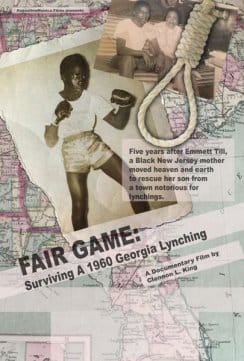
King is the father of two adult sons, Crawford and Jordan, and resides in Roxbury, Massachusetts, home to his company, AugustineMonica Films. King founded his video production house in 2002, and in addition to producing fundraising and marketing videos for area nonprofits, the house also has to its credit three diversity program offerings. His first was the award-winning documentary “Passage at St. Augustine: A 1964 Black Lives Matter Movement That Transformed America,” which was presented at the Putney School, Vermont, in 2016. King’s second, the 65-minute documentary entitled “Fair Game: Surviving a 1960 Georgia Lynching,” premiered last August at Martha’s Vineyard Strand Theatre in Oak Bluffs. The third offering is a slideshow-lecture MLK’s Boston Years,” providing a granular look at Dr. Martin Luther King, Jr.’s New England years. 

Q: What is the meaning of your company’s name, AugustineMonica?

CLENNON L. KING: It bothers me how arbitrary society is about what stories it tells. So, when I discovered that the oldest city in the U.S. was named for a black preacher who was a fourth-century African bishop before becoming a saint, I decided to tell that story by using my company name. At the same time, I wanted to salute Augustine of Hippo’s mother, Monica, an African mother, for whom the California city, Santa Monica, is named. Worth noting as well is that my first documentary takes place in St. Augustine, Florida. I wanted to share this hidden history that speaks to the greatness of Black people.

Q: Did your mother have any influence on your career?

CLK: Indeed. What I thank my late mother Carol Johnson King for most is how she protected my freedom of expression growing up, sometimes much to the irritation of my father and siblings. I can hear her saying, “Let him express himself.” She was good about that. On the other hand, she was a Cleveland, Ohio native who earned her college degree in early childhood education and lived and raised her children in the deep South. For all the reasons above, Mom was a stickler about correcting my diction, grammar, and dialect, even in the presence of childhood friends. While embarrassing, her direction helped cut a clean path to what became a fulfilling career in communications, journalism, and visual storytelling.  

Q: Why did you abandon your law studies? 

CLK: The short answer is my heart wasn’t in it. Add to that that I was also a poor reader—and by extension, student—who found it far easier to learn by talking with people than by reading books. Don’t get me wrong. I had a dream of practicing law with my legendary Dad and was awestruck by his mastery of language, his love of the law, and commanding presence inside hostile Southern courtrooms. But that was his path, not mine. So, when I found out, during my first year of law school, that I had been passed over for an internship with ABC World News Tonight with Peter Jennings in the London Bureau because I was in law school and not pursuing journalism actively, I knew I had to make a choice. When I got back stateside, I did.      

ragfdfag

Movie poster for Fair Game.

Q: How did you find out about the Athenæum?

CLK: In 2011, I think I was doing research on Elizabeth Peabody, a Massachusetts native who founded America’s first kindergarten. Since she also inspired the name of the settlement house I used to work for in Somerville as the director of marketing and development, I wanted to find out as much as I could about her, as it might be important to would-be donors. In my quest, I was directed to the Athenæum. Once I found out it wasn’t open to the public and that you had to be a member, I knew I wanted in. Given that my profession as a journalist and filmmaker often requires extensive research, I resolved I would buy a membership as soon as I could. And six years later, I did.

Q: What appeals to you about the Athenæum?

CLK: What appeals to me most are the out-of-print volumes, city directories, and the archival maps you can’t find anywhere else. It’s a researcher’s heaven.

Q: What were the great struggles of working on your documentary? The great joys?

CLK: The truth is my documentary, “Fair Game: Surviving a 1960 Georgia Lynching” was ‘in the can’ by the time I bought a membership to the Athenæum. But the challenge was to find a place to edit the film, uninterrupted. With just six months left to complete the documentary before it was to premiere on Martha’s Vineyard, I was under the gun. I found the solitude I was looking for on the Athenæum’s fifth floor. The natural light. The surroundings. The quiet. Being able to hear my thoughts. It was a short ride from my home in Roxbury. I could edit on my laptop from 9 a.m. to 8 p.m., take walks on Beacon Hill and just work, in the name of meeting my deadline. Doesn’t get much better than that.

Q: Any projects you’re working on now?

CLK: There is an interesting story. I was recently doing research to make changes to an online video quiz I wrote and produced entitled “MLK’s Boston Years.” Specifically, I was trying to determine the exact Beacon Hill address of Dr. Martin Luther King, Jr.’s future wife, Coretta Scott, who, in the fall of 1951, had just arrived in Boston. Her landlord, as it turns out, was a Boston Cabot, who agreed to rent Scott a room and provide her breakfast, so long as she assumed housemaid duties—cleaning rooms, scrubbing floors, sweeping stairwells, and doing laundry. As a struggling music education major at the New England Conservatory of Music, she agreed to the terms and performed the requested duties for three months, before moving to Massachusetts Avenue in Boston’s South End. That’s where she met a young Boston University divinity student who happened to live three blocks away. And the rest, as they say, is history. As for the exact address where Scott lived, her fifth floor room was located at 1 Chestnut Street, a six-minute walk from the Athenæum. In fact, back in November, I took a break from working here, walked over, and knocked on the door, where the current residents were nice enough to give me an impromptu tour of Scott’s former digs. It doesn’t get much better than that.

Q: How often are you asked if you are related to Martin Luther King, Jr.?

CLK: Often. I don’t mind it, only because there was a relationship between our families because of our respective roles in the Civil Rights Movement.

On Thursday, February 7, 2019, at 5:30 p.m., see a showing of Clennon King’s documentary Fair Game: Surviving a 1960 Georgia Lynching.

There will also be a showing at Georgia Tech. Click here for more information.

12.18.2018

Staff Book Suggestions Winter 2019

Zoë Burnett

The Friend by Sigrid Nunez

(Library of Congress NEW PZ4 .N970 Fr 2018)

“Please say nothing bad happens to the dog.”

Sigrid Nunez’s The Friend is not about a dog. Neither sentimental nor tearjerking, her latest novel is affecting without the melodrama that tends to saturate memoirs centered on pets, often with good reason. Nunez’s dry, almost disaffected prose prohibits this, yet is not without empathy or compassion. The narrator focuses on how and why her longtime friend, and many other writers before him, are seemingly able to write their way into suicide. By no means a “light” read due to the heavy subject matter, her observations and reflections about the passage of time, the inevitable, and how some take the prerogative to cut that process short, are brief but not without impact. This makes the novel easy to pick up and put down at any time, and is the first in a long while to almost make me miss my T stop. Nunez’s absorptive style is nearly toneless, allowing the reader to imbue her words and phrases with their own meaning. Her arresting descriptions will keep the reader engaged, all the while urging them to keep in mind that there is, and must, be an end to everything.

Maria Daniels

The Woman Who Smashed Codes by Jason Fagone

(Library of Congress CT275 .F737 F33 2017)

This dramatic work of nonfiction, which came out in 2017, traces the origins of US government surveillance agencies through the life of an extraordinary woman. Starting with a handful of individuals who began decoding messages of the Central Powers in World War I, the effort was organized to disrupt criminal gangs during Prohibition, and eventually to grapple in World War II with the mind-bendingly complex Enigma and Purple cipher machines developed by the Germans and the Japanese. This absorbing, improbable account is told as the biography of Elizebeth Smith Friedman, who began her career investigating the authorship of Shakespeare’s plays and became an indispensable (though unknown) factor in the US war effort. She developed her method of approaching puzzles methodically with pencil, paper, and patience, and married a like-minded man, William, who would become known as the father of American cryptology. Their relationship, at the heart of the story, touches on themes familiar to readers of spy novels: crushing responsibility, anonymous menace, corrosive secrecy, escalating paranoia, and brushes with madness. Elizebeth’s own prowess—in large part a driver of her husband’s—was kept under lock and key, literally, by J. Edgar Hoover, as the FBI claimed credit for her work. How fortunate readers are that writer Jason Fagone gained access to her declassified files and put together such a captivating narrative.

Daria Hafner

The Bone Clocks by David Mitchell

(Library of Congress PZ4 .M6793 Bo 2014)

This novel by David Mitchell has been on my to-read list for several years. This is a great book for cold winter days because it draws you in and captures your attention—perfect for curling up on snowy days. In The Bone Clocks, Mitchell covers a vast array of topics by piecing together the perspectives of different characters over several decades. Mitchell covers the geography of western Europe and the United States and the topics of climate change, technology, family dynamics, and supernatural powers. This novel is not for the faint of heart, and reading it felt like putting together a complicated jigsaw puzzle. The end result is well worth the intellectual effort, however, and it is one of the best books I have read in the last year. Mitchell grabs his readers with a sympathetic main character, and this is a book that I struggled to put down until the very end.

Carolle Morini

Agatha Christie: A Mysterious Life by Laura Thompson

(Library of Congress CT788.C479 T46 2018)

Enjoyable and insightful biography on Chrisitie. The story of her life is told along side the stories and plays she wrote. Excellently paced book. 

Hannah Ovaska

Difficult Women by Roxane Gay

(Library of Congress PZ4.G2846 Di 2017)

Roxane Gay has done it again! Difficult Women is a collection of short stories about the complex experiences of women—especially unconventional women—in modern America. As in her other works, Gay has created a haunting experience for the reader as they travel through the unique (and not so unique) lives of diverse women. There is no shortage of beauty and shock, and I can assure you that some of these tales will stick in your memory after you finish the book.

Kaelin Rasmussen

The Division Bell Mystery by Ellen Wilkinson, with a preface by Rachel Reeves MP, and an introduction by Martin Edwards

(Library of Congress NEW PZ3 .W6579 Di 2018)

A classic British mystery novel is a great way to ward off winter blues! The premise: London, 1930s. A financier is found shot in the House of Commons. Suspecting foul play, a parliamentary private secretary takes on the role of amateur sleuth. Used to turning a blind eye to covert dealings, he must now uncover the shocking secret behind the man’s demise, amid distractions from the press and the dead man’s enigmatic daughter. Originally published in 1932, this is the only novel written by Ellen Wilkinson (1891–1947), one of the first women elected to Parliament, a member of the Labour Party, suffragist, and social justice activist. The Division Bell Mystery is an excellent mystery story, but I think what I enjoyed most was the insider perspective on the House of Commons and Wilkinson’s understated but razor-sharp satire, which is at its most cutting when directed at the attitude towards the women who tread the halls of that traditionally male institution.

Anthea Reilly

How to Be a Good Creature by Sy Montgomery

(Library of Congress  NEW QL85 .M65 2018​)

A charming memoir by author and naturalist Sy Montgomery, a fast read and delightful.

Mad, Bad, Dangerous to Know by Colm Tóibín

(Library of Congress  NEW PR8727 .T65 2018​)

Essays by Colm Tóibín on the fathers of Wilde, Yeats and Joyce, evocative of a time in Irish history and written by an Irishman with passion for his subjects and a splendid voice.

City of Light: The Making of Modern Paris by Rupert Christiansen

(Library of Congress  NEW DC733 .C483 2018​)

Paris during the Second Empire, written with a definite feel for the city, its inhabitants and its history.

Mary Warnement

Heat Lightning by Helen Hull

(Library of Congress PZ3.H8783 He)

I had to travel to London to discover this author from my home state of Michigan. At first I thought Hull hailed from a city with a connection to my mom, but I confused Albion for Allegan. No matter, they are in the same region. The first paragraph mentioned the interurban bus (and trolley) system that used to connect southern Michigan and Indiana and that my mom recalled with fond reminiscing of her father. But none of that helps you know whether Hull’s writing is for you. Hull left Michigan for NY and spent most of her life teaching at Columbia and spending summers in Maine with her partner Mabel Louise Robinson. Hull belonged to a group of feminists called the Heterodoxy Club, about which I am eager to learn more. Heat Lightning was a book of the month club selection in 1932 when it appeared. It details a week-long visit home by Amy during the summer of 1930 when her own life is in as much turmoil as the stock market. Her interactions with her parents, siblings, and extended relatives rang true. (If you had enough of your own family over the holidays, this could help you gain perspective.) Amy may be the eyes through which we see all, but the personality of her grandmother is at the center of this world. Anyone who enjoys fiction about relationships will want to read this. I read an edition reprinted by Persephone (found in their charming, eccentric London shop which I also highly recommend) but the Athenæum has the 1932 edition as well as 15 other books by Hull.

Francis Wyman

Winter War by Eric Rauchway

(Library of Congress CALL NUMBER NOT ASSIGNED YET)

Every presidential inauguration has its iconic pictures that serve to validate our democratic process. Among the more memorable ones is the one of the dour, outgoing President Herbert Hoover, and the ebullient President-elect Franklin D. Roosevelt riding together, down Pennsylvania Avenue, to the inaugural ceremonies at the Capitol. The uneasiness of the scene reflects more than Hoover’s defeat and Roosevelt’s triumph and their mutual dislike of each other but the solidifying of the conservative-liberal divide that has largely defined America politics ever since. That divide, the outlines of which were visible in the 1932 election campaign, sharpened in the four month interregnum, between the election in November 1932 and Roosevelt’s inauguration in March 1933. It is this unfamiliar political history that University of California Professor Eric Rauchway covers in his book, Winter War: Hoover, Roosevelt, and the First Clash Over the New Deal.

In late 1932 the United States was in the midst of the Great Depression, the country’s worst economic downturn in its history. Millions of Americans were out of work, desperate and despairing at ever finding employment again; agricultural prices were plummeting, driving farms into foreclosure; and banks were collapsing in ever larger numbers. By early 1933, the economy was teetering on the brink of complete collapse. For Roosevelt, the path out the crisis, and the means to save capitalism, was a program that included public works, lower tariffs, federally-owned hydroelectric power plans, agricultural subsidies, reform of the banking system, a social insurance program, minimum wages, maximum hours, labor’s right to organize, and tight control of unnecessary government spending.

For Hoover, FDR’s New Deal, which involved the intervention of the federal government on a scale not seen before, was not just un-American but communistic. According to Hoover, the president-elect’s radical program emitted “fumes of witch’s caldron [sic] which boiled in Russia and in its attenuated flavor spread over the whole of Europe.” While outwardly accepting the results of the election, Hoover worked to nullify them by attempting to persuade FDR to abandon the New Deal and accept the policies his administration had been pursuing. 

Professor Rauschway’s Hoover is crafty, self-important, and at times petty. While he sought to get Roosevelt to renounce his program, he sought to turn the Republican Party into a bulwark against the New Deal. The outgoing president believed only he was capable of guiding the transformation. The party, with him at its helm, would be ready to govern again when Roosevelt’s program failed. 

Roosevelt was too seasoned a politician to be caught in Hoover’s scheme. He resisted the president’s pressure to renounce the New Deal and embrace his administration’s financial policies. According to Professor Rauchway, Roosevelt’s New Deal set the country on the road to economic recovery.

There is plenty to quibble with in this book. Hoover did not stand on the sidelines as the depression grew worse, although he could have done much more. Roosevelt’s grasp of economics may not have been as sure footed as Professor Rauchway argues. Still, the book is a worthwhile read for what it might tell us about the 2020 presidential campaign and possible presidential transition.