
09.02.2016

Books and Libraries

Picture Books

But Excuse Me That is My Book by Lauren Child

(Children Picture Book + CHILD)

When Lola’s favorite book is not on the library’s shelf, her older brother, Charlie, tries to find another book she will enjoy.

The House of Wisdom by Florence Parry Heide & Judith Heide Gilliland; illustrated by Mary GrandPré

(Children Picture Book + HEIDE)

Ishaq, the son of the chief translator to the Caliph of ancient Baghdad, travels the world in search of precious books and manuscripts and brings them back to the great library known as the House of Wisdom.

Library Mouse by Daniel Kirk

(Children Picture Book + KIRK)

Sam, a shy but creative mouse who lives in a library, decides to write and illustrate his own stories which he places on the shelves with the other library books, but when children find the tales, they all want to meet the author.

Library Lion by Michelle Knudsen; illustrated by Kevin Hawkes

(Children Picture Book + KNUDS)

A lion starts visiting the local library but runs into trouble as he tries to both obey the rules and help his librarian friend.

The Midnight Library by Kazuno Kohara

(Children Picture Book + KOHAR)

“Once there was a library that only opened at night. Step inside and meet the little librarian and her three assistant owls.” Provided by publisher.

Bats at the Library by Brian Lies

(Children Picture Book LIES)

Bored with another normal, inky evening, bats discover an open library window and fly in to enjoy the photocopier, water fountain, and especially the books and stories found there.

Lola at the Library by Anna McQuinn; illustrated by Rosalind Beardshaw

(Children Picture Book MCQUI)

“Lola loves Tuesdays. That’s when she and her mommy go to the library. Lola meets her friends there. They share books and don’t have to be quiet all the time. The nice librarian tells stories. There is a big machine that buzzes Lola’s books in and out, and she can take any books she wants home with her. Lola and her mommy always stop for a treat on the way home. No wonder Lola loves the library.” Provided by publisher.

Tomás and the Library Lady by Pat Mora; illustrated by Raúl Colón

(Children Picture Book + MORA)

While helping his family in their work as migrant laborers far from their home, Tomás finds an entire world to explore in the books at the local public library.

Miss Moore Thought Otherwise: How Anne Carroll Moore Created Libraries for Children by Jan Pinborough; illustrated by Debby Atwell

(Children Picture Book + PINBO)

Examines the story of how librarian Ann Carroll Moore created the first children’s room at the New York Public Library.

Marguerite Makes a Book by Bruce Robertson; illustrated by Kathryn Hewitt

(Children + PZ7 .R55 Ma)

In medieval Paris, Marguerite helps her nearly blind father finish painting an illuminated manuscript for his patron, Lady Isabelle.

Beginning Readers

Mr. Putter and Tabby Turn the Page by Cynthia Rylant

(Children Picture Book RYLAN)

Mr. Putter and Mrs. Teaberry bring Tabby and Zeke to the library for a special storytime.

Chapter Books

Booked by Kwame Alexander

(Children PZ7.A3771 Bo 2016)

“In this middle grade novel-in-verse by the Newbery Medal-winning and Coretta Scott King Honor Award-winning author of The Crossover, soccer, family, love, and friendship, take center stage as twelve-year-old Nick learns the power of words as he wrestles with problems at home, stands up to a bully, and tries to impress the girl of his dreams.” Provided by publisher.

The Grimm Legacy by Polly Shulman

(Children PZ7.S559474 Gr 2010)

New York high school student Elizabeth gets an after-school job as a page at the “New-York Circulating Material Repository,” and when she gains coveted access to its Grimm Collection of magical objects, she and the other pages are drawn into a series of frightening adventures involving mythical creatures and stolen goods.

The Library Card by Jerry Spinelli

(Children PZ7.S7546 Li 1997)

The lives of four young people in different circumstances are changed by their encounters with books.

The Great Good Thing by Rod Townley

(Children PZ7.T628 Gr 2001)

Nothing ever changes inside the storybook kingdom inhabited by twelve-year-old Princess Sylvie, her parents, and many other characters until Sylvie discovers that by allying herself with the Reader she can experience new adventures beyond the confines of the book.

The Forbidden Library by Django Wexler

(Children PZ7.W523 Fo 2014)

When her father is lost at sea shortly after meeting a very unusual visitor, Alice must leave her home to live with an “uncle” whose rural Pennsylvania estate includes a massive and mysterious library that holds much more than books.

Young Adult

The Book of Dead Days by Marcus Sedgwick

(Young Adult PZ7.S4435 Bo 2004)

With the help of his servant and an orphan girl, a magician named Valerian searches graveyards, churches, and underground waterways for a book he hopes will save him from a pact he has made with evil.’

The Book Thief by Markus Zusak

(Young Adult PZ7.Z837 Boo 2006)

Trying to make sense of the horrors of World War II, Death relates the story of Liesel—a young German girl whose book-stealing and story-telling talents help sustain her family and the Jewish man they are hiding, as well as their neighbors

Informational Texts

Book by John Agard

(Children Z4.Z9 A625 2015)

Books contain countless tales but what if Book told its own story? From clay tablets to e-readers, here is a quirky, kid-friendly look at the book.

How a Book is Made by Aliki

(Children + Z116.A2 A42 1986)

Side by Side: Five Favorite Picture Book Teams Go to Work by Leonard S. Marcus

(Children + Z286.P53 M37 2001)

Describes the process by which several teams of authors and illustrators have created such picture books as “Louis the Fish,” “The Glorious Flight,” “The Stinky Cheese Man and Other Fairly Stupid Tales,” “Sam and the Tigers,” and “The Magic School Bus Explores the Senses.”

Ways of Telling: Conversations on the Art of the Picture Book by Leonard S. Marcus

(Children NC965 .M345 2002)

A collection of interviews with fourteen artists and writers of picture books who, regardless of their country of origin, have had a major impact in the United States.

Richard Wright and the Library Card by William Miller; illustrated by Gregory Christie

(Children + CT275.W7445 M54 1997)

Based on a scene from Wright’s autobiography, Black Boy, in which the seventeen-year-old African-American borrows a white man’s library card and devours every book as a ticket to freedom.

Children’s Book Covers: Great Book Jackets and Cover Design by Alan Powers

(Children + NC973 .P68 2003)

08.25.2016

Chiang Yee

September 2016

By Adriene Galindo

In 1933, Chinese government official Chiang Yee left his family and native province of Jiangxi to begin a new life as an artist and scholar in London. Surrounded by corruption and an angry civil war, Chiang had become disillusioned with the life of a magistrate, dreaming instead of time spent pursuing the arts.

When Chiang arrived in London, he managed to do just that: simultaneously teaching Chinese language at the London School of Oriental Studies, and exhibiting his Chinese-style watercolors. Though he created art in the traditional Chinese style, the subject matter was chiefly British. Chiang was inspired by his new environment. By representing thoroughly Western subjects using Eastern techniques, he managed to introduce the British public to a new perspective—an outsider’s perspective. This would become the theme of Chiang’s Silent Traveller books, a series recording a Chinese traveler’s impressions of cities all over the world. Scattered throughout are Chiang’s own poetry, sketches, and watercolor illustrations inspired by his surroundings. While books written by Westerners detailing their travels through the East were commonplace, the opposite was not, and Chiang managed to make an impression on many academics and art critics.

In 1952, Chiang traveled to Boston to write his tenth book in the Silent Traveller series, The Silent Traveller in Boston. It was then the author met Walter Whitehill, director of the Boston Athenæum from 1946 to 1973. In The Silent Traveller in Boston, Chiang shares an outsider’s observations, giving insight into a city that even born-and-raised Bostonians will find enlightening…and entertaining. Included are such lessons as:

  • How to tell a Harvard man from a Yale man (ask about his grandfather—the conversation will inevitably turn to education and pedigree. According to Chiang, if his grandfather went to Harvard, you can be sure that he and his father also did.)
  • What Chiang calls the “Boston nose.” After observing the identical noses on the busts of John Adams, John Quincy Adams, and Charles Francis Adams on the fifth floor of the Athenæum, Chiang concluded that the Adams legacy lives on in the form of the Adams nose, which can still be found on the streets of Boston.

Whitehill and Chiang remained lifelong friends, and Whitehill was responsible for showing Chiang many of the sights in downtown Boston. In fact, members will recognize Whitehill’s name, among others, in the early pages of The Silent Traveller in Boston. In 1957 and 1959, the Athenæum exhibited Chiang’s drawings and watercolor paintings, which now reside in our Prints and Photographs department.

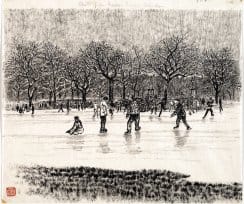
Chiang Yee (1903–1977), Skating in Boston Public Garden, ca. 1953. Brush and ink over graphite. Boston Athenaeum, purchased from the artist, 1959.

Chiang Yee (1903–1977), Skating in Boston Public Garden, ca. 1953. Brush and ink over graphite. Boston Athenaeum, purchased from the artist, 1959.

In 1975, Chiang returned to his homeland for the first time in 42 years. Having been unable to return to China due to World War II, the Chinese Civil War, and ensuing isolationism, Chiang was eager to be reunited with his family and witness the many changes that had taken place in his absence. He penned his observations in China Revisited: After Forty-Two Years, praising his country for its increased prosperity and education. Chiang died two years later in Beijing and is now buried near his hometown in Jiangxi Province.

Selected Works

China Revisited, After Forty-two Years (Cutter Classification A3 .C431)Chinese Childhood​ (Cutter 53 .C431)Chinese Eye: An Interpretation of Chinese Painting (Cutter UP3 .C43)Silent Traveller in Boston (Library of Congress Classification F73.52 .C48)Silent Traveller in Dublin (Cutter ADUD85 .C432 .s .2)Silent Traveller in Edinburgh (Cutter ADSEd4 .C4327 .s)Silent Traveller in London (Library of Congress DA684 .C53 1938)Silent Traveller in New York (Cutter 967N48 .C431 .s)Silent Traveller in Oxford (Cutter DUEOx .MCh)Silent Traveller in Paris (Cutter AFP2 .C426 .s .2)Silent Traveller in San Francisco (Cutter 9B7Sa5 .C431)

07.27.2016

Nathaniel Philbrick

August 2016

By Alyssa True

An English major who never enjoyed his history classes, Nathaniel Philbrick writes history meant to be enjoyed. A frequent New York Times bestselling author, he won the National Book Award for nonfiction for In the Heart of the Sea in 2000 and was the finalist for the Pulitzer Prize for History for Mayflower in 2007. Many of his books have become or are in the process of becoming feature films. His newest book, Valiant Ambition, is the second of three books about the Revolutionary War. Philbrick came to the Athenæum to speak about it on June 16.

Philbrick does not believe his own life story merits anyone’s attention. He likes to go sailing with family and that’s it. He watches “stupid” television. “I’m a writer,” he said. “Not a lot going on here.”

Born in Boston, Philbrick grew up in Pittsburgh, and earned degrees from Brown and Duke. While at Brown University he became its first Intercollegiate All-American sailor in 1978 and then won the Sunfish North American Championship. Long before In the Heart of the Sea and Sea of Glory, Philbrick edited the magazines Sailing World and Yaahting: A Parody. He moved to Nantucket with his wife Melissa and two kids in 1986 and has lived on the island ever since. His first book, Away Off Shore, grew out of his desire to understand his new home. 

Though well known for his oceanic epics, Philbrick never considered himself a “sea writer.” “I’m just really interested in America,” he said. He said each book “organically evolves from the one before it” and he is fascinated by leadership: “The book about Benedict Arnold evolved after finishing Bunker Hill: I just had to see where George Washington was going to go to next in the Revolution, but wanted to pair him with someone who would take the narrative in interesting places [and] ended up with Benedict Arnold.” Philbrick, however, doesn’t ignore the connections to the sea if they come up: “I’m always interested in trying to cast a light on the maritime side of history that isn’t always thought of being sea—well, water, connected.”

Philbrick has always been fascinated with the dark side of human behavior. He told National Writers Series in 2013, “I love the details. Especially if someone is suffering from dehydration and starvation.” He also told New York Times Book Review this May that one of his admired writers is Stephen King: “I may write history, but all my books are horror stories of one kind or another.” And even if he were to try to write an upbeat tale, he doubts it will end well: “All my books seem to lead to betrayal and disaster and a lot of suffering.”

When researching a topic for a book, Philbrick records his first impressions and reactions in a notebook and goes back to them later. As he told the Paris Review in 2013, he has learned those responses ultimately shape his book: “I find that when I’m new to a topic, that’s when I’m catching the best details. It’s all new to me—it’s what the reader will respond to. Because you can so easily over-know a topic, and you lose the magic. It becomes interesting to you, but you’ve lost the connection to the reader.”

For Philbrick, his writing process would turn into a family affair before sending his work to his editor. He would read drafts aloud to his wife and after receiving her “pointed” notes, send his revised draft to his father and mother, a retired English professor and kindergarten teacher, respectively. He still does this with his wife and father, who both have been a part of his writing “since the beginning.” Philbrick views his writing as solitary work so another mind early on is very helpful: “It’s nice when you’re in the beginning of the early stages of the book to have readers you know well enough that they’ll tell you what they think and you’ll know where they’re coming from.”

Philbrick has been a member of the Athenæum since 2002 and a proprietor since 2005. The man who introduced him to the Athenæum happened to be the same close friend, John Drake Ross, who introduced Philbrick to Melissa when he was a teenager. Ross, then a proprietor, obtained his share through his mother, but eventually realized his own children were not interested in the Athenæum. When Ross asked his friend if he would be interested in his share, Philbrick said, “Yeah! I love the Athenæum!”

As a result of being “stuck like a barnacle to Nantucket,” Philbrick feels he does not have the opportunity to give the Boston Athenæum the time it deserves. He appreciates the people who contributed to the Athenæum’s history, as well as those who sustain it today. “It’s not only a wonderful literary refuge within the craziness of Boston,” he said about its appeal, “but it’s the people I’ve run into.” The Nantucket Atheneum, though unaffiliated, also had its present location built in 1847 and Philbrick thinks of it as the Athenæum’s “Nantucket outpost,” which has been important to his work. But even brief stays are hard to manage: “Every time I go in there, I don’t really want to leave.”

Selected Works

Away Off Shore: Nantucket Island and its People, 1602-1890 (Library of Congress Classification F72.N2 P44 1994)Bunker Hill: a City, a Siege, a Revolution (Library of Congress E241.B9 P48 2013)In the Heart of the Sea: the Tragedy of the Whaleship Essex (Library of Congress G530 E76 2000)Last Stand: Custer, Sitting Bull, and the Battle of the Little Bighorn (Library of Congress E83.876 .P47 2010) Mayflower: A Story of Courage, Community, and War (Library of Congress F68 .P44 2006) Mayflower and the Pilgrims’ New World (Children’s Library F68 .P445 2008)Revenge of the Whale: The True Story of the Whaleship Essex (Children’s Library G530.E77 P454 2002)Sea of Glory: America’s Voyage of Discovery: the U.S. Exploring Expedition, 1838-1842 (Library of Congress GN663 .P48 2003)Valiant Ambition: George Washington, Benedict Arnold, and the Fate of the American  Revolution (Library of Congress NEW E206 .P48 2016)

Why Read Moby-Dick? (Library of Congress PS2384.M62 P55 2011)

References

Foster, Cymbre. 2013. “An Evening with Nathaniel Philbrick: Event Recap.” National Writers Series. May 14. Accessed July 24, 2016. http://nationalwritersseries.org/programs/an-evening-with-nathaniel-philbrick/.

Philbrick, Nathaniel, interview by Alyssa True. 2016. August 2016 Athenæum Author Interview (July 25).

Shattuck, Ben. 2013. “Small Island: An Interview with Nathaniel Philbrick.” The Paris Review (blog). July 24. Accessed July 24, 2016. http://www.theparisreview.org/blog/2013/07/24/small-island-an-interview-with-nathaniel-philbrick/.

Sunday Book Review. 2016. “New York Times.” Nathaniel Philbrick: By the Book. May 26. Accessed July 24, 2016. http://www.nytimes.com/2016/05/29/books/review/nathaniel-philbrick-by-the-book.html?_r=1.

Tandem Literary. n.d. “Nat’s Bio.” Nathaniel Philbrick. Accessed July 19, 2016. http://www.nathanielphilbrick.com/wp-content/themes/philbrick/downloads/bio.pdf.

06.22.2016

Staff Book Suggestions Summer 2016

Emily Anderson

Brilliant Beacons: A History of the American Lighthouse​ by Eric Jay Dolin
(Library of Congress Classification​ NEW VK1023 .D65 2016​​)

Combine your love of history, biography, the ocean, adventure, and birds (?), and commemorate the three hundredth anniversary of America’s oldest light station, Boston Light, by enjoying this comprehensive history of America’s lights. Build up your lighthouse enthusiasm by watching Eric Jay Dolin’s Athenæum lecture on Vimeo, or listen to the podcast recording on SoundCloud.

A Short, Bright Flash: Augustin Fresnel and the Birth of the Modern Lighthouse by Theresa Levitt
(Library of Congress Classification​ VK1015 .L48 2013​​)

A fascinating history of the invention that enhanced the safety, cost efficiency, and effect of lighthouses worldwide, and the man whose research altered the science of optics.

David Dearinger

Burr​ by Gore Vidal
(Library of Congress PZ3.V6668 Bu​​)

Forget all the hoopla about Alexander Hamilton. Aaron Burr was a far more interesting character, especially as he appears in Gore Vidal’s fascinating, thoroughly readable, and hysterical historical novel (And if you are worried about historical accuracy: Vidal’s Burr is no more fictionalized than Broadway’s Hamilton—and, even without the hip-hop, he’s a lot more fun). In fact, Vidal gives us a Burr who, though aged, is as brilliant, feisty, cunning—and randy—as he was in his youth, glimpses of which we get through Burr’s “memoirs” that Vidal occasionally inserts into the narrative. Whatever else he might be, Vidal’s Burr is also a true patriot, which makes one suspect that Vidal’s Burr is, in many ways, Vidal himself.

Emily Levine

The Circle​ by Dave Eggers
(Library of Congress PZ4.E30 Cir 2013​​)

In his dystopian novel, Eggers follows Mae, his young heroine, into an internet startup company to explore questions of social media, privacy, democracy, history, and collective memory in twenty-first century America.

Musicophilia by Oliver Sacks
(Library of Congress ML3830 .S13 2007​​)

Oliver Sacks, celebrated neurologist and author, explores the connection between music and the human psyche through several extraordinary nonfiction stories.

Heather Lonks
Call the Midwife: A Memoir of Birth, Joy, and Hard Times by Jennifer Worth
(Library of Congress CT788.W777 A3 2012​)

For those of you who, like me, are already going through withdrawals and just can’t wait for the Call the Midwife Christmas special, I highly recommend picking up the memoir the show is based on.

Call the Midwife: A Memoir of Birth, Joy, and Hard Times by Jennifer Worth is the first part of the affectionately termed Midwife Trilogy. I couldn’t put this book down! Some of the stories are reminiscent of specific episodes, and it is fun to try and remember how the characters looked in the show. And there are a number of stories that were brand new to me.

The wonderful thing about reading this memoir is we really hear Jenny’s voice. We get her internal dialogue, including her struggle adapting to life in Poplar and how she feels interacting with its slew of characters. The stories are just as heartwarming (and heartbreaking) as the television program. I can’t wait to continue reading about Jenny’s East End adventures in the second installment, Shadows of the Workhouse.

Judith Maas
Downtown: My Manhattan by Pete Hamill​
(Library of Congress F128.3 .H25 2004)

Pete Hamill grew up in Brooklyn and still remembers his first glimpse of Manhattan—from the foot of the pedestrian ramp of the Brooklyn Bridge: it looked like Oz. That sense of excitement has stayed with him. He began his journalism career as a reporter for the New York Post in 1960, finding that he always wanted to keep learning about the people and the neighborhoods he covered, even after his stories were written. Walking around lower Manhattan, he says, he still seeks not adventure, but chances to see the familiar in new ways.

Hamill intersperses memoir and history, exploring how streets and neighborhoods—the Bowery, Broadway, Park Row, Fifth Avenue, the Lower East Side—changed over time. All kinds of subjects come to light, from the rise of newspapers, to the beginnings of tap dancing, to the development of the grid, to the stories behind landmark buildings. He doesn’t just give the facts, but tries to envision everyday life in bygone New York, to see the city from the perspective of the old Knickerbocker families or the newly arrived immigrants. Along the way, Hamill reflects on New York’s never-ending dynamism and on why the city is the “capital of nostalgia.”

Carolle Morini
Love, Nina by Nina Stibbe​
(Library of Congress​ CT788.S853 A4 2014)

Dear Reader,

Reading this book has been such a joy. Here is a recent conversation I had with a friend about it.

Me: I am so very happy  one of the members suggested this book to me to read this summer.

Friend: How come?

Me: It makes me laugh.

Friend: That’s cool, what else?

Me: One of the people in the book was the editor of the London Review of Books and I like learning more about her. The nanny, Nina, captured the characteristic of the family she worked for and all the people who visited so well! I feel like I am sitting with them at the table eating pie made from tin filling.

Friend: Tin filling?

Me: You have to read the book.

Friend: Maybe.

Me: YOU HAVE TO READ IT! It is an epistolary novel. Nina write to her sister in the 1980s about all her London adventures!

Friend: EPISTOLARY!! Why didn’t you say that to begin with?! I love epistolary novels!

Me: sigh.

Enjoy the book!

Kaelin Rasmussen
Solaris by Stanislaw Lem​​
(Library of Congress​ NEW PZ4.L537 So 1987)

I only recently became aware of this science fiction classic, but it was worth the wait. Solaris was first published in Warsaw in 1961, was translated into French, and then translated into English, from the French, in 1970. The story follows the (now) classic scenario of humans in the future interacting with extraterrestrial life. There’s a lot to this story: part mystery, part ghost story, part philosophical rumination. It has excellent, deftly drawn characters, and the world-building is top-notch. The plot: for more than one hundred years, scientists have studied the mysterious planet Solaris—its surface is covered by a massive ocean that’s not made of water, but is in fact theorized to be a sentient life form. The only thing scientists know for sure is that the Ocean has defied all attempts to classify it and ignored all overtures of communication. After some puzzling messages are sent to Earth from the space station orbiting Solaris, rookie Solarisist Kelvin is sent to find out what’s going on. He is horrified to find himself confronted with a being, an exact copy of a long-dead lover, apparently plucked from his memory. She is not human, but she thinks she is. The grief-stricken Kelvin attempts to find out what she is and why, asking himself how two species with no common ground—not language, not memory, not even life and death—could ever hope to understand one another.

Arnold Serapilio
The Brief and Frightening Reign of Phil​ by George Saunders
(Library of Congress PZ4.S2548 Br 2005)

Published in 2005, George Saunders’s absurdist take on border disputes, bad leadership, and civic responsibility resonates to an unsettling degree in 2016. And it’s all over in under 130 pages, making this funny and smart romp one heck of a breezy read.

Mary Warnement

Expert in Murder by Nicola Upson

(Library of Congress NEW PZ4.U685 Ex 2008)

In the mood for a mystery from the heyday of whodunnits from the 1930s but you’ve already read all of the classics? Well, Upson has written one set in 1934 whose detective is Josephine Tey, which was the pen name used by Elizabeth Mackintosh for her classics, Man in the Queue and The Daughter of Time. Upson has done her homework to add convincing details, like giving a character a typewriter with the brand name “Good Companion,” referencing Saveloy skins and May Gaskell’s war library for soldiers, making the policeman an educated man with a taste for paintings, and revolving the action around the final performances of the long-running Richard of Bordeaux, an actual play written by Mackintosh. This is a well-plotted and suspenseful story, though the end may have dragged a bit, beyond the denouement. Mystery lovers with a taste for that period and bookish intrigue will enjoy this.

06.07.2016

Thomas Mickey

July 2016

Interview by Emily Levine

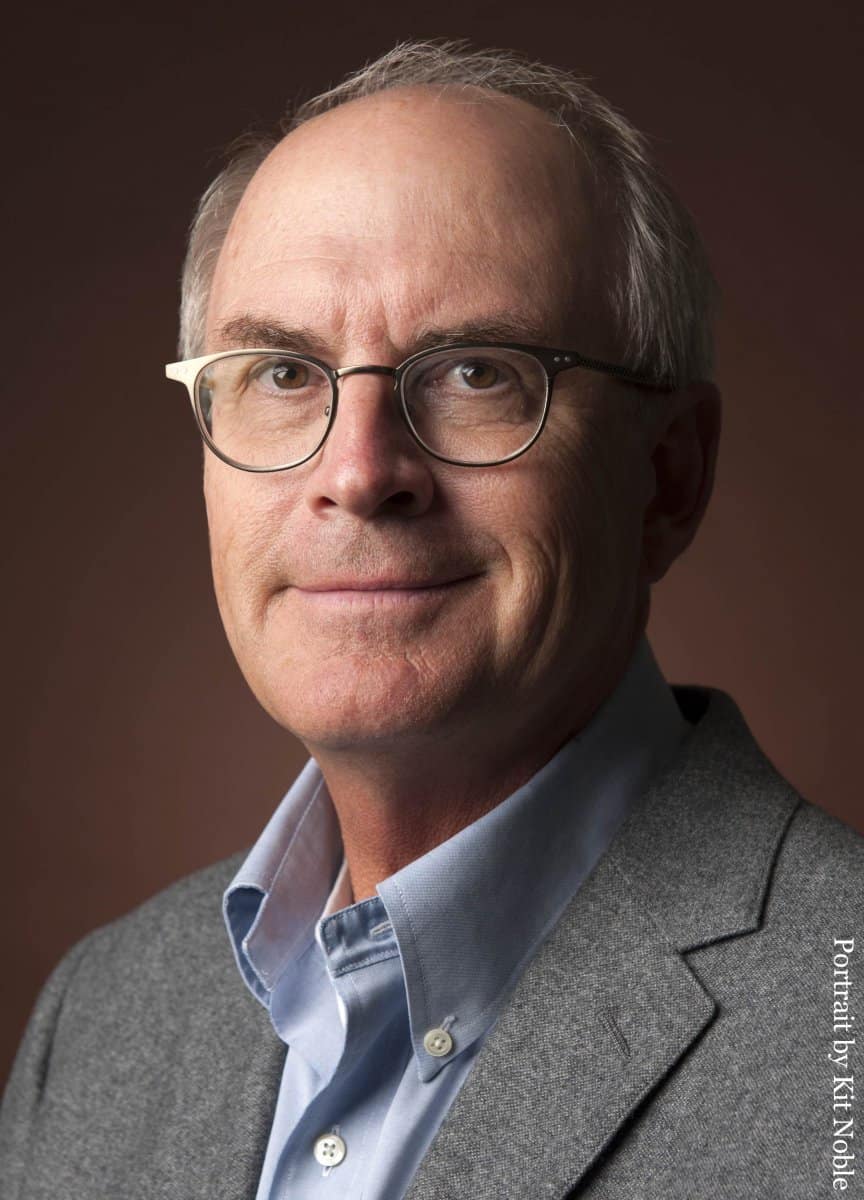
During long city summer days in Boston there are few places more beautiful than the Boston Public Garden. Thomas Mickey—scholar, author, retired professor, and active Master Gardener—says there is nothing more lovely and welcoming than a well-designed public garden “for anybody to go in and enjoy.” Mickey has lived on the east coast for almost 40 years and holds the title of Master Gardener in the state of New Hampshire. After earning a Ph.D. in Communications from the University of Iowa, Mickey moved east for a teaching job at the New England College in Henniker, NH; after ten years, he moved to Bridgewater State to teach communications, of which he is now Professor Emeritus.

Purchasing a New Hampshire home sparked Mickey’s green thumb, and his research interests lie in the intersection of “history, marketing, and gardening.” Mickey won the Enid A. Haupt Fellowship from the Horticultural Services Division of the Smithsonian to research seed catalogs at Smithsonian archives in the District of Columbia. His studies formed the foundations of his book America’s Romance with the English Garden (2013)Mickey has authored several other books, including Best Garden Plants for New EnglandDeconstructing Public Relations, and Sociodrama: An Interpretive Theory for the Practice of Public Relations.

I sat down for a conversation with Mickey to talk about his research, gardening, and the Athenæum.

Q:  I understand you grew up in the Midwest.

A: Yes, in Milwaukee, I was born and raised there.

Q: Did your gardening thumb come as a consequence of living in the Midwest?

A: No, it just happened when I bought a house 30, 35 years ago and it needed some gardening. It just needed some landscaping outside, so I really started back then, I suppose. That is when I was teaching at New England College in Henniker, NH.

Q: Did your family garden?

A: My father did. My mother and father are both from farms, but my father did some gardening in our house in the backyard so I could see that as I was growing up.

Q: Farms? I have fond memories of Iowa, and I understand you spent some time there.

A: I went to the University of Iowa! I was a student there in the journalism school, that is where I got my Ph.D. I loved it. I loved all my years at Iowa. I love Iowa City. It was really a lot of fun.

Q: What brought you to the East Coast?

A: I got a job teaching at New England College in Henniker; I taught there for ten years and then I taught for almost 30 years at Bridgewater State University near Boston. That is what brought me out east, and I have lived here all these years.

Q: Did you always know you wanted to teach?

A: I did actually. I knew that I liked teaching; it is a lot of fun.

Q: Speaking of school, I understand you have the title of Master Gardener. What kind of schooling or manual labor does that require?

A: Oh yes, I am a Master Gardener of the State of New Hampshire. Master Gardening status is given by the University of New Hampshire Extension Service, so I took a year of classes with them… Every state has a program that is usually connected with the state university extension program. In Iowa, there is a big Master Gardener program too, I think. You have to pass all these tests, and every year you have to volunteer community service in gardening. You are trained not just to do gardening in your own garden, but to help in the community in some way. Master Gardener programs don’t want people to go for all of this training and then just go home, they want you to give back.

Q: I saw your blog that details your travels and interests, http://americangardening.net. Are there specific gardens you really like, or that have inspired you in your journeys?

A: The ones that stand out in my mind that are open for anybody to go in, the great public gardens. There are so many wonderful public gardens that we have all across the country. When I travel, I try to see those when I can. Those are the ones that have particular designs expressed in them that I enjoy. It gives you a feel for the city and for the area. When I was writing the book, I was invited to give a talk related to the content of the book in England. So I went to England with my wife and while we were there, I visited nine classic gardens that date to the 1700s. Old gardens, those are really exceptional! I was so happy I saw them. One of them, Stowerham, is on my blog, a real classic garden. The classic gardens often have what we would call a mansion attached to them. These gardens usually belonged to people who had a lot of money, so they not only had this extensive land to have amazing landscapes, they also had huge houses. They were often summer houses; they would be in London during the cold months, and have estates in the warm summer months.

Q: Could you tell me a bit about how you came to write your most recent book, America’s Romance with the English Garden?

A: I teach public relations writing and public relations campaign strategies in the communication department at Bridgewater. However, I am also interested in gardening and landscaping, so I wrote a proposal to the Smithsonian that I come to Washington to the horticultural resources that the Smithsonian has to study how the garden was promoted to America in the nineteenth century. My proposal was titled, “The Selling of the Garden in Nineteenth​ Century America.” The Smithsonian loved the idea, and they invited me down for a whole year. I traveled back and forth and really looked at the seed and nursery catalogs in the horticultural archives. I did not know going in that I was going to do a book. The book evolved after the year was over, and I went from there. 

Q: It seems like the research out of your fellowship is a direct fusion of your gardening and marketing interests.

A: Correct! Most of the people who receive fellowships from the Smithsonian are from the departments of horticulture at universities. However, I was one of the rare individuals invited in from another field (communications and marketing), but I still possessed a strong knowledge of plants and gardening. Both fields combined well for a research project, and the Smithsonian loved it. 

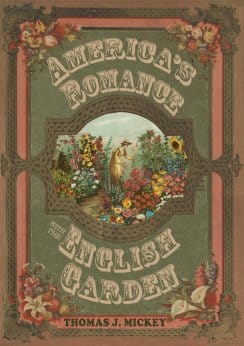
America's romance with the English garden book cover

Q: When you were at the Smithsonian, did you have any individual objects you very much enjoyed? I noticed the cover of your book.

A: That is a catalog that I came across—actually that is a catalog cover. The image of the woman in the center at the flower beds is from another catalog. The artist put the images from the catalogs together to create the cover of the book. I thought the image of the woman was so powerful and so brilliant in its color. It illustrates so well the theme I was raising of marketing to an American audience.

Q: Could you tell me a bit about your personal gardening?

A: We live in a condo in Quincy, but our house in New Hampshire is the house we had before I took my job at Bridgewater State University, and this is where my big garden is. We had this house before so we just kept it, and this is where I do most of my gardening.

Q: Do you garden in Quincy too?

A: Just containers on the deck. I am precise about what I want in them, but my gardening ideas can get expressed in that way too even though space is limited.

Q: Are you putting in plants or flowers right now, or is it past that time? Tell me more!

A: I have a lot of things I am planting now because this is the time to plant annuals. Not quite seeds yet, it is too cold for that at night, still, so we will wait for warmer nights to put some seeds which grow quite well when the weather warms. We also are planting easy things to grow, like nasturtiums.

Q: Do you grow vegetables?

A: No, because I have too much shade. To do veggies, you have to have a lot of sun, otherwise all you get are leaves and no yummy fruit. I tried in the past, but I am happy with what I have. For many flowering ornamental plants you don’t really need total sun, just partial sun, which is what I have.

Q: If I was in a small city apartment and I wanted to get a plant or I wanted to start gardening and just had a patio, what would you suggest?

A: Well, you should do a container with ornamental flowering plants and ornament plants with colored leaves, like coleus. Coleus is a wonderful plant and there are hundreds of varieties. You can get short ones, big ones, all kinds. They’re really pretty. You have to experiment to see what’s going to work. Leaves are really an incredible beauty in themselves. They really are so powerful. You can contrast a purple leaf with a yellow plant, or a leaf that’s kind of gray-green or fuzzy next to a plant that has bright green leaves and a yellow flower. Striking combinations like that can really be quite charming.

Q: What is your relation to the Boston Athenæum?

A: I used to come every week when I was in the throes of the book, but now I come once a month or so. I still have to research articles for my blog. I am working on two new books as well, which I cannot reveal to you, but I am at the Athenæum to do research for topics on history, marketing, and gardening.

Q: Thank you so much for your time!

A: Happy to do it! I love the Athenæum. They are very helpful to me.

05.04.2016

Alice Brown

June 2016

By Emily Levine

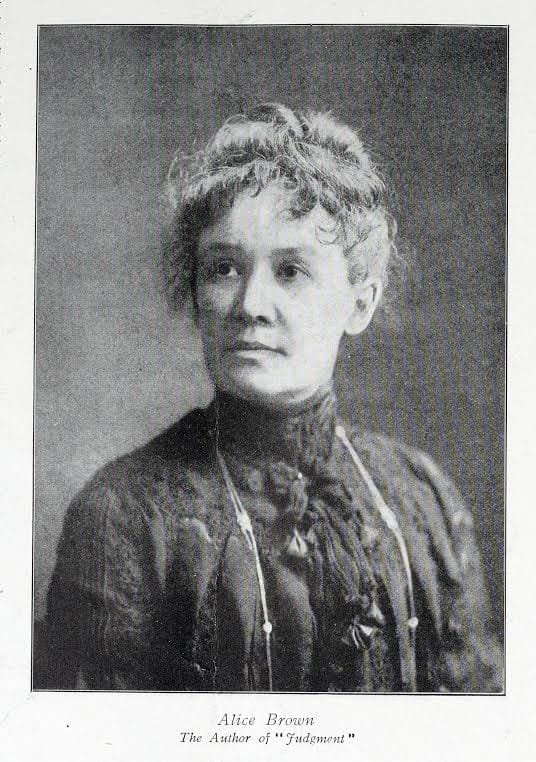
Known in her day as a “cornerstone in Boston’s most Bostonian life and lore,” after her death in 1948 Alice Brown’s vibrant regional writing faded from local and literary memory. However, a resurgence of interest in overlooked women authors of the nineteenth and twentieth centuries has prompted recent reprinting and reissues of numerous of Brown’s regional short story volumes, bringing her to the spotlight once again as a talented and central figure in New England local color writing.

Alice Brown was born in 1857 on a farm in Hampton Falls, New Hampshire, a small agricultural community about six miles from the sea that later acted as a template for the towns in her works. She attended Robinson Female Seminary in Exeter, where she displayed a talent for writing at a young age. After graduating in 1876 she taught there, “hating it more and more every minute.” Restless with her small town life, Alice moved to Boston in her early twenties to serve on the staff of The Christian Register, a bold move for a woman of her time. It was during her early years in Boston that Brown published her first novel Stratford by the Sea (1884), set in a small coastal community; it was this novel, with her rich descriptions and candid characters, that established Brown as a regional color writer. 

Having begun a new editing job at Youth’s Companion, Brown began to draw attention from Boston’s literary elite. She made the acquaintance of Louise Imogen Guiney, a successful poet, and this became one of the most fruitful friendships of her personal and literary career. Guiney and Brown shared both a love of prose and a fondness for travel, and the two women spent ten weeks walking through the English countryside together in 1895. Upon their return, the friends founded the Women’s Rest Tour Association to provide reputable and reliable information to like-minded women about travel abroad. In 1896, Brown also published a series of essays about her travels with Guiney in her collection By Oak and Thorn. Guiney left to live in England in 1901, but the two stayed close friends until Guiney’s death in 1920. Brown wrote a tribute to her friend, Louise Imogen Guiney (1921), detailing and appreciating her friend’s life work and character.

Though remarkable for both her variety and volume of work, Brown was best known for her popular New England tales, mostly published from 1895 to 1910. Collected into volumes, her stories of idyllic New England life portray the traditional simplicity and bounteous goodness of country life. Tiverton Tales (1899), The Country Road (1906), Meadow Grass (1886), and Country Neighbors (1910) portray female protagonists in domestic spaces, with a leisurely pace, happy endings, and an unforced dialect. Some of the stories first saw print in Atlantic Monthly, Harper’s Monthly, and Harper’s Bazaar. 

A great many other of Brown’s works were popular in her time. In 1914 she won the Winthrop Ames Prize in Drama for her play Children of the Earth, an award that carried a cash payout of $10,000. The Road to Castalay and Ellen Prior displayed Brown’s devotion to poetry. She also published a wide range of novels, ranging from her first book My Love and I (1896, published under the pseudonym Martin Redfield) to Willoughbys (1935). Other books include John Winterbourne’s Family (1910), The Prisoner (1916), Bromley Neighborhood (1917), and Dear Old Templeton (1927), which deal with darker themes of sexual repression and family strife.

Alice Brown’s later years were somewhat lonely—she never married—but she did enjoy a vibrant spiritual correspondence with Reverend Joseph M. Lelen of Falmouth, Kentucky for 18 years. They exchanged sentiments of faith and poems on occasion. Brown’s work fell to the wayside due to her mid-Victorian optimism and sentimentality as she aged into the 1930s. Brown died at Massachusetts General Hospital in 1948 at 91 years of age. 

Brown was a dedicated member of the Athenæum during her time living in Boston, and also acted as a term president of the Boston Authors Club. Brown’s personal library, including autographed copies of books from her author friends, is housed at the Hampton Falls Free Library in Hampton Falls, New Hampshire. Some of her personal papers are available at the University of New Hampshire Library in Durham, and the rest of her personal material is kept at the Beinecke Rare Book and Manuscript Library at Yale University in New Haven.

Selected Works

Bromley Neighborhood (Library of Congress Classification PZ3.B812 Bl) 
By Oak and Thorn; A Record of English Days (Cutter Classification AE .B81) 
Children of the Earth (Cutter VED.B81)  
Country Neighbors (Library of Congress PZ3.B812 Cou) 
The County Road (Library of Congress PZ3.B812 Co) 
Louise Imogen Guiney (Cutter 65.G94.b) 
Meadow Grass (Rare Book Z232.C68 no. 25; full text also available on the Internet Archive)  
My Love and I (Library of Congress PZ3.B812 Mys) 
The Prisoner (Library of Congress PZ3.B812 Pr) 
Road to Castaly, and Later Poems (Cutter VEP. B81 .2) 
Tiverton Tales (Library of Congress PZ3.B812 Ti)

References

“Alice Brown.” Contemporary Authors Online, Biography in Context. Gale, Cengage Learning. Updated   28 October 2003.
 “Alice Brown, American Author.” Encyclopedia Britannica. 2016. 
Fiskin, Beth Wynne. “Alice Brown.” Legacy 6, no. 2 (Fall 1989): 51–57. 
Alice Brown Papers, 1876–1947, MC 82, Milne Special Collections and Archives, University of New Hampshire Library, Durham, NH, USA. 
“Guide to the Alice Brown Papers.” Yale University Libraries. 2016. 

Tardiff, Olivia. “Seacoast Women: Alice Brown (1856–1948).” From “They Paved the Way – A History of New Hampshire Women,” Women for Women Weekly Press (1980). Seacoast New Hampshire. 1997. 
Toth, Susan Allen. “Alice Brown (1857–1948).” American Literary Realism, 1870–1910 5, no. 2 (Spring, 1972): 134–143. 

04.27.2016

Lucy Stone

May 2016

By Adriene Galindo

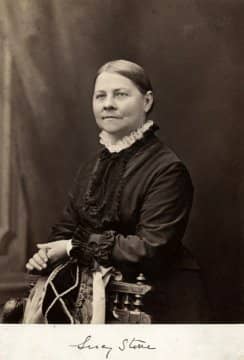
Too often the name Lucy Stone is overlooked in the history of the fight for women’s suffrage in the United States. But much is owed to this trailblazer, particularly in Massachusetts, for she achieved many firsts for women.

Born on August 13, 1818 to a farming family in West Brookfield, Stone was aware early on in life of the ways in which women were discriminated against. Although she was a brilliant and hardworking student, her desire to attend college was scoffed at by her traditional and domineering father. As she watched her older brothers earn a higher education (paid for by their father), 16-year-old Stone began teaching in the local schools, with the aim of saving enough to send herself to university. At the age of 25, she enrolled in Oberlin College—the first in the nation to accept both women and blacks. The latter was an attraction for Stone, who came from a family of ardent abolitionists. When she graduated four years later in 1847, she became the first woman from Massachusetts to earn a college degree.  

After Oberlin, she followed in the footsteps of abolitionist William Lloyd Garrison, her hero, and began lecturing for the American Anti-Slavery Society. As one of the earliest female lecturers, Stone was controversial. Not only was this brazen woman speaking in public to mixed audiences, she was debating the hot button issues of slavery and women’s rights. The profession was a dangerous one and she was sometimes the target of verbal and physical assaults. Still, Stone (who was tiny in stature) easily commanded her audiences with her quiet but imposing manner—qualities that made her a highly respected teacher by her pupils. She was so successful, in fact, that she soon was earning as much as or more than her male counterparts. 

In 1850, the first national women’s convention was held in Worcester, Massachusetts, due not in small part to Stone’s efforts and now well-known name. Although the 1848 Seneca Falls Convention is widely regarded as the beginning of the women’s movement, Stone considered the event in Worcester to be a greater milestone, as it was national rather than regional. 

She was still causing controversy eight years later when she refused to pay property taxes, citing the same reason as America’s founding fathers: no taxation without representation. Unable to vote and unrepresented in Congress, Stone and many other women around the country protested, knowing their properties would be impounded. 

In addition to her work as an abolitionist and suffragist, Stone is perhaps best known as the first woman to officially keep her maiden name after she married. Stone had never intended to take a husband’s name; indeed, she never expected to marry, preferring to dedicate her life to fighting for women’s rights. She particularly abhorred laws dictating that a woman’s property went to her husband. But in Henry Browne Blackwell she found an equal. At their wedding in 1855 the couple recited an oath of their own in addition to the traditional wedding vows: ”This act on our part implies no sanction of, nor promise of, voluntary obedience to such of the present laws of marriage as refuse to recognize the wife as an independent, rational being, while they confer upon the husband an injurious and unnatural superiority.” Blackwell supported the causes his wife fought for and helped her found Woman’s Journal, which printed speeches, debates, and columns on women’s suffrage. Run from its offices on Park Street in Boston, Woman’s Journal was the leading publication of the women’s movement. The nearby location allowed Stone and her daughter Alice to frequent the Boston Athenæum, where Alice in particular spent many hours. 

Woman’s Journal was also the official publication of the American Woman Suffrage Association (AWSA). Stone left the National Woman Suffrage Association, founded by Susan B. Anthony and Elizabeth Cady Stanton, after disagreements arose over the Fifteenth Amendment. True to her abolitionist upbringing, Stone supported the amendment while Anthony and Stanton opposed it, resentful that it excluded women. Relationships between Stone and the other leaders of the movement remained strained afterward and the women continued to disagree about tactics for getting women the vote. In 1890, Stone’s daughter, Alice Stone Blackwell, united the two organizations as the National American Woman Suffrage Association. Under NAWSA, Woman’s Journal became The Woman Citizen, but reclaimed its former name in 1927. Publication ceased in 1931.

Lucy Stone did not live to see women earn the vote. She died at the age of 75 on October 19, 1893. Her ashes rest in Forest Hills Cemetery in Jamaica Plain and, although she does not sit with her suffragist sisters in the Portrait Monument at the Library of Congress in Washington, D.C., her likeness can be found in the Commonwealth Avenue Mall where she is accompanied by fellow women and activists Phillis Wheatley and Abigail Adams.

Selected Works

Stone, Lucy. Friends and Sisters: Letters Between Lucy Stone and Antoinette Brown Blackwell, 1846–93 (Library of Congress HQ1413.S73 A4 1987)
Stone, Lucy. Loving Warriors: Selected Letters of Lucy Stone and Henry B. Blackwell, 1853 to 1893 (Library of Congress HQ1413.S73 A4 1981)
Woman’s Journal  (Rare Newspaper, Appointment required)

References

Lasser, Carol. American National Biography Online. http://www.anb.org/articles/15/15-00663.html 
“Lucy Stone (1818–1893).” Women’s History Museum. https://www.nwhm.org/education-resources/biography/biographies/lucy-stone/
McMillen, Sally G. Lucy Stone: An Unapologetic Life. Oxford University Press, 2015.

04.05.2016

Robert Allison

April 2016

By Alyssa True

Robert J. Allison says there are worse things to be considered than a Boston historian. Originally moving for college and for Boston’s favorable gender imbalance, he has spent over three decades here. Since obtaining his doctorate from Harvard in the history of American civilization in 1992 and while teaching college courses on the subject, Allison has written or edited several books about Boston and Massachusetts, as well as eighteenth-century American history. He is the president of the South Boston Historical Society, vice president of the Colonial Society of Massachusetts, a fellow of the Massachusetts Historical Society, and a member since 1993 of the Athenæum. About Boston he says, “The city is a fascinating place.” 

His almost 90 year old mother, however, still somewhat holds his vocation against him. In the acknowledgements of The American Revolution: A Concise History and The American Revolution: A Very Short Introduction, Allison writes that his mother “who hates history” took him to Morristown where a “quick glimpse of a white wig and a Continental uniform” inspired his drive for historical research. He explained that while the trip was purely for his entertainment, his mother did not hate history so much as she hated the way it was taught. “I think it really is a case of a time when you were supposed to memorize dates and memorize names,” he said.    

Allison’s career path took a detour when he dropped out of college in the 1970s after his older brother died. He had gone to University of Wisconsin-Madison to study history and get away from his parents, but started questioning the practicality of his major. He was working as a dishwasher and thought, “I can keep working as a dishwasher and get a degree in history and then probably still [be a dishwasher], or I could become a cook and not get a degree.” So he became a cook, working in hotels in New England and Florida before ending up in Phoenix. Summers are slow for Phoenix’s hotel business so he spent time in used book stores, looking for anything interesting. Allison found Bernard Bailyn’s Pamphlets of the American Revolution and his Ideological Origins of the American Revolution, and called the latter a “revolutionary” book for him. In his acknowledgements in The Crescent Obscured, he credits Bailyn and his book for setting him back on track: “From a second-hand copy of Ideological Origins of the American Revolution I learned that ideas matter, that what people think makes a difference, and I decided to finish college. On the day I bought that book, I became a student of history.” Allison later worked with Bailyn as a graduate assistant, which he considered “really a lesson in how you go about writing and how you go about researching.” 
  
Years of cooking did not directly benefit Allison’s writing except for being able to multitask and “reduce, reduce, reduce” something to a purer form: “You can do the same thing, perhaps, by putting more stuff in, but it is stronger if you get the flavor by taking out what is unnecessary.” Allison—whose titles often contain “concise,” “short,” and “very short”—never really enjoyed writing but enjoyed the challenge of putting something into as few words as possible. “People are busy,” he said. “People want to know the story, want to know what’s interesting about it.” He wrote in an email that he starts off with a question to answer and then spends time researching to “find out the stories, the people.” After writing it all down, it’s “rewrite and rewrite to put what you have written into a coherent form.” Allison is always aware that his work is not for his own enjoyment: “One also has to remember that someone is going to eat whatever you are dishing out. In writing or teaching, you do have to be conscious of your audience.”

Allison has taught at Suffolk University since 1992, where he is now the chair of history. He also teaches at Harvard Extension School and has created two online courses on colonial American history and the U.S. Constitution. At the Extension School, he won the Petra T. Shattuck Excellence in Teaching Award in 1997. Suffolk awarded him the Outstanding Faculty Award in 2007 and 2010 and its Student Government Association honored him with their Distinguished Faculty Award in 2006. Though he considers it misleading to “make the past into the present,” Allison tries to make students understand how issues in the 1770s are valid today: “There isn’t anything more important than understanding how government is structured and how we organize government because it has so many implications for us.”  

Allison understands the particular interest people have in the city where they live. His favorite thing about teaching in Boston is taking students to sites and telling them what happened. In his acknowledgments for Short History of Boston, he wrote about the interest even of his two sons: “I can only hope this book will help them better understand their hometown.” He also said his mother in New Jersey, who does not have colonial American ancestry, enjoys her “least favorite subject” when there’s a good story, like hymnal wadding at the Battle of Springfield:  “It’s something you learn to cherish in the place where you are, the stories of where you are.”

Allison’s Athenæum affiliation began after he tagged along on a special tour for Suffolk’s History Society given by retired English professor and Athenæum member Stanley M. Vogel. He enjoys the friendliness (“much friendlier than any other library”) and the quiet to do work: “It’s a great place to spend time with the great minds.” Allison credits the Athenæum, and especially Curator of Prints & Photographs Catharina Slautterback, in his books and says it’s a great place to look at pictures as well as research. “And it’s because you come here to the Boston Athenæum and you can really find such great images that are unexpected,” he said. He also said the “best comments” in his Short History of Boston and Short History of Cape Cod were about images that were nowhere else. But it isn’t all just research. Allison enjoys both classic and contemporary novels for fun and has read Trollope, Thackeray, and Richard Russo. He is also currently enjoying Decline and Fall of the Roman Empire. Of the many books he’s consumed at the Athenæum, he says: “I wouldn’t venture to guess a percentage, but it’s probably more fun than research.”

Selected Works

American Revolution: A Concise History (Library of Congress Classification E208.A425 2011)
American Revolution: A Very Short Introduction (Library of Congress E208.A425 2015)
Crescent Obscured: The United States and the Muslim World, 1776–​1815 (Library of Congress DT197.5.U6 A45 1995)
Revolutionary Sites of Greater Boston (Library of Congress F73.37.W454 2005)
Short History of Boston (Library of Congress F73.3.A45 2004)
Stephen Decatur: American Naval Hero, 1779–​1820 (Library of Congress CT275.D411 A44 2005)

03.31.2016

Staff Book Suggestions Spring 2016

Kristin Cook

Vita Nova by Louise Glück
(Library of Congress PS3557.L8 V58 1999​)

Spring and autumn are my favourite times for poetry, and last fall I fell in love with poet Lousie Glück, who makes her home in Cambridge. In mid-April I read Vita Nova in one sitting, a collection of poems about spring, about death and rebirth, about starting over. Although the ostensible subject matter of the collection is the aftermath of a broken marriage, Vita Nova is replete with symbols drawn from classical mythology. As a historian and art historian, I find these themes in her work a hearkening back to oral tradition, to the foundations of poetry. In the New York Times Book Review it was once written that “no American poet writes better than Louise Glück[;] perhaps none can lead us so deeply into our own nature.” This exploration of the human condition has led critics to consider Glück’s work to be “bleak” or “dark,” but I find her work wholly uplifting, perhaps because of what poetryfoundation.org calls her poetry’s “dreamlike quality that at the same time deals with the realities of passionate and emotional subject.” If you wish to explore her work, the Athenæum holds many of her publications, as well as a volume of her collected works.

Adriene Galindo

Notes From a Small Island by Bill Bryson
(Library of Congress DA566.4 .B79 1996​)

If you’ve visited Great Britain before, many of Bryson’s anecdotes will sound all too familiar. I enjoyed being virtually transported back to one of my favorite places on the planet and being reminded of its lovable quirks. If you’ve never been to England, Wales, or Scotland, this book is a fun, quick read introducing you to the charming people and places you’ll find there. Notes From a Small Island is Bryson’s final tour of Britain before returning to America after living 20 years as an expat. By the end of the book, you and Bill will wonder together why on earth he would want to leave such a lovely place.​ Flaubert’s verdant pastures and dusty roads of provincial France come alive, as does Madame’s hunger for the good life and fiery passions. A Gallic workout for the senses.

James Kraus
Submission by Michel Houellebecq; translated from French by Lorin Stein
(Library of Congress NEW PZ4.H8334 Su 2015​)

Released in its English translation in late 2015, Submission, Michel Houellebecq’s (pronounced: well-beck) fourth novel, put the author into a near Rushdie-like exile after the book rankled Muslim extremists due its portrayal of the of the New Islamic Party candidate’s election to French President and the consequent induction of Islamic Law. Houellebecq’s caricature “graced” the cover of the January 7, 2015 lampooning tabloid Charlie Hebdo​. That morning two Islamic gunmen shot and killed twelve Hebdo staff members and sparked the international Je Suis Charile movement.

The Islamic President’s election is a minor portion in a brief book, much like the controversial references to Mohammed in Rushdie’s Satanic Verses. Through its main character and narrator François—​the bored, depressive, self-indulgent Sorbonne University Professor and J. K. Huysman expert—Submission questions how we all submit on a daily basis, and how true submission is an act of devotion in a society awash in manipulation, politicking and instantaneous impulse gratification.

Judith Maas
The Man That Got Away: The Life and Songs of Harold Arlen by Walter Rimler
(Library of Congress NEW CT275.A75 R55 2015​)

Harold Arlen’s music has always been better known than his name. A sampling of his songs shows that he deserves much better: “Over the Rainbow,” “Get Happy,” “The Man That Got Away,” “Blues in the Night,” “One for My Baby,” “World on a String,” “Stormy Weather,” “Come Rain or Come Shine,” “Last Night When We Were Young.” Songwriters across generations, from Irving Berlin to Paul McCartney, have admired his work.

Arlen (1905–1986) grew up in Buffalo, the son of a cantor, and drew upon memories of his father’s music when writing his songs. Largely self-taught, he started out as a singer, pianist, arranger, and bandleader, before finding his calling as a composer, pretty much by accident—he came up with the melody of “Get Happy” in 1929 to pass the time during a gig as a rehearsal pianist. Over a long career, he worked in vaudeville houses and nightclubs, on Broadway, and in Hollywood, and collaborated with such great lyricists as Johnny Mercer, E. Y. Harburg, and Ira Gershwin. 

Reading this biography, I especially enjoyed learning about Arlen’s working methods, the genesis of many of the songs, the ups and downs of the music business, and what qualities makes an Arlen song an Arlen song.

Kaelin Rasmussen
The Crime of Sylvestre Bonnard by Anatole France; translated by A. W. Evans​
(Cutter Classification VFG .F84 .c)

When I first learned that this nineteenth century novel’s protagonist is a scholarly bibliophile, even a bibliomaniac, I expected to enjoy the book. When I read the first page or so and found that M. Bonnard, that respected antiquarian and member of the Institute, enjoys sitting in his library browsing catalogues of medieval manuscripts and confiding in his haughty feline companion, I knew I had found a new favorite. The story follows Bonnard’s pursuit of an obscure and elusive manuscript, mostly disengaged with the characters he encounters along the way. A chance act of kindness, however, helps him find people who mean as much to him (or almost, anyway!) as his beloved books.

Arnold Serapilio
Never Let Me Go by Kazuo Ishiguro
(Library of Congress PZ4.I78 Ne 2005)

I’m well behind the eight ball on this one, but for the seven people left who haven’t already read Ishiguro’s Never Let Me Go, now’s as good a time as any. His wistful, understated prose is suffused with melancholy, making this an odd choice for a spring read, since we usually associate spring with rejuvenation and joy. Well, maybe it was just the flowers and trees blooming and sunlight settling in, but I found this story—which charts the dynamics between three friends from school, their fears and hopes and failings and love for each other—quietly uplifting. That may sound like faint praise, but it was just the reminder I needed that life goes on even if you let go.

Alyssa True
My Grandfather Would Have Shot Me: A Black Woman Discovers Her Nazi Past by Jennifer Teege and Nikola Sellmair
((Library of Congress NEW CT1098.T43 A3 2015​)

I personally recommended the Athenæum acquire this book after I read it in 2015. The author, Jennifer Teege, was in her forties when she realized her birth mother was the youngest daughter of Amon Goeth, a notorious Nazi commandant made famous to another generation by Ralph Fiennes’s portrayal in Schindler’s List. Teege, who studied Hebrew in Israel and whose birth father is Nigerian, struggled to reconcile the heinousness in her heritage. The book splits its narration between Teege and journalist Nikola Sellmair. This was the first book in a while I read even when I could have done anything else.

Mary Warnement

Germany: Memories of a Nation by Neil MacGregor

(Library of Congress DD17 .M33 2014)

I have taken my time to read this encylopædic-like tome by Neil MacGregor, recently retired director of the British Museum, who based this book on his BBC Radio 4 show and accompanying exhibition at the British Museum. The premise will be familiar to those who have enjoyed recent books exploring history through a discrete set of objects (In fact, the MacGregor and the British Museum started the trend with A History of the World in 100 Objects). Each chapter uses one object as a starting-point, and because this coincided with a BM exhibition, that item is usually held by the BM; however, the conversation leads to other objects held in Germany and elsewhere. The radio program featured input from experts at other institutions, and even reading the text, you feel as though you are part of a conversation. The objects range from paintings by Holbein that one only sees in museums to lowly Notgeld which can be purchased by anyone for a couple dollars. If you have any interest in German history, I highly recommend this engaging book. I recommend reading one chapter before dinner; especially if you are having sausage (see chapter 10).

02.24.2016

Gamaliel Bradford

March 2016

By Alyssa True

Gamaliel Bradford (1863–1932), the fourth of this name, was a prolific author and biographer. Since childhood, he dreamed of being a writer, but failed to thrive until he switched from fiction to biography. In the April 27, 1932, issue of the Nation, he’s quoted thusly: “I should prefer to write great novels, but we do what we can, not what we should like.”

Charles Knowles Bolton, long-time librarian of the Athenæum, memorialized Bradford for the Massachusetts Historical Society in 1933 and expounded on the latter’s enjoyment of the Athenæum’s “warmly human influence.” Recorded in volume 65 of their Proceedings, Bolton said Bradford, just as his father before him, sent a “barrel of apples to the staff” every year at Christmas.

Bradford, according to Bolton, mentioned the Athenæum in his book Quick and the Dead. Bolton also said that Bradford researched his biographies at the Athenæum: “He always favored the purchase of source material for the study of character, and it did not matter if the ideals of people so pictured were utterly at variance with his own. In his sonnet to Sainte-Beuve he referred with approval to him who could
‘pray with saints yet press the sinner’s hand.’”

But Bradford also used the collections for his own enjoyment. A fan of detective novels, Bradford once said, “There is nothing so soothing as murder.” Bolton recounted an interaction between Bradford and a trustee:

E.M.P.: Here is a book for Mr. Bradford. It is called Murder for Profit.
G.B.: No. I prefer Murder for Pleasure.

Selected Works

As God Made Them: Portraits of Some Nineteenth-century Americans
Cutter Classification 65 .9°B72 .a 

Biography and the Human Heart
Cutter 65 .9°B72 .b 

Damaged Souls
Cutter 65 .9°B72 .d 

Darwin
Cutter 5E .D255 .br 

D. L. Moody: A Worker in Souls
Cutter 65 .M771 .b 

Elizabethan Women
Cutter 7BE6 .B728 

Lee the American
Cutter 65 .L516 .bq 

The Letters of Gamaliel Bradford, 1918–1931
Cutter VE5 .B724 .b 

Pageant of Life [poems]
Cutter VEP .B722 

Portraits of American Women
Cutter 65 .9WB72 .2 

The Quick and the Dead
Cutter 5 .B729 .q 

Saints and Sinners
Cutter 5 .B729 .s 

Unmade in Heaven: A Play in Four Acts
Cutter VED .B723