
01.05.2017

Trains

Picture Books

Two White Rabbits by Jairo Buitrago; pictures by Rafael Yockteng; translated by Elisa Amado

(Children Picture Book BUITR)

“In this moving and timely story, a young child describes what it is like to be a migrant as she and her father travel north toward the US border. They travel mostly on the roof of a train known as The Beast, but the little girl doesn’t know where they are going. She counts the animals by the road, the clouds in the sky, the stars. Sometimes she sees soldiers. She sleeps, dreaming that she is always on the move, although sometimes they are forced to stop and her father has to earn more money before they can continue their journey. As many thousands of people, especially children, in Mexico and Central America continue to make the arduous journey to the US border in search of a better life, this is an important book that shows a young migrant’s perspective.” — Provided by publisher.

How to Train a Train by Jason Carter Eaton; illustrated by John Rocco

(Children Picture Book Lg EATON)

A whimsical guide to training a “pet train” instructs young enthusiasts about important issues including where trains live, what they like to eat, and how to get them to perform the best train tricks.

Locomotive by Brian Floca

(Children Picture Book Lg FLOCA)

Learn what it was like to travel on the transcontinental railroad in the 1860s.

New Baby Train by Woody Guthrie; illustrated by Marla Frazee

(Children Picture Book +GUTHR)

An illustrated version of the song that answers the question “Where do little babies really come from?”

The Cows Are Going to Paris by David Kirby and Allen Woodman; illustrated by Chris Demarest

(Children Picture Book KIRBY)

One day a herd of cows leaves the pasture and boards the train for Paris. The cows dress up in clothes and royally tour the city before returning home.

The Little Train by Lois Lenski

(Children Picture Book LENSK)

Engineer Small at the throttle takes the little train on its run from Tiny Town to the big city.

A Train Goes Clickety Clack by Jonathan London; illustrated by Denise Roche

(Children Picture Book LONDO)

Easy-to-read, rhyming text describes the sounds of, and uses for, different kinds of trains.

All Aboard the Dinotrain by Deb Lund; Illustrated by Howard Fine

(Children Picture Book + LUND)

When dinosaurs seek adventure by taking a train ride, they find the trip has some unexpected surprises along the way.

Mister Whistler by Margaret Mahy; illustrated by Gavin Bishop

(Children Picture Book + MAHY)

Mister Whistler always has a song in his head and a dance in his legs. But when he has to catch the train, he is so distracted he loses his ticket—and has to dance his way out of his clothes to find it!

The Little Engine that Could by Watty Piper; with new art by Loren Long

(Children Picture Book Lg PIPER)

Although she is not very big, the Little Blue Engine agrees to try to pull a stranded train full of toys over the mountain.

Tupelo Rides the Rails by Melissa Sweet

(Children Picture Book SWEET)

After being left by the side of a road with nothing but her favorite sock toy, Tupelo meets a pack of dogs led by Garbage Pail Tex as they are wishing for new homes, then joins them as they catch a passing train and share stories of dog heroes.

The Polar Express by Chris Van Allsburg

(Children Picture Book VANAL)

A magical train ride on Christmas Eve takes a boy to the North Pole to receive a special gift from Santa Claus.

Can You See What I See? : Toyland Express by Walter Wick

(Children Picture Book + WICK)

In this search-and-find story, children read the simple text and use the picture clues to search twelve photos for 100 hidden objects!

An Outlaw Thanksgiving by Emily Arnold McCully

(Children PZ7.M136 Ou 1998)

While travelling with her mother cross-country by train in 1896, a young girl unexpectedly shares Thanksgiving dinner with the notorious outlaw, Butch Cassidy.

John Henry by Julius Lester; illustrated by Jerry Pinkney

(Children + PZ8.1.L434 Jo 1994)

Retells the life of the legendary African American hero who raced against a steam drill to cut through a mountain.

Beginning Reader

Mr. Putter and Tabby Take the Train by Cynthia Rylant; illustrated by Arthur Howard

(Children Picture Book RYLAN)

After a small setback, Mr. Putter and his favorite companions enjoy the best train ride of their lives.

Chapter Books

Five Go Off to Camp by Enid Blyton

(Children PZ7.B629 Fgo 2015)

Spook trains in the dead of night. And they seem to vanish into thin air—but where do they go? The Famous Five are on to it. But the discovery of an unusual underground tunnel system and a secret train-service has them puzzled. If they follow the tracks, will they solve the mystery?

The Boundless by Kenneth Opel

(Children PZ7.O614 Bo 2014)

Aboard “The Boundless,” the greatest train ever built, on its maiden voyage across Canada, teenaged Will enlists the aid of a traveling circus to save the train from villains.

The Invention of Hugo Cabret by Brian Selznick

(Children PZ7.S4654 Inv 2007)

When twelve-year-old Hugo, an orphan living and repairing clocks within the walls of a Paris train station in 1931, meets a mysterious toyseller and his goddaughter, his undercover life and his biggest secret are jeopardized.

Young Adult

As Easy as Falling Off the Face of the Earth by Lynne Rae Perkins

(Young Adult PZ7.P4313 As 2010)

A teenaged boy encounters one comedic calamity after another when his train strands him in the middle of nowhere, and everything comes down to luck.

Informational Texts

The Train of States by Peter Sis

(Children + E180 .S58 2004)

Gives information about each state, including capital, motto, state tree, state bird, source of name, and date of statehood.

Subway: The Story of Tunnels, Tubes, and Tracks by Larry Dane Brimner; illustrated by Neil Waldman

(Children + TF845 .B685 2004)

Underground railways, or subways, are an engineering marvel. But why were they built? How? Here is a high-speed tour of early subways from London to New York City to answer those questions and more.

Beneath the Streets of Boston: Building America’s First Subway by Joe McKendry

(Children + TF847.B7 M38 2005)

“Beckoning readers to explore the territory beneath Boston’s streets, Joe McKendry explores a century-old world when Beantown designed and created the country’s first subway.” — Provided by publisher.

The Secret Subway by Shana Corey; illustrated by Red Nose Studio

(Children + TF847.N5 C66 2016)

“In 1870, Alfred Ely Beach invents New York’s first underground train.” — Provided by publisher.

We Rode the Orphan Trains by Andrea Warren

(Children HV985 .W39 2001)

“They were ‘throw away’ kids, living in the streets or in orphanages and foster homes. Then Charles Loring Brace, a young minister working with the poor in New York City, started the Children’s Aid Society and devised a plan to give homeless children a chance to find families to call their own. Thus began an extraordinary migration of American children. Between 1854 and 1929, an estimated 200,000 children, mostly from New York and other cities of the eastern United States, ventured forth to other states on a journey of hope.” — Provided by publisher.

Across America on an Emigrant Train by Jim Murphy

(Children PR5495 .M79 1993)

Combines an account of Robert Louis Stevenson’s experiences as he traveled from New York to California by train in 1879 and a description of the building and operation of railroads in nineteenth-century America.

12.12.2016

Edward Rowe Snow

January 2017

By Nicole Critchley

Edward Rowe Snow is best remembered as a New England maritime historian and a Flying Santa. A proprietor of the Boston Athenæum and Massachusetts native, Snow was born in 1902. He graduated high school at the age of 16 and for the next decade traveled the world working on oil tankers, sailing ships, and also as a Hollywood extra. He entered Harvard in 1929, graduated in three years by attending summer sessions in 1932, the year he married Anna-Myrle Haegg. He was a history high school teacher in Winthrop but left to write and lecture full time. He wrote for the Patriot Ledger in Quincy from 1957 until 1982, lectured, and made several radio and TV interviews (some of which can be found on YouTube). During the war, Snow was a member of the US Air Force, Twelfth Bomber Command. He was wounded in 1942 over North Africa and discharged in 1943 because of those wounds.

A descendant of sea captains and an avid explorer, Snow found shipwrecks, coins, and other artifacts on his boating trips around Boston Harbor. He defined island as “a body of land surrounded by adventure” in Secrets of the North Atlantic Islands and worked hard to preserve Massachusetts’s islands. An example is Georges Island: when Logan Airport wanted to extend on runway that would harm Fort Warren, Snow fought to save it and it is now in the state’s park system.

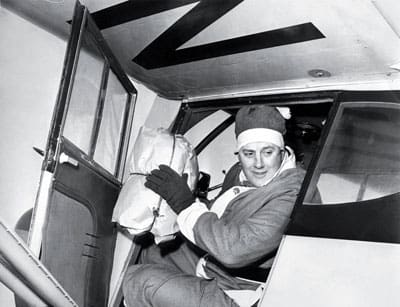
During his brief tenure teaching, one of his students got him involved with his father, Captain William Wincapaw, who had started dropping Christmas gifts to remote islands in 1929. In 1936 Snow joined him. Snow was the perfect choice of volunteer because of his hobby taking aerial photos of lighthouses. Snow delivered presents and goods (donated by sponsors and himself alike) up and down the New England coast, even expanding the flights to lighthouses on the Great Lakes and Bermuda Islands. In 1947, he visited 176 lighthouses. Beside a brief hiatus during the war, Snow would not give up the Santa suit until 1981. 

While at the Athenæum, Snow researched and wrote many books on maritime New England history, including subjects such as the islands of Boston Harbor and surrounding sea, lighthouses, shipwrecks, nautical figures, sailing, forts, and sea tales. He also wrote about pirates and their treasures, stories about ghosts, and folktales about New England. He told the Boston Globe, “What I really like to do is to find a story so improbable that no one will believe it, and then prove beyond a doubt that it is true. I do think that folklore is important and that it should be preserved.” Thirty of his books are at the Athenæum. On the open shelf are The Romance of Boston Bay (1944), Women of the Sea (1962), True Tales of Pirates and Their Gold (1953), Great Sea Rescues and Tales of Survival (1958), and Boston Bay Mysteries and Other Tales (1977). His first published work, Castle Island, Its 300 Years of History and Romance (1935), is held in Special Collections and can be viewed by appointment.

Snow dressed for santa

Edward Rowe Snow, photo courtesy of Dolly Bicknell.

In researching his second book, The Island of Boston Harbor: Their History and Romance 1626–​1935 (1935), based on his college thesis, he used and referenced many of the Athenæum’s resources. Some of these included A History of East Boston by William Sumner, The History of New England from 1630 to 1649 by John Winthrop, First Governour of the Colony of the Massachusetts Bay, A Topographical and Historical Description of Boston by Nathaniel B. Shurtleff, A Valedictory Poem by Frederick W.A.S. Brown, Prison Life by John M. Brewer, Notes on the Sea-Shore by James Lloyd Homer, The Pirates of the New England Coast, 1630–1730 by George Francis Dow, and Recollections of Alexander H. Stephens. He probably also took advantage of the Athenæum’s periodical collection; he references articles from The BostonianBoston Post, and the Boston Globe in this book as well. 

Snow passed away on April 10, 1982 at the age of 79. He was buried near the sea he loved. There is also a children’s book in our collection based on Snow’s Christmas flights.Selected Works

The Lighthouse Santa (Children Picture Book + HUNTE)
Boston Bay Mysteries and Other Tales (Cutter Classification 964 .Sn644 .b)
Great Sea Rescues and Tales of Survival (Cutter RX .Sn64 .gre)
The Island of Boston Harbor: Their History and Romance 1626–1935 (Cutter 964B6⁰H .Sn62 .is)
Secrets of the North Atlantic Islands (Cutter B3S .Sn783se)
True Tales of Pirates and Their Gold (Cutter RQ .Sn61 .tr)
Women of the Sea (Cutter RX .Sn64 .w)
Great Sea Rescues and Tales of Survival (Cutter RX .Sn64 .gre)References

“Edward Rowe Snow.” Contemporary Authors Online. Biography in Context, Gale, 2003. libraries.state.ma.us/login?gwurl=http://ic.galegroup.com/ic/bic1/BiographiesDetailsPage/BiographiesDetailsWindow?disableHighlighting=false&displayGroupName=Biographies&currPage=&scanId=&query=&prodId=BIC1&search_within_results=&p=BIC1&mode=view&catId=&limiter=&display-query=&displayGroups=&contentModules=&action=e&sortBy=&documentId=GALE%7CH1000092989&windowstate=normal&activityType=&failOverType=&commentary=&source=Bookmark&u=mlin_b_simmcol&jsid=c0f82ae6b697ebce93bb5ca6ae713dbb. 

Hunter, Sara Hoagland. “Edward Rowe Snow Brief life of a “Flying Santa”: 1902-1982.” Harvard Magazine, January-Feburary 2012. http://harvardmagazine.com/2012/01/vita-edward-rowe-snow

Quill Ed. “Author Edward R. Snow is Buried Near Sea He Loved and Wrote About.” Boston Globe, [Boston, Mass] 14 Apr 1982: 1. 

Riley, John Wm. “Edward Rowe Snow, 79, Lecturer, Sea Author, Flying Santa Claus’.” Boston Globe, [Boston, Mass] 11 Apr 1982: 1.

Tague, Brian. “The Origins and History of the Flying Santa.” Friends of Flying Santa. 2016. http://www.flyingsanta.com/HistoryOrigins.html

Theroux, Joseph P. “Flying Santa: Edward Rowe Snow and the Romance of History.” Historic Nantucket. 2008. http://www.nha.org/pdfs/hn/HistoricNan-Winter2008.pdf

12.01.2016

Staff Book Suggestions Winter 2017

Hanna Bertoldi

A Revolution in Color: The World of John Singleton Copley by Jane Kamensky
(Library of Congress Classification, in Acquisitions​​)

This is a thoroughly researched book about the life and works of painter John Singleton Copley. With the American Revolution as the backdrop, the reader follows Copley as he struggles to assimilate to London’s elite society while never giving up his Boston roots. Read the book before Kamensky’s talk on February 27th!

Kristin Cook

Trouble with Trolls by Jan Brett​
(Children Picture Book + BRETT​)

Trouble with Trolls may be a children’s picture book, but I revisit it once every winter on a snowy day, much like the one when young Treva decides to take her skis up a nearby mountain with her dog in tow. There, tricky trolls accost her, trying to steal her dog, and Treva must use all her wits to outsmart them! A sweet, short adventure story by noted illustrator Jan Brett, author of The MittenTrouble with Trolls includes an ongoing story in the margins of a little hedgehog family. See if you or your little ones can tell what they are up to as you turn the pages!

Emily Cure

“Titanic” Disaster: Hearings before the Committee on Commerce, United States Senate, 1912
(Library of Congress VK1255 .T6 1912b)

There’s a reason why traffic slows after a car crash; it is human nature to indulge in a calamity, to be fascinated by events so horrific that they seem to exist in a universe separate from our own. James Cameron’s (misleading but captivating) 1997 film Titanic resuscitated our interest in the ill-fated ship; unbeknownst to most, there exists an even more gratifying record of the disaster.

“Titanic” Disaster: Hearings is the US government’s official investigation into the causes leading to the wreck of the RMS Titanic. Its inconspicuous raw umber binding holds the testimonies of nearly 90 survivors and “witnesses,” recorded verbatim and within a week of the sinking. Read through the torturous hearing of the infamous J. Bruce Ismay, and the vivid accounts from passengers of every class. Not to be missed: one particularly illuminating testimony from historian Archibald Gracie, and the heart-wrenching affidavits made by the widows of some of the world’s most eminent men. “Titanic” will not offer you any warmth this winter, but its chilling record of one of the most enigmatic disasters in world history will certainly add some devilish excitement to this otherwise bleak time of year.

Adriene Galindo
Homegoing by Yaa Gyasi
(Library of Congress NEW PZ4.G9982 Ho 2016​)

Homegoing traces the journey of a family over several generations, beginning with two sisters fated to two very different destinies. Beginning in the eighteenth century of what is now Ghana, the novel opens with Effia, who marries a white Englishman, and Essia, who is sold into slavery. The consequences of these events are felt deeply by the sisters’ descendants over the next 200 years in the form of colonialism and warfare, slavery and Jim Crow. Every character must overcome the struggles of their forebears in addition to their own. In Homegoing, Yaa Gyasi paints a personable portrait of family, race, legacy, and destiny. I was astounded by both the emotional and intellectual impact this book had on me. More than anything, it has reminded me that it is essential to revisit and understand our past in order to comprehend and engage with the present. Highly recommended reading for all, and School Library Journal predicts Homegoing will one day be required reading for teens.

Judith Maas
A Girl in Winter by Philip Larkin
(Library of Congress PZ4.L328 Gi)

A Girl in Winter (1947), the second of two novels by English poet Philip Larkin, takes place in an unnamed English city during World War II and portrays a day in the life of Katherine Lind, a European refugee. A flashback in the middle of the novel recounts a summer that Katherine spent in Oxfordshire before the war.

The opening chapter, describing a bleak winter morning, perfectly sets the mood. Katherine lives alone and works, unhappily, as a library assistant. From a series of mundane events in her day—the toothache of a co-worker, a missing pocketbook, the arrival of a letter, awkward conversations—Larkin writes movingly of exile, isolation, and loneliness. His calling as a poet is clear in the great care he takes in detailing ordinary, everyday scenes, whether city streets, drab flats and offices, or a countryside village on a quiet summer day.

Elizabeth O’Meara
Bury Your Dead by Louise Penny
(Library of Congress PZ4.P4275 Bu 2010​)

A perfect winter read, this sixth book in the wonderful Inspector Gamache series by Louise Penny takes place in old Quebec City during Winter Carnival. Gamache is on leave from an investigation that has gone awry and is spending his time reading at the library of the Literary and Historical Society. While in Quebec City, Gamache becomes involved with an historical mystery involving Samuel de Champlain. A fascinating tale along with a wonderful sense of place. After reading this you’ll want to visit Quebec City in the middle of winter and stay at the Chateau Frontenac! For an additional treat, listen to Ralph Cosham’s reading of the book.

Kaelin Rasmussen

The Black Tulip by Alexandre Dumas

(Cutter Classification VFG .D89 .bl)

I like to get through the winter by thinking of spring. And what says spring like tulips, right? This historical novel by Dumas (the elder) takes place in the Netherlands in the 1670s against a backdrop of real-life political unrest and cut-throat gardening. At the height of the Dutch tulip mania, the price of tulip bulbs soared, and wealthy gentlemen poured fortunes into the cultivation of these delicate flowers in ever more fantastic colors and varieties. The Black Tulip follows young Cornelius van Baerle as he sets out to win a contest that will award 100,000 gold florins to the man who can produce the perfect black tulip. His jealous neighbor’s machinations and his own unhappy political connections land Cornelius in prison, but he is undeterred. Not even the prison guard’s lovely daughter Rosa who comes to his aid can distract Cornelius from his passion for the elusive black bloom. Classic swashbuckling romance paired with unlikely dark humor, a perfect winter distraction.

Arnold Serapilio

Memento Mori​ by Muriel Spark

(Library of Congress PZ4.S735 Me)

“Remember you must die” is what the title translates to and what a mysterious caller continually reminds the characters throughout Spark’s slyly satirical masterpiece. Really, you can’t go wrong with any Spark in any season, but Mori feels especially appropriate now, what with winter signifying death and decay and everything. Pleasant dreams!

Mary Warnement

Dictator by Robert Harris

(Library of Congress PZ4.H3157 Di 2015)

Those of you reading Harris’s excellent series on ancient Rome seen through the eyes of Cicero in an imagined biography by his long-term secretary/slave/companion Tiro may have missed the appearance of the last in the trilogy, long delayed. It was worth the ten year wait between Imperium and Dictator. I had feared that the final segment had been deemed unworthy by author or publisher and therefore held back. Every time another book appeared by him, I felt frustration. When one book got movie treatment, I cursed Hollywood for distracting a favorite author. I can’t be too critical; I waited a few months after the book’s appearance to read it and then a couple more months before recommending. The silver lining: it is no longer a 14-day book. You have two months to savor Harris’s immersion in the final years of both Cicero and the Roman Republic.

11.28.2016

Katherine Dimancescu

December 2016

Interview by Emily Levine

I recently sat down with local historian and Boston Athenæum member Katherine Dimancescu to discuss New England history writing, research, and preservation. Ms. Dimancescu elaborates on the search for her seventeenth-century maternal ancestors whom she brings to life for a modern-day audience in her books The Forgotten Chapters: My Journey into the Past and Denizens: A Narrative of Captain George Denison and his New England Contemporaries.

Q: I understand you are originally from Concord?

A: I grew up in Lincoln, not far from Concord, a very small, historic agricultural community with roots going right back to the seventeenth century. That’s where I grew up, and all of my roots are Mass Bay Colony. My mom was born and raised in Dayton, Ohio, and my dad was born and raised overseas. Before my parents decided to stay here in the 70s, our family hadn’t lived here since the 16 or 1700s, so we are returning to our roots, literally, by settling here in the East.

Q: And you also lived abroad for a little while?

A: Yes, in England, and I thought I was going to go back. I have a master in European studies from The University of Westminster, London and a second master in the history of international relations from The London School of Economics and Political Science. I truly thought when I came back to the US from graduate school that I would spend one year living here and then would be out of here to live abroad, but that did not pan out. I love England and I loved living in London. Anyways, I came home, and got a job as a managing editor. 

Q: Where? 

A: For a small company where I live in West Concord that no longer exists. I was working as a managing editor for an international newsletter. I got to handle the work for the former Soviet Union, countries like Azerbaijan, Georgia, Moldova, and I was responsible for putting together a monthly newsletter. It proved a challenge because a lot of those countries are and were going through very tumultuous times; you’re asking people to supply materials for a newsletter but they have far more diabolical things going on. It was never a dull moment. It was basically, ‘Excuse me, I know you have to evacuate, but can I have a moment of your time?’ I did both that kind of work and also produced the company’s reports. Both tasks totally called upon everything I had learned with my international relations degree. I loved it, I really did. And when the company was sold to Thomson Reuters I could have stayed, but I decided to switch gears. 

Q: Is that when you decided to turn to history?

A: Yes. When I was 14, I went to see an ancestor’s home in Connecticut. I didn’t even know that we had an ancestral home in Connecticut up until that point. This was a private residence, the first part built around 1725 at the very end of First Period architecture. I was 14 and was in eighth grade, and my dad and I decided to pay a visit. We were amazed to find that the house was still standing, happily occupied by an older couple who bought it in the 50s. This was 1995 and there were no cell phones so we gave no warning, we just pulled up and said ‘Hi, my ancestors lived here.’ I walked into the house and I tell you, it was one of those moments that you know you are going to do something. It was a light bulb moment: ‘This is it,’ I thought, ‘I know that I am going to write a book. I am going to write this book about my family heritage. I know it’s going to be a while, but I am going to write this book.’ So in 2009, when I switched gears from being a managing editor to an author, I knew I was going to write about my ancestors in Connecticut. So that’s what got the ball rolling for what became The Forgotten Chapters, my first book. 

Q: Had you undertaken any primary source research related to your family prior to that?

A: Yes, yes I had bits and pieces. My great grandmother had joined the Daughters of the American Revolution in 1923, so I had a very basic genealogy going back to our patriot ancestors who fought in the American Revolution. My starting point was the research my great grandmother did, and then I built upon that. I went to places like the Connecticut Historical Society and to the Connecticut State Library in Hartford, but some of the best things I found were in smaller local historical societies. The local societies were sometimes teeny tiny rooms usually in a library, and many act as repositories for generations of people and their subsequent materials. Local historical societies have been phenomenal for my purposes. They usually just give you a box and say ‘This is what we have for this particular family name, have at it.’ These local materials opened so many doors for me, including the fact that my ancestors owned slaves. I had no idea that my family owned slaves. They were just farmers in Connecticut, and the fact that my ancestors had slaves never came up in my family narrative. When I went to the Connecticut State Library, I saw ancestral wills with values assigned to slaves giving them to their children when people pass away. Actually, according to a family account at the historical society, my ancestors were buried near their slaves in the same burial ground but then later generations removed the slaves and buried them elsewhere in an unknown location. That was a lot for me to take in, and more than a little disturbing. You can’t deny the fact that your ancestors owned slaves when the evidence is that black and white. That took a lot to come to terms with. Here in the Northeast we say that slavery was a southern problem. We don’t really talk about slavery as much, but in this day and age it has become more commonplace. 

Q: Have you had any follow-up from these discoveries in order to contextualize past slavery in the twenty-first century? 

A: The huge blessing of all of this is that I have been able to meet descendants of people who were owned by my ancestors, and there is no animosity from them. They just say, ‘It was what it was, and we aren’t judging you.’ That, to me, has been incredible. To have a dialogue with them and hear their stories has been remarkable. I get to learn about my ancestors through the stories of their slaves, which is not something that I ever expected. 

Q: I understand your first book is a family history, so is your second book an extension of that? 

A: At its inception, my second book Denizens was going to be very historical. I loved that The Forgotten Chapters became very personal, but I wanted Denizens to be the exact opposite and be very historical. My ancestor George Denison is right up there with the ancestors that I think about the most. He is an amazing guy—he fought in King Philip’s War and the English Civil War, dealt with all sorts of land settlements—he is amazing. Anyway, it is 1631 and George, his parents, and two of his brothers settle in Roxbury​ when the Massachusetts Bay Colony is brand new. Who George later becomes is a product of what he is seeing and doing in Roxbury. What had not been done to date was a work about George’s life in Roxbury, with his family and his brothers. I really wanted to focus in on George’s Roxbury years and initially that is what Denizens was going to be: the making of George Denison the man. Over time as I began writing, Denizens broadened to become a story of my larger family roots in Roxbury through the lens of George’s story. Denizens then quickly went from being George’s book, which I had intended it to be, to the story of something far greater, larger, and interesting. I should have a shirt that says ‘Made in Roxbury’ because basically most of my family roots here in New England come out of Roxbury. In Denizens, I ask people to care about ancestors who are not their own. It has taken a little while to synthesize all of the material into one cohesive unit, which is why the book is taking a little longer than I had initially planned, but it’s really coming together into a cohesive narrative.

Q: Denizens sounds like a departure from your first book, as far as perspective is concerned? 

A: It’s funny, both of my books are very different. They are both my babies and they’re a reflection of me, but they each have their own little unique personality. It’s amazing when they go out into the world because the reactions from readers are just across the board. 

Q: When you are doing research and starting a book, when do you stop research and start writing?

A: That’s the hardest thing! It is really hard to call time on research. That’s where editors come in! I have worked with a couple of pretty amazing editors. As a writer, working with a great editor is key; they let you know when you get carried away and help you not get bogged down by minutiae you might find fascinating that others might not. The largest challenge of Denizens has been keeping it under 400 pages. That being said, there will be a third book because there is so much that I just couldn’t cover in this one, so we have not seen the last of George Denison and these people of Roxbury! The editor I am working with now is based in England. She helps me focus on what material is interesting from an English perspective. Another reason why Denizens is taking its time in being published is that I am making it bigger and better for both UK and US audiences. I did not do that with The Forgotten Chapters; the language is very different in Denizens because I am approaching an English audience from an American perspective. 

Q: Where did you find the covers for your books?

A: The map on the cover of The Forgotten Chapters is from the Boston Public Library, a map of the New England coastline ca. 1675. I got special permission from the BPL to use it, and that just made the book come to life. The cover image for Denizens, which is on the website, is a depiction of the Battle of Marston Moor where we know that George Denison fought. We know he was there, and he survived. I received permission to use the image from Bridgeman Images, but it was definitely a very formal procedure. 

Q: I love your blog—it seems you go to a lot of different local places to make living history really accessible to a large audience.

A: Yes, that’s about right. My feeling is that people are not going to preserve history unless they see what they are preserving. Unless they experience it and enjoy it. I do not necessarily think history has to be your own to motivate people to want to save it. I encourage people to go to places like burial grounds and house museums because that’s where history comes alive. Yes, you can read a book, but it is not the same as going to see where the history actually happened. That’s my goal with the blog: to help people explore their own family roots, but also to save history. I realize that not everyone wants to spend money on museum admissions, so I do my best to find places that maybe you can just walk around, or go to a park and have a picnic; it doesn’t have to be big bucks or going abroad, it can be a mini break, or half a day. History means different things to different people, and history is what you make of it; but it is so important that we save it. If we don’t save it now, there is going to be nothing. We are lucky in Boston that so much has been saved, but that awareness is not everywhere and it is a challenge to get people to care. We should work to spread awareness as much as we can. We can’t save all historic structures, but my goal is to save as many and give as many places a second chance as possible. One of the things I am focused on is how buildings have been given a second chance at life; historic places becoming homes, or even places of small business. That, to me, means people enjoying and respecting an historic place in their own right in a modern day and age. Look at Sturbridge Village—they have done a great job moving and appreciating historic buildings. I also love Ipswich, Massachusetts. Ipswich has some of the best and well preserved First Period architecture homes—you just walk around and it’s an outdoor museum! There is a lot of conserved and protected land up there and a lot of historic barns. When I visualize what my studio will look like I see an old barn. One day I will have an old barn!

Q: Thanks so much for your time, Kate—​any final words on history today?

A: I think in school a lot of people do not get that feeling of living history, and they are bored. History is not boring! You do not need to jazz it up, if it is presented the right way. One tour can change your life, one home visit can create a writer. 

[For more information on Kate’s books, The Forgotten Chapters: My Journey into the Past and Denizens: A Narrative of Captain George Denison and his New England Contemporaries, please visit Kate’s website. You can also check out Kate’s history blog on Facebook here.]

11.25.2016

Toys

Picture Books & Illustrated Books

10 Little Rubber Ducks by Eric Carle

(Children Picture Book Lg CARLE)

When a storm strikes a cargo ship, ten rubber ducks are tossed overboard and swept off in ten different directions. Based on a factual incident.

The Tub People by Pam Conrad; illustrated by Richard Egielski

(Children Picture Book CONRA)

A family of wooden toys lives on the edge of the bathtub until disaster strikes and they fear they have been separated forever.

Tatty Ratty by Helen Cooper

(Children Picture Book + COOPE)

When Molly’s stuffed rabbit gets lost, she and her parents imagine all the adventures it is having before returning home.

Olivia and the Missing Toy by Ian Falconer

(Children Picture Book + FALCO)

When her best toy mysteriously disappears, Olivia the feisty pig is determined to find out who is responsible.

I Don’t Like Koala by Sean Ferrell; illustrated by Charles Santoso

(Children Picture Book FERRE)

Adam doesn’t like his stuffed koala because of its terrible eyes, terrible face, and terrible paws, but each time he tries to get rid of it, Koala comes back until Adam realizes that Koala is on his side.

Corduroy by Don Freeman

(Children Picture Book FREEM)

A toy bear in a department store wants a number of things, but when a little girl finally buys him he finds what he has always wanted most of all.

Toys in Space by Mini Grey

(Children Picture Book + GREY)

A group of toys, left out at night for the first time, begin to be afraid but the WonderDoll distracts them by weaving a story of lost toys, space travel, and a strange alien.

Traction Man is Here! by Mini Grey

(Children Picture Book + GREY)

Traction Man, a boy’s courageous action figure, has a variety of adventures with Scrubbing Brush and other objects in the house.

Waiting by Kevin Henkes

(Children Picture Book + HENKE)

Five friends sit happily on a windowsill, waiting for something amazing to happen. The owl is waiting for the moon. The pig is waiting for the rain. The bear is waiting for the wind. The puppy is waiting for the snow. And the rabbit is just looking out the window because he likes to wait! What will happen? Will patience win in the end? Or someday will the friends stop waiting and do something unexpected? —Provided by publisher.

La La Rose by Satomi Ichikawa

(Children Picture Book +ICHIK)

La La Rose, a young girl’s stuffed rabbit, gets lost in Luxembourg Gardens.

Nothing by Mick Inkpen

(Children Picture Book + INKPE)

Left behind by the family in whose attic he has been staying, a thing who has forgotten his name tries to find out who he is.

The Apple Doll by Elisa Kleven

(Children Picture Book + KLEVE)

Lizzy is scared to start school, so she makes a doll out of an apple from her favorite tree to take with her on the first day and keep her company. Includes instructions for making an apple doll.

The Hanukkah Mice by Steven Kroll; illustrated by Michelle Shapiro

(Children Picture Book KROLL)

A family of mice enjoys the doll house and furnishings that Rachel receives as gifts on the eight nights of Hanukkah.

Dahlia by Barbara McClintock

(Children Picture Book + MCCLI)

Charlotte does not like dolls, until she receives a special doll from her aunt and they become good friends.

The All-I’ll-Ever-Want Christmas Doll by Patricia McKissack; illustrated by Jerry Pinkney

(Children Picture Book + MCKIS)

“Christmas always comes to Nella’s house, but Santa Claus brings gifts only once in a while. That’s because it’s the Depression and Nella’s family is poor. Even so, Nella’s hoping that this year she and her two sisters will get a beautiful Baby Betty doll. On Christmas morning, the girls are beside themselves with excitement! There is Baby Betty, in all her eyelash-fluttering magnificence. ‘Mine!’ Nella shouts, and claims the doll for herself. But soon she discovers that Baby Betty isn’t nearly as much fun as her sisters. Would it be more fun to share this very best gift with them after all?” —Provided by publisher.

Princess Sparkle-Heart Gets a Makeover by Josh Schneider

(Children Picture Book + SCHNE)

Amelia and her best friend, Princess Sparkle-Heart, do almost everything together, so when the Princess suffers an accident, Amelia’s mother puts her sewing box to good use and makes the doll better than ever.

The Night After Christmas by James Stevenson

(Children Picture Book STEVE)

Tossed in garbage cans after they are replaced by new toys at Christmas, a teddy bear and a doll are befriended by a stray dog.

The Hidden House by Martin Waddell

(Children Picture Book WADDE)

With the owner gone, three dolls watch as their house becomes hidden by growing plants and trees until a man walks by and discovers the residence.

Knuffle Bunny: A Cautionary Tale by Mo Willems

(Children Picture Book WILLE)

“Trixie, Daddy, and Knuffle Bunny take a trip to the neighborhood Laundromat. But the exciting adventure takes a dramatic turn when Trixie realizes somebunny was left behind.” —Provided by publisher.

William’s Doll by Charlotte Zolotow

(Children Picture Book ZOLOT)

William’s father gives him a basketball and a train but these do not make him want a doll less.

The Story of Holly and Ivy by Rumer Godden; illustrated by Adrienne Adams

(Children PZ7 .G54 St)

“Ivy, Holly, and Mr. and Mrs. Jones all have one Christmas wish. Ivy, an orphan, wishes for a real home and sets out in search of the grandmother she’s sure she can find. Holly, a doll, wishes for a child to bring her to life. And the Joneses wish more than anything for a son or daughter to share their holiday. Can all three wishes come true?” —Provided by publisher.

Rachel Field’s Hitty: Her First Hundred Years by Rosemary Wells & Susan Jeffers

(Children + PZ7 .W46843 Rac 1999)

A doll named Hitty recounts her adventures as she moves through a continually changing string of owners.

The Lonely Doll by Dare Wright

(Children Lg PZ7 .W95 Lo 1998)

The story of a doll named Edith who had no one to play with and was very lonely.

Coppélia by Margot Fonteyn; paintings by Steve Johnson and Lou Fancher

(Children + PZ8 .F668 Co 1998)

A dollmaker cleverly schemes to pass his most beautiful doll off as a real girl, but he is outwitted by the townspeople he tries to deceive.

The Toys of Nuremberg by Lillian Sturges

(Children PZ8.3 .S89 T6)

The city of Nuremberg is famous for the toys made there, but the children who live there never get to play with them—until one night, the toys rebel.

The Velveteen Rabbit by Margery Williams

(Children PZ8.9 .B47 Ve)

By the time the velveteen rabbit is dirty, worn out, and about to be burned, he has almost given up hope of ever finding the magic called Real.

The Doll in the Window by Pamela Bianco

(Children PZ8.9 .B48 Do)

A Christmas story about the merits of giving.

Candy Floss by Rumer Godden

(Children PZ8.9 .G65 Can)

A doll named Candy Floss is very happy serving as Jack’s lucky charm at his stall at the fair, until a spoiled rich girl steals her.

Impunity Jane by Rumer Godden

(Children PZ8.9 .G65 Im)

A tiny doll lives an adventurous life in a little boy’s pocket and as a member of a gang of boys.

Chapter Books

Memoirs of a London Doll, Written by Herself by Richard H. Horne

(Children PR4803 .H6 M4)

“Maria Poppet, a doll, has many adventures and misadventures as she passes through the hands of many owners.” —Provided by publisher.

Doll Bones by Holly Black

(Children PZ7 .B52878 Dol 2013)

Zach, Alice, and Poppy, friends from a Pennsylvania middle school who have long enjoyed acting out imaginary adventures with dolls and action figures, embark on a real-life quest to Ohio to bury a doll made from the ashes of a dead girl.

House of Dolls by Francesca Lia Block

(Children PZ7 .B61945 Ho 2010)

Madison Blackberry’s dolls—Wildflower, Rockstar, and Miss Selene—have lives that she envies, with their beautiful clothes and warm, cozy house, while she’s lonely most of the time.

The Miraculous Journey of Edward Tulane by Kate DiCamillo; illustrated by Bagram Ibatoulline

(Children PZ7 .D5455 Mi 2006)

Edward Tulane, a cold-hearted and proud toy rabbit, loves only himself until he is separated from the little girl who adores him and travels across the country, acquiring new owners and listening to their hopes, dreams, and histories.

The Jamie and Angus Stories by Anne Fine; illustrated by Penny Dale

(Children PZ7 .F495673 Jam 2002)

“From the moment Jamie sets eyes on Angus in the shop window, with his silky white coat and forlorn stare, he just knows that they belong together. On Christmas morning, they’re finally united and soon the toy Highland bull is Jamie’s constant companion.” —Provided by publisher.

The Mouse and His Child by Russell Hoban; illustrated by David Small

(Children PZ7 .H637 Mr 2001)

Two discarded toy mice survive perilous adventures in a hostile world before finding security and happiness with old friends and new.

Toys Go Out by Emily Jenkins; illustrated by Paul O. Zelinsky

(Children PZ7 .J4134 Toy 2006)

Six stories relate the adventures of three best friends, who happen to be toys.

Ollie’s Odyssey by William Joyce

(Children PZ7 .J85 Ol 2016)

“When a toy is bestowed with the title of ‘favorite,’ it takes on a coveted rank among the world of household things. But when a vengeful toy conspires to destroy these favorites, he must be defeated by a stuffed toy rabbit.”—Provided by publisher.

Amy’s Eyes by Richard Kennedy

(Children PZ7 .K385 Am 1985)

A girl who has changed into a doll and a doll who has changed into a sea captain sail the pirate-ridden high seas with a crew of Mother Goose animals, in search of gold treasure.

The Doll People by Ann M. Martin & Laura Godwin; illustrated by Brian Selznick.

(Children PZ7 .M35675 Do 2000)

A family of porcelain dolls that has lived in the same house for one hundred years is taken aback when a new family of plastic dolls arrives and doesn’t follow The Doll Code of Honor. Annabelle Doll is eight years old- she has been for more than a hundred years. Not a lot has happened to her, cooped up in the dollhouse, with the same doll people, day after day, year after year…until one day the Funcrafts move in. Ann M. Martin and Laura Godwin, with the help of Brian Selznick’s remarkable illustrations, bring to life two wonderful families who prove that dolls are people, too!

The Mennyms by Sylvia Waugh

(Children PZ7 .W35115 Me 1994)

The Mennyms, a family of life-size rag dolls living in a house in England and pretending to be human, see their peaceful existence threatened when the house’s owner announces he is coming from Australia for a visit.

The Pasteboard Bandits by Arna Bontemps and Langston Hughes; illustrated by Peggy Turley

(Children + PZ7 .B6443 Pas 1997)

When he and his parents move to the quiet Mexican town of Taxco, Kenny makes friends with Juanito Perez, and the two share many adventures with Juanito’s special papier-mache toy, Tito.

Miss Hickory by Carolyn Sherwin Bailey

(Children PZ8.9 .B16 Mi)

“Miss Hickory is very worried. Her owner has moved to Boston, and how can Miss Hickory survive a harsh New Hampshire winter all alone? After all, she is just a doll whose body is an apple-wood twig and whose head is a hickory nut, and whose house is made out of corncobs. But Miss Hickory has ingenuity, and the help of neighbors like Crow, Bull Frog, and Ground Hog to see her through. And near the end of those cold, dark months, something unexpected happens to Miss Hickory—something even more welcome than the coming of spring.” —Provided by publisher.

The Silent Playmate: A Collection of Doll Stories edited and with an introduction by Naomi Lewis; illustrated by Harold Jones

(Children PZ8.9 .L49)

“An anthology of doll stories, poems, and excerpts from novels, drawn from a variety of sources.” —Provided by publisher.

11.04.2016

Caroline M. Hewins

November 2016

By Dani Crickman

Though the Boston Athenæum featured only briefly in the life of “First Lady of the Library” Caroline M. Hewins, it served as an introduction to the profession where she would leave her lasting mark. As a student at Girls’ High and Normal School, Hewins came to the Athenæum on a special project researching the Civil War for the school’s principal. So taken with the library, she persuaded her parents to let her work there after graduation. From 1866 to 1867, Hewins was employed as an assistant under renowned librarian and bibliographer William Frederick Poole. Upon leaving the Athenæum, Hewins taught for seven years before returning to librarianship at Hartford’s Young Men’s Institute, a subscription library that became the Hartford Public Library under her direction. There, she forged a distinguished 50 year career as a key player in the early public libraries movement, best known for her work as one of the founders of library services to children. Hewins is remembered as an influential bibliographer in her own right as the author of Books for the Young, later republished as Books for Boys and Girls

The first bibliography of books for children, Books for the Young, was published in 1882. The publication fit into Hewins’s larger goal of establishing widespread library services to children. During the same year, Hewins sent out a survey to other librarians about the services their libraries were offering to children. She had been increasing children’s membership and use of the Young Men’s Institute since her start there, culling the shelves for books well-suited to children and encouraging area schools to take out memberships so students whose families could not afford to join could visit. Before the creation of the Hartford Public Library’s children’s room in 1904, Books for the Young presented a view of childhood reading that anticipated and, indeed, necessitated the children’s librarian. Books for the Young was the product of Hewins’s iconoclastic views on children’s reading and her own expansive love of literature, formed at a young age. 

Born in Roxbury on October 10, 1846, Hewins was the daughter of a wealthy merchant and the oldest of nine children. Surrounded by her extended family, Hewins had the good fortune of a happy childhood. After learning to read at age four, Hewins became a voracious reader. In her memoir, A Mid-Century Child and Her Books, Hewins reminisces on her youth as a pleasant and educative time, emphasizing the importance of pageantry and play alongside an early introduction to Western history and art. It was this imaginative liveliness and intellectual engagement that she strove to inspire in other children, through the source that had proven invaluable to her own young life: books. 

Hewins’s bibliography of recommended reading covers a wide range of topics (albeit with a distinct Western focus)—religion, the arts, biography, history, the sciences, travel, outdoor skills, and domestic labor, to name a few. The selections adhered to her personal views of what constituted quality literature for children. In the preface to the 1915 edition of Books for Boys and Girls, Hewins characterizes its contents as “stories which broaden the horizon of children, cultivate their imagination and love of nature, and add to their stock of general knowledge. It contains also the historical tales and traditions that are the common property of the world, without which it is impossible to understand a sermon or the editorial page of a great daily newspaper.” Notoriously discerning in her selection, Hewins was disparaging of most popular literature. Some exceptions to this general rule, somewhat grudgingly made, provide insight into her criteria for literary excellence and her ideals for childhood: “a few stories of modern life that have become general favorites, even though they have faults of style like ‘Little Women,’ or a sensational plot like ‘Little Lord Fauntleroy,’ are in the list, for the sake of the happy, useful home-life of the one and the sunshiny friendliness of the other.” Hewins also held strong views about what kinds of stories were not appropriate for children: “Stories of the present day in which children die, are cruelly treated, or offer advice to their fathers and mothers and take charge of the finances and love affairs of their elders, are not good reading for boys and girls in happy homes, and the favorite books of less fortunate children are fairy-tales or histories rather than stories of life like their own.” Through her criteria for children’s reading, she advanced an idyllic conception of childhood, inherited from the Romantics.  

Hewins viewed her efforts as a response to societal decline: “the bookish child is growing out of favor as the interests of child-life increase, and is now encouraged to use his hands in weaving baskets or taking photographs, instead of absorbing everything between the covers of the family collection of books.” Even at the turn of the twentieth century, the fear that other activities would take children’s attention away from the pursuit of reading loomed large. This trend alarmed Hewins because children’s reading, as she envisioned it, instilled both moral righteousness and civic responsibility. She tasked children’s literature with guiding the young toward the recognized masterpieces of the Western canon. She also valued children’s books that offered enjoyment to both children and adult readers and re-readers, rather than books children would outgrow, and lauded those that conformed to adult-oriented standards of literary quality. 

Hewins offered guidance not just on what books children should read, but how they should encounter them in their lives: parents would do well to supply their children with reading material, but should not be overindulgent in either the amount of books or the quality of particular editions purchased. The ideal children’s book was attractive enough to be appreciated but not too precious for the wear and tear of regular reading. In this regard, Hewins’s views on children’s books fit the middle-class ethos that fueled the broad shift from subscription to public libraries. 

Although she is best remembered for her services to children, this was by no means Hewins’s only area of accomplishment. As library director, first woman to address the American Library Association, and active contributor to the periodicals Library Journal and Public Libraries, she was committed to advancing the field of librarianship as a whole. Her published articles cover all manner of topics, from the benefit of open stacks to the potential hazards of electric lighting. Hewins was equally concerned with the philosophical principles that informed public libraries and the intricacies of their day-to-day operations. She encouraged women interested in entering the profession to regard librarianship as a rigorous career, writing, “There are no easy places in a library where a girl can play ‘lady.’” Her contributions to children’s services were a significant piece in a wide-ranging, groundbreaking career.

It is working with children, however, that occupied the majority of Hewins’s interest outside of her commitments as library director. With her cheerful disposition, Hewins brought a festival-like atmosphere to the many parties, outings, and activities she arranged for children. Once the Hartford Public Library had its own children’s librarian, she still made frequent visits to the children’s room. When the workday was over, she returned to the North Street Settlement House where she lived for 12 years, even opening a small library branch there, which she staffed on her own for resident children. The Hartford Public Library’s young patrons were also at the forefront of her mind when she traveled. She sent them letters from her trips abroad and collected dolls from foreign countries to share with them upon her return. Her generous involvement with children continued until the day she died, November 4, 1926, after contracting pneumonia on her way home from attending the New York Public Library’s children’s Halloween party. 

By example and through Books for the Young, Hewins established the role of the children’s librarian not only as advocate for children in the library, but as critic, tastemaker, and gatekeeper. Anne Carroll Moore, Hewins’s good friend and protégé, would take up this mantle, exerting huge influence over children’s publishing and writing prolifically on books for children. Children’s librarians were instrumental to the heyday of children’s literature during the early decades of the twentieth century: their vocal, critical attention created high standards for publishing. That the best known literary award for children’s books, the Newbery Medal, is administered by the American Library Association is a direct reflection of this legacy. Children’s literature now struggles to outgrow the white, middle-class, assimilatory politics that shaped the standards of its earliest champions. But thanks to Hewins, children’s literature gained cultural status as art, worthy of discussion, critique, and recommendation. Her iconoclastic spirit leaves a legacy worth embracing in the present day, reminding contemporary children’s librarians, who retain cultural authority in determining what constitutes “good” reading for children, to examine these inherited assumptions.

With Hewins very much on our minds, the Children’s Library has begun its own new list-making endeavor—a project to highlight new acquisitions and old gems in the collection around a monthly theme. This month we’re featuring Women Who Made History.

Selected Works

Books for Boys and Girls; A Selected List (Cutter Classification :XYE .H49 .b)
Books for the Young. A Guide for Parents and Children. (Cutter :XYE .H49) 
“The History of Children’s Books.” The Atlantic Monthly. Jan. 1888. 
A Mid-Century Child and Her Books (Cutter XVEJ .H496) 

References 

Aller, Susan. “The Public Library Movement: Caroline Hewins Makes Room for Young Readers.” Connecticut Humanities. http://connecticuthistory.org/the-public-library-movement-caroline-hewins-makes-room-for-young-readers/ 

“Caroline Maria Hewins.” Connecticut Women’s Hall of Fame. http://www.cwhf.org/inductees/education-preservation/caroline-maria-hewins/#.V7TIhzWRaDZ 

Farrow, Anne. “Cap and Gown for Innovator.” Hartford Public Library: Hartford History Center. http://hhc.hplct.org/cap-and-gown-for-an-innovator/ 

Hewins, Caroline M. Books for Boys and Girls: A Selected List. Chicago: American Library Association Publishing Board, 1915.   

Hewins, Caroline M. “Library Work for Women: Some Practical Suggestions on the Subject.” Library Journal, vol. 16, June 1891, pp. 273-274. Hathi Trust Digital Library https://catalog.hathitrust.org/Record/000494488 

Lindquist, Jennie D. “Caroline M. Hewins and Books for Children.” The Horn Book Magazine, Feb. 1953, pp. 13-27. 

Lundin, Anne. “Constructing the Canon of Children’s Literature.”  Beyond Library Walls and Ivory Towers. New York: Routledge, 2004.

10.27.2016

Women Who Made History

Librarian’s Note: I hope that this list can serve as a starting point for learning about the accomplishments of women throughout history, but let me be clear: this list is not an especially good one. It includes some amazing books about some amazing women, but it’s also full of gaps. Where are all the latina women? The Asian women? The Middle Eastern women? The trans women? I could go on. There are so many ways of being an influential, history-making woman that just aren’t represented here, and these absences are a disservice to all of us. Some of these gaps are the product of larger forces in children’s book publishing and our society, but many can and will be filled through future book purchasing. Here, for now, is the best of what we have. I hope you’ll enjoy sharing these books with the children in your life.

Picture Books

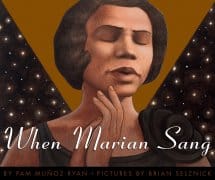
When Marian Sang by Pam Mu ñoz Ryan; illustrated by Brian Selznick

(Children + CT 275 .A51 R92 2002)

An introduction to the life of Marian Anderson, extraordinary singer and civil rights activist, who was the first African American to perform at the Metropolitan Opera, whose life and career encouraged social change.

The Daring Nelly Bly: America’s Star Reporter by Bonnie Christensen

(Children + CT 275. B527 C57 2003)

Introduces the life of Nellie Bly who, as a “stunt reporter” for the New York World newspaper in the late 1800s, championed women’s rights and traveled around the world faster than anyone ever had.

The Daring Escape of Ellen Craft by Cathy Moore; illustrated by Mary O’Keefe Young

(Children CT 275 .C723 M66 2002)

“On December 21, 1848, Ellen Craft slipped out into the cold, dark night and took her first steps toward freedom. Ellen and her husband, William, had a daring plan to escape from slavery. Posing as a white man, Ellen hoped to travel north as William’s slave master. If anyone discovered her, she’d be severely punished. But Ellen was willing to risk everything—even death—to be free.” —provided by the publisher

Ella Fitzgerald: The Tale of a Vocal Virtuosa by Andrea Davis Pinkney; illustrated by Brian Pinkney

(Children + CT275 .F5662 P56 2002)

A brief recounting of the career of this jazz musician in the voice of “Scat Cat Monroe.”

Voice of Freedom: Fannie Lou Hamer, Spirit of the Civil Rights Movement by Carole Boston Weatherford; illustrated by Ekua Holmes

(Children + CT275 .H346 W42 2015)

Celebrates the life and legacy of civil rights advocate Fannie Lou Hamer in inspiring words and vibrant artwork.

Zora Hurston and the Chinaberry Tree by William Miller; illustrated by Cornelius Van Wright and Ying-Hwa Hu

(Children + CT 275 .H868 M54 1994)

“William Miller presents a lyrical account of a little-known episode in the childhood of the renowned writer Zora Neale Hurston. This inspirational story will appeal to all readers who, like Zora, believe in their dreams.” —provided by the publisher

Rosa by Nikki Giovanni; illustrated by Bryan Collier

(Children + CT 275 .P3752 G56 2005)

“Rosa Parks is one of the most famous figures in American history. On December 1, 1955, she got on a Montgomery, Alabama city bus after work and refused to give up her seat to a white man, an act that sparked a revolution.” —provided by the publisher

They Called Her Molly Pitcher by Anne Rockwell; illustrated by Cynthia von Buhler

(Children CT 275 .P5566 R62 2002)

A picture book biography of Revolutionary War heroine, Mary Ludwig Hayes McCauly, also called “Molly Pitcher.”

A Voice of Her Own: The Story of Phillis Wheatley , Slave Poet by Kathryn Lasky; illustrated by Paul Lee

(Children Lg CT 275 .W525 L37 2003)

A biography of an African girl brought to New England as a slave in 1761 who became famous on both sides of the Atlantic as the first Black poet in America.

Beatrix: Various Episodes from the Life of Beatrix Potter by Jeanette Winter

(Children CT 788 .P68 W56 2003)

This simple biography of Beatrix Potter, best known for writing The Tale of Peter Rabbit, includes excerpts from her published letters and journals and reveals why she drew and wrote about animals.

Cloth Lullaby: The Woven Life of Louise Bourgeois by Amy Novesky; illustrated by Isabelle Arsenault

(Children + CT 1018 .B69 .N68 2016)

“Louise spent her childhood in France as an apprentice to her mother before she became a tapestry artist herself. She worked with fabric throughout her career, and this biographical picture book shows how Bourgeois’s childhood experiences weaving with her loving, nurturing mother provided the inspiration for her most famous works. With a beautifully nuanced and poetic story, this book stunningly captures the relationship between mother and daughter and illuminates how memories are woven into us all.” —provided by the publisher

Amelia to Zora: Twenty-Six Women Who Changed the World by Cynthia Chin-Lee; illustrated by Miriam Klein Stahl

(Children CT 3207 .C49 2005)

“From adventurer Amelia Earhart to computer pioneer Grace Hopper to novelist Zora Neale Hurston, discover women who have made a difference in people’s lives.” —provided by the publisher

Rad American Women: A to Z by Kate Schatz; illustrated by Megan Halsey and Sean Addy

(Children CT 3260 .S33 2015)

“Profiled are 26 American women from the 18th through 21st centuries, who have made-or are still making–history as artists, writers, teachers, lawyers, or athletes. The women come from a variety of economic and ethnic backgrounds and many had to overcome extreme hardships. One woman represents each alphabetical letter beginning with Angela Davis, an activist, teacher, and writer, and concludes with Zora Neale Hurston, an anthropologist and writer” — Provided by publisher.

Josephine: The Dazzling Life of Josephine Baker by Patricia Hruby Powell; illustrated by Christian Robinson

(Children + GV 1785 .B3 P68 2014)

A portrait of the passionate performer and civil rights advocate Josephine Baker, the woman who worked her way from the slums of St. Louis to the grandest stages in the world.

Bloomers! by Rhonda Blumberg; illustrated by Mary Morgan

(Children HQ 1236.5 .U6 B58 1993)

Explains how the new-fashioned outfit, bloomers, helped Amelia Bloomer, Elizabeth Cady Stanton, and Susan B. Anthony spread the word about women’s rights.

Beautiful Warrior: The Legend of the Nun’s Kung Fu by Emily Arnold McCully

(Children + PZ7 .M14 Be 1998)

Tells the story of two unlikely kung fu masters and how their skill in martial arts saves them both.

Drum Dream Girl: How One Girl’s Courage Changed Music by Margarita Engle; illustrated by Rafael L ópez

(Children Picture Book + ENGLE)

Follows a girl in the 1920s as she strives to become a drummer, despite being continually reminded that only boys play the drums, and that there has never been a female drummer in Cuba. Includes note about Millo Castro Zaldarriaga, who inspired the story, and Anacaona, the all-girl dance band she formed with her sisters.

The Escape of Oney Judge: Martha Washington’s Slave Finds Freedom by Emily Arnold McCully

(Children Picture Book + MCCUL)

Young Oney Judge risks everything to escape a life of slavery in the household of George and Martha Washington and to make her own way as a free black woman.

Red Butterfly: How a Princess Smuggled the Secret of Silk Out of China by Deborah Noyes; illustrated by Sophie Blackall

(Children Picture Book + NOYES)

In long-ago China, as a young princess prepares to leave her parents’ kingdom to travel to far-off Khotan where she is to marry the king, she decides to surreptitiously take with her a precious reminder of home.

Aunt Harriet’s Underground Railroad in the Sky by Faith Ringgold

(Children Picture Book Lg RINGG)

With Harriet Tubman as her guide, Cassie retraces the steps escaping slaves took on the Underground Railroad in order to reunite with her younger brother.

Frida by Jonah Winter; illustrated by Ana Juan

(Children Picture Book WINTE)

About the childhood of Frida Kahlo and how it influenced her art.

Biographies

Claudette Colvin: Twice Toward Justice by Phillip Hoose

(Children CT 275 .C6495 H66 2009)

Biography of one of the first young activists to resist bus segregation in Montgomery, Alabama.

Amelia Lost: The Life and Disappearance of Amelia Earhart by Candace Fleming

(Children CT 275 .E15 F53 2011)

Tells the story of Amelia Earhart’s life—as a child, a woman, and a pilot—and describes the search for her missing plane.

Margaret Fuller: Bluestocking, Romantic, Revolutionary by Ellen Wilson

(Children CT 275 .F85 W55)

A biography of an American writer active in early women’s rights activities and prominent in the transcendentalist movement of the early 1800’s.

The World at Her Fingertips: The Story of Helen Keller by Joan Dash

(Children CT 275 .K4486 D37 2001)

Biography of the socialist, anti-racist, disability rights activist.

Woman Against Slavery: The Story of Harriet Beecher Stowe by Anthony Scott

(Children CT 275 .S866 S36)

Biography of the author and abolitionist.

Only Passing Through: The Story of Sojourner Truth by Anne Rockwell; illustrated by R. Gregory Christie

(Children CT 275 .T78 R62 2000)

Biography of the abolitionist and women’s rights activist.

Kindred Spirit: A Biography of L.M. Montgomery, Creator of Anne of Green Gables by Catherine M. Andronik

(Children CT 310 .M66 A62)

Covers the personal life and literary career of the Canadian writer best known for her novels about Anne, a girl from Prince Edward Island.

The Bronte Sisters: The Brief Lives of Charlotte, Emily, and Anne by Catherine Reef

(Children CT 787 .B76 R43 2012)

“The Bronte sisters were the most extraordinary of literary siblings. In the nineteenth century, when women were discouraged from writing and publishing books, all three produced one or more novels now considered masterpieces.” —provided by the publisher

Untamed: The Wild Life of Jane Goodall by Anita Silvey

(Children + CT 788 .G65 S55 2015)

“This biography for children will trace Goodall’s life, but each chapter will also focus on two or more the chimpanzees that she observed, with information in sidebars about these particular animals. Along with biographical details, the book will explore the ethical issues that surround Goodall’s work and show what has changed in our understanding of Great Apes. What do we know today about these animals in terms of language, speech, tool use, and DNA? How has sophisticated technology—GPS systems, Satellite imagery, portable digital microphones—been used to gain new information about animal populations.” —provided by the publisher

Joan of Arc by Diane Stanley

(Children + DC 103.5 .S66 1998)

A biography of the fifteenth-century peasant girl who led a French army to victory against the English and was burned at the stake for witchcraft.

Women of Hope: African Americans Who Made a Difference by Joyce Hansen

(Children Lg E 185.86 .H27 1998)

Features photographs and biographies of twelve African-American women.

With Courage and Cloth: Winning the Fight for a Woman’s Right to Vote by Ann Bausum

(Children + JK1896 .B38 2004)

Recounts the story of the fight for women’s suffrage with particular focus on the efforts of Alice Paul.

10.04.2016

Abraham Schechter

October 2016

Interview by Carolle R. Morini, a special interview in honor of National Archive Month

Please tell us about your background—education and careers.

My childhood years were immersed in two large cities: New York and Paris, and French is my mother tongue. Thanks to the influence of place and family, my life has always been steeped in the fine arts. My mother introduced me to drawing and calligraphy. At 15, I taught myself how to develop film and print, using old box-cameras bought at SoHo flea markets. After graduating from New York’s renowned High School of Art & Design, I packed up my cameras and drawing materials and moved to Portland to attend the Maine College of Art. After graduating from art college with a BFA in the late 1980s, rooting myself in downtown Portland, I immediately found work as a commercial photographer and photography teacher. Through the 1990s, I ascended to the level of master printer, and with a few colleagues in a custom photographic lab in Portland, we built a national reputation for our techniques, printing portfolios, books, and shows for National GeographicAperture, and Magnum photographers. Between these projects, I also exhibited and published my own work, while teaching on the Maine College of Art faculty for a decade.

By the late 90s, I saw the end was near for the handcrafted photo field, and I sought my second career, noticing my clients in libraries, archives, and museums were still very busy. Through those years, I created photo conservation processes. I decided to pursue archival education, grounding myself with two years of graduate-level studies in history at the University of Southern Maine, and at the University of Massachusetts at Boston. During the latter, while working at the Harvard University Archives (on some of Harvard’s photo collections), my colleagues encouraged me to visit and transfer to Simmons College. By the time I graduated with my MLS from Simmons, I had already begun teaching bookbinding and conservation (having apprenticed at Northeast Document Conservation Center) and publishing on the topic. For the past 17 years, I’ve been employed as a professional archivist and conservator in my home state of Maine—continuing to teach, present at conferences, and provide consulting services to my regional neighbors. Since late 2005, I’ve been serving as Head of Special Collections and Archivist at Portland Public Library. The Library has grown to become Maine’s most visited cultural venue.

How did you come across the Boston Athenæum?

The archival program at Simmons College comprises internships, adding practical scenarios to theoretical learning. While I was purposefully completing my practica in Maine, helping special collections departments at Bowdoin College, University of Southern Maine, Osher Map Library, and Portland Museum of Art, some of my Simmons friends were serving as interns at the Athenæum. As my graduating class was completing final projects, one of my classmates organized for about five of us to visit the Athenæum for afternoon tea and a tour. That was my first time at the Athenæum, and I was thoroughly impressed. I’ve attended many afternoon teas over the years, taking days off from work. My graduation gift to myself was to join; that was in June 1998, and I’ve been a grateful member ever since.

Why do you like being a member?

While I was a graduate student, I began cultivating an enduring love for learning and writing. The Athenæum is the perfect place to pursue a life of learning. I especially like the term self-culture as used by the author and abolitionist James Freeman Clarke, whose books are at the Athenæum. I cherish my membership, and have been making it a point to travel to Boston at least once a month so that I can enjoy the Athenæum. Over the years, I’ve made many friends here, among members and staff—also recruiting a lot of members, giving my own version of “the tour!”

Do you mind writing about the research you do when you are here?

I refer to the Boston Athenæum as my scriptorium, as it is my oasis for writing, reading, friendship, and learning. With every visit I continue to find literary treasures to sign out, especially in the basement Drum! As a writer, retreats are essential occasions for respite and creative rejuvenation. This practice began with my first of countless and continuing sojourns at Vermont’s Weston Priory. Beginning in 2011, I created my own version of a monastic retreat right on Beacon Hill. Twice a year, I stay for a week at Beacon Hill Friends House while participating in the Quaker community there, the community at the Church of the Advent, with a solid week of blissful study in the Vershbow Room at the Athenæum. It’s a life-giving immersion experience, especially with the texts I choose from the Athenæum’s great collection of inspirational writing. For each sojourn, I create a theme that I use as I navigate the catalogue to select study material. Much of what I’ve studied in the Vershbow Room has been of Quaker provenance. I like to say that in the library I’m listening to the saints of old, and on Chestnut Street the saints of now. Between these retreats, I compile my handwritten notes into electronic indices. Last year, during a week’s study, a fellow Vershbow researcher was talking about dissertation prep and wading through the density of Richard Baxter’s work. I mentioned that I had spent a week in the Vershbow studying his personal writing, and sent this fellow member my indexed notes for which she was very thankful. This is an example of how the Athenæum can bring scholars together. I believe that with inspiration we inspire others.     

Tell us about the Portland Public Library and the archive collections you work with. What is held within its collections?

Though the Portland Public Library is 150 years old, the library’s special collections area—called The Portland Room—was created in 1979. Prior to that, rare books and manuscripts had been part of the reference department. As the library’s first professional archivist, my marching orders were to develop and organize focused collections while also integrating the department into public programming. The Portland Room has become the go-to place to study city history. The program offerings I’ve created range from school group Portland history units to curated exhibits to maker spaces (bookbinding and calligraphy) to “Socrates Café” groups (something I learned to do at UMass-Boston) and currently a monthly “Journaling in the Library” group.

Alongside processing, conserving, and digitizing existing collections has been accessioning more documentary archival material to continue enriching Portland’s story. Within this are such gems as city maps, prints, newspapers dating back to the 1780s, manuscripts, photographs, printed books from various presses in Portland, and the archives of Children’s Theatre of Maine, which began in 1924 and is the oldest running American children’s theatrical company. 

Do you have any favorite items?

Among my favorites is my current labor-of-love: in late 2009, I rescued 70 years (1936–2005) of newspaper photo negatives (camera originals) from the sub-basement of the former newspaper building, right before it was gutted. Arranging the collection took nearly three years, during which I examined more than a million images. The descriptive work is well in progress, with assistance from faithful volunteers, as I construct the finding aid and begin thematic digitization work. I find this a wonderful collection, not just because of the rescue story, but because I recognize the locations, and I’m enjoying a unique learning experience about Portland through the twentieth century. Streets, bygone buildings, community institutions, people, events, and even the physical film attest to the history of photography. I even saw myself in the 1980s! The collection is not yet available to the public, as it is deep in the process, but it will be a tremendous resource in the future.

What advice would you give to training or early career archivists, historians, and librarians who are hoping to secure permanent, full-time work at an archive or library?

I may not have the best advice, considering that I also look for good career advice, as my own career continues to be fluid and open-ended. What I can confidently advise is that you get a handle on playing multiple positions. If you’re doing a lot of scanning and metadata creation, learn to work with patrons in a reference librarian’s role, learn to create catalogue records, try leading a reading group, present a topic at a conference. Listen to those who use libraries, and stand in their shoes. Cultivate your narrative writing skills. Remember that leadership and communication rise and fall together. The library/archives field is competitive and narrowing, with many more graduates than there are jobs. We do well to network with each other, supporting each other.      

What excites and inspires you about archives?

As a reader of archives and manuscripts, it is an extraordinary privilege to hold and read an author’s primary documents. In 2013, I received a C. S. Lewis Foundation fellowship to study Lewis’s manuscripts at the Bodleian Library, Oxford—and to live in his house, The Kilns, during Trinity Term. Reading all of Lewis’s handwritten notebooks, essays, letters, drawings—and even his lesson plans—was a great honor. Among these studies, I read his handwritten original Screwtape Letters, reading through his crossed-out sections, and making note of his changes. He had beautiful and clear handwriting, and I could detect when he stopped to re-ink his dip pen. By reading his own handwriting on paper I felt like I could hear his words.

As a curator of archives, the tandem mission to preserve and make available is something I think about every day. Archivists are among those whose discoveries can be extended to the public. We are organizing material into discernable units of information. Many times, I’ve had to turn woeful messes of paper in boxes and piles of bags into hierarchical entities, through painstaking processing. But it’s worthwhile, especially as I think of the researchers who will be making discoveries themselves. As an archivist working with documentation as well as with the public, I often serve as memory for others; that is a very serious yet gratifying role. When I conserve books, I also think of their future readers. We use what we call best practices, because we view our temporal stewardship as serving the long term.

Do you have any personal archives/collections of your own?

Considering that I’m essentially a lifelong photographer, my own collections of negatives, slides, proofs, and prints constitute an archive of my own. Alongside the photographs, I’ve been a regular journal writer since 1994, and have saved all my journals and chapbooks. The Athenæum continues to be a favorite journaling perch, and is written about in countless entries. I’ve also been a blogger for ten years, and maintain a digital archive of all my essays and photo illustrations.                                                                                                          

cover: Basic Book Repair Methods by Abraham Schecter

Can you also include a list of links to the blogs and/or websites you contribute to, and other writings you have?

Writing is my adventure with words and observations; journaling and essay writing have been my primary formats thus far. Along with the Oxford/Lewis Scholar in Residence fellowship in 2013, I was also writer in residence at the Dylan Thomas birthplace and home in Swansea, Wales. There I was able to participate in writing events, as well as experience the places and steps of my most loved poet. Every year, in Portland, I read his Child’s Christmas in Wales to audiences, and have been doing this for a dozen years. I am the world’s only resident of both C. S. Lewis’s and Dylan Thomas’s homes. 

  1. In 2006 I began La Vie Graphite, which is my continuing collection of illustrated essays. I do all the writing and photography.
  2. Within these essays is “archives of the soul,” a term I coined, as I believe each of us have an inner archive.
  3. Essays from my Oxford fellowship.
  4. Essays from one of the sojourns in Wales, which includes my residency at Dylan Thomas’s home.
  5. The City Has Ghost Streets is my series of historic essays about bygone Portland streets.
  6. As a working archivist and conservator, I write these for the Portland Public Library’s blog, called The Life of the Library.
  7. Flickr image albums, which include conservation projects and instructional programming.

Other works, in print, include Basic Book Repair Methods (1999, currently in its third printing), Guy Gannett Foundation Archives (2000), Silent Type: A Retrotech Journal (volume 1, 2009; volume 2, 2010). I was a featured author in Spiritual Journey (Princeton, 2010 and 2012). 


09.28.2016

Ghosts

Picture Books

Leo: A Ghost Story by Mac Barnett; illustrated by Christian Robinson

(Children Picture Book + BARNE)

“You would like being friends with Leo. He likes to draw, he makes delicious snacks, and most people can’t even see him. Because Leo is also a ghost. When a new family moves into his home and Leo’s efforts to welcome them are misunderstood, Leo decides it is time to leave and see the world” –Provided by publisher.

Skeleton Hiccups by Margery Cuyler; illustrated by S. D. Schindler

(Children Picture Book + CUYLE)

Ghost tries to help Skeleton get rid of the hiccups.

Little Ghost by Kate Khdir and Sue Nash; illustrated by Caroline Church

(Children Picture Book + KHDIR)

Ghost’s attempts to scare the pupils at a human school result in his becoming part of their Halloween play.

Ghosts in the House by Kazuno Kohara

(Children Picture Book + KOHAR)

Tired of living in a haunted house, a young witch captures, washes, and turns her pesky ghosts into curtains and a tablecloth.

The Snow Ghosts by Leo Landry

(Children Picture Book LANDR)

Snow ghosts live in the far north, and they love to play and have fun.

The Haunted Hamburger and Other Ghostly Stories by David LaRochelle; illustrated by Paul Meisel

(Children Picture Book + LAROC)

A ghost father tells his children three frightening stories to help them go to sleep at night.

Ol’ Clip Clop: A Ghost Story by Patricia C. McKissack; illustrated by Eric Velasquez

(Children Picture Book + MCKIS)

One October night in 1745, John Leep, a mean and stingy lawyer, sets out to evict a widow from one of his rental houses and is followed by a ghostly rider.

The Ghost-Eye Tree by Bill Martin, Jr. and John Archambault ; illustrated by Ted Rand

(Children Picture Book + MARTI)

Walking down a dark lonely road on an errand one night, a brother and sister argue over who is afraid of the dread Ghost-Eye tree.

Just in Case: A Trickster Tale and Spanish Alphabet Book by Yuyi Morales

(Children Picture Book + MORAL)

As Se ñor Calavera prepares for Grandma Beetle’s birthday he finds an alphabetical assortment of unusual presents, but with the help of Zelmiro the Ghost, he finds the best gift of all.

The Bake Shop Ghost by Jacqueline K. Ogburn; illustrated by Marjorie Priceman

(Children Picture Book + OGBUR)

Miss Cora Lee Merriweather haunts her bake shop after her death, until the new shop owner makes a deal with her.

The Canterville Ghost by Oscar Wilde; illustrated by Lisbeth Zwerger

(Children + PZ7.W64583 Can 1986)

A celebrated and feared English ghost is outraged when the new American owners of his haunting place refuse to take him seriously and actually fight back against him.

Beginning Readers

A Ghost Named Fred

Nathaniel Benchley; illustrated by Ben Schecter

(Children Picture Book BENCH)

Chapter Books

The Night Gardener by Jonathan Auxier

(Children PZ7.A931 Ni 2014)

Irish orphans Molly, fourteen, and Kip, ten, travel to England to work as servants in a crumbling manor house where nothing is quite what it seems to be, and soon the siblings are confronted by a mysterious stranger and secrets of the cursed house.

Doll Bones by Holly Black

(Children PZ7.B52878 Dol 2013)

Zach, Alice, and Poppy, friends from a Pennsylvania middle school who have long enjoyed acting out imaginary adventures with dolls and action figures, embark on a real-life quest to Ohio to bury a doll made from the ashes of a dead girl.

Spirit’s Key by Edith Cohn

(Children PZ7.C66493 Spi 2014)

Having finally developed the psychic ability her father has used to provide for them, twelve-year-old Spirit Holden, aided by the ghost of her beloved dog Sky, investigates the mystery of why wild dogs are dying on their remote island.

All the Lovely Bad Ones by Mary Downing Hahn

(Children PZ7.H1256 Al 2008)

While spending the summer at their grandmother’s Vermont inn, two prankster siblings awaken young ghosts from the inn’s distant past who refuse to “rest in peace.”

The Ghost of Crutchfield Hall by Mary Downing Hahn

(Children PZ7.H1256 Gho 2010)

In the nineteenth century, ten-year-old Florence Crutchfield leaves a London orphanage to live with her great-uncle, great-aunt, and sickly cousin James, but she soon realizes the home has another resident, who means to do her and James harm.

The Beasts of Clawstone Castle by Eva Ibbotson; illustrated by Kevin Hawkes

(Children PZ7.I11555 Bea 2006)

While spending the summer with elderly relatives at Clawstone Castle in northern England, Madlyn and her brother Rollo, with the help of several ghosts, attempt to save the rare cattle that live on the castle grounds.

The Haunting of Granite Falls by Eva Ibbotson; illustrated with Kevin Hawkes

(Children PZ7.I11555 Hau 2004)

Constable & Toop by Gareth P. Jones

(Children PZ7.J712 Co 2013)

In Victorian London, an undertaker’s son who can see ghosts and is haunted by their constant demands for attention must decide whether to help when a horrible disease imprisons ghosts into empty houses in the world of the living.

The Ghost of Thomas Kempe by Penelope Lively

(Children PZ7.L7397 Gh)

The Wild Hunt of Hagworthy by Penelope Lively

(Children PZ7.L7397 Wi)

Liesl & Po by Lauren Oliver; illustrated by Kei Acedera

(Children PZ7.O475 Lie 2011)

A mix-up involving the greatest magic in the world has tremendous consequences for Liesl, an orphan who has been locked in an attic, Will, an alchemist’s runaway apprentice, and Po, a ghost, as they are pursued by friend and foe while making an important journey.

The Screaming Staircase by Jonathan Stroud

(Children PZ7.S92475 Sc 2013)

Follows three young operatives of a Psychic Detection Agency as they battle an epidemic of ghosts in London.

Young Adult

The Ghosts of Kerfol by Deborah Noyes

(Young Adult PZ7.N96157 Gh 2008)

Over the centuries, the inhabitants of author Edith Wharton’s fictional mansion, Kerfol, are haunted by the ghosts of dead dogs, fractured relationships, and the bitter taste of revenge.

The Turning by Francine Prose

(Young Adult PZ7.P94347 Tur 2012)

“A teen boy becomes the babysitter for two very peculiar children on a haunted island in this modern retelling of The Turn of the Screw”– Provided by publisher.

The Other Side of Dark by Sarah Smith

(Young Adult PZ7.S65918 Oth 2010)

Since losing both of her parents, fifteen-year-old Katie can see and talk to ghosts, which makes her a loner until fellow student Law sees her drawing of a historic house and together they seek a treasure rumored to be hidden there by illegal slave-traders.

Afterworlds by Scott Westerfield

(Young Adult PZ7.W5197 Aft 2014)

In alternating chapters, eighteen-year-old Darcy Patel navigates the New York City publishing world, and Lizzie, the heroine of Darcy’s novel, slips into the “Afterworld” to survive a terrorist attack and becomes a spirit guide, as both face many challenges and both fall in love.

09.08.2016

Staff Book Suggestions Autumn 2016

Kristin Cook

Jonathan Strange & Mr. Norrell by Susanna Clarke
(Library of Congress PZ4.C605 Jo 2004​​​)

In the early nineteenth century, magic begins to return to England, a place where only gentleman-magicians have existed for 300 years—academics but not practitioners. As the Napoleonic wars rage on the Continent, these practical magicians must decide where their interests lie—in their own world, which they can help defend, or in that of faerie, which promises to unlock more of the mysteries of ancient English magic. Populated with unforgettable characters (and some of my favourite I’ve ever read), JSAMN is a sweeping, powerful narrative about the choices of men and their effect on those in the shadows—women, servants, the poor—who are often marginalized but on whom the world turns. This is a great novel for a long weekend with some tea or spiced cider as the leaves begin to fall!

Jimmy Feeney

Amazing Tales From The Red Sox Dugout by Jim Prime and Bill Nowlin
(Library of Congress GV875.B62 P74 2012)

A collection of entertaining stories of former Sox players who graced Fenway over the last century. Some tales you’ll remember, some you won’t, and some you’ll forget as soon as you read them. Not a pitcher’s duel, but it is relaxing as an afternoon in the bleachers.

Judith Maas
Bernard Berenson: A Life in the Picture Trade by Rachel Cohen
(Library of Congress CT275.B467 C63 2013)

To all appearances, the life of Bernard Berenson (1865–1959) was a dream come true: leaving behind his impoverished immigrant origins, he attained fame as an art historian and connoisseur and lived in grand style in his Florence villa. But this biography casts Berenson in a more interesting light, as someone torn between his desire to contemplate Italian Renaissance art as an end in itself and his need and desire for money. Over time, he devoted his talents more and more to the business side of the art world, authenticating paintings in a secret arrangement with an art dealer. Despite many accomplishments, he spoke of himself as being a failure.      

Cohen’s biography explores Berenson’s character, his many friendships and romances, and the different worlds in which he traveled. His intellectual life began in Boston, where he became a devoted reader from an early age, thanks to the Boston Public Library, and, with the support of patrons, attended Harvard. Highlights of the book for me were its accounts of nineteenth-century Boston and a chapter describing how Berenson looked at paintings and why he thought a painted version of an object gives a viewer more pleasure than the object itself.

Kaelin Rasmussen
Invisible Man by Ralph Ellison
(Library of Congress​ PZ4.E47 In)

This twentieth-century American classic has been on my list for a long time. Though not particularly evocative of autumn, the book does start out in an academic setting, fitting for the start of a new school year. The narrator is a young African American man attending college in the segregated South, at an all-black institution funded by wealthy Northern white men. The story traces the young man’s journey, from youthful complaisance in the South to disillusionment in the North, in the heart of Harlem, where he struggles to understand a hostile world and the brutal truth of racism in this country. He concludes that his race has rendered him invisible. Beautifully written, but not easy to read, this superb novel is as relevant today as when it was first published in 1952.

Alyssa True
The Rival Queens: Catherine de’ Medici, her Daughter Marguerite de Valois, and the Betrayal that Ignited a Kingdom by Nancy Bazelon Goldstone
(Library of Congress CT1018.C39 G64 2015)

The Rival Queens is for those who enjoy badly-behaved royals with a healthy dose of snark. This is an enthralling double biography of Catherine de’ Medici and her daughter Marguerite de Valois, both queens of France. Despite her cynicism toward most of the nobility, Goldstone paints a fair picture of Margot/Marguerite/Margaret, who is definitely the tragic hero of this tale.

Mary Warnement

All For Nothing by Walter Kempowski​

(Library of Congress NEW PZ4.K326 Al 2015​)

This novel must be informed by the research Kempowski conducted for decades to produce both his nine-volume novel Die deutsche Chronik and magnificent series Echolot or “Sonar” of which only the last volume, Swansong, 1945, has been translated into English. Many refer to Echolot as a collage—letters, memoir, testimony—all first-hand accounts of war-time in Germany that he amassed and selected. He did not choose a particular place or class but rather sought to represent the entirety. All For Nothing focuses on one particular family and those surrounding them in one place, a town in East Prussia, in the winter of 1945 as the Russians approach. We know what happens, but he does not allow his characters that 20/20 vision. This is published by Granta and The Guardian loved it. If you are looking for WWII-era thriller, this is not it. The unease of waiting and not knowing takes precedence as a series of travelers pass by and through this home of a fading aristocratic family. The intensity builds as the family considers taking to the road and becoming refugees themselves. I shall say no more.

If interested in the topic but you want more traditional story-telling, I recommend Chris Bohjalian’s Skeletons at the Feast, also in the collection.

Hannah Weisman

Nothing to Envy: Ordinary Lives in North Korea by Barbara Demick

(Library of Congress HN730.6.A8 D46 2009​)

Barbara Demick’s non-fiction account of life in North Korea follows six individuals through the 1990s into the early 2000s as they survive “the Arduous March” (North Korea’s deadly famine), the death of Kim Il-sung and the transition to the dictatorship of Kim Jong-il, the harsh conditions of life under a totalitarian regime, and eventual defection. Demick’s detailed narrative—focused on individuals rather than facts and figures—reads like a novel, making the grim subject matter easier to grapple with. Nothing to Envy is both intriguing and terrifying and provides an excellent introduction to the realities of life in North Korea.