
05.30.2017

Architecture

Picture Books

Building Our House by Jonathan Bean

(Children Picture Book Lg BEAN)

A young girl narrates her family’s move from the city to the country, where they have bought a piece of land and live in a trailer while they build a house from the ground up, with help from relatives and friends.

Iggy Peck, Architect by Andrea Beaty; illustrated by David Roberts

(Children Picture Book + BEATY)

Ever since he was a baby, Iggy Peck has built towers, bridges, and buildings, which comes in handy when his second grade class is stranded on an island during a picnic.

Arches to Zigzags: An Architecture ABC by Michael J. Crosbie; photography by Steve and Kit Rosenthal

(Children Picture Book + CROSB)

A rhyming alphabet of architectural elements, from arches and doors to I-beams, mantels, and urns.

Henry Builds a Cabin by D.B. Johnson

(Children Picture Book JOHNS)

Young Henry Thoreau appears frugal to his friends as he sets about building a cabin. Includes biographical information about Thoreau.

What’s Inside? Fascinating Structures Around the World by Giles Laroche

(Children Picture Book + LAROC)

An introduction to architectural structures and the stories behind their creation.

Informational Books

Julia Morgan: Architect of Dreams by Ginger Wadsworth

(Children CT225.M67 W32 1990)

Recounts the life of the architect whose projects included designing the Hearst Castle at San Simeon, California.

Spiderwebs to Sky-scrapers: The Science of Structures by David Darling

(Children TA634 .D37 1991)

Hands-on experiments introduce natural and manmade structures such as a bird’s nest and skyscraper and such structural elements as arches, domes, trusses, and beams.

Building: The Fight Against Gravity by Mario Salvadori

(Children TA634 .S24 1979)

An introduction to the basic principles of architecture and engineering including a discussion of structural materials and their properties and such problems as how skyscrapers are kept from swaying excessively and buildings prevented from sinking into the ground.

Castle by Christopher Gravett; photography by Geoff Dan

(Children + GT3520 .G738 2000)

A look at these fascinating structures through full-color photos.

Castle by Richard Pratt; illustrated by Stephen Biesty

(Children Lg GT3550 .B54 1994)

Detailed cross-sections allow readers to explore how people lived and defended themselves in medieval castles.

Great Building Stories of the Past by Peter Kent

(Children Lg NA2555 .K46 2001)

Explains the stories and principles behind some the world’s greatest structures, including the Great Pyramid at Giza, the Great Wall of China, the Eiffel Tower, and the Brooklyn Bridge.

Building Big by David Macauly

(Children + NA2555 .M24 2000)

“Why this shape and not that? Why steel instead of concrete or stone? Why put it here and not over there? These are the kinds of questions that David Macaulay asks himself when he observes an architectural wonder. These questions take him back to the basic process of design from which all structures begin, from the realization of a need for the structure to the struggles of the engineers and designers to map out and create the final construction. As only he can, David Macaulay engages readers’ imaginations and gets them thinking about structures they see and use every day—bridges, tunnels, skyscrapers, domes, and dams. In Building Big he focuses on the connections between the planning and design problems and the solutions that are finally reached. Whether a structure is imposing or inspiring, he shows us that common sense and logic play just as important a part in architecture as imagination and technology do. As always, Macaulay inspires readers of all ages to look at their world in a new way.” — Provided by publisher.

Mosque by David Macaulay

(Children Lg NA4670 .M33 2003)

An author and artist who has continually stripped away the mystique of architectural structures that have long fascinated modern people, David Macaulay here reveals the methods and materials used to design and construct a mosque in late-sixteenth-century Turkey. Through the fictional story and Macaulay’s distinctive full-color illustrations, readers will learn not only how such monumental structures were built but also how they functioned in relation to the society they served.

Cathedral by David Macaulay

(Children Lg NA4830 .M32)

Text and detailed drawings follow the planning and construction of a magnificent Gothic cathedral in the imaginary French town of Chutreaux during the thirteenth century.

City: A Story of Roman Planning and Construction by David Macaulay

(Children Lg TA16 .M33)

Text and black and white illustrations show how the Romans planned and constructed their cities for the people who lived within them.

The Story of Buildings by Patrick Dillon; illustrated by Stephen Biesty

(Children + TA149 .D54 2014)

Examines how architecture has evolved over time by looking at buildings that typify each period, from the pyramids and the Parthenon to the Chrysler Building and the Sydney Opera House.

Building by Philip Wilkinson

(Children + TA634 .W54 2000)

Take a tour of world architecture from the slender minarets of Turkish mosques to the earthquake-resistant skyscrapers of Tokyo.

Underground by David Macaulay

(Children + TD159.3 .M3)

Text and drawings describe the subways, sewers, building foundations, telephone and power systems, columns, cables, pipes, tunnels, and other underground elements of a large modern city.

Bridges: From My Side to Yours by Jan Adkins

(Children + TG148 .A35 2002)

A look at bridges throughout history, from simple arrangements of stepping stones, to famous landmarks such as London Bridge, to marvels of engineering such as New York’s Brooklyn Bridge.

Unbuilding by David Macaulay

(Children Lg TH153 .M23)

This fictional account of the dismantling and removal of the Empire State Building describes the structure of a skyscraper and explains how such an edifice would be demolished.

Mill by David Macaulay

(Children Lg TS1324.R4 M33 1983)

The mills at Wicksbridge are imaginary, but their planning, construction, and operation are quite typical of mills developed in New England throughout the nineteenth century.

Castle by David Macaulay

(Children Lg UG405 .M18)

Text and detailed drawings follow the planning and construction of a “typical” castle and adjoining town in thirteenth-century Wales.

05.01.2017

Marjorie Lyle Crandall

March 2017

By Mary Warnement

Marjorie Lyle Crandall published one book, Confederate Imprints: A Check List Based Principally on the Collection of the Boston Athenæum (1955); however, her one effort was considered “monumental” by a contemporary reviewer. It was also called  “pioneering” by those assessing her computer-assisted successors in the 1980s who also put her “fine example” in a class with Charles Evans, pre-eminent bibliographer who published American Bibliography in 14 volumes between 1901 and 1934.  

Crandall was born in 1900 in Malden where she lived most her life. Her father James L. Crandall hailed from New Bedford, Massachusetts. Her mother Carrie A. (Stuart) Crandall was born in English-speaking Canada, St. Johns, New Brunswick. She was, unusually for that period, eight years his senior. They lived in Malden, and he worked as a civil engineer.

Crandall attended Smith College, where she graduated Phi Beta Kappa in 1922. The Smith College Archive holds 85 letters that Crandall wrote home to her parents. During her four years there, she was an assisting managing editor on The Weekly Board and played on the cricket team. Her participation in both La Societé Française and El Club Español, the French and Spanish clubs, no doubt relates to her later affinity for traveling to foreign countries.

She started working at the Boston Athenæum in 1923 as a classifier. She went on to become a cataloguer, then reference librarian. In 1933, her salary increased to $42 a week (approx. $2,184 a year), at a time when the Librarian earned $4,000 a year. When Librarian and Director Elinor Metcalf resigned in February 1946, Marjorie was appointed Acting Librarian at a salary of $300 a month until Walter Muir Whitehill, the permanent replacement, started in July 1946 when Marjorie became Assistant Librarian.

The Athenæum started collecting Confederate Imprints soon after hostilities ended in 1865. Trustee Francis Parkman had agreed to travel south to Richmond with a friend seeking news of family. Parkman was a respected historian, and he shared his vision to preserve printed material from that south that might otherwise have been lost in the chaos of war and its aftermath. His fellow trustees on the Library Committee voted to extend him $500 for purchases during his trip. He bought books, pamphlets, and newspapers, including the Richmond Examiner in full from February 1861 to the end of the Confederacy for $325 more, for which he was reimbursed later.

The librarian William F. Poole pursued further purchases to extend the collection. He used personal and professional connections as well as advertisements in publications. By the autumn of 1865, Poole lamented having inspired expectations of high payment in the Richmond area, but he looked throughout the South. Poole explained the Athenæum’s aim in a September letter [quoted in Crandall’s introduction]:

“What you call ‘the smaller fry of ballads, songs, speeches, and sermons’ is precisely the fry we would tote into our net. We are willing to pay for anything of this sort. Everything printed at the South during the war that goes to illustrate the state and action of the southern mind we desire to preserve in the Boston Athenæum.”

Gifts followed as well. There was critical assessment; they did not collect just any old thing—for instance, autographs were not sought or accepted. Poole was most strenuous in his collecting efforts in 1865 but pursued items until he left in 1868 to become librarian of the Cincinnati Public Library. Acquisitions on a smaller scale continued every year, until 1944 when the Athenæum acquired a whopping 1,500 more items from the collection of Raymond Sanger Wilkins who had started collecting in the 1920s; when he was named to the bench of the Massachusetts Supreme Judicial Court, he knew he no longer had time to devote to his collection. 

Confederate materials were cataloged as other items added to the Athenæum’s collections, but given its specialized nature and unexpected location—who expects to find Confederate printings in Yankee Boston—a separate publication devoted to the subject became a goal. In 1917, the Athenæum published Confederate Literature, a List of the Books and Newspapers, Maps, Music, and Miscellaneous Matter printed in the South during the Confederacy, now in the Boston Athenæum. Charles Baxter worked at the Athenæum from 1903 to 1912, then he became librarian of Blackstone Memorial Library in Branford, CT. James M. Dearborn worked at the Athenæum from 1912 until he retired in 1949. He was, at one point, “Order Department Head” or Head of Acquisitions. James Ford Rhodes wrote the introduction. Rhodes was an Ohio industrialist-turned-historian who made his fortune and moved to Boston in order to find better libraries. In the early twentieth century, he published a multi-volume history of the United States. He was a proprietor at the Athenæum from 1890 until his death in 1927. In 1918, he published A History of the Civil War 1861–​1865 that won the Pulitzer Prize. This 1917 list, as its title carefully calls it, was known as Baxter & Dearborn (though the two never collaborated) and was not considered exhaustive even when it first appeared. “Better than nothing” would be an adequate description of its reception.

After 1944’s increase to the Confederate Imprint Collection, the Athenæum decided it was time to update its published bibliography of the collection. In 1947, librarian Whitehill sought input from southern librarians and scholars in order to improve the revision. Whitehill first engaged a scholar, Hedwig Schleiffer, with funds from trustee Donald McKay Frost, to start organizing the materials, but then chose Assistant Librarian Crandall to take charge of the project. He helped established the criteria for inclusion. The bibliography would include Confederate Imprints (exclusive of newspapers and periodicals):

1. owned by the Athenæum

2. listed in the Union Catalogue of the Library of Congress

3. reported to the Athenæum by their owners (that is, in private collections)

4. listed in selected modern bibliographies

Only the Athenæum’s holdings of newspapers and periodicals would be listed and only those works printed in the Confederate States during the life of that government. Therefore, items of Confederate sentiment from border or union states were not included. Nor were items from Confederate States before a state seceded or after it capitulated.

Crandall began her work on the Confederate Imprint checklist in summer 1947. She worked alone except for typing assistance from Evelyn Coker (on staff) and help with one section by Richard B. Harwell of Emory University who had researched the collection and shared ideas with Whitehill. Harwell’s specialty was sheet music, and he completed that section (volume 2, Part III). She worked for three years to prepare her list, and the printer began to return galley proofs in 1951. Crandall shared these with seven other libraries who were able to confirm entries but in the process, they also added entries. This improved the final product with the price of delaying its completion for several more years.

Whitehill and Crandall wanted to create a useful bibliography that would serve as a helpful reference work but also serve as inspiration to researchers. The catalogue is arranged by subject. Author access is in the index. The first volume includes official publications of the Confederate States of America listed by branch and department, then by state. The second volume is organized by subjects meant to describe life in the Confederacy.  

The Athenæum sponsored similar projects publishing, in 1897, a catalogue of the Washington Collection and, in 1938, a catalogue of the books of John Quincy Adams deposited at the Athenæum (which are now back at the Stone Library in Quincy, MA). Both of these catalogues were undertaken by scholars not on staff.

Crandall resigned in November 1953. She did agree to stay on, part-time, and see this book through publication. The 1954 Annual Report outlined the Athenæum’s appreciation for her work:

The foregoing record of her services gives a very feeble idea of her notable efficiency in them all, with a number of other activities such as the immediate charge of the personnel, pensions and maintenance of the building. We shall miss her greatly, although she is continuing on a part-time basis to see final through the Press the Catalogue of Confederate Literature which she has found time to compile among her many other services. Certain of her duties are being assumed by the Director, and many of the others will be performed by Ebenezer Gay, who was appointed Executive Officer on November 15, 1954.

Her publication was not the final word. It had not been a complete census of all libraries, and by the 1980s, with computers allowing easier collaboration and manipulation of data, a new project was undertaken and published in one large volume in 1987. The authors credit Crandall in their subtitle:

 Confederate Imprints: A Bibliography of Southern Publications from Secession to Surrender {Expanding and Revising the Earlier Works of Marjorie Crandall & Richard Harwell}.

T. Michael Parrish and Robert M. Willingham, Jr., also included Harwell because he had followed her book with a supplementary book More Confederate Imprints. The 1987 publication became known as P&W, and the numbered entries now act as call numbers in the Athenæum’s collection.

No biography or even obituary of Marjorie Lyle Crandall was written. We have few clues to know how she lived. Smith College holds 85 letters she wrote home to her parents while matriculating. She lived most of her life in Malden but also lived in Lexington by 1955 and again in 1958. In 1960 she was in Back Bay. She died in Brookline in 1974. The Boston Globe used to list attendance at Symphony Hall, and we can see that she enjoyed musical performances. She was known for enjoying travel, and Ancestry.com contains her 1960 travel visa to Brazil. The directories indicate she worked for the Christian Science church after leaving the Athenæum; she published some articles in the Christian Science Sentinel and that travel visa listed her occupation as copy editor. The Athenæum’s archive holds a few more tantalizing clues. For example, librarian Charles Knowles Bolton kept a ledger of staff-related instructions and memos among which is one penciled from her, informing the librarian not to attract a mouse onto the table with cheese. There are letters to her from colleagues traveling by ship to Europe in which they mention flirting with the ship’s captain. The 1930 census mentions that her sister is also a librarian and that the family had a radio. Hardly the sources to inspire a full-length book, but Marjorie Lyle Crandall’s work at the Athenæum has helped every researcher who has passed through the red door’s at 10½ to study the US Civil War and quite a few who were never able to make the trip but knew of the Athenæum’s rich holdings because of her concerted efforts. References

Calvin Elliker, review of Confederate Imprints: A Bibliography of Souther Publications from Secession to Surrender, by T. Michael Parrish and Robert M. Willingham, Jr., Notes 57.3 (2001): 555.

Charles N. Baxter and James M. Dearborn, Confederate Literature, a List of the Books and Newspapers, Maps, Music, and Miscellaneous Matter printed in the South during the Confederacy, now in the Boston Athenæum, 1917.

Marjorie Crandall, Confederate Imprints: A Check List Based Principally on the Collection of the Boston Athenæum (1955).

Stanley F. Horn, review of Confederate Imprints, by Marjorie Lyle Crandall, Civil War History 2 (1956): 119-120.

Thomas W. Richey and Glenna R. Schroeder, review of Confederate Imprints: A Bibliography of Souther Publications from Secession to Surrender, by T. Michael Parrish and Robert M. Willingham, Jr., Georgia Historical Quarterly 73 (Spring 1989): 200.

T. Michael Parrish and Robert M. Willingham, Jr., Confederate Imprints: A Bibliography of Southern Publications from Secession to Surrender {Expanding and Revising the Earlier Works of Marjorie Crandall & Richard Harwell}. 1987

04.20.2017

Ocean

Picture Books

The Serpent Came to Gloucester by M.T. Anderson; illustrated by Bagram Ibatoulline

(Children Picture Book Lg ANDER)

Rhyming text tells of a sea serpent that plays off the coast of Massachusetts the summer of 1817, and is hunted upon its return the next year. Includes a page of facts upon which the story is based.

The Merbaby by Teresa Bateman

(Children Picture Book BATEM)

When he and his brother Josh find a mer-baby caught in their fishing net, Tarron, rejecting his brother’s plan to sell the baby and make a profit, discovers that there are greater treasures than gold.

Sea Horse: The Shyest Fish in the Sea by Chris Butterworth; illustrated by John Lawrence

(Children Picture Book BUTTE)

An informative overview that’s also a great read aloud, with colorful hand-printed illustrations.

The Mermaid and the Shoe by K.G. Campbell

(Children Picture Book + CAMPB)

Each of King Neptune’s 50 mermaid daughters boasts a special talent, except for little Minnow, who seems to be good only at asking questions. When she finds a strange object, Minnow follows her questions to a wondrous place and finds answers, including the answer to the most important question of all: Who am I? A gorgeously illustrated story about finding one’s purpose.

10 Little Rubber Ducks by Eric Carle

(Children Picture Book Lg CARLE)

When a storm strikes a cargo ship, ten rubber ducks are tossed overboard and swept off in ten different directions. Based on a factual incident.

Mister Seahorse by Eric Carle

(Children Picture Book Lg CARLE)

After Mrs. Seahorse lays her eggs on Mr. Seahorse’s belly, he drifts through the water, greeting other fish fathers who are taking care of their eggs.

Hooray for Fish! by Lucy Cousins

(Children Picture Book Lg COUSI)

Little Fish has all sorts of fishy friends in his underwater home, but loves one of them most of all.

Big Blue Whale by Nicola Davies ; illustrated by Nick Maland

(Children Picture Book + DAVIE)

Examines the physical characteristics, habits, and habitats of the blue whale.

Surprising Sharks by Nicola Davis; illustrated by James Croft

(Children Picture Book + DAVIE)

Introduces many different species of sharks, pointing out such characteristics as the small size of the dwarf lantern shark and the physical characteristics and behavior that makes sharks killing machines.

Bats at the Beach by Brian Lies

(Children Picture Book LIES)

On a night when the moon can grow no fatter, bats pack their moon-tan lotion and baskets of treats and fly off for some fun on the beach.

If You Want to See a Whale by Julie Fogliano; illustrated by Erin Stead

(Children Picture Book FOGLI)

Advises the reader about what to do, and not do, in order to successfully spot a whale, such as wrapping up in a not-too-cozy blanket, ignoring the roses, and especially, being patient.

Wave by Suzy Lee

(Children Picture Book LEE)

A wordless picture book that shows a little girl’s first experiences at the beach, as she goes from being afraid of the roaring waves to playing on the shore while gulls soar overhead.

All You Need for a Beach by Alice Schertle; illustrated by Barbara Lavallee

(Children Picture Book + SCHER)

Rhyming text describes items essential for fun at the beach, from the first grain of sand, to a beach umbrella, to a bucket and shovel, to the waves rolling in to tickle your toes.

Flotsam by David Wiesner

(Children Picture Book WIESN)

The story of what happens when a camera becomes a piece of flotsam.

Beginning Readers

Henry and Mudge and the Forever Sea by Cynthia Rylant

(Children Picture Book RYLAN)

Follows the seaside adventures of Henry, Henry’s father, and Henry’s big dog, Mudge.

Middle Grade

The Clambake Mutiny by Jerome Beatty, Jr.; illustrated by Tomi Ungerer

(Children PZ7.B380542 Cl)

When his uncle is caught in a trap and taken out of the ocean, a young lobster decides to get in the next trap and see what happens to caught lobsters. Together they lead a mutiny at a clambake.

The Sea Egg by L.M. Boston

(Children PZ7.B6497 Se 1967)

A sea triton hatches from a special egg-shaped stone, to both the expectation and amazement of two little English school boys on holiday at the coast.

Aquamarine by Alice Hoffman

(Children PZ7.H6533 Aq 2001)

A love-struck mermaid named Aquamarine supplies adventure and insights to two twelve-year-old girls, life-long friends who are spending their last summer together before one of them moves away.

Dear Dolphin by Herbert A. Kenny

(Children PZ7.K3958 De)

A girl searching for the Lost Atlantis is accompanied by a witty dolphin who introduces her to the sea creatures.

The Tail of Emily Windsnap by Liz Kessler

(Children PZ7.K4842 Tai 2004)

After finally convincing her mother that she should take swimming lessons, twelve-year-old Emily discovers a terrible and wonderful secret about herself that opens up a whole new world.

Informational Books

Tracking Trash: Flotsam, Jetsam, and the Science of Ocean Motion by Griffin Burns

(Children GC232 .B87 2007)

Describes the work of a man who tracks trash as it travels great distances by way of ocean currents.

The Burgess Seashore Book for Children by Thornton W. Burgess

(Children QH91 .B8)

An entertaining tale describing the Atlantic Coast and the seashore’s natural history.

Fossil Fish Found Alive:Discovering the Coelacanth by Sally M. Walker

(Children QL638.L26 W36 2002)

Describes the 1938 discovery of the coelacanth, a fish previously believed to be extinct, and subsequent research about it.

Eight Dolphins of Katrina: A True Tale of Survival by Janet Wyman Coleman; illustrated by Yan Nascimbene

(Children QL737.C432 C563 2013)

Recounts the true story of eight bottlenose dolphins and their trainers who survived the devastation of Hurricane Katrina.

Shark by Miranda MacQuitty

(Children + QL795.S46 M78 2000)

Describes, in text and photographs, the physical characteristics, behavior, and life cycle of various types of sharks.

04.13.2017

Ellen F. Mason

May 2017

By Kaelin Rasmussen

Her name does not appear on the title page of any book on the Athenæum’s shelves, but Ellen F. Mason deserves her place among the ranks of the “Athenæum Authors.” She is all but forgotten today, but in her time she was known to her friends as an author, philanthropist, civic leader, trustee, and staunch advocate of women’s education. She worked steadily throughout her life to improve educational opportunities for women, and was part of a community of wealthy, socially prominent, and intellectually engaged New England women working to the same end.

Ellen Francis Mason was born in Brookline on June 24, 1846, daughter of wealthy Boston merchant Robert Means Mason and Sarah Ellen Francis. Robert Means Mason was the son of U.S. Senator Jeremiah Mason, and he had a successful career as a partner in several merchant firms of Boston, the final being Mason & Lawrence.1 Sarah Ellen Francis was the youngest daughter of another prominent Boston merchant, Ebenezer Francis. The couple married in 1843, and several years after that, Jeremiah Mason died, leaving his son a sizable inheritance.

The young family was thus very wealthy, but the years of the 1850s and 1860s were not entirely happy ones. The Masons spent much of this time away from Boston, traveling often for Mrs. Mason’s health, and eventually settling in Europe, where they passed the years of the Civil War. Of the six children born in that period, three died in childhood. Mrs. Mason died in 1865,2 and after her death, Mr. Mason returned to Boston with his three surviving daughters: Elizabeth (“Bessie”), who would go on to marry Robert Charles Winthrop, Jr.; Ida Means; and Ellen Francis.3

In 1861, Robert Means Mason had purchased an impressive home on Beacon Hill for his family, 1 Walnut Street. This famous house had originally been designed by Charles Bulfinch and built in 1804, and had had several well-known owners since, including John Phillips (1770–1823) and Thomas Lindall Winthrop (1760–1841), who made some substantial renovations. Robert Mason and his daughters finally took up residence there in 1866.4  The family also had a mansion on Rhode Island Avenue in Newport, where they spent their summers, a practice that was just becoming fashionable at the time. Robert Means Mason died suddenly in 1879, having caught pneumonia while on a trip to Florida.5 In his will, he left the Walnut Street house to his three daughters, and the Newport “cottage” to Mason outright.6 Mason and her younger sister Ida (born 1856) were both unmarried, and they lived together in these two homes, Boston in the winter and Newport in the summer, for the next 50 years.

Robert Means Mason was a Proprietor of the Boston Athenæum, and upon his death, his share (#458) passed to Ida Mason.7 It is easy to imagine the two Mason sisters walking the few short steps to the Athenæum. They were certainly well-known and well-regarded in Boston society. Mason left behind no letters or diaries, like many women of the time, so information about her personality and life comes from other, more widely disseminated sources. For example, the young Sarah Orne Jewett (1849–1909) claimed close friendship with Mason. Jewett’s letters and diaries have been made available in a comprehensive database, The Sarah Orne Jewett Text Project.8 In an entry for Easter 1872, she writes, “One thing about my Boston visit which I think I shall remember longest—is my knowing Ellen Mason better. I have always fancied her very much.” She mentions “dear Miss Mason” in her letters with fondness, seemed to enjoy their conversations on many topics.9

It was around the time of Sarah Orne Jewett’s early diary entries that Mason participated in the founding of an organization that would give many women educational opportunities previously unavailable to them. Mason and her peers could afford to hire tutors and had ample time to pursue higher education independently, but without those advantages it was extremely difficult, even impossible, for the average woman. With this in mind, Anna Eliot Ticknor founded the Society to Encourage Studies at Home in 1873. The Society, often called SH, was one of the first correspondence schools in the United States, run by women (on a volunteer basis) and open to all women who were committed to a course of independent study, for a yearly fee of $2.00. The founding committee included: Anna Eliot Ticknor (Secretary and Treasurer), Mrs. Louis Agassiz, Elizabeth C. Cleveland, Lucretia Crocker, Ellen W. Gurney, Katharine P. Loring, Ellen F. Mason, Elizabeth W. Perkins, Mrs. Ticknor, Anna’s mother, and Samuel Eliot, who served as chairman.10 In the first term, there were six volunteer correspondent teachers and 45 students in seven states; by the time of Anna Eliot Ticknor’s death in 1897, there were hundreds of teachers and thousands of students. Ticknor and the others envisioned a program that would be accessible to women of all backgrounds and economic circumstances.11

Students were admitted to one of six departments: history, science, art, French literature, German literature, English literature. The correspondents assigned the students readings, and the students were then tested on those readings, much like a modern college take-home exam. The SH also maintained a lending library of texts supporting the curricula, books that traveled all over the country and back to Boston with amazingly few lost or damaged, including expensive art books with accompanying plates and scientific mineral samples. Most of the yearly fee the students paid went toward the costs associated with shipping library books. In this way, all the students had access to necessary textbooks without having to bear the cost.

While Ticknor actively avoided advertising and publicity, the SH grew steadily in the 1880s and 1890s. It offered not only instruction, but also guidance, criticism, and sympathy to a student body that ranged from teachers seeking professional development to wives and mothers busy with domestic responsibilities. As one student put it, “My first knowledge of the Society came at a time of much perplexity, when circumstances rendered a collegiate course impracticable, and its equivalent was difficult to find. Intellectual study and the stimulus of other minds, without publicity or absence from home, was very desirable for me, and possible under no other system.”12 Mason served as head of the Society’s French department from 1873 to 1878. Ida Mason, too, became involved in the Society—she was Librarian from 1881 to 1887.13

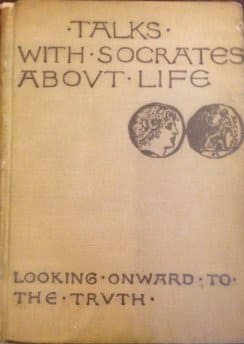
In the midst of this and her other pursuits, Mason evidently found time to devote to her own studies, especially Classics. In 1879, Charles Scribner’s Sons published a volume of her translation of some selections from Plato, Socrates: A Translation of the Apology, Crito, and Parts of the Phaedo of Plato. The translation was anonymous, though her identity was known by 1880,14 and her work carried the endorsement of a glowing introduction by Harvard Greek professor W.W. Goodwin. This was followed by three more volumes of Plato selections: A Day in Athens with Socrates (1883), Talks with Socrates About Life (1886), and Talks with Athenian Youths (1890). The Athenæum has copies of three of these books with publishers’ cloth bindings designed by Sarah Wyman Whitman.

Mason’s selected translations proved extremely popular and went into several editions. There is also a possibility that Ida Mason collaborated in this well-received work.15 To quote one favorable review, from the New York Times: “We have carefully compared the present translations with Jowett’s, Whewell’s, Victor Cousin’s and others, and they seem to us to convey more of the original tone of the Greek, and at the same time to be more in harmony with modern style than any of those famous versions.”16 This review established that her command of the Greek was equal if not superior to that of her formally educated male contemporaries. Her ability to render her translations into good English was also considered top-notch.

This latter quality is also telling because it conveys the accessibility of her translations, both as an introduction to life in ancient Athens and to the most famous of Plato’s works: “The translator is deserving of the warm thanks of all who have not had the advantage of what is called a liberal education, for placing within their reach a volume that contains the essence of writings that the scholar has toiled after. It is a model translation in every respect, and one that can be easily read and understood.” One might detect a hint of condescension in the words “within their reach” and “easily read and understood,” as if the complexity of the original must naturally be simplified for the beginning (female?) reader of Plato.

On the other hand, it is easy to imagine Mason writing for precisely that audience, those who, without the “advantage” of years of classroom recitation and irregular Attic Greek verb conjugation, still wanted to engage with some of the most foundational texts of Western philosophy and literature. And study them further, if so inclined. It is not clear how Mason acquired her knowledge of ancient Greek. The fact that Professor W.W. Goodwin of Harvard’s Greek department wrote the introductions to all four of her books is significant, but although he did give private instruction to female students,17 there is no evidence that he was her tutor.

Mason’s involvement with the cause of women in higher education would continue for the rest of her life. One particular moment stands out: on May 22, 1882, an organization was formed called The Society for the Collegiate Instruction of Women, “whose purpose was to promote the education of women with the assistance of the instructors in Harvard University.”18 Two of the signers of that original agreement were Professor Goodwin and Ellen F. Mason. Its formal name was rarely used; it was commonly known as “Harvard Annex,” and would later become Radcliffe College.19 Mason remained associated with Radcliffe well into the 1900s, and she is listed as an Associate (trustee) in 1914.20

When Ellen F. Mason died on April 28, 1930, her estate was valued at approximately $5,000,000. Her money, according to The Boston Globe, was “left largely to charitable and altruistic purposes,”21 so as to benefit institutions in Boston and throughout the country.​ She was well-known in Newport, too, where she was president of the Civic League for many years. Those familiar with Rhode Island Avenue will recognize Mason’s distinctive mansion (rebuilt in 1901 after a fire destroyed the one her father had built) as the current home of the St. Michael’s Country Day School.22 While one could hope for an account of her life or some parts of it in her own words, the record as it stands shows that she was widely known for her generosity, philanthropy, and life-long commitment to improving educational opportunities for women, as well as furthering her own studies. It is entirely possible the Athenæum’s collections, only a stroll away from her Beacon Street home, helped her in all these pursuits.

Book cover: Talks with Athenian Youths

Book cover, photo courtesy of Kaelin Rasmussen. 

1. Winthop, Robert C., Jr. “Memoir of Robert Means Mason,” Proceedings of the Massachusetts Historical Society 18 (1880–1881): 302–317, 304. 12. Memoir, Autobiography, and Correspondence of Jeremiah Mason: reproduction of the privately printed edition of 1873. (Kansas City: Lawyers International Publishing Co.), 473.3. Jeremiah Mason, 4734. Holly, H. Hobart. “Aldrich Center: One Walnut Street, Boston, Mass.” Accessed April 21, 2017. http://www.aldrichcenter.org/aldrich/file/Long_History.pdf.5. Winthrop, “Robert Means Mason,” 315–66. Lippincott, Bertram, III. “The Mason Sisters of Newport,” Newport History 75 (2006): 31–54.7. Boston Athenæum, The Boston Athenæum Centenary: The Influence and History of the Boston Athenæum from 1807 to 1907 (Boston, Mass.: The Boston Athenæum, 1907), 149.8. “The Sarah Orne Jewett Text Project.” Accessed April 21, 2017. http://www.public.coe.edu/~theller/soj/sj-index.htm.9. “Sarah Orne Jewett Diaries 1871-1879: 1 May 1871–28 December 1879.” Accessed April 21, 2017. http://www.public.coe.edu/~theller/soj/let/soj-diary-1871.html.10. Society to Encourage Studies at Home. Society to Encourage Studies at Home. (Cambridge, Mass.: Riverside Press, 1897), 13.11. Society to Encourage Studies at Home, 2.12. Society to Encourage Studies at Home, 62.13. Society to Encourage Studies at Home, 185.14. Library Journal 5 (1880): 54.15. “Mrs. Ellen F. Mason,” Boston Globe, April 29, 1930, 6.16. Plato. A Day in Athens with Socrates, trans. Ellen F. Mason (New York: Charles Scribner’s Sons, 1883), publisher’s advertisements at end.17. Kaledin, Eugenia. The Education of Mrs. Henry Adams (Philadelphia: Temple University Press, 1981), 203.18. Kaledin, 207.19. “Radcliffe College,” Wikipedia, last modified March 23, 2017, https://en.wikipedia.org/wiki/Radcliffe_College.20. Harvard University. Harvard University Catalogue, 1914–15 (Cambridge, MA: Harvard University. 1915), 842.21. “Mason will leaves millions to public,” Boston Globe, May 16, 1930, 6.22. Day, Jeff. St. Michael’s Country Day School History, accessed April 21, 2017, https://issuu.com/smcds/docs/history_of_smcds.

Selected Works

Plato. A Day in Athens with Socrates. trans. Ellen F. Mason (Cutter Classification VP .P5 .9d)
Plato. Socrates. trans. Ellen F. Mason (TBMR VP .P5 .9m)
Plato. Talks with Athenian Youths. trans. Ellen F. Mason (TBMR VP .P5 .9t)
Plato. Talks with Socrates About Life. trans. Ellen F. Mason (TBMR VP .P5 .9ta)

04.05.2017

Christopher Minty

April 2017

By Carolle Morini

Tell us about how you first became interested in Americana History and about your education.
I have a BA, with First Class Honours, and a Ph.D. from the University of Stirling, Scotland. During my eight years at Stirling, I wrote an undergraduate thesis on medicine in Georgia and North Carolina in the Civil War and a doctoral dissertation on the origins of loyalism in New York City prior to the American Revolution, both of which are available in Stirling’s library. Before going to university, in 2006, I was interested in American history largely thanks to my father, who introduced me to Ken Burns’ s The Civil War, a nine episode documentary miniseries broadcast on PBS in September 1990. After I started my undergraduate studies, my interest only grew from there. In 2008, my father and I went on a tour of Civil War sites, visiting Antietam, Gettysburg, and Harper’s Ferry, among others. Toward the end of our mini-tour, I attended a small lecture by James McPherson, author of Battle Cry of Freedom (1988), at Princeton University.
 
What makes The Adams Papers exciting to you?
Working at The Adams Papers at the Massachusetts Historical Society is unique. Unlike most founding-era projects, a majority of the Adams documents we work with are held at the Society. David McCullough, author of the Pulitzer Prize-winning John Adams (2001), called the Adams Family Papers at the Society “a national treasure.” The collection comprises over 300,000 pages of manuscript material for the three generations of Adamses who were almost always a feature of public life from the American Revolution through the Geneva Arbitration of 1871–1872. The main body of the archive contains the public and private correspondence, diaries, and other papers of Presidents John Adams (1735–1826) and John Quincy Adams (1767–1848) as well as the diplomat Charles Francis Adams (1807–1886). Their wives, Abigail Adams (1744–1818), Louisa Catherine Adams (1775–1852), and Abigail Brooks Adams (1808–1889), recorded their own lives and those of their families in voluminous correspondences. Altogether, the collection offers multiple insights into nearly every aspect of early American history from the mid-eighteenth century onward. If something was happening, it’s likely that at least one of the Adamses had something to say about it!
 
Do you find a connection between the American Revolution and Scotland’s vote for independence?
Well, kind of. In the build up to the American Revolution many colonial Americans felt that Parliament didn’t represent their interests. When taxes were introduced after the French and Indian War (1754–1763), many believed they were having money taken out of their pockets without receiving the full benefits of parliamentary representation, thus the phrase “no taxation without representation.” In modern-day Scotland, many feel that Westminster doesn’t represent their interests, either. If you look at a political map of the United Kingdom and how the House of Commons is made up, Scotland is almost entirely yellow (for the Scottish National Party) and England is largely made up of blue and red (for the Conservative Party and Labour Party, respectively) with other colored dots across England, Wales, and Northern Ireland representing the Liberal Democrats, Green Party, DUP, Sinn Féin, Independents, and Plaid Cymru. Although there are many differences between then and now, the fundamental similarity is that many Scots don’t think Westminster represents their interests, largely because however its MPs vote, they can be easily outvoted. Thus you can have a situation where Scots feel marginalized.
 
What projects are you currently working on?
Obviously, volume 13 of the Adams Family Correspondence! The almost 300 letters in volume 13 were written between May 1798 and September 1799, a difficult time for President John Adams. From Quincy, a severely ill Abigail Adams wrote frequent letters to Philadelphia and received wonderfully readable responses from son Thomas Boylston and John’s newly appointed secretary and future founder of the Boston Athenæum, William Smith Shaw. The letters in volume 13 attest to John’s popularity in the wake of the XYZ Affair, but they also chronicle passage of the Alien and Sedition Acts and the Kentucky and Virginia Resolutions, which cloud Adams’s presidential legacy in spite of his successful navigation of the Quasi-War with France. Altogether, it’s a great volume! In particular, William Smith Shaw’s correspondence with Abigail Adams and Thomas Boylston Adams is particularly interesting. Outside of the Adams Papers, I am also revising my dissertation for publication and working on an edited volume on the Revolutionary War correspondence of Myles Cooper. Finally, I am finishing off an article on John Adams’s journey to Philadelphia in the summer of 1774.

Do you have a favorite Adams? 
Thomas Boylston Adams, John and Abigail’s youngest son. His letters are full of personality, wit, candor, and imagination.

What historians (or authors) do you admire?
I aspire to write like Joanne Freeman (Yale), John Cassidy (The New Yorker), and Jill Lepore (Harvard and The New Yorker). If I could be as productive as Alan Taylor (Virginia), who apparently writes for four hours each day, that would be nice, too.

Do you have a favorite book?
Two of my favorite books of the last few years are Jessica Choppin Roney’s Governed by a Spirit of Opposition (2014) and Andrew Beaumont’s Colonial America and the Earl of Halifax (2014). I am currently reading, and thoroughly enjoying, Jennifer Van Horn’s The Power of Objects in Eighteenth-Century British America (2017).

Why do you like being a member of the Athenæum?
Amid the hustle of central Boston, the Athenæum offers a peaceful respite for contemplation and a perfect venue for writing. I’ve found the fifth-floor Long Room is the perfect spot for me to settle down and write for two, three, or even four uninterrupted hours. I also have great admiration and respect for the Athenæum’s staff, many of whom have contributed to volume 13 of the Adams Family Correspondence. Several people went above and beyond in helping answer my sometimes-obscure questions, the result of which was a truly fabulous illustration of a Boston Library Society lending record for Daniel Greenleaf, a friend of the Adamses. I also have deep admiration for those in Advancement, whose work is invaluable to the Athenæum’s short- and long-term future.

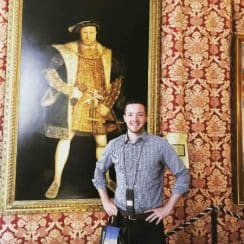
Christopher Minty

At Hampton Court Palace​, photo by Heather Lonks

Minty Publications

Adams Family Correspondence, vol. 13 (coming the the BA shelves soon)

“‘Of One Hart and One Mind’: Local Institutions and Allegiance during the American Revolution,” Early American StudiesVolume 15, Issue 1, Winter 2017.  Journal on the 2nd floor.   

 “Republicanism and the Public Good: A Re-examination of the DeLanceys, c. 1768–1769,” New York History. Volume 97, Number 1. Winter 2016. 

“A List of Persons on Long Island: Biography, Voluntarism, and Suffolk County’s 1778 Oath of Allegiance,” Long Island History Journal, Volume 24, Number 2, December 2015.

03.30.2017

Gardens

Picture Books

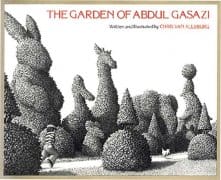
The Garden of Abdul Gasazi by Chris van Allsburg

(Children + PZ7.V266 Gar)

When the dog he is caring for runs away from Alan into the forbidden garden of a retired dog-hating magician, a spell seems to be cast over the contrary dog.

The Pea Blossom by Amy Lowry Poole

(Children + PZ8.P795 Pe 2005)

In a garden near Beijing, five peas in a shell grow and wait to discover what fate has in store for them.

The Turnip by Jan Brett

(Children Picture Book + BRETT)

Badger Girl is delighted to find the biggest turnip she has ever seen growing in her vegetable garden, but when the time comes to harvest the giant root, she is unable to pull it up without help from family and friends.

Flower Garden by Eve Bunting

(Children Picture Book BUNTI)

Helped by her father, a young girl prepares a flower garden as a birthday surprise for her mother.

The Night Gardener by The Fan Brothers

(Children Picture Book Lg FAN)

“One day, William discovers that the tree outside his window has been sculpted into a wise owl. In the following days, more topiaries appear, and each one is more beautiful than the last. Soon, William’s gray little town is full of color and life. And though the mysterious night gardener disappears as suddenly as he appeared, William—and his town—are changed forever.” — Provided by publisher.

Muncha! Muncha! Muncha! by Candace Fleming; illustrated by G. Brian Karas

(Children Picture Book + FLEMI)

After planting the garden he has dreamed of for years, Mr. McGreely tries to find a way to keep some persistent bunnies from eating all his vegetables.

And Then It’s Spring by Julie Fogliano; illustrated by Erin Stead

(Children Picture Book + FOGLI)

Simple text reveals the anticipation of a boy who, having planted seeds while everything around is brown, fears that something has gone wrong until, at last, the world turns green.

Round the Garden by Omri Glaser; illustrated by Byron Glaser

(Children Picture Book GLAS)

Traces the journey of a tear as it falls to the ground, evaporates, reappears as rain, and waters a garden to make an onion grow to produce more tears.

Flora’s Surprise by Deb Gliori

(Children Picture Book + GLIOR)

Flora, a young rabbit, tries to grow a house by planting a brick.

My Garden by Kevin Henkes

(Children Picture Book + HENKE)

After helping her mother weed, water, and chase the rabbits from their garden, a young girl imagines her dream garden complete with jellybean bushes, chocolate rabbits, and tomatoes the size of beach balls.

The Carrot Seed by Ruth Krauss; illustrated by Crockett Johnson

(Children Picture Book KRAUS)

Despite everyone’s dire predictions, a little boy has faith in the carrot he plants.

The Imaginary Garden by Andrew Larsen; illustrated by Irene Luxbacher

(Children Picture Book LARSE)

In an apartment too small for a garden to grow, Theo and her grandfather paint one instead.

The Greenling by Levi Pinfold

(Children Picture Book + PINFO)

Mr. Barleycorn picks a green baby growing on his land, unleashing the incredible power of nature. When zucchinis flower in the kitchen and carrots sprout out of their television, Mr. Barleycorn’s wife insists that the Greenling has to go. But the bounty and beauty of nature have a strange power—the power to bring a whole community together.

Fox’s Garden by Princesse Camcam

(Children Picture Book PRINC)

“One snowy night, a fox loses its way, entering a village. Chased away by the grown ups, Fox takes shelter in a greenhouse. A little boy sees this from his window. Without hesitating, he brings a basket of food to the greenhouse, where he leaves it for the fox. His gift is noticed and the night becomes a garden of new life, nourished by compassion and kindness. Princesse Camcam’s cut-paper illustrations, along with the beautiful lighting of the sets she creates, make the experience of looking at these illustrations both touching and transcendent. Their beauty and essential simplicity reflect the beauty of the story. The reader is left charmed by the fox and the child and thoughtful about the emotional lives of both humans and other creatures.” — Provided by publisher.

Grandpa Green by Lane Smith

(Children Picture Book SMITH)

A child explores the ordinary life of his extraordinary great-grandfather, as expressed in his topiary garden.

The Gardener by Sarah Stewart

(Children Picture Book + STEWA)

A series of letters relating what happens when, after her father loses his job, Lydia Grace goes to live with her Uncle Jim in the city but takes her love for gardening with her.

Pumpkin, Pumpkin by Jeanne Titherington

(Children Picture Book TITHE)

Jamie plants a pumpkin seed and, after watching it grow, carves it, and saves some seeds to plant in the spring.

The Tale of Peter Rabbit by Beatrix Potter

(Children PZ10.3.P47 Tap 27)

A mischievous rabbit encounters trouble in a farmer’s garden.

Beginning Readers

Biscuit in the Garden by Alyssa Satin Capucilli; illustrated by Pat Schories

Children Picture Book CAPUC

Biscuit the puppy is eager to see the plants and make friends with the animals in the garden.

Chapter Books

The Night Gardener by Jonathan Auxier

(Children PZ7.A931 Ni 2014)

Irish orphans Molly, fourteen, and Kip, ten, travel to England to work as servants in a crumbling manor house where nothing is quite what it seems to be, and soon the siblings are confronted by a mysterious stranger and secrets of the cursed house.

Linnea in Monet’s Garden by Christina Björk; illustrated by Lena Anderson

(Children PZ7.B52855 Lin 1987)

A young girl learns about Monet and Impressionist art through a trip to Paris.

The Children of Green Knowe by L.M. Boston

(Children PZ7.B6497 Ch)

Ghostly children haunt a manor in an overgrown garden in the English countryside.

The Secret Garden by Frances Hodgson Burnett; pictures by Tasha Tudor

(Children PZ7.B934 Se)

When bratty orphan Mary Lennox arrives at her uncle’s English manor, she and her sickly cousin Colin undergo change for the better through restoring an abandoned garden.

Seedfolks by Paul Fleischma ; illustrations by Judy Pederson

(Children PZ7.F5991 Se 1997)

One by one, a number of people of varying ages and backgrounds transform a trash-filled inner-city lot into a productive and beautiful garden, and in doing so, the gardeners are themselves transformed.

Tom’s Midnight Garden by Philippa Peace

(Children PZ7.P3145 To)

Quarantined in his aunt and uncle’s home, part of what was once a country house, Tom slips back in time and finds a friend.

Mary Poppins in Cherry Tree Lane by P.L. Travers

(Children PZ7.T689 Masn 1982)

Mary Poppins takes her charges to the Herb Garden in a park in London for a night of magic on Midsummer’s Eve.

The Dog in the Tapestry Garden by Dorothy Pulis Lathrop

(Children PZ8.L348 Do)

A lonely greyhound jumps into the old tapestry hanging on the wall to play with a little white dog woven into its garden.

Informational

Wings, Worms, and Wonder: A Guide for Creatively Integrating Gardening and Outdoor Learning into Children’s Lives by Kelly Johnson

(Children + SB324 .J64 2012)

So you have a garden, but now what do you do with it? Peppered with anecdotes and friendly advice, while based in research and experience, Wings, Worms, and Wonder answers this question. Above and beyond gardening guidance on topics such as composting and organic pest control, it gives adults the tools to reconnect themselves and the children in their lives to the natural world through holistic gardening experiences. It will ignite your confidence to create outdoor learning experiences that nurture both wonder and ecological literacy. Overflowing with tips for successfully gardening with children in school and community settings, as well as including 36 child tested lesson plans, you’ll find everything you need to seamlessly integrate gardening into both elementary curricula and daily life. Rooted in scientific and arts based Nature-Study and progressive education models, this guide is invaluable for anyone wanting to grow a thriving children’s gardening program. This book will inspire and equip you to sprout a happier, healthier generation of children! — Provided by publisher.

03.20.2017

Staff Book Suggestions Spring 2017

Pat Boulos

Norwegian By Night by Derek B. Miller
(Library of Congress Classification PZ4.M645 Nor 2013​)

Best New Crime Writer of the Year: Winner of the CWA 2013 John Creasey Dagger Award
Best of 2013, The Guardian
Best of 2013, Financial Times
Best of 2013, The Economist

David Dearinger

The Go-Between​ by L. P. Hartley
(Library of Congress Classification PZ3.H2537 Go)​​

Remember the movie starring Julie Christie and Alan Bates with a screenplay by Harold Pinter (If you do, you’re dating yourself)? If you haven’t read the book on which the movie was based—or haven’t read it in a long time and/or as an adult—you should do so. Hartley captures the innocence (and loss) of youth in beautifully constructed prose and by means of a narrative that is captivating and, from that first, famous sentence to the last page, ultimately haunting. No wonder this book, which has never been out of print, was a huge bestseller when it first came out in 1953 and again with the release of that critically acclaimed movie in 1971. Pick it up, and you won’t be able to put it down (at least emotionally) until you have finished it. Currently available in a beautifully produced paperback edition published by the New York Review of Books or, of course, at the Athenæum.

Andria Lauria
The Eyre Affair by Jasper Fforde
(Library of Congress  PZ4.F444 Ey 2002​)

Book one of the seven part (so far) Thursday Next series. Did you enjoy the style of this Author of the Month? Then I highly recommend joining protagonist Thursday Next on her often hilariously absurd ride as a literary detective. It is a wild mystery caper that primarily takes place in an alternative 1980s in which literature reigns supreme. Time-traveling is the norm, many members of society are named after famous writers (oftentimes requiring a number be tacked on one’s name, e.g. John Milton 137), some citizens belong to sects hellbent on destroying storylines from within or proving conspiratorial literary ideas (including an entire group that travels door-to-door attempting to convert people into believing that Shakespeare did not write his plays), and extinct animals have been brought back as pets! I laughed out loud at least once every few chapters. Highly enjoyable and I’m thrilled I don’t have to hunt for a new book for at least six more books from now.

Judith Maas
Max Perkins: Editor of Genius by A. Scott Berg​
(Library of Congress  CT275.P47 B47​)

When Max Perkins joined Scribner’s in 1910, the company limited itself to publishing well-established authors and sending manuscripts off to the printers with little or no editing. The atmosphere in the office was genteel and a bit musty—“Dickensian,” says Berg. In the years that followed, Perkins remade Scribner’s and redefined the role of editor. He sought out promising new novelists and guided them with infinite patience, insight, and generosity. F. Scott Fitzgerald called him “my most loyal and confident encourager and friend.”

Perkins’s efforts helped usher in modern American literature. He suggested how Fitzgerald could make Jay Gatsby a more vivid character; he persuaded a reluctant Charles Scribner to publish Hemingway’s Sun Also Rises; and he spent countless hours with Thomas Wolfe transforming mountains of manuscript pages into Look Homeward Angel and Of Time and the River. Describing these collaborations, Berg explores both their professional and personal sides. He succeeds in making a book about a quiet, modest man who spent most of his life hard at work in the office an enthralling read.

Elizabeth McCullough
A Life In Parts by Bryan Cranston
(Library of Congress NEW  CT275.C735 A3 2016)

A Life In Parts is a breezy read with serious undertones. Cranston hasn’t had an easy life, but it’s all grist for his work as an actor in such parts as Walter White (Breaking Bad) and LBJ (All the Way). Highly recommended, especially if you’re a fan.

Kaelin Rasmussen
Time Travel: A History by James Gleick
(Library of Congress NEW QC173.59.S65 G54 2016​)

I really enjoyed this book—to me, it read like a perfect blend of literary criticism, cultural history, and popular science. And the discussion of the real life scientific concepts was well written and accessible to one such as me who has always been rather afraid of math! Description: Gleick’s story begins at the turn of the twentieth century with the young H.G. Wells writing and rewriting the fantastic tale that became his first book, an international sensation, The Time Machine.  A host of forces were converging to transmute the human understanding of time, some philosophical and some technological—the electric telegraph, the steam railroad, the discovery of buried civilizations, and the perfection of clocks. Gleick tracks the evolution of time travel as an idea in the culture—from Marcel Proust to Doctor Who, from Woody Allen to Jorge Luis Borges. He explores the inevitable looping paradoxes and examines the porous boundary between pulp fiction and modern physics. Finally, he delves into a temporal shift that is unsettling our own moment: the instantaneous wired world, with its all-consuming present and vanishing future.

The Three-Body Trilogy by Cixin Liu

The Three-Body Problem translated by Ken Liu
(Library of Congress PZ4.L735 Th 2014​)

The Dark Forest translated by Joel Martinsen
(Library of Congress NEW PZ4.L735 Da 2015​)

Death’s End translated by Ken Liu
(Library of Congress NEW PZ4.L735 De 2016​)

This massive trilogy was written by Cixin Liu, one of China’s most popular science fiction writers. It’s easy to see why, now he’s one of my favorites, too. The English translation of the first book, The Three-Body Problem, debuted to rave reviews (even in the New Yorker), and won the Hugo Award in 2015. All this to say—it’s excellent! One sprawling work in three parts, this trilogy begins against the backdrop of the Cultural Revolution in China, and revolves around the story of one traumatized young scientist and the impact that the decisions of one person can have on the course of human history in its very largest sense. It’s a story of first contact, about humanity’s reaction to the fact that we’re not alone in the universe. It begins a bit slowly, with what seems to be very elaborate stage dressing, but it builds momentum as it goes along, every detail is significant, and plot twists and revelations hit with a bang. Fans of vintage Golden Age science fiction (Asimov, Clarke, et al.) will revel in this superbly written, thought-provoking epic!!

Casey Riley

The Civil Wars of Julia Ward Howe by Elaine Showalter

(Library of Congress CT275.H69 .S56 2016)

A terrific biography—comprehensively researched, well-paced, insightful. Showalter largely avoids speculation with regard to her subject’s motivations, drawing instead upon Howe’s own writing—both published and private—to illuminate her ambitions and frustrations. In Showalter’s account, Howe’s accomplishments in writing, public speaking, and political organizing are all the more remarkable given the state of her marriage to Samuel Gridley Howe, who was by turns a jealous, manipulative, and abusive partner. After the [merciful? timely?] death of her husband in 1876, JWH devoted herself to a number of causes related to women’s rights, thereby distinguishing herself as a leader and ensuring her status as an icon of late nineteenth century feminism. Showalter’s account is a sympathetic but clear-eyed review of JWH’s accomplishments and character, and as such is an enriching, engrossing read.

Mary Warnement

Meetings with Remarkable Manuscripts by Christopher De Hamel

(Library of Congress NEW Z106.5.E85 D44 2016)

If you enjoy medieval history and book history, then you want to check this hefty volume out.

This book is a commitment; it has over 600 pages, including endnotes, and those notes, in spite of their tiny font, are well worth reading. They point to fascinating classics, obscure articles, and academic in-fighting; not that De Hamel shies from that in his text. He is particularly scathing in his descriptions of the use of white gloves in rare book reading rooms. As a librarian myself, I felt for my counterparts. I understand their perspective, although I know that white gloves are not necessary. In all fairness, he is studying nine treasures; the white glove treatment may have been special for him. Though he has an Oxbridge pedigree, a long tenure at Sotheby’s, and a well-known reputation, he is an enthusiast and encourages all his readers to visit rare book rooms to study the originals. He goes even farther and tells general readers that the small group of specialists in medieval manuscripts is welcoming and would enjoy engagement. I am curious to know if he is correct, so start reading and get out there to find this community of scholars. You may want to wait until this book is no longer new, but you can always contact the Circulation Desk and request renewals. We are a welcoming bunch too.

03.02.2017

Immigrants and Refugees

Picture Books

Watch the Stars Come Out by Riki Levinson; illustrated by Diane Goode

(Children + PZ7 .L5796 Wat 1985)

Grandma tells about her mama’s journey to America by boat, years ago.

Grandfather’s Journey by Allen Say

(Children + PZ7 .S2744 Gr 1993)

A Japanese American man recounts his grandfather’s journey to America which he later also undertakes, and the feelings of being torn by a love for two different countries.

Tea with Milk by Allen Say

(Children + PZ7 .S2744 Te 1999)

After growing up near San Francisco, a young Japanese woman returns with her parents to their native Japan, but she feels foreign and out of place.

The Arrival by Shaun Tan

(Children Lg PZ7 .T16123 Ar 2006)

In this wordless graphic novel, a man leaves his homeland and sets off for a new country, where he must build a new life for himself and his family.

Somos Como Las Nubes = We Are Like the Clouds by Jorge Argueta; pictures by Alfonso Ruano; translated by Elisa Amado

(Children Picture Book ARGUE)

Why are young people leaving their country to walk to the United States to seek a new, safe home? Over 100,000 such children have left Central America. This book of poetry helps us to understand why and what it is like to be them. ¿Por qué los jóvenes que salen de su país para caminar a los Estados Unidos para buscar un hogar nuevo y seguro? Más de 100.000 niños han salido de Centroamérica. Este libro de poesía nos ayuda a entender por qué y cómo es ser ellos.

Two White Rabbits by Jairo Buitrago; pictures by Rafael Yockteng; translated by Elisa Amado

(Children Picture Book BUITR)

“In this moving and timely story, a young child describes what it is like to be a migrant as she and her father travel north toward the US border. They travel mostly on the roof of a train known as The Beast, but the little girl doesn’t know where they are going. She counts the animals by the road, the clouds in the sky, the stars. Sometimes she sees soldiers. She sleeps, dreaming that she is always on the move, although sometimes they are forced to stop and her father has to earn more money before they can continue their journey. As many thousands of people, especially children, in Mexico and Central America continue to make the arduous journey to the US border in search of a better life, this is an important book that shows a young migrant’s perspective.”—Provided by publisher.

The Matchbox Diary by Paul Fleischman; illustrated by Bagram Ibatoulline

(Children Picture Book + FLEIS)

Follow a girl’s perusal of her great-grandfather’s collection of matchboxes and small curios that document his poignant immigration journey from Italy to a new country.

Tomás and the Library Lady by Pat Mora; illustrated by Raúl Colón

(Children Picture Book + MORA)

While helping his family in their work as migrant laborers far from their home, Tomás finds an entire world to explore in the books at the local public library.

Stepping Stones: A Refugee Family’s Journey by Margriet Ruurs; artwork by Nizar Ali Badr; translation into Arabic by Falah Raheem

(Children Picture Book RUURS)

“This unique picture book was inspired by the stone artwork of Syrian artist Nizar Ali Badr, discovered by chance by Canadian children’s writer Margriet Ruurs. The author was immediately impressed by the strong narrative quality of Mr. Badr’s work, and, using many of Mr. Badr’s already-created pieces, she set out to create a story about the Syrian refugee crisis. Stepping Stones tells the story of Rama and her family, who are forced to flee their once-peaceful village to escape the ravages of the civil war raging ever closer to their home. With only what they can carry on their backs, Rama and her mother, father, grandfather and brother, Sami, set out to walk to freedom in Europe. Nizar Ali Badr’s stunning stone images illustrate the story.”—Provided by publisher.

The Journey by Francesca Sanna

(Children Picture Book SANNA)

What is it like to have to leave everything behind and travel many miles to somewhere unfamiliar and strange? A mother and her two children set out on such a journey; one filled with fear of the unknown, but also great hope. Based on the author’s interactions with people forced to seek a new home, and told from the perspective of a young child.

The Quiet Place by Sarah Stewart; illustrated by David Small

(Children Picture Book + STEWA)

A little girl moves to the United States from Mexico with her family and writes letters to her aunt in Mexico about her new life.

A Piece of Home by Jerri Watts; illustrated by Hyewon Yum

(Children Picture Book + WATTS)

When Hee Jun’s family moves from Korea to West Virginia he struggles to adjust to his new home. He can’t understand anything the teacher says, and even the sky seems smaller and darker. Hee Jun begins to learn English words and make friends on the playground. One day at a classmate’s house he sees a flower he knows from his garden in Korea: mugunghwa, or rose of Sharon. Hee Jun is happy to bring a shoot to his grandmother to plant a “piece of home” in their new garden.

Yoko Learns to Read by Rosemary Wells

(Children Picture Book WELLS)

Despite the doubts of some classmates and her native-born Japanese mother’s inability to read English, Yoko finds the key to reading and catches up with the other students in putting new leaves on the classroom’s book tree.

Chapter Books

The Circuit: Stories from the Life of a Migrant Child by Francisco Jiminez

(Children PS3560 .I55 C57 1997)

An autobiographical novel based in part on the author’s journey from Mexico to the US.

I Lived on Butterfly Hill by Marjorie Agosín; translated from the Spanish by E.M. O’Connor; illustrated by Lee White

(Children PZ7 .A2686 Iah 2014)

When her beloved country, Chile, is taken over by a militaristic, sadistic government, Celeste is sent to America for her safety and her parents must go into hiding before they “disappear.”

Echoes of the White Giraffe by Sook Nyul Choi

(Children PZ7 .C44626 Ec 1993)

Fifteen-year-old Sookan, the heroine of Year of Impossible Goodbyes, adjusts to life in the refugee village in Pusan, a city in a southern province of Korea. The Korean War is raging, and Sookan has again been separated from her father and older brothers. She continues to hope that the civil war will end and her family will be reunited in Seoul. Her immediate concerns, though, are those of any teenage girl: friendships, studies, and most of all, a first romance.

Wild Girl by Patricia Reilly Giff

(Children PZ7 .G3626 Wh 2009)

When twelve-year-old Lidie leaves Brazil to join her father and brother on a horse ranch in New York, she has a hard time adjusting to her changed circumstances, as does a new horse that has come to the ranch.

The Children of the King by Sonya Hartnett

(Children PZ7 .H266 Ch 2014)

“Cecily and Jeremy have been sent to live with their uncle Peregrine in the English countryside, safe from the war, along with a young refugee named May. But when Cecily and May find two mysterious boys hiding in the ruins of a nearby castle, an extraordinary adventure begins.”—Provided by publisher.

The Midnight Zoo by Sonya Hartnett

(Children PZ7 .H266 Mid 2011)

Twelve-year-old Andrej, nine-year-old Tomas, and their baby sister Wilma flee their Romany encampment when it is attacked by Germans during World War II, and in an abandoned town they find a zoo where the animals tell their stories, helping the children understand what has become of their lives and what it means to be free.

A Handful of Stars by Cynthia Lord

(Children PZ7 .L87734 Ha 2015)

When her blind dog slips his collar, twelve-year old Lily meets Salma Santiago, a young Hispanic girl whose migrant family is in Maine for the blueberry-picking season, and, based partly on their mutual love of dogs, the two forge a friendship while painting bee boxes for Lily’s grandfather—but as the Blueberry Queen pageant approaches Lily and Selma are confronted with some of the hard truths of prejudice and migrant life.

Shadow by Michael Morpugo

(Children PZ7 .M82712 Sh 2012)

Teenager Aman and his mother lose their loyal spaniel Shadow while escaping Afghanistan to flee to England. Now they must depend on a friend and his grandfather to enable Shadow’s return.

West of the Moon by Margi Preus

(Children PZ7 .P9271 We 2014)

In nineteenth-century Norway, fourteen-year-old Astri, whose aunt has sold her to a mean goatherder, dreams of joining her father in America.

My Family for the War by Anne C. Voorhoeve ; translated by Tammi Reichel

(Children PZ7 .V944 My 2012)

Before the start of World War II, ten-year-old Ziska Mangold, who has Jewish ancestors but has been raised as a Protestant, is taken out of Nazi Germany on one of the Kindertransport trains, to live in London with a Jewish family, where she learns about Judaism and endures the hardships of war while attempting to keep in touch with her parents, who are trying to survive in Holland.

Young Adult

A Step from Heaven by An Na

(Young Adult PZ7 .N14 St 2001)

A young Korean girl and her family find it difficult to learn English and adjust to life in America.

The Other Side of Truth by Beverly Naidoo

(Young Adult PZ7 .N1455 Ot 2001)

Smuggled out of Nigeria after their mother’s murder, Sade and her younger brother are abandoned in London when their uncle fails to meet them at the airport and they are fearful of their new surroundings and of what may have happened to their journalist father back in Nigeria.

Habibi by Naomi Shihab Nye

(Young Adult PZ7 .N976 Hab 1997)

When fourteen-year-old Liyanne Abboud, her younger brother, and her parents move from St. Louis to a new home between Jerusalem and the Palestinian village where her father was born, they face many changes and must deal with the tensions between Jews and Palestinians.

Salt to the Sea: A Novel by Ruta Sepetys

(Young Adult PZ7 .S47957 Sa 2016)

“World War II is drawing to a close in East Prussia, and thousands of refugees are on a desperate trek toward freedom. When their paths converge in route to the ship that promises salvation, Joana, Emilia, and Florian find their strength, courage, and trust in one another tested with each step closer toward safety. When tragedy strikes the Wilhelm Gustloff, they must fight for the same thing: survival.”—Provided by publisher.

The Sun is Also a Star by Nicola Yoon

(Young Adult PZ7 .Y79 Su 2016)

“Two teens—Daniel, the son of Korean shopkeepers, and Natasha, whose family is here illegally from Jamaica—cross paths in New York City on an eventful day in their lives—Daniel is on his way to an interview with a Yale alum, Natasha is meeting with a lawyer to try and prevent her family’s deportation to Jamaica—and fall in love.”—Provided by publisher.

Informational Texts

Uprooted: The Japanese American Experience During World War II by Albert Marrin

(Children D769.8 .A6 M329 2016)

“Just seventy-five years ago, the American government did something that most would consider unthinkable today: it rounded up over 100,000 of its own citizens based on nothing more than their ancestry and, suspicious of their loyalty, kept them in concentration camps for the better part of four years. How could this have happened? Uprooted takes a close look at the history of racism in America and follows the treacherous path that led one of our nation’s most beloved presidents to make this decision. Meanwhile, it illuminates the history of Japan and its own struggles with racism and xenophobia, which led to the bombing of Pearl Harbor, ultimately tying the two countries together.”—Provided by publisher.

The Journey that Saved Curious George: The True Wartime Escape of Margret and H.A. Rey by Louise Borden; illustrated by Allan Drummond

(Children + CT275 .R46 B67 2005)

“In 1940, Hans and Margret Rey fled their Paris home as the German army advanced. They began their harrowing journey on bicycles, pedaling to Southern France with children’s book manuscripts among their few possessions.”—Provided by publisher.

This Land is Our Land: A History of American Immigration by Linda Barrett Osborne

(Children + E184 .A1 O83 2016)

“This book explores the way government policy and popular responses to immigrant groups evolved throughout U.S. history and the fundamental ways in which immigration forms an essential part of the American identity. The book also recounts the experiences of three centuries of immigrants in their own words.”—Provided by publisher.

01.27.2017

Black Poetry, Black History

February is Black History Month, but we hope you’ll refer to this list of poetry, verse biographies and histories, and novels in verse all year long.

Voice of Freedom: Fannie Lou Hamer, Spirit of the Civil Rights Movement by Carole Boston Weatherford; illustrated by Ekua Holmes

(Children + CT275 .H346 W42 2015)

Celebrates the life and legacy of civil rights advocate Fannie Lou Hamer in inspiring words and vibrant artwork.

Freedom in Congo Square by Carole Boston Weatherford; illustrated by R. Gregory Christie

(Children + F379 .N57 C667 2016)

Six days a week, slaves labor from sunup to sundown and beyond, but on Sunday afternoons, they gather with free blacks at Congo Square outside New Orleans, free from oppression. Includes foreword about Congo Square by Freddi Williams Evans, glossary, and historical notes.

Josephine: The Dazzling Life of Josephine Baker by Patricia Hruby Powell; pictures by Christian Robinson

(Children + GV1785 .B3 P68 2014)

A portrait of the passionate performer and civil rights advocate Josephine Baker, the woman who worked her way from the slums of St. Louis to the grandest stages in the world.

I, Too, Sing America: Three Centuries of African American Poetry , selected and annotated by Catherine Clinton; illustrated by Stephen Alcorn

(Children + PS591 .N4 I35 1998)

A collection of poems by African-American writers, including Lucy Terry, Gwendolyn Bennett, and Alice Walker.

Soul Looks Back in Wonder , illustrated by Tom Feelings

(Children PS591 .N4 S58 1994)

Artwork and poems by such writers as Maya Angelou, Langston Hughes, and Askia Toure portray the creativity, strength, and beauty of their African American heritage.

Bronzeville Boys and Girls by Gwendolyn Brooks; illustrated by Faith Ringgold

(Children + PS3503 .R7244 B76 2007)

A collection of poems that celebrate the joy, beauty, imagination, and freedom of childhood.

My People by Langston Hughes; photographs by Charles R. Smith Jr.

(Children PS3515 .U274 M9 2009)

Hughes’s spare yet eloquent tribute to his people has been cherished for generations. Now, acclaimed photographer Smith interprets this beloved poem in vivid sepia photographs that capture the glory, the beauty, and the soul of being a black American today.

The Poet Slave of Cuba: A Biography of Juan Francisco Manzano by Margarita Engle; art by Sean Qualls

(Children PS3555 .N4254 P64 2006)

Juan Francisco Manzano was born in 1797 into the household of wealthy slaveowners in Cuba. He spent his early years at the side of his owner’s wife, entertaining her friends. His poetry was his outlet, reflecting the beauty and cruelty of his world. Written in verse.

Blues Journey by Walter Dean Myers; illustrated by Christopher Myers

(Children PS3563 .Y48 B58 2003)

Harlem by Walter Dean Myers; illustrated by Christopher Myers

(Children Lg PS3563 .Y48 H37 1997)

Here in Harlem: Poems in Many Voices by Walter Dean Myers

(Children PS3563 .Y48 H47 2004)

Acclaimed writer Walter Dean Myers celebrates the people of Harlem with these powerful and soulful first-person poems in the voices of the residents who make up the legendary neighborhood.

Carver: A Life in Poems by Marilyn Nelson

(Children PS3573 .A4795 C37 2001)

A verse biography of George Washington Carter.

Fortune’s Bones: The Manumission Requiem by Marilyn Nelson

(Children PS3573 .A4795 F64 2004)

Fortune was a slave who lived in Waterbury, Conn., in the late 1700s. He was married and the father of 4 children. When Fortune died in 1798, his master, Dr. Porter, preserved his skeleton to further the study of anatomy. Now the skeleton is in the Mattatuck Museum where it is still being studied.

A Wreath for Emmett Till by Marilyn Nelson; illustrated by Phillipe Lardy

(Children PS3573 .A4795 W73 2005)

“In 1955 people all over the United States knew that Emmett Louis Till was a fourteen-year-old African American boy lynched for supposedly whistling at a white woman in Mississippi. The brutality of his murder, the open-casket funeral held by his mother, Mamie Till Mobley, and the acquittal of the men tried for the crime drew wide media attention. In a profound and chilling poem, award-winning poet Marilyn Nelson reminds us of the boy whose fate helped spark the civil rights movement.” — Provided by publisher.

Locomotion by Jacqueline Woodson

(Children PS3573 .O64524 L63 2003)

In a series of poems, eleven-year-old Lonnie writes about his life, after the death of his parents, separated from his younger sister, living in a foster home, and finding his poetic voice at school.

Brown Girl Dreaming by Jacqueline Woodson

(Children PS3573 .O64524 Z46 2014)

“Jacqueline Woodson, one of today’s finest writers, tells the moving story of her childhood in mesmerizing verse. Raised in South Carolina and New York, Woodson always felt halfway home in each place. In vivid poems, she shares what it was like to grow up as an African American in the 1960s and 1970s, living with the remnants of Jim Crow and her growing awareness of the Civil Rights movement. Touching and powerful, each poem is both accessible and emotionally charged, each line a glimpse into a child’s soul as she searches for her place in the world. Woodson’s eloquent poetry also reflects the joy of finding her voice through writing stories, despite the fact that she struggled with reading as a child. Her love of stories inspired her and stayed with her, creating the first sparks of the gifted writer she was to become.” — Provided by publisher.

Jazz Day: The Making of a Famous Photograph by Roxane Orgill; illustrated by Francis Vallejo

(Children + PS3615 .R45 J39 2016)

“When Esquire magazine planned an issue to salute the American jazz scene in 1958, graphic designer Art Kane pitched a crazy idea: how about gathering a group of beloved jazz musicians and photographing them? He didn’t own a good camera, didn’t know if any musicians would show up, and insisted on setting up the shoot in front of a Harlem brownstone. Could he pull it off? In a captivating collection of poems, Roxane Orgill steps into the frame of Harlem 1958, bringing to life the musicians’ mischief and quirks, their memorable style, and the vivacious atmosphere of a Harlem block full of kids on a hot summer’s day. Francis Vallejo’s vibrant, detailed, and wonderfully expressive paintings do loving justice to the larger-than-life quality of jazz musicians of the era.” — Provided by publisher

Booked by Kwame Alexander

(Children PZ7 .A3771 Bo 2016)

“In this middle grade novel-in-verse by the Newbery Medal-winning and Coretta Scott King Honor Award-winning author of The Crossover , soccer, family, love, and friendship, take center stage as twelve-year-old Nick learns the power of words as he wrestles with problems at home, stands up to a bully, and tries to impress the girl of his dreams.” — Provided by publisher.

01.10.2017

Louise Miller

February 2017

By Arnold Serapilio

Everything in its place. Clean as you go. Whether baking or writing—and Louise Miller does both—the job requires a methodical approach. “I do my best plotting and my best thinking about writing when I’m baking. I’ve worked that into my process, so now at the end of my writing day, in the evening, I make myself a list of problems and questions and I put that list next to my prep list at work in the morning. I’ve figured out more plot issues with my novel when I had to make ten apple pies,” she says, and although she’s laughing as she says this, you know it’s absolutely true. 

Miller is talking about the creation of her debut novel, The City Baker’s Guide to Country Living, much of which she wrote and revised ensconced in silence on the Athenæum’s contemplative fifth floor. She has served the Union Club as pastry chef for the past thirteen years and counting. She arrives at six in the morning, bakes until two in the afternoon, then walks around the corner to the library to write her way into the resolving evening hours. “I find there aren’t too many distractions, the three or four doors it takes me to get here, so it keeps me disciplined.”

Discipline is a recurring theme in a conversation that covers a childhood split between Watertown and Wellesley (she moved to the latter with her father when she was nine), a fortuitous opportunity to see Hamilton before it went to Broadway and exploded (she loved the show, wishes high school students could see it, and is disheartened that demand and ticket costs are so prohibitive. “I’m a big proponent of art being accessible. Anyone with a body can relate to dance.”), and a visit to the Topsfield Fair in 1999 where, on a whim, she decided to enter a pie baking contest.

Told to report to the arts and crafts building at 7:00 p.m. for the contest results, Miller arrived at the expansive, grange hall-like room to find upwards of one hundred people silently staring down three people in a glassed-off kitchen. “It felt like the lights were dimmed, and the kitchen was glowing like an aquarium,” she recalls. “The judging had run over. Everyone was just watching three people eat pie. The room was dead silent. It was so tense and bizarre. And that image haunted me for so long: what could be at stake for these people? Why would they care so much?” This encounter was the first ingredient for what would ultimately become The City Baker’s Guide to Country Living.

The story begins in Boston where protagonist Olivia Rawlings enjoys work as a pastry chef for a private club before accidentally setting ablaze the place in a baked Alaska presentation gone awry. Cuts and burns are inevitable. Rattled and in need of respite, she drives to Vermont with her dog Salty to visit her best friend Hannah and to consider her next step. To read the rest, stop by the New Book Shelves in the first-floor Bow Room.

The City Baker's Guide to Country Living, photo courtesy of Nina Subin​.

The cover of Miller’s debut novel, photo courtesy of Nina Subin​.

Work on the novel began in 2009, and in 2012, Miller received a scholarship to attend GrubStreet’s novel incubator program, where she learned her tendencies as a writer: she writes linearly, and visually too, focusing first and foremost on transcribing the events as they unfold in real time in the playground of her mind. She learned how to deliver formal critique on her peers’ work, how to cull the most useful bits of feedback from a wide and uneven sea of it, and how to not be precious about when/why/how she worked—i.e., how to be disciplined, to work any time there’s time, not just when she feels the electricity of inspiration.

As for writers who inspired her to pursue the craft, Miller was most moved by those who were writing about the mundane. Raymond Carver being so formative and transformative in this respect that she named her dog in his honor. “I couldn’t believe that someone could make art out of something so familiar to me. That was what really broke me open.”

Her excitement to create is clear both in her writing and our chat. She mentions more than once, often without my prompting, of the joy of writing, of the unadulterated pleasure of escaping into a world of her own design. “Writing this book was my refuge,” she says at one point. What, then, were some of the great struggles? “Writing is all problem solving—that’s the hardest part.” Problem solving and decision making. You make one thousand decisions, and then you make one thousand more, and one thousand more after that—and that’s only the first chapter. It can get exhausting just thinking about it, so let’s end on a more positive note.​

What was her favorite part of the entire experience, door to door? Was it the perfecting of an earlier draft? Getting the dang story sold? Or maybe helping to choose the title and cover? How about the sweet agony of sitting alone in a room in a protracted game of chicken with that smug and taunting blank page? “I think finishing the first draft was probably my favorite part,” she says. “Because I just had started a million things in my life and not finished them, and so finishing felt really, really good.” 

And as someone with the same completion complex, all I can say is: amen to