
09.28.2017

Natural Disasters

Recent natural disasters, and those most impacted by them, have been at the front of our minds. Knowing that many families have been discussing these tragedies together, we offer the following list of books.

Picture Books

Out of the Woods: A True Story of an Unforgettable Event by Rebecca Bond

(Children Children Picture Book + BOND)

“Inspired by the author’s grandfather’s experiences living in a lodge in the woods, a story of how people and animals survive a forest fire in a small Canadian town.” — Provided by publisher.

Tsunami by Kimiko Kajikawa; illustrated by Ed Young

(Children Picture Book + KAJIK)

A wealthy man in a Japanese village, who everyone calls Ojiisan, which means grandfather, sets fire to his rice fields to warn the innocent people of an approaching tsunami.

Mama by Jeanette Winter

(Children Picture Book WINTE)

A true story in which a baby hippo loses his mama during the tsunami, but finds a new home and a new mama.

Chapter Books

A City Tossed and Broken by Judy Blundell

(Children PZ7.B627146 Cit 2013)

It is 1906, and when her family is cheated out of their tavern, fourteen-year-old Minnie Bonner is forced to become a maid to the Sump family, who are moving to San Francisco—three weeks before the great earthquake.

Night of the Howling Dogs by Graham Salisbury

(Children PZ7.S15225 Ni 2007)

In 1975, eleven Boy Scouts, their leaders, and some new friends camping at Halape, Hawaii, find their survival skills put to the test when a massive earthquake strikes, followed by a tsunami.

Young Adult

Exodus by Julie Bertagna

(Children PZ7.B4627 Exo 2008)

In the year 2100, as the island of Wing is about to be covered by water, fifteen-year-old Mara discovers the existence of New World sky cities that are safe from the storms and rising waters, and convinces her people to travel to one of these cities in order to save themselves.

Love in the Time of Global Warming by Francesca Lia Block

(Children PZ7.B61945 Lo 2013)

After a devastating earthquake destroys the West Coast, causing seventeen-year-old Penelope to lose her home, her parents, and her ten-year-old brother, she navigates a dark world, holding hope and love in her hands and refusing to be defeated.

In Darkness by Nick Lake

(Children PZ7.L185 In 2012)

In the aftermath of the Haitian earthquake, fifteen-year-old Shorty, a poor gang member from the slums of Site Soleil, is trapped in the rubble of a ruined hospital, and as he grows weaker he has visions and memories of his life of violence, his lost twin sister, and of Toussaint L’Ouverture, who liberated Haiti from French rule in the 1804.

Nation by Terry Pratchett

(Children PZ7.P8865 Nat 2008)

After a devastating tsunami destroys all that they have ever known, Mau, an island boy, and Daphne, an aristocratic English girl, together with a small band of refugees, set about rebuilding their community and all the things that are important in their lives.

Beneath a Meth Moon: An Elegy by Jacqueline Woodson

(Children PZ7.W868 Ben 2012)

“A young girl uses crystal meth to escape the pain of losing her mother and grandmother in Hurricane Katrina, and then struggles to get over her addiction.” —Provided by publisher.

Informational Books

Eight Dolphins of Katrina: A True Tale of Survival by Janet Wyman Coleman

(Children QL737.C432 C563 2013)

Recounts the true story of eight bottlenose dolphins and their trainers who survived the devastation of Hurricane Katrina.

Owen & Mzee: The True Story of a Remarkable Friendship by Isabella Hatkoff, Craig Hatkoff, and Dr.Paula Kahumbu; photographs by Peter Greste

(Children QL737.U57 H38 2006)

“A one-year-old hippo calf christened Owen was found alone and dehydrated by wildlife rangers near the Indian Ocean at Malindi, Kenya, in the days after the Asian Tsunami. He was placed in an enclosure at a wildlife sanctuary in Mombasa where he befriended a male tortoise. The tortoise is named Mzee, which is Swahili for ‘old man’. Mzee ‘adopted’ Owen and they are still rarely seen apart. Their unusual bonding has surprised and delighted zoologists in Kenya and become worldwide news.” —Provided by publisher.

How We Know What We Know About Our Changing Climate: Scientists and Kids Explore Global Warming by Lynne Cherry and Gary Braasch

(Children QC981.8.C5 C475 2008)

“When the weather changes daily, how do we really know that Earth’s climate is changing? Here is the science behind the headlines – evidence from flowers, butterflies, birds, frogs, trees, glaciers and much more, gathered by scientists from all over the world, sometimes with assistance from young citizen-scientists. And here is what young people, and their families and teachers, can do to learn about climate change and take action. Climate change is a critical and timely topic of deep concern, here told in an age-appropriate manner, with clarity and hope.” —Provided by publisher.

An Inconvenient Truth: The Crisis of Global Warming by Al Gore

(Children QC981.8.G56 G675 2007)

Young readers’ version of the documentary film’s companion adult volume.

Storms by Seymour Simon

(Children + QC941.3 .S55 1989)

Describes the atmospheric conditions which create thunderstorms, hailstorms, lightning, tornadoes, and hurricanes and how violent weather affects the environment and people.

Drowned City: Hurricane Katrina and New Orleans by Don Brown

(Children + HV636 2005.N4 B75 2015)

“On August 29, 2005, Hurricane Katrina’s monstrous winds and surging water overwhelmed the protective levees around low-lying New Orleans, Louisiana. Eighty percent of the city flooded, in some places under twenty feet of water. Property damages across the Gulf Coast topped $100 billion. One thousand eight hundred and thirty-three people lost their lives. The tale of this historic storm and the drowning of an American city is one of selflessness, heroism, and courage—and also of incompetence, racism, and criminality. Don Brown’s kinetic art and as-it-happens narrative capture both the tragedy and triumph of one of the worst natural disasters in American history.” —Provided by publisher.
09.12.2017

Staff Book Suggestions Autumn 2017

Dani Crickman

The Best We Could Do: An Illustrated Memoir by Thi Bui

(Library of Congress NEW E184.V53 B85 2017

Thi Bui’s graphic memoir offers an intimate perspective on how war and immigration shaped one Vietnamese American family. With the birth of her own child, Bui grapples with questions about family history and the legacies that are passed down from one generation to the next. She looks to the past for answers, drawing on the oral histories she has gathered from her parents. Their stories, informed by colonialism and conflict, illuminate the events that caused them to flee Vietnam with their young children for the US. Bui is a capable visual storyteller, and her use of heavy ink lines and sepia tones works just right. The Best We Could Do is a pertinent read that delves into the deeply personal cost of war and its intergenerational impact.

A Different Pond by Bao Phi; illustrated by Thi Bui
(Children Picture Book + PHI​)

As a children’s and young adult librarian, I really can’t recommend a book from the general collection without suggesting a related book for young people. Fortunately, it’s easy in this case: Thi Bui also illustrated the recent picturebook A Different Pond, written by Vietnamese American poet Bao Phi. One morning in 1982, a father takes his young son fishing. This seemingly simple interaction brims with the complexity of its context: the pair goes out very early before the father has to leave for his second job; they fish not for fun but to save on food expenses; as they talk by the water, their conversation treads lightly on the subject of the war that forced them from their former home seven years prior. Told through the perspective of a child character, A Different Pond echoes aspects of Vietnamese immigrant experience portrayed in The Best We Could Do in a way that’s accessible for a young audience. And most important for a picturebook: Bui’s detailed illustrations are captivating, conveying a distinct sense of time and place and capturing the quiet poignancy of Phi’s prose.

Nicole Critchley

Polaroid: The Magic Material​ by Florian Kaps

(Library of Congress TR269 .K37 2016)

This is a timely read as Polaroid (the company) is back to making instant film! Written by one of the founders of The Impossible Project, which kept instant film alive after Polaroid stopped making it in 2008. The book talks about how instant film and the Polaroid influenced visual culture and what led to the start of the The Impossible Project.

Andria Lauria

The Southern Reach Trilogy (AnnihilationAuthorityAcceptance) by Jeff VanderMeer

(Library of Congress PZ4.V237)

According to VanderMeer’s Amazon page, he is “called ‘the weird Thoreau.’” Intrigued? Stephen King calls the trilogy “…creepy and fascinating.” Interested yet? The first book, Annihilation, has been made into a movie, set to be released early next year. What are you waiting for—go check these out already! As a fan of both sci-fi and horror novels, I could not escape this trilogy. I was at once perplexed, intrigued, thrilled, and uncomfortable. The pacing and descriptions of the landscape, with all of its horrors, had me clenching my jaw with both dread and excitement. What the hell is going on?! I had vivid dreams filled with nightmarish plants and fantastical animals while reading the trilogy and for weeks afterwards. A horrific adventure!

Carolle Morini

O Pioneers! by Willa Cather

(Library of Congress PZ3.C2858 Op​)

Review from Goodreads: Published in 1913. Sharp physical realities and the mythic sweep of the transformation of the American frontier—and the transformation of the people who settled it. Cather’s heroine is Alexandra Bergson, who arrives on the wind-blasted prairie of Hanover, Nebraska as a girl and grows up to make it a prosperous farm. But this archetypal success story is darkened by loss, and Alexandra’s devotion to the land may come at the cost of love itself.

Kaelin Rasmussen

Journey to the Abyss: The Diaries of Count Harry Kessler, 1880–​1918 / edited, translated, and with an introduction by Laird M. Easton.

(Library of Congress CT1098.K47 A3 2011)

A faithful diarist since childhood, Count Harry Kessler (1868–​1937) provides a fascinating perspective on the intellectual life of Europe, before and after World War I. Kessler was wealthy and aristocratic, with the highest of connections (Wilhelm I was a family friend), and he knew absolutely everyone in European court and artistic life. This edition covers his education and youth, and takes him through the years of the war. It’s a fascinating read. He was also founder and driving creative force of the Cranach Presse in Weimar, which printed exquisite books in limited editions—​and several of these can be found in the Athenaeum’s collections.

It by Stephen King
(Library of Congress PZ4.K5227 It)

An excellent choice for horror fans as it approaches Halloween, I revisited this childhood favorite in preparation for the new movie adaptation. The story is about a group of kids who don’t fit in, the “Losers Club,” who come together one summer to take on a monster that takes the shape of a clown and preys on the children of their hometown, the fictitious Derry, Maine. I think one of the most interesting things about this admittedly escapist book is King’s portrayal of the impact of human evil, cruelty, and apathy, alongside the more flamboyant supernatural menace (the creepy evil clown). Perhaps most frightening for me are some very graphic descriptions of New England winter weather!

Mary Warnement

Forgotten Land: Journeys Among the Ghosts of East Prussia by Max Egremont

(Library of Congress DK4600.P775 E47 2011)

Or the land about to be forgotten. Egremont interviewed a selection of survivors of the post-WWII diaspora and their descendants as well as a few Russians, Poles, and Lithuanians who now live in former East Prussia, and he wrote about their experiences with a sensitivity to the perspectives of each group. These memoirs combined with his own research and travels make for an intelligent read. Those interviewed seem chosen somewhat at random. Obviously, survival, a willingness to talk, or the fact that one published one’s memoirs were factors. I am not certain Kathe Kollwitz’s experiences really tell the story, because I connect her with Berlin: she was born there but she left in her teens to study art in Berlin and Munich and lived most of her life in Berlin. However, I enjoyed reading his sections about her. East Prussia, and Koenigsberg especially, were always on the edge of Germany, and now—its lands divided and distributed to Russia, Poland, and Lithuania—it lies on the edge of memory. Egremont ends with the words of Klaus Lunau, who may be the last human living who knew the old Prussia. Klaus enjoys, even in his 80s, swimming in the Baltic and advises: “You need to learn,” he says, “when to let yourself be carried along rather than struggle against the relentless grey water: also when precisely to kick free, when to strike out or to make for home.” Or be swept over by the wave of History.

Salt to the Sea by Ruth Sepetys
(Young Adult (Children’s Room) PZ7.S47957 Sa 2016)

Do not let the nearly 400-page length of this book put you off. Four voices narrate this young adult novel set during the flight of refugees—Lithuanians, Poles, and aristocratic Junkers and ordinary Germans living there—from East Prussia in 1945. Rather than distract, the multiple voices let the story build. Also, the book’s design appeals to me because it includes a two-page spread at front and back: maps of the region in 1945 and in present day. I like to pair fiction and non-fiction reading on topics that interest me, and like Egremont, Sepetys conducted similar interviews and research, which she outlines in supplemental afterwords: “author’s note,” “research and sources,” and “acknowledgments.” I liked her appeal to her readers: “What determines how we remember history and which elements are preserved and penetrate the collective consciousness? If historical novels stir your interest, pursue the facts, history, memoirs, and personal testimonies available. These are the shoulders that historical fiction sits upon. When the survivors are gone, we must not let the truth disappear with them.”

Hannah Weisman

Memoirs of a Polar Bear​ by Yoko Tawada

(Library of Congress NEW PZ4.T235 Me 2016)

Yoko Tawada’s novel, translated into English from German, explores migration, exile, and identity through three generations of polar bears in the twentieth and twenty-first centuries. Tawada blurs the lines of reality in her story as the bears display human emotions and undertake human tasks, but also have bear traits. Vignettes throughout the book hang together to shed light on the impact of migration and exile across generations.

The book is wacky, and someone else needs to read it so I can have a discussion about it.

09.11.2017

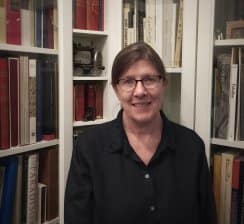
Dr. Sheila Cordner

October 2017

By Arnold Serapilio

“We seem a bit obsessed with the Victorian period today.”

Dr. Sheila Cordner is commenting on the recent uptick in the exploration of the Victorian period in American pop culture. Cordner suggests there may be something about the structure of the era that resonates—a comfort to the rigidity that scratches us right where we itch, before adding, “We love seeing characters who break out of that structure. Particularly female characters, who learn to thrive even in situations where they’re facing so many obstacles.” Perhaps the media centered on the Victorian time is a reflection of, and a way to transfigure, a shared anxiety in our society.

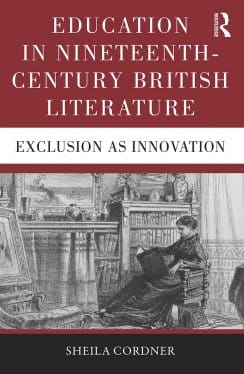
Cordner grew up in Westchester County, New York, in a house full of books, leaving home for undergraduate work at Smith College with an enduring appreciation for literature. At Smith she majored in English and spent a year at Oxford. It was during this year that she fell in love with writing and independent research. Classes demanded only an hour or two of her time per week; the rest she spent ensconced in quiet, self-directed study. She earned her masters in English and Comparative Literature at Columbia while working for Columbia University Press (acquiring a love for publishing along the way), and attributes her drive to write books, in part, as a result of meeting so many professors passionate about their own writing projects. That passion was contagious, and while pursuing her PhD in English Literature at Boston University, she began work on a dissertation that would ultimately become her new book Education in Nineteenth-century British Literature: Exclusion as Innovation, though at the time, concrete plans to expand and publish were not yet concrete. Cordner spoke at the Victorian Literature and Culture Seminar at Harvard University, the Huntington Theatre Company in Boston, and the Jane Austen Society of North America’s Massachusetts chapter, and presented her work at numerous national and international conferences. Before pursuing university teaching and academic writing, she worked in the public relations department at Carnegie Hall and at Columbia University Press in New York, and taught at Dana Hall School and Phillips Academy Andover in Massachusetts. She currently teaches in the humanities at Boston University.

Cordner was pleased to find, upon completion of her book, an infectious jones for all things Victorian in America and abroad. “It doesn’t always happen to scholars to discover the world at large is interested in the subject they’ve been working on. It was thrilling.” Even more thrilling is the fact that she has an engaged and enthusiastic audience for her book, that it appeals across demographics. In fact she describes the positive feedback, from within educational circles and from without, as the great joy of the whole process. The great struggle? Keeping herself from pursuing the myriad tangents of interest that unfurled before her as she immersed herself in research.

“I met my editor at a conference I attended in Venice. We were sitting in this piazza. She had read one of my other essays that I’d published in another book and asked if we could meet at this conference. It was a very wonderful first meeting.” Prior to the book’s publication in England and New York in 2016, Cordner rewrote and revised much of the text at the Boston Athenæum. A friend had once shown her around the building and Cordner was struck by the atmosphere. When she knew she needed a quiet place to finish her book, she signed up for membership and made her way to the fifth floor to work undisturbed, aligning herself with a Boston writer’s tradition that spans centuries and genres alike. Mornings are when the writing gets done, and research is for afternoons.

Cordner's book cover

Cordner’s new book, published in 2016.

In her book, Cordner unpacks a history of traditional education models in nineteenth century Britain, and the ingenuity that some prominent figures—including Jane Austen, Elizabeth Barrett Browning, and Thomas Hardy—leveraged to forge their own path in the face of an exclusionary system. She traces how these well-known authors, excluded from Oxford and Cambridge because of their gender or social class, carved out their own path of rigorous independent learning. Cordner set out to write a book that could be readily understood and enjoyed by both experts and non: “As an academic and professor, one of my main goals is to make these great works of literature more accessible.” That the book has been so well-received is a testament to her lucid and compelling prose.

Having researched Victorian education extensively, Cordner is surprised at how relevant the concerns of the time are to today’s discourse. “It strikes me how so many of these debates are still ongoing.​ Standardized testing, for example. I was interested in the Victorian period because this was when education was made accessible to the masses for the first time in Britain’s history. It wasn’t until 1870 that Parliament passed legislation paving the way for a universal education system. You picked up a Victorian periodical [then] and I guarantee you there’d be some reference to these education debates. It was such a hot topic of conversation and people were so troubled by it. ‘What will happen if we give the masses education? We want to give them just enough to keep them out of the pubs, but not enough to get them to overturn the rigid class structure.’” What have we inherited, good or bad, from these older approaches? What are the echoes? Cordner mentions standardized testing and the attendant limitations, but in the positive column, there is a push to emphasize the value of independent learning, and imaginative, innovative thinking, thanks to the ground work laid down by Austen et al.

This December Cordner will present at the Boston University Women’s Guild, discussing the current fascination with the Victorian Era.​ She has some projects on the horizon, among them a new book in the works about how Victorian children’s literature responded to education reform. Keep your eyes peeled! 

08.30.2017

School

Picture Books

David Goes to School by David Shannon

(Children + PZ7.S52865 Dav 1999)

David’s activities in school include chewing gum, talking out of turn, and engaging in a food fight, causing his teacher to say over and over, “No, David!”

I Am Absolutely Too Small for School by Lauren Child

(Children Picture Book + CHILD)

When Lola is worried about starting school, her older brother Charlie reassures her.

Back to School for Rotten Ralph by Jack Gantos; illustrated by Nicole Rubel

(Children Picture Book GANTO)

Afraid of being left alone, Rotten Ralph, the nasty red cat, follows Sarah to school and tries to prevent her from making new friends.

Wemberly Worried by Kevin Henkes

(Children Picture Book + HENKE)

A mouse named Wemberly, who worries about everything, finds that she has a whole list of things to worry about when she faces the first day of nursery school.

Flight School by Lita Judge

(Children Picture Book + JUDGE)

Little Penguin, who has the “soul of an eagle,” enrolls in flight school.

School’s First Day of School by Adam Rex; illustrated by Christian Robinson

(Children Picture Book + REX)

“It’s the first day of school at Frederick Douglass Elementary and everyone’s just a little bit nervous, especially the school itself.” —Provided by publisher.

Miss Bindergarten Gets Ready for Kindergarten by Joseph Slate; illustrated by Ashley Wolff

(Children Picture Book + SLATE)

Introduces the letters of the alphabet as Miss Bindergarten and her students get ready for kindergarten.

Ming Goes to School by Deirdre Sullivan; illustrated by Maja Löfdahl

(Children Picture Book + SULLI)

Ming goes to preschool, where she bravely plays all kinds of games with new friends and old, but she is still not quite ready for the big red slide.

Emily’s First 100 Days of School by Rosemary Wells

(Children Picture Book Lg WELLS)

Starting with number one for the first day of school, Emily learns the numbers to one hundred in many different ways.

Yoko Learns to Read by Rosemary Wells

(Children Picture Book WELLS)

Despite the doubts of some classmates and her native-born Japanese mother’s inability to read English, Yoko finds the key to reading and catches up with the other students in putting new leaves on the classroom’s book tree.

Middle Grade

Booked by Kwame Alexander

(Children PZ7.A3771 Bo 2016)

“In this middle grade novel-in-verse by the Newbery Medal-winning and Coretta Scott King Honor Award-winning author of The Crossover, soccer, family, love, and friendship, take center stage as twelve-year-old Nick learns the power of words as he wrestles with problems at home, stands up to a bully, and tries to impress the girl of his dreams.” —Provided by publisher.

Frindle by Andrew Clements

(Children PZ7.C59118 Fr 1996)

When he decides to turn his fifth grade teacher’s love of the dictionary around on her, clever Nick Allen invents a new word and begins a chain of events that quickly moves beyond his control.

The School for Good and Evil by Soman Chainani

(Children PZ7.C34874 Sc 2013)

Best friends Sophie (princess wannabe) and Agatha (witchy loner) are headed (via kidnapping) to the School for Good and Evil, but their assumed destinies are reversed.

George by Alex Gino

(Children PZ7.G379 Ge 2015)

“When people look at George, they think they see a boy. But she knows she’s not a boy. She knows she’s a girl. George thinks she’ll have to keep this a secret forever. Then her teacher announces that their class play is going to be Charlotte’s Web. George really, really, REALLY wants to play Charlotte. But the teacher says she can’t even try out for the part . . . because she’s a boy. With the help of her best friend, Kelly, George comes up with a plan. Not just so she can be Charlotte — but so everyone can know who she is, once and for all.” —Provided by publisher.

Clara Lee and the Apple Pie Dream by Jenny Han

(Children PZ7.H185 Cl 2014)

Korean American fourth-grader Clara Lee longs to be Little Miss Apple Pie, and when her luck seems suddenly to change for the better, she overcomes her fear of public speaking and enters the competition.

Amina’s Voice by Hena Kahn

(Children PZ7.K496 Am 2017)

“A Pakistani-American Muslim girl struggles to stay true to her family’s vibrant culture while simultaneously blending in at school after tragedy strikes her community.” —Provided by publisher.

Goodbye Stranger by Rebecca Stead

(Children PZ7.S80857 Go 2015)

Bridge is an accident survivor who’s wondering why she’s still alive. Emily has new curves and an almost-boyfriend who wants a certain kind of picture. Tabitha sees through everybody’s games—or so she tells the world. The three girls are best friends with one rule: No fighting. Can it get them through seventh grade?… This year everything is different for Sherm Russo as he gets to know Bridge Barsamian. What does it mean to fall for a girl—as a friend?… On Valentine’s Day, an unnamed high school girl struggles with a betrayal. How long can she hide in plain sight?

When You Reach Me by Rebecca Stead

(Children PZ7.S80857 Wh 2009)

As her mother prepares to be a contestant on the 1980s television game show, “The $20,000 Pyramid,” a twelve-year-old New York City girl tries to make sense of a series of mysterious notes received from an anonymous source that seems to defy the laws of time and space.

Young Adult

New Boy by Julian Houston

(Children PZ7.H823 Ne 2005)

As a new sophomore at an exclusive boarding school, a young black man is witness to the persecution of another student with bad acne.

The Disreputable History of Frankie Landau-Banks by E. Lockhart

(Children PZ7.L79757 Dis 2008)

Sophomore Frankie starts dating senior Matthew Livingston, but when he refuses to talk about the all-male secret society that he and his friends belong to, Frankie infiltrates the society in order to enliven their mediocre pranks.

Lucy and Linh by Alice Pung

(Children PZ7.P98 Lu 2016)

“Lucy is a bit of a pushover, but she’s ambitious and smart, and she has just received the opportunity of a lifetime: a scholarship to a prestigious school, and a ticket out of her broken-down suburb. Though she’s worried she will stick out like badly cut bangs among the razor-straight students, she is soon welcomed into the Cabinet, the supremely popular trio who wield influence over classmates and teachers alike. Linh is blunt, strong-willed, and fearless—everything Lucy once loved about herself. She is also Lucy’s last solid link to her life before private school, but she is growing tired of being eclipsed by the glamour of the Cabinet. As Lucy floats further away from the world she once knew, her connection to Linh—and to her old life—threatens to snap. Sharp and honest, Alice Pung’s novel examines what it means to grow into the person you want to be without leaving yourself behind.” — Provided by publisher

Informational

Tinker vs. Des Moines: Student Protest by Leah Farish

(Children KF228.T56 F37 1997)

Considers the landmark case that dealt with the rights of students to wear arm bands to protest U.S. involvement in the Vietnam War.

The Forbidden Schoolhouse: The True and Dramatic Story of Prudence Crandall and Her Students by Suzanne Jurmain

(Children LA2317.C73 J87 2005)

Narrative nonfiction, supplemented by black-and-white photographs and engravings, about Prudence Crandall’s school for African American girls opened in 1833.

Poetry

Miss Crandall’s School for Young Ladies & Little Misses of Color by Elizabeth Alexander & Marilyn Nelson; pictures by Floyd Cooper

(Children PS3551.L3494 M57 2007)

The story of Prudence Crandall’s school for African American girls, told in verse.

Locomotion by Jacqueline Woodson

(Children PS3573.O64524 L63 2003)

In a series of poems, eleven-year-old Lonnie writes about his life, after the death of his parents, separated from his younger sister, living in a foster home, and finding his poetic voice at school.

08.29.2017

John Fiske

September 2017

Interview by Kaelin Rasmussen

This month’s Athenæum Author is local writing teacher John Fiske. In June, he sat down with me for an informal conversation about himself, his new book (his first), and what he likes best about being a member of the Athenæum.

Mr. Fiske was born in Boston, has lived in the area his whole life, and now lives in Beverly. He has a BA in history from Trinity College in Hartford and a Master in education from Lesley University. Currently, he teaches English composition at the college level at Bunker Hill Community College in Charlestown. Many of his students are non-native English speakers.

He has been a member of the Athenæum for 14 years, but he has known about us since the late 1970s. At first, he told me, he thought one had to be part of “some sort of privileged, exalted class” to join. He was pleased to discover this was not the case.

Since becoming a member, he has felt a strong connection between the Athenæum’s collections and his work as an educator.

Q: What appeals to you about the Athenæum​ and being a member here?

A: It’s all about literacy, and books, obviously. And given what I do in the classroom, which is to promote literacy, the two just make perfect sense. I really enjoy the collections here, they’re better and different than at a public library. There’s a little bit higher level here, and what’s more, it’s quiet ]laughs]! The Athenæum just connects to what I do in the classroom. And I know I’ve taken books out of here to use in the classroom.

We also spoke about his new novel, Titan’s Gold, and he described to me how he got the idea for the book, the process of writing it, and some of his real life inspirations.

First, a brief summary of Titan’s Gold: it is a science fiction story based on a classic what-if. It is a fact that the NASA/ESA probe Huygens landed on the surface of Titan, Saturn’s largest moon, in 2005. But what if Huygens had discovered evidence of alien life in the form of a derelict spacecraft? The plot is built around designing, planning, and executing a mission (privately funded) to find and salvage this derelict, and bring it back into Earth’s orbit where it can be examined by a team of scientists. In the course of investigating, the team finds evidence that this abandoned alien craft might hold the secrets behind the building of the Egyptian pyramids. But there are others who want the secrets, too, making for an exciting ending that leaves the reader wanting more. Mostly, it’s a fun story, as Mr. Fiske summed it up for me: “That’s what Titan’s Gold is, it’s just fun!”

Not all the action takes place in outer space. Titan’s Gold also has some local color. The characters spend time at MIT, and readers will readily recognize several Cambridge landmarks. And Mr. Fiske’s own experience as a private pilot informs some of the action, including his experience as an observer at the Mt. Washington Wave Camp, where they do glider flights down the mountain!

Q: Tell me a little bit about Titan’s Gold.

A: Titan’s Gold came to mind not long after the European Space Agency craft Huygens landed on Titan. The idea was, what would be the reaction, what would happen if NASA found a spacecraft on another planet? And I tinkered around with it. I tried writing some preliminary chapters, and I got nowhere, for a long time. I could not figure out what the story was. And then in October 2015, I saw the movie The Martian…when I was walking out of the theater, I could feel things starting to move. I decided that the story should be about a very fundamental act, and the fundamental act would either be a chase, a fight, a rescue, or something like that. The Martian was about a rescue, that’s a very basic, human thing to do. So I thought about having the story centered around a basic human act, so the story is about recovering something, bringing something back. And then—I don’t know why this happened—but I was driving with a neighbor…and this whole thing about the pyramids rushed into my head…some people really actually do believe [laughs] the pyramids were built by aliens! From there I said, alright, I know where this is going, I know what I’m going to do. And I started to get to work, and I realized I needed to see the pyramids, so I went there. I visited the pyramids twice—there was nobody there. I was standing there all by myself, and I thought, this is pretty cool! And once I got back I really just put my head down and wrote and wrote and wrote. A lot of junk. I went through probably five drafts, and then I knew I was ready for it to be read professionally. You’ve got to have another reader, you can’t rely on your own reading. So I found a reader through GrubStreet, met with [her], and she said I should be proud of what I’d done, she said she loved it. And I didn’t make any effort to find a publisher. So by the end of March or April of this year I published it myself, it’s available on Amazon, and I’ve done a few publicity events.

Q: What was your great joy in writing the novel? And your great struggle?

A: Joy and struggle. The joy is I just like to write. It’s fun, it’s easy for me. The struggle was typical writerly stuff. Just solving problems, whether it’s point-of-view problems, or timeline problems, and keeping that stuff straight. But the joy is, you know, telling my story, telling a story, getting my words—expressing myself, getting my idea out there. I think it’s a good idea, and I hope people latch onto it.

Q: Do you have any projects coming up—​like a sequel to Titan’s Gold—​that you’d like to talk about?

A: I’m working on the sequel. I know exactly what it’s going to do. There’s going to be a little bit of romance, which is going to be fun. There’s going to be another somewhat vague ending…You know Titan’s Gold was a little vague at the end?

Q: [laughs] There were some things, yeah, that I was wondering about!

A: And I left Titan’s Gold the way it is so that there’s a lot of room for questions, people’s minds can invent stuff, and I want that. I don’t want to be closing off the imaginations of others. The sequel, which will be called Egyptian Gold, is going to end at the Great Pyramid of Khufu. I can’t wait to do it, it’s going to be so much fun to write.

07.26.2017

Laura Davidson

August 2017

By Mary Warnement

“It was the making of me,” said Laura Davidson, about encountering medieval illuminated manuscripts in the British Library (then located within the British Museum). Awed by these books, she returned repeatedly during her week-long visit to admire and study these treasures on display.

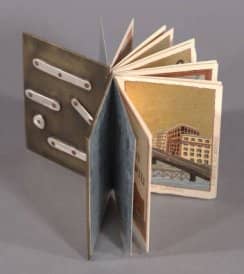
Davidson has loved making books since childhood. Born in Indiana and raised in Michigan, Laura attended Michigan State University, where she followed her two older sisters until realizing that an art school suited her better. She considered going to Cleveland but ultimately chose the Kansas City Art Institute, where she received her BFA. She had thought she would become an illustrator of books, but in searching for the best academic fit she found the most amenable and inspiring mentors by choosing a major in fiber. That spirit of finding her way expresses the sum of Davidson’s life and work. Her final requirement for the degree involved paper-making, which she has not done since graduation; however, the many materials she uses—paper, pencil, watercolor, gold leaf, silver point, copper, vinyl, and so many others, too many to list—illustrate her method; she knows what she wants to make and finds a way to do so, not necessarily using the traditional method. As an example of her ingenuity, Davidson wanted illuminated pages in her work, so she developed her own method for Fort Port Illuminatedan artists’ book now among the Athenæum’s special collections.

Her parents have supported her decision to live a life of creativity—creating and supported by creating—even though many parents would have cringed at the risk of making a living by one’s art. Her father travelled to Kansas City with her when she chose art school; he said he would have liked to attend too. After graduation, she accompanied her parents to Italy where her father was facilitating the use of computer design in car manufacture. She slept on a cot in her parents’ hotel room and was so inspired that later she “kickstarted” her own return to Italy by letting anyone who had ever shown any interest in her work know that if they gave any amount to help her travel, she would in turn give them a drawing. When she first arrived in Boston, she put her art school education in fibers to good use by painting fabric for payment. She would paint silk in the morning, and then work on her own pursuits. (Another artist would then make then the fabric into a dress.)

She had studio space—which occasionally was living space—in the area where she eventually settled into an artists’ cooperative. Her parents visited and stayed with her, even in her early, unconventional studio. She could tell they wondered at her living arrangements, but they did not criticize.

Her works are among the holdings of world-class institutions such as Harvard University, the Library of Congress, Michigan State University, as well as other universities. The Athenæum holds an impressive number of Davidson’s works, but her first interaction gave her mixed messages. In the mid-1980s, she submitted an item for a show but after its acceptance, she dropped it off only to receive a call informing her it had subsequently been rejected and must be picked up. However, that would not be the last word: almost a decade later, Joan Nordell, director of development at the time, was also a collector, and she met Davidson at an exhibition at Harvard’s Houghton Library. That connection brought Davidson back into the Athenæum’s orbit so that she applied for and received a 1996–1997 Mary Catherine Mooney Fellowship to study the Athenæum’s Nuremberg Chronicle as inspiration for her own artistic works. The arrival of a child created new priorities, but as her daughter has grown, Davidson has found time to return to the building.

She enjoys listening to podcasts as she walks up the hill from her Fort Point Studio where she and her partner Gabrielle, a potter, have lived for over 25 years. Davidson claims her time at the Athenæum “fortifies” her. Here she enjoys studying large art books, too large to carry home, in the quiet and contemplative spaces. This allows her to winnow her own collection of large art books to those most essential to her work and pleasure, to find inspiration everywhere—through travel, in great works of art as well as ephemera—and to make her own way.

Fort Port Illuminated

Photo courtesy of Laura Davidson.

Selected Works

5 Cities Walking [art original]. Boston, Mass.: Laura Davidson, 2006.​Almost Home. Boston, Mass.: Laura Davidson, 2014.​Barred Owl [graphic]. Boston: Printed by Laura Davidson, 2015.Boston Treasure [art original]. Boston  Laura Davidson, 2010.Eastern Screech Owl [graphic]. Boston: Printed by Laura Davidson, 2015.Endangered Neighborhood [graphic]. Boston: Printed by Laura Davidson, [1995].Etui Portable Necessities copy #7Flora and Fauna [graphic]. Boston, Mass.: Laura Davidson, 2008.Fort Point Illuminated [art original]. Boston : Laura Davidson, 2006.Gay Authors [graphic]. Boston, Mass., 2015.Ideal City. Boston, Mass.: L. Davidson, 1997.L. Frank Baum & OzMy Mr. Darcys: An Appreciation. Boston, Mass.: Laura Davidson, 2009.Owls Illuminated. Boston, Mass.: Laura Davidson, 2014.Read Art Calling Card [graphic]. Boston: Printed by Laura Davidson, 2012.State House – Boston [graphic]. Boston: Laura Davidson, [ca. 1998].Time, Space and Sea. Boston, Mass.: L. Davidson, 1996.Travelogue. Boston, Mass.: L. Davidson, 1993.Tunnel Vision: The Big Dig View from my Studio Window on the Corner of “A” and Wormwood Streets in Boston, MA.  Boston, Mass.: L. Davidson, 2001.Useful Knowledge. Boston, Mass.: L. Davidson, 1998.WanderlustWormwood Street – Boston [graphic]. Boston: Laura Davidson, 2015.

07.26.2017

Folk and Fairy Tales

Picture Books

Raven: A Trickster Tale from the Pacific Northwest by Gerald McDermott

(Children + E99.N77 M33 1993)

“Raven, the trickster, wants to give people the gift of light. But can he find out where Sky Chief keeps it? And if he does, will he be able to escape without being discovered? His dream seems impossible, but if anyone can find a way to bring light to the world, wise and clever Raven can!” —Provided by publisher.

The Girl of the Wish Garden: A Thumbelina Story by Uma Krishnaswami; illustrated by Nasrin Khosravi

(Children PZ8.K9116 Gi 2013)

A retelling of Hans Christian Andersen’s classic fairy tale about a girl who is only one inch tall.

Issun Bôshi: The One-Inch Boy by Icinori

(Children Lg PZ8.1.I25 Is 2014)

This classic Japanese fairy tale tells the story of Issun Bôshi, the tiny son of an old, long childless couple. He is tested in several adventures and handles himself so bravely that, in the end, he is rewarded with just the right princess!

The Talking Eggs by Robert D. San Souci; illustrated by Jerry Pinkney

(Children + PZ8.1.S227 Tal 1989)

A Southern folktale in which kind Blanche, following the instructions of an old witch, gains riches, while her greedy sister makes fun of the old woman and is duly rewarded.

Sugar Cane: A Caribbean Rapunzel by Patricia Storace; illustrated by Raúl Colón

(Children + PZ8.1.S864 Su 2007)

A version of the folktale Rapunzel, set in the Caribbean.

Glass Slipper, Gold Sandal by Paul Fleischman; illustrated by Julie Paschkis

(Children Picture Book + FLEIS)

The author draws from a variety of folk traditions to put together this version of Cinderella, including elements from Mexico, Iran, Korea, Russia, Appalachia, and more.

Princess Furball by Charlotte Huck; pictures by Anita Lobel

(Children Picture Book + HUCK)

A princess in a coat of a thousand furs hides her identity from a king who falls in love with her.

Puss & Boots by Ayano Imai

(Children Picture Book + IMAI)

“It’s all about the shoes! A poor shoemaker and his cat lived together. Business was bad. ‘Don’t give up so easily,’ advised the cat. ‘Make me some beautiful boots, and I will do the rest!’ This clever cat can deal with anything, even a shoe-loving monster. Ayano Imai’s delightful twist on the classic Puss in Boots story, sees the loyal cat taking on a terrible monster—and winning.” —Provided by publisher.

Little Red Riding Hood by Jerry Pinkney

(Children Picture Book + PINKN)

A sweet little girl meets a hungry wolf in the forest while on her way to visit her grandmother.

Stinky Cheese Man and Other Fairly Stupid Tales by Jon Scieszka & Lane Smith

(Children Picture Book + SCIES)

Madcap revisions of familiar tales.

The True Story of the 3 Little Pigs! by Jon Scieszka; illustrated by Lane Smith

(Children Picture Book + SCIES)

The wolf gives his own outlandish version of what really happened when he tangled with the three little pigs.

Can You Guess My Name? By Judy Sierra; illustrated by Stefano Vitale

(Children Picture Book + SIERR)

A collection of fifteen folktales from all over the world, including stories that resemble “The Three Pigs,” “The Bremen Town Musicians,” and “Rumpelstiltskin.”

Little Red and the Very Hungry Lion by Alex T. Smith(Children Picture Book + SMITH)

In this version of Little Red Riding Hood, set on the African plains, Little Red realizes what the Very Hungry Lion is up to, and teaches him a lesson before generously sharing her donuts with him.

Snow White and the Seven Dwarfs translated by Randall Jarrell; illustrated by Nancy Ekholm Burkert

(Children Picture Book Lg SNOW)

Retells the tale of the beautiful princess whose lips were red as blood, skin was white as snow, and hair was black as ebony.

Mufaro’s Beautiful Daughters: An African Tale by John Steptoe

(Children Picture Book + STEPT)

Mufaro’s two beautiful daughters, one bad-tempered, one kind and sweet, go before the king, who is choosing a wife.

Chapter Books

Ella Enchanted by Gail Carson Levine

(Children PZ7.L578345 El 1997)

In this novel based on the story of Cinderella, Ella struggles against the childhood curse that forces her to obey any order given to her.

Baba Yaga’s Assistant by Marika McCoola; illustrated by Emily Carroll

(Children PZ7.M134 Ba 2015)

“Most children think twice before braving a haunted wood filled with terrifying beasties to match wits with a witch, but not Masha. Her beloved grandma taught her many things: that stories are useful, that magic is fickle, that nothing is too difficult or too dirty to clean. The fearsome witch of folklore needs an assistant, and Masha needs an adventure. She may be clever enough to enter Baba Yaga’s house-on-chicken-legs, but within its walls, deceit is the rule. To earn her place, Masha must pass a series of tests, outfox a territorial bear, and make dinner for her host. No easy task, with children on the menu!” —Provided by publisher.

I Was a Rat by Philip Pullman

(Children PZ7.P968 Iw 2002)

A little boy turns life in London upside down when he appears at the house of a lonely old couple and insists he was a rat.

Young Adult

Bound by Donna Jo Napoli

(Children PZ7.N15 Bo 2004)

In a novel based on Chinese Cinderella tales, fourteen-year-old stepchild Xing-Xing endures a life of neglect and servitude, as her stepmother cruelly mutilates her own child’s feet so that she alone might marry well.

Zel by Donna Jo Napoli

(Children PZ8.N127 Ze 1996)

Based on the fairy tale Rapunzel, the story is told in alternating chapters from the point of view of Zel, her mother, and the nobleman who pursues her, and delves into the psychological motivations of each of the characters.

Poetry

Mirror, Mirror: A Book of Reversible Verse by Marilyn Singer; illustrated by Josée Masse

(Children + PS3569.I546 M57 2010)

A collection of short poems which, when reversed, provide new perspectives on the fairy tale characters they feature.

Collections

The Seven Wise Princesses: A Medieval Persian Epic retold by Wafaʹ Tarnowska; illustrated by Nilesh Mistry

(Children + PZ8.T178 Se 2000)

A lonely king, inspired by seven mysterious portraits, invites seven lovely princesses to live with him; their stories entertain and educate him in the ways of a wise ruler.

The People Could Fly: The Book of Black Folktales told by Virginia Hamilton; illustrated by Leo and Diane Dillon

(Children + PZ8.1.H154 Pe 1985)

Retold Afro-American folktales of animals, fantasy, the supernatural, and desire for freedom, born of the sorrow of the slaves, but passed on in hope.

The Tales of Uncle Remus: The Adventures of Brer Rabbit as told by Julius Lester; illustrated by Jerry Pinkney

(Children PZ8.1.L434 Las 1994)

“Whether he is besting Brer Fox or sneaking into Mr. Man’s garden, Brer Rabbit is always teaching a valuable lesson. These classic tales are full of wit, humor, and creativity, and Julius Lester brings an added contemporary sense to these forty-eight timeless stories.” —Provided by publisher.

The Serpent Slayer and Other Stories of Strong Women by Katrin Tchana; illustrated by Trina Schart Hyman

(Children Lg PZ8.1.T19 Se 2000)

A collection of twenty traditional tales from various parts of the world, each of whose main character is a strong and resourceful woman.

Land of the Long White Cloud: Maori Myths, Tales, and Legends by Kiri Te Kanawa; illustrated by Michael Foreman

(Children + PZ8.1 .T23 1989)

A collection of nineteen tales from various Maori tribes of New Zealand about the trickster Maui, the Creation, monsters, birds, animals, and special places.

06.29.2017

Art

Picture Books

Radiant Child: the Story of Young Artist Jean-Michel Basquiat by Javaka Steptoe

(Children + CT275.B3774 S73 2016)

“Jean-Michel Basquiat and his unique, collage-style paintings rocked to fame in the 1980s as a cultural phenomenon unlike anything the art world had ever seen. But before that, he was a little boy who saw art everywhere: in poetry books and museums, in games and in the words that we speak, and in the pulsing energy of New York City. Now, award-winning illustrator Javaka Steptoe’s vivid text and bold artwork echoing Basquiat’s own introduce young readers to the powerful message that art doesn’t always have to be neat or clean—and definitely not inside the lines—to be beautiful.”—Provided by publisher.

Gordon Parks: How the Photographer Captured Black and White America by Carole Boston Weatherford; illustrated by Jamey Christoph

(Children + CT275.P375 W42 2015)

“Gordon Parks is most famous for being the first black director in Hollywood. But before he made movies and wrote books, he was a poor African American looking for work. When he bought a camera, his life changed forever. He taught himself how to take pictures and before long, people noticed.”—Provided by publisher.

Cloth Lullaby: The Woven Life of Louise Bourgeois by Amy Novesky; illustrated by Isabelle Arsenault

(Children + CT1018.B69 .N68 2016)

“Louise Bourgeois (1911–2010) was a world-renowned modern artist noted for her sculptures made of wood, steel, stone, and cast rubber. Her most famous spider sculpture, Maman, stands more than 30 feet high. Just as spiders spin and repair their webs, Louise’s own mother was a weaver of tapestries. Louise spent her childhood in France as an apprentice to her mother before she became a tapestry artist herself. She worked with fabric throughout her career, and this biographical picture book shows how Bourgeois’s childhood experiences weaving with her loving, nurturing mother provided the inspiration for her most famous works. With a beautifully nuanced and poetic story, this book stunningly captures the relationship between mother and daughter and illuminates how memories are woven into us all.”—Provided by publisher.

My Name is Georgia: A Portrait by Jeanette Winter

(Children ND237.O5 W56 1998)

Presents, in brief text and illustrations, the life of the painter who drew much of her inspiration from nature.

The Theft of the Mona Lisa by Cyriel Verleyen; illustrated by Henry Branton

(Children ND623.L5 V513 1971)

Describes Leonardo da Vinci’s efforts to get the Mona Lisa to smile, the trouble the smile caused him, and the speculation it aroused in the Louvre for three centuries until the painting was mysteriously stolen.

Dinner at Magritte’s by Michael Garland

(Children + PZ7.G18413 Di 1995)

Young Pierre spends the day with surrealist artists René Magritte and Salvador Dalí.

The Incredible Painting of Felix Clousseau by Jon Agee

(Children Picture Book + AGEE)

An unknown artist becomes an overnight sensation when his painting comes to life.

Maybe Something Beautiful: How Art Transformed a Neighborhood by F. Isabel Campoy and Theresa Howell; illustrated by Rafael Lopez

(Children Picture Book +CAMPO)

“Mira lives in a gray and hopeless urban community until a muralist arrives and, along with his paints and brushes, brings color, joy, and togetherness to Mira and her neighbors.”—Provided by publisher.

Eyes of the Dragon by Margaret Leaf; illustrated by Ed Young

(Children Picture Book LEAF)

An artist agrees to paint a dragon on the wall of a Chinese village, but the magistrate’s insistence that he paint eyes on the dragon has amazing results.

Matthew’s Dream by Leo Lionni

(Children Picture Book + LIONN)

A visit to an art museum inspires a young mouse to become a painter.

Brush of the Gods by Lenore Look

(Children Picture Book + LOOK)

During the Tang dynasty, master painter Wu Daozi creates an extraordinary mural for the emperor.

Lulu and the Flying Babies by Posy Simmonds

(Children Picture Book + SIMMO)

Stuck waiting for her family in the art museum when she would much rather be playing outside in the park, a little girl is picked up by two cherubim and taken for a wild romp through several paintings.

You Can’t Take a Balloon Into the Museum of Fine Arts by Jacqueline Preiss Weitzman; illustrated by Robin Preiss Glaser

(Children Picture Book + WEITZ)

While a brother and sister, along with their grandparents, visit the Museum of Fine Arts, the balloon they were not allowed to bring into the museum floats around Boston, causing a series of mishaps at various tourist sites.

Art & Max by Davis Wiesner

(Children Picture Book WIESN)

Max wants to be an artist like Arthur, but his first attempt at using a paintbrush sends the two friends on a whirlwind trip through various media, with unexpected consequences.

Frida by Jonah Winter; illustrated by Ana Juan

(Children Picture Book WINTE)

Discusses the childhood of Frida Kahlo and how it influenced her art.

The Magic Brush by Kat Yeh; illustrated by Huy Voun Lee

(Children Picture Book YEH)

Jasmine’s grandfather teaches her Chinese calligraphy by drawing and making up stories together. Includes Chinese characters and pronunciation key, brief history of Chinese art, and descriptions of Chinese treats.

Chapter Books

Chasing Vermeer by Blue Balliett ; illustrated by Brett Helquist

(Children PZ7.B2128 Ch 2004)

When seemingly unrelated and strange events start to happen and a precious Vermeer painting disappears, eleven-year-olds Petra and Calder combine their talents to solve an international art scandal.

Masterpiece by Elise Broach

(Children PZ7.B78083 Mas 2008)

After Marvin, a beetle, makes a miniature drawing as an eleventh birthday gift for James, a human with whom he shares a house, the two new friends work together to help recover a Durer drawing stolen from the Metropolitan Museum of Art.

From the Mixed Up Files of Mrs. Basil E. Frankenweiler by E.L. Konigsburg

(Children PZ7.K8352 Fr)

“Claudia knew that she could never pull off the old-fashioned kind of running away…so she decided not to run FROM somewhere, but TO somewhere. And so, after some careful planning, she and her younger brother, Jamie, escaped—right into a mystery that made headlines!” —Provided by publisher.

The Old Man Mad About Drawing: A Tale of Hokusai by François Place

(Children PZ7.P6899 Ol 2004)

Tojiro, a young seller of rice cakes in the Japanese capital of Edo, later known as Tokyo, is amazed to discover that the grumpy and shabby old man who buys his cakes is a famous artist renowned for his sketches, prints, and paintings of flowers, animals, and landscapes.

Young Adult

Still Life With Tornado by A. S. King

(Young Adult PZ7.K573 St 2016)

“A talented 16-year-old artist slowly discovers the history of domestic violence behind why her brother left the family years earlier and why she suddenly cannot make art.” — Provided by publisher

I’ll Give You the Sun by Jandy Nelson

(Young Adult PZ7.N433835 Il 2014)

“Jude and her twin brother, Noah, are incredibly close. At thirteen, isolated Noah draws constantly and is falling in love with the charismatic boy next door, while daredevil Jude cliff-dives and wears red-red lipstick and does the talking for both of them. But three years later, Jude and Noah are barely speaking. Something has happened to wreck the twins in different and dramatic ways … until Jude meets a cocky, broken, beautiful boy, as well as someone else — an even more unpredictable new force in her life. The early years are Noah’s story to tell. The later years are Jude’s. What the twins don’t realize is that they each have only half the story, and if they could just find their way back to one another, they’d have a chance to remake their world.” — Provided by publisher

Informational Books

Virginia Lee Burton: A Life in Art by Barbara Elleman

(Children + CT275.B8745 E44 2002)

Examines the life, career, artistic style, and literary themes of the twentieth-century author and illustrator of such classic picture books as “Mike Mulligan and His Steam Shovel” and “The Little House.”

Chuck Close: Face Book by Chuck Close

(Children + CT275.C585 A3 2012)

Presents an autobiography about the author’s artistic life, describing the creative processes he uses in the studio and his struggles with his disabilities. Includes a self-portrait mix-and-match section that demonstrates his techniques and images.

Story Painter: The Life of Jacob Lawrence by John Duggleby

(Children + CT275.L38653 D83 1998)

A biography of the African American artist who grew up in the midst of the Harlem Renaissance and became one of the most renowned painters of the life of his people.

Randolph Caldecott: The Man Who Could Not Stop Drawing by Leonard S. Marcus

(Children Lg CT788.C1443 M37 2013)

Available in time for the 75th anniversary of the Caldecott Medal, an utterly unique biography of the remarkable artist the award honors: Randolph Caldecott, the father of the modern picture book. Includes never-before-published drawings by Caldecott himself.

Leonardo: Beautiful Dreamer by Robert Byrd

(Children + N6923.L33 B97 2003)

Illustrations and text portray the life of Leonardo da Vinci, who gained fame as a artist through such works as the Mona Lisa, and as a scientist by studying various subjects including human anatomy and flight.

Cave Paintings to Picasso by Henry Sayre

(Children + N7440 .S29 2004)

Introduces fifty celebrated works of art, including King Tut’s sarcophagus and Andy Warhol’s paintings of Campbell’s soup cans, with historical and interpretive information for each piece.

Romare Bearden: Collage of Memories by Jan Greenberg

(Children + N6537.B4 G74 2003)

Recounts the life of the twentieth-century African-American collage artist who used his southern childhood, New York City, jazz, and Paris to influence his bold and meaningful art.

Don’t Hold Me Back: My Life and Art by Winfred Rembert

(Children + ND237.R35 A2 2003)

Through words and paintings, an artist tells about growing up on a cotton plantation in Cuthbert, Georgia, serving time in prison for his actions during a civil rights demonstration, and finding a purpose and direction in life.

Grant Wood: The Artist in the Hayloft by Deborah J. Leach

(Children + ND237.W795 L43 2005)

This tour through Grant Wood’s Cedar Rapids hayloft studio welcomes young readers into the world of an iconic, rural American artist whose rich, stylised paintings have an immediate appeal to children.

Monet by Jude Welton

(Children + ND553.M7 W39 1999)

“Explore Claude Monet’s life and art, and the influences that shaped his work.” —Provided by publisher.

Van Gogh by Bruce Bernard

(Children + ND653.G7 B47 2000)

“Explore Vincent van Gogh’s life and art, and the influences that shaped his work.” —Provided by publisher.

Four Pictures by Emily Carr by Nicolas Debon

(Children ND249.C3 D42 2003)

Written and illustrated in comic strips, the book traces Carr’s life through four of her famous paintings.

06.23.2017

Julius Aboyneau Palmer, Jr.

July 2017

By Nicole Critchley

Julius Aboyneau Palmer, Jr. spent his early years as “a roving blade” working as a merchant sailor and captain.1 Palmer was born March 1, 1840, to Julius Aboyneau Palmer, a jeweler and politician, and Lucy Manning Peabody, who bore eight other children. This native Bostonian crossed the Pacific Ocean four times, went around Cape Horn and the Cape of Good Hope, sailed the Mediterranean twice, and spent periods in South America, Japan, and the Hawaiian Islands. He briefly lived in San Francisco before returning to Boston. He mastered many languages, speaking and writing in French, Spanish, Italian, and Portuguese.

Eventually Palmer settled down and turned to writing and lecturing. One can imagine the Athenæum’s ambiance suiting this pursuit. He wrote as a contributor on various current topics for many periodicals, including the Boston Transcript Company (“A trustworthy, clean, and interesting family newspaper”) and the Boston Globe.2 Many of his fictional stories were nautical in nature. Palmer’s experiences as a sailor were just one aspect of his passion for the outdoors. He was a member of the Athenæum as well as the Boston Marine Society, Massachusetts Horticultural Society, Appalachian Mountain Club, and the New York American Shipmasters Association.

Being a “professed fungus eater,” he stalked mushrooms on the Common as one of the founding members and first president of the Boston Mycology Club in 1895.3 Mushrooms and amateur mycology were growing in popularity at that time. Within two years the club had 430 members.4 Palmer published articles about their properties in medical journals and newspapers. Many focused on what made fungi poisonous, and on his own experiments eating them. In a letter to Charles Peck, an authority on fungi, Palmer recalled an inconclusive chicken dinner of a potentially psychoactive variety, calling it “very sweet and good.”5 Palmer rejected British mycologist Miles Joseph Berkeley’s theory that the alkalinity of mushrooms is what made them toxic. He also theorized one could be poisoned by the absorption of toxins through the skin.

Palmer first lived in Pemberton Square, Boston—an area just north of the Athenæum that was eventually torn down to make way for the new court house. He moved farther away to the top (third) floor of Number 10 on Broad Street for the last period of his life. During his travels, he observed that many people lived in the same part of the city in which they worked. There he had a telephone, and according to one Boston Globe article about him, he twice used it to save his building from fire. It is also noted that he owned a beautiful piano that used to belong Josie (Helen Josephine) Mansfield.6

In December 1893, the Boston Transcript Company commissioned Palmer to go to Honolulu “for the purpose of ascertaining the facts in regard to the revolution which was inaugurated on the 17th of January of that year.”7 During that visit, he interviewed Queen Liliʻuokalani as well as officials in the Provisional Government, which had overthrown her. Palmer wrote many telegraphs detailing his observations supporting the Queen and the Hawaiian people. When Queen Liliʻuokalani visited the U.S. in 1896 to 1897, Palmer acted as her personal secretary, which put him into the public eye; their relationship was construed as a romantic one by one news article.8 She mentioned Palmer in her memoir, writing that his “reputation as a man of unblemished honor and integrity, recommended him to me…I have found Captain Palmer to be well informed on all matters relating to Hawaii, whether in those earlier days when he visited the Islands under the monarch, or since 1893 under the rule of the Provisional Government.”9 He used his connections to organize meetings for her with officials, including President McKinley, for whose inauguration she received an invitation. Palmer witnessed the signature of her official protest to the treaty annexing Hawaii. His extensive journalistic work informed his later published books.

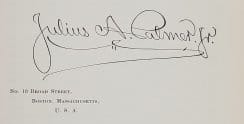
Julius A Palmer signature

Julius A Palmer’s signature.

Palmer died January 11, 1899, in Boston, and is remembered most for his acquaintance with Queen Liliʻuokalani—which garnered considerable public interest—and also as a gentleman scholar with diverse interests in steam engineering, nautical navigation, and mushrooms.

1. “HOMES AMID TRAFFIC’S ROAR.” Boston Daily Globe (Boston, MA 1872–1922), Dec. 23 1894.2. Julius A. Palmer, Jr. Memories of Hawaii and Hawaiian Correspondence. Boston: Lee and Shepard, 1894.3. Julius A. Palmer Jr. About Mushrooms: A Guide to the Study of Esculent and Poisonous Fungi. Boston: Lee and Shepard, 1894: 17.4. Elio Schaechter, “In the Company of Mushrooms: A Biologist’s Tale.” Cambridge MA: Harvard University Press, 1997.5. David W. Rose, “The Poisoning of Count Achilles de Vecchj and the Origins of American Amateur Mycology.” McIlvainea 16, no. 1 (Spring 2006): 37–55.6. Mansfield was a contemporary famous for having one wealthy lover murder the other.7. Palmer, Memories of Hawaii8. “Julius Aboyneau Palmer’s Story.” Boston Daily Globe (Boston, MA 1872–1922), Sep 12, 1897.9. Liliuokalani, Hawaii’s Story by Hawaii’s Queen. Boston: Lee and Shepard, 1898.

Selected Works

About Mushrooms: A Guide to the Study of Esculent and Poisonous Fungi​ (Cutter Classification JE .P18​)
Memories of Hawaii and Hawaiian Correspondence​ (Cutter EBU .P18)
One Voyage and its Consequences​ (Cutter :VEF .P184 .o)

References

Conant, Jennie F. “The Boston Mycological Club.” Rhodora 2, no. 17 (May 1900): 93–95.”Homes Amid Traffic’s Roar.” Boston Daily Globe (Boston, MA 1872-1922), Dec. 23 1894.”Julius A. Palmer Dead.” Boston Daily Globe (Boston, MA 1872-1922), Jan. 14, 1899.”Julius Aboyneau Palmer,” Ancestry.com, accessed May 16, 2017. “Julius Aboyneau Palmer,” FamilySearch.org, accessed June 13, 2017.Liliuokalani. Hawaii’s Story by Hawaii’s Queen. Boston: Lee and Shepard, 1898. Palmer, Julius A., Jr. About Mushrooms. A Guide to the Study of Esculent and Poisonous Fungi. Boston: Lee and Shepard, 1894.Palmer, Julius A., Jr. “HINTS FOR YOUNG YACHTMEN.” Boston Daily Globe (1872-1922): 1. Aug 11 1907.Palmer, Julius A. Jr.  Memories of Hawaii and Hawaiian Correspondence. Boston: Lee and Shepard, 1894.Rojo, Heather Wilkinson. “Who was Julius Palmer?” Nutfield Genealogy, February 2, 2012.Rose, David W. “The Poisoning of Count Achilles de Vecchj and the Origins of American Amateur Mycology.” McIlvainea 16, no. 1 (Spring 2006): 37–55.Schaechter, Elio. “In the Company of Mushrooms: A Biologist’s Tale.” Cambridge MA: Harvard University Press, 1997.Yachting Notes.” Boston Daily Globe (Boston, MA 1872-1922), Feb. 20, 1888.​

06.12.2017

Staff Book Suggestions Summer 2017

Victoria Johnson

Grace by Daphne A. Brooks

(Library of Congress ML3470 .T54 no. 23)

Brooks’s examination of Jeff Buckley’s sole legendary album Grace is a pleasure. This quick read is a personal love letter to the man and his music. Brooks—once tapped to write the liner notes for this album’s anniversary re-release—delves deep into Buckley’s lyrics, live performances, and legacies by examining his previously off-limits journals. It is also a thorough examination of Buckley’s influences (including Nina Simone, Rainer Maria Rilke, Led Zeppelin, and Nusrat Fateh Ali Khan). If you’re already a Buckley fan, this book re-examines the album you thought you knew, song by song. If you’re reading this and thinking, “Who’s Jeff Buckley?” I implore you to check this book out. As the weeks of summer roll on, set your weekend road trips to the sound of Jeff Buckley’s Grace.*

*If the “mystery white boy” isn’t your preferred travel companion, peruse the shelf where this book is located—there you’ll find biographies of similarly masterful albums—from Dusty Springfield’s Dusty in Memphis to Kanye West’s My Beautiful Dark Twisted Fantasy.

Not Just Jane: Rediscovering Seven Amazing Women Writers Who Transformed British Literature by Shelley DeWees
(Library of Congress PR111 .D49 2016)

Unless you’ve been living under the world’s largest rock for the past two centuries, you know all about Miss Jane “it-is-a-truth-universally-acknowledged” Austen. While she is undoubtedly one of the most celebrated female authors in history, she alone did not write the book (pun-intended) on making a name for oneself as a woman writer. This excellent debut from Shelley DeWees takes readers through the glorious English countryside as we meet seven women writers who were just as celebrated, successful, and famous in their day as Austen. While the book can only offer guesses at their subsequent descent into obscurity, it emphatically presents seven new authors to add to your Goodreads summer reading queue.

Judith Maas

The Summer Guest by Alison Anderson
(Library of Congress  PZ4.A545 Su 2016)

In the summers of 1888 and 1889, Anton Chekhov and his family rented a house on a country estate in Ukraine and struck up a friendship with the estate owners. At the time, he was practicing medicine, publishing short stories, and beginning to write for the theater. In this novel, Anderson teases the reader with the possibility that Chekhov wrote a novel during those peaceful summers, inspired by his conversations with Zina Lintvaryova, a doctor and a daughter of the estate owners. 

The story is set in the past and the present and told from the viewpoints of three women, each of whom is facing painful life changes and reassessing her place in the world: Zina herself, who keeps a diary in which she reflects on the events of the two summers; Katya Kendall, a Russian emigre living in London in 2014 who plans to publish Zina’s diary; and Ana Harding, hired by Katya to translate the diary. The different strands of the novel blend together beautifully: the perspectives of the three women; the mystery of whether Chekhov wrote a novel; and the deep connection that blossoms between Chekhov and Zina.

Elizabeth O’Meara
The Millionaire and the Bard: Henry Folger’s Obsessive Hunt for Shakespeare’s First Folio by Andrea Mays
(Library of Congress Z989.F66 M28 2015​)

This was such a fun book. Henry Folger and his wife Emily started collecting Shakespeare even before they could afford it. Their first Shakespeare purchase was made in 1888, a copy of the 1685 Fourth Folio of the plays for $107.50. As Henry’s career advanced at Standard Oil, eventually leading him to president then chairman of Standard Oil of New York, their collecting became truly obsessive. His primary interest was in First Folios but the collecting broadened out to anything related to Shakespeare’s era. He and his wife were real partners in their love and knowledge of all things Shakespeare. The stories of his hunt for First Folios were exciting and it was amazing how many he was able to collect while concealing his identity. After their library was built in Washington D.C. (1932), it took more than six months to locate all the storage units housing the collection and transport the collection to the library. So…it was, at last, all in one place. Interestingly, the year before The Millionaire and the Bard was published, Collecting Shakespeare: The Story of Henry and Emily Folger by Stephen Grant was published. He was at the Athenæum in 2015 and his talk is available here.

Hannah Ovaska
And Then There Were None by Agatha Christie
(Library of Congress PZ3.C4637 An​)

Are you looking for a thrill this summer? If so, Agatha Christie’s And Then There Were None is the perfect mystery to dive into after the sun goes down. Follow ten characters, trapped on an abandoned island, to discover what lurks in their pasts and if they will live to see the next day. Published in 1939, this best-selling novel remains timeless, spooky, and a true nail-biter for a reason.

Makesha Uditnarain

Lily and the Octopus by Steven Rowley

(Library of Congress  PZ4.R87947 Li 2016)

For all dog owners (as many of our members are) and animal lovers: this is the book for you! Lily is an aging 12-year-old dachshund loved by her owner Ted, a struggling writer who spends his time being a worrywart. Both are confronted by an enemy, the Octopus, which in turns becomes a metaphor for something greater. Rowley does an amazing job describing the love of a dog, and engaging the reader emotionally. The dialogue between Lily and Ted is eccentric, relatable and comedic. Rowley leaves you with lessons and the biggest one of all is fighting for the ones you love. Caution—you might shed a tear or two!

Mary Warnement

Open City by Teju Cole​

(Library of Congress PZ4.C68958 Op 2011)

This is a bookish book, my favorite kind. I took this on a trip to New York City, because I am the sort of reader who likes to pair reading materials with destinations. This novel features a medical resident, an immigrant from Nigeria who wanders the city, meeting friends and strangers and musing about books, art, music, and life in general. I expected the climax to center on his own, fractured relationship with his mother and his desire to reconnect with his grandmother; however, the author caught me by surprise with a revelation that made me turn back the page to reread and make sure I had not missed something. I was confused and questioned what had been my sympathetic sense of the main character. I remain uneasy, no doubt the authorial intent. The book stayed with me. It is about NYC and so much more. My only previous encounter with Teju Cole was his non-fiction essay, “Water has no Enemy” in Granta 124. Cole writes beautifully, and I will read his other novel.

Here is New York by E.B. White
(Cutter Classification VE3 .W583 .h)

I chose E.B. White’s 1948 essay as my post-trip reading, a way to ease back into my routine after a relaxing vacation. White’s description is shorter but offers an interesting comparison to Cole’s more expansive novel. His clever turns of phrases please me, as he turns his observant self to the city around him, to consider other New Yorkers’ “emanations from without” (11). He says he’s not bringing NYC “down to date…” because that is the “reader’s duty” (6). He also claims “New York blends the gift of privacy with the excitement of participation” (13). Those who have been to NYC once or who’ve lived there a lifetime could enjoy agreeing or arguing with him. He was thinking of nuclear war, I suspect—or even conventional warfare—when he wrote his ending: “The subtlest change in New York is something people don’t speak much about but that is in everyone’s mind. The city, for the first time in its long history, is destructible. A single flight of planes no bigger than a wedge of geese can quickly end this island fantasy, burn the towers, crumble the bridges, turn the underground passages into lethal chambers, cremate the millions” (51). Of course he did not have a premonition; he was speaking of his own time. The destruction he imagined resulted from technology and human actions similar to what we saw befall NYC in 2001. His words seemed shocking at first to me, but I realized, soon enough, that humanity has behaved similarly—at its best and at its worst—throughout recorded history. Our own age has no special claim; recognizing that could help us behave better, I think. So I read and recommend you do too.