
02.28.2018

Ray Anthony Shepard

March 2018

Interview by Dani Crickman

Ray Anthony Shepard’s first book, Now or Never! 54th Massachusetts Infantry’s War to End Slavery, was published in October 2017. Shepard describes the book as “the story of two black Civil War soldiers whose battlefield dispatches documented the regiment’s battle against Northern white racial arrogance as they fought the Confederacy’s attempt to establish an independent slave empire. George E. Stephens and James Henry Gooding answered Frederick Douglass’s call: ‘through Massachusetts we can get our hands on treason and slavery.’”

Dressed in the uniform that the soldiers of the 54th would have worn, Shepard delivered a dynamic presentation on Now or Never! to a rapt Athenæum audience in November 2017. Afterward, Shepard answered my questions about the book, its impact and reception, and his inspiration and research process.

RAY ANTHONY SHEPARD: I was born in Missouri, a state that benchmarked the path to Civil War, in a family whose grandparents and great-grandparents were enslaved. I grew up on the flat Nebraska prairie, the state from which Stephen Douglas notched another benchmark toward bloody disunion. I attended a junior high school named after the abolitionist poet John Greenleaf Whittier and graduated from high school in a town reluctantly named after the slain president. It’s not surprising that after years of teaching American history and developing history textbooks at Houghton Mifflin, I have launched an encore career writing stories about the lives of little-known but extraordinary African Americans who tipped the scales toward justice and equality.

Q: Why did you write this book?

RAS: I wanted to find a way to tell the story of how difficult it was for the country to free itself from human slavery and the economic gains of enslaved labor. When I worked at Houghton Mifflin, then located a few doors from the Athenæum, I passed the Shaw Memorial twice a day. Often I would stop to admire the artist’s realistic portrayal of the soldiers’ facial features and how Saint Gaudens showed these free men of the North’s unwavering courage and pride as they offered to sacrifice themselves to liberate enslaved African Americans. It urged me to retell their story.

Q: When you first conceived of the project, did you know you would focus on Gooding and Stephens?

RAS: I wanted to tell the story of the 54th through firsthand accounts. When I started I knew of Robert Gould Shaw’s personal letters and James Henry Gooding’s letters published in the New Bedford Mercury. A few months into the project I became aware of George E. Stephens through Boston-based scholar Donald A. Yacovone’s research and transcriptions of Stephens’s letters. With nearly 100 wartime dispatches from Stephens and Gooding I was able to tell the story of the “glory” regiment from the viewpoint of two African American soldiers. It was something that had not been done before and I felt it was worth doing.

Q: What did your research process involve?

RAS: Tons of reading primary and secondary sources, and of course being a member of the Boston Athenæum I always had a wonderful spot to read and think. Site research, however, is as valuable as archival sleuthing. To help me better describe the scenes in the book, I visited every place I wrote about. If the reader is able to see and smell what James Henry Gooding felt when he entered the Confederate hellhole of Andersonville, it is because I walked through the gate of that barren prison and imagined the open latrines used by 13,000 prisoners. I imagined the filth, disease, and depression that overwhelmed Gooding. In my writing, I tried to share that experience as if the reader, too, were entering a death camp.

Q: Was there information that was particularly challenging to find, or notably absent? 

RAS: George E. Stephens wrote about the importance of the stories his father shared about life in Virginia at the time of the Nat Turner Revolt. But young Stephens didn’t write any of the details of those stories. I wish he had. Whatever they were, they led him to become determined and articulate, a brave soldier and writer who risked enslavement and death to help liberate 4,000,000 from America’s slave camps.

Q: Did your experience in educational publishing inform your approach to writing this book?

RAS: I have had the honor and good fortune of being a teacher, a schoolbook editor, and a teacher trainer. I am now even more blessed to publish a book about slavery, race, and emancipation. To show that the end of slavery was not a generous act of the North, but an unintended consequence of the Civil War—a war that took the lives of 315,000 Confederate soldiers, most of whom never owned a slave; of 435,000 white Union soldiers, few of whom thought slaves were worth the sacrifice; and the lives of 65,000 black Union soldiers who fought in the last two years of the war and who barely registered in our memory. It took 800,000 lives to end slavery, but it wasn’t enough blood to wash away the underlying cause—a racial hierarchy built on the soft bed of racial arrogance.
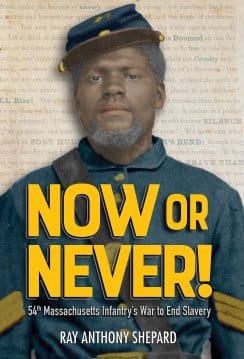
Now or Never! book cover

Now or Never!, published in 2017.

Q: Why did you decide to write this book for a young audience?

RAS: My first goal was to tell a good story, one that engages readers from 12 to 80. Underneath that effort lies my effort to show readers the critical role that free and literate African Americans played in the Civil War—saving the Union from slavery. (75 percent of military-aged Northern black men served in the Union Army.) It’s a story missing from school history curricula and one that leaves a knowledge gap in most adults’ understanding of our country’s history.

Q: What do you hope readers will take away from reading Now or Never!?

RAS: That the purpose of the Emancipation Proclamation was to fill depleted Union ranks by enlisting free African Americans to help liberate slaves who Abraham Lincoln had declared free. The success of the 54th encouraged the enlistment of 180,000 black soldiers and gave the Union a manpower advantage over the Confederates, who had more African Americans, but dared not arm them to defend their own enslavement. Yet even though the Union needed these men, there were restrictions: the regiments would be comprised of blacks but led by white officers. The War Department promised equal pay; however, after the regiment left Boston for Confederate battlefields the government reneged on its promise and ruled that African Americans were to be classified as manual laborers and paid half the rate of white soldiers. In protest, the soldiers and officers of the 54th refused all pay and fought and died for 18 months without pay. The stance of the Massachusetts 54th and 55th pressured Abraham Lincoln’s administration to restore equal pay. It was a heroic sacrifice greater than their charge on Fort Wagner.

Q: The book has received some stellar recognition, including starred reviews from Kirkus and School Library Connection and a place on Kirkus and the New York Public Library’s “Best Books for Teens 2017” lists. What’s been the most gratifying response you’ve received since the book’s publication?

RAS: It’s not often that someone my age, closer to 80 than 70, succeeds in launching an encore career. I’m grateful for the support I received from my wife, especially.

Q: What are you working on next? 

RAS: I’m in the beginning research stage for a group biography of the African Americans who attacked Harper’s Ferry in 1859.

01.30.2018

Thomas Bailey Aldrich

February 2018

By Dani Crickman

“Thomas Bailey Aldrich always seemed like a judge, so serious and dignified that one could not imagine him writing that extremely funny book, ‘The Story of a Bad Boy’” (34), writes Mary Jane Regan in Echoes from the Past; Reminiscences from the Boston Athenæum (1927). Others remember him differently: witty, affable, and youthful in his conversations with friends, though aloof with strangers and reticent about public speaking.

Though not as well known today as some of his contemporaries, Thomas Bailey Aldrich was a prominent literary figure of the late nineteenth century, praised by Nathaniel Hawthorne and emulated (though not without critique) by Mark Twain. Given the societal position and literary fame Aldrich achieved in his lifetime, his involvement in the Athenæum is perhaps unsurprising. When he joined, the library would have already housed many of his works on its shelves. Aldrich became a proprietor in 1884, three years into his tenure as the editor of The Atlantic Monthly, working out of an office just down the road at No. 4 Park Street with a view of the Old Granary Burying Ground.

How did Aldrich come to be this man of letters, remembered as the sometimes-somber creator of comedic tales? Born in Portsmouth, NH in 1836, Aldrich was the son of a businessman whose work took them to New Orleans for much of his childhood. At 13, he was brought back to Portsmouth to prepare for entry to Harvard, but abandoned those plans when his father died, leaving the family without adequate finances.

At sixteen, Aldrich moved to New York City to work as a clerk in his uncle’s office, where he took advantage of any break in the day’s work to pursue his own writing. He lived in the company of other writers and poets and began to publish poems and short stories. After the publication of a particularly well-received poem, “The Ballad of Babie Bell,” he acquired work first as a literary critic and then as an editor, and he had published his first collection of poems by age 19. He left New York to serve as a Civil War correspondent briefly, but returned to the city in 1862 and continued to work as an advisor for a publishing company until meeting his wife, Lilian Woodman. In 1865, they moved to Boston, where Aldrich became editor of the Every Saturday, a publication devoted to foreign literature, produced under the auspices of the publishing company owned by fellow Athenæum proprietors George Ticknor and James Fields. Aldrich appears to have made a happy home in Boston, settling in on Beacon Hill and praising the city for its “intellectual atmosphere” and “full-blooded readers.”

It was at this stage of life, contemplating boyhood and fatherhood in anticipation of the birth of his twin sons, that Aldrich wrote what proved to be his most impactful work, The Story of a Bad Boy. Set in Portsmouth, the semi-autobiographical novel chronicles the pranks and adventures of childhood. Tom’s hijinks stood in contrast to the moral tales dictating proper conduct that reigned as the standard for children’s literature. The Story of a Bad Boy is generally thought to be the first realistic depiction of childhood in American literature, and it provides telling insight into the culture of mid-nineteenth century white boyhood, both in its glorification of disobedience and in its subordinate treatment of non-white people and girls. The Story of a Bad Boy offered to the US what Thomas Hughes’s Tom Brown’s Schooldays had offered to England a decade before and began the “bad boy book” subgenre of American children’s literature, commonly typified by Mark Twain’s Adventures of Tom Sawyer and Adventures of Huckleberry Finn.  

Published over the course of the first months of 1869 in the children’s serial Our Young Folks (a publication of the former Ticknor and Fields; at this time, Fields, Osgood, & Co.), The Story of a Bad Boy garnered wide popularity. Our Young Folks increased its subscribers by several thousand while the story ran, and once it was published in book form in 1869, it quickly went through 11 reprints. (The “Story of Bad Boy” in its original serialized form is available in the Athenæum’s special collections, and well worth a look.) Aldrich, who’d long sought to establish himself first and foremost as a lyric poet, gained an international reputation as a humorist.

After the dissolution of the Every Saturday in 1874, Aldrich spent his next five years free from work, writing and touring Europe and spending time with his wife and children. Aldrich became the editor of The Atlantic in 1881 and held the position for nine years before retiring. Under his leadership, the magazine saw a decrease in social and political commentary, and a bias toward traditional forms and subjects, reflective of Aldrich’s taste for what constituted praiseworthy literature. Among the writers whose work Aldrich published during this time were Sarah Orne Jewett, Charles Egbert Craddock (Mary Noailles Murfree), and perhaps most notably, Charles W. Chesnutt, the first African American writer to gain a foothold in the US publishing industry.

Aldrich spent the last 17 years as a self-described “man of leisure and letters,” continuing to write and publish novels and volumes of short stories and poetry. One of these, “The Unguarded Gates,” continues to be contentiously discussed in classrooms for its exclusionary argument against immigration. Aldrich also published “Old Town by the Sea,” a tour of Portsmouth, in 1893.

Aldrich died in 1907, with the quotable last words: “In spite of it all, I am going to sleep; put out the lights.” He was buried in Mount Auburn Cemetery. Apart from the writing he left behind, he is also remembered through the Thomas Bailey Aldrich House Memorial in Portsmouth, which preserves as part of the Strawbery Banke Museum Aldrich’s grandfather’s home—the setting of The Story of a Bad Boy.

from The Life of Thomas Bailey Aldrich

From Greenslet’s The Life of Thomas Bailey Aldrich.

References

“Aldrich, Thomas Bailey (1836–1907).” The Vault at Pfaff’s: An Archive of Art and Literature by the Bohemians of Antebellum New York. Lehigh University, 2017. Accessed 17 Jan. 2018.

Goodman, Susan. “Thomas Bailey Aldrich: Guardian at the Gate.” Republic of Words: The Atlantic Monthly and Its Writers, 1857–​1925. Hanover: University of New England Press, 2011, pp. 142–150.

Greenslet, Ferris. The Life of Thomas Bailey Aldrich. Boston: Houghton Mifflin, 1908.

Regan, Mary Jane. Echoes from the Past; Reminiscences of the Boston Athenæum. Boston: The Boston Athenæum, 1927.

Rideing, William H. “Thomas Bailey Aldrich.” Many Celebrities and a Few Others. Garden City: Double, Page, & Company, 1912, pp. 131–140.

“Thomas Bailey Aldrich House.” Strawbery Banke Museum. Strawbery Banke, 2016. Accessed 17 Jan. 2018. 

01.27.2018

2018 Winter Olympics

In celebration of the 2018 Olympics and Paraolympics in PyeongChang, South Korea, we’ve gathered together a list of books about Korea, the Olympics, and winter sports!

South Korea

Picturebooks

The Royal Bee by Frances Park

(Children + PZ7.P21977 Ro 2000)

In the days when only wealthy Korean children are allowed to attend school, a poor boy named Song-ho learns by listening outside a schoolroom door, which eventually earns him a chance to better himself and make life easier for his widowed mother.

The Name Jar by Yangsook Choi

(Children Picture Book + CHOI)

After Unhei moves from Korea to the United States, her new classmates help her decide what her name should be.

Where’s Halmoni? by Julie Kim

(Children Picture Book + KIM)

Searching for their missing grandmother, two Korean children follow tracks into a fantastic world filled with beings from folklore who speak in Korean. Includes translations and information about the folkloric characters.

The Firekeeper’s Son by Linda Sue Park

(Children Picture Book + PARK)

In eighteenth-century Korea, after Sang-hee’s father injures his ankle, Sang-hee attempts to take over the task of lighting the evening fire which signals to the palace that all is well. Includes historical notes.

A Piece of Home by Jeri Watts; illustrated by Hyewon Yum

(Children Picture Book + WATTS)

When Hee Jun’s family moves from Korea to West Virginia he struggles to adjust to his new home. He can’t understand anything the teacher says, and even the sky seems smaller and darker. Hee Jun begins to learn English words and make friends on the playground. One day at a classmate’s house he sees a flower he knows from his garden in Korea: mugunghwa, or rose of Sharon. Hee Jun is happy to bring a shoot to his grandmother to plant a “piece of home” in their new garden.

Chapter Books

Year of Impossible Goodbyes by Sook Nyul Choi

(Children PZ7.C44626 Ye 1991)

A young Korean girl survives the oppressive Japanese and Russian occupation of North Korea during the 1940s, to later escape to freedom in South Korea.

Echoes of the White Giraffe by Sook Nyul Choi

(Children PZ7.C44626 Ec 1993)

Fifteen-year-old Sookan, the heroine of Year of Impossible Goodbyes, adjusts to life in the refugee village in Pusan, a city in a southern province of Korea. The Korean War is raging, and Sookan has again been separated from her father and older brothers. She continues to hope that the civil war will end and her family will be reunited in Seoul. Her immediate concerns, though, are those of any teenage girl: friendships, studies, and most of all, a first romance.

A Gathering of Pearls by Sook Nyul Choi

(Children PZ7.C44626 Ga 1994)

Sookan struggles to balance her new life as a college freshman in the United States with expectations from her family at home in Korea.

A Single Shard by Linda Sue Park

(Children PZ7.P24 Si 2001)

Tree-ear, a thirteen-year-old orphan in medieval Korea, lives under a bridge in a potters’ village, and longs to learn how to throw the delicate celadon ceramics himself.

When My Name Was Keoko by Linda Sue Park

(Children PZ7.P24 Wh 2002)

With national pride and occasional fear, a brother and sister face the increasingly oppressive occupation of Korea by Japan during World War II, which threatens to suppress Korean culture entirely.

Olympics and Winter Sports

Picture Books

The Mud Flat Olympics by James Stevenson

(Children PZ7.S84748 Mu 1994)

At the Mud Flat Olympics if the animals don’t win the Deepest Hole Contest, the All-Snail High Hurdles, or the River-Cross Freestyle, they can still come to the picnic after the games and have ice cream for dessert.

Babar’s Celesteville Games by Laurent de Brunhoff

(Children Picture Book Lg BRUNH)

Babar’s children have all grown up. He and Celeste take them to the Celesteville Games. All the best animal athletes will be there to compete. Babar’s daughter Flora falls in love with a young athlete, Corriander, from the country of Mirza. They decide to marry and all of Celesteville is invited.

Hans Brinker by Bruce Coville; illustrated by Laurel Long

(Children Picture Book + COVIL)

A Dutch brother and sister work toward two goals, finding the doctor who can restore their father’s memory and winning the competition for the silver skates.

Chapter Books

Toad Rage by Morris Gleitzman

(Children PZ7.G4824 Tor 2004)

Determined to understand why humans hate cane toads and to improve relations between the species, Limpy embarks on a dangerous trek from his swamp to the Summer Olympics in Sydney, Australia.

Roller Girl by Victoria Jamieson

(Children PZ7.J156 Ro 2015)

“A funny and inspiring graphic novel about friendship, girl power, and RRRR-ROLLER DERBY!” — Provided by publisher

Twelve Kinds of Ice by Ellen Bryan Obed; illustrated by Barbara McClintock

(Children PZ7.O118 Twe 2012)

From the first ice, a thin skin on a bucket of water, through thickly-iced fields, streams, and gardens, a girl, her family, and friends anticipate and enjoy a winter of skating, ending with an ice show complete with costumes, refreshments, and clowns.

Ghost by Jason Reynolds

(Children PZ7.R333 Gh 2016)

“Ghost. Lu. Patina. Sunny. Four kids from wildly different backgrounds with personalities that are explosive when they clash. But they are also four kids chosen for an elite middle school track team—a team that could qualify them for the Junior Olympics if they can get their acts together. They all have a lot to lose, but they also have a lot to prove, not only to each other, but to themselves. Ghost has a crazy natural talent, but no formal training. If he can stay on track, literally and figuratively, he could be the best sprinter in the city. But Ghost has been running for the wrong reasons—it all starting with running away from his father, who, when Ghost was a very little boy, chased him and his mother through their apartment, then down the street, with a loaded gun, aiming to kill. Since then, Ghost has been the one causing problems—and running away from them—until he meets Coach, an ex-Olympic Medalist who blew his own shot at success by using drugs, and who is determined to keep other kids from blowing their shots at life.” — Provided by publisher

12.30.2017

Seafaring

Picture Books

Tim & Lucy Go to Sea by Edward Ardizzone

(Children + PZ7.A682 Til)

Lucy is a lonely little girl who lived with an old friend, Mr. Grimes. Lucy longs for a playmate and adventure until she meets Tim. Tim encourages Mr. Grimes to buy a yacht, and they all go to sea where they do experience adventure.

Burt Dow, Deep Water Man by Robert McCloskey

(Children + PZ7.M1336 Bu)

Burt goes fishing, takes refuge from a storm in a whale’s stomach, and decorates a whole school of whales’ tails with striped band-aids.

Loud Emily by Alexis O’Neill; illustrated by Nancy Carpenter

(Children PZ7.O5523 Lo 1998)

A little girl with a big voice who lives in a nineteenth-century whaling town finds a way to be useful and happy aboard a sailing ship.

Moby Dick adapted and illustrated by Allan Drummond

(Children Picture Book DRUMM)

Retells the story of the ill-fated voyage of a whaling ship led by the fanatical Captain Ahab in search of the white whale that had crippled him.

The Further Adventures of the Little Mouse Trapped in a Book by Monique Félix

(Children Picture Book FÉLIX)

A mouse trapped inside the pages of a book chews his way out to an ocean and sails away in a paper boat.

Pirate Girl by Cornelia Funke; illustrated by Kerstin Meyer

(Children Picture Book + FUNKE)

Ferocious pirate Captain Firebeard THINKS that he and the ruthless crew of the “Horrible Haddock” rule the high seas. But Firebeard and his band meet their match when they kidnap a small but feisty girl named Molly.

Over the Ocean by Taro Gomi

(Children Picture Book GOMI)

A young girl gazes out over the horizon, and wonders what lands lie beyond the ocean, and what the people are like who live in those lands.

Boats by Patricia Hubbell; illustrated by Megan Halsey and Sean Addy

(Children Picture Book HUBBE)

Illustrations and rhyming text celebrate different kinds of boats and what they can do.

Pigs Ahoy! By David McPhail

(Children Picture Book + MCPHA)

A young man joins an ocean cruise on which some bad-mannered pigs create disaster while on board, and when the man returns home, a great surprise awaits him.

As Time Went By by José Sanabria

(Children Picture Book SANAB)

“Once upon a time there was a ship that sailed beside the sun with very important people on board. The spirit of reinvention—and the importance we place on things—is beautifully expressed in José Sanabria’s visually evocative story. A steamship makes a journey across time from luxury and exclusivity, industry and abandonment, to stewardship and inclusion as we see the evolving functions of the ship and the changing faces of the people who cherish it most of all.”—Book jacket.

Little Tug by Steven Savage

(Children Picture Book SAVAG)

Little Tug knows what to do when the tall ship, the speedboat, and the ocean liner need him, and at such times, he is indispensable.

Middle Grade

Keeper by Kathi Appelt

(Children PZ7.A6455 Ke 2010)

On the night of the blue moon when mermaids are said to gather on a sandbar in the Gulf of Mexico, ten-year-old Keeper sets out in a small boat, with her dog BD and a seagull named Captain, determined to find her mother, a mermaid, as Keeper has always believed, who left long ago to return to the sea.

The True Confessions of Charlotte Doyle by Avi

(Children PZ7.A953 Tr 1990)

As the lone “young lady” on a transatlantic voyage in 1832, Charlotte learns that the captain is murderous and the crew rebellious.

The Wanderer by Sharon Creech

(Children PZ7.C8615 Wan 2000)

Thirteen-year-old Sophie and her cousin Cody record their transatlantic crossing aboard the Wanderer, a forty-five foot sailboat, which, along with uncles and another cousin, is en route to visit their grandfather in England.

Secrets at Sea by Richard Peck

(Children PZ7.P33 Sec 2011)

In 1887, the social-climbing Cranstons voyage from New York to London, where they hope to find a husband for their awkward older daughter, secretly accompanied by Helena and her mouse siblings, for whom the journey is both terrifying and wondrous as they meet an array of titled humans despite their best efforts at remaining hidden.

Young Adult

Bloody Jack: Being an Account of the Curious Adventures of Mary “Jacky” Faber, Ship’s Boy by L.A. Meyer

(Young Adult PZ7.M55 Bl 2002)

Reduced to begging and thievery in the streets of London, a thirteen-year-old orphan disguises herself as a boy and connives her way onto a British warship set for high sea adventure in search of pirates.

Nonfiction

The Longitude Prize by Joan Dash; illustrated by Dusan Ptericic

(Children QB107 .D28 2000)

The story of John Harrison, inventor of watches and clocks, who spent forty years working on a time-machine which could be used to accurately determine longitude at sea.

Recounts the true story of eight bottlenose dolphins and their trainers who survived the devastation of Hurricane Katrina.

Ship by David Macaulay

(Children Lg VM311.C27 M33 1993)

Describes wooden ships or caravels of the fifteenth century and follows archaeologists as they uncover a lost caravel in the Caribbean Sea.

Poetry

Sea Songs by Myra Cohn Livingston; illustrated by Leonard Everett Fisher

(Children + PS3562.I945 S4 1986)

Poetic images of cresting waves, mermaids, sunken ships, and other aspects of the sea.

12.12.2017

Staff Book Suggestions Winter 2018

Will Evans

The Transylvanian trilogy by Miklós Bánffy; translated by Patrick Thursfield and Katalin Bánffy-Jelen; volume I: They Were Counted

(Library of Congress PZ3.B2235 Tr 2013 v.1)

Looking for a hefty epic to help pass your house-bound hours this winter? Withdraw into the world of They Were Counted, the first novel in Count Miklós Bánffy’s The Transylvanian trilogy, a sumptuous milieu of beau monde opulence and political unrest set against the twilight years of the Austro-Hungarian Empire. A sense of doom lingers in the reader’s mind, knowing that the chivalry and extravagance Bánffy describes will meet a cataclysmic end by the assault of WWI.

Emily Levine

Why Time Flies: A Mostly Scientific Investigation​ by Alan Burdick​

(Library of Congress QB213 .B925 2017​)

As the New Year fast approaches, people take the time to reflect on the transpirations of the past 365 days (8760 hours, 525600 minutes, or 3.154e+7 seconds). Alan Burdick’s Why Time Flies explores all aspects of  “father time” and how it operates—​on a scientific level, a social level, and even in popular culture. Well researched and flawlessly presented with just the right amount of self deprecating humor, Why Time Flies is helping me reflect on how I will spend more of my “time” in the New Year—​perhaps it can help you, too!

Carolle Morini

Lincoln in the Bardo​ by George Saunders

(Library of Congress PZ4.S2548 Li 2017​)

I found this book to be truly one of the most beautiful books I’ve read in 2017.  It was a lovely and honest book to read regarding grief and loss. Saunders weaves primary resources with his text in a wonderful way. 

Kaelin Rasmussen

The Makioka Sisters by Jun’ichirō Tanizaki; translated from the Japanese by Edward G. Seidensticker

(Library of Congress  PZ3.T1626 Mak​)

Snow seen atop Mt. Fuji from far off, and the spring-time custom of viewing cherry blossoms bring a nice escape from winter. The Japanese novelist Jun’ichirō Tanizaki spent many years writing this, one of his greatest novels, and it was first published in Japan serially between 1943 and 1948. The Seidensticker English translation came out in 1957. The story follows the decline of the once-grand Makioka family of Osaka leading up to World War II, 1936 to 1941. It focuses on the family’s attempts to find a husband for the third sister, Yukiko, who is approaching 30 and dangerously near spinsterhood. As Yukiko navigates unsuitable suitors, the youngest sister Taeko seems to invite modernity into the sedate Makioka household by contemplating a career and falling in love without her family’s approval. Hints of turmoil in the larger world filter through to color the domestic scene, but even as their traditions wane and fortunes suffer, the Makiokas continue with their lives, unaware of the approaching war.​

Virginia Rundell

Midwinter Break by Bernard MacLaverty​

(Library of Congress PZ4 .M162 Mi 2017)

A long winter weekend away to Amsterdam gives Gerry and Stella, a retired couple with “not that much marriage left in us,” an opportunity to reflect on love, faith, aging, and their future together or apart. The writing is strong and the observations subtly keen in this moving novel by Booker shortlisted author Bernard MacLaverty.​

Mary Warnement

Birds Art Life Death: A Field Guide to the Small and Significant by Kyo Maclear​

(Library of Congress NEW PR9199.4.M32 Z46 2017)

I bought this book published by 4th Estate (there is at least one other edition) at the London Review Bookshop and loved its subject, size, illustrations—both drawn (including a map) and photographic—as well as the portion of Anne Carson’s poem on the page after the dedication. A slim Penguin Modern Poets including Anne Carson as one of three also tempted me, but I only had a carry-on and had to choose wisely. I ordered that once home and was disappointed LRB didn’t have an online shop. I felt I owed the purchase to them for their wonderful suggestions. I saw at least 20 books I hadn’t known about that caught my eye—or books in editions I hadn’t known. I typically know what I want so the bookstore that can lead me to something new is a treasure. But this is a review of Maclear’s charming meditation and not of that bookshop. It’s hard to classify it, but I’d call it a reader embracing the experience of the natural world and reconciling it with her interior, artistic life as well as her family and social life. I enjoyed her use of words and phrases infrequently seen in print. She clearly was playing with words, testing thoughts. I didn’t always agree with her generalizations or conclusions, but that’s why I read, to encounter another’s viewpoint. She evoked T.S. Eliot for me when she enjoined readers to, “die knowing something. Die knowing your knowing will be incomplete” (122). I have many notes to consider more deeply or people or facts to look up. Maclear learned about “spark birds” from Olivia Gentile’s Life List. These are birds that awaken an interest in birdwatching (113). Then, she “began to think about “spark books…that ignited love of reading” (115). I expand that to mean more than the first book that inspired one’s affinity for reading (which would be hard to pinpoint for most—who can remember) but to also describe a life of linked reading. The mark of a good book, I always say, is it leads you to other authors, other books. I bet Maclear would love to know she wrote a “spark book.”

Hannah Weisman

Eight Flavors: The Untold Story of American Cuisine by Sarah Lohman

(Library of Congress TX715 .L795 2016)

My recommendation for the winter is Sarah Lohman’s Eight Flavors: The Untold Story of American Cuisine (Simon & Schuster, 2016). It’s an easy but fascinating read that explores the rise in popularity of eight of the most common flavors used in US-American kitchens. Indulging in comfort food is always a cozy way to beat the winter blues and Lohman delivers delicious narrative alongside clever recipes.

Francis Wyman

The Last 100 Days: FDR at War and at Peace by David B. Woolner

(Library of Congress​ NEW CT275 .R667 W66 2017)

More than 70 years after his death, Franklin D. Roosevelt remains one the most beloved and fascinating American presidents, about whom there is no shortage of excellent biographies, specialized monographs, and articles. Among very recent additions to the bulging shelf of works on him is David Woolner’s The Last 100 Days. As the title suggests, the author, a senior fellow and resident historian of the Roosevelt Institute and Professor of History at Marist College, is concerned with FDR’s last months, from December 1944 until his death on April 12, 1945. In declining health and conscious that his life was slipping away, a gaunt and exhausted FDR exerted himself to the limits of his diminishing strength, determined to see a postwar world of peace, security, and stability. Key to his vision of international cooperation was the creation of the United Nations, and vital to the world organization’s future, in the president’s estimation, was the Soviet Union’s participation in it. “It was this goal above all others,” Woolner writes, “that FDR pursued in his last 100 days, and that determined many of the policy decisions he made during the Yalta conference and in the weeks and months that followed.” Woolner’s story is, in most respects, a familiar one, but his rich narrative and timeliness of his book, as the Trump administration appears to be following a foreign policy whose aim is to unwind the international order that FDR helped to build and reject the global leadership position he forged for the United State, makes it an important and rewarding read.

11.29.2017

Food

Picture Books

The Turnip by Jan Brett

(Children Picture Book + BRETT)

Badger Girl is delighted to find the biggest turnip she has ever seen growing in her vegetable garden, but when the time comes to harvest the giant root, she is unable to pull it up without help from family and friends.

Today is Monday by Eric Carle

(Children Picture Book Lg CARLE)

Each day of the week brings a new food, until on Sunday all the world’s children can come and eat it up.

How My Parents Learned to Eat by Ina R. Friedman; illustrated by Allen Say

(Children Picture Book FRIED)

An American sailor courts a Japanese girl and each tries, in secret, to learn the other’s way of eating.

Bon Appétit!: The Delicious Life of Julia Child by Jessie Hartland

(Children Picture Book + HARTL)

A picture book biography of Julia Child, the famous chef –Provided by publisher.

Happy Belly, Happy Smile by Rachel Isadora

(Children Picture Book ISADO)

Sitting in the kitchen of his grandfather’s Chinese restaurant, a young boy enjoys watching the chefs and waiters prepare and serve mouth-watering dishes.

The Ugly Vegetables by Grace Lin

(Children Picture Book LIN)

A little girl thinks her mother’s garden is the ugliest in the neighborhood until she discovers that flowers might look and smell pretty but Chinese vegetable soup smells best of all.

If You Give a Moose a Muffin by Laura Numeroff; illustrated by Felicia Bond

(Children Picture Book NUMER)

Chaos can ensue if you give a moose a muffin and start him on a cycle of urgent requests.

The King’s Taster by Kenneth Oppel; paintings by Steve Johnson & Lou Fancher

(Children Picture Book + OPPEL)

The royal chef takes Max the dog, the royal taster, on several international journeys to find a dish for the land’s pickiest king.

Minette’s Feast by Susanna Reich; illustrated by Amy Bates

(Children Picture Book REICH)

While Julia is in the kitchen learning to cook up elaborate, delicious dishes, the only feast Minette is truly interested in is that of fresh mouse. Includes biographical information about Julia Child.

The Little Red Hen Makes a Pizza retold by Philemon Sturges; illustrated by Amy Walrod

(Children Picture Book + STURG)

In this version of the traditional tale, the duck, the dog, and the cat refuse to help the Little Red Hen make a pizza but do get to participate when the time comes to eat it.

Pizza Kittens by Charlotte Voake

(Children Picture Book VOAKE)

Kittens Lucy, Joe, and Bert prefer pizza to peas.

Beginning Reader

In Aunt Lucy’s Kitchen by Cynthia Rylant

(Children PZ7.R982 In 2004)

While staying with their aunt for a year, three nine-year-old cousins keep busy baking and selling cookies, putting on a poetry and singing performance, and trying to encourage a romance between their aunt and one of their former customers.

Chapter Books

Granny Torelli Makes Soup by Sharon Creech

(Children PZ7.C8615 Gr 2003)

With the help of her wise old grandmother, twelve-year-old Rosie manages to work out some problems in her relationship with her best friend, Bailey, the boy next door.

A Tangle of Knots by Lisa Graff

(Children PZ7.G751577 Tan 2013)

“Destiny leads 11-year-old Cady to a peanut butter factory, a family of children searching for their own Talents, and a Talent Thief who will alter her life forever”–Provided by publisher. Includes cake recipes.

Madame Pamplemousse and Her Incredible Edibles by Rupert Kingfisher; illustrated by Sue Hellard

(Children PZ7.K59 Mad 2008)

Forced to work in her unpleasant uncle’s horrible restaurant, a Parisian girl finds comfort and companionship in a shop nearby that sells otherworldly foods prepared by a mysterious cook and her cat.

The Great Cake Mystery: Precious Ramotswe’s Very First Case by Alexander McCall Smith; illustrated by Iain McIntosh

(Children PZ7.M1255 Gr 2012)

Before becoming the first female private investigator in Botswana, eight-year-old Precious Ramotswe tracks down a thief who has been stealing her classmates’ snacks.

Stef Soto, Taco Queen by Jennifer Torres

(Children PZ7.T626 St 2017)

“Seventh grader Estefania ‘Stef’ Soto is itching to shake off the onion-and-cilantro embrace of Tia Perla, her family’s taco truck. She wants nothing more than for her dad to get a normal job and for Tia Perla to be put out to pasture. It’s no fun being known as the ‘Taco Queen’ at school. But just when it looks like Stef is going to get exactly what she wants, and her family’s livelihood is threatened, she will have to become the truck’s unlikely champion. In this fun and multicultural middle grade novel, Stef will discover what matters the most, and ultimately embrace an identity that even includes old Tia Perla.”–Publisher’s website.

YA Books

The Lie Tree by Frances Hardinge

(Children PZ7.H21834 Li 2016)

On an island off the south coast of Victorian England, Faith investigates the mysterious death of her father, who was involved in a scandal. She discovers a tree that bears fruit only when she whispers a lie to it — and the fruit, in turn, delivers a hidden truth. Does the tree hold the key to her father’s murder? Or will it lead the murderer to Faith herself?

Informational Books

The Adventurous Chef: Alexis Soyer by Ann Arnold

(Children + CT1018.S686 A76 2002)

A biography of a flamboyant, successful French chef and inventor of kitchen tools who opened soup kitchens during the Irish potato famine and taught the army how to feed itself during the Crimean War.

The Pooh Cookbook by Virginia H. Ellison

(Children TX767.H7 E44 1969)

Recipes for beverages, sandwiches, desserts, soups, and meat and vegetable dishes, most of which use honey.

Fanny at Chez Panisse by Alice Waters, with Bob Carrau and Patricia Curtan; illustrations by Ann Arnold

(Children + TX652.5 .W359 1992)

Seven-year-old Fanny describes her adventures with food and cooking at her mother’s restaurant in Berkeley, California. Includes forty-two recipes.

Chocolate: Riches from the Rainforest by Robert Burleigh

(Children + TX767.C5 B94 2002)

Traces the history of chocolate from a drink of the Olmec and Maya and later in Europe to its popularity around the world today.

11.22.2017

Cullen Murphy

December 2017

By Mary Warnement

“Edit this, trim it all down.” Cullen Murphy opened with this advice about how to handle the transcript of his interview—welcome words from a respected author and editor—as we sat down to chat in my office about his latest book, Cartoon County: My Father and His Friends in the Golden Age of Make-Believe. Murphy is currently editor-at-large at Vanity Fair, which he joined in 2006. Before that, he spent two decades as managing editor of The Atlantic Monthly, and on the side, starting in 1979, he wrote the comic strip Prince Valiant, a 25 year collaboration with his father John Cullen Murphy, who had succeeded Hal Foster as illustrator of the strip. Murphy’s book is an evocation of a now-vanished world, when scores of the country’s top comic strip artists lived and worked a few miles from one another in Connecticut. As Murphy put it when we spoke, “Fairfield County, with its large concentration of cartoonists in the mid-twentieth century—my father centrally among them—is the locus of my book.” Cartoon County ranges widely—where did cartoonists get their ideas? what were their ideas? were they funny in person? could they draw?—and is held together throughout by a son’s loving portrait of a father.

Born in New Rochelle, New York, in 1952, Cullen Murphy was raised in Cos Cob, Connecticut—the eldest of eight Murphy children. He attended Catholic grammar school and enjoyed the two years when his parents “moved the whole family, just on a lark” to Dublin, Ireland, for his seventh and eighth grade years. In 1974, Murphy graduated from Amherst College. He now chairs its board of trustees. Murphy credits Amherst with, among other things, “one of my most influential jobs—a truly intensive education” on the Amherst Student, the undergraduate newspaper. After graduation, Murphy worked at Change: the Magazine of Higher Learning and The Wilson Quarterly. He wrote for the Atlantic Monthly before joining the staff and remained there until shortly before the magazine’s offices moved to Washington D.C. His wife, Anna Marie, whom he met at The Wilson Quarterly, is the deputy editor of Boston College magazine. They have three children.

The Athenæum has Cullen Murphy to thank for its select holdings, primarily from the twentieth century, of archival material from The Atlantic. Anyone interested can discover this archive’s finding aid in the online catalog and make an appointment to study it in the Arthur and Charlotte Vershbow Special Collections Reading Room.

Murphy had discovered the Athenæum when he first moved to Boston. “I was lucky enough to fall in with some people who knew the Athenæum well,” he recalled. “I was drawn to the Athenæum immediately—who wouldn’t be? It’s an extraordinary resource, both for its holdings and for the physical space it occupies. And it’s in the very heart of the city. I wrote one of my books up on the fifth floor, and have researched others here.” He loves exploring in the drum stacks as much as he enjoys the view of the trees from the main reading room.

We debated the merits of views from different floors in this historic landmark building. He recalled observing the red-tailed hawks nesting in a cornice overlooking the Granary Burying Ground, and he admired my second-floor office window view still shrouded by a thick canopy of leaves in November—a consequence of thermal peculiarities in the neighborhood—before we turned to the topic of his new book.

Q: What was your biggest challenge while writing Cartoon County? It had to be quite different when the subject is your father rather than ancient history, as with Are We Rome.

The biggest challenge was finding the right tone—in the middle ground between distance and sentiment. The world I am trying to describe is gone and so is my father—so distance is inevitable, and indeed is part of the story: something vanished and irretrievable lies beyond the membrane. And yet too much distance can feel cold—and the subject matter is in fact very warm to me: my life was intimately bound up with what I’m writing about. It would be easy to err in the other direction—to become too personal, in a way that readers might find hard to take. I had been toying with the idea of writing a book of this kind ever since my father died, in 2004, and was waiting for a moment of emotional balance to assert itself. One summer day, three years ago, I had an idea for how to start the book, and found that, as I started writing, I was in the right place (I hope).

Q: What sort of review do you think your father would give Cartoon County?

Well, I have one small clue. Two decades ago, I wrote an article about him and the artwork he did in the Pacific during World War II—it was for American Heritage magazine and was abundantly illustrated. My father didn’t read it until it came out, and when he called me he was in a fine mood and said, “Most people don’t get to read their own obituaries.” In other words, he was tickled. My father loved the cartoonists’ world that he was a part of, was rightly proud of his own achievements, and was conscious of the fact that the cartoonist community as he knew it was slowly fading. He would have liked knowing that it was being preserved in memory somehow. As for what I write specifically about him as a person—as a character—I suspect he would have found himself torn between embarrassment and enjoyment: not a bad place to be.

Q: He was drawing when you were young. Did you doodle or color in his works?

I never did that. There were a lot of kids in our family and he had a little drawing table in the studio for the children. All of us would sit there at the mini drawing table doing our own work. I never defaced any of his.

Q: Are you the only sibling who worked with your father?

No, my sister Meg [Mairead Nash] was also intimately involved in the strip. I’m the oldest, she’s the youngest. She did all the lettering and all the coloring. Lettering is one of those under-appreciated arts. Nowadays you can buy computer fonts that look like real comic strip lettering, and they’re good enough, but they don’t look like what a master would make. My sister Meg was extremely good.

Q: Were the children of your father’s friends at that same table in the studio? Were you friends with them?

With some of them. There were a number of other cartoonists who had families, sometimes even large families. Mort Walker, who is still alive, and who did Beetle Bailey and other strips, had six children, and we would see them. The children of other cartoonists pretty much had the same experience we had. There were real commonalties. One is that your father—and it was almost always a father—worked at home. Nobody else’s did. So he was always around. Second, your father was doing no visible work. I mean, we knew on some level that in fact he was working, but it looked like fun rather than work. Probably the most important thing is that all of these people were living by their wits. They weren’t hired by a company and told that this is your job and here’s how you do it. Come in every day and do that. They had to be thinking all the time about what is it that they were creating, how to do it over the next week. It was an unusual way of putting a life together, at least at that time, when many other people in the same neighborhoods in Connecticut were working for corporations, banks, and Madison Avenue, and children didn’t see their fathers until their fathers came home. It took a while before you began to understand how unusual this was. And it was something very special, something to be cherished.

Q: You work as an editor. When you step into the other side—as a writer—how’s it work? Are you your own editor?

Throughout my life I’ve been an editor and a writer, so the nature of that dynamic is pretty well known to me and I see it from both sides. This may be wishful thinking, but I’m probably not a troublesome writer for an editor, and probably not a troublesome editor for a writer. I had a wonderful editor at FSG (Farrar Straus Giroux) named Jonathan Galassi, who is the editor in chief there. He is very shrewd and had some terrific advice on the macro level. He’s also a very smart line editor. It was an educational experience working with him, so I’m deeply grateful to Jonathan for that. As well as for signing up the book.

Q: Would you ever write about your life as an editor?

No. I prefer to be outer-directed in what I write. Even in this book, which seems to be a memoir, the substance is not about me. I’m just the set of eyes that is viewing. It’s my father, it’s his friends, it’s this world that I saw—that’s the subject.

Q: Do you take much of a breather, or do your projects overlap?

I tend to work on many things at once. It’s fun to jump from one task to another. If you’re doing the same thing all the time, it can become a little bit stale. When you have the freedom to move from one endeavor to another, it makes everything that you turn to seem fresh.

Q: So what are you working on now?

I have two books under way with Farrar Straus. Right now I’m in the middle of research on the fountains of Rome—how and why Rome came to be the city with more fountains than any other. It’s a tale that begins in antiquity, gathers force in the Renaissance, and ranges over topics like the environment, urban and papal politics, art history. There’s even a lost manuscript that plays a crucial role.

Down the road I plan another book about “how to edit yourself,” because it’s very hard to get the perspective on your writing that fresh eyes have—eyes that aren’t your own. And more and more people are writing, even if it’s only for their families and themselves.

Q: Two books about Rome? Why Rome?

I love the city of Rome. I love the history of it, the art, the feel of it as a social space, and I go back there frequently. A friend, who had never been there before and went for the first time, came back, and was going on and on about the fountains. That was a classic case of someone seeing with fresh eyes something that I was taking for granted. So I thought about the idea of doing a book on the fountains, and it turns out there’s an interesting back story. Why, during the Renaissance and the Baroque period, did the city suddenly embark on the greatest effort at fountain-building the world has ever seen?

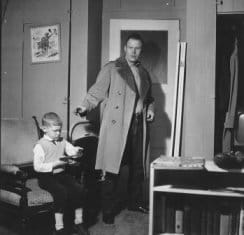
Murphy as a child, photo courtesy of Cullen Murphy

Murphy as a child, photo courtesy of Cullen Murphy.

Q: Have you worked in any of the libraries in Rome?

The Vatican Library. For the fountains of Rome book, I wanted to look at and eventually reproduce original design drawings of fountains as well as engineering plans for sixteenth-century waterworks. The Vatican Library has a lot of this—they’ve even produced a wonderful book of Bernini drawings, about six inches thick, including designs for fountains and monuments that were never built. Most of us know the famous statue of the obelisk on top of the elephant, but Bernini had other ideas for what to do with that obelisk which he made designs for and are fun to look at. Anyway, many of the original Bernini drawings are preserved at the Vatican Library, and so I made a point of going there and seeing them for myself. Librarians in white coats brought them out in stiff folders and laid them out for viewing.

We ended our conversation by repeating our shared appreciation of the view from the window. Murphy hopes to return to the Athenæum when he writes the fountains book. I asked how working at the Vatican Library compared to the Athenæum, where visitors frequently feel overwhelmed. He said, “You don’t have to surrender your passport when you enter the Athenæum.”

Selected Works

Atlantic Monthly Press, Archive, ca. 1866–​2003 (Mss. .L738) Rubbish!: The Archaeology of Garbage (Library of Congress TD793.3 .R38 1992)Just Curious: Essays (Library of Congress AC8 .M895 1995)Word According to Eve: Women and the Bible in Ancient Times and Our Own  (Library of Congress BS680.W7 M87 1998)Are We Rome?: The Fall of an Empire and the Fate of America (Library of Congress E169.1 .M957 2007)God’s Jury: The Inquisition and the Making of the Modern World (Library of Congress BX1713 .M87 2012)Cartoon County: My Father and His Friends in the Golden Age of Make-Believe (Temporarily shelved at New Book Shelves CT275.M8639 M87 2017)

10.31.2017

LGBTQ

Board Books

Baby’s First Words by Stella Blackburn

(Children Picture Book BLACK)

Come spend the day with a busy baby and her two dads and learn the words for all the things you see along the way. Includes seek-and-find pictures.

Daddy, Papa, and Me by Leslea Newman; illustrated by Carol Thompson

(Children Picture Book NEWMA)

The story of a toddler’s daily activities with two loving fathers.

Mommy, Mama, and Me by Lesléa Newman; illustrated by Carol Thompson

(Children Picture Book NEWMA)

A baby enjoys a number of fun activities with her two mothers.

Picture Books

Worm Loves Worm by J.J. Austrian

(Children Picture Book AUSTR)

Two worms in love decide to get married, and with help from Cricket, Beetle, Spider, and the Bees they have everything they need and more, but which one will be the bride and which the groom?

Heather Has Two Mommies by Lesléa Newman; illustrated by Laura Cornell

(Children Picture Book + NEWMA)

“Heather’s favorite number is two. She has two arms, two legs, and two pets. And she also has two mommies. When Heather goes to school for the first time, someone asks her about her daddy, but Heather doesn’t have a daddy. Then something interesting happens. When Heather and her classmates all draw pictures of their families, not one drawing is the same. It doesn’t matter who makes up a family, the teacher says, because ‘the most important thing about a family is that all the people in it love one another.'” —Provided by publisher.

A Family is a Family is a Family by Sara O’Leary

(Children Picture Book + OLEAR)

“When a teacher asks the children in her class to think about what makes their families special, the answers are all different in many ways—but the same in the one way that matters most of all. One child is worried that her family is just too different to explain, but listens as her classmates talk about what makes their families special. One is raised by a grandmother, and another has two dads. One is full of stepsiblings, and another has a new baby.” —Provided by publisher.

This Day in June by Gayle E. Pitman; illustrated by Kristyna Litten

(Children Picture Book PITMA)

“A picture book illustrating a Pride parade. The endmatter serves as a primer on LGBT history and culture and explains the references made in the story.” —Provided by publisher.

Chapter Books

Star-Crossed by Barbara Dee

(Children PZ7.D351 St 2017)

When Mattie is cast as Romeo in an eighth-grade play, she is confused to find herself increasingly attracted to Gemma, a new classmate who is playing Juliet.

Better Nate Than Ever by Tim Federle

(Children PZ7.F314 Bet 2013)

“Nate Foster has big dreams. His whole life, he’s wanted to star in a Broadway show. (Heck, he’d settle for seeing a Broadway show.) But how is Nate supposed to make his dreams come true when he’s stuck in Jankburg, Pennsylvania, where no one (except his best pal Libby) appreciates a good show tune? With Libby’s help, Nate plans a daring overnight escape to New York. There’s an open casting call for E.T.: The Musical, and Nate knows this could be the difference between small-town blues and big-time stardom.” —Provided by publisher.

George by Alex Gino

(Children PZ7.G379 Ge 2015)

“When people look at George, they think they see a boy. But she knows she’s not a boy. She knows she’s a girl. George thinks she’ll have to keep this a secret forever. Then her teacher announces that their class play is going to be Charlotte’s Web. George really, really, REALLY wants to play Charlotte. But the teacher says she can’t even try out for the part . . . because she’s a boy. With the help of her best friend, Kelly, George comes up with a plan. Not just so she can be Charlotte—but so everyone can know who she is, once and for all.” —Provided by publisher.

Young Adult

Simon vs. the Homo Sapiens Agenda by Becky Albertalli

(Children PZ7.A334 Si 2015)

“Sixteen-year-old, not-so-openly-gay Simon Spier is blackmailed into playing wingman for his classmate or else his sexual identity—and that of his pen pal—will be revealed.” —Provided by publisher.

The Darkest Part of the Forest by Holly Black

(Children PZ7.B52878 Dar 2015)

In the town of Fairfold, where humans and fae exist side by side, a boy with horns on his head and ears as pointed as knives awakes after generations of sleep in a glass coffin in the woods, causing Hazel to be swept up in new love, shift her loyalties, feel the fresh sting of betrayal, and make a secret sacrifice to the faerie king. —Provided by publisher.

Georgia Peaches and Other Forbidden Fruit by Jaye Robin Brown

(Children PZ7.B815 Ge 2016)

“Joanna Gordon has been out and proud for years, but when her popular radio evangelist father remarries and decides to move all three of them from Atlanta to the more conservative Rome, Georgia, he asks Jo to do the impossible: to lie low for the rest of her senior year. And Jo reluctantly agrees. Although it is (mostly) much easier for Jo to fit in as a straight girl, things get complicated when she meets Mary Carlson, the oh-so-tempting sister of her new friend at school. But Jo couldn’t possibly think of breaking her promise to her dad. Even if she’s starting to fall for the girl. Even if there’s a chance Mary Carlson might be interested in her, too. Right?” —Provided by publisher.

The Miseducation of Cameron Post by Emily M. Danforth

(Children PZ7.D2136 Mi 2012)

In the early 1990s, when gay teenager Cameron Post rebels against her conservative Montana ranch town and her family decides she needs to change her ways, she is sent to a gay conversion therapy center.

The Great American Whatever by Tim Federle

(Children PZ7.F314 Gr 2016)

“Teenaged Quinn, an aspiring screenwriter, copes with his sister’s death while his best friend forces him back out into the world to face his reality.” —Provided by publisher.

Girl Mans Up by M-E Girard

(Children PZ7.G4395 Gi 2016)

“In Ontario, Pen is a sixteen-year-old girl who looks like a boy. She’s fine with it, but everyone else is uncomfortable—especially her Portuguese immigrant parents and her manipulative neighbor who doesn’t want her to find a group of real friends.” —Provided by publisher.

Will Grayson, Will Grayson by John Green

(Children PZ7.G8233 Wi 2010)

When two teens, one gay and one straight, meet accidentally and discover that they share the same name, their lives become intertwined as one begins dating the other’s best friend, who produces a play revealing his relationship with them both.

Hold Me Closer: The Tiny Cooper Story by David Levithan

(Children PZ7.L5798 Ho 2015)

“Larger-than-life Tiny Cooper finally gets to tell his story, from his fabulous birth and childhood to his quest for true love and his infamous parade of ex-boyfriends, in the form of a musical he wrote.” —Provided by publisher.

When the Moon Was Ours by Anna-Marie McLemore

(Children PZ7.M224 Wh 2016)

“To everyone who knows them, best friends Miel and Sam are as strange as they are inseparable. Roses grow out of Miel’s wrists, and rumors say that she spilled out of a water tower when she was five. Sam is known for the moons he paints and hangs in the trees and for how little anyone knows about his life before he and his mother moved to town. But as odd as everyone considers Miel and Sam, even they stay away from the Bonner girls, four beautiful sisters rumored to be witches. Now they want the roses that grow from Miel’s skin, convinced that their scent can make anyone fall in love. And they’re willing to use every secret Miel has fought to protect to make sure she gives them up.” —Provided by publisher.

I’ll Give You the Sun by Jandy Nelson

(Children PZ7.N433835 Il 2014)

“Jude and her twin brother, Noah, are incredibly close. At thirteen, isolated Noah draws constantly and is falling in love with the charismatic boy next door, while daredevil Jude cliff-dives and wears red-red lipstick and does the talking for both of them. But three years later, Jude and Noah are barely speaking. Something has happened to wreck the twins in different and dramatic ways … until Jude meets a cocky, broken, beautiful boy, as well as someone else—an even more unpredictable new force in her life. The early years are Noah’s story to tell. The later years are Jude’s. What the twins don’t realize is that they each have only half the story, and if they could just find their way back to one another, they’d have a chance to remake their world.” —Provided by publisher.

If I Was Your Girl by Meredith Russo

(Children PZ7.R91 If 2016)

“Amanda Hardy is the new girl in school. Like anyone else, all she wants is to make friends and fit in. But Amanda is keeping a secret, and she’s determined not to get too close to anyone. But when she meets sweet, easygoing Grant, Amanda can’t help but start to let him into her life. As they spend more time together, she realizes just how much she is losing by guarding her heart. She finds herself yearning to share with Grant everything about herself, including her past. But Amanda’s terrified that once she tells him the truth, he won’t be able to see past it.” —Provided by publisher.

Aristotle and Dante Discover the Secrets of the Universe by Benjamin Alire Sáenz

(Children PZ7.S1273 Ar 2012)

“Fifteen-year-old Ari Mendoza is an angry loner with a brother in prison, but when he meets Dante and they become friends, Ari starts to ask questions about himself, his parents, and his family that he has never asked before.” —From title page verso.

History is All You Left Me by Adam Silvera

(Children PZ7.S594 Hi 2017)

Even though Theo had moved to California for college and started seeing Jackson, Griffin never doubted Theo would come back to him when the time was right. But when Theo dies in a drowning accident, the future he’s been imagining for himself is gone. To make things worse, the only person who truly understands his heartache is Jackson. As Griffin loses himself in his obsessive compulsions and destructive choices, the secrets he’s been keeping are tearing him apart.

Informational

Queer, There, and Everywhere: 23 People Who Changed the World by Sarah Prager; illustrated by Zoë More O’Ferrall

(Children HQ73 .P73 2017)

World history has been made by countless lesbian, gay, bisexual, transgender, and queer individuals — and you’ve never heard of many of them. Queer author and activist Sarah Prager delves deep into the lives of 23 people who fought, created, and loved on their own terms. From high-profile figures like Abraham Lincoln and Eleanor Roosevelt to the trailblazing gender-ambiguous Queen of Sweden and a bisexual blues singer who didn’t make it into your history books, these true stories uncover a rich queer heritage that encompasses every culture, in every era.

10.26.2017

Stephen Davis

November 2017

By Kaelin Rasmussen

Stephen Davis started his writing career in music journalism. Now he writes biographies of rock stars. Wikipedia will tell you he is “perhaps America’s best-known rock biographer.” Led Zeppelin, The Rolling Stones, Fleetwood Mac, Aerosmith, Guns N’ Roses, Carly Simon, Bob Marley, Jim Morrison…any of those ring a bell? His newest bookGold Dust Woman, is about Stevie Nicks, and will be released on November 21.

A longtime resident of Milton, he has been a member of the Athenæum for over 30 years. When we spoke in early October, he shared some BA memories, his fondness for typewriters (“I’ve got my father’s 1940 Corona, it’s like this tall, and, you know, ‘tap-tap-tap.’ My children think I’m insane.”), and also some of his experiences as a bestselling author, all with a good, ready dose of dry humor.

Q: Tell us about your background, where you were born and raised, etc. And how did you get into writing biographies?

A: Born and raised in New York City, went to a private academy in Philadelphia, had five years of Latin, and I came here, to Boston University, in 1965, and I’ve never left. I started my career writing. I was the editor of the BU News, which at the time was the largest student newspaper in the country—this was in 1967, ’68, ‘69. Couldn’t really go to class because we were going to demonstrations every day. I burned my draft card on the steps of the Arlington Street Church, 50 years ago, like, this month, November, October, with all my friends. Several thousand people burned our draft cards. Then when it was time to be drafted later on, I had to tell them that I didn’t have my draft card anymore.

But anyway, I graduated in 1969. I wrote the first story on the first front page of what was then called the Cambridge Phoenix, which then became the Boston Phoenix. I was the music editor of the Phoenix, a weekly paper in Boston. There were so many students. Each issue was 500 pages, in ten sections…they were amazing, and unwieldy. Then I became music editor of Rolling Stone, and then started writing for The Boston Globe, and The New York Times.

And then an editor at Doubleday saw an article I had written about Bob Marley, before anyone had heard of Bob Marley, and commissioned me and my photographer friend, Peter Simon, to go to Jamaica and write a book about reggae and the politics in Jamaica and the Rastafarians and ganja, all that stuff we kinda liked anyway—and that’s where my pathetic career begins. And this book was published 40 years ago this month, called Reggae Bloodlines, and this led to several other books about Jamaica. I worked with Bob Marley on his memoirs, and then he died and I finished them. And I left Rolling Stone and started working with rock bands.

I had this wonderful literary agent who said, ‘All of these rock bands are gonna have legends, and someone’s gonna have to be the guy who writes the legends.’ And so I started touring with Led Zepplin, Rolling Stones, and spent ten years doing that and working with all the big bands, Fleetwood Mac and Doors, and all that stuff. I’ve published 19 of these things so far…

You hear a lot of talk in my business that rock is dead. ‘Rock’n’roll will never die,’ but now these aren’t the same stories as the rock stories. Rock is like an ‘ism’, it’s like an artistic movement, like modernism or surrealism, and Rock-ism is kinda over. But on the other hand, it’s spawned the biggest audience of its kind in history. I mean, Zepplin sold 200,000,000 albums; Fleetwood Mac, over 100,000,000. There are religions on the planet that don’t have as many people as in the rock audience. So that’s why I’ve been so lucky, to be the guy telling these stories to this enormous planetary audience. My books get translated into Urdu, and Chinese piracies, Arabic, and Korean—Bob Marley just came out in Korean—and Hammer of the Gods is in 20 different languages…and some of the material in, like, the Bulgarian editions is stuff that I didn’t write, they just throw it in there to bring the story up to date. So I’ve been very lucky to have this audience. But I think we’re in the last years of this audience. I don’t think that many people want to read about Lady Gaga, Katy Perry, or whoever the bands are today. There have already been about ten books about U2. It’s amazing that Stevie Nicks is getting such great reviews. She’s still around, she’s 69 years old, and she’s going out on tour with Fleetwood Mac for the next two years. But these are the last days of this, so I’m gonna have to switch to, like, horticulture or some other topic. I’ll figure out stuff to do.

Q: How did you find your way to the Athenæum? What about it appeals to you?

I had a friend whose father was a proprietor, and when I was working on the Bob Marley material in the early ‘80s, he said, ‘You should go to the Boston Athenæum because they’ll have all this stuff on Jamaica that no one else has,’ and it’s true. This library has Long’s history of the island of Jamaica. You have to go to the rare book room. They have all this incredible stuff, you’d have to go to the British Library in King’s Cross in order to get as good early, early Jamaican stuff…so I joined the library. Back then it was two or three recommendations I had to get people to write, to prove I wasn’t a book thief. Which is a lie [laughs]. And it was amazing. This was in the days of Rodney Armstrong, several directors ago, and he didn’t believe that the library should be air conditioned or climate controlled—and you could ask Mr. Feeney about this, he remembers this—sometimes on hot summer days, a directive would go out, a memorandum, mimeographed, saying, ‘Everyone go home at three today because we don’t want anyone to die.’ And so if you were coming to return a book in July, the entire staff would be coming out of the library, staggering out, drenched in perspiration, literally streaming with sweat because the library was so hot!

I use the library all the time. It’s hard to park, though. I don’t take advantage of the book mailing because I like coming here so much, you know, because Milton is so boring. And to come up to Beacon Hill is a cool thing. The library has been, really, an important part of my career. As a guy who writes rock books, it hasn’t been all that germane, but the thing about my books is I try to bring in all the other stuff that is the background, like with Long’s history of Jamaica, to find out where it’s all coming from.

Also, the serials and periodicals are really important, because Tom can lay his hands on all sorts of esoteric stuff, from way back…unfortunately he won’t let me take them home [laughs]. It’s okay, it’s a library, I’ve become used to this.

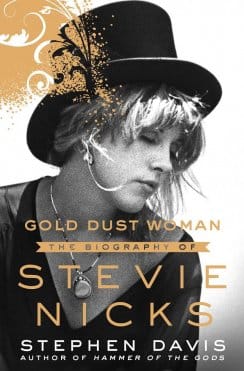
Gold Dust Woman book cover

Davis’s new book, published in November 2017.

Q: What about your newest book?

My new book is called Gold Dust Woman, a biography of the singer Stevie Nicks from Fleetwood Mac. It covers the period from her birth in 1948 to 2017.

It’s gotten rave reviews in the trades…it got a star in Publisher’s Weekly…which is a good thing, and a very good review in Kirkus, and now we’re waiting for Library Journal, if it still exists [ha]. It’s the big three. If you do very well in those, odds are that the librarians—how many thousands of towns out there in this country and how many thousands of librarians?—so of my 19 books, I think five have been NYT bestsellers. You can tell pretty early on because when the orders start coming in from the libraries in Kansas, Montana, whatever, there’s hundreds of them. That’s the way they do the bestsellers list, they look at libraries, they look at Amazon, the independent bookstores, all that.

I have this ritual when I’m in New York, where I go to the St. Patrick’s Cathedral, St. Andrew’s Chapel, and I throw in like 50 bucks in the little thing, and I light about ten candles and I go, ‘Please, please, one more bestseller!’

All readers are writers, even if you don’t write. I will say to the younger writers—it’s the old Robert Graves joke—that the only thing that an old writer can do for a young writer is die. You can’t teach this stuff, you either have it or you don’t, so I’m prepared to die. As soon as someone wants to come up and do what I do, I’m gonna retire.

10.18.2017

Dr. Heidi Gearhart

January 2018

Interview by Arnold Serapilio

Dr. Heidi Gearhart discovered the Boston Athenæum as a teenager when her mother brought her on an impromptu trip to Boston for an informal tour of historic sites. She was taken with the atmosphere of the first floor reading spaces. ‘Those big red chairs, and looking out onto the graveyard. I just loved it.’ She went on to obtain a Bachelor in Arts from Pomona College, a Master in Art History from Tufts University, and a PhD in History of Art from the University of Michigan. Then, after several years of moving around the country and the world for various academic and professional pursuits, she landed back in Boston to teach at Assumption College, where she is currently Assistant Professor of Art History​.

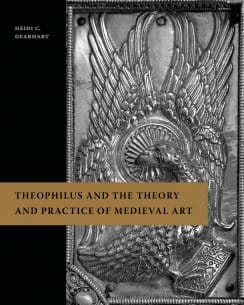
Gearhart and I sat down to discuss her first book, Theophilus and the Theory and Practice of Medieval Art, an exploration of twelfth-century German monk Theophilus’s rare treatis​e On Diverse Arts—and also the excitement of the highs and lows of the writing process, and the new project on her horizon.​

DR. HEIDI GEARHART: I grew up in Marblehead, and I went to college out in California. I studied studio art, and mathematics. Then I bounced around for a number of years: I worked in L.A., I lived in Italy. I came back here to get a master’s at Tufts. I ended up at Ann Arbor for my PhD. I got into art history because I decided I really like art but I don’t actually like doing it. I don’t like sitting there and mixing paint, say. [laughing] I loved writing in my journal about what I would do—that’s what I liked. 

Q: Taking it in is what moves you—

HG: Thinking about what art could be. At this stage—thinking about what art has been over thousands of years, right, and we’re sitting here at the edge of it looking back—what is there to do now? I was really obsessed with that question. How do you do something that is worthwhile at this point in time? That was more interesting to me than actually sitting down and doing it.

Q: I’m curious about the mathematics connection because there are other members who seem to have this dual aptitude for math and art. I don’t know whether it speaks to a larger pattern. What was your background in math?

HG: I just always liked it so I just kept taking it. In some ways it has correspondences to writing. I like the beauty of numbers. I like that there are patterns. I like the abstraction. And there are some parallels to the way I think, in terms of art history. In terms of process, when you’re doing a math proof, it’s like a puzzle. You’re trying to make the pieces work, and sometimes you go down one path and you get stuck. ‘But all my logic was sound!’ and yet you get to a stopping point. Writing is like that. You go down these paths and you get stuck but you have to go down there, and then you come back up and you finally find the right path and all the pieces fit and it’s this amazing, gorgeous thing.

Q: Is that how it happened with this book?

HG: Yes and no. I think writing is a whole bunch of small instances of that—and lots of dead ends. I wouldn’t say that as a whole it was that way. It was such a big project that happened over such a long period. 

I was first introduced to the topic of this book, this twelfth century art manual, in grad school. It started out as thinking about who artists were in the Middle Ages, and using Theophilus’s manual to think about artistic practice during that time. I looked at all the manuscript copies of that text. There are 25 of them and they’re all over Europe, so I went and looked at every single one and tried to figure out, How is this book read? How was it understood in the Middle Ages? So that was the dissertation, finished in 2010. In 2011, I started working on this book.

Q: When you were doing your dissertation, were you thinking the whole time that you would eventually expand it to book proportions?

HG: I had hoped to. In academic art history that’s the goal. If you get an academic job you’re expected to come out with a book in six years. You hope that it will turn into a book—and that it won’t be that hard to turn it into a book—famous last words, right? I decided I would talk about what the values were of art-making in the twelfth century. What did artistic work mean? What did it mean to be somebody making something in the medieval period, particularly in a monastic context? Because there is this idea that work and learning are part of your spiritual exercise. Theophilus is trying to make art-making part of the spiritual world.

Q: Is writing a love of yours or a means to an end?

HG: I really enjoy it. I enjoy the process. It’s hard, but I enjoy it. I like all aspects of it. I like when you’re writing just to write, to get something out. And then there’s this whole long process of going back and endless editing and figuring out, What am I actually trying to say? It suits me somehow. I would write all the time if I could. 

Q: And your writing is primarily research-based, right?

HG: Right.

Q: So you have that whole other layer of—if I had to pull from sources to put something together I would never be able to stop the research portion and begin writing. How do you negotiate that balancing act? Is that a challenge for you?

HG: There is this point where you have to just cut yourself off and write. And know that you can fill in holes. I’ve found you don’t always know what you need until you’re writing, so it actually is good to start writing sooner than later.

I was writing an article about an altar-piece, and I thought I was writing about aspects of material—it has this inscription on it that says it’s made of this much gold and this much silver. And it turns out that altar-piece, which was from Germany, is a lot like altar-pieces that were being made in Denmark. But if I had just kept on going with the strain of research that I thought I was doing, about materiality—what I really need to know is how this piece works with other pieces. So then I had to go and look at Danish altar-pieces.

Q: What were some of the great joys and struggles of this writing process?

HG: I had one chapter that was really difficult—I had to rewrite the entire chapter. And at that point it had already gone through peer review and wouldn’t again.

Q: When you delivered the first version were you feeling that part was off?

HG: I knew I had struggled with it. One of the nice things about writing is that when an argument works it doesn’t feel difficult or convoluted. When you have a really clear argument, it makes sense. It will unfold, and the pieces fit, and you’re thinking clearly. Getting to that point is horrendous. That’s the struggle, right? But somehow, I have this gut feeling about what something is at the beginning. Then I go on this roundabout path, and at the end of the day I end up pretty close to where I started—but it’s more clear. I enjoy taking a step back and thinking, What am I actually trying to say? With that chapter, I was trying to make the argument more complicated than it needed to be. And in making it more complicated than it needed to be, it was weaker. 

Q: There’s this tendency to get as much out of you and onto the page, but simplicity always seems to be the way to go. When I write drafts, I usually end up cutting most of it.

HG: But that’s not a bad thing. I have to go through that process. I wonder whether there are people—you hear stories about somebody who’s such a clear, brilliant thinker that they just sit down and—

Q: You hear those stories, but is that all [bunk]? I’ve never actually met anyone who has copped to that.

HG [laughing]: Me neither!

Q: Rewriting and reassessing what it is you were trying to say in the first place, for me, is the actual work.

HG: Right, right. I think for most people, writing is really hard work. I enjoy the work—but it’s really time consuming, it’s really slow, and it’s hard.

I remember talking to someone when I was writing my dissertation. I was in Germany at the time. He’s an American professor and was there giving a lecture. I was really in the middle of the dissertation writing and just suffering, suffering to no end [laughing]. I said, ‘This is so awful, does it get easier?’ He said, ‘It gets easier. The dissertation is the hardest, but it gets easier.’ OK. Great. Gets easier. So I finish the dissertation and I work on the book. And I actually just saw him last spring at the medieval conference when this book came out and I said, ‘You told me it gets easier!’ And he said, ‘I did? I lied.’ [laughing]

Q: He probably didn’t want to push you over the edge!

HG [laughing]: He saw that I was going to lose it. He said, ‘It doesn’t get easier, it just gets harder.’

Theophilus and the Theory and Practice of Medieval Art

Gearhart’s new book, published in 2017.

Q: Harder as in busier? Or more daunting?

HG: My optimistic thought is that the longer you do this and the more practice you get, the easier it gets. Because I’ve been through the process now a couple times I understand the process better, so I deal with it better. ‘OK. Here I am in a dead end, step away, calm down, start again.’ Or, ‘Just keep on going.’ 

What I think gets harder—and I don’t know, I’m just speculating in thinking about the new book—

Q: Audience expectation?

HG: Possibly audience expectation, although—well, that is something to worry about—

Q: No. Don’t go down that road! Not worth it! [I’m sorry I even mentioned it, in retrospect]

HG: What I’m thinking of is similar in that, the longer you’re in the field, the more you know. Which is good, because you have more to say. But that also means you know all the problems with any kind of argument. You can see all the different sides. If I talk about how artists are remembered, for example—what does that actually mean? Who is doing the remembering? How are they remembering? That turns into self doubt. It’s a different kind of self doubt. When you’re younger, it’s, ‘Can I do it?’ Now I have less self doubt about that. I can get it done. Will it be solid? As good as I want it to be? Maybe that’s what he meant, when I saw him last spring. You just can see too many sides of the argument.

Q: Couldn’t that ultimately be leveraged as a strength? If you’re able to incorporate it into your work without going insane, you have anticipated and preempted a detractor’s arguments?

HG: Ideally, yes. But there’s also the fear of muddling it. When you’re younger—students see things with fresh eyes because they don’t have all the noise. They can look at something and see it in a new way, and ask a new question that was right there all along. 

Q: Are you able to talk about your current project?

HG: I’m looking at how artists in the Middle Ages were remembered. Who gets remembered? Women don’t get remembered. Lay people—their names aren’t often remembered. A monk will be remembered because he’s part of the system in which they are remembering people. This whole project is looking at the structures of memory and what that tells us about art-making in the Middle Ages. What it meant for an abbey to have something a particular person made. Whether that person was real doesn’t matter so much. What I’m interested in is what that story did for them, why they needed that story to be the way it was.

My favorite story, there’s an abbot who’s trying to build a church, so he hires these stonemasons to come to the abbey to build. He says, ‘While you’re here at the abbey, you can’t eat pork.’ So, the masons go out into the woods and cook a pig. The story goes that a little dove comes to the abbot and tells him, ‘Go out into the woods and you’ll find all your stonemasons.’ He goes into the woods, finds the stonemasons, and tells them, ‘I told you not to eat pork while you’re working on the church.’ He tries to convince them of how it’s good for their soul—this is all in a monastic chronicle, mind you. Finally, he says ‘I’m not going to pay you unless you stop eating the pork and come back to work.’ And the story ends—[here her vocal delivery is ironic]—’And the masons were pricked to the heart, and they decided to go back to work!’

It shows you, number one, that even if you’re a lay person working for the church, you’re expected to behave according to the rules of that abbey. Number two, it’s a tacit acknowledgment of the fact that at the end of the day, the stonemasons a) want to eat pork, and b) want to get paid. So what I’m trying to do is tease out, What can we tell about what matters to these people in art-making through these stories?

I like having a puzzle in my head, that’s just the way I am. I like having something to stew on. I like books for that. They let you think about something for a long time. After [the first book] was done, I wanted to think about the next book. I wanted to have something bigger, more encompassing. I’d rather have that new puzzle to stew on.

Q: That’s a healthy instinct, just forge ahead.

HG: This is why I believe in over-writing. Just write. Some path that you went down that ended up being a dead end could be useful for something else. Things come around. I try to trust in that. And that gives me hope not to worry and not to be too precious. The word to teach in Latin is docere, which is to lead. My Latin teacher said, ‘My job is only to help you put things in order. It’s already in your head.’ All your dead ends, all your discarded ideas—they just haven’t found a place yet. They’re still there. They just need a place to live.