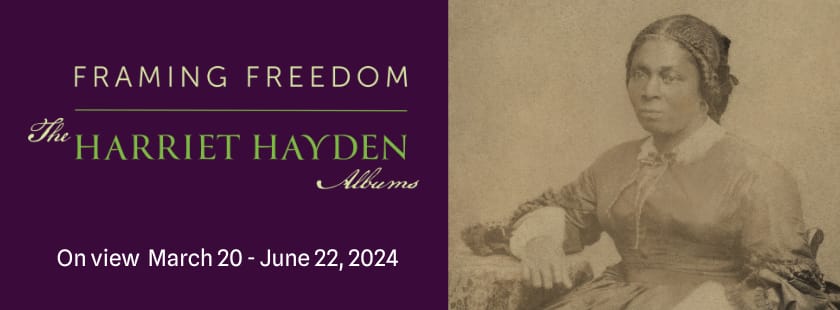
Hayden exhibition photo and wordmark

Harriet Hayden Albums exhibition announced

02-15-24

First-ever major exhibition of the Harriet Hayden albums, displaying original photographs of notable Black Bostonian and national abolitionists

The exhibition opens March 20 and runs through June 22.

The exhibition centers on two photograph albums once owned by anti-slavery activist Harriet Hayden. Together, the albums contain 87 cartes-de-visite. The 2⅛ x 3½-inch portrait photographs portray many of Boston’s most prominent Black abolitionist figures – including suffragist Virginia Hewlett Douglass, lawyer Robert Morris, educator Elizabeth N. “Lizzie” Smith, and Dr. John V. DeGrasse – and include rare examples by makers like the Black landscape painter Edward Mitchell Bannister.

The exhibition centers on two photograph albums once owned by anti-slavery activist Harriet Hayden. Together, the albums contain 87 cartes-de-visite. The 2⅛ x 3½-inch portrait photographs portray many of Boston’s most prominent Black abolitionist figures – including suffragist Virginia Hewlett Douglass, lawyer Robert Morris, educator Elizabeth N. “Lizzie” Smith, and Dr. John V. DeGrasse – and include rare examples by makers like the Black landscape painter Edward Mitchell Bannister.

Framing Freedom offers a new lens to view the significance of Harriet and Lewis Hayden’s extensive social network and their influence in the social justice movements of their day. While her husband, Lewis Hayden, is better known for his public activism, these works encourage us to recognize the home-based activism and movement contributions of Harriet Hayden.

The exhibition features Harriet’s photograph albums alongside objects from the 19th century anti-slavery movement in Boston, including the only two known portraits of Harriet, displayed together for the first time.

This special exhibition is co-curated by Makeda Best, PhD, Deputy Director of Curatorial Affairs at the Oakland Museum of California, a specialist in nineteenth-century photography, race, and gender, and Virginia Reynolds Badgett, PhD, former Assistant Curator at the Boston Athenaeum and scholar of American art and material culture.

“The Harriet Hayden Albums exhibition draws much-needed attention to Harriet Hayden’s role in Boston’s abolitionist movement, centering the Hayden home as a crucial site for the formation and execution of a societal crusade to which they devoted their lives,” says Makeda Best.

“By integrating Harriet’s cartes-de-visite with objects from the nineteenth-century anti-slavery movement in Boston, the exhibition offers a new contextual lens through which one can view the significance of the Haydens’ extensive social network and their historic home on Beacon Hill – located blocks from the Boston Athenaeum – to understand better their influence in the social justice movements of their day,” Best says.

In 1844, Harriet Hayden, her husband Lewis Hayden, and their son, Joseph, escaped slavery in Lexington, Kentucky. By 1849 they settled on the north slope of Boston’s Beacon Hill neighborhood, where Lewis opened a clothing store on Cambridge Street. It became the second largest establishment in Boston to be owned by a Black man. Their home at 66 Phillips Street served as a special place of refuge during the height of activity on the Underground Railroad, helping hundreds of self-emancipated sojourners on their journey to freedom in the wake of the Fugitive Slave Act of 1850.

In the early 1860s, Harriet received two cartes-de-visite photograph albums as gifts from fellow Boston anti-slavery activists Robert Morris and Dr. Samuel Birmingham. Harriet Hayden’s carte-de-visite albums offer a unique window into a close-knit and well-organized Black activist community and present an opportunity to re-evaluate conventional understandings of the domestic sphere and Boston’s broader abolitionist presence.

“The legacy of Harriet Hayden deserves to be better known. The albums provide insight into an under-recognized history, revealing the interconnectedness of individuals’ identities in a crucial moment in American history,” said John Buchtel, the Boston Athenaeum’s Curator of Rare Books and Head of Special Collections. “The Boston Athenaeum’s Harriet Hayden Albums exhibition tells a fuller story of our national and regional abolitionist history, and how Boston’s past and present are linked.”

Additional exhibition features connect Harriet Hayden’s carte-de-visite albums to a societal and historic narrative arc that transports the viewer from the Beacon Hill neighborhood into both the public sphere and the Hayden home. Artifacts include photographs, prints, illustrated rare books, broadsides and ephemera, American paintings, decorative arts, and personal objects associated with key individuals and the exhibition’s themes of race, gender, representation, and community.

The exhibition reflects several years of ongoing work to conserve, digitize, and research the Harriet Hayden albums and bring them to a broader understanding of the importance of social networks and anti-slavery activism.

“I am deeply proud of the The Harriet Hayden Albums exhibition ,” said Leah Rosovsky, Stanford Calderwood Director at the Boston Athenaeum. “It builds on several past exhibitions that have explored how Boston’s Black community is connected to politics and culture. Harriet Hayden’s story, and the stories of all those in this exhibition, are important additions to a full understanding of Boston’s rich history.”


Framing Freedom: The Harriet Hayden Albums is generously supported by the Terra Foundation for American Art, Cabot Family Charitable Trust, Gladys Krieble Delmas Foundation, Mass Humanities, Mass Cultural Council, and Fiduciary Trust.


See details on the Framing Freedom: The Harriet Hayden Albums exhibition page

02.06.2024

Davene Wright finds her “third place”

Davene Wright member sitting in a red chair with bookshelves behind her.

An interview with Davene Wright, a member since 2022.

What drew you to become a member of the BA?

Davene: I love libraries. And I wanted a “third place” that wasn’t home or work, but another place to spend time. And for me specifically, at least for where I live in the city and where I work, I don’t have a reason to come all the way into downtown Boston. So, that’s been really nice to be able to come to this area where I wouldn’t normally spend time and explore other things.

What’s your favorite spot in the building?

Davene: The Bornheimer Room at the end of the Long gallery. It’s a great view — you can see all the tourists in the Granary Burying Ground and know that “I’m in here and they may not even know about it!” — which is wild. That room in particular acknowledges explicitly the role of colonizers and comes to terms with that. That is very, very important.

We have a lot of good spaces, but the fifth floor is a particularly nice one. I love it when people doing research leave books on the tables. I like to look at the stacks and see what they’re interested in.

What are you working on at the BA currently? 

Davene: I’m an academic, and we have to write manuscripts and papers, so being here is a way to focus on that. It’s quiet and I’m not going to get distracted by things at home or by what’s going on at my office — I can come here to a beautiful place and use it as a writing space.

Is there anything you’ve discovered here that you’d want to share? 

Davene: After the book readings, there was a wine and cheese reception and I was not expecting that! Even though I’d made plans to go out after the book reading, we stayed here instead. I’ve come to like the social events; I get to meet other people and find out why they come to the Athenaeum. 

What’s your favorite perk of being a member?

Davene: My favorite perk is the ebooks! Over the holidays I was getting on the plane and thought, “Oh, I don’t have anything new to read!”  I have five library cards and went to see what ebooks were available at other libraries and many had 20-week waits, but when I went to CloudLibrary a book I wanted was available immediately. It’s amazing. 

If any, what fictional character or historical figure would you expect to find in the Athenaeum? 

Davene: President Bartlet from the West Wing. He would be particularly mad about people talking in the silent reading room, not following the rules or not being good members of the community. I think he’d like to read here, he’d like the history, he’d play chess, he’d have debates — he’d like all those things! And he was from New Hampshire, so I think he would love it here.

Learn more about membership.

12.11.2023

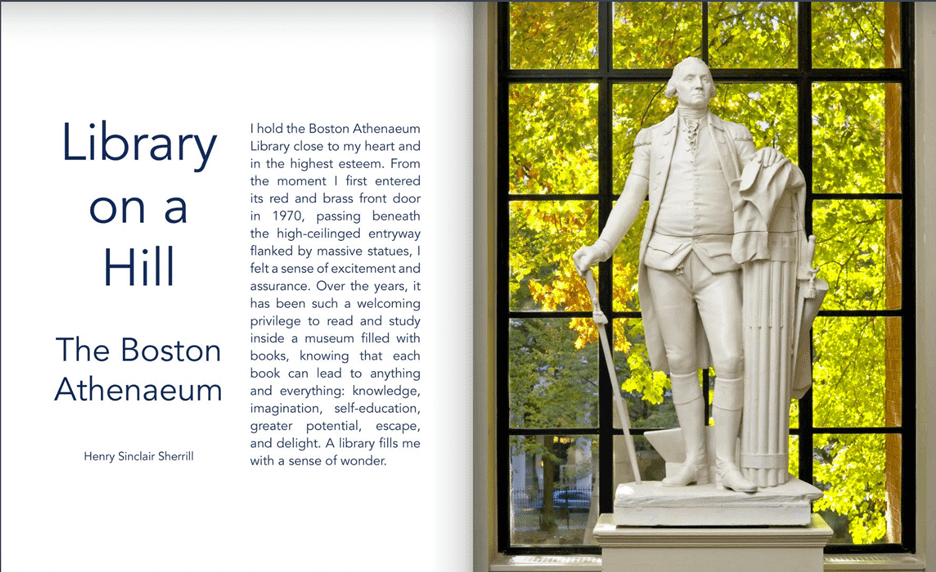
Library on a Hill – VIM magazine article

First page of the article.

Proprietor Henry Sinclair Sherrill published an article on the Boston Athenaeum in VIM magazine. It is an appreciation and history and is well worth reading. We include the opening paragraph here, yet we encourage you to read the full article.

“I hold the Boston Athenaeum Library close to my heart and in the highest esteem. From the moment I first entered its red and brass front door in 1970, passing beneath the high-ceilinged entryway flanked by massive statues, I felt a sense of excitement and assurance. Over the past years, it has been such a welcoming privilege to read and study inside a museum filled with books, knowing that each book can lead to anything and everything: knowledge, imagination, self-education, greater potential, escape, and delight. A library fills me with a sense of wonder.”

Read the full article. It starts on page 82.

11.09.2023

Metamorphosis of the Boston Athenaeum

Published in “Traditional Building” November 9, 2023

Metamorphosis of the Boston Athenaeum
Annum Architects has breathed new life into the Boston Athenaeum’s art, books—and membership
.
By J. Michael Welton

Excerpt:

One of the nation’s oldest libraries—and one of Boston’s finest mid-19th-century buildings—recently emerged from a 21st-century metamorphosis.

The Boston Athenaeum was established in 1807 by a group of forward-looking merchants dedicated to reading materials, newspapers, and learning. It was not a private men’s club, though it was membership-driven.

“The founders and first shares were in men’s names, but they were really family memberships,” says Leah Rosovsky, director of the Athenaeum. “In 1822 the first woman owned a proprietorship in her name.” Over time, its members—educated through its library and personal interactions—were met with great success. “Its purpose was not to be social, but to increase people’s access to knowledge,” she says. Moreover, its members were civic-minded. The Boston Public Library and the Museum of Fine Arts evolved from Athenaeum members.

Read the full article in Traditional Building.

11.08.2023

Boston Athenaeum receives a Mass Cultural Council grant for building expansion

Person viewing photograph contact sheets in the Athenaeum's new exhibition gallery.

The Cultural Facilities Fund, run jointly by the Mass Cultural Council and MassDevelopment, awarded the Boston Athenaeum a $145,000 grant to support its recent renovation and expansion. The grant is among 28 totaling $3.14 million for cultural facilities and projects throughout Massachusetts.

The Athenaeum’s renovation and expansion preserved the beauty of its historic building while providing more space for programs and events, varied art and historical exhibitions, reading and research, and more opportunities for connection. The project was completed in the Fall of 2022.

“The expansion is helping us create a more welcoming space that serves more people than ever,” said Leah Rosovsky, Stanford Calderwood Director. “It helps us preserve our historic structure and adapt to the needs of the twenty-first century. This kind of public funding from the state and the Governor’s office is crucial to the success of cultural institutions all over Massachusetts.”

The grants are from MassDevelopment and Mass Cultural Council, two state agencies jointly administering the Cultural Facilities Fund (CFF, which invests in the acquisition, design, repair, renovation, expansion, and construction of nonprofit and municipal cultural facilities.

View the full list of recipients.

09.25.2023

Staff book suggestions for Autumn 2023

Six staff members holding books up in front of their faces.

Jacqueline Chambers

Homecoming: A Novel by Kate Morton

Full of beautiful Australian imagery and Morton’s classic use of buried, tangled family histories, this is an enjoyable read that gives you pause for reflection long after finishing.

Emily Cohen

Selfish, Shallow, and Self-absorbed: Sixteen Writers on the Decision Not to Have Kids edited and with an introduction by Meghan Daum

If spring is the season of birth, then I, as a proud childfree adult, could make the case that this book recommendation works for the fall, but the truth is, I just like this book. The great thing about essay collections on a particular topic is that some may ring very true to your own experience, some you may hate, and some entice you to read more by that author. While the subject matter is one I feel strongly about, Danielle Henderson is the writer that made me want to read it and while her work never disappoints, I also enjoyed Anna Holmes and Kate Christensen.

Although Selfish, Shallow, and Self-absorbed may seem like a book for a limited group of individuals, it might be the perfect book to have around during the holidays. Perhaps there’s a conversation you’ve been wanting to have with your significant other or family members that seem to use their biological clocks to tell time in other people’s time zones?

Julie Corwin

A Most Agreeable Murder by Julia Seales

Do we need another book reflective of Pride and Prejudice? Yes! You’ll find wit, suspense, romance, and a lead character you want to root for all wrapped up in this fun, polite murder mystery. It’s light and fluffy and perfect for the commute. Available on cloudLibrary.

Bruno Faria

The Box Man: A Novel by Kobo Abe; translated by E. Dale Saunders

“I personally feel that a box, far from being a dead end, is an entrance to another world. I don’t know to where, but an entrance to somewhere, some other world.”
—Kōbō Abe, The Box Man

A book that I have never been able to finish although I’ve tried countless times, simply because it is pure genius.

Shay Glass

Pumpkinheads by Rainbow Rowell

I’ll recommend Pumpkinheads by Rainbow Rowell. This graphic novel pretends to be about two friends working their last shift together at a pumpkin patch, but really it’s about as many quintessentially fall treats as the creators can squeeze in. Are you a fall person? This book is for you.

Anna Kelly

A Council of Dolls by Mona Power

A Council of Dolls follows three generations of Dakota women and their struggles and triumphs, primarily told through the stories of their relationship with their dolls. It is a powerful story about both the effects of intergenerational trauma as well as the ability, through love and forgiveness, to overcome it.

Michelle LeBlanc

Unworthy Republic by Claudio Saunt

In this gripping read, Saunt brings in a variety of voices to expand the story of the Trail of Tears and shows how the removal of Indigenous communities was not an inevitability and garnered widespread protest as well as indifference. His use of letters and government documents is particularly compelling and paints a vivid picture of both human suffering and the unfathomable undertaking of forcibly removing thousands of families from their homes.

Kat Meyers-Moock

Once and Future Sex by Eleanor Janega

Forget everything you’ve ever learned about women’s roles in medieval European society. Janega dives into court records and documents to find the women who were making a living for themselves and their families, while defying the roles that thinkers of that age placed women into.

Mastering the Art of Soviet Cooking by Anya Von Bremzen

Food is the backbone of so many of our memories and nostalgic longings, so what happens when the foods you love and crave from your youth are so directly tied to pain and suffering? This book will make you cry, while also making you crave kolbasa and good rye bread.

Christina Michelon

We Have Always Lived in the Castle by Shirley Jackson

I Capture the Castle by Dodie Smith

If you like houses (or castles) that become main characters, unusual first-person narrators, or complicated but (sometimes) heartwarming family dynamics, read Dodie Smith’s I Capture the Castle (1948) and Shirley Jackson’s We Have Always Lived in the Castle (1962) back-to-back this fall. Both books are fictional diaristic recountings of the protagonists’ daily lives that are anything but normal. Strong and complex bonds between sisters drive both narratives and anchor two rich casts of characters. Start with Smith in early autumn, follow with Jackson for spooky season!

Carolle Morini

Hour After Happy Hour by Mary O’Donoghue

A wonderful short story collection that is in touch with the subtleties, sensitivities, and humor of being human. Click here for more on this author.

Zoe Palmer

Mexican Gothic by Silvia Moreno-Garcia

Silvia Moreno-Garcia’s Mexican Gothic is the perfect read to get into the Halloween mood. Travel with its protagonist Noemí to the mysterious High Place, where nothing is as it seems, and everything is conspiring against Noemí. Mexican Gothic combines classic Gothic tropes with explorations of colonialism’s sinister sciences to make a book that will have you afraid to turn the page but unable to turn away.

Leah Rosovsky

Tomorrow, and Tomorrow, and Tomorrow by Gabrielle Zevin

This book explores the relationship between three friends over a 20 year stretch. I didn’t believe that I would find the setting—a company that creates video games—to be interesting. I was completely wrong! It’s an incredibly compelling read.

Grumpy Pants by Claire Messer

If anyone in your life is under age six, you should pick up this book. It’s the story of a penguin and how he copes with a very bad day. The story and illustrations are charming and instructive. After all, who doesn’t need guidance on strategies for conquering a bad mood?

Mary Warnement

The Burgundians: A Vanished Empire; A History of 1111 years and One Day by Bart van Loo

Autumn means back to school for me, and my favorite topic to study is medieval history, specifically the fifteenth century. I was delighted to see this popular history, The Burgundians: A Vanished Empire; A History of 1111 Years and One Day by Bart van Loo appear in paperback in English this year. Given that lengthy subtitle and awkward second subtitle (preceded by semicolon for those of you who like to keep up to speed on obscure bibliographic citation rules), you may well fear taking home this hefty tome, but Loo manages to keep it under 600 pages. Bart van Loo is Flemish, lives in Belgium, and has published extensively on French history, literature, and culture. His popular treatment of the Low Countries at its pinnacle has received high praise and spawned a podcast in both Flemish and French. If you’re interested in the art of Jan Van Eyck or Rogier van der Weyden, the library of Philip the Bold, and historic cities like Bruges, Antwerp, and Brussels, then this is the title for you.

The Bookbinder by Pip Williams

Pip Williams’s The Bookbinder is the author’s second novel, also set in the bookish world of Oxford. There is overlap of periods and characters with her earlier Dictionary of Lost Words, but you need not have read that to fully grasp her follow up. Again, there is a map of Oxford with buildings key to the plot illustrated. Various titles published at the Oxford University Press during WWI (when this novel is primarily set) appear in the plot, and several act as section headings, although in the afterword Williams tells her readers that she did not put much thought into their choice. I don’t quite believe her (I’d like to know if other readers agree with me). Williams has researched extensively, created believable characters, and doesn’t wrap everything up in a neat bow, which was appreciated. A world where books act as insulation, inspiration, and solace is one in which I am comfortable. If you are the same and enjoy historical fiction, then I highly recommend this.

09.25.2023

Athenaeum hosts Community Day

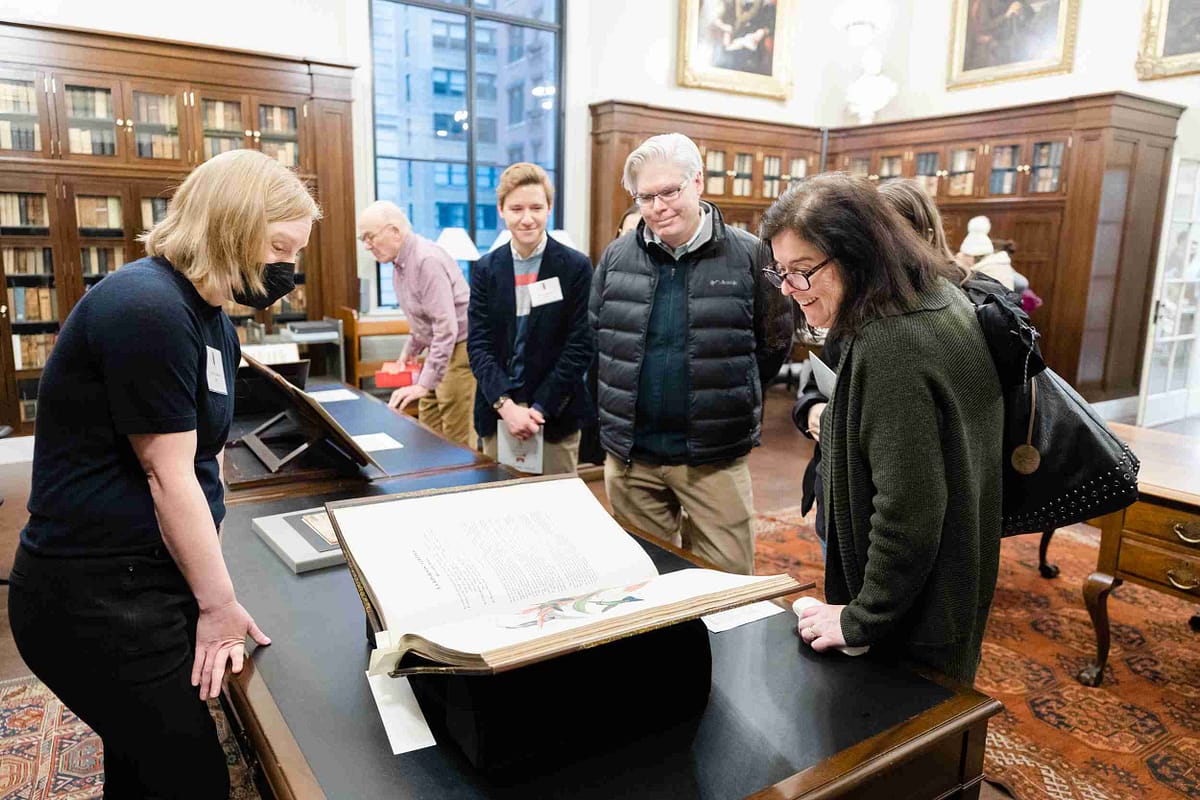
Event attendees view a rare book on display.

The Boston Athenaeum invites the Boston community to its Community Day open
house on Saturday, September 30, welcoming all residents, visitors, families, and friends across
the city to explore the landmark building’s five galleried floors and enjoy performances, art
activities, and displays of special collections from 10 am to 4 pm. The event is free and open to
everyone.

This open house event at the renowned library, museum, and cultural center will include
activities for guests spread throughout the building, including a bookmaking workshop by book
artist and printmaker Annie Silverman; a demonstration by the Athenaeum’s conservation team
on the creation of paste-paper, which is used in both book arts and conservation; special
collections show and tell by its curators; musical performances by local artists Joe Sabourin,
Grooversity, and Anibal Cruz; a treasure hunt and hawk-sighting tour; and much more.

“We are a member-supported organization that anyone can join,” said Leah Rosovsky, the
Athenaeum’s Director. “We invite everyone to explore and experience the books, exhibits and
programming that make the Athenaeum such a unique place.”

There will be the chance to meet renowned Roxbury artist, book illustrator, and educator Ekua Holmes, known for her mixed-media collage art investigating family histories, childhood, and the power of self-determination. The Children’s Library’s visual centerpiece is a vibrant streetscape mural by Holmes and the original collages created for the mural will also be on display.

Visitors will also see the recent expansion and renovation enhanced the classic beauty of the
building but also added space for more programs and events, more varied art, more places for
reading and research, and more opportunities for connection.

09.06.2023

Clive Martin shares his pursuit of lifelong curiosity.

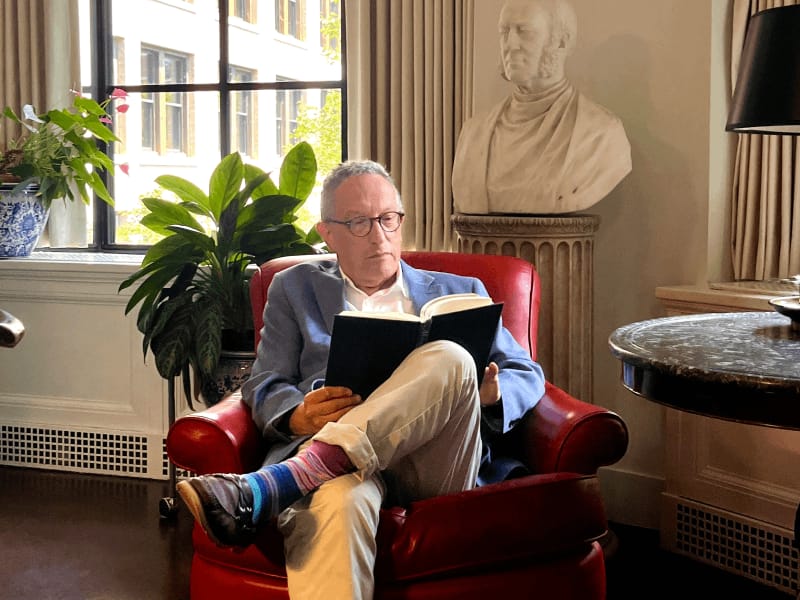
Man with white hair reading a book while sitting in a comfy red leather chair.

Excerpts from an interview with Clive Martin, member since 2013 and docent

What drew you to become a member of the BA?

Clive: I’ve been a member of the BA for 10 years. Before I retired, I used to work just down the road actually, and I would come in here on my lunchtimes and just look around.

Ten years ago, my Boston Globe subscription came with promotions including a reduced-price membership to the BA. I thought, “So anyone can join? I’ll try it!” I love libraries, I’ve always loved learning and reading and meeting like-minded people, so it was a no-brainer…I never looked back!

What are you working on at the BA currently?

Clive: It’s rare that I just get a chance to sit down and read! That’s what I always think of doing, but what I come here for is my docent tours, and my book groups, Dickens and Literary Conversations, and I’m also a member of Poetry, and all three of those are very active. It just keeps me very very busy.

How has the BA supported your interests? What have you discovered here?

Clive: Oh, what have I discovered?! …I mean, it stretches your mind and your intellect. The book talks, the concerts, the discussions, the book groups, and the friends you make. …and I love the collections.

I’ve learned a lot about cultural history, and how it’s presented. We [docents] must ensure our cultural history is presented honestly. For instance, the rehanging of the paintings here was so thoughtfully done. Now we tell a much fuller story, with the re-hanging, about our country’s art and history, including so much that’s been neglected or ignored.

What’s your favorite spot in the building?

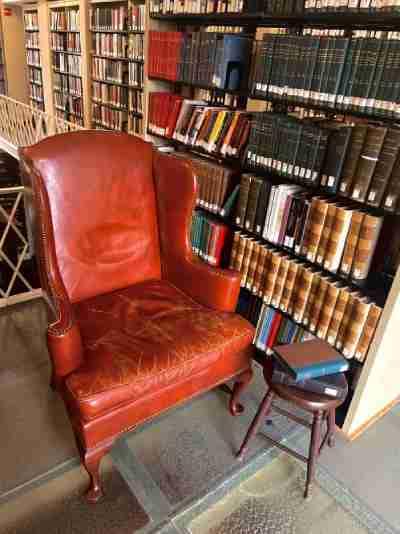
Clive: Oh, I have a lot of favorite spots… Now you’re going to give away all my good secrets! My favorite place to sit and read is on the fourth-floor gallery. There’s a winged armchair. You get lost in it. I do like the art library. It’s fantastic. Great places to sit, surrounded by all the art books.

If you go to the gallery levels, you can find chairs no one knows about. It’s nice to sit down and get lost. The only person who will find you there is the security guard

What is your favorite perk of being a member of the BA?

Clive: There’s so many… If you boil it all away, it’s the people. There’s no lack of people to talk to, who are glad to engage in conversation– really good discussions with interesting people.

What fictional character or historical figure would you expect to find in the Athenaeum?

Clive: Dorothea Brooke from Middlemarch. And her husband Rev. Edward Casaubon. I would not be at all surprised if I ran into them in here. Dorothea Brooke is full of the delight in learning and the love of literature, the love of philosophy, and the love of theology.

I would expect to find her reading on the 5th floor. And Rev. Casaubon would be studying the books in the King’s Chapel Library collection, turning the pages, and inhaling the accumulated dust that has built up since 1698 when they were shipped to Boston.

Learn more about membership.

08.22.2023

Exhibition of Berenice Abbott and Irene Shwachman photographs opens

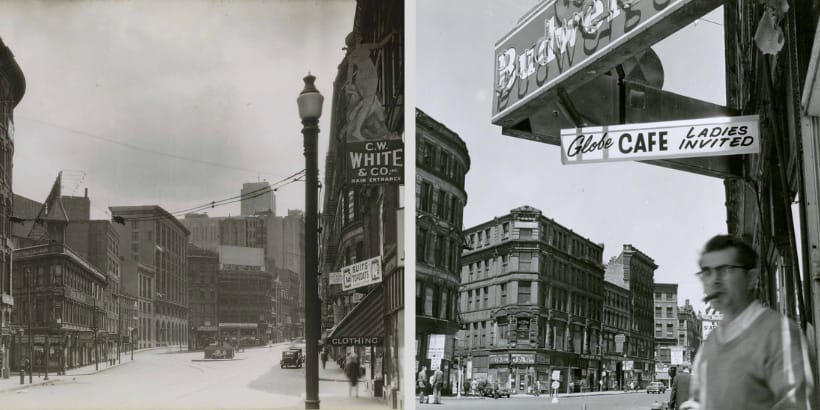
Two side by side black and white photographs of Boston buildings.

First-ever joint presentation of Berenice Abbott and Irene Shwachman images, supplemented by contemporary Artists For Humanity Boston photos

The Boston Athenaeum’s newest exhibition opens August 28. Developing Boston: Berenice Abbott & Irene Shwachman Photograph a Changing City features the first joint presentation of work by the two pioneering photographers of the 1930s and 1960s as they captured a Boston in the midst of great change and redevelopment.

Abbott’s 1934 photos and Shwachman’s 1959-68 images capture many of the same locations 30 years apart, including the Old State House, Faneuil Hall, West End, Beacon Hill, and Adams Square (now Government Center), with some locations and buildings still recognizable today, others utterly transformed by redevelopment. They also include historical images of “New City Hall” and the Prudential Tower under construction in the 1960s. The exhibition will be open through the end of December and available with a first-floor admission ticket.

Leah Rosovsky, the Boston Athenaeum’s Stanford Calderwood Director, said, “For anyone who loves exploring the modern history of Boston and the evolution of photographic technique and composition, ‘Developing Boston’ promises to be a rich and inspiring experience. We are also so honored and excited to partner with and showcase the teen photographers of Artists For Humanity as we work to deepen the Athenaeum’s connections with people from all of Boston neighborhoods and present new perspectives on our city and its history.”

The photographers have notable personal connections, as well as differing approaches to photographing the city. Abbott approaches Boston from a distance, offering stoic views, oscillating between straightforward and oblique angles. Shwachman, a onetime student of Abbott’s who photographed alongside, and even worked for a time as Abbott’s darkroom printer, amended her teacher’s approach by photographing Boston through a personal, subjective lens to highlight the city’s dynamism.

“By examining the works of Abbott and Shwachman in conversation, Developing Boston explores how each photographer viewed, dissected, and preserved Boston as it evolved throughout the twentieth century. As Abbott employed her documentary practice to create clear sightlines between the past and present, Shwachman developed her practice to signal towards Boston’s uncertain future,” says Lauren Graves, Ph.D., assistant curator at the Boston Athenaeum. “The documentary approaches of both photographers, whose work has never previously been presented in a joint exhibition, shine together to present a side of Boston’s buildings and public spaces that would have otherwise been lost. We hope that this exhibition helps Bostonians and visitors alike to find their place in the city.”

Building on this documentary photography exhibition, the Boston Athenaeum has also partnered with Artists For Humanity to add to the exhibition a selection of contemporary images of Boston made over the last two years, bringing teenage AFH photographers and their visual take on Boston into conversation with the seminal works of Abbott and Shwachman.

“Boston Athenaeum was so invested in the teens’ vision—from start to finish,” said AFH’s Photography Director Mary Nguyen, “They trusted that the teens were the experts in representing their own city through their lenses. The teens felt empowered, embraced, and celebrated as artists, and as young people, by such a historic institution and a great partner.”

“This will be the first time having my artwork in an exhibition outside of AFH,” said AFH Teen Photographer, Victoria “Tori” Kutta. “Being able to tour a famous place like Boston Athenaeum, where thousands of people visit, and then exhibit my own photography there—it’s surreal!”

AFH’s Studio team is so proud of their artwork being added to the Athenaeum’s collections, continuing the photographic story of Boston started by Abbott and Schwachman.

More about Berenice Abbott and Irene Shwachman:

Berenice Abbott (1898 – 1991) was commissioned in 1934 by architectural historian Henry-Russell Hitchcock to photograph American cities along the east coast, including Boston. She spent the next few decades continuing to photograph American cities, most notably, New York. When she returned to the Boston area in 1958, the Athenæum’s then-director, Walter Muir Whitehill, asked Abbott to reprint her 1934 Boston series to help the Athenaeum meet its goals of preserving imagery of the city’s past and collecting the work of contemporary artists.

Irene Shwachman (1915 – 1988) began her nine-year, self-directed project “The Boston Document” in 1959, during which she documented a Boston amid change, growth, progress, and decline. Shwachman considered “The Boston Document”, totaling over 3,500 negatives, her “contribution to America.” The collection captures the demolition of Boston’s West End neighborhood and other renewal projects. In 1962, the Boston Athenæum hosted an exhibition of “The Boston Document” and continued acquiring Shwachman’s work throughout the decade. The Boston Athenaeum today holds the largest collection of Shwachman photographs outside of her archive at the Center for Creative Photography in Tucson, Arizona.

In a 1972 letter, Shwachman wrote to Stephen Jackerie, the Worcester Art Museum’s Associate Photography Curator: “In the back of my mind I have always had a wish to have my prints shown with Berenice Abbott’s” – a dream that, 51 years later, is now coming true at the Athenaeum.

This exhibition, Developing Boston: Berenice Abbott and Irene Shwachman Photograph a Changing City, is generously funded by the Polly Thayer Starr Charitable Trust. The Mass Cultural Council supports the collaboration with Artists For Humanity.

07.06.2023

An interview with Graham Jones, award-winning screenwriter

July 2023

Interview by Zoe Palmer

Graham Jones is an award-winning screenwriter and proud Athenæum member who hails from Greenwich, Connecticut. After studying history at the University of Colorado, he moved to Los Angeles to work as a production assistant in the film industry. There, he began writing screenplays and attending workshops at the University of California, Los Angeles Extension.

Q: Can you please tell me about your journey in the film industry and your background as a writer?

GRAHAM JONES: I wasn’t really a writer and didn’t think I wanted to be a writer until I was going up the chairlift in Aspen with a friend of my parents and said, “I’d like to go to Hollywood, but I’m a history major, not a film major.” They didn’t have film majors in my day. Maybe at University of Southern California, or University of California Los Angeles. My friend said, “History’s a good preparation, you should go do that.”

I was never admitted to UCLA. When I first went to Los Angeles, I applied to all the big film schools, USC, UCLA, American Film Institute, right? After I’d been there for a year or two, I started working for a film director, Peter Markle. He made me what was called a director of development, to read all the scripts he wrote, that his friends wrote, that his agent (Creative Artists Agency) sent over. This was a big deal. You’re 27 and you’re the director of development for a working movie director who’s represented by CAA. It’s a pretty big deal. So after about a year our mailbox was filled with invitations begging me to come to the screening of the work of film students whose class I would’ve been in!

I worked for Peter after working in the mailroom at Walt Disney, and that was no fun, and also helping friends on their student projects, which was fun. Peter said to me, “If you want your dreams to come true in Hollywood, you have to write screenplays.” And I couldn’t. I just wasn’t any good at it. It didn’t happen. But I was around Peter, and I was around screenwriters, and this was, dare I say it, the early to mid 90s. Career instability in Los Angeles, that’s the name of the game there. It’s not Boston, it’s very different. Lots of career instability. I started taking film classes at UCLA.

Fast forward to the writing. I made a little film and it did OK, it won an award, and then the writing just started to come. And it started to come while I was working for Mark Burnett, the reality television guy, who didn’t care about scripts. They humored me and read a couple of them, and then I just started writing.

Q: What are some of your favorite screenplays you’ve written?

GJ: Back when I was a 20-something, I actually wrote this screenplay to make in Boston, but I lost it! So I’m seeing this therapist, saying, “I don’t know where the thing is!” After, I wrote a bunch of scripts and they won a bunch of awards, I found the script I’d lost. It was a hard copy, the digital was long gone. I read it and it’s one of my favorite scripts. I’ve rewritten it a couple times, but it’s never been as good as this version that I barely remember writing.

At this point it was the mid to late 2000s, and I wrote screenplays about George Washington and Theodore Roosevelt and Ulysses Grant, and I wrote a screenplay about equestrian polo. Back then in LA, I was pretty into polo for a couple of years. In a grass field polo team, there are four players. And guess what, there are three Musketeers and D’Artagnan. I read The Three Musketeers, wrote down all the plot points the way Syd Field tells you to. Dumas, he wrote like film. First act, second act, midpoint, climax, end of second act, third act, resolution. That’s the way he wrote. Boom, I turned it into a script about four polo players at a mystical college. It’s really UCLA, but I call it University of Los Angeles. I wrote it around 2005, I wrote it to take place after the First Gulf War. You read these things now and they read like period pieces, which makes me feel like I should have a little walker.

In some ways, I’m the most proud of those scripts, but they’re not my best. My best are the three president scripts I wrote, one each about Washington, Roosevelt, and Grant.

Q: What is your writing process like?

GJ: I used to say the writing process consisted of the right mix of junk food, naptime, and exercise, but I don’t eat junk food anymore. At my age, you can’t eat junk food. So it’s naptime and exercise. I can never write a script in class. I have to have it done first. I would write, and then take the class, and rewrite.

I wrote a novel in second person singular, which we don’t often use in English, but a friend of mine from Paris said it is more common in French. So I wrote that novel, but it’s not published—I couldn’t get anybody interested in it. The process behind that was lots of caffeine, especially in Los Angeles. Taking my laptop, writing around people. That was something I could do then. I’m not sure I could do that now.

So my process is to be alone. I don’t have any writing partners. I don’t want one. I have tons of writing friends. We don’t do this to have a partner. That’s the whole point. We have a production company for a movie. That’s fine. But when somebody wants to be a writing partner, you buy it. You go, “Hand me the check, see you later.”

Q: I noticed on your IMDB page that you’ve also directed and produced and edited some of your own work?

GJ: Yes, my short work, and some of Peter’s stuff I helped develop. I enjoyed that part of the process as sort of a social, exciting thing to do with friends.

Q: Are there any writers or screenwriters whose work you particularly admire?

GJ: A filmmaker named Curtis Hanson. I never met him personally. The guy who wrote LA Confidential, James Ellroy, was my favorite writer. When I was a boy, I read a lot of Tolstoy. I read War and Peace a few times, Anna Karenina. William Goldman was the ghostwriter on a lot of stuff. He’s probably the best screenwriter there is. And these writers in these workshops at UCLA, some really good writers there. And you learned as much from the other writers as you did from the instructor.

Q: How did you first get involved with the Athenæum?

GJ: Dad had some friends that were very involved and I think still are, and a friend of my mother’s and father’s bought my father a membership. Friends got Dad his first Athenæum membership, and a friend gave me mine.

Q: And to close us out, do you have any favorite spots in the library to work or read?

GJ: I like the quiet room on the fifth floor with the vaulted ceilings. Probably the statue of Washington. I also like the portrait of Mrs. Cabot that I think is from 1910 or 1912, the tall thing where she’s got the big hat and the long 1912 style. I think it’s pre-World War I. That’s probably my favorite right now. A lot of my writing has to do with portraits. The first script, the one I lost and then found, was about a guy in Boston being haunted by a ghost that lives in one of his family’s portraits at their house on Beacon Hill.