
06.05.2015

Staff Book Suggestions Summer 2015

Elizabeth Borah
Alien The Archive: The Ultimate Guide to the Classic Movies by Titan Books
(Library of Congress Lg PN1997.A32253 A45 2014)

For admirers of the classic Alien film(s), this oversize art book is a visual feast. And not only that, but a wonderful read: it’s full of cast and crew interviews, which offer an unprecedented behind-the-scenes history. This book is said to be the most complete volume on the film franchise’s history yet to date. For film buffs in general, it’s an amazing resource for exploring the rise to fame of Ridley Scott, H.R. Geiger, Sigourney Weaver, and many others. Additionally, the book explores a number of unused concept artworks and scenes that never made the films’ final cuts.

As someone who revels in learning how films’ practical (physical, not computer-generated) effects were accomplished, Alien The Archive has granted me hours of insight into some of cinema’s finest gritty world/creature creation. If you’re wary of the famed xenomorphs, this may not be the right book for you. But if you’re a sci-fi fan, I’m assigning it as your summer reading as of today!

Andrew Hahn
The Story of French by Jean-Benoît Nadeau and Julie Barlow
(Library of Congress PC2075 .N33 2006)

If the Hermione and the exhibition, Lafayette: An American Icon, have left you in a particularly French state of mind, turn your attention to The Story of French, a detailed exploration of the French language, its evolution, its expansion, and its future.

Judith Maas
The Reluctant Empress by Brigitte Hamann
(Library of Congress CT918.E44 H15)

This is an absorbing biography of Elisabeth (1837–1898), wife of the Habsburg ruler Franz Joseph (1830–1916). Her title—Empress of Austria and the Queen of Hungary and Bohemia—expressed grandeur, wealth, and tradition. She wanted none of it. Elisabeth had enjoyed a lively, carefree youth in the Bavarian countryside. Married into a family of staunch conservatives, she sympathized with the democratic and nationalist movements of the era. At the Vienna court, with its snobbery and rigid protocols, she was an outsider and sought solace in her own, obsessive pursuits: travel; moonlit hikes; horseback riding; poetry; a menagerie of birds and monkeys; grueling exercise and diet regimens. Amidst regal surroundings, she created an alternative world, isolating herself from her royal duties, her children, and her baffled, adoring husband. Biographer Hamann draws on many first-hand materials, including Elisabeth’s poetry, to bring the people and period to life. Drama is plentiful, from European politics to family conflict. Elisabeth, alienated, rebellious, and struggling to express herself, emerges as a very modern figure.

Amanda McSweeney-Geehan
We Were Liars by E. Lockhart
(Library of Congress PZ7.L79757 We 2014)

Cadence’s extended family spends their summers on a private island off the coast of Massachusetts. On the surface, they are perfect. Everyone is healthy and beautiful and confident in their strong family bonds. This façade begins to crumble and a year after a mysterious accident, Cadence struggles to recall what happened and what led up to it. Due to a severe head injury, Cadence’s narration is unreliable. But hers is the only point of view we have. The story is presented in a fractured way that adds to the sense of unease as the reader pieces together what really happened to Cadence, her cousins, and her first love, an intense outsider named Gat.

After Dark by Haruki Murakami
(Library of Congress PZ4.M97373 Ad 2007)

This book takes place over the course of a warm night and revolves around two sisters. Eri sleeps alone in her room. Or, at least she appears to be alone. Meanwhile Mari is reading by herself in a twenty-four hour Denny’s in Tokyo. Here, she meets a young man who swears they’ve met before. From there, the story unfolds. It’s a short, quiet story with an emphasis on atmosphere. Characters drift in and out as the night deepens, then fades into dawn.

Katie Mika
A Little Life by Hanya Yanagihara
(Library of Congress PZ4.Y223 Li 2015)

At more than 700 pages Hanya Yanagihara’s A Little Life is actually a great big post-identity novel that chronicles the lives of four young men as they navigate friendship, adulthood, and creative culture in New York City. Although the beginning reminds the reader more of a brilliant, if typical, story of upper middle class twenty-somethings in the style of Clair Messud’s The Emperor’s Children or Mary McCarthy’s The Group, A Little Life quickly reveals itself as one of 2015’s most ambitious, challenging, subversive, often upsetting, and yet truly astonishing works of literature. Yanagihara writes a complex story that is magnificently characterized. The four protagonists—Willem, JB, Malcolm, and Jude—meet as undergraduates at a prestigious (yet unnamed) Boston area university and maintain their friendship to varying degrees over the following three decades. The apparent normalcy of the first 50 pages belies the sinister and traumatic past endured by the main character, Jude St. Francis. While the book includes graphic descriptions of abuse that are rare for literary fiction, the strength of A Little Life is in its most moving and tender moments that constitute great friendship. The book can be difficult and bleak at times, but it will reward you with an elegant and evocative story of the power of long-term family and friendship.

Carolle Morini
The PZ3s on 2G
(Library of Congress Classification)

Short stories are the perfect beach size. Where else can one find compilations titled The Beat Generation and The Angry Young Men (Kerouac, Ginsberg, Mailer and Amis) next to The Fireside Book of Dog Stories (Thurber, Mann, Lawrence and Kipling)?  2G is the place! Immerse yourself in a specific year, for example: The Best Short Stories of 1923 (Anderson, Dreiser, Hemingway and Prescott) or The Best British Short Stories of 1931 (Du Maurie, Lowry, Sackville-West and Warner). Curious about embarking on a new genre, like mysteries, pick up: Treasury of Great Mysteries Vol. 1 and 2 (Christie, Simenon, Sayers and Chandler). Does your summer have days filled with thinking about exotic travel from a seat on the T? Sail away with stores by Melville, Hugo, London and Cooper in Great Sea Stories. Transport to new scenery through the eyes of Dickens, Trollope, West, and Bishop in The Oxford Book of Travel Stories. Use the heat waves of summer to introduce yourself to a new author, genre, or particular time period of publishing by checking out a PZ1.

Kaelin Rasmussen

Death on the Cherwell by Mavis Doriel Hay

(Library of Congress PZ3.H3219 De 2014)

I was intrigued and delighted to come across the British Library Crime Classics series in my recent cataloging efforts. A series of reissues of previously forgotten early crime stories and novels, it promises a wealth of new (or old) discoveries for mystery fans. Several volumes have hit the New Book Shelves in the past few weeks. Death on the Cherwell by Mavis Doriel Hay stood out to me immediately because of its similarity to one of my old favorites, Gaudy Night. Like the latter, Death on the Cherwell takes place at a fictitious women’s college at Oxford University circa 1935. Death on the Cherwell opens on an Oxford afternoon in January—a prospect guaranteed to bring a cool, foggy shiver to the sweltering summer reader! Four inquisitive undergrads spot a canoe floating down the river, containing the apparently-drowned body of the college’s contentious bursar. Scandal threatens to break over the idyllic Persephone College, unless our young sleuths can untangle the mystery in time to preserve the college’s spotless reputation. Though at times a trifle silly, this book was a real treat for me. It was clever and funny, with the added bonus of true-to-life Oxford scenery.

Rendezvous with Rama by Arthur C. Clarke

(Library of Congress PZ3.C551205 Ren)

Need a break from the heat? Try the absolute zero of outer space! This 1973 novel from science fiction great Arthur C. Clarke takes place in a future where Earth has been decimated by a giant asteroid, and humanity has sought refuge in colonies throughout the solar system (except on Pluto, naturally!). When it becomes apparent that a gargantuan space object, dubbed “Rama,” is in fact a planet-sized spacecraft intentionally approaching the sun’s orbit, the scattered colonies must come together to decide on a course of action. A hastily-assembled exploratory mission is assigned to investigate Rama, and what they find will amaze, enthrall, and terrify. Though on the surface familiar to those of us with a taste for space-themed stories, Rendezvous with Rama still has a few twists and surprises. It’s classic science fiction bordering on horror, full of cold, dark, lonely places and uncomfortable speculations. And like all the best science fiction, its characters are as smart and sharply drawn as the speculative world around them.

Mary Warnement

84, Charing Cross Road by Helene Hanff

(Cutter Classification VE5 .H187)

The Duchess of Bloomsbury Street by Helene Hanff

(Cutter AE .H193)

Even though I am no longer a child with whole summer days to spend flopped on my stomach with a book open before me, I anticipate the season as a time to revel in reading, which for me naturally leads to daydreaming. I recently reread Helene Hanff’s epistolary collection with Frank Doel and her travel diary, two books easily read together in one sitting, though I recommend letting a few days pass, if only to prolong the pleasure. How could such thin volumes evoke so many thoughts? Reading and rereading this is like having a conversation with her and all her books. She’s a strong personality; you won’t agree with her every assessment; that is half the fun. Being thorough and arguing every point would require writing my own book. The conversation of course was half (or wholly) in my imagination, but if you are a bookish person, you must put these on your reading list. Note also, Anne Bancroft and Anthony Hopkins star in a 1987 adaptation for cinema.

Hannah Weisman
Franny and Zooey by J.D. Salinger
(Library of Congress PZ4.S165 Fr)

Salinger’s meditative narrative weaves the story of the Glass family with particular focus on Franny, her quest for spiritual enlightenment, her older brother Zooey, and his quest to fix his sister. The book’s appeal lies in Salinger’s uncanny ability to tell a universal story through the eyes of his exceptional, yet deeply damaged, protagonists.

05.05.2015

Joyce M. Bowden

June 2015

By Arnold Serapilio

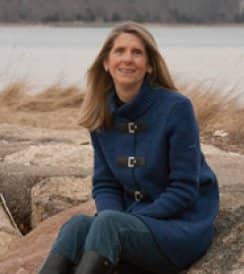
“There are always puzzles that you can never completely resolve. At some point you just have to draw the line, and you have to be comfortable drawing the line.” Joyce M. Bowden is responding to my question of whether she solved every mystery she set out to when she traced the family history on her maternal grandfather’s side. This project—which began in December 2004 in Columbia, South Carolina when she was tracking down her mother’s birth certificate, only to find that her mother’s legal first name was not what she thought it was—would span over nine years and culminate in the publishing of her first book in January 2014,  Four Connor Generations in South Carolina, 1790–1920.

The journey started when Joyce received her mother Rachel’s death certificate and noted that Greenville, South Carolina was the listed birth place. This did not jibe with Joyce’s memories of childhood visits to Rachel’s own childhood home in Shelby, North Carolina, so she decided to find the birth certificate. Joyce recalls sitting in the waiting room of the South Carolina Department of Health and Environmental Control​ in Columbia. “You fill out a form and you give it to somebody who’s going to do the research, and then you’re simply asked to wait. And I waited, and I waited, and I waited. And the researcher came back—she was very nice—I stood up when she walked in the room. She said, ‘I think you ought to sit down.'”

What the researcher found was that Joyce’s mother, the woman everyone knew as Rachel, was legally named Carrie Lou. “I think my mother thought her name was Rachel,” Joyce says. “I came to the conclusion it was a compromise between Mom and Dad. Dad wanted Carrie Lou because that was his mother’s name—turns out he was wrong [it was actually Caroline Lucinda]—and Mom wanted Rachel because that was her mother’s name. So the compromise was, for the official record, we’ll go for Carrie Lou, but when it comes to what we call her, we’re going to call her Rachel.”

It isn’t difficult to imagine how disconcerting this news must have been. “Here I was at the vital records center in Columbia, finding out that I didn’t even know my mother’s name! I remember walking out and sitting on a bench under a tree and saying to myself, ‘Well, Joyce, if you don’t know her name, what else don’t you know?'” And so she had her marching orders. The weight of discovery in the ensuing years was unanticipated; Joyce unearthed information of profound historical import. She writes, in the introduction to her book, “The task evolved from one done to satisfy my own curiosity to one done to provide a source for others with similar interests.”

But let’s back up a bit. Joyce was born in Georgia and, for the most part, was raised there. Between undergraduate and graduate school, in the mid-1960s, she served in the Peace Corps for roughly two and a half years. Her mission: to disseminate information on public heath. She trained in Seattle, Washington, learning Spanish in an immersive environment alongside hospital administrators, med techs, lab techs, visiting nurses, and teachers. She was then deployed to Bolivia. “Public health means something quite different there than it does here,” Joyce says. “We would routinely encounter diphtheria. There was even an outbreak of plague close to where my project was located. And my assignment was a leprosarium.” I hazard that this sounds like an unusual Peace Corps experience, and she confirms it is, though she is quick to add that leprosy is not, in fact, a fatal disease, “despite what has been written about it. It can be treated, and the disease can be arrested, and people can return to normal life.” Even so, pervasive fear of the disease meant that those afflicted with leprosy (or, in some cases, those simply thought to be afflicted) were quarantined far away and effectively forgotten about, making proper treatment challenging to conduct.

“My job while I was there was to start some sort of system of keeping track of who the patients were. Just name, age, sex, what part of the country they came from, what was the diagnosis. Once we had interviewed all of them and recorded all of this data, the medical director then sent me and a lab tech to those places where the patients came from. To make presentations to the medical personnel, if there were any in those places.” Medical personnel could mean one or two doctors, or it could mean a group of midwives. “Really, anybody we could get to listen to us.” Her audiences were not always eager to listen or enact change, though. “We found sometimes just showing up worked better, because that didn’t give them a chance to get their defenses up.” I ask the natural (if not naïve) question, Why such resistance to improvements? “It all comes down to resources,” she says, “and there weren’t any resources.” I think about the obstacles she and her fellow volunteers must have met along the way, and, feeling a bit dizzy, ask whether she left feeling accomplished, or if things just seemed hopeless. “Any small improvement, any little bit of progress, as in the case of leprosy treatment, is huge.”

After the Peace Corps Joyce studied Latin American history in graduate school. Completing her master’s degree, she took a job representing a Washington D.C.-based foundation that ran programs in Central America and the Caribbean. She worked in Guatemala, Honduras, El Salvador, and the Dominican Republic. After about two years she left the foundation looking for a new challenge and decided to move to Boston, taking a fundraising job at Tufts University. She then worked on capital campaigns for M.I.T. and Brandeis. Out of a chance meeting with a Merrill Lynch branch manager while both waited to run a 10K came a job interview. Merrill Lynch was actively trying to hire more women at this time, and Joyce joined the team. She proved a natural for sales, which she surmises is a result of her upbringing during World War II. Her father worked for Bell Aircraft so she and her family frequently traveled. “Trains were filled with soldiers, and sailors, and people, and families like us. To me, as a child, it seemed like the whole world was on the move.” She would walk up and down the aisles of the train, chatting up the people who, just like her, were constantly in motion.

In 2001 Joyce moved to Boston with her husband, whom she had met while training her replacement Peace Corps group. They had lived in Boston in the 1970s but spent most of their married life in the midwest. She read in the news that the Athenæum was undergoing its second renovation at 10½ and tracked its progress, joining when the doors re-opened in 2002. In 2009, she answered the Athenæum’s appeal for docents to lead semi-weekly art and architecture tours (she still does them to this day). By this time she was well-credentialed, as she had several years of experience giving tours for Historic New England. “All I knew was that I just wanted to be involved in history in some way,” Joyce recalls of her mindset when she returned to history-rich Boston. She responded to an ad from HNE in the Boston Globe and was hired as a house museum guide, giving tours of Harrison Gray Otis House on Cambridge Street and Walter Gropius House in Lincoln, working part-time year round at both houses. She served in this capacity through 2007, stopping not out of fatigue or boredom but because she wanted to jump headfirst into her family research, which had been gradually gaining momentum since that game-changing surprise in Columbia, South Carolina in late 2004.

Joyce’s latest work is an article that appears in the spring 2015 issue of American Ancestors. Entitled “Documenting Our Shared Past: Black & White in South Carolina,” the piece is co-authored with Morna Lahnice Hollister, a family historian and geneaologist who lives in Simpsonville, South Carolina. Both researching their family lines, the two met in 2010 after learning “their ancestors’ paths had intersected, and that a tiny detail of one family’s history was central to the other’s story” (42). It turns out that some of Joyce’s ancestors had owned slaves who were Ms. Hollister’s ancestors. Suddenly a solo journey to understand her roots had social resonance—wider ripples in the murky waters of American history. I ask Joyce what the article is to her and she says that “It’s an interesting story of black and white families in South Carolina, and if that’s all the reader gets out of it, it’s fine. But beneath that, is a story about sources, and how, if you’re interested in Southern family history and genealogy​, you have to pursue the unusual, you have to pursue the rare, you have to pursue the difficult. In other words, you need a broad approach to sources.” Indeed, both her article and her book are thoroughly well-sourced—the source list for the book, for instance, is 17 pages long. 

I wrap up my conversation with Joyce by asking what the great joys were of the whole process. “When I’m asked to speak about this topic, I start out by saying, with a smile, to the people in the audience, ‘All of you would like to do your genealogical research in your jammies. I know that—I would too.'” I immediately think about how advertisements pitch the opposite message, that nothing worth doing involves putting on pants and going outside, and I am heartened, and Joyce smiles. “You’re going to have to leave the house,” she says. “You’re going to have to travel. You’re going to have to get out of your comfort zone.” 

References

Bowden, Joyce M. Four Connor Generations in South Carolina, 1790–1920. Amherst: White Poppy Press, 2014.Bowden, Joyce M. and Morna Lahnice Hollister, “Documenting Our Shared Past: Black & White in South Carolina,” American Ancestors, v. 16, no. 2 (Spring 2015): 41–45

03.20.2015

Daniel Webster

By Kristin Cook

May 2015

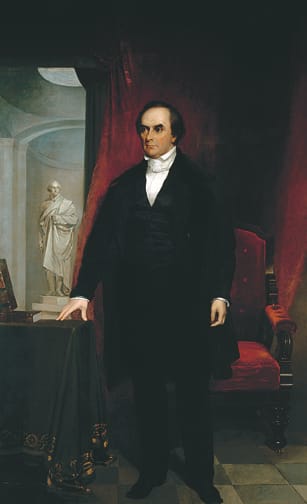
Daniel Webster has a place amongst America’s second generation of founding fathers, his time in the United States Senate and his famed orations helping to chart the path of the still-young nation in the first half of the nineteenth century. We are familiar with grand portraits of Webster, and five different busts of his likeness can be seen in the current gallery show at the Athenæum. Yet how much do we learn about him after elementary school? Perhaps if we study politics or law we are well-versed in Webster’s influence on the Constitution’s development, but if like many you grew up with Webster only in the periphery, read on for a primer:

Daniel Webster was born on January 18, 1782, in Salisbury, New Hampshire. At the time the small town was part of the exposed northern frontier, and Webster’s modest homestead can still be visited today, though it has been moved multiple times and is now seated in Franklin, New Hampshire. Webster’s father, Ebenezer, had been granted 225 acres of land for his service in the militia during the invasion of Canada in 1759, and was a founder and local leader of Salisbury. He achieved the rank of colonel, though he preferred to retain the title captain. Abigail Eastman was Ebenezer’s second wife and Webster’s mother. Daniel was the ninth of ten children (Abigail’s fourth) and a youth of delicate health. He was precocious and of a passionate nature, which encouraged his father to spare him from physical labor and send him to school—something Captain Webster was never afforded. In 1796, at the age of fourteen, Webster was enrolled at Phillips Exeter Academy. He proved capable in his studies but was shy and found himself incapable of participating in the mandatory public declamations. In December of that year Webster returned home with his father without completing his course, and for a short while taught school. An arrangement was made after a brief period for him to study under the Rev. Samuel Wood of Boscawen, a town not too distant, in preparation for entry to Dartmouth College. In the fall of 1797, with competency in Latin and Greek, Webster entered Dartmouth where he proved much more successful than at Exeter. He contributed to the village newspaper, participated in college debating societies, and earned a reputation as a speaker so great that the citizens of Hanover requested he give the Fourth of July oration. At only eighteen years old the characteristic vigor of his early speeches was already on display in this effort.

After graduating near the top of his class, Webster began to study law at the office of Thomas W. Thompson of Salisbury. He seems to have doubted he was suited for the profession, and after a few months accepted a position as a teacher in the small village of Fryeburg. Webster could have made a good living teaching, which would have allowed him to aid his father and support his elder brother Ezekiel in college. Yet, at the urging of his family and friends, he returned to the tutelage of Thompson in 1802. When Ezekiel began teaching school in Boston he invited Daniel to join him there, and Webster was soon clerking for Christopher Gore. In March 1805 he was admitted to the Boston Bar but was soon recalled to Boscawen due to his father’s failing health. By September 1807, his father had passed and Webster had transferred his practice to Portsmouth, New Hampshire. The following nine years he lived on the New Hampshire seacoast with his wife Grace Fletcher (the daughter of a clergyman), and enjoyed the professional rivalry of Jerimiah Mason, from whom he learned to curtail his ostentatious courtroom style in favor of Mason’s incisive manner.

During this period Webster was drawn into politics; the federalist convictions he inherited from his father were reinforced by his contacts in Boston. Though he was conservative in temperament, remember that Webster had come of age amidst the fear of the French revolutionary ideas of democracy, which were more radicalized than those upon which his own nation was founded. Webster thought these ideas undermined national union and threatened civil war, and he became known for Fourth of July orations and occasional pamphleteering in the name of revived federalism. He championed the shipping interests of New England, and voiced the opposition to the embargo laws of the early nineteenth century. At the famous “Rockingham Memorial” in August of 1812, he condemned the national administration for leading the country into an unjustifiable war, and renounced the idea of New England separating from the Union.

He was nominated for Congress soon after, and upon winning a seat became a member of the committee of foreign relations. Reelected in 1814, he was influential in the attempts to make peacetime economic adjustments. He was well known for his devotion to sound principles of public finance and for his opposition to the high protective duties of the 1816 tariff, which threatened the import and shipbuilding industries in New England. In August of that year Webster moved from New Hampshire back to Boston, where he put aside politics and focused on his law practice. It was not long before he was bringing in high profile cases and high profits. In fact, Webster was the lawyer for the Dartmouth College trustees in the Trustees of Dartmouth College v. Woodward case, a landmark decision from the United States Supreme Court dealing with the application of the Contract Clause of the United States Constitution to private corporations. The case arose when the president of Dartmouth College was deposed by its trustees, and the New Hampshire legislature attempted to force the college to become a public institution and thereby place the ability to appoint trustees in the hands of the governor of New Hampshire. On February 2, 1819, the Supreme Court upheld the sanctity of the original charter of the college, which predated the creation of the state, and Webster became, in the opinion of many, the foremost lawyer of the time. Three weeks after this decision he appeared for the Bank of the United States in McCullough v. Maryland, which concerned the state of Maryland taxing banks that had been chartered by the federal government rather than by the state. The tax was ruled unconstitutional and the case became the legal cornerstone of subsequent expansions of federal power.

As Webster rose in prominence, he was unable to stay out of politics (and the public eye) for long. In December 1819 he publicly opposed the admission of Missouri as a slave state, and the next autumn made the main address in favor of free trade at a meeting of New England importers in Faneuil Hall. On December 22, 1820, he gave a moving speech at Plymouth in celebration of the 200th anniversary of the Pilgrims’ landing. By then, he had made popular the idea of the occasional oratory, a trend that would thrive for decades. He briefly held a seat in the Massachusetts House of Representatives in the spring of 1822 before being elected to represent Boston in Congress, where he was made chairman of the judiciary committee in December 1823. An oration on Greek independence in January signaled his return to the national arena, but his main focus was to be the tariff question and what he could do to challenge Henry Clay’s arguments for protection, beginning in April 1824 with his attack on the proposed tariff bill. Other issues at play during his term were his support for John Quincy Adams’s doctrine of internal improvements; his leading of the (futile) fight for a revision of the federal judicial system; and his appeal for representation in the congress for Panama. In 1827 he was elected to the United States Senate from Massachusetts, but he temporarily lost interest in public life when his wife died around the time he took office. However, once the Tariff Act of 1828 passed, Webster found himself again embroiled in the debate. Now less satisfied with economic theory and more concerned with the realities of life, he believed the federal government had decided on its policy and that the New England states must adapt to a future of protection (later he would become an aggressive champion of this policy). Unfortunately for Webster, more losses followed: Jackson defeated Adams for reelection, and Webster’s favorite brother Ezekiel (who had entered New Hampshire politics) died. Webster’s life took on newfound meaning upon his marriage to the young New York sophisticate Caroline Le Roy in mid-December 1829, and just over a month later he was back in action in the famous Webster-Hayne debate, battling Senator Robert Y. Hayne of South Carolina on the topic of protectionist tariffs. The heated speeches between Webster and Hayne from January 19 to 27 1830 were unplanned, and stemmed from debate over a resolution by Connecticut Senator Samuel A. Foot calling for the temporary suspension of further land surveying until land already on the market was sold (this would effectively stop the introduction of new lands onto the market). Webster’s “Second Reply to Hayne” was generally regarded as the most eloquent speech ever delivered in Congress, and Webster’s description of the U.S. government as “made for the people, made by the people, and answerable to the people,” was later paraphrased by Abraham Lincoln in the Gettysburg Address in the words “government of the people, by the people, for the people.” The debate was considered a victory for federalism over the cause of states’ rights, and over nullification, the legal theory that a state has the right to nullify or invalidate any federal law that the state deems unconstitutional. Known as the Defender of the Constitution, Webster’s fame again reached national scale, and with this turning point in all aspects of his life, dreams of the White House seemed as though they could come true.  

With the formation of the new Whig Party, which opposed Jackson and his war on the Bank of the United States, Webster was nominated as the party’s presidential candidate from Massachusetts for the 1836 election. With other Whig nominees in the field, however, he did not garner much support outside of New England, and following his defeat he gave serious consideration to retiring from politics. His interests turned to the personal, including his seaside home in Marshfield where he entertained lavishly and fell into debt. In 1839, he and his family visited England, hoping to find buyers for lands he owned in the American West, and also to acquaint himself with the issues surrounding the border dispute between Maine and Canada. Not long after his return to Boston, Webster was made secretary of state by the new president, William Henry Harrison; upon Harrison’s death a month later, his successor John Tyler retained the cabinet in office. When Tyler successfully vetoed two measures by the Whigs that sought to reestablish a United States bank, all the members of the cabinet resigned except for Webster, who tried to play a conciliatory role. He was determined not to throw the foreign concerns of the country into disarray over party proceedings, and in fact brought to a successful conclusion the Webster-Ashburton Treaty of 1824, which negotiated the Maine-New Brunswick border and established shared use of the Great Lakes, reaffirming the western frontier of the Rocky Mountains at the 49th parallel, defining seven crimes subject to extradition, and calling for an end to the slave trade on the high seas. Webster’s other successes in the State Department include successful negotiations with Portugal, important discussions with Mexico, and preliminary discussions about the opening of diplomatic relations with China. He was, however, under strong Whig pressure to resign, and with reluctance in May 1843 he did just that. Overwhelmed with debt, Webster returned to his legal practice for a short time, and in the winter of 1845 he returned to the Senate. In the spring of 1846—after the United States annexed Texas—The Mexican-American War began, as Webster feared would happen. He had opposed the annexation and the resulting extension of slavery, and joined the Whig policy of condemning the war. He held, however, that supplies should be voted in an attempt to bring the conflict to a speedy and successful termination. His second son, Major Edward Webster, died on exposure in service near Mexico City.

Not entranced by notions of empire, Webster introduced resolutions repudiating the dismemberment of Mexico, yet the war ended in a treaty that gave the United States a vast domain carved out of their neighboring country. Webster voted consistently for the Wilmot Proviso, which would have banned slavery in territory acquired from Mexico had it ever passed both houses of Congress. Seeking his former glory and the one office he had not attained, Webster made a Southern tour in the spring of 1847, which only drew him further into debt, as well as into poor health and spirits. His daughter Julia had also died fairly young, and coupled with the death of Edward he fell into a depression. He was passed over for the nomination of his party in favor of military hero General Zachary Taylor, but became secretary of state again in 1850 after Taylor’s death, for Millard Fillmore’s cabinet. In 1851 Webster wrote to denounce as revolution the secession of Southern states, and in foreign affairs dealt with diplomatic difficulties with Spain, Mexico, Peru, Great Britain, and with the Hungarian Revolution and the Austrian empire. Webster’s presidential aspirations were revived once more in 1852 (much to the embarrassment of many in his party, as Fillmore was also a candidate). Ultimately neither was chosen to represent the Whigs, and Webster became increasingly ill as the year progressed. By autumn he was diagnosed with cirrhosis of the liver. He died on October 24, 1852. He was survived by his second wife Caroline and his son Fletcher, who was later killed in the Civil War.

A stirring champion of the American Union, Daniel Webster left his mark on American history through his work in the constitutional courts, the House of Representatives, and twice as the secretary of state. His political career spanned four decades and he became nationally renowned for his oratorical skill. Webster is today still a revered figure in New Hampshire and Massachusetts, and is also the subject of a short story by Stephen Vincent Benet, “The Devil and Daniel Webster,” which was made into a 1941 Academy Award-winning film titled All That Money Can Buy. It tells the story a fictional farmer who sells his soul to the devil but is defended by a fictional version of Daniel Webster, who is able to win over the jury of the damned and save the farmer’s soul from hell solely by virtue of his eloquence.

Selected Works

The Devil and Daniel Webster (Library of Congress PZ3.B4292 De) The Life, Speeches, and Memorials of Daniel Webster : Containing his most celebrated orations, a selection from the eulogies delivered on the occasion of his death, and his life and times (Cutter 65 .W395 .sm)

One And Inseparable : Daniel Webster and the Union (Library of Congress CT275.W408 B29)

Daniel Webster (Library of Congress CT275.W408 B27)

Daniel Webster (Cutter 65 .W395 .fu [2 volumes])

References

Baxter, Maurice G. “Daniel Webster.” Encyclopedia of the American Constitution. Gale,
2000.

“Daniel Webster.” Dictionary of American Biography. New York: Charles Scribner’s Sons,
1936.

“Daniel Webster.” Merriam Webster’s Biographical Dictionary. Springfield, Ma: Merriam-
Webster, 1995.

Daniel Webster Homestead. Accessed March 18, 2015. http://www.nhstateparks.org/explore/state-parks/daniel-webster-birthplace-state-historic-site.aspx.

03.06.2015

Staff Book Suggestions Spring 2015

Emily Anderson

Anne of Green Gables by L.M. Montgomery

(Library of Congress Classification PZ7.M767 An Children’s Library)

While Anne has an expansive imagination, little is required of the reader to find joy in this book and its many characters. Read it again and reminisce about childhood, or read it for the first time and discover the humor and warmth contained within. After that, see if you can’t stop yourself from reading all the sequels.

Elizabeth Borah

Soviet Space Dogs by Olessya Turkina

(Library of Congress TL789.8.R8 T87 2014)

This title caught my eye when it arrived to the New Book shelves. Beyond a very attractive cover and page layout, it’s full of interesting history surrounding the famed Soviet-era “space dogs.” The mostly-canine space test subjects (or furry cosmonauts, depending on one’s perspective) were widely commemorated with a variety of memorabilia, not only in the USSR but around the world. The book showcases these antiques alongside a wealth of information about the animals and their spaceflights. For a book on a slightly niche subject, this one has much to offer.

Wool by Hugh Howey
(Library of Congress PZ4.H8588 Wo 2013)

This might not be the most springtime-evocative novel, but it certainly is one of hope for a fuller world beyond the confines of the indoors, something I’m sure we’ve all experienced this winter. Set in a silo miles underground, Wool weaves together the stories of a succession of inhabitants. Humanity, as it is known, lives entirely within the levels of the silo, with a single camera view of the terrain above. There are stories remaining of the times above ground, but they are taken as mythic fictions…but a few hold to a hope there’s more out there than they know. I won’t spoil the rest! A gripping read for this season of slow change, natural revelations, and renewal.

Kristin Cook

Joan of Arc: A Life Transfiguredby Kathryn Harrison

(Library of Congress CT1018.J61 H37 2014)

Joan of Arc was published in 2014 and follows Joan’s story from her birth through her rise to fame and the captivity and trial that led to her execution for heresy. My fascination with Joan began when I depicted her in a seventh-grade school play, and this is the most lucid writing on her that I have found. The narrative of her life is seamlessly interwoven with commentary on the contemporary conditions that encouraged her rise to prominence and led to her downfall. The author also discusses how Joan has been portrayed in different media throughout the centuries. Anyone interested in French (or English!) history, the history of war, women’s studies, art history or film history should definitely take a look at this book, which will lift you up with its spirit and race along at the speed of a novel.

David Dearinger
The War That Ended Peace: the Road to 1914 by Margaret MacMillan
(Library of Congress D511 .M257 2013)

In June 2015, the Boston Athenæum will present an historic exhibition Lafayette: An American Icon. The exhibition, which focuses on portraits of Lafayette, will comprise over 50 paintings, sculptures, engravings, manuscripts, and artifacts borrowed from institutions from around the country including the Metropolitan Museum of Art, the Smithsonian American Art Museum, Crystal Bridges Museum of American Art, Cornell University, and Lafayette College. If you would like to do some homework before the exhibition opens on June 17, you couldn’t do better that to read Laura Aurricchio’s excellent new biography The Marquis: Lafayette Reconsidered (New York: Alfred A. Knopf, 2014) which is highly readable and offers new perspectives on both American and French attitudes toward Lafayette. Of the older biographies of Lafayette—and they are legion—Harlow Giles Unger’s Lafayette (Hoboken, NH: John Wiley & Sons, 2002) is also excellent and makes a good introduction to the topic. A more complete bibliography on Lafayette will be provided at the time of the opening of the exhibition. So stay tuned!

Andrew Hahn
The Art of Travel by Alain de Botton
(Library of Congress TR790 .B68 2002b)

As the snow melts and our minds turn to warmer weather, we may begin to ponder summer trips. Beyond choosing locations to visit, we may want to think about how to travel. This volume from the popular philosopher Alain de Botton delves into how with the help of travelers from throughout the ages.

If you are particularly motivated after reading this book continue on to A Journey Round My Room by Xavier de Maistre (Cutter Classification VFG .M28), in which a journey is indeed a state of mind.

And if you are even more motivated, continue your journey on to the original French version, Voyage Autour de Ma Chambre (Cutter VFF .M285 .v3).

James F. Kraus
American Pastoral by Philip Roth
(Library of Congress PZ4.R8454 Am 1997)

Today is March 19. On this occasion of Philip Roth’s eighty-second birthday it is only fitting to recommend one of my favorite books, in recent memory, by one of my favorite authors. Roth’s American Pastoral contains numerous forceful and enthralling scenes that jump off the page and persist long after the reading is over. Early in the novel, when Roth’s long-utilized narrator, Nathan Zuckerman, reflects, in the tradition of Tolstoy, on what it means to get people right (or is that wrong?) it was as though I were run over by a tank, treads and all. Every subsequent rereading of that passage, it’s like I’m being backed over and rolled over again and again.

Judith Maas
Robert Henri and His Circleby William Innes Homer, with the assistance of Violet Organ
(Cutter U9 +H38 +h)

The Art Spirit by Robert Henri

(Cutter U .H393 .2)

Teacher, iconoclast, and painter of portraits, landscapes, and city scenes, the American artist Robert Henri (1865–1929) is remembered today for his part in creating the 1908 New York exhibition of The Eight—a group of artists who rebelled against the strictures of academic painting and, inspired by their immediate surroundings, produced scenes of everyday urban street life. Until the 1913 Armory show, Henri was seen as the leader of the progressive faction in the American art world. Painter John Sloan called him “the great emancipator.” Even as his reputation was eclipsed by the arrival of the European avant-garde, Henri has been recognized for his influence on generations of students through his book, The Art Spirit, his reflections on painting, openness to experience, and creativity as integral to living.

I had read The Art Spirit earlier and wondered who and what had influenced Henri. Biographer Homer provides the context I had hoped for, describing Henri’s frontier upbringing, the art world in Europe and America as he came of age, his formal training in Philadelphia and Paris, and the artists whom he admired. Henri was also proudly self-taught, creating informal salons, traveling, and reading widely—Emerson and Whitman were as much a part of his education as time spent at his easel. I came away from these books admiring Henri’s eloquence and his ability to put his aspirations into action—his life combined work, play, study, friendship, art, and family, without the usual boundaries and compartments.

Kaelin Rasmussen
The Leopard: With Two Stories and a Memory by Giuseppe Tomasi di Lampedusa
(Library of Congress PZ4.T655 Le 1998)

This book brought alive for me the sun-drenched, slow-paced days of nineteenth-century Sicily. I discovered The Leopard not long ago, but it’s not a new book, published in 1958 in Italy. Giuseppe Tomasi di Lampedusa was the last of a line of Sicilian princes that had fallen much in the world. After his ancestral home was bombed and pillaged by the Allies in World War II, he wrote The Leopard, which is based on the life of his great-grandfather, as a sort of farewell to the aristocratic life that was now gone forever. The novel was not well-received during his lifetime and was published posthumously, but it is now widely recognized as one of the best historical novels of all time. The story describes the fortunes of a Sicilian prince and his family in the nineteenth century, when shifts in politics and the existing social order threaten to make the aristocracy obsolete. Sunny, sweltering days and citrus orchards are plentiful. Part love story, part scathing satire, The Leopard can hold its own against any of the great novels of the nineteenth century (I know whereof I speak here!), and at a fraction of the length. The perfect book to banish the dregs of winter!

Suzanne Terry

Vanessa and Her Sister by Priya Parmar

(Library of Congress PZ4.P254 Va 2014 NEW)

A fictional account of life amidst the Bloomsbury group, as seen through the eyes of the painter Vanessa Bell, with additional (fictional) correspondence between other literary figures such as Lytton Strachey, art critic Roger Fry, Leonard Woolf, and Vanessa’s sister, Virginia Woolf. The book draws you into the salons and intrigues of the group, and the difficulty of handling Virginia for everyone close to her.

Mary Warnement
Slow Train to Switzerland: One Tour, Two Trips, 150 Years—and a World of Change Apart by Diccon Bewes
(Library of Congress DQ36.B49 2014)

I once read Jon Krakauer’s Into Thin Air during a Chicago heat wave just for the descriptions of frigid conditions on Mount Everest during the 1996 disaster. No wonder the cover of this book recently caught my eye for an escape from these mounds of snow that seem as high as Everest. Is a book about hiking through the Alps a reasonable escape? Yes, the hikes occurred in summer. Bewes is a travel writer based in Bern. Researching another project, he discovered a travel journal written by a woman who participated in Thomas Cook’s first Conducted Tour of Switzerland in 1863. Her manuscript was discovered among ruins of a London home during the blitz and was published in 1963, 100 years after her adventure. Bewes decided to follow her itinerary, although not down to every detail; he was never astride a donkey or crossing glaciers and mountain precipices in a crinoline. This is not only a history of tourism through the experiences of Thomas Cook but also railroad development, and the evolution of Swiss nationalism. Minor facts along the way, like what causes the holes in Swiss cheese, keep you from feeling the weariness the hikers felt. I don’t read travel writing to be satisfied with armchair sightseeing; I read it to be inspired to set off myself.

01.26.2015

Scott B. Guthery

March 2015

By Arnold Serapilio

You’ve seen Scott Guthery at the Athenæum before. You know him from the Mathematics, Technology, and Society discussion group, which he leads, as well as the newly-formed Athenæum Encyclopӕdists, which he also leads. You’ve taken one of the art and architecture tours offered every Tuesday and Thursday at 3:00 p.m. and Scott was the docent on duty, enthusiastically expounding upon the many wonderful pieces of art in our collection, peppering his stories with points of mathematical interest. You’ve bumped into him while you’re both getting happily lost in the Lower Pilgrim stacks—which, incidentally, is how the math group was formed. If nothing else, you’ve seen him working in an alcove on the second floor. He’s a fixture. 

As a young man growing up in Cleveland, Ohio, Scott spent much of his time learning about computer programming and discovered it is concentric with mathematics. The designs of both studies are ordered by hierarchy, i.e., the approach to and execution of programming a computer and solving a math problem are essentially the same, so an understanding of mathematics is helpful when programming computers. 

His burgeoning curiosity in technology aside, Scott’s academic goal at first was to become a medical doctor. To that end he began his undergraduate study of medicine at Colgate University in 1959. But a lifelong interest in mathematics proved too integral to be denied. After two years he decided to finish up his undergraduate work at Miami University of Ohio, securing his degree in mathematics. In 1966 he earned his master’s; his Ph.D he acquired soon after at Michigan State. 

Recently Scott and I sat down for a chat in the back nook near Conservation. I wanted to get some basic information about his personal history and his background in math. What I got was a lovely conversation with a smart, spirited, and curious man. Scott was generous enough to share even more thoughts over email. Below is the distilled essence of these talks.

Q: When and how did you wind up in Boston?

SG: I moved from Austin, Texas in 1999 to co-found a mobile network applications business called Mobile-Mind. I moved to Boston since getting a start-up running from two locations is difficult at best. 

[Scott discovered the Athenæum in 2011 when the Ticknor Society organized a special tour for book collectors. Scott signed up for the in-depth tour, which included curator presentations about special features of the collection. Not surprisingly, he was sold with that first look. Within a year of establishing membership he answered the Athenæum’s call for new docents. Any excuse to spend time at 10 1/2 Beacon.]

Q: Toward what area of mathematics are you most compelled

SG: When I worked for technology companies I wrote about interesting mathematics. When I started my own press I wanted to write about interesting mathematicians. “Interesting” here means eclectic and unrecognized; that is, anything but famous. Anybody can write about famous mathematicians. Their papers have been collected and their works bound. I find that it is far more enjoyable and challenging to write about people whose contrail in history is almost invisible. 

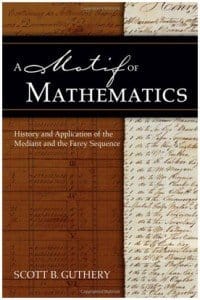
[In line with this approach, Scott published A Motif of Mathematics: History and Application of the Mediant and the Farey Sequence, in 2010.]

Q: What is A Motif about?

SG: A very simple sequence of numbers called the Farey sequence.

[The Farey sequence is the arrangement of irreducible fractions (in order of increasing size) between 0 and 1 with denominators less than or equal to given value n. E.g.: when n= 5, the Farey sequence is 0, ⅕, ¼, ⅓, ⅖, ½, ⅗, ⅔, ¾, ⅘, 1.]

John Farey was a British geologist who published a short letter in the May 1816 issue of Tilloch’s Philosophical Magazine and Journal inquiring about a mathematical property of the sequence. He has ever since been taken to task in the mathematics literature for stealing the insight from “somebody named Haros” so I decided to write a a book about Haros. As it turns out, it was a lion of French mathematics and a colleague of Charles Haros, Augustin-Louis Cauchy, who misnamed the sequence after Farey. See Stigler’s Law of Eponymy: No scientific discovery is named after its original discoverer. By the way, Stigler’s law was first recognized by Robert Merton so it is an example of itself.

[Scott’s not just being funny. Though it’s unclear to me whether Stigler’s Law is truly, serendipitously an example of itself or whether Stigler exercised a little dramatic license—after all, who says math types can’t be creative? More on that later.]

Q: When/how/why did you decide to start your own press? 

SG: Mobile-Mind was acquired by a telecom company in 2006. I stayed with the buyer for a while and then was recruited to build cryptography and digital security products for a global technology company. But once you get the start-up bug and work for yourself it’s really hard to go back to working in a big hierarchical organization. So I left in 2009 and started Docent Press.

Q: Any projects on the horizon? 

SG: The book I’m currently working on, Readers at the Boston Athenæum (1827–1850), is centered on the Athenæum’s books borrowed registers. The first four volumes of the register have been digitized and contain 122,020 charge records of 705 individuals. As my background is mathematics, I started by writing a chapter about all the Athenæum readers who borrowed at least one mathematics book. There were 44 of them. Another chapter is about all the readers that held at least one US patent. There are 15 of them and as a group they held 67 patents with the leader being Erastus Bigelow of Bigelow carpet fame, who held 20. I’m currently working on a chapter about John Guardenier, a four-time Athenæum proprietor and prodigious Boston book binder who bound hundreds of books for the Athenæum and who paid for his shares in kind. Guardenier generated 393 entries in the four registers, borrowing some 227 titles.

One of my favorite stories coming out of my work with the Athenæum’s Books Borrowed registers is about the Josiah Parsons Cookes, Sr. and Jr. Josiah Parsons Cooke, Sr., was an Athenæum proprietor and a widely-respected Boston lawyer. Josiah Parsons Cooke, Jr. was “the first university chemist to do truly distinguished work in the field of chemistry” in the United States. An apocryphal story about Jr. is that his interest in chemistry was sparked by reading Edward Turner’s Elements of Chemistry. Sure enough, consulting the books borrowed register we find that on June 17, 1842, Sr. borrowed “Terners [sic] Chemistry.” Jr. was 15 years old at the time. Not only is Turner’s book still on the shelf at the Athenæum but I like to imagine that it is the very copy that was borrowed by Sr. and started the illustrious career of Jr.”

[Scott’s enthusiasm is contagious. With this anecdote in mind I dashed to the shelves to pull the signature card from Turner’s book; my hopes, in turn, were dashed when the card wasn’t there. However: at the end of that same shelf is Cooke Jr.’s Elements of Chemical Physics. The checking out of one book led to the publishing of a book not ten inches down the row 32 years later. This is the stuff of chills.]

Q: What is the future of mathematics? What avenues are mathematicians exploring today? Where are their discoveries leading us?

SG: The absolute end of mathematics is when the percentage of mathematics in the future is zero everywhere in our concentric circle landscape. The effective end of mathematics is when the rate of change of this value is zero everywhere in the landscape. In either of these senses, how close to the end are we today? Mathematics researchers are the people moving mathematics from the future to the past; i.e., decreasing the percentage of mathematics in the future. I think of those working in the inner circles as pushing the percentage of mathematics in the past upward and I think of those working in the outer circles as pushing the percentage of mathematics in the past outward. I also think that they are both having a harder time. That is, the rate of change both upward and outward is tending to zero. [I]t’s harder to know more about what you already know a lot about and easier to know more about what you don’t know much about.

[Scott stresses more than once (primarily due to my obtuseness) the idea that today’s findings encapsulate everything previously discovered. One finds the sum total of information on a topic to be the most generalized and abstract, which ultimately may prove unhelpful to somebody looking for solutions to a real-world problem. “Mathematics is not a discipline that appreciates its own history,” Scott notes. To a mathematician, today’s findings are the most inclusive, so why bother tracing the history? That Scott rejects this way of thinking is refreshing and heartening. He mentions how great the Athenæum’s de-acquisition policy is: that there is no de-acquisition. Once we’ve obtained a book we hold onto it, ensuring an expansive, alive collection.]

[There is also the notion of creativity in mathematics. Scott asserts there are many very bright people applying mathematics in creative ways in order to solve practical problems; the example he gives is of Oliver Evans, the inventor of the automated grist mill, trying to determine the minimum amount of resources and correct conditions needed to yield the greatest output. Mathematicians who discount yesterday’s techniques (which are simple in presentation and more readily understood) applied today’s findings (abstract, more abstruse) and arrived at an answer mill builders intuited was insufficient. The mill builders themselves applied some more fundamental ideas and yielded more profitable results. If the future of mathematics is uncertain, it’s because we are getting mired in the abstract rather than re-appropriating what we already know in new and innovative ways.]

Suppose then that the rate of change in all directions goes to zero; that despite their best and most strenuous efforts, research mathematicians cannot budge the horizon between past and future; that we know all the mathematics we can know and will ever know. There are certainly mathematical lines of investigation that have reached this impasse. Why not the entire field?

[Our conversation ends because Scott has to run upstairs to the Athenæum Encyclopӕdists meeting that begins in minutes. Before we part ways, though, he takes me down to Lower Pilgrim to show off the math section. Cutter H. I watch him pulling the books down from the shelves and admiring them. There is love and attention and reverence in his fingers and in his voice. Each book is tactile history, weighty but within reach.]

Selected Works:

A Motif of Mathematics: History and Application of the Mediant and the Farey Sequence

Bibliography of Raymond Clare Archibald (Appointment Required)

Calculating Curves: The Mathematics, History, and Aesthetic Appeal of T. H. Gronwall’s Nomographic WorkDeveloping MMS Applications: Multimedia Messaging

Learning C. with Tiny C.

Practical Purposes: Readers in Experimental Philosophy at the Boston Athenæum (1827-1850)

References

Cohen, I. Bernard (1959). “Some Reflections on the State of Science in America During the Nineteenth Century”. 

Proceedings of the National Academy of Sciences 45 (5): 666–677.

Guthery, Scott B. A Motif of Mathematics: History and Application of the Mediant and the Farey Sequence. Boston: Docent Press, 2010.

Jensen, William B. “Physical Chemistry before Ostwald: The Textbooks of Josiah Parsons Cooke,” Bull. Hist. Chem, v. 36, n. 1(2011), pp. 10–21.

01.02.2015

Staff Book Suggestions Winter 2015

Elizabeth Borah
The Last of the Really Great Whangdoodles by Julie Edwards
(Children’s Library PZ7.A5673 Las)

Did you know Dame Julie Andrews of stage and screen is also an accomplished children’s fiction author? Published in 1974 under her married name, this novel is a well-written delight for readers of any age. The book tells the story of three children who encounter a rather odd professor, and through honing their imaginative skills, take a journey to find the last whangdoodle of Whangdoodleland. Written at a grade school level, this makes for an excellent read-aloud book for younger children, as it provides a great deal of fanciful creatures for the reader to embody!

The Anime Encyclopedia : A Guide to Japanese Animation Since 1917 by Jonathan Clements and Helen McCarthy
(Library of Congress NC1766.J3 C53 2011)

Containing brief write-ups on almost every anime series, miniseries, and feature from 1917 to 2006, this encyclopedia might help you find your next favorite show to marathon-watch in 2015. The book also serves to reference predecessors and influences on newer shows, so one can trace the roots of a genre.

Though lacking newer selections, if you’re interested in finding a retro pick, this book is an excellent place to start. A quick review of the plot summary for a series will let one in on how graphic a show is, which parents can reference if they have children watching at home.

Stanley Cushing
The War That Ended Peace: the Road to 1914 by Margaret MacMillan
(Library of Congress D511 .M257 2013)

This intricate review of the crises and decisions that led to World War I paints a far more complex picture than I imagined. There were so many flawed human beings taking momentous actions without ever really believing that Europe would fall to pieces as a result. So many of the problems being faced today are just continuations of the nationalist hatreds and religious fanaticism that led to the Great War. It is especially sobering to read how ignorant the civilian governments were about the inexorable war plans being produced by their own military establishments.

The Cheapside Hoard: London’s Lost Jewels by Hazel Forsyth
(Library of Congress + NK7309.3 .F67 2013)

Workmen digging foundations in 1912 on the site of London’s old district of goldsmiths’ and jewelers’ shops came upon a large cache of gems and jewelry dating back to the 1600s and earlier. This catalogue of the Museum of London exhibition of this treasure describes the important pieces and speculates on their possible history. The wide diversity of geographical sources for the gems makes plain how extensive were the trade routes that brought gems from around the world to be crafted into intricate jewelry and sold in London. Some of the jewels in this hoard are unique while others were only known by their representations in seventeenth century portraits.

Lena Denis
Tinkers by Paul Harding
(Library of Congress PZ4.H2636 Ti 2009)

Tinkers is a truly wintry book not only in terms of the season over which most of it takes place, but also because it deals with the winter of a life. That may sound really dreary and depressing, but this book is actually a supremely beautiful novel that reflects on the moments and small actions, as well as life-long relationships, that define the world of a family. In particular, the physical world of Tinkers is a beautiful but harsh one. The narrative shifts between modern-day Massachusetts and early twentieth-century rural Maine, where deep frozen forests teach a man and his son profound lessons about themselves, as well as the universe as they see it. If you don’t want to take my word for it, this book also won a Pulitzer.

Coorain Devin
The Electric Kool-Aid Acid Test by Tom Wolfe
(Cutter Classification 65 .K465 .w)

Whether you consider “New Journalism” to be its own distinct genre, there is no denying that The Electric Kool-Aid Acid Test is a great piece of writing. What makes it so brilliant is that the engaging style of prose matches the content, creating a seamless experience. The bright colors and vivid descriptions in this nonfiction book read like fiction. A historically important book, I would recommend it and consider it relevant in 2015.

Will Evans
Strange Meeting by Susan Hill
(Library of Congress PZ4 .H6488 St 1989)

It’s the autumn of 1915. All England speaks of peace before Christmas with conviction. John Hilliard, a British subaltern returns to his unit in France after spending the summer at his home convalescing from a leg wound. Hilliard, while now physically fit, still suffers from the inescapable emotional trauma front-line fighting inflicts. In his absence much of his unit has been killed or wounded and replaced by untried, unsuspecting men. One such recruit is David Barton, a young officer as affable and open as Hilliard is reticent and withdrawn. The two form an intense friendship as Barton slowly becomes initiated in numbing horror of trench warfare. Told in an unsensational manner, Susan Hill’s tale is all the more heartbreaking for its simplicity.

James Kraus
Seize the Day by Saul Bellow
(Library of Congress PZ3.B41937 Se)

Ever feel bombarded by the culture of self-help gurus sagely selling ancient wisdom, advising we take intention-fueled risks in order to achieve real-life miracles while we on Earth contend with abrading real-world setbacks and realities? Saul Bellow’s brilliant and resonant novella, Seize the Day, is a memorable, single-day urban journey in the life of Wilhelm Adler, a man drowning in an ocean of modern problems, on a timetable, taking a great risk, and trusting. Clear, wrenching, and nearly absent of his intellectual posturing, it’s simply Bellow at his best. Be still my cynical heart.

On the Athenæum’s second floor I came across a diminutive literary journal, One Story, that publishes a single story 14 to 16 times a year. Inside was an engaging tale by the author Diane Cook (former producer of NPR’s This American Life). I couldn’t put her story “Dave Santana Meteorologist” down, physically or critically. I’ve just completed her debut short story collection, Man Vs. Nature, that contains the mentioned story among many others. All are eerie, sticky tales that occupy a space between Tom Perrotta’s suburbia and George Saunders’s future vision with simply worded breezy smarts and emotions that’ll get under your skin. If you’re like me, you’ll be telling the world.

Judith Maas
Suspended Sentences by Patrick Modiano
(New Books, Library of Congress PZ4.M6956 Su 2014)

A deserted train platform, an abandoned chateau, a dingy alley lined with street lamps, all in and around Paris: the settings in Patrick Modiano’s novella collection Suspended Sentences are eerie and ominous. This is an alternative Paris, not the fabled city of glamour and romance. In each of these tales, a narrator recalls people, places, and events from his Parisian youth during the 1950s and early 1960s, when war and occupation still cast a long shadow over the city. An enigma lies at the heart of each of the three stories, upon which the narrator conjectures—a reticent photographer; the suspicious activities among a group of adults caring for two brothers; a double suicide. Seeking resolution, he moves back and forth in time, weaving together remembered sights and sounds. The past proves elusive; he recalls fleeting relationships, uncertain identities, the loss of familiar buildings and landmarks.

What drew me into these stories was their pensive mood, aura of mystery, and strong sense of place and atmosphere. Like a painter, Modiano is attentive to weather, season, time of day, the details of rooms and clothing. In exploring the play of memory, he creates images of postwar Paris that are sometimes sharp and vivid, and sometimes strange and dreamlike.

Modiano is the winner of the 2014 Nobel Prize in Literature.

Amanda McSweeney-Geehan
Boston Noir 2: The Classics
(Library of Congress PS648.N64 B673 2012)

Though they don’t necessarily have to take place this time of year, I always find myself reading more mysteries and noir in the winter. The chilly weather perfectly accentuates the bleak world of the stories. Boston Noir 2: the Classics is a collection of short stories taking place in and around Boston. All the stories are previously published and many of them are excerpts from longer works, including a segment of one of my favorite books, David Foster Wallace’s Infinite Jest. There are numerous big-name authors in the collection, including Wallace, Andre Dubus, Robert B. Parker, and Dennis Lehane (who is one of the collection’s editors). Short story collections are a great way to try out a new author or in this case, have something you can dip in and out of while commuting among all the places featured in these stories.

Carolle Morini
They Came Like Swallows by William Maxwell
(Library of Congress PZ3.M4518 Th)

Quite a lovely book. Published in 1937. Beautifully written. Not a word out of place. As one reviewer for The Guardian said in 2002, “I shall give no more details—for the simple reason that you will enjoy the book more if you find out for yourself.”

Kaelin Rasmussen
Renegade Revolutionary: The Life of General Charles Lee by Phillip Papas
(Library of Congress CT275.L4216 P36 2014)

A new biography of the largely neglected Charles Lee, an Englishman who joined the Revolution early on as George Washington’s second-in-command. At first the revolutionaries were jubilant, as Lee was an experienced military officer. In the British army, he had fought as a young lieutenant in the French and Indian Wars, where he gained a healthy respect for the American way of fighting, and he had seen action in Europe that imbued him with a strong sense of justice and an abhorrence for tyrannical rulers. He was also a dog person, and his pet Pomeranian, Spado, was often seen sharing his saddle! On the personal side, however, he was an eighteenth-century “eccentric”: he had a sharp temper, bad manners, was outspoken to a fault, and craved attention and personal glory. These traits led to a clash of wills with Washington, and a court martial that ended his military career. I enjoyed Phillip Papas’s treatment of Lee’s life because it is both sympathetic and rigorously researched, with generous quotations from primary sources. Perhaps most interesting is the way Lee himself viewed his eventual downfall, that is, as a direct result of his refusal to deify Washington as others had done. Any opposition to Washington does seem sacrilegious, especially within the walls of the Athenæum, but Papas’s book is still a good read!

Anthea Reilly
Fordlandiaby Greg Grandin
(Library of Congress F2651.F55 G72 2009)

Fascinating account of Ford’s failed attempt at growing his own rubber in the Amazon at a community called Fordlandia.

Also worth checking out, Georges Simenon’s Maigret novels. He is one of the greatest writers of the twentieth century, and quite addictive. Good winter reading.

Suzanne Terry
The Dark is Rising by Susan Cooper
(Children’s Library PZ7.C7878 Dar 2002)

The dead of winter is the best time to read this classic fantasy about an eleven-year-old boy who discovers that his destiny is to lead the forces of Light against the Dark. Incorporating Celtic and Arthurian mythology, it is an evocative adventure in the wintry forests of England.

Deborah Vernon
Barefoot Contessa At Home by Ina Garten
(Library of Congress + TX714 .G363 2006)

I adore the Barefoot Contessa cookbooks. Ina Garten’s recipes are a happy fusion of the fresh, sparkling flavors of the Mediterranean and the butter-friendly comfort food of Europe. Some of the recipes take minutes to create while others need to braise in the oven for six hours. The common theme is that they are all delicious.

I have just about all of the Barefoot Contessa cookbooks, but the one I use with the most frequency is her At Home cookbook. I love it because it is one of her “freshest” cookbooks in that it features lots of fruits and vegetables, zesty soups, grilled meats, etc. To be fair, it is a cookbook best suited to the summer in terms of ingredients. However, after all of the rich holiday foods, I find myself turning to her pesto pea salad, Asian salmon, and garlicky broccoli rabe. If you need a break from the chowders, roast beef, and hot chocolate, I can’t recommend a better alternative. And if you don’t need a break, have no fear—her seafood gratin and classic coconut cake are there for you. An added surprise of this book is that many of her recipes are vegan and allergen friendly, such as the dairy-free Ultimate Ginger Cookies or the vegan and gluten-free Guacamole Salad. Check this one out and try a recipe or two—I guarantee your taste buds shan’t be disappointed!

Mary Warnement
Turn Right at Machu Picchu: Rediscovering the Lost City One Step at a Time by Mark Adams
(Library of Congress F3429.1.M3 A43 2011)

This has been on my reading list for three years, though on my shelf only since appearing in paperback. While I read it on the subway, a man next to me praised the book before asking, “you’re reading it just now?” Books have the advantage of never spoiling.

Do I trust Mark Adams to have researched Peru’s history and represented it accurately? I think so. History isn’t simply for the specialists, who often write on such obscure topics that the average reader cannot connect. Adams certainly delved into the scholarly bibliography, but his contacts were independent scholars, many of them adventure guides or adventurers who have become interested (some may say obsessed) with the ruins at Machu Picchu. Would I want to hike through the Andes to see these many archæological sites? No, I am not even a “martini explorer,” as the guide John Leivers described Hiram Bingham III, who “discovered” Machu Picchu in 1911.

One question, among many, remained for me, but this is a frivolous one: what does his title mean? Is it simply referencing the notion of walking there by citing a direction? Or what? Recommended for readers who enjoy history, biography, archæology, travel, and current events.

Alexandra Winzeler
The Devil in the White City: Murder, Magic, and Madness at the Fair that Changed America by Erik Larson
(Library of Congress HV6248.M8 L37 2003)

I applaud Erik Larson’s work to keep this book as true to historical events as possible. He goes so far to note that anything in quotation marks comes directly from a firsthand source, an unbelievable task given the subject matter of the story. Follow the team of ambitious architects tasked with out-doing the Eiffel Towel at the Chicago World’s Fair; despair in the seemingly insurmountable odds that slow their progress and revel in their impossibly large successes. Beyond the dramas and egos of the artists, architects, and politicians, there lurks a darker character: a charming, deceitful serial killer finding great success in the mess of a dense and complicated, up-and-coming city. A fascinating read for insight into the goings-on of one of America’s first serial killers, as well as a stunning look behind the curtain of the World’s Fair, and a glimpse into the realistic day-to-day of historical Chicago.

12.12.2014

Ellen Louise Chandler Moulton

The snow and the silence came down together,
Through the night so white and so still;
And young folks, housed from the bitter weather,—
Housed from the storm and the chill,—

Heard in their dreams the sleigh-bells jingle,
Coasted the hill-sides under the moon,
Felt their cheeks with the keen air tingle,
Skimmed the ice with their steel-clad shoon.

(Moulton, “Out in the Snow,” 1878, stanzas 1 and 2)

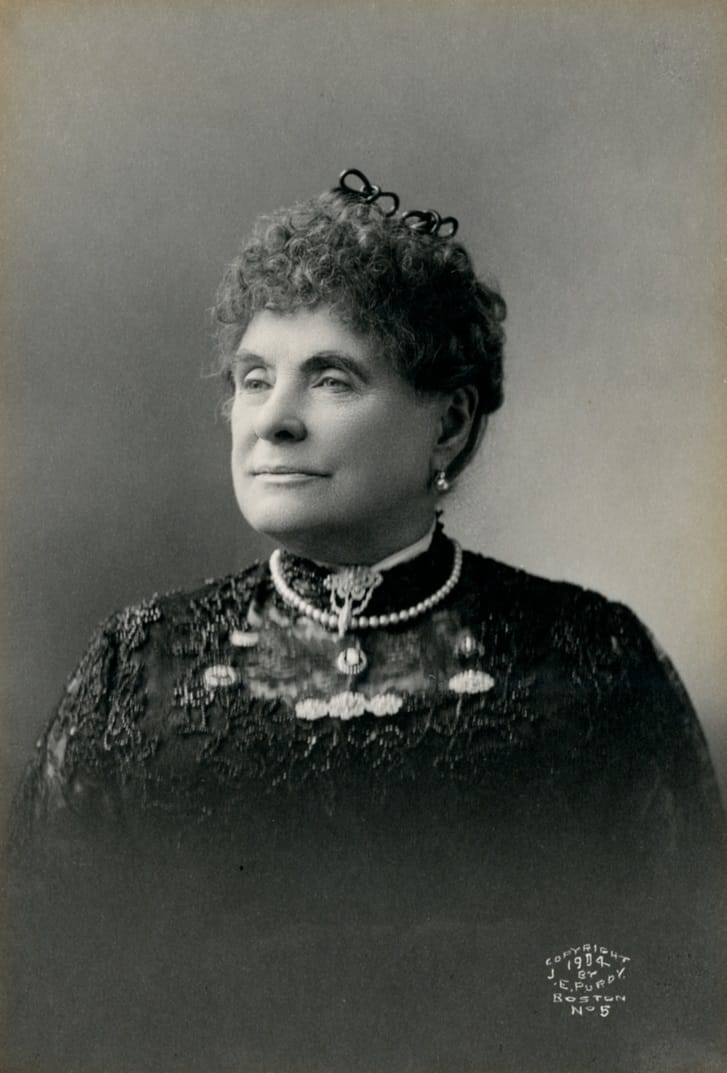
This month’s author is today best known for her myriad friendships with the lettered men and women of her time but was in fact an accomplished poet and writer herself. Louise Chandler Moulton, christened Ellen in 1835, was born in Pomfret, Connecticut, the only child of Lucius Lemel and Rebecca Clarke Chandler. At Christ Church Hall School in Pomfret her classmates included the artist James McNeill Whistler and Edmund Clarence Stedman, one of the first seven men chosen for membership in the American Academy of Arts and Letters. Both Whistler and Stedman remained Moulton’s lifelong friends, and she always kept Whistler’s childhood gift of an “exquisite little painting,” lending it to be part of a Boston exhibition sponsored by the Copley Society after the artist’s death.

In her youth Moulton was a diligent student, as was expected from her stern Calvinist parents but also, it seems, because she enjoyed learning. Her free time was given over to versifying and creating stories of young women with lives more dramatic than her own. She wrote of the heroine of one of her tales that “ideality was the predominant characteristic of her mind.” This could well be said of Moulton herself, who was first published at the age of 14, when one of her poems appeared in a newspaper of Norwich, Connecticut. Encouragement from friends and other authors who had seen her work followed and she went on to contribute poems to gift books. At the age of 17, she edited a gift book of her own verses and short stories along with contributions from other authors, called The Book of the Boudoir. With this publication she came “fully and formally into full-fledged authorship,” according to her friend and biographer Lilian Whiting, and a wider audience saw that “she was deeply tinged with the sentimental fashions which reigned universally in America in the middle of the nineteenth century.”

The melancholy and sensitivity of Moulton’s poems have been attributed to her strict Protestant upbringing, even by herself. The doctrine of election, in which the identity of those who will be saved and admitted to heaven has been preordained by God, haunted Moulton as a child. Despite the fact that her parents were not fanatical, their faith instilled in their child a foreboding of doom and despair and she “imaginatively suffered intensely.” As an adult, Moulton once told a London interviewer, “I can recall waking in the depth of night, cold with horror, and saying to myself, ‘Why, if I’m not one of the elect, I can’t be saved, no matter how hard I try.’” Indeed, if much of Moulton’s poetry seems to have an underlying obsession with death and the departure of loved ones, this might be the answer to the origin of her pathos.

At the age of 18 Moulton published another book, which reportedly sold 20,000 copies: This, That, and the Other, a collection of all her previous submissions to newspapers and magazines. At over 400 pages long, it received glowing criticism; Stedman even compared Moulton to Harriet Beecher Stowe. In hindsight, Whiting considered this review “a matter of private judgment … for although the stories of Ellen Louise were singularly sweet and winsome in their tone, with an unusual grasp of sentiment and glow of fancy for so youthful and inexperienced a writer, they could hardly yet claim to rank with the work of Mrs. Stowe.” Regardless, this publication contributed to the high regard in which Moulton’s peers held her when she joined Mrs. Willard’s Seminary in Troy, New York, when she was 19 years old. At the end of the one-year education she was chosen as the class poet and was asked to write and deliver a fairly standard verse for the commencement ceremony.

During her time at the women’s school, Moulton contributed regularly to literary magazines such as Godey’s Lady’s Book and Peterson’s Magazine, and six weeks after her graduation, on August 27, 1855, she married William Upham Moulton, the publisher of The True Flag, one of the many magazines that had published her poems. The couple moved to Boston, where Moulton settled in as part of a vibrant literary community. The two were members of the Boston Athenæum, and the last time she saw her friend Ralph Waldo Emerson before his death was in fact within those walls; he had just returned from a trip to California and asked if she had ever ventured there to see the big trees. Along with enjoying the historic environs the city had to offer, the new Mrs. Moulton hosted a Friday salon in her home, which was frequented by artists, musicians, and writers, including John Greenleaf Whittier, the poet and abolitionist, poet Henry Wadsworth Longfellow, and poet, physician, and professor Oliver Wendell Holmes, Sr.

Interestingly, Holmes was the inventor of the American stereoscope, consisting of two prismatic lenses and a wooden stand to hold a stereo card, which displayed two copies of the same photograph side by side. Looking through the two lenses rendered the image three-dimensional, and was an enjoyable recreation for those who wanted to view (rather than read about) monuments, nature, and celebrities far before the age of the television, internet, or even radio. One must wonder whether it was Holmes’s influence or her husband’s know-how as a publisher and promoter that prompted the creation of a stereo card featuring Moulton posing in the fashion of the day. Either way, public interest in her works and her person were clearly very high. Indeed, when in 1855 she published the novel Juno Clifford anonymously, it received high praise even without her name attached to it; surely her earnestness of spirit shone through in all her works, whether attributed or not. And it was a spirit fitting with the times, for as Whiting noted, “the fiction of the day was . . . largely occupied with a certain didactic embodiment of ideas of conduct,” and Moulton’s heroines always acted as a good woman should.

Moulton’s third book, another collection of her stories and poems previously published in magazines, aptly titled My Third Book, appeared under her name in 1859. From this point and for the following 10 years Moulton’s extensive notes on her reading are extant, a practice she had picked up in school along with a taste that was “catholic” and an “attitude toward literature … of genuine seriousness.” She found The Scarlet Letter profoundly impressive, for example, but thought Sense & Sensibility “interesting but deficient in earnestness.” There are also notes for many projected but unwritten stories, though in 1873 she published Bedtime Stories, dedicated to her young daughter Florence. Florence became an only child as Ellen Louise had been, for a son born not long after died within a few days. Meanwhile, Moulton contributed to newly-launched magazines, including such titles as Atlantic MonthlyHarper’s and Scribner’s, and also some children’s publications. She also served as the Boston literary correspondent for the New York Tribune from 1870 to 1876, and contributed a weekly letter on books for the Boston Sunday Herald from 1886 to 1892.

In this mature stage of her life Moulton’s salons were frequented by the Sargents, the Howes, and the Higginsons, and she began to travel abroad to London and Paris. Eventually, she spent six months of the year in London and presided over a salon there, where she knew Browning, Eliot, and Hardy. She also met Swinburne, through whom she came to know the Pre-Raphaelites, including its leaders, the Rossettis, and important followers like William Morris, William Holman Hunt and Edmund Burne-Jones. Her successful effort to win recognition in America for these artists and writers, considered “late Romantics,” was one of her major achievements. Yet three more of her own books were still to come, all of them travel sketches and cultural “appreciations”: 1881’s Random Rambles; 1887’s Ourselves and Our Neighbors; and 1896’s Lazy Tours in Spain and Elsewhere. In 1888 her husband William passed away, and though “no faith or philosophy could ease her fear of death,” Moulton reportedly found some solace in Christian Science in her own last months. She died of Bright’s disease in her Boston home in 1908, and is buried beside her husband in Mount Auburn Cemetery, Cambridge.

Ellen Louise Chandler Moulton was never domestic in her tastes, nor involved in the social questions of her day. She corresponded with a Mrs. Eliot who along with her husband was a constant supporter of the Booker T. Washington School in Tuskegee, but there is no evidence that Moulton ever supported those less fortunate. Instead, she gave to the world a number of stories, some pleasant, some heart-rending. Aside from her fostering of others’ talents and the introduction of Pre-Raphaelite and French symbolist poetry to an American readership, Moulton’s most enduring legacy is her poetry, in which “she recorded her deepest convictions and her most intimate perceptions of the facts of life.” Moulton herself once called her work “the rhymes into which, from the first, I put more of myself than any other form of expression.” Unfortunately, like many women, she is today remembered for the men she knew and cultivated rather than in her own right. Yet the evidence of many professional portraits taken over the course of her lifetime and the fact that many photographs from her youth were reissued the year after her death suggests that her contributions to Boston literary life were appreciated by her contemporaries.

Selected Works:

Random Rambles(Cutter Classification, AA .M86)
Lazy Tours in Spain and Elsewhere (Cutter Classification, AA . M86.1)
Ourselves and Our Neighbors (Cutter Classification, 1S . M86)
The Poems and Sonnets of Louise Chandler Moulton (Cutter Classification VEP. M86)
In the Garden of Dreams: lyrics and sonnets (Cutter Classification VEP .M86 .i)

References:

“Ellen Louise Chandler Moulton.” Dictionary of American Biography. New York: Charles    Scribner’s Sons, 1936. Biography in Context. Accessed 30 May 2014.  
James, Edward T, Janet Wilson James, and Paul S. Boyer, eds. Notable American Women 1607-    1950: a biographical dictionaryCambridge, MA: The Belknap Press of Harvard    University Press, 1971. 
Moulton, Louise Chandler. Swallow-FlightsLondon: Macmillan and Co., 1878. 
Whiting, Lilian. Louise Chandler Moulton, Poet and Friend. Boston: Little, Brown, and    Company, 1910. p. 10, p. 19, p. 21, p. 22, p. 23, p.24, p.31, pp. 44–45, p.46, p. 52, p.57

11.25.2014

James Conroy

December 2014

by Emilia Mountain

James Bernard Conroy was born in Bridgeport, Connecticut in 1949 to Bernard and Marguerite Johnson Conroy. Bernard was a 17-year-old medic in the WWII invasion of France and later became a hematologist. Marguerite took care of the home and encouraged Conroy’s reading, especially history. As a very young boy, Conroy remembers being disappointed to learn that he couldn’t become a Sioux Indian when he grew up. He read Anne Terry White’s All About Archaeology (1959) until the binding started to fall apart. Indeed, nothing trumped his boyhood love of archeology until he read Jim Bishop’s The Day Lincoln Was Shot (1955) as a teenager. He was utterly fascinated by Bishop’s methodology: searching for fact after fact, recording them on index cards, putting them in order by the minute and the hour, then writing a history of a single day’s events. Conroy has been drawn to historical research and writing ever since.

In 1967, Conroy enrolled at the University of Connecticut to study political science and history. He admits with good humor that his favorite college locations were not the classrooms. And yet he can still remember that fateful day on a patio, deep in thought, when he made the difficult decision between going to graduate school for history and moving to Washington D.C. to pursue a life in politics—an attractive prospect for many of his generation who were inspired by John F. Kennedy. He eventually served as Press Secretary for the United States Senate Committee on the Budget, Administrative Assistant to Congressman James Scheuer (D.N.Y.), and in the United States Navy Reserve as a photographer and journalist. After his daughter was born, however, he sought a profession that was not so dependent upon elections. Conroy earned his J.D. at Georgetown University and became a commercial litigation attorney, transitioning to semi-retirement only recently.

Throughout the years, writing history was always “in the middle,” as opposed to “in the back,” of Conroy’s mind. The trick was finding a topic. One day, while reading from Shelby Foote’s The Civil War: A Narrative (1986), he came across a reference to peace negotiations between Lincoln and three senior Confederate officials that took place on a riverboat in Virginia. He’d never heard of the Hampton Roads Peace Conference and found that very little had been written about it. “Never before had a sitting US president engaged in peace talks with the enemy in the midst of a shooting war, and never has it happened since.” Our One Common Country: Abraham Lincoln and the Hampton Roads Peace Conference of 1865 (2014) is Conroy’s attempt to address this gap in the Civil War narrative and help readers understand the underlying issues behind the tragic failure of the peace talks.Conroy, James. Our One Common Country. Lyons Press: Guilford, CT, 2014.

Conroy visited many libraries while researching Our One Common Country, including the Museum of the Confederacy in Richmond, the Library of Virginia, Duke University Library, the University of North Carolina Library, and the Library of Congress. However, he actually completed most of his research at the Boston Athenæum, where primary and secondary sources for both the Union and the Confederacy are extensive. Even while he was still working at his law firm at One Beacon Street, he could walk over on a lunch break to pick up books at Circulation or Interlibrary Loan and ask a question or two of the “uniformly pleasant and helpful” reference librarians and interns. The fifth floor reading room was also a relaxing place to complete most of his writing, and he found the nineteenth-century margin notes in some of the older donated volumes on the Civil War both amusing and illuminating. In February 2014 he enjoyed giving a lecture to an Athenæum audience where he felt there was a true intellectual and sentimental “resonance” with his subject (As our Civil War Discussion Group attended in full, this is no surprise).

In his spare time, Conroy enjoys family history research. His great-grandfather, born in Ireland and also named James Conroy, was in the fortieth New York Infantry in the Civil War. The Civil War veteran’s wife, born Bridget Burns, was a dressmaker for high society—Mrs. Lincoln included. At the moment, Conroy is hard at work, with the help of our reference librarians, choosing another mysterious, little-known, historical topic to research. That would be his favorite kind.Works Cited: Conroy, James. Our One Common Country: Abraham Lincoln and the Hampton Roads Peace Conference of 1865. Lyons Press: Guilford, CT, 2014. 

10.28.2014

Staff Book Suggestions Autumn 2014

Emily Anderson

What If?: Serious Scientific Answers to Absurd Hypothetical Questions by Randall Munroe

(to be cataloged)

Sometimes one requires answers to questions such as: what would happen if everyone on earth aimed laser pointers at the moon?; or, could a person really live on a small but super-massive asteroid like The Little Prince? Answers to these and many other important questions can be found in What If?, but a lot of fun is also had with the unanswered questions—those the author deemed too “weird (and worrying)” for response. Randall Munroe is the creator of the popular webcomic xkcd, and has been responding to What If?questions on a blog with the same title for the past two years. This is his second book.

Kristin Cook

Middlemarchby George Eliot

(Library of Congress Classification PZ3.E43 Mi 1912)

Middlemarchfeels like the quintessential autumn book to me. Maybe because I first read it in the fall, maybe because of the gloamy English small-town setting, or perhaps because it’s such a hefty tome that one feels like curling up with by a fire or in a window seat as the chilly November rain pours down. Middlemarch is a book I always recommend if someone wants to delve into “literature” but wants to have a good time. A complex tale of individuals and how they are shaped by the expectations of their community—and how they shape each other—at a time when society was changing, Middlemarch is full of subtle irony and, perhaps surprisingly, suspense: will everyone be miserable after making decisions they were sure would make them happy? Or is there yet hope? For fans of anything BBC-related, though less soap-operatic than it might seem, Virginia Woolf famously remarked that Middlemarch is “one of the few English novels written for grown-up people.”

Stanley Cushing

When Paris Went Dark: the City of Light under German Occupation, 1940–44 by Ronald C. Rosbottom

(Library of Congress DC737 .R67 2014)

This account of life in Paris during the German Occupation is nuanced and sobering. It surprised me to learn that the Paris police force was responsible for the actual round up and deportation of all the Jews they could find to send to concentration camps. Having just been in Paris I was shocked to realize that the Nazis had taken over the hotel where I stayed and used it to house their officers. This book makes it very clear that the citizens of Paris were worn down by the numerous regulations, curfews, and deprivations. The varieties of accommodations made by the populace to survive still continue to be a source of pride and regret.

David Dearinger

Longbournby Jo Baker

(Library of Congress PZ4.B1685 Lo 2013)

We all know about prequels and sequels, whether based on older movies, novels, or political candidates. In literature, these are often written by someone other than the author of the original work; at times, this has led to the victimization or unnecessary exploitation of classics. Think, for example, of the various attempts to improve upon Margaret Mitchell’s never-to-be-matched Gone with the Wind(e.g., Alexandra Ripley’s Scarlett or Donald McCaig’s Rhett Butler’s People). Sad. But with a sequel extending a narrative’s time-line into the future and a prequel looking to the past, what do we call a book that has a plot that occurs at exactly the same time as a previously told tale? Whatever the term might be, the best book of this unusual type that I’ve encountered is Jo Bell’s wonderful Longbourn, published exactly 200 years after the novel on which it is based, in 2013. Fans of British literature in general will immediately identify that predecessor: the title of Baker’s book is that of the home of the family of Elizabeth Bennett, the heroine of Jane Austen’s Pride and Prejudice.The plot of Longbourn, the book, in fact, uses the plot of Austen’s famous novel as its armature; but for Baker, the focus is a housemaid named Sarah, who is a member of one of the small group of servants who work below-stairs at Longbourn. Like Elizabeth Bennett, Sarah’s smart and feisty character makes her worth knowing, and her story is worth telling: exciting in its structure, human in its emotion, and readable in every way. A perfect book to consume while waiting for the next season of Downton Abbey.

Coorain Devin

Carsickby John Waters

(Library of Congress PN1998.3.W38 A3 2014)

The latest book from master of trash cinema, John Waters, will delight old fans—the man has done nothing to clean up his act. Readers who have not experienced Waters or have only seen his popular Hairspray may want to stick with something a little less vulgar. That said, Carsick delivers what it promises—a fun twist on the road novel.

Will Evans

The Surprise of Cremona by Edith Templeton

(Cutter, AI .T246)

Templeton, a British fiction writer, here provides a travelogue of her journey through Northern Italy in the early 1950s. Thoughtful and funny, she also carries a bit of the imperiousness of her native country to the continent, as she makes her way from Cremona to Arezzo, offering crisp, witty pronouncements on Italian art, food, and men.

Adriene Galindo

Ella Enchanted by Gail Carson Levine

(Children’s Library PZ7.L578345 El 1997)

Ella Enchanted is a twist on a classic fairy tale, featuring a free-spirited Cinderella and an empowering message. A delightful book for teens or for families to read together, Ella is the heroine of her own story and is sure to win over the hearts of all who meet her. Enjoy the book first and then compare it to the movie adaptation with the whole family.

Evan Knight

Wise Blood, A Good Man Is Hard to Find, and The Violent Bear It Away, all by Flannery O’Connor

(Library of Congress PZ4.O183 Wi, PZ4.O183 Go, and PZ4.O183 Vi, respectively)

I just finished reading Flannery O’Connor’s first short novel from 1952, Wise Blood, and a 1955 short story compilation of hers, A Good Man Is Hard to Find, and Other Stories. I’m just starting her 1960 novel The Violent Bear it Away, and it seems to be in the same mold as the others: compelling prose that invigorates stories of personal triumph or tragedy, city versus country life, religious frailty, and of course, death, in the post-war South.

Amanda McSweeney

Fangirlby Rainbow Rowell

(Children’s Library PZ7.R79613 Fan 2013)

With the school year in full swing, it’s a good time to read a story set on a college campus. It’s Cath’s freshman year and she’s feeling extremely out of place. With a delicate father, a gruff roommate, and awkward interactions with several cute classmates to worry about, she really only finds comfort in her familiar Simon Snow fan fiction. But her twin sister is urging her to branch out and maybe she isn’t entirely wrong to do so. Rainbow Rowell manages to capture all the uncertainties of college, from living off protein bars because you can’t find the dining hall to larger concerns like worrying about the family you left behind. With excerpts from the fictional Simon Snow novels and characters you’ll want to befriend yourself, Fangirl is perfect for anybody looking forward to (or back on) their own college years.

Carolle Morini

A Hilltop on the Marne by Mildred Aldrich

(Cutter 8A97 .M34 .a 1915)

Has the exhibition Over Here: World War I Posters from Around the World piqued your interest for reading personal accounts? If so, A Hilltop on the Marne, by Mildred Aldrich (who grew up in Boston) is just for you. Her account begins on June 3, 1914, where she writes to say she has completed her move to Huiry and is at peace to retire and be buried there. On August 3, 1914 she writes to say that war has been declared. What follows is her unbelievable account of the war from her hilltop. Aldrich writes beautifully and intimately. Her style draws you right into her salon where she penned these letters and has you joining her for morning coffee by her pear tree. It helps, too, that she loved books. August 10, 1914 she writes: “I have your cable asking me to come ‘home’ as you call it. Alas, my home is where my books are—they are here. Thanks all the same.”

Anthea Reilly

My Brilliant FriendThe Story of a New Name,and Those Who Leave and Those Who Stay, all by Elena Ferrante

(Library of Congress PZ4.F356 My 2012, PZ4.F356 St 2013, and PZ4.F356 Th 2014, respectively)

These novels trace the friendship between two headstrong Italian Neapolitan women from their school days in the 1950s to the present day. Entertaining with a great sense of place and time. 

Graham Skinner

Three novels by Sjón, translated from Icelandic by Victoria Cribb

(to be cataloged)

With the publication of these novels, the Icelandic myth-maker Sjón makes a grand American debut expertly blending surrealism, scientific reasoning, fable, magical realism, myth and history into captivating giants of prose. From the Mouth of the Whale is a rich, delightful, and surreal saga set between 1635 and 1639, exploring the all-consuming hunger for knowledge, scientific curiosity, the natural world, psychological realities, and the dark sides of humanity. The novel is mesmerizing, humorous, terrifying, and a lyrical masterpiece. A slender volume, The Blue Fox, reads more as a prose poem that’s part fairy tale and part mystery. Backed by the Icelandic winter, The Blue Fox intertwines two stories: that of a priest-hunter hunting the elusive, magical, and somewhat demonic blue fox, and the story of a naturalist mourning the death of his charge. It is a quick and absolute delight, a symphony of prose. The Whispering Muse artfully blends the fantastic with the dull, retelling the story of Jason and the Argonauts’ mythical quest for the Golden Fleece and that of the launch of the Danish cargo ship, the MS Elizabet Jung-Olsen in 1949. The fantastic is embodied in Caeneus, the mythical hero and myth-teller, and the dull is embodied in Haraldsson, the man obsessed with his research on the influence of fish consumption on the Nordic people. Odd and fantastical, this novel plays out brilliantly.

Deborah Vernon

Drawings by C. D. Gibson

(Library of Congress + NC1075 .G4 1898)

I stumbled upon this book while shelving in the Art Department. I don’t know why it caught my attention, exactly—perhaps it was the romance of its appearance: tea-dipped, smoothed by palms and thumbs, precious as an artist’s portfolio. Inside were pen and ink drawings of men and women in Edwardian dress. Some of the illustrations were satirical in nature—such as those mocking the matrimony of a youthful heiress with an aged aristocrat—while others were sorrowful. I was struck by one drawing in particular entitled “Love Will Die.” In it, a man and woman mourn separately while the emblem of their love—a young child—lies in death upon an altar between them. Curious to learn more, I asked David Dearinger, the Athenӕum’s Susan Morse Hilles Curator of Paintings & Sculpture & Director of Exhibitions, if he knew the artist in question, a one C. D. Gibson. David knew a lot. Apparently, C. D. Gibson was one of the most well-known graphic artists at the turn of the 20th century. He created the “Gibson Girl,” an icon of the young and beautiful American woman. Although problematic in ways, Gibson used this figure to address the corrupted values of American and European society. He namely critiqued the “ill-mated pairs,” or marriages, that were determined by economic factors rather than love or affection. Gibson’s works were influential and appeared in magazines, newspapers, and books. His drawings would also be a source of inspiration for subsequent graphic artists, such as Norman Rockwell. For my part, I feel lucky to have peeked into this volume to discover a world that was heretofore unknown to me. Even if Gibson’s works are already known to you, I would recommend inspecting this book. It’s worth it.

Mary Warnement

Pleasured by Philip Hensher
(Library of Congress Classification PZ4.H5235 Pl 1998)

Commemorating the 20th anniversary, the Guardian listed Hensher’s novel as one of the top ten books on the fall of the Berlin Wall in 1989. Opening on New Year’s Eve 1988, readers meet the protagonist Friedrich, a 90s slacker, on the road returning from West Germany to West Berlin with a young woman and the British ex-pat driver Peter who has agreed to give them a ride. The car breaks down in the section of the book called Kaputt, and the plot takes turns that could seem madcap, as when Friedrich decides to attempt a con in which he will overthrow the government by distributing ecstasy for free to East Berliners; however, the two final sections of the book, Genug(Enough) and Reichskristallnact (Empire’s Night of Broken Glass) show that behind the depiction of Berlin’s youthful sub-culture there is a consideration of German history, humanity’s impatience and tendency to excuse its worst self, and the role of painkillers, pharmaceutical and otherwise, to deal with life, stories, and death.

Alexandra Winzeler

The Road by Cormac McCarthy

(Library of Congress PZ4.M1235 Ro 2006)

I reread this book about once a year when the weather really starts to get cold. It is the bleak survival story of a man and his son in a post-apocalyptic winter, and McCarthy’s only science-fiction-like book. There is a satisfying combination of immediate and tense action sequences with more abstract poetic language as the characters make their dangerous journey to the coast.  While not a warm winter pick-me-up of a book, The Road highlights all things beautiful and terrible in both nature and humanity and builds a compelling plot you will not be able to put down.

10.23.2014

Nathaniel Hawthorne

November 2014

by Deborah F. Vernon

Nathaniel Hawthorne (1804–1864) was born in Salem, Massachusetts. He was the descendant of one of the first families to settle in Salem, the Hathornes. By the time he was born, the family name had fallen from its place of distinction. This was due to his great-great-grandfather, William Hathorne, and his great-grandfather, Colonel John Hathorne. The former claimed Quakers were heretics and persecuted them as such, including the notorious flogging of a Quaker woman as she was dragged half naked through the streets of Salem. The latter was a judge during the Salem Witch Trials. The Colonel found over a hundred women guilty of witchcraft and would ride out to Gallows Hill to witness the hangings. Legend has it that one of the “witches” cursed the Colonel and his family before her death. Nathaniel Hawthorne never escaped a sense of guilt for his family’s deeds, and in that sense, the curse was real. The burden of the past manifested in his writing, perhaps most directly in the short story “Young Goodman Brown” (1835) and The Scarlet Letter(1850). Hawthorne wryly summarized, “Let us thank God for having given us such ancestors and let each successive generation thank him, not less fervently, for being one step further from them in the march of ages” (Wineapple,15).

A discredited name was paired with a steady decline in the Hathornes’ financial standing. Matters were made worse when Hawthorne’s father died at sea. With his death, Hawthorne’s mother was unable to care for her four-year-old son and two daughters. His uncles, Richard and Robert Manning, supported the family. Thus, Hawthorne traveled from one Manning household in Maine to another in Salem for much of his youth. He graduated from Bowdoin College in 1825. As a student he was undistinguished, but what set him apart from his peers was his determination to be a writer. He moved home to Salem with the express purpose of writing the next great American novel. It was during this time that he changed his name from Hathorne to Hawthorne to distance himself from his family history.

The novel Hawthorne dreamed of writing during this time never came to fruition, but he did write several short stories that brought him some acclaim. “Young Goodman Brown” (1835) is a story concerning witchcraft—bearing allusions to William Hathorne and Colonel John Hathorne—that continues to be a staple of high school English classes. The story reflects a preoccupation with the past and a doubting self and is also indicative of the solitude and darkness that Hawthorne associated with these years after college. He may have continued in Salem, writing, lonely, publishing a piece of literature that would bring him some mention but little financial success, if he had not fallen in love. Sophia Peabody claimed, “I never intend any one shall have me for a wife” (Wineapple, 112)—obviously, Hawthorne convinced her otherwise, but this did not mean he had the means to support a wife and family. He left Salem for Boston where he worked at the Boston Custom House in the hopes of saving enough capital to marry his intended.

It was during these years in Boston that Hawthorne frequented the “noble hall” of the Boston Athenӕum, which at the time was located on Pearl Street. He particularly enjoyed spending a quiet hour in the Reading Room and it was there that he came into contact with one of the Athenӕum’s resident ghosts—Reverend Thaddeus Mason Harris. In April of 1842, Hawthorne entered the Athenӕum’s Reading Room to find the Reverend in his usual chair, newspaper in hand. Hawthorne did not think there was anything untoward until later that evening, when a friend told him the Reverend had died. Hawthorne explained that this was impossible as he had seen the Reverend at the Athenӕum earlier that day. Hawthorne was eventually convinced of the Reverend’s death but went to the Reading Room the next day only to see the apparition of the Reverend again. Hawthorne speculated that the ghost could have been reading his own obituary. He wrote of the encounter:

Chester Harding (1792-1886), Thaddeus Mason Harris, ca. 1820, Oil on canvas, 75.6 x 62.2 cm, Athenӕum purchase, 1993 (UR253).

“I remember—once at least, and I know not but oftener—a sad, wistful, disappointed gaze, which the ghost fixed upon me from beneath his spectacles; a melancholy look of helplessness, which, if my heart had been as hard as a paving-stone, I could hardly have withstood. But I did withstand it; and I think I saw him no more after this last, appealing look.” (The Athenæum Centenary, 34)

Given the witch’s curse from Hawthorne’s past, it isn’t surprising that he would be the one to espy Mason’s ghost. Indeed, Hawthorne was more intrigued by the phantom than distressed.

By the time Hawthorne raised enough funds to marry Sophia in 1842, he decided he and his wife would not settle in Salem. He was tired of living in a landscape where his family’s and town’s painful history were inextricable. Instead, he shrugged off hauntings and relocated with Sophia to Concord, Massachusetts. There they socialized with the Transcendentalists of the time, including Ralph Waldo Emerson and Henry David Thoreau. Hawthorne never considered himself a Transcendentalist but he appreciated their company. The time he and Sophia spent in their Concord home, The Old Manse, was marked by the sense of contentment he had hoped the move would bring. Thus, it made their move back to Salem in 1845 all the more difficult.

Hawthorne’s return to Salem was an embittered one. He did not want to go back to the setting of his family’s misdeed and only did so because he had produced little in the way of writing in the five years spent at The Old Manse and was unable to financially support Sophia and himself. A few years after the return to Salem, he lost his job at the Boston Custom House. However, his unrest was also a motivator. Shortly after losing his position, he wrote The Scarlet Letter(1850). The book made him famous in his own time and continues to be the primary tome associated with his name. The book brought with it the literary success he had desired since adolescence. In short succession, he wrote The House of Seven Gables(1851) and The Blithedale Romance(1852).

In 1853, the Hawthorne family experienced a change. Hawthorne was friends with statesmen Franklin Pierce. When Pierce was elected President of the United States, he appointed Hawthorne to the position of the United States Consul in Liverpool, England. The position was a prestigious one and brought Hawthorne the financial security he sought but rarely possessed. His family and he moved to England in 1853 and lived there until 1857. After his term, they traveled to Italy for a year. This year abroad was the inspiration for his last novel, The Marble Faun(1860), which he wrote upon his settling in Wayside, Massachusetts.

Hawthorne’s death is as mysterious as his vision of Reverend Thaddeus Mason Harris in the Athenӕum all those years ago. In 1862, Hawthorne’s body began to fail. He lost the good looks that people had ascribed to him since childhood. He aged suddenly, his hair turning a shock of white. In two years he transformed from an able-bodied man to a feeble one. He died on a trip with his friend Pierce to New Hampshire. There has been speculation but no certainty regarding what stole him from the world of the living. Considering his haunted life, it is not surprising that Hawthorne’s death had the same air of mystery. At least his ghost can be at peace knowing his legacy is quite different from that of his ancestors.

Selected Works:

The Complete Writings of Nathaniel Hawthorne(Cutter Classification, VE .H313 .2)

The Ghost of Dr. Harris(Cutter Classification, $XL5 .B65 .h—apt. required)

The Heart of Hawthorne’s Journals(Library of Congress, PS1881 .A25)

The House of the Seven Gables(Library of Congress, + PZ3.H318 Ho 1970)

The Marble Faun(Library of Congress, PZ3.H318 Ma 1931)

Novels(Library of Congress, PZ3.H318 No)

The Old Manse(Library of Congress, PZ3.H318 Ol)

The Scarlet Letter(Library of Congress, PZ3.H318 Sc 2003)

Tales and Sketches(Library of Congress, PZ3.H318 Ta)

Tanglewood Tales for Girls and Boys(Library of Congress, + PZ8.1.H318 Ta 1887)

Twice Told Tales(Library of Congress, PZ3.H318 Tw 1893)

A Wonder-Book for Girls and Boys(Library of Congress, PZ8.1.H318 Wo)

Works Cited:

The Athenӕum Centenary—The Influence and History of the Boston Athenӕum from 1807 to 1907 with a Record of its Officers and Benefactors and a Complete List of Proprietors.Boston: The Boston Athenӕum, 1907.

Mays, James O’Donald. Mr. Hawthorne Goes to England.Burley, Hampshire: New Forest Leaves, 1983.

Mellow, James. Nathaniel Hawthorne in His Times.Boston: Houghton Mifflin, 1980.

Miller, Edwin Haviland. Salem Is My Dwelling Place: A Life of Nathaniel Hawthorne

“Nathaniel Hawthorne.” Encyclopedia Brittanica Online. Chicago: Illinois. 1 Oct., 2014. http://library.eb.com/levels/referencecenter/article/39629

Wineapple, Brenda. Hawthorne: a Life.New York: Alfred A. Knopf, 2003. Print.