02.24.2014

Therese Sellers

February 2014

By Emilia Poppe Mountain

Therese Sellers is the author of Alpha is for Anthropos, a collection of Greek nursery rhymes she composed over seventeen years teaching Ancient Greek to children. Her sister, Lucy Bell Jarka-Sellers, is the book’s illustrator. Born in Philadelphia to Peter and Lucy Bell Sellers, Sellers describes herself as “Greek by affection, if not by birth.” She’s unsure whether this affinity is due to the layover her parents made in Athens while on their way to a two-year stay in Kenya she was only six months old, the time her father, a mathematician, spent teaching her Greek letters on index cards, or to the entire year her fourth grade class spent studying Ancient Greece. Nevertheless, her passion for Athena’s homeland has never waned.

As a freshman at Germantown Friends School, she was the youngest student in the newly instituted Ancient Greek course. By the time she enrolled at Harvard at age 17, she already had four years of Greek and immediately enrolled in upper level courses. While she was excited and inspired by Greek literature, she never felt completely at home in the world of academia and has spent her career finding different ways to take Ancient Greek out a purely academic setting. She did this in her undergraduate years with an outdoor production of Euripides’ Bacchae performed in the Harvard football stadium with all the choral odes in the original Greek.

Teaching Greek to children was another departure from upper-level classical studies and was the inspiration for Alpha is for Anthropos, which invites readers, young and old, to engage with the book of various levels of character formation, art and design, mythology and song. Sellers attributes this endeavor to a strange request made by a college friend almost two decades ago: to teach her four-year-old son Ancient Greek. True, she had surrounded herself with Greek culture ever since she was cast as Antigone at age nine, even moving to Greece for three years in her twenties and building a house there. But to teach a small child Ancient Greek? The task still seemed Herculean. During their first meetings, the boy wouldn’t remember anything they’d covered from one week to the next and Sellers began to wonder if it was all a waste of time. But suddenly, she decided to change her teaching style entirely. Instead of working with paper, they took walks. When they came upon an oak tree, she gave him the word for oak and told him a related story about Zeus. They started singing the alphabet and phrases to the tune of familiar songs and nursery rhymes. They drew in the dirt. They chalked the sidewalks. And then an amazing thing started to happen: this young boy was learning Ancient Greek, and quickly. Families in her neighborhood got wind of the fun, and she soon was teaching Greek to whole groups of preschoolers. When she offered to bring her Greek curriculum to Glen Urquhart School in Beverly, they also hired her to run their Latin program. 

After seven years in the classroom, Sellers decided to leave teaching to become a full-time writer. Alpha is for Anthropos is her first book. On the horizon is a biography of Eva Palmer-Sikelianos (1874-1952) whom Sellers researched while living in Greece as a young woman. She’s also revising a novel that began as a NaNoWriMo challenge during her last year of teaching, and in the publishing process for a novel she translated as a part of her PhD, Aioliki Yi by Ilias Venezis. When her family realized that there was no way she could get any writing done at their busy city apartment, they gave her a Boston Athenæum membership, enabling her to do her writing in the quiet fifth floor reading room which she describes as “heaven” in comparison. Here, she can work amid books, statues and architectural details that bring her right back to Greece. Once in awhile, she’ll even depart from the classics to review the work of long ago Boston Athenæum member, Sarah Orne Jewett, or to write and tweet haiku at @qerese. In January 2014, Sellers presented Alpha is for Anthropos at the Boston Athenæum to a diverse group of parents, children, and Classics enthusiasts from around the world. After thanking Athena for presiding over them, she shared her book, the myth of Arachne and Athena, the riddle of the Sphinx, slices of Greek New Year’s Day cake, and most importantly, her belief that teaching is done most effectively “with joy and beauty.” 

02.24.2014

Louisa May Alcott

January 2014

By Chloe Morse-Harding

“Her place is in the forefront among those saintlike women who saw a stern duty lying very near them, and courageously assumed it to their own honorable profit and renown”. – The New York Times, October 14, 1889

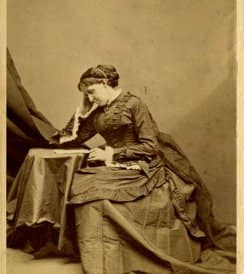
Louisa May Alcott (1832-1888) was born in Germantown, Pennsylvania to parents Amos Bronson Alcott and Abigail May.  Abby, called “Marmee” by her four future daughters, grew up in Boston, well-read and well-educated.  While visiting her brother, Reverend Samuel May, in Brooklyn, Abby met Bronson in 1827.  Bronson had been teaching in Connecticut, but lost his position and May invited Bronson to come and visit him.  May, who was “an educational reformer himself…arranged a position for him at the Charity Infant School in Boston.”  When Abby found out about Bronson’s new position in Boston, she applied to be his assistant.  But, they were to be joined in an entirely different way: when “the penniless Alcott refused to hire her as his deputy, she proposed marriage instead.”  They were married in Boston, at Kings Chapel in 1830, and so began their tumultuous life together.

In 1831, Bronson was offered a new teaching job and the couple moved to Germantown.  Their first child, Anna was born in 1831, and Louisa came next in 1832.  In 1834, the Alcott family moved back to Boston, and founded the School for Human Culture (also known as the Temple School) with the help of Elizabeth Palmer Peabody.  The Alcott’s third daughter was born in 1835, and named Elizabeth in Peabody’s honor.  In 1840, after the controversies of the closing of the Temple School, the Alcotts resettled in Concord, where their fourth daughter Abigail May was born.  Louisa, who had been educated at the Temple School, continued her education with her father at home, which was supplemented by the teachings of local family friends Henry David Thoreau and Ralph Waldo Emerson.

When Louisa was 11, in 1843, the Alcotts, with the help of Charles Lane and Samuel May, purchased and moved in to their famous farm, Fruitlands, in nearby Harvard.  After a disastrous few years, Abby’s inheritance came through and the family moved back to Concord and purchased their new home, Hillside, where Louisa began to practice her writing skills.  In 1849, Louisa wrote her first novel, The Inheritance, which was to remain hidden amongst her papers at Harvard University’s Houghton Library until two professors stumbled upon the 150-page manuscript in 1996.  Previously, scholars had believed Louisa’s first novel was Moods, published in 1864.  The Alcotts remained at Hillside, until Abby sold the property to Nathaniel Hawthorne in 1852.  In 1853, they moved to another Concord home, Orchard House; the Alcotts lived at Orchard House until 1877.  It was at Orchard House where, in 1868, Louisa wrote her classic family tale, Little Women, based on life at Hillside.

Like her mother, Louisa was a staunch abolitionist and supporter of women’s rights, and she “demanded both the abolition of slavery and political recognition of woman’s rights”.  When America’s Civil War broke out on 1861, Louisa, at the age of 30, was determined to be part of the war effort.  In 1862, Louisa came to Washington, D.C. to work in the Union Hotel Hospital; although married women were usually recruited to be nurses, some strings were pulled for Louisa.  Her “friends and family connections were as influential politically as they were in writing and publishing, and they helped her join the nursing service.”  The letters Louisa wrote home and the journal she kept became the basis for Hospital Sketches, later published in 1863, the same year Louisa contracted typhoid and was discharged from service.  She eventually recovered, but the mercury-based medication she took for the fever caused “lifelong debilitation; she thereafter had painful joints, swollen limbs, and headaches that would not be soothed.”  It was during the years during and after the war that Louisa’s writing was at its prime, from her well-known young adult novels to her lesser-known thrillers.        

During the 1860’s, Louisa led a “double literary life [which] was a well-kept secret for almost a century”, renting out a room in Boston to write “thrillers whose themes include sexual power struggles, narcotics addiction, murder, revenge, and feminist triumph” under the pen name A.M. Barnard.  Alcott’s thrillers were published by Frank Leslie in his weeklies and monthlies (Frank Leslie’s Illustrated NewspaperFrank Leslie’s Chimney Corner, and Frank Leslie’s Lady’s Magazine).  In the same decade, Louisa also published stories in The Atlantic MonthlyFlag of Our UnionPutnam’s Magazine and the children’s serial, Merry’s Museum.  At the end of the decade, in 1869, Louisa was granted access to the Boston Athenæum by her uncle, Reverend Samuel May, and so became what we call “a Reader.”

Although we know her as an author, Louisa worked as a maid, a seamstress, a teacher (which she apparently had an affinity for, but did not enjoy), and a governess.  Louisa “appointed herself Alcott breadwinner, and to this end tried every means then available of making money” to support her family, and “[i]t was usually, even in late years, the need of money that impelled her to write”.  She also had dreams of becoming an actress, and although she never acted professionally (save for “as an amateur in performances for the benefit of the Sanitary Commision”), she remained “a constant theatre-goer all the later years of her life.” 

Just two days after Bronson died in March of 1888, Louisa died from a cold that developed into spinal meningitis.  She was buried in the family plot in the famed Concord, MA cemetery, Sleepy Hollow.  In an article published in the New York Times on March 7, 1888, the author notes “[t]he most widely-known and most popular of American female authors will be sincerely mourned by thousands of children, and thousands of children of larger growth, wherever the English language is spoken, and by all who in other languages have read translations of her writings”.

Selected Works:

Behind a mask : the unknown thrillers of Louisa May Alcott (Library of Congress, PZ3.A355 Be)

Hospital sketches, and Camp and fireside stories (Library of Congress, PZ3.A355 Ho 1888)

Jo’s boys and how they turned out : a sequel to “Little Men” (Library of Congress, PZ3.A355 Jo)

Little women : or, Meg, Jo, Beth, and Amy (Library of Congress, PZ3.A355 Lit)

Little women : an annotated edition (Library of Congress, PZ3.A355 Lit 2013 **Currently in the New Book Shelves)

Moods : a novel (Library of Congress, PZ3.A355 Moo)

Rose family : a fairy tale (Cutter, VEK .Al1 )

Silver pitchers : and Independence, a centennial love song (Library of Congress, PZ3.A355 Si 1899)

Under the lilacs (Library of Congress, PZ7.A335 Un 1878 )

Work : a story of experience (Library of Congress, PZ3.A355 Wo)

References:

(1888, March 7).  Louisa May Alcott.  The New York Times, pp.4.

(1888, March 7).   Louisa M. Alcott Dead: The authoress dies on the day of her father’s funeral.  The New York Times, pp. 5.

(1889, October 14).  New Publications: Miss Alcott’s Stern Life Battle.  The New York Times, pp. 3.

Alcott, L.M. (1993).  From Jo March’s Attic: Stories of Intrigue and Suspense.  M.B. Stern & D. Shealy (Eds.).  Boston, MA: Northeastern University Press.

“Bronson and Abigail Alcott”.  Retrieved from  http://www25.uua.org/uuhs/duub/articles/bronsonalcott.html

Elbert, A. (Ed.).  (1997).  Louisa May Alcott on Race, Sex, and Slavery.  Boston, MA: Northeastern University Press.

“Learn about the Alcott’s and Orchard House”.  Retrieved from http://www.louisamayalcott.org/alcottorchard.html

“Today in History: November 29”.  Retrieved from http://memory.loc.gov/ammem/today/nov29.html

“Uncovered at Harvard: Alcott’s First Novel”.   Retrieved from http://www.nytimes.com/1996/05/01/books/uncovered-at-harvard-alcott-s-first-novel.html?pagewanted=print&src=pm

Wineapple, Brenda (2012).  “Where Credit Is Due ‘Marmee & Louisa’ and ‘My Heart Is Boundless’”.  Retrieved from  http://www.nytimes.com/2012/12/23/books/review/marmee-louisa-and-my-heart-is-boundless.html?_r=0

02.24.2014

Ann Wadsworth

December 2013

By Emilia Poppe Mountain

Ann Wadsworth was born in St. Louis and began writing stories and plays at an early age. She remembers with some amusement a “little magazine” she created about age eleven for family and neighborhood children “filled with my own highly emotional prose and a couple of awful poems.” More than any technical skill, Wadsworth believes it was the imagination and creative delight of her family circumstances that pointed her in the direction of her writing career. Her mother was an avid reader and passed her love of books on to her daughters. Her father instilled in her his love of opera and classical music, an affinity that continues to this day. One of her sisters is a textile artist, the other a librarian. Her household was always full of high drama and the dinner table lively with conversation.

Ann entered Berea College, majoring in English, and during her junior year was elected to Twenty Writers, a select group of students with literary talent. After completing her BA she entered graduate school at the Catholic University in Washington, DC, majoring again in English with a concentration in Renaissance literature. Upon receiving her MA a professor there recommended her for a position at the Folger Shakespeare Library, where she spent the next six years working with 16th– and 17th-century rare books. During this period the Folger sponsored her attendance at the Italian University for Foreigners in Perugia, Italy, where she studied Italian language and literature and fell in love with the country.

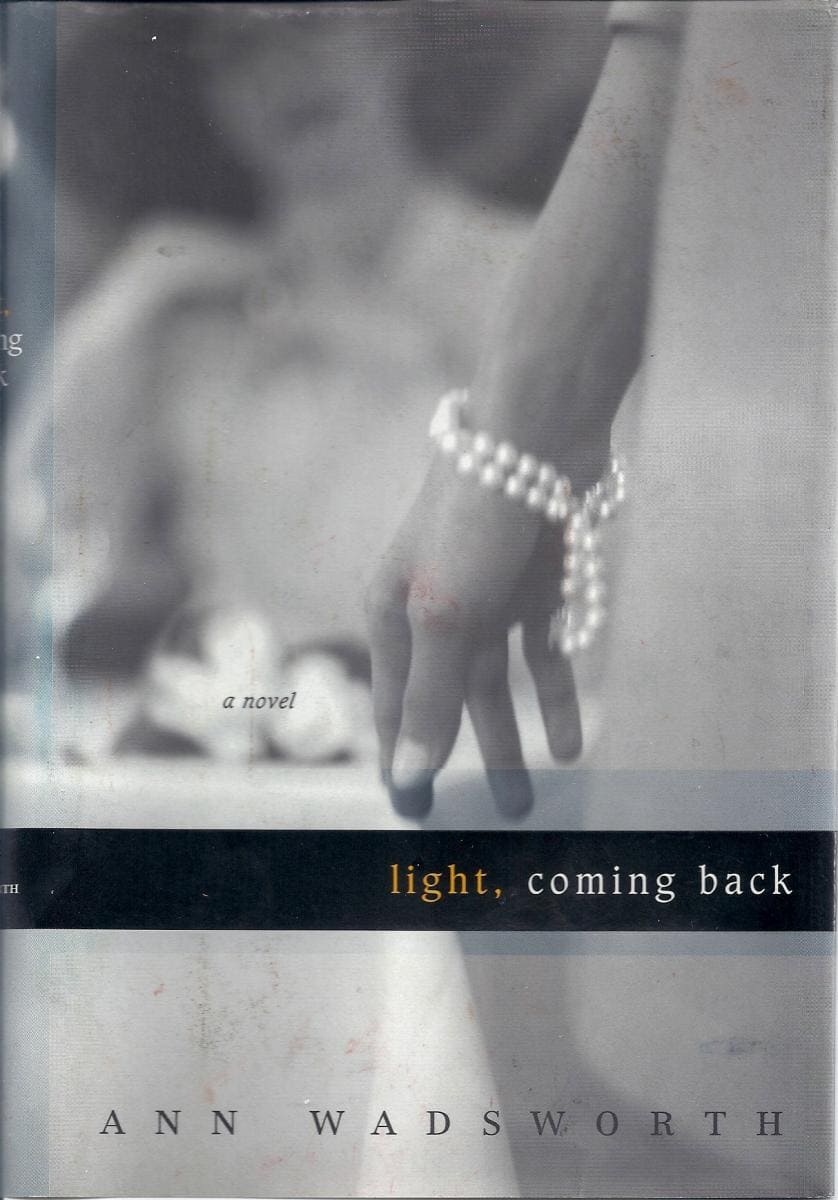
Ann joined the staff of the Boston Athenæum in 1972. During her 30 plus years here she held a variety of positions, and in 1990 became the Editor of Publications, a position she held until her retirement in 2010. Throughout her years at the Athenæum she continued to write fiction, publishing several short stories and completing two novels (presently languishing in a drawer). A fellowship at the MacDowell Colony and a Wellspring Grant from the Athenæum some years later allowed her to move forward with her third novel, Light, Coming Back, which was published by Alyson Press in 2001 and afterwards translated into German and French. It was short-listed for the Lambda Literary Award, the Stephen Crane First Fiction Award, and the Ferro-Grumley Prize. Set in Boston, Light, Coming Back introduces Mercedes Medina and her much older dying husband Patrick. When Mercedes meets Lennie at a Cambridge flower shop, emotions surface that she has ignored for many years, and she begins to entertain thoughts of how, at the age of sixty, she might finally find her own life. Wadsworth says that in this story she wanted to explore how these three unlikely characters might attempt to deal with their awkward, painful, but also exciting and inspiring circumstances. “I like to take characters, throw them into a pot, and see what happens.”

Book Cover: Wadsworth, Ann. Light, Coming Back: A Novel. Los Angeles, CA: Alyson Publications, 2001.Wadsworth says her own work is usually character driven, and the characters, once created, lead her along the path her writing must follow. She looks for similar qualities in the books she reads and has a number of favorites that she picks up whenever she can’t sleep or is “stuck in a rut” with her writing. She admires Joan Didion’s ability to “cut right to the bone of things.” Lawrence Durrell’s Alexandria Quartet is a series she manages to re-read once a year. She feels his genius lies in writing about spirit of place and how strangers’ lives can become unexpectedly interwoven. Richard Ford “always tells a good story.” Of Ann Patchett and James Salter she says, “I am always impressed by people who can write easily and well. These two writers always bring me something new and hold me with the breadth of their imagination and use of words.” Salter, especially, writes “with grace and wit,” and she loves Patchett’s use of music and the way her characters often find themselves in situations that run against their own perceptions of themselves. In the case of Patchett’s State of Wonder, Wadsworth was intrigued by “the creepiest collection of snakes and crawlies I’ve ever encountered.” She also loves Joseph Conrad for his writings about the sea, and Henry James for his writings on Italy, her favorite place on Earth.

Her agent is presently “shopping” her most recent novel, Ferragosto, set in Italy during a hot August summer holiday season.

02.24.2014

Barbara Cooney

November 2013

By Alexandra Winzeler

Barbara Cooney brought us the lively and lovely images in such children’s book classics as Miss Rumphius (The Lupine Lady) and Hattie and the Wild Waves.  While her favorite places were the beautiful wilds of Maine, Cooney has lived, traveled, and illustrated a great variety of places and stories. 

Cooney was born in Brooklyn, New York on August 6, 1917, to stockbroker father, Russell Schenck Cooney and amateur painter mother, Mae Evelyn Bosser.  She had three brothers, two younger and another who was her twin.  The nature of her father’s work kept the family near the bustle of the city, though Cooney preferred the Maine countryside near her Grandmother’s residence.  To keep herself entertained, young Cooney played with her mother’s oil paints and watercolors.  As long as Cooney cleaned the paint brushes, her mother left her to explore and create, a freedom the yet-to-be illustrator appreciated. 

Cooney was sent to boarding school as a child and later went on to Smith College as a young adult.  She graduated from Smith in 1938 with a degree in art history. Eager to put this accomplishment to use, Cooney decided to transform her portfolio into a new career: children’s illustrator.  She improved her artistic skills by taking printmaking classes at the Art Students League in New York City, and she began showing her work to publishers in the area. 

Her plans were disrupted by World War II, and in 1942 she enrolled in the Women’s Army Corps, eventually reaching the rank of second lieutenant.  She left the Corps upon her marriage to Guy Murchie Jr. and becoming pregnant with her first child.  The couple divorced in 1947, and Cooney devoted herself full-time to her work as an illustrator as a means to support her family, now of two children.  Two years later, Cooney remarried, this time to physician Charles Talbot Porter, and the growing family moved to Pepperell, Massachusetts. 

For many years, Cooney was known for her scratchboard, limited-color art style.  While this approach had an affinity with folk-tale-based books and with Cooney’s print-making skills, it was not a decision made wholly by choice.  The black-and-white, or three-color limit was partly imposed to reduce the printing expenses of the publishers and partly self-inflicted as Cooney worked to develop her lacking technical skills in different mediums.  As can been seen in the sheer volume of her work as an illustrator, Cooney eventually became a master in the high-contrast, scratchboard style that brought her initial fame.  She continued to experiment in art mediums, later branching out to make magnificent works in colored pencils and watercolor. 

By 1949, Cooney was illustrating numerous books per year, and ten years later, after being involved in over a dozen published projects, her illustrated adaptation of Chaucer’s “Nun’s Priest Tale,” Chanticleer and the Fox, won her the Caldecott Medal.  She was thirty-two years old. 

Over the next several decades, Cooney continued to illustrate and write children’s books. She traveled and researched in order to grasp the details of foreign folklore, unfamiliar landscapes, and indigenous art styles of the culture and story at hand.  These locations sometimes included far-away destinations such as France, Spain, Switzerland, Ireland, England, St. Lucia, and Haiti.  But some projects kept her closer to home, studying and sketching in New England.  Her pursuit of historical research brought her to the Boston Athenæum.  Her illustrations for a story set in Maine, The Ox-Cart Man, won Cooney won her second Caldecott Medal in 1979. 

Enjoying great success and achievement late in life, Cooney worked steadily on new books up until her death in 2000 at the age of eighty three at her dream house in Maine.  Cooney has sometimes been described as a “librarians’ illustrator,” choosing understated but rich stories to illustrate.  She even gave a nod to librarians everywhere by bestowing that profession on the title character Miss Rumphius (the Lupine Lady).  Her stories are for lovers of New England landscapes, playful characters, and the subtle and beautiful of everyday life.     

Selected Works:

Bedard, Michael and Cooney, Barbara (illustrator).  Emily.
Children’s Library PZ7.B381798 Em 1992

Cooney, Barbara.  Eleanor.
Children’s Library + CT275.R666 C66 1996

Cooney, Barbara.  Hattie and the Wild Waves: a Story from Brooklyn.
Children Picture Book COONE

Cooney, Barbara.  Island Boy.
Children Picture Book COONE

Cooney, Barbara. Miss Rumphius.
Children Picture Book COONE

Donald Hall and Barbara Cooney (illustrator). Ox-cart man.
Children Picture Book HALL

References:

Bader, Barbara. Barbara Cooney.  The Horn Book, Inc. 2011.  Accessed October 2013.
http://archive.hbook.com/magazine/articles/2000/sep00_bader.asp>

Barbara Cooney: About Barbara Cooney.  Penguin Group USA, LLC.  2013.  Accessed October
2013.  http://www.us.penguingroup.com/nf/Author/AuthorPage/0,,1000002642,00.html>

Ortakales, Denise.  Barbara Cooney.  Women Children’s Book Illustrators.  8/24/2002.
Accessed October 2013 http://www.ortakales.com/illustrators/cooney.html>

Otis, Rebecca.  Barbara Cooney.  Carol Hurst’s Children’s Literature Site.  2012.  Accessed
October 2013.  http://www.carolhurst.com/authors/bcooney.html>

Peters, Jefferson.  “Depicting Emily Dickinson: Michael Bedard and Barbara Cooney’s Emily.”
Fukuoka University Review of Literature and Humanities 38 (Dec. 2006): 789-817.
Accessed online October 2013. http://www.adm.fukuoka-u.ac.jp/fu844/home2/Ronso/Jinbun/L38-3/L3803_0789.pdf>

02.24.2014

William Landay

October 2013

By Emilia Poppe Mountain

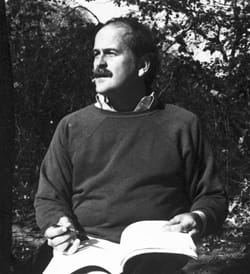
One sleepy Monday morning in the late 1970s, an English teacher at Roxbury Latin named Joseph Kerner stared out at a sea of listless, clueless faces. The previous weekend, R.L. had had an important football game and after-party. One thing was certain: none of his students had done the assigned reading, the opening chapter to John Updike’s Rabbit Run. Mr. Kerner could have berated them, flunked them, or at the very least made some comment about “kids these days.” Instead, he just read the book aloud, pausing from time to time to comment on the artistry of a phrase or a point of grammar.  One of his students in particular, William Landay, was completely captivated by this performance. He was stunned by the realization that literature was a passion for his teacher, not just a mathematical equation to be solved. Not long after, Landay learned that Mr. Kerner even had an unpublished manuscript lying around. Teenage Landay’s first thought was “Imagine that—the hubris of the man!” Novelists were not regular humans, but haloed gods living somewhere in the region of Mount Olympus. Yet years later, even after obtaining a B.A. in American Studies from Yale and a J.D. from Boston College Law School, the incidence of Mr. Kerner’s hubris continued to haunt him.

After completing law school, Landay clerked for the Massachusetts Supreme Judicial Court in Boston then became an assistant D.A. in Middlesex County. While working as a prosecutor, he underwent what he affectionately refers to as a “quarter life crisis” and decided that he needed to try to write a novel. Like his teacher before him, it didn’t even need to be published. He just wanted to see if he could do it. He’d been thinking about the novel Lonesome Dove, a book that he felt was evidence of an author working at the outermost limits of his craft, and how if anything were ever to happen to Larry McMurtry, he’d have this wonderful book to leave behind that no one could ever take away from him. 

So, Landay began to write. And the more he wrote, “the further the goalpost went back.” It was no longer sufficient just to write a novel; now he wanted to write a great novel. He joined the Boston Athenæum and began drafting on the fifth floor. There he met mystery writer and B.A. volunteer Michael Mesrobian (pen name Grant Michaels). “He was a wonderful, sweet guy. I hadn’t published anything then. I had no credentials. He had no reason to believe I would amount to anything. But whenever we took a break from writing, he spoke to me as a fellow writer.”

In 1998, Landay left his D.A. position to work on his writing full time. But three years later, when his wife announced she was pregnant, he started to lose hope. He still hadn’t sold his first novel. He wrote about crime, but his style was a bit more literary and “dense” than what the market seemed to expect from crime writers. Meanwhile, those who read fiction proper tended to avoid the mystery/thriller/crime genres altogether. What made his writing unique was proving to be a definite marketing problem. But one day, while sitting alongside his wife as she underwent an ultrasound, he got the call from his agent that his first novel, Mission Flats, had finally sold. It would win the Dagger Award for best debut crime novel of 2003.

The Strangler, a novel about Boston set in 1963, was published in 2007 and named a Favorite Crime Novel of the Year by the L.A. Times. Landay refers to it as “L.A. Confidential meets The Friends of Eddie Coyle.” The research process for the book was fascinating. John Daley, a retired Boston Police detective, was his most valuable resource. Always a phone call away, Daley could tell Landay which station kept the horses, where a cop in the 1960s would have picked up new uniform trousers, and other amusing historical details, such as how police officers would use white plastic belts for collars because they were easier to clean. Ultimately, The Strangler is a journey through Boston during a time when it was “a much grittier place” and no one was entirely sure whether it would become the sophisticated city it has been deemed today or something altogether more worrisome.

Despite the names of the awards he’s received, Landay has never thought of himself as a crime writer per se. He doesn’t write about murder investigations because they are necessarily interesting. (In fact, he knows from personal experience they can be quite boring). Rather, these stories give him a chance to explore the lives of seemingly ordinary people whose minds, emotions and even physical health are put to the test in ways most people cannot imagine (whether that means the investigators, lawyers, police officers, victims or the criminals themselves). And Landay also admits that he likes a story that moves, unlike the “quiet slice-of-life” tone that seems to be preferred in mainstream fiction.

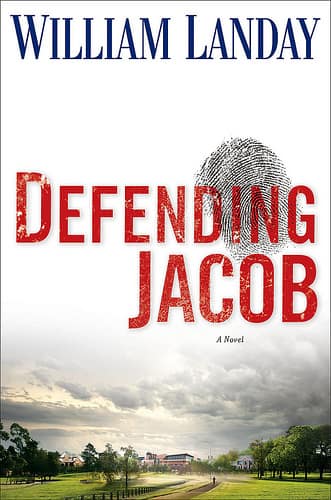
Set in Newton, MA, Landay’s third novel, Defending Jacob (2012), explores the brutal unraveling of a formerly tight-knit community in the wake of a child murder investigation. The most rewarding aspect of the success of this particular novel (winner of the Strand Magazine Critics Award for best novel of 2012) for Landay is that so many different types of readers seem to have enjoyed it: New York Times reviewers, suburban book clubs, high school teachers assigning summer reading, and business people at the airport—to name a few. His favorite comment from readers is “I don’t usually read these types of books, but I loved this.”

When asked about future projects, Landay is quiet, except to say he is working on something that is similar in tone to Defending Jacob but will not be “Defending Jacob, Part II.” And in case the incidence of Mr. Kerner’s hubris is still haunting you at this very moment, you might be partially relieved to learn that at a recent book party for Landay and his old Roxbury Latin pal John Kenney (author of Truth in Advertising, 2013), the two authors were able to meet up with their old English teacher and thank him for a teaching style that inspired them both long ago to become novelists. Their humble teacher had had no idea.

02.12.2014

Staff Book Suggestions Winter 2014

David Dearinger
Aimless Love: New and Selected Poems by Billy Collins
(New Books, Library of Congress PS3553.O47478 A73 2013)

Billy Collins’s poems will be familiar to readers of the New Yorker and the Atlantic. He has been Poet Laureate of the United States twice, an honor that suggests the universal appeal (and accessibility, in the best sense of the word) of his work. This volume features over fifty poems: so you can read one a day, to the end, and, by the time you’re finished, spring will (almost) be here.

Some favorites: “Obituaries,” “Greek and Roman Statuary,” “What She Said,” “To My Favorite 17-Year-Old High School Girl,” “Lincoln,” “Central Park,” “A Word About Transitions,” “The Names,” and “The Trouble with Poetry,” in which Collins tells us that “the trouble with poetry is / that it encourages the writing of more poetry.” In Collins’s case anyway, thank god for that.

Coorain Devin
Gods Like Us: On Movie Stardom and Modern Fame by Ty Burr
(Library of Congress P96.C35 B85 2012)

This look at movie stardom starts with stars of the silent screen and ends with a complex look at today’s celebrity culture. By taking a historical approach, Burr is able to pick out common archetypes that practically every famous face fits into. So maybe this year, resolve to avoid picking up the tabloids and pick up a deeper understanding of what exactly is so appealing about the tabloids.

Jayne Giuduci
Gardening Women: Their Stories from 1600 to the Present by Catherine Horwood
(Library of Congress SB451 .H67 2010)

After the first frost and as soon as winter begins to settle in, I start planning and revamping my gardens for the next year. Gardening women by Catherine Horwood is an inspirational read for the avid gardener.

Gertrude Jekyll and Vita Sackville-West maybe familiar to many as the mavens of gardening women; Horwood enlightens us to a few of the more elusive plants women.  These women sponsored and funded plant hunters, cared for unique tropical plants such as orchids and lilies in their greenhouses and traded seeds they had harvested with the Royal Botanic Gardens at Kew. They also fostered the art of horticulture by breeding specialized varieties of orchids, roses and irises.

Now I just have to wait until the ground thaws to begin anew.

Carolle Morini
Frances and Bernard by Carlene Bauer
(Library of Congress PZ4.B3375 Fr 2012)

Inspired by the lives of Flannery O’Connor and Robert Lowell, this epistolary novel will not only entertain you while staying indoors (hopefully by a fire), but may inspire you to write a few letters and revisit the works by the writers who inspired this novel.

Chloe Morse-Harding
The Painted Girls by Cathy Marie Buchanan
(New Books, Library of Congress PZ4.B9185 Pan 2013)

This is the story of three sisters living in Paris during the late 19th century. Recently, their father passed away and their mother spends more time drinking absinthe than doing anything else. The chapters go back and forth between the two older sisters, Marie and Antoinette. Marie describes her time dancing with the ballet and her relationship with Edgar Degas, while Antoinette’s story details her struggles taking care of her family, her love affair with a dangerous young man, and finally her redemption. An engaging family tale with a bittersweet ending.

Emilia Mountain
Winter’s Bone: A Novel by Daniel Woodrell
(Library of Congress PZ4.W891 Wi 2006)

An Appalachian odyssey of sorts. Our heroine is a sixteen year old girl traipsing through the heavy Ozark snow in a skirt, boots and her late Mamaw’s old coat. It’s a struggle against time and the elements as she searches for her “crank chef” father before the law takes the family home. Some of the most raw, creepy and fascinating characters I’ve ever *met* in a book. I’ve saved the 2010 film for the holiday break.

Humorous Readings from Charles Dickens for the Platform, the Social Circle, and the Fireside edited by Charles R. Neville
(Library of Congress PZ3.D55 Hu)

I would say, “The subtitle says it all,” but that would be robbing you of a sneak peek of some of the most amusing chapter titles in print, including “Mr. Pickwick and the Middle-Aged Lady—A Comical Little Bedroom Farce,” “How Sam Weller Gave Sergeant Buzfuz More Information Than He Wanted,” “The Milliner Proposes to Put Her Expensive Husband on a Fixed Allowance” and “The Cooing of Widow Nickleby’s Mad Lover.” If this book isn’t on the shelf, it is probably because I am reading it, as directed, by the fireside.

Tara Munro
Americanah by Chimamanda Ngozi Adichie
(New Books, Library of Congress PZ4.A225 Am 2013)

Americanah is the story of a young Nigerian woman, Ifemelu, who travels to the United States to pursue an education. While here she starts a blog about race in America from the perspective of a non-American black person with inspiration coming from her experiences in school, her employers, and the people she dates. It’s an interesting, telling, and witty commentary about assumptions and perspectives surrounding an uncomfortable topic, as well as a story of an individual’s journey from being an expatriate to her return home.

Suzanne Terry
We Need New Names by NoViolet Bulawayo
(Library of Congress Classification PZ4.B9335 We 2013)

A fresh debut novel by a young Zimbabwean author, this book was short listed for the Man Booker Prize. Bulawayo tells the story in the voice of ten-year old Darling, who lives in abject poverty in a shanty town in Zimbabwe, where corruption is rampant and children run wild. She is one of the lucky ones with a relative in the USA, however, and in the second half of the book, we follow her struggles as an immigrant trying to better her position in life. Written in short chapters, a totally unflinching look at the life of a forthright and engaging young girl’s coming of age.

The Bookman’s Tale by Charlie Lovett
(New Books, Library of Congress PZ4.L89925 Bo 2013)

This is the story of an American rare book dealer in England. He’s involved in a mystery about documents proving the true identity of the Shakespeare plays. And lots more. Many details involving libraries, rare book rooms, collectors & dealers, provenance, book conservation, conservation labs—and murder! Three separate plot lines spanning different eras all combine to solve the mystery. Perfect for bibliophiles!

Peter Walsh
Bernard Berenson: A Life in the Picture Trade by Rachel Cohen Yale
(New Books, Library of Congress CT275.B467 C63 2013)

Bernard Berenson, the legendary art historian and connoisseur, started out with nothing, went to Harvard, knew everyone, may have shared a mistress with J. Pierpont Morgan, wrote many books, inspired and infuriated people by the dozens, had no real profession or business yet lived better than a millionaire, hid out from the Nazis, taught several generations of leading professors and curators without ever being a professor or curator, reinvented himself multiple times, and, almost impossibly, survived well into his nineties. Born in Lithuania into a poor Jewish family, Berenson came to Boston as a small child and, though he lived almost all his long life in Europe, remained in some deep sense a Bostonian. He helped Mrs. Gardner find the greatest works in her Boston museum and left his Italian villa and library to Harvard as a research center for scholars of Italian Renaissance Art. This, the first Berenson biography in a quarter century, tells all with grace, economy, and deep sympathy for the foibles of its subject.

Mary Warnement
Mr. Selden’s Map of China: Decoding the Secrets of a Vanished Cartographer by Timothy Brook
(Library of Congress GA1121 .B76 2013)

The seventeenth century is one of my least favorite time periods, yet I was eager to read this book about a manuscript map acquired by John Selden, famed constitutional lawyer (perhaps known best to Athenӕum members for his involvement in the Antiquarian Society), and bequeathed to the Bodleian in his large gift of the mid-seventeenth century. I have been reading about China lately. First a mystery set in Peking and revolving around the disappearance of important prehistoric fossils during WWII (Claire Taschdjian’s The Peking Man is Missing, Cutter Classification VEF .T181 .p), then a history about a crime in Peking just before the start of WWII (Paul French’s Midnight in Peking: How the Murder of a Young Englishwoman Haunted the Last Days of Old China, Library of Congress Classification HV6535.C43 F74 2012) which I chose because I wasn’t ready to leave Peking behind. I commonly succumb to this tendency to follow a tread (as in rut), but why should I consider it a temptation rather than focused study? Because I know myself; I’m following my interests down whatever paths of digression they take me and enjoying the coincidences along the way. One such was encountering an author I have mentioned before in my dilettantish look at China; Brook thanks his friend Frances Wood of the British Library for pointing out materials relevant to his study. Brook and Wood both studied in China at a time when that was rare (see her Hand-grenade Practice in Peking: My Part in the Cultural Revolution, Library of Congress Classification DS795.13 .W66 2000), and in fact Brook introduces his book by describing his attempt to leave China with a then-current map in his backpack. Map aficionados as well as those interested in book history, economic history, library studies, and China will enjoy Brook’s ability to tell a story as well as illustrate history’s relevance to current events. Some chapters stray far from the map at the center, but the information provided was necessary. Was it an accident that the chapter on the map’s compass was at the center of the book? If maps are your main interest, you may want to focus on that chapter and the last one which address cartographic questions in most detail.

Alexandra Winzeler
Jonathan Strange & Mr. Norrell by Susanna Clarke
(Library of Congress PZ4.C605 Jo 2004)

This historical fantasy novel follows the rise and fall of English Magicians.  The book opens on a private group of “magicians” in London whose emphasis on academics have left them so far removed from the practice of magic, they could not perform a single spell.  Our two title characters (one cautious and knowledgeable, the other a daring amateur) arrive on the scene and turn the idea of modern magic on its head.  This novel is an artful blend of realistic history and gothic fantasy.  Most notable with this story is the writing style.  Published in 2004, the language reads like a historical account directly from the nineteenth century.

Feeling skeptical?  Bear with this story a little ways and you won’t regret it.  Non-fiction readers: the historic detail of events such as the Napoleonic War and the realistic world of historic London might hold your interest more than you expected, not to mention the authentic-feeling antiquated writing style.  Young Adult and Fantasy readers: have a little patience with the vocabulary and pace of this novel and you will be rewarded with devious faerie princes, pathways to other worlds behind every mirror, and even a brush with the legendary Raven King.  Jonathan Strange & Mr. Norrell is a unique, genre-bending story worth the little trip outside your usual comfort zone. 
09.19.2013

Staff Book Suggestions Autumn 2013

Emily Anderson
The Death of Ivan Ilyich by Leo Tolstoy
(On order)

A nice, short introduction to Tolstoy. And as Autumn approaches, both the author and nature guide us through contemplations of life and death.

Pat Boulos
Beautiful Ruins: A Novel by Jess Walter
(Library of Congress PZ4.W2355 Be 2012)

If you love the ancient charms of the Italian coast on the Ligurian Sea, Edinburgh and its cold rain and distant hot sun, and stories of the dream factory that is Hollywood, you will not put down this book until you are finished reading it.

James Feeney, Jr.
New England Icons: Shaker Villages, Saltboxes, Stone Walls and Steeples
by Bruce Irving
(New Books, Library of Congress F5 .I78 2011)

Entertaining and precise descriptions, accompanied by fine photos.

Jayne Giuduci
Excellent Women by Barbara Pym
(Library of Congress PZ3.P9936 Ex)

Mildred Lathbury is an excellent woman; a clergyman’s daughter, single, and supportive of her local parish church, doer of good works and organizer of jumble sales. Hers is a very ordered life, until some new neighbors move into the village. They unsettle Mildred’s world and her expectations. This is a wonderfully “British” novel where “nothing much happens” but it will amuse you and make you smile. At least a few references to autumn too.

Andrew Hahn
Wittgenstein’s Poker: The Story of a Ten-Minute Argument Between Two Great Philosophers
(Library of Congress B3376.W564 E35 2001)

Philosophical battles are often waged in words, however during a brief meeting of Ludwig Wittgenstein and Karl Popper, a poker, used perhaps for rhetorical flourish, suggested the possibility of words erupting into the realm of the physical, at least that is the provocative  hook that David Edmonds and John Eidinow use to present the legacies and thought of the two philosophers in Wittgenstein’s Poker.

Andria Lauria
Wool by Hugh Howey
(On order)

In a dystopian world, humanity takes refuge in an underground silo where the dream of a world beyond the silo is punished by death. Be prepared for surprises and chills. The implications of this fictional world are spine-tingling and characters do not always end up as anticipated. Wool is the first omnibus in a three part saga (Wool, Shift, Dust). And, it’s probably worth noting, Ridley Scott bought the rights to Wool a few months back, so it’s possibly a soon-to-be film. I will probably hate the film, though, because I have no clue how he could capture the entirety of this book, but then again, “Alien” and “Bladerunner” are two of my favorite films, so if anyone is going to make it happen, it’s Mr. Scott.

Kristy Lockhart
Call the Midwife: A Memoir of Birth, Joy and Hard Times by Jennifer Worth
(Library of Congress CT788.W777 A3 2012)

Watching the first season of the television series based upon this memoir made me very curious about the actual events. This is the first of three books based upon the life of Jennifer Worth who, as a very young woman from an upper middle class family, began her career as a midwife in London’s East End, providing care to women living in some of the worst conditions of the 1950s. Despite some of the rather horrifying circumstances under which women were giving birth at the time, Worth’s memoir is told with such nostalgia for that post-war era that even the most disturbing aspects of poverty are softened by the joy with which Worth remembers her colleagues and patients. If you are as big a fan of the PBS series as I am, then make sure to read this book before season two airs this fall.

Carolle R. Morini
Leaving the Atocha Station by Ben Lerner
(Library of Congress PZ4.L615 Le 2011)

Both comic and tragic, this novel is about a young American poet, Adam Gordan, who is on a fellowship in Madrid. His days are filled with his “research”: hash, wine, medication and the most overwhelming research project: himself. Once you accept Gordon’s neurotic ways, the prose swiftly takes you along his inner dialogues, his relationships with friends, lovers and family, and his relationship with the uncertainty of his future and his writing.

Chloe Morse-Harding
After You’d Gone by Maggie O’Farrell
Library of Congress PZ4.O313 Af 2002)

Alice Raikes takes a train from London to Scotland to visit her family, but when she gets there she witnesses something so shocking that she insists on returning to London immediately. A few hours later, Alice is lying in a coma after an accident that may or may not have been a suicide attempt. Alice’s family gathers at her bedside and as they wait, argue, and remember, long-buried tensions emerge. The more they talk, the more they seem to conceal. Alice, meanwhile, slides between varying levels of consciousness, recalling her past and a love affair that recently ended. A riveting story that skips through time and interweaves multiple points of view, After You’d Goneis a novel of stunning psychological depth and marks the debut of a major literary talent.” (Goodreads.com)

Emilia Mountain
Roots: The Definitive Compendium with More than 225 Recipes by Diane Morgan
Library of Congress + TX801 .M677 2012)
Plenty: Vibrant Vegetable Recipes from London’s Ottolenghi by Yotam Ottolenghi
Library of Congress + TX801 .O88 2011)
Vegetable Literacy: Cooking and Gardening with Twelve Families from the Edible Plant Kingdom by Deborah Madison
New Books, Library of Congress + TX801 .M235 2013)

I have the great “honor” of shelving books in Lower Pilgrim, which can actually be a harrowing task when I am hungry—for that is where the cookbooks live.  The above three glossy titles will give you countless ideas on how to prepare seemingly boring plants in the most savory and colorful ways, making you the envy of this season’s harvest-themed parties.

Peter Walsh
The Unwinding: An Inner History of the New America by George Packer
(New Books, Library of Congress E839 .P28 2013)

Just selected for the National Book Award’s “long list.” From the Washington Post: “Packer’s dark rendering of the state of the nation feels pained but true. He offers no false hopes, no Hollywood endings, but he finds power in . . . the dignity and heart of a people.”

Mary Warnement
Swamplandia! by Karen Russell
New Books, Library of Congress Classification PZ4.R9635 Sw 2011)

I should have seen what was coming on pages 327-330 but I didn’t. This sad book made me laugh out loud several times. This eloquent author made me underline many a well-turned or novel phrase. I’d hesitated to read it because I suspected it could belong to our age’s freak-show genre, but it wasn’t. I empathized with the characters. Kiwi’s awkward intellectualism touched me; okay, I really empathized with the poor guy who knew all the big words without knowing how to pronounce them because he’d only encountered them in books. The main character Ava called to mind Harper Lee’s Scout and Muriel Barbery’s Renee in The Elegance of the Hedgehog. (I admit, I had to look up that character’s name. Her thoughts are memorable but her name hasn’t entered the canon. My canon.) I’m glad I read Swamplandia! and recommend it. Russell is an admirable writer, but I’m not sure I’ll read any of her other books any time soon. I’ll need to let the sadness pass.

Alexandra Winzeler
When You Are Engulfed in Flames by David Sedaris
(Library of Congress PS3569.E314 W48 2008)

Summer’s over and it’s back to work, and don’t even mention the holidays with the family on an ever-approaching horizon. Sounds like it’s time for some David Sedaris.  Like all of his autobiographical works, When You Are Engulfed in Flames contains insightful, quirky, hilarious stories about life’s problems and the people involved.  Sedaris will have you laughing out loud at the anxiety of plane travel or the stress of quitting smoking. These short stories can be read at random, or back to back like a novel. The perfect balance of realism and wit, a great book for closing the summer and preparing for the bustle of autumn.

08.24.2013

James Marshall

September 2013

By Kristy Lockhart

“I would much rather have a friend like you than all the gardens in the world.”-Martha, George and Martha Encore

Celebrated picture book illustrator and author James “Jim” Marshall was born in San Antonio, Texas in 1942. The son of an insurance salesman, George Marshall, and Cecille Harrison Marshall, he doodled a great deal in his early years, but discouraged from the pastime early in his schooling, he focused his energy instead on his prodigious musical talent, studying the viola and violin and eventually earning a coveted scholarship to attend the New England Conservatory in Boston. Unfortunately, he had only been attending the school for a year when a serious injury to his hand put an end to his musical career before it had even begun. Undaunted, Marshall decided to study French and History at Trinity College and then Southern Connecticut State College, where he earned a Master’s degree, before returning to Boston to teach at Cathedral High School in the South End.

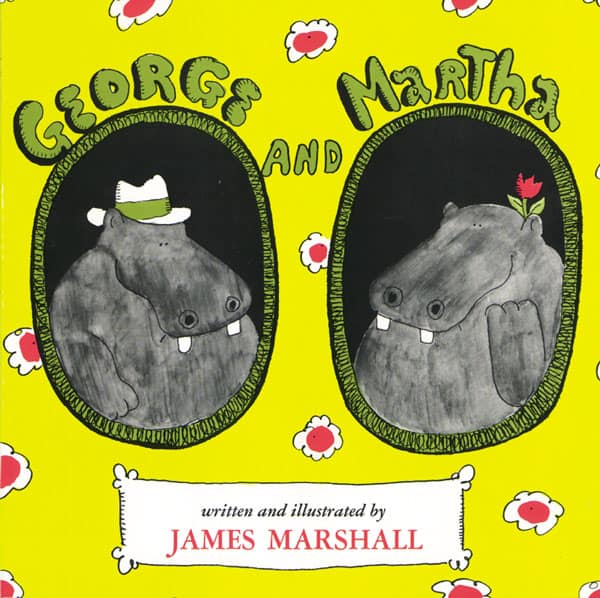
During this stint as a teacher, Marshall began to draw seriously again. In 1971 a friend convinced him to take some of his sketches to Houghton Mifflin, and a few short weeks later an editor there asked him to illustrate Plink, Plink, Plink by Byrd Baylor (1971). Though the book was not a success, Houghton Mifflin was impressed with Marshall and a year later he published his own first book, George and Martha (1971), which heralded the arrival of what would become Marshall’s most endearing characters: a pair of best friends, who happen to be hippos, named (with Marshall’s usual tongue-in-cheek humor) for the embattled main characters in Edward Albee’s Who’s Afraid of Virginia Woolf.  The book immediately made a splash in the world of children’s books and was listed as a New York Times Best Illustrated Book of the Year and an American Library Association Notable Book for 1972.

Marshall, James. George and Martha. Boston: Houghton Mifflin, 1972.

Marshall’s deceptively simplistic style and knack for the ridiculous earned him a loyal following of young readers during a career that spanned more than twenty years and produced more than 75 works. He won few awards while he was alive, however, an oversight that his close friend, Maurice Sendak, explained as the result of his complete lack of commercialism: “No shticking, no nudging knowingly, no winking or pandering to the grown-ups at the expense of the kids. He paid the price of being maddeningly underestimated.”

Marshall was not only a talented artist but also an avid patron of the arts in every form. His close friend and publisher Regina Hayes wrote of him: “He loved to have beautiful things around him: a perfect Oriental rug, a handsome silver tea set, Japanese chests in mellow wood.” Understandably, Marshall had a deep appreciation for institutions like the Athenæum, which he joined in the final year of his life.

Sadly, the greatest recognition for Marshall’s work came only after his death on October 13, 1992, at the age of 50, after a very long illness. His loss was felt deeply by his long-time readers. Friends and colleagues wrote tribute after tribute describing his unforgettable spirit, his charm, his perfectionism: “Discussing his work doesn’t show what Jim Marshall meant to the people who knew him and cared about him. He combined the intelligence and wicked wit of a Dorothy Parker with the charm and generosity of a true Southern gentleman. He was endearing, loyal and much beloved. We will not see his like again.”

Marshall was posthumously awarded the Laura Ingalls Wilder Medal by the American Library Association in 2007 for his lasting contributions to literature for children.

Selected Works:

George and Martha (1972), Library of Congress: PZ7.M35672 Gem

What’s the matter with Carruthers? (1972), Library of Congress: + PZ10.3.M3535 Wh

George and Martha encore (1973), Library of Congress: PZ7.M35672 Geo

George and Martha rise and shine (1976), Library of Congress:  PZ7.M35672 Ge

Portly McSwine (1979), Library of Congress: PZ7.M35672 Po

Taking care of Carruthers (1981), Library of Congress: PZ7.M35672 Tak

George and Martha back in town (1984), Library of Congress:  PZ7.M35672 Gc 1984

George and Martha round and round (1988), Library of Congress:  PZ7.M35672 Gee

Hansel and Gretel (1990), Library of Congress:  + PZ8.M4327 Han 1990

Fox outfoxed (1992), Library of Congress: PZ7.M35672 Fs 1992

Fox on stage (1993), Library of Congress: PZ7.M35672 Fq 1993

Swine Lake (1999), illustrated by Maurice Sendak, Library of Congress: PZ7.M35672 Sw 1999

References:

Di Capua, Michael, et al., “James Marshall remembered.” Publishers Weekly 239, no. 53 (1992): 30.

Hayes, Regina. “James Marshall.” The Horn Book Magazine 83, no. 4 (2007): 355.

Keenan, Hugh T. “James Marshall.” In Dictionary of Literary Biography, Volume 61: American Writers for Children Since 1960: Poets, Illustrators and Nonfiction Authors, edited by Glenn E. Estes, 189-199. Detroit: Gale Research Company, 1987.

Sendak, Maurice, “James Marshall, wicked angel.” New York Times, November 16, 1997. http://www.nytimes.com/books/97/11/16/bookend/bookend.html

Silvey, Anita. “Marshall, James.” In Children’s Books and Their Creators, edited by Anita Silvey, 435-436. Boston: Houghton Mifflin Company, 1995.

07.23.2013

Daphne Kalotay

August 2013

By Emilia Poppe Mountain

Daphne Kalotay was born in Long Branch, New Jersey to Canadian parents, Andrew Kalotay, a financial statistician, and Jill Kalotay, a dancer with a degree in teaching. When Daphne was three, her mother obtained a position teaching modern dance at Drew University, and the family moved to Madison. (Kalotay would go on to study dance though graduate school, with that art form continuing to permeate her writing later in life). She remembers a childhood full of books and poems—many written by Canadian authors, such as The Olden Days Coat and A Bird in the House by Margaret Laurence, Garbage Delight and Alligator Pie by Dennis Lee, and new editions of the Canadian Children’s Annual every Christmas. And despite the fact that it was located in a basement cluttered with piping, the library of her primary school was an enchanting place, presided over by the (seemingly ironically named) librarian, Mrs. Brightly. Kalotay loved to imagine that somewhere upon the highest shelf there might be a magical book that never ended. In the meantime, one could devour Encyclopedia Brown and Bobsy Twins novels and read and re-read Harriet the Spy, which introduced Kalotay to the novel concept that writing one’s observations down in a notebook might actually be considered a legitimate use of time.

Surprisingly, Kalotay is the first to admit that she was not the ideal student. English essays were something to finish in gym class. In her first days of high school, she was harshly graded by an English teacher who told her a parenthetical statement she had written was “too long” for parentheses—yet this supposed grammatical crime was something she’d seen in countless books considered classics. With her confidence in the system shaken, she turned to her friend (and now published author) Kirsten Menger-Anderson as a literary ally. To entertain each other on their walks home from school, they invented dramatic stories, which—like the magic novel sought in the elementary school library—seemed to have no end. They became so enamored with the activity that they even split the cost of a publishing guidebook. While it may have taken them fifteen years or so to make good on this investment, they are both in many ways back to their teen antics.

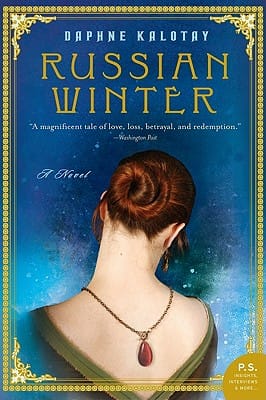
Kalotay, Daphne. Russian Winter: A Novel. New York: Harper, 2010.

In 1988, Kalotay enrolled at Vassar College and became a psychology major. It was not until her final semester there that she took a creative writing class as an elective with Beverly Coyle. Everything changed. A lifetime of notebooks full of thoughts and stories were now seen as a professional resource. Coyle gave Kalotay a brochure for the New York State Summer Writers Institute in Saratoga Springs, where Kalotay attended courses with Amy Hempel and Marilyn Robinson and then spent the next year preparing to apply to graduate programs, finally settling upon Boston University’s M.F.A. in Creative Writing. But Kalotay did not stop there. A year of graduate reading only served to teach her that she still had much more to read, so she applied for a PhD program at BU and under Saul Bellow completed a dissertation on Mavis Gallant. And in her own words, a PhD program was a great opportunity “to read books for free”—a seemingly paradoxical comment coming from the woman who as a girl wrote her English essays in gym class—but a comment that might give hope to all of the budding authors out there who have ever been discouraged by an uninspiring teacher.

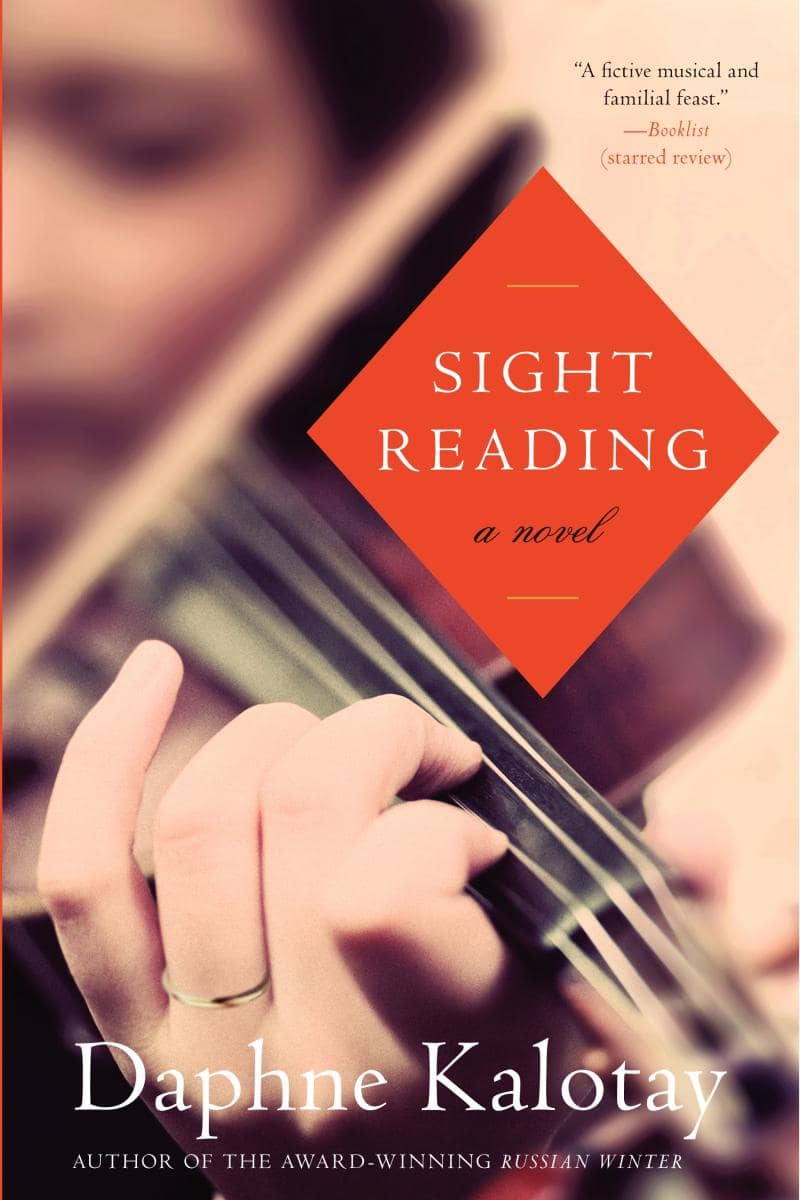
Calamity and Other Stories was published in 2005. They are tales of ordinary life in America and contain an awareness of both the absurdity and humor than can be found in the midst of tragedy, whether great or small—both of which Kalotay feels are conveyed by the word “calamity.” Soon after, she began work on Russian Winter (2010), which tells the story of a former Bolshoi ballerina’s life under Stalin and in her adopted city of Boston. Kalotay’s most recent work, Sight Reading (2013), follows the relationships of a group of musicians in Boston between 1987 and 2007, as an exploration of creativity and intuition, as well as the many varieties of love and friendship. Kalotay is currently working on a new novel set primarily in New York in the early 1990s.

Apart from writing novels on the fifth floor of the Boston Athenæum, Kalotay has been busy for several years now teaching creative writing part-time at Boston University and Grub Street. She is currently co-president of the Boston chapter of the Women’s National Book Association (which was founded in 1917 but now includes men in its ranks), whose mission she describes (much as the gold plaques on the first floor describe the mission of the BA to its members) as supporting women “in the community of the book,” whether as authors, editors, publishers, marketers, librarians or readers through events, internships, book clubs, charity work, annual teas and many other opportunities.

Kalotay, Daphne. Sight Reading: A Novel. New York: Harper, 2013.

Kalotay joined the Boston Athenæum in 2005 when she began her research for Russian Winter. Here she was able to find Russian points of view on Stalinism as well as the observations of American and European travelers, for whom the goings-on behind the Iron Curtain were new and strange and excellent fodder for descriptive memoirs. A favorite was Postmarked Moscow by Lydia Kirk, a very opinionated, but observant, wife of an American ambassador to Russia.  The Reference Department and interlibrary loan sersvice were also able to help find obscure books on Russian gold marks and other material culture resources. Kalotay has remained a fifth floor reader and writer, as she likes the high ceilings and striking artwork and seeing familiar faces, because “writing can be quite the solitary profession.”  Russian Winter even includes a scene at the Athenæum. When asked by her editor why so many of the men in the scene were wearing bow ties, Kalotay explained that she would simply have to see the place for herself.

06.28.2013

Elizabeth Palmer Peabody

July 2013 

By Chloe Morse-Harding

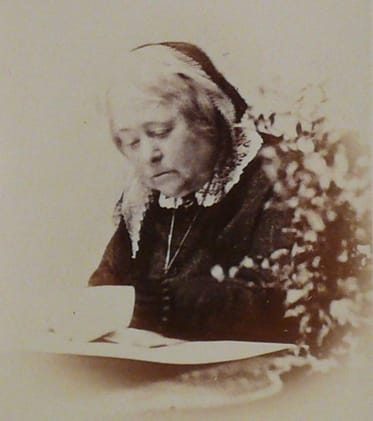
Elizabeth Palmer Peabody (1804-1894), “the grandmother of Boston”, was born to parents Elizabeth (“Eliza”) Palmer Peabody and Nathaniel Peabody, the eldest of seven children.  Elizabeth’s parents met in Atkinson, New Hampshire in 1798 when Eliza was sent to work at a boarding house after her father died.  Nathaniel Peabody was working there as a teacher while he was studying at Dartmouth.  They fell in love and married in November of 1802.

The young couple moved to Andover, Massachusetts and both taught at the North Andover Free School; two years later, they moved to Billerica and Elizabeth was born that May.  In 1806, the family moved to Cambridge so Nathaniel could attend medical lectures at Harvard, having decided to become a dentist.  The couple’s second child, Mary was also born in 1806.  Another two years later, the family picked up again and settled down in Salem, Massachusetts where Eliza began her own school and Nathaniel practiced dentistry.  The following year, in 1809, Sophia was born.  Over the next ten years, the Peabody’s had three sons (Nathaniel, George, and Wellington) and another daughter, Catharine, who died in infancy.

Elizabeth was educated at her mother’s school, and Eliza “appeared to be a rock of strength and stability, a model for her daughter of both strength of character and maternal, self-sacrificial spirit.”  Indeed, in 1821, the family moved to Lancaster and Elizabeth set up her own school, the Lancaster Boarding School; her sisters, Mary and Sophia, were some of her first students.  In 1822, Elizabeth moved to Boston, and befriended Ralph Waldo Emerson, from whom she took Greek lessons. 

After a few years working in Boston, Elizabeth moved to Maine and spent the following two years as a tutor and governess.  In 1825, Elizabeth moved back to Boston and started a successful all-girls school in Brookline with her sister Mary.  Elizabeth later ran into some trouble when the parents of some of her students heard of her seemingly radical style of teaching in regards to religion, and in 1826, she eventually moved her school to Boston where she felt she would have more support.  The school was very well received at first, but “eventually failed largely due to a mishandling of finances by a third party” and a massive loss of students due to what Elizabeth referred to as “the New Bedford Affair” when she got wrapped up in what the rest of Massachusetts called “The Great Rotch Scandal” regarding the indiscretions made by Francis Rotch of New Bedford and his mistress.  In 1833, the school closed, and the Peabody sisters took their lives and careers in very different directions.

In 1834, Elizabeth went back to teaching and helped Bronson Alcott start the Temple School in Boston.  She recorded Alcott’s dialogues with his students and the first edition of Record of a School was published in 1835.  In the two following years, both volumes of Alcott’s Conversations with Children on the Gospels were published.  Although she respected Alcott’s goals for the Temple School, they did not see eye to eye.  Elizabeth “began to doubt his method…she worried that Alcott manipulated his students’ discussions, rather than allowing genuine expression.”  In fact, Elizabeth did not want Alcott to publish his second book in its original format.  She was worried about a “possibly hostile public opinion toward Temple School with Alcott’s probing and revealing of his young students’ feelings.  There were certain insights and intimations in a child’s inner life that were better left unexplored and unexpressed.”  Alcott ignored her fears, and Elizabeth left the school and moved back home to Salem.  Elizabeth ended up being right, and “the controversy that followed the publication of Conversations nevertheless tarnished [her] reputation as well as Alcott’s and effectively prevented her from gathering a full and profitable school of her own for some time.”  

When Elizabeth left her position at Temple School, she decided to enter the book business, and in 1842, she opened her Boston book shop at 13 West Street.  The shop blossomed, as “Elizabeth believed that a book shop ought to not merely sell books but should function more widely as a meeting place for authors and readers to congregate, discuss, and purchase books.”  Elizabeth encouraged discussion and many famous minds congregated there, such as Margaret Fuller, Dr. William Ellery Channing, Ralph Waldo Emerson, and Reverend James Freeman Clarke.  Soon after opening her store, Elizabeth decided to add a circulating library (known as The Foreign Library) that consisted of “classic and living literature,” as well as foreign books and periodicals.  It was also during this time that Elizabeth helped to publish the famous Transcendentalist journal The Dial.  The book store was also the site of two very special family weddings: Sophia Peabody to American author Nathaniel Hawthorne and Mary Peabody to education reformer Horace Mann. 

In 1849, Elizabeth gave a set of books on Polish and French history to the Boston Athenæum, “partly to keep them intact and partly in gratitude for reading privileges there.”  When her mother died in 1853, and Elizabeth and her father moved to New Jersey, and “the Foreign Library collection was packed up and shipped there.”  In 1855, when her father died, Elizabeth once again packed up her library and moved back to New England. 

Back in New England, Elizabeth met the Schurz family who “had operated a German-speaking kindergarten in Wisconsin in 1856, following the methods of German Educational reformer Friedrich Froebel.”  Elizabeth studied Froebel’s methods and established the first English-speaking Kindergarten in 1860 in Boston on Pinckney Street.  Based on Froebel’s theories, Elizabeth believed that a “kindergarten pupil should be encouraged to grow organically, both physically, through play, and spiritually, through music and art.”  Elizabeth had at last found her true calling, and spent the rest of her life promoting the Kindergarten in the United States.

Elizabeth died in January of 1894 and was buried amongst some of New England’s other great minds at the Sleepy Hollow Cemetery in Concord, Massachusetts.

Selected Works:

Lectures in the training schools for kindergartners (Cutter- DK .P31)

Last evening with Allston, and other papers (Cutter- VE3 .P313 .l)

Record of a school: exemplifying the general principles of spiritual culture (Rare, LC- LB695.A3 P42 1836)

To fathers and mothers: letter from Miss Peabody (Rare, Cutter- Bro. 10 .188)

Universal history tables (Cutter- :7 .6P31)

References:

Elbert, M.M., Hall, J.E., & Rodier, K. (2006).  Reinventing the Peabody Sisters.  Iowa City: University of Iowa Press.

“Elizabeth Palmer Peabody: an outline biography.”  Retrieved from http://www.age-of-the-sage.org/transcendentalism/elizabeth_palmer_peabody.html

Marshall, Meghan.  (2005).  The Peabody Sisters.  Boston, MA: Houghton Mifflin Company.

Peabody, E.P. (1984).  Letters of Elizabeth Palmer Peabody: American Renaissance woman.  Ronda, B.A. (Ed.).  Middletown, CT: Wesleyan University Press.

“The Peabody Sisters.”  Retrieved from http://www25.uua.org/uuhs/duub/articles/peabodysisters.html

Ronda, B.A. (1999).  Elizabeth Palmer Peabody: a Reformer on her own terms.  Cambridge, MA: Harvard University Press.