05.30.2014

Charlotte Silver

June 2014

By Emilia Poppe Mountain

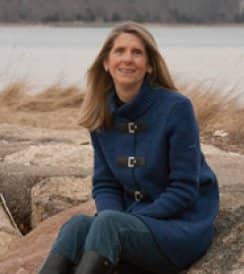
Charlotte Silver grew up in Cambridge, Massachusetts, before attending Bennington College. She studied writing at The Bread Loaf Writers’ Conference and has been published in The New York Times. Her books are: Charlotte au Chocolat: Memories of a Restaurant Girlhood (Riverhead, 2012) and The Summer Invitation (Roaring Brook Press, Spring 2014).

Q: When did you first decide to write your memoir? 

A: I wrote the very first draft of what later became CharlotteauChocolat right after Upstairs at the Pudding closed, when I was twenty. I wanted to find a way of remembering the details of this wonderful world, and in particular the beautiful, beautiful building at 10 Holyoke Street in which I was lucky enough to spend so much of my childhood. I wanted to take readers there. The book was intended to be a kind of a valentine not just to a different era in Cambridge and Boston local history, but to the vanishing art of fine dining — so many of the restaurants like the Pudding are no more, and my book is a chance to revisit them: the fresh flower arrangements, the decadent sauces and desserts, the big (not “small!”) plates, the glamour and the abundance.

Q: Your memoir often has the flair of an old Hollywood movie. Certainly, the hostesses and waiters all seemed to be after careers in show business. If Charlotte au Chocalat were to be a film, whom would you cast (living or dead, at any age) to play your eccentric array of characters?

A: Great question! Well just to start, I definitely think Lana Turner in her “Imitation of Life” phase could play my mother. She had such fantastic cocktail coats in that. Oh no, I guess that means that I would be played by Sandra Dee? I asked my mother’s business partner Mary Catherine Deibel who would play her and she said Tina Fey! And for Veronica, the woman who worked in the coatroom and used to be an Avedon model, I would say one of the great old worldly European actresses — Jeanne Moreau, maybe? Incidentally, Veronica was the basis for the “Aunt Theodora” character in my new book, The Summer Invitation, so the two books have this connection.

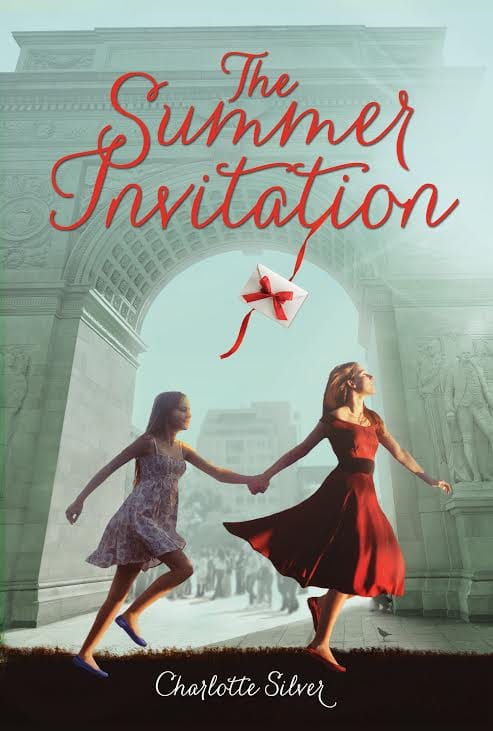
Q: Your memoir is heartbreaking in many instances—not only because you give us the intimate details of one mom and pop business after another being replaced by huge retail chains.   It’s also heartbreaking when you tell us that these days you and your friends mainly eat things like lightly dressed beet salads. Can we hope that you’ll continue to share more memories of butter soaked, sugar crystallized, booze drizzled recipes with us?Dust jacket: Silver, Charlotte. The Summer Invitation. New York: Roaring Book Press, 2014.

A: Oh, definitely! I still like rich food. Rest assured that my second book, The Summer Invitation, has a lot of good food and fancy meals in it too. The girls in it are always being taken to nice restaurants. 

Q: What was the inspiration for your forthcoming young adult novel, The Summer Invitation? 

A: I got the beginnings of the idea for The Summer Invitation when I really was “chaperoning” two delightful sixteen-year-old girls in Greenwich Village one August a number of years ago now. From that experience emerged a book, about two sisters who come to New York for the summer and have various romantic adventures under the tutelage of their chaperone, named Clover, and their mysterious Aunt Theodora. It was such a fun book to write and I’d love to write something for girls again! 

Q: When did you join the Boston Athenæum? 

A: I first became a member of The Boston Athenæum in 2008 when I was still living in Boston, and was delighted to be able to rejoin recently when I was home for a couple of months last fall. I did all of my revisions for my novel, Bennington Girls Are Easy, in the Fifth Floor Reading Room. What a gracious place to work. Reading from Charlotte au Chocolat in the first floor long room was also a 2012 was a fantastic experience. 

Charlotte is now living and writing in New York City. Bennington Girls Are Easy is scheduled for publication by Doubleday in 2015. 

04.28.2014

Maturin Murray Ballou

By Alexandra Winzeler

May 2014

In her memoir, Echoes of the Past, Athenæum staff member Mary Jane Regan names Maturin Murray Ballou as a “daily visitor” to the Athenæum, using his time at the library to write his popular travel books.  Many of these books are still in the circulating collection today; you can check out a few from the list below.  However, Ballou played an even bigger role in Boston history beyond enjoying the Athenæum: he was a founder of The Boston Globe newspaper. 

Maturin Murray Ballou was born on April 14th, 1820 in Boston.  He worked in journalism since he was a teenager, his father Reverend Hosea Ballou founding the Protestant publication known as the Universalist Review which ran from 1844 to 1891.  In 1839 while working as a clerk in the Boston post office, M.M. Ballou married Mary Anne Roberts and the two of them travelled widely at home and abroad in the next two decades. 

For some time, Ballou served as the editor of the Gleason’s Pictorial Drawing-Room Companion a “copiously illustrated family miscellany,” popular and singular for the amount of pictures per text in every issue.  After several successful years, Gleason traveled Europe and found he was tired of the publishing business.  He sold the periodical to his editor, Ballou, in 1854 who promptly changed the title to Ballou’s Pictorial.  Though competing illustrated newspapers rose in New York, Ballou’s Pictorial still led in the topics of travel and natural history. 

By the start of 1855, Ballou was additionally publishing his own paper, Ballou’s Dollar Monthly Magazine, to great success, eventually discontinuing Gleason’s in 1859.  Ballou’s periodical changed its name in 1866 to simply Ballou’s Monthly Magazine when the price was raised to $1.50.  He went on producing the monthly magazine for more than 30 years, eventually selling it to Thomes and Talbot in 1886. 

In 1871 it is easy to see why Ballou’s opinion had such sway over advertiser Stephen Niles, when talk of creating a new Boston newspaper began: “at 51 Ballou was a man of letters and a man of affairs who had published several books of travel and history, a monthly magazine, and the first substantial illustrated weekly.”  Ballou inspired Niles, telling him there was a place for a “superior newspaper” in Boston.  By the close of Niles’ initial meetings regarding a new publication, the group had gained funding and the vessel of the Boston Globe had set sail, with Maturin Murray Ballou at the helm as editor. 

The first issue was published March 4th, 1872, initially called, Maturin Ballou’s Globe, and it was 8 page, 7 columns, all for the price of 4 cents.  Back in the 1850s, while working at Gleason’s Pictorial, Ballou had been in favor of strongly moral content, printing a series of essays on the clergymen of Boston, for example.  Likewise he had strong thoughts on the direction for The Globe and announced this to the public in its first issue, writing that the publication would be “devoted to the intelligent and dignified discussion of political and social ethics and current events at home and abroad” and literature and the arts should be given “ample and judicious attention from experienced individuals.”

While leading the publication, Ballou certainly staffed The Globe with “experienced individuals,” including Percy Whipple, a talented literary lecturer, Benjamin Edward Woolf, a composer of plays and opera, Charles E. Pascoe as foreign editor, and Benjamin F. Burnham as their legal specialist.  Ballou also hired a woman, which was rare for the day, Georgia Hamlen of Charleston, who at first worked various chores, and eventually took over writing literary reviews for Percy Whipple.

A financial depression at the time made the newspaper world a hard one, administrators waging a constant battle of adjusting pricing and hoping for additional subscriptions.  Due to the tough times and waning public interest, Ballou left The Globe in June of 1873.  The newspaper endured, however, and continued to work towards Ballou’s grand goal of making The Globe “second to none in the country.”

After his work in journalism, Ballou kept up his passion for world travel, circumnavigating the globe at his own path and pace.  His travels continued to inspire his voluminous writing on countless foreign countries.  He passed away in 1895 while abroad in Egypt with his wife.  Despite the frequent excursions that took him away from the city he helped shape, Ballou was ultimately buried in Boston. 

Selected Works:

Bibliography:

  • Lyons, Louis M.  Newspaper Story: One Hundred Years of the Boston Globe.  Cambridge, MA: Belknap Press of Harvard University Press.  1971. 
  • Marquis Who’s Who Incorporated.  Who Was Who in America: Historical Volume 1607-1896.  Chicago: Marquis Publications.  1963. 
  • “Maturin Murray Ballou.”  Wikipedia.  Updated April 3, 2014.  URL
  • Mott, Frank Luther.  A History of American Magazines 1850-1865.  Cambridge, MA: Harvard University Press.  1938.  Vol II.
  • Pierce, Sally.  “Gleason’s Pictorial: Elevating and Celebrating American Life.”  The Ephemera Journal. Vol. 5. 1992. pp.13-24.
  • Regan, Mary Jane.  Echoes from the Past: Reminiscences of the Boston Athenæum.  Boston Athenæum: 1927. 
04.24.2014

Sarah Orne Jewett

March 2014

By Kristy Lockhart

“Find your quiet center of life and write from that to the world.” – Sarah Orne Jewett

Sarah Orne Jewett was born in 1849, in South Berwick Maine, the small village that would be her artistic inspiration and her “true home” for the entirety of her life. Her father was a physician and would often take his young daughter along with him on visits to the homes of local farmers and fisherman. These early outings likely inspired Jewett’s profound love of the people of Maine and their way of life. She attended the Berwick Academy through 1865, though frequent illnesses kept her home and tutored by her father. Jewett would later say that she considered herself to be primarily self-educated through excessive reading, and this became a lifelong trend: she remained an enthusiastic consumer of the written word and a supporter of many of her artistic contemporaries, even as she found success with her own writing. Jewett published her first story, “Jenny Garrow’s Lovers” in 1868, when she was only nineteen years old. For that work and her other early stories she used the pen name “Alice Eliot” or “A. C. Eliot”. A decade later those stories and others would be published as Deephaven (1877), a collection depicting a fictional New England town modeled on South Berwick. She wrote three novels: A Country Doctor (1884), A Marsh Island (1885), and The Tory Lover (1901), as well as several books for children. Her greatest strength lay in her collections of short stories and vignettes, particularly The Country of Pointed Firs (1896), by far her most well-known work. As with much of her work, it focused on a fictional town in Maine. In her works, Jewett returned to the recurring theme of the changing landscape of those towns, where shipyards and wharves were closing, and where young people, particularly men, were beginning to leave the old villages.  She had a precise way of writing and a compact style that many of her contemporaries admired. In her obituary, the Boston Globe remarked on the strength that lay in “the detail of her work, in fine touches, in simplicity.” Despite spending most of her time in Maine, Jewett was a valued member of Boston’s flourishing literary circle and often stayed part of each year in the city. She was always welcome in the home of her dear friend Annie Fields, who lived in the heart of Beacon Hill. Authors like Oliver Wendall Holmes, Rudyard Kipling, Henry James, Harriet Beecher Stowe, Alfred Tennyson, Mark Twain, and Henry Wadsworth Longfellow were also guests at Mrs. Fields’ beautiful home at 148 Charles Street. It was another friendship, with Mrs. Cabot of Beacon Hill, which would connect Jewett to the Boston Athenæum. The two became close friends at the end of Mrs. Cabot’s life and Sarah often kept her company after the older woman became bed-ridden. Upon her death, Mrs. Cabot willed Sarah her membership to the Athenæum, an appropriate choice given their shared love of literature. Jewett’s lasting legacy also includes her influence on another “great” American author. In 1907, she first met Willa Cather, whom she befriended and mentored in a relationship with a deep and lasting impact. At the time, Cather was working as a journalist in New York City, something Jewett discouraged because she believed Cather needed to dedicate herself entirely to her work. When asked for an opinion on a piece of writing, Jewett responded at length, passing on advice gleaned from her own career: “You must write the human heart, the great consciousness that all humanity goes to make up. Otherwise what might be strength in a writer is only crudeness, and what might be insight is only observation; sentiment falls to sentimentality—you can write about life, but never write life itself.” She encouraged Cather to write what she knew, to write the life and experiences that had shaped her own world. In turn, Cather dedicated O Pioneers!, based upon memories of her childhood in Nebraska, to Jewett. In 1902 Jewett suffered an accident that damaged her spine and head. These injuries left her in poor health for the rest of her life, and sadly put an end to her writing. She retained her positive outlook and continued to spend time with her friends in Boston. In 1909, she passed away at her beloved house in Berwick, of which she had said years earlier: “I was born here and I hope to die here, leaving the lilac bushes still green and growing and all the chairs in their places.” 

Selected Works:

  • Deephaven (1877), Library of Congress: PZ3.J55 De
  • Country by-ways (1881), Library of Congress: PZ3.J55 Cou
  • Marsh Island (1885), Library of Congress: PZ3.J55 Ls
  • Betty Leicester; a story for girls (1890), Library of Congress: PZ7.J556 Be 
  • Strangers and Wayfarers , Library of Congress: PZ3.J55 St 
  • Tales of New England <(1894), Library of Congress: PZ3.J55 Ta 
  • The Country of the Pointed Firs (1896), Library of Congress: PZ3.J55 Co
  • The Tory Lover(1901), Library of Congress: PZ3.J55 To
  • Old Friends and New (1907), Library of Congress: PZ3.J55 O1

Bibliography:

  • Cohen, Rachel. A Chance Meeting: Intertwined Lives of American Writers and Artists, 1854-1967. New York: Random House, 2004.
  • “Death Claims Famed Writer.” Boston Daily Globe (1872-1922) June 25 1909.
  • Fields, Annie, ed. Letters of Sarah Orne Jewett. Boston: Houghton Mifflin Company, 1911.
  • “Jewett, Sarah Orne.” Encyclopædia Americana: International Edition. 2000. Print.
  • Silverthorne, Elizabeth. Sarah Orne Jewett: A Writer’s Life. Woodstock: Overlook Press, 1993.
04.02.2014

Sara Hoagland Hunter

By Emilia Poppe Mountain

April 2014

Children’s author Sara Hunter was born in Dover, MA, to John (“Jack”) and Sara (“Sally”) Ray Hoagland. She describes her young self as the “bossy” tomboy older sister who both devised and led the neighborhood children in all manner of shenanigans, typically inspired by the books she consumed by the dozens. Hunter remembers Dover as one of those old fashioned towns where the children weren’t allowed inside before dinner—so entertainment was key. Sure, there was always ice skating and other games, but with Hunter as ring leader, there were also plays and tests of bravery. There were even investigative adventures based upon Nancy Drew novels. One day, she and the local children broke into an unsuspecting neighbor’s shed, carried away by the plot of The Bungalow Mystery. The grown-ups were not nearly as amused as the children.

Hunter credits her first grade teacher, Mrs. Quinlan, with her dramatic introduction to the magic of books. Through her teacher’s recommendations, Hunter became enthralled with the power of a book to transport her into a completely different world.  A children’s biography series introduced her to Thomas Edison. She then convinced her parents to purchase her a chemistry set, and inspired by his biography, dutifully tore all of the labels off the chemical jars and replaced them with images of skulls and crossbones.  She had moments of reckoning with her book characters though. Running away from home with her favorite belongings attached to a stick and a thermos of stolen coffee to emulate Tom Sawyer and Huck Finn, turned out to be neither as fun, nor as delicious, as Mark Twain made it seem.

The Lighthouse Santa

Hunter enrolled at Dartmouth College in 1972—the first year of coeducation. Soon after graduation, she began working at Christian Science Monitor, first in Boston, then in New York. A few years later, she returned to Dover to teach high school English and reading skills. Thus, she was able to experience the peculiar pleasure of calling her former teachers by their first names and assigning homework to her friends’ younger siblings. She recalls that some of her most rewarding work during that time was teaching public speaking. During these sessions, she saw many students shine who didn’t normally excel at academics; these were students who were outgoing and funny among their friends but had difficulty consuming and analyzing texts. This observation prompted her to enroll in Harvard’s graduate program for reading and reading disabilities, where she studied with Dr. Jeanne Chall.

In the years following graduation, she married Andy Hunter, adopted two children, directed a documentary about the adoption process, and began teaching part time in childhood enrichment programs. When her children entered grade school, she began working in earnest on three different children’s books.  Her first book was part of an Easy-to-Read series, featuring “Sesame Street” characters. Her young daughter was a great help, telling her when a word was too hard for the book. Hunter remembers being incredibly nervous while pitching the story across the enormous conference table at Jim Henson headquarters in Manhattan. In order to stay calm, she made sure to stare at the life size portrait of Kermit dressed as Gainsborough’s “The Blue Boy” almost the entire time. During her children’s elementary school years, she was also writing scripts, parodies and other story books for Warner Bros., Looney Tunes, and Nickelodeon.

Every Turtle Counts by Sara Hoagland Hunter

Hearkening back to her early fascination with books like Ursula Nordstrom’s The Secret Language and Clifford B. Hicks’ Alvin’s Secret Code, Hunter decided to write a story acknowledging the little known Navajo code talkers of World War II. The Unbreakable Code (illustrated by Julia Miner) was published in 1996 and won many awards, including the Smithsonian magazine Notable Children’s Book of the Year. To this day, she is still visiting elementary schools to discuss this book and experiment with code games. Her next picture book, The Lighthouse Santa, was based on the real life Edward Rowe Snow. Also known as “The Flying Santa,” Snow was a magical presence in the lives of lighthouse families who looked forward to his present-dropping flights for over forty years. Hunter read from this book at the Boston Athenæum in 2011. Her forthcoming Every Turtle Counts, illustrated by Susan Spellman, tells the story of the rare species of turtle that washes ashore each year on the shores of Cape Cod and the dedicated residents who undertake the task of rescuing them. The main character is based on Hunter’s niece, a great animal lover who happens to be autistic.

When asked what authors she might turn to for inspiration, Hunter praises Horton Foote’s ability to capture a small town, E.B. White “for clarity, tenderness and speaking to the heart,” and Louisa May Alcott for the tales of family to which she aspires. (As a child, she remembers being enchanted with Alcott’s writing desk with a view to Walden Pond and is pleased to report that she’s been able to position her current writing desk with a similar orientation). She also admires Ralph Waldo Emerson for ideas, Kate DiCamillo and Sherman Alexie for contemporary children’s fiction, and Keven Henkes for picture books. She enjoys Henry Beston and Sarah Orne Jewett for their descriptions of nature.  She recently read and loved John Kennedy Toole’s A Confederacy of Dunces and is re-reading an old favorite, Watership Down by Richard Adams.

Hunter enjoys reading, writing, and sharing her work at the Boston Athenæum because of the “inspiring aura of rich history, all around.” She is scheduled to visit and share her thoughts on Every Turtle Counts in the autumn of 2014.

Selected Works:

The Unbreakable Code. Illustrated by Julia Miner. Flagstaff, AZ: Northland Pub., c1996. (On order)
The Lighthouse Santa.Illustrated by Julia Miner. Boston: Flying Dog Stories, c2011. (Children Picture Book + HUNTE)
Every Turtle Counts. Illustrated by Susan Spellman. Portsmouth, NH: Peter E. Randall Pub., 2014. (On order)

02.24.2014

Therese Sellers

February 2014

By Emilia Poppe Mountain

Therese Sellers is the author of Alpha is for Anthropos, a collection of Greek nursery rhymes she composed over seventeen years teaching Ancient Greek to children. Her sister, Lucy Bell Jarka-Sellers, is the book’s illustrator. Born in Philadelphia to Peter and Lucy Bell Sellers, Sellers describes herself as “Greek by affection, if not by birth.” She’s unsure whether this affinity is due to the layover her parents made in Athens while on their way to a two-year stay in Kenya she was only six months old, the time her father, a mathematician, spent teaching her Greek letters on index cards, or to the entire year her fourth grade class spent studying Ancient Greece. Nevertheless, her passion for Athena’s homeland has never waned.

As a freshman at Germantown Friends School, she was the youngest student in the newly instituted Ancient Greek course. By the time she enrolled at Harvard at age 17, she already had four years of Greek and immediately enrolled in upper level courses. While she was excited and inspired by Greek literature, she never felt completely at home in the world of academia and has spent her career finding different ways to take Ancient Greek out a purely academic setting. She did this in her undergraduate years with an outdoor production of Euripides’ Bacchae performed in the Harvard football stadium with all the choral odes in the original Greek.

Teaching Greek to children was another departure from upper-level classical studies and was the inspiration for Alpha is for Anthropos, which invites readers, young and old, to engage with the book of various levels of character formation, art and design, mythology and song. Sellers attributes this endeavor to a strange request made by a college friend almost two decades ago: to teach her four-year-old son Ancient Greek. True, she had surrounded herself with Greek culture ever since she was cast as Antigone at age nine, even moving to Greece for three years in her twenties and building a house there. But to teach a small child Ancient Greek? The task still seemed Herculean. During their first meetings, the boy wouldn’t remember anything they’d covered from one week to the next and Sellers began to wonder if it was all a waste of time. But suddenly, she decided to change her teaching style entirely. Instead of working with paper, they took walks. When they came upon an oak tree, she gave him the word for oak and told him a related story about Zeus. They started singing the alphabet and phrases to the tune of familiar songs and nursery rhymes. They drew in the dirt. They chalked the sidewalks. And then an amazing thing started to happen: this young boy was learning Ancient Greek, and quickly. Families in her neighborhood got wind of the fun, and she soon was teaching Greek to whole groups of preschoolers. When she offered to bring her Greek curriculum to Glen Urquhart School in Beverly, they also hired her to run their Latin program. 

After seven years in the classroom, Sellers decided to leave teaching to become a full-time writer. Alpha is for Anthropos is her first book. On the horizon is a biography of Eva Palmer-Sikelianos (1874-1952) whom Sellers researched while living in Greece as a young woman. She’s also revising a novel that began as a NaNoWriMo challenge during her last year of teaching, and in the publishing process for a novel she translated as a part of her PhD, Aioliki Yi by Ilias Venezis. When her family realized that there was no way she could get any writing done at their busy city apartment, they gave her a Boston Athenæum membership, enabling her to do her writing in the quiet fifth floor reading room which she describes as “heaven” in comparison. Here, she can work amid books, statues and architectural details that bring her right back to Greece. Once in awhile, she’ll even depart from the classics to review the work of long ago Boston Athenæum member, Sarah Orne Jewett, or to write and tweet haiku at @qerese. In January 2014, Sellers presented Alpha is for Anthropos at the Boston Athenæum to a diverse group of parents, children, and Classics enthusiasts from around the world. After thanking Athena for presiding over them, she shared her book, the myth of Arachne and Athena, the riddle of the Sphinx, slices of Greek New Year’s Day cake, and most importantly, her belief that teaching is done most effectively “with joy and beauty.” 

02.24.2014

Louisa May Alcott

January 2014

By Chloe Morse-Harding

“Her place is in the forefront among those saintlike women who saw a stern duty lying very near them, and courageously assumed it to their own honorable profit and renown”. – The New York Times, October 14, 1889

Louisa May Alcott (1832-1888) was born in Germantown, Pennsylvania to parents Amos Bronson Alcott and Abigail May.  Abby, called “Marmee” by her four future daughters, grew up in Boston, well-read and well-educated.  While visiting her brother, Reverend Samuel May, in Brooklyn, Abby met Bronson in 1827.  Bronson had been teaching in Connecticut, but lost his position and May invited Bronson to come and visit him.  May, who was “an educational reformer himself…arranged a position for him at the Charity Infant School in Boston.”  When Abby found out about Bronson’s new position in Boston, she applied to be his assistant.  But, they were to be joined in an entirely different way: when “the penniless Alcott refused to hire her as his deputy, she proposed marriage instead.”  They were married in Boston, at Kings Chapel in 1830, and so began their tumultuous life together.

In 1831, Bronson was offered a new teaching job and the couple moved to Germantown.  Their first child, Anna was born in 1831, and Louisa came next in 1832.  In 1834, the Alcott family moved back to Boston, and founded the School for Human Culture (also known as the Temple School) with the help of Elizabeth Palmer Peabody.  The Alcott’s third daughter was born in 1835, and named Elizabeth in Peabody’s honor.  In 1840, after the controversies of the closing of the Temple School, the Alcotts resettled in Concord, where their fourth daughter Abigail May was born.  Louisa, who had been educated at the Temple School, continued her education with her father at home, which was supplemented by the teachings of local family friends Henry David Thoreau and Ralph Waldo Emerson.

When Louisa was 11, in 1843, the Alcotts, with the help of Charles Lane and Samuel May, purchased and moved in to their famous farm, Fruitlands, in nearby Harvard.  After a disastrous few years, Abby’s inheritance came through and the family moved back to Concord and purchased their new home, Hillside, where Louisa began to practice her writing skills.  In 1849, Louisa wrote her first novel, The Inheritance, which was to remain hidden amongst her papers at Harvard University’s Houghton Library until two professors stumbled upon the 150-page manuscript in 1996.  Previously, scholars had believed Louisa’s first novel was Moods, published in 1864.  The Alcotts remained at Hillside, until Abby sold the property to Nathaniel Hawthorne in 1852.  In 1853, they moved to another Concord home, Orchard House; the Alcotts lived at Orchard House until 1877.  It was at Orchard House where, in 1868, Louisa wrote her classic family tale, Little Women, based on life at Hillside.

Like her mother, Louisa was a staunch abolitionist and supporter of women’s rights, and she “demanded both the abolition of slavery and political recognition of woman’s rights”.  When America’s Civil War broke out on 1861, Louisa, at the age of 30, was determined to be part of the war effort.  In 1862, Louisa came to Washington, D.C. to work in the Union Hotel Hospital; although married women were usually recruited to be nurses, some strings were pulled for Louisa.  Her “friends and family connections were as influential politically as they were in writing and publishing, and they helped her join the nursing service.”  The letters Louisa wrote home and the journal she kept became the basis for Hospital Sketches, later published in 1863, the same year Louisa contracted typhoid and was discharged from service.  She eventually recovered, but the mercury-based medication she took for the fever caused “lifelong debilitation; she thereafter had painful joints, swollen limbs, and headaches that would not be soothed.”  It was during the years during and after the war that Louisa’s writing was at its prime, from her well-known young adult novels to her lesser-known thrillers.        

During the 1860’s, Louisa led a “double literary life [which] was a well-kept secret for almost a century”, renting out a room in Boston to write “thrillers whose themes include sexual power struggles, narcotics addiction, murder, revenge, and feminist triumph” under the pen name A.M. Barnard.  Alcott’s thrillers were published by Frank Leslie in his weeklies and monthlies (Frank Leslie’s Illustrated NewspaperFrank Leslie’s Chimney Corner, and Frank Leslie’s Lady’s Magazine).  In the same decade, Louisa also published stories in The Atlantic MonthlyFlag of Our UnionPutnam’s Magazine and the children’s serial, Merry’s Museum.  At the end of the decade, in 1869, Louisa was granted access to the Boston Athenæum by her uncle, Reverend Samuel May, and so became what we call “a Reader.”

Although we know her as an author, Louisa worked as a maid, a seamstress, a teacher (which she apparently had an affinity for, but did not enjoy), and a governess.  Louisa “appointed herself Alcott breadwinner, and to this end tried every means then available of making money” to support her family, and “[i]t was usually, even in late years, the need of money that impelled her to write”.  She also had dreams of becoming an actress, and although she never acted professionally (save for “as an amateur in performances for the benefit of the Sanitary Commision”), she remained “a constant theatre-goer all the later years of her life.” 

Just two days after Bronson died in March of 1888, Louisa died from a cold that developed into spinal meningitis.  She was buried in the family plot in the famed Concord, MA cemetery, Sleepy Hollow.  In an article published in the New York Times on March 7, 1888, the author notes “[t]he most widely-known and most popular of American female authors will be sincerely mourned by thousands of children, and thousands of children of larger growth, wherever the English language is spoken, and by all who in other languages have read translations of her writings”.

Selected Works:

Behind a mask : the unknown thrillers of Louisa May Alcott (Library of Congress, PZ3.A355 Be)

Hospital sketches, and Camp and fireside stories (Library of Congress, PZ3.A355 Ho 1888)

Jo’s boys and how they turned out : a sequel to “Little Men” (Library of Congress, PZ3.A355 Jo)

Little women : or, Meg, Jo, Beth, and Amy (Library of Congress, PZ3.A355 Lit)

Little women : an annotated edition (Library of Congress, PZ3.A355 Lit 2013 **Currently in the New Book Shelves)

Moods : a novel (Library of Congress, PZ3.A355 Moo)

Rose family : a fairy tale (Cutter, VEK .Al1 )

Silver pitchers : and Independence, a centennial love song (Library of Congress, PZ3.A355 Si 1899)

Under the lilacs (Library of Congress, PZ7.A335 Un 1878 )

Work : a story of experience (Library of Congress, PZ3.A355 Wo)

References:

(1888, March 7).  Louisa May Alcott.  The New York Times, pp.4.

(1888, March 7).   Louisa M. Alcott Dead: The authoress dies on the day of her father’s funeral.  The New York Times, pp. 5.

(1889, October 14).  New Publications: Miss Alcott’s Stern Life Battle.  The New York Times, pp. 3.

Alcott, L.M. (1993).  From Jo March’s Attic: Stories of Intrigue and Suspense.  M.B. Stern & D. Shealy (Eds.).  Boston, MA: Northeastern University Press.

“Bronson and Abigail Alcott”.  Retrieved from  http://www25.uua.org/uuhs/duub/articles/bronsonalcott.html

Elbert, A. (Ed.).  (1997).  Louisa May Alcott on Race, Sex, and Slavery.  Boston, MA: Northeastern University Press.

“Learn about the Alcott’s and Orchard House”.  Retrieved from http://www.louisamayalcott.org/alcottorchard.html

“Today in History: November 29”.  Retrieved from http://memory.loc.gov/ammem/today/nov29.html

“Uncovered at Harvard: Alcott’s First Novel”.   Retrieved from http://www.nytimes.com/1996/05/01/books/uncovered-at-harvard-alcott-s-first-novel.html?pagewanted=print&src=pm

Wineapple, Brenda (2012).  “Where Credit Is Due ‘Marmee & Louisa’ and ‘My Heart Is Boundless’”.  Retrieved from  http://www.nytimes.com/2012/12/23/books/review/marmee-louisa-and-my-heart-is-boundless.html?_r=0
02.24.2014

Ann Wadsworth

December 2013

By Emilia Poppe Mountain

Ann Wadsworth was born in St. Louis and began writing stories and plays at an early age. She remembers with some amusement a “little magazine” she created about age eleven for family and neighborhood children “filled with my own highly emotional prose and a couple of awful poems.” More than any technical skill, Wadsworth believes it was the imagination and creative delight of her family circumstances that pointed her in the direction of her writing career. Her mother was an avid reader and passed her love of books on to her daughters. Her father instilled in her his love of opera and classical music, an affinity that continues to this day. One of her sisters is a textile artist, the other a librarian. Her household was always full of high drama and the dinner table lively with conversation.

Ann entered Berea College, majoring in English, and during her junior year was elected to Twenty Writers, a select group of students with literary talent. After completing her BA she entered graduate school at the Catholic University in Washington, DC, majoring again in English with a concentration in Renaissance literature. Upon receiving her MA a professor there recommended her for a position at the Folger Shakespeare Library, where she spent the next six years working with 16th– and 17th-century rare books. During this period the Folger sponsored her attendance at the Italian University for Foreigners in Perugia, Italy, where she studied Italian language and literature and fell in love with the country.

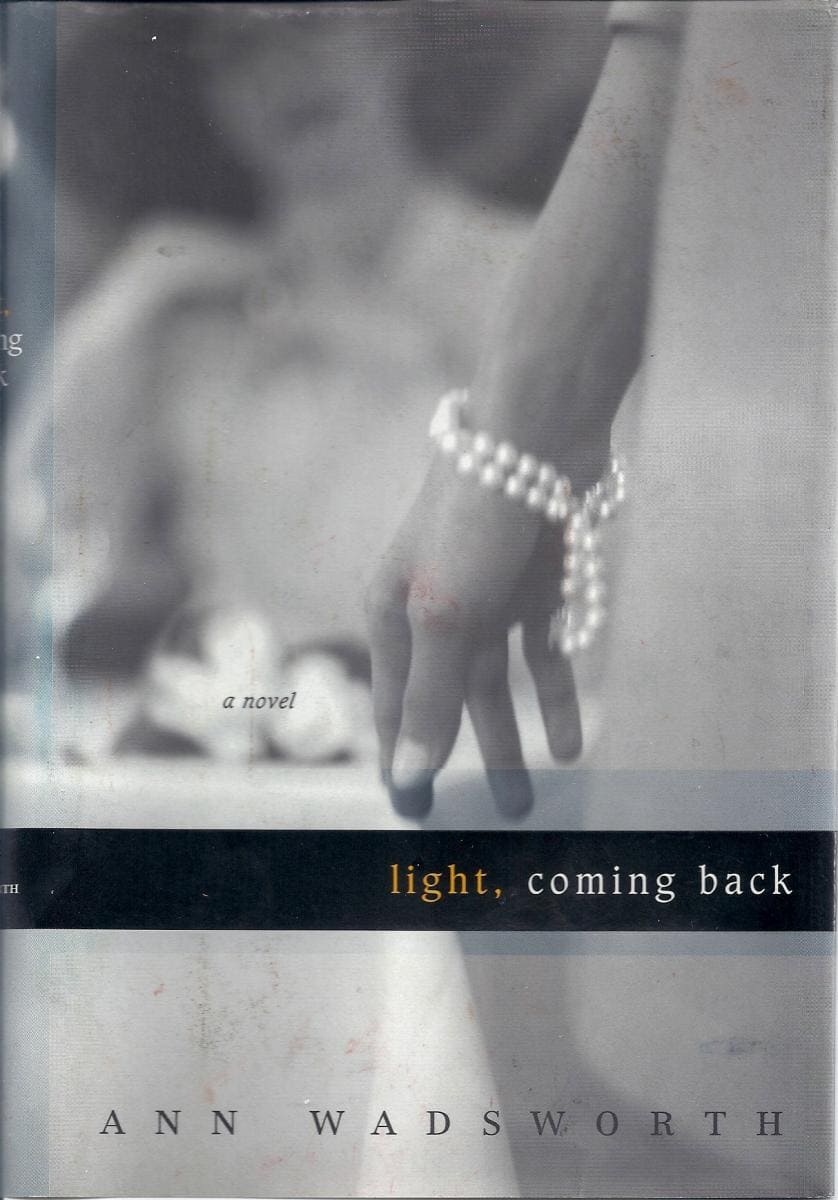
Ann joined the staff of the Boston Athenæum in 1972. During her 30 plus years here she held a variety of positions, and in 1990 became the Editor of Publications, a position she held until her retirement in 2010. Throughout her years at the Athenæum she continued to write fiction, publishing several short stories and completing two novels (presently languishing in a drawer). A fellowship at the MacDowell Colony and a Wellspring Grant from the Athenæum some years later allowed her to move forward with her third novel, Light, Coming Back, which was published by Alyson Press in 2001 and afterwards translated into German and French. It was short-listed for the Lambda Literary Award, the Stephen Crane First Fiction Award, and the Ferro-Grumley Prize. Set in Boston, Light, Coming Back introduces Mercedes Medina and her much older dying husband Patrick. When Mercedes meets Lennie at a Cambridge flower shop, emotions surface that she has ignored for many years, and she begins to entertain thoughts of how, at the age of sixty, she might finally find her own life. Wadsworth says that in this story she wanted to explore how these three unlikely characters might attempt to deal with their awkward, painful, but also exciting and inspiring circumstances. “I like to take characters, throw them into a pot, and see what happens.”

Book Cover: Wadsworth, Ann. Light, Coming Back: A Novel. Los Angeles, CA: Alyson Publications, 2001.Wadsworth says her own work is usually character driven, and the characters, once created, lead her along the path her writing must follow. She looks for similar qualities in the books she reads and has a number of favorites that she picks up whenever she can’t sleep or is “stuck in a rut” with her writing. She admires Joan Didion’s ability to “cut right to the bone of things.” Lawrence Durrell’s Alexandria Quartet is a series she manages to re-read once a year. She feels his genius lies in writing about spirit of place and how strangers’ lives can become unexpectedly interwoven. Richard Ford “always tells a good story.” Of Ann Patchett and James Salter she says, “I am always impressed by people who can write easily and well. These two writers always bring me something new and hold me with the breadth of their imagination and use of words.” Salter, especially, writes “with grace and wit,” and she loves Patchett’s use of music and the way her characters often find themselves in situations that run against their own perceptions of themselves. In the case of Patchett’s State of Wonder, Wadsworth was intrigued by “the creepiest collection of snakes and crawlies I’ve ever encountered.” She also loves Joseph Conrad for his writings about the sea, and Henry James for his writings on Italy, her favorite place on Earth.

Her agent is presently “shopping” her most recent novel, Ferragosto, set in Italy during a hot August summer holiday season.

02.24.2014

Barbara Cooney

November 2013

By Alexandra Winzeler

Barbara Cooney brought us the lively and lovely images in such children’s book classics as Miss Rumphius (The Lupine Lady) and Hattie and the Wild Waves.  While her favorite places were the beautiful wilds of Maine, Cooney has lived, traveled, and illustrated a great variety of places and stories. 

Cooney was born in Brooklyn, New York on August 6, 1917, to stockbroker father, Russell Schenck Cooney and amateur painter mother, Mae Evelyn Bosser.  She had three brothers, two younger and another who was her twin.  The nature of her father’s work kept the family near the bustle of the city, though Cooney preferred the Maine countryside near her Grandmother’s residence.  To keep herself entertained, young Cooney played with her mother’s oil paints and watercolors.  As long as Cooney cleaned the paint brushes, her mother left her to explore and create, a freedom the yet-to-be illustrator appreciated. 

Cooney was sent to boarding school as a child and later went on to Smith College as a young adult.  She graduated from Smith in 1938 with a degree in art history. Eager to put this accomplishment to use, Cooney decided to transform her portfolio into a new career: children’s illustrator.  She improved her artistic skills by taking printmaking classes at the Art Students League in New York City, and she began showing her work to publishers in the area. 

Her plans were disrupted by World War II, and in 1942 she enrolled in the Women’s Army Corps, eventually reaching the rank of second lieutenant.  She left the Corps upon her marriage to Guy Murchie Jr. and becoming pregnant with her first child.  The couple divorced in 1947, and Cooney devoted herself full-time to her work as an illustrator as a means to support her family, now of two children.  Two years later, Cooney remarried, this time to physician Charles Talbot Porter, and the growing family moved to Pepperell, Massachusetts. 

For many years, Cooney was known for her scratchboard, limited-color art style.  While this approach had an affinity with folk-tale-based books and with Cooney’s print-making skills, it was not a decision made wholly by choice.  The black-and-white, or three-color limit was partly imposed to reduce the printing expenses of the publishers and partly self-inflicted as Cooney worked to develop her lacking technical skills in different mediums.  As can been seen in the sheer volume of her work as an illustrator, Cooney eventually became a master in the high-contrast, scratchboard style that brought her initial fame.  She continued to experiment in art mediums, later branching out to make magnificent works in colored pencils and watercolor. 

By 1949, Cooney was illustrating numerous books per year, and ten years later, after being involved in over a dozen published projects, her illustrated adaptation of Chaucer’s “Nun’s Priest Tale,” Chanticleer and the Fox, won her the Caldecott Medal.  She was thirty-two years old. 

Over the next several decades, Cooney continued to illustrate and write children’s books. She traveled and researched in order to grasp the details of foreign folklore, unfamiliar landscapes, and indigenous art styles of the culture and story at hand.  These locations sometimes included far-away destinations such as France, Spain, Switzerland, Ireland, England, St. Lucia, and Haiti.  But some projects kept her closer to home, studying and sketching in New England.  Her pursuit of historical research brought her to the Boston Athenæum.  Her illustrations for a story set in Maine, The Ox-Cart Man, won Cooney won her second Caldecott Medal in 1979. 

Enjoying great success and achievement late in life, Cooney worked steadily on new books up until her death in 2000 at the age of eighty three at her dream house in Maine.  Cooney has sometimes been described as a “librarians’ illustrator,” choosing understated but rich stories to illustrate.  She even gave a nod to librarians everywhere by bestowing that profession on the title character Miss Rumphius (the Lupine Lady).  Her stories are for lovers of New England landscapes, playful characters, and the subtle and beautiful of everyday life.     

Selected Works:

Bedard, Michael and Cooney, Barbara (illustrator).  Emily.
Children’s Library PZ7.B381798 Em 1992

Cooney, Barbara.  Eleanor.
Children’s Library + CT275.R666 C66 1996

Cooney, Barbara.  Hattie and the Wild Waves: a Story from Brooklyn.
Children Picture Book COONE

Cooney, Barbara.  Island Boy.
Children Picture Book COONE

Cooney, Barbara. Miss Rumphius.
Children Picture Book COONE

Donald Hall and Barbara Cooney (illustrator). Ox-cart man.
Children Picture Book HALL

References:

Bader, Barbara. Barbara Cooney.  The Horn Book, Inc. 2011.  Accessed October 2013.
http://archive.hbook.com/magazine/articles/2000/sep00_bader.asp>

Barbara Cooney: About Barbara Cooney.  Penguin Group USA, LLC.  2013.  Accessed October
2013.  http://www.us.penguingroup.com/nf/Author/AuthorPage/0,,1000002642,00.html>

Ortakales, Denise.  Barbara Cooney.  Women Children’s Book Illustrators.  8/24/2002.
Accessed October 2013 http://www.ortakales.com/illustrators/cooney.html>

Otis, Rebecca.  Barbara Cooney.  Carol Hurst’s Children’s Literature Site.  2012.  Accessed
October 2013.  http://www.carolhurst.com/authors/bcooney.html>

Peters, Jefferson.  “Depicting Emily Dickinson: Michael Bedard and Barbara Cooney’s Emily.”
Fukuoka University Review of Literature and Humanities 38 (Dec. 2006): 789-817.
Accessed online October 2013. http://www.adm.fukuoka-u.ac.jp/fu844/home2/Ronso/Jinbun/L38-3/L3803_0789.pdf>

02.24.2014

William Landay

October 2013

By Emilia Poppe Mountain

One sleepy Monday morning in the late 1970s, an English teacher at Roxbury Latin named Joseph Kerner stared out at a sea of listless, clueless faces. The previous weekend, R.L. had had an important football game and after-party. One thing was certain: none of his students had done the assigned reading, the opening chapter to John Updike’s Rabbit Run. Mr. Kerner could have berated them, flunked them, or at the very least made some comment about “kids these days.” Instead, he just read the book aloud, pausing from time to time to comment on the artistry of a phrase or a point of grammar.  One of his students in particular, William Landay, was completely captivated by this performance. He was stunned by the realization that literature was a passion for his teacher, not just a mathematical equation to be solved. Not long after, Landay learned that Mr. Kerner even had an unpublished manuscript lying around. Teenage Landay’s first thought was “Imagine that—the hubris of the man!” Novelists were not regular humans, but haloed gods living somewhere in the region of Mount Olympus. Yet years later, even after obtaining a B.A. in American Studies from Yale and a J.D. from Boston College Law School, the incidence of Mr. Kerner’s hubris continued to haunt him.

After completing law school, Landay clerked for the Massachusetts Supreme Judicial Court in Boston then became an assistant D.A. in Middlesex County. While working as a prosecutor, he underwent what he affectionately refers to as a “quarter life crisis” and decided that he needed to try to write a novel. Like his teacher before him, it didn’t even need to be published. He just wanted to see if he could do it. He’d been thinking about the novel Lonesome Dove, a book that he felt was evidence of an author working at the outermost limits of his craft, and how if anything were ever to happen to Larry McMurtry, he’d have this wonderful book to leave behind that no one could ever take away from him. 

So, Landay began to write. And the more he wrote, “the further the goalpost went back.” It was no longer sufficient just to write a novel; now he wanted to write a great novel. He joined the Boston Athenæum and began drafting on the fifth floor. There he met mystery writer and B.A. volunteer Michael Mesrobian (pen name Grant Michaels). “He was a wonderful, sweet guy. I hadn’t published anything then. I had no credentials. He had no reason to believe I would amount to anything. But whenever we took a break from writing, he spoke to me as a fellow writer.”

In 1998, Landay left his D.A. position to work on his writing full time. But three years later, when his wife announced she was pregnant, he started to lose hope. He still hadn’t sold his first novel. He wrote about crime, but his style was a bit more literary and “dense” than what the market seemed to expect from crime writers. Meanwhile, those who read fiction proper tended to avoid the mystery/thriller/crime genres altogether. What made his writing unique was proving to be a definite marketing problem. But one day, while sitting alongside his wife as she underwent an ultrasound, he got the call from his agent that his first novel, Mission Flats, had finally sold. It would win the Dagger Award for best debut crime novel of 2003.

The Strangler, a novel about Boston set in 1963, was published in 2007 and named a Favorite Crime Novel of the Year by the L.A. Times. Landay refers to it as “L.A. Confidential meets The Friends of Eddie Coyle.” The research process for the book was fascinating. John Daley, a retired Boston Police detective, was his most valuable resource. Always a phone call away, Daley could tell Landay which station kept the horses, where a cop in the 1960s would have picked up new uniform trousers, and other amusing historical details, such as how police officers would use white plastic belts for collars because they were easier to clean. Ultimately, The Strangler is a journey through Boston during a time when it was “a much grittier place” and no one was entirely sure whether it would become the sophisticated city it has been deemed today or something altogether more worrisome.

Despite the names of the awards he’s received, Landay has never thought of himself as a crime writer per se. He doesn’t write about murder investigations because they are necessarily interesting. (In fact, he knows from personal experience they can be quite boring). Rather, these stories give him a chance to explore the lives of seemingly ordinary people whose minds, emotions and even physical health are put to the test in ways most people cannot imagine (whether that means the investigators, lawyers, police officers, victims or the criminals themselves). And Landay also admits that he likes a story that moves, unlike the “quiet slice-of-life” tone that seems to be preferred in mainstream fiction.

Set in Newton, MA, Landay’s third novel, Defending Jacob (2012), explores the brutal unraveling of a formerly tight-knit community in the wake of a child murder investigation. The most rewarding aspect of the success of this particular novel (winner of the Strand Magazine Critics Award for best novel of 2012) for Landay is that so many different types of readers seem to have enjoyed it: New York Times reviewers, suburban book clubs, high school teachers assigning summer reading, and business people at the airport—to name a few. His favorite comment from readers is “I don’t usually read these types of books, but I loved this.”

When asked about future projects, Landay is quiet, except to say he is working on something that is similar in tone to Defending Jacob but will not be “Defending Jacob, Part II.” And in case the incidence of Mr. Kerner’s hubris is still haunting you at this very moment, you might be partially relieved to learn that at a recent book party for Landay and his old Roxbury Latin pal John Kenney (author of Truth in Advertising, 2013), the two authors were able to meet up with their old English teacher and thank him for a teaching style that inspired them both long ago to become novelists. Their humble teacher had had no idea.

08.24.2013

James Marshall

September 2013

By Kristy Lockhart

“I would much rather have a friend like you than all the gardens in the world.”-Martha, George and Martha Encore

Celebrated picture book illustrator and author James “Jim” Marshall was born in San Antonio, Texas in 1942. The son of an insurance salesman, George Marshall, and Cecille Harrison Marshall, he doodled a great deal in his early years, but discouraged from the pastime early in his schooling, he focused his energy instead on his prodigious musical talent, studying the viola and violin and eventually earning a coveted scholarship to attend the New England Conservatory in Boston. Unfortunately, he had only been attending the school for a year when a serious injury to his hand put an end to his musical career before it had even begun. Undaunted, Marshall decided to study French and History at Trinity College and then Southern Connecticut State College, where he earned a Master’s degree, before returning to Boston to teach at Cathedral High School in the South End.

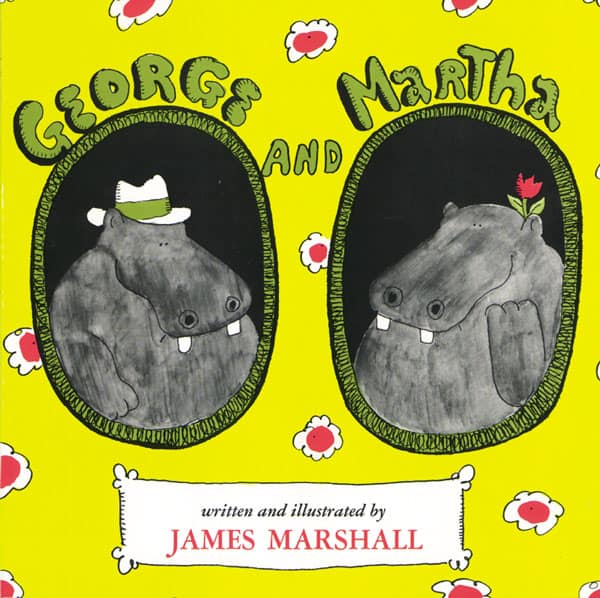
During this stint as a teacher, Marshall began to draw seriously again. In 1971 a friend convinced him to take some of his sketches to Houghton Mifflin, and a few short weeks later an editor there asked him to illustrate Plink, Plink, Plink by Byrd Baylor (1971). Though the book was not a success, Houghton Mifflin was impressed with Marshall and a year later he published his own first book, George and Martha (1971), which heralded the arrival of what would become Marshall’s most endearing characters: a pair of best friends, who happen to be hippos, named (with Marshall’s usual tongue-in-cheek humor) for the embattled main characters in Edward Albee’s Who’s Afraid of Virginia Woolf.  The book immediately made a splash in the world of children’s books and was listed as a New York Times Best Illustrated Book of the Year and an American Library Association Notable Book for 1972.

Marshall, James. George and Martha. Boston: Houghton Mifflin, 1972.

Marshall’s deceptively simplistic style and knack for the ridiculous earned him a loyal following of young readers during a career that spanned more than twenty years and produced more than 75 works. He won few awards while he was alive, however, an oversight that his close friend, Maurice Sendak, explained as the result of his complete lack of commercialism: “No shticking, no nudging knowingly, no winking or pandering to the grown-ups at the expense of the kids. He paid the price of being maddeningly underestimated.”

Marshall was not only a talented artist but also an avid patron of the arts in every form. His close friend and publisher Regina Hayes wrote of him: “He loved to have beautiful things around him: a perfect Oriental rug, a handsome silver tea set, Japanese chests in mellow wood.” Understandably, Marshall had a deep appreciation for institutions like the Athenæum, which he joined in the final year of his life.

Sadly, the greatest recognition for Marshall’s work came only after his death on October 13, 1992, at the age of 50, after a very long illness. His loss was felt deeply by his long-time readers. Friends and colleagues wrote tribute after tribute describing his unforgettable spirit, his charm, his perfectionism: “Discussing his work doesn’t show what Jim Marshall meant to the people who knew him and cared about him. He combined the intelligence and wicked wit of a Dorothy Parker with the charm and generosity of a true Southern gentleman. He was endearing, loyal and much beloved. We will not see his like again.”

Marshall was posthumously awarded the Laura Ingalls Wilder Medal by the American Library Association in 2007 for his lasting contributions to literature for children.

Selected Works:

George and Martha (1972), Library of Congress: PZ7.M35672 Gem

What’s the matter with Carruthers? (1972), Library of Congress: + PZ10.3.M3535 Wh

George and Martha encore (1973), Library of Congress: PZ7.M35672 Geo

George and Martha rise and shine (1976), Library of Congress:  PZ7.M35672 Ge

Portly McSwine (1979), Library of Congress: PZ7.M35672 Po

Taking care of Carruthers (1981), Library of Congress: PZ7.M35672 Tak

George and Martha back in town (1984), Library of Congress:  PZ7.M35672 Gc 1984

George and Martha round and round (1988), Library of Congress:  PZ7.M35672 Gee

Hansel and Gretel (1990), Library of Congress:  + PZ8.M4327 Han 1990

Fox outfoxed (1992), Library of Congress: PZ7.M35672 Fs 1992

Fox on stage (1993), Library of Congress: PZ7.M35672 Fq 1993

Swine Lake (1999), illustrated by Maurice Sendak, Library of Congress: PZ7.M35672 Sw 1999

References:

Di Capua, Michael, et al., “James Marshall remembered.” Publishers Weekly 239, no. 53 (1992): 30.

Hayes, Regina. “James Marshall.” The Horn Book Magazine 83, no. 4 (2007): 355.

Keenan, Hugh T. “James Marshall.” In Dictionary of Literary Biography, Volume 61: American Writers for Children Since 1960: Poets, Illustrators and Nonfiction Authors, edited by Glenn E. Estes, 189-199. Detroit: Gale Research Company, 1987.

Sendak, Maurice, “James Marshall, wicked angel.” New York Times, November 16, 1997. http://www.nytimes.com/books/97/11/16/bookend/bookend.html

Silvey, Anita. “Marshall, James.” In Children’s Books and Their Creators, edited by Anita Silvey, 435-436. Boston: Houghton Mifflin Company, 1995.