
07.23.2013

Daphne Kalotay

August 2013

By Emilia Poppe Mountain

Daphne Kalotay was born in Long Branch, New Jersey to Canadian parents, Andrew Kalotay, a financial statistician, and Jill Kalotay, a dancer with a degree in teaching. When Daphne was three, her mother obtained a position teaching modern dance at Drew University, and the family moved to Madison. (Kalotay would go on to study dance though graduate school, with that art form continuing to permeate her writing later in life). She remembers a childhood full of books and poems—many written by Canadian authors, such as The Olden Days Coat and A Bird in the House by Margaret Laurence, Garbage Delight and Alligator Pie by Dennis Lee, and new editions of the Canadian Children’s Annual every Christmas. And despite the fact that it was located in a basement cluttered with piping, the library of her primary school was an enchanting place, presided over by the (seemingly ironically named) librarian, Mrs. Brightly. Kalotay loved to imagine that somewhere upon the highest shelf there might be a magical book that never ended. In the meantime, one could devour Encyclopedia Brown and Bobsy Twins novels and read and re-read Harriet the Spy, which introduced Kalotay to the novel concept that writing one’s observations down in a notebook might actually be considered a legitimate use of time.

Surprisingly, Kalotay is the first to admit that she was not the ideal student. English essays were something to finish in gym class. In her first days of high school, she was harshly graded by an English teacher who told her a parenthetical statement she had written was “too long” for parentheses—yet this supposed grammatical crime was something she’d seen in countless books considered classics. With her confidence in the system shaken, she turned to her friend (and now published author) Kirsten Menger-Anderson as a literary ally. To entertain each other on their walks home from school, they invented dramatic stories, which—like the magic novel sought in the elementary school library—seemed to have no end. They became so enamored with the activity that they even split the cost of a publishing guidebook. While it may have taken them fifteen years or so to make good on this investment, they are both in many ways back to their teen antics.
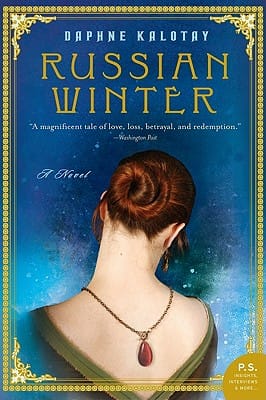
Kalotay, Daphne. Russian Winter: A Novel. New York: Harper, 2010.

In 1988, Kalotay enrolled at Vassar College and became a psychology major. It was not until her final semester there that she took a creative writing class as an elective with Beverly Coyle. Everything changed. A lifetime of notebooks full of thoughts and stories were now seen as a professional resource. Coyle gave Kalotay a brochure for the New York State Summer Writers Institute in Saratoga Springs, where Kalotay attended courses with Amy Hempel and Marilyn Robinson and then spent the next year preparing to apply to graduate programs, finally settling upon Boston University’s M.F.A. in Creative Writing. But Kalotay did not stop there. A year of graduate reading only served to teach her that she still had much more to read, so she applied for a PhD program at BU and under Saul Bellow completed a dissertation on Mavis Gallant. And in her own words, a PhD program was a great opportunity “to read books for free”—a seemingly paradoxical comment coming from the woman who as a girl wrote her English essays in gym class—but a comment that might give hope to all of the budding authors out there who have ever been discouraged by an uninspiring teacher.

Calamity and Other Stories was published in 2005. They are tales of ordinary life in America and contain an awareness of both the absurdity and humor than can be found in the midst of tragedy, whether great or small—both of which Kalotay feels are conveyed by the word “calamity.” Soon after, she began work on Russian Winter (2010), which tells the story of a former Bolshoi ballerina’s life under Stalin and in her adopted city of Boston. Kalotay’s most recent work, Sight Reading (2013), follows the relationships of a group of musicians in Boston between 1987 and 2007, as an exploration of creativity and intuition, as well as the many varieties of love and friendship. Kalotay is currently working on a new novel set primarily in New York in the early 1990s.

Apart from writing novels on the fifth floor of the Boston Athenæum, Kalotay has been busy for several years now teaching creative writing part-time at Boston University and Grub Street. She is currently co-president of the Boston chapter of the Women’s National Book Association (which was founded in 1917 but now includes men in its ranks), whose mission she describes (much as the gold plaques on the first floor describe the mission of the BA to its members) as supporting women “in the community of the book,” whether as authors, editors, publishers, marketers, librarians or readers through events, internships, book clubs, charity work, annual teas and many other opportunities.
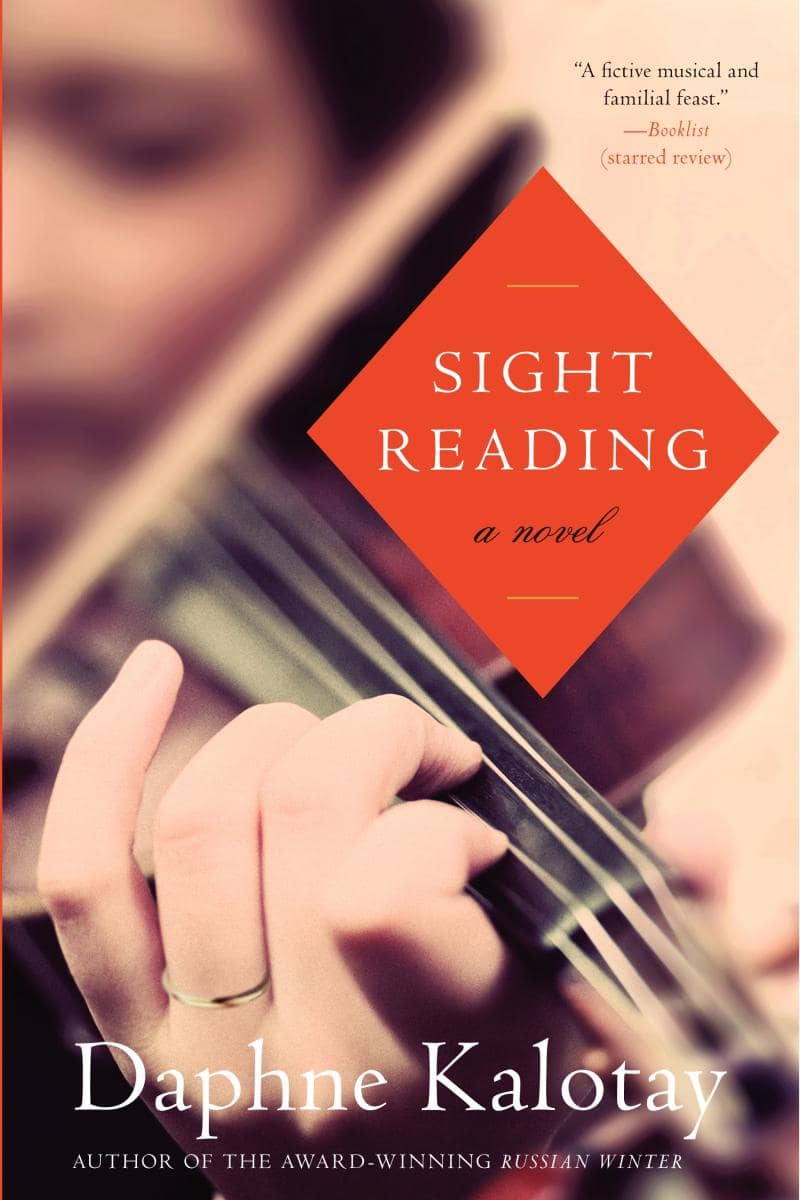
Kalotay, Daphne. Sight Reading: A Novel. New York: Harper, 2013.

Kalotay joined the Boston Athenæum in 2005 when she began her research for Russian Winter. Here she was able to find Russian points of view on Stalinism as well as the observations of American and European travelers, for whom the goings-on behind the Iron Curtain were new and strange and excellent fodder for descriptive memoirs. A favorite was Postmarked Moscow by Lydia Kirk, a very opinionated, but observant, wife of an American ambassador to Russia.  The Reference Department and interlibrary loan sersvice were also able to help find obscure books on Russian gold marks and other material culture resources. Kalotay has remained a fifth floor reader and writer, as she likes the high ceilings and striking artwork and seeing familiar faces, because “writing can be quite the solitary profession.”  Russian Winter even includes a scene at the Athenæum. When asked by her editor why so many of the men in the scene were wearing bow ties, Kalotay explained that she would simply have to see the place for herself.
06.28.2013

Elizabeth Palmer Peabody

July 2013 

By Chloe Morse-Harding

Elizabeth Palmer Peabody (1804-1894), “the grandmother of Boston”, was born to parents Elizabeth (“Eliza”) Palmer Peabody and Nathaniel Peabody, the eldest of seven children.  Elizabeth’s parents met in Atkinson, New Hampshire in 1798 when Eliza was sent to work at a boarding house after her father died.  Nathaniel Peabody was working there as a teacher while he was studying at Dartmouth.  They fell in love and married in November of 1802.

The young couple moved to Andover, Massachusetts and both taught at the North Andover Free School; two years later, they moved to Billerica and Elizabeth was born that May.  In 1806, the family moved to Cambridge so Nathaniel could attend medical lectures at Harvard, having decided to become a dentist.  The couple’s second child, Mary was also born in 1806.  Another two years later, the family picked up again and settled down in Salem, Massachusetts where Eliza began her own school and Nathaniel practiced dentistry.  The following year, in 1809, Sophia was born.  Over the next ten years, the Peabody’s had three sons (Nathaniel, George, and Wellington) and another daughter, Catharine, who died in infancy.

Elizabeth was educated at her mother’s school, and Eliza “appeared to be a rock of strength and stability, a model for her daughter of both strength of character and maternal, self-sacrificial spirit.”  Indeed, in 1821, the family moved to Lancaster and Elizabeth set up her own school, the Lancaster Boarding School; her sisters, Mary and Sophia, were some of her first students.  In 1822, Elizabeth moved to Boston, and befriended Ralph Waldo Emerson, from whom she took Greek lessons. 

After a few years working in Boston, Elizabeth moved to Maine and spent the following two years as a tutor and governess.  In 1825, Elizabeth moved back to Boston and started a successful all-girls school in Brookline with her sister Mary.  Elizabeth later ran into some trouble when the parents of some of her students heard of her seemingly radical style of teaching in regards to religion, and in 1826, she eventually moved her school to Boston where she felt she would have more support.  The school was very well received at first, but “eventually failed largely due to a mishandling of finances by a third party” and a massive loss of students due to what Elizabeth referred to as “the New Bedford Affair” when she got wrapped up in what the rest of Massachusetts called “The Great Rotch Scandal” regarding the indiscretions made by Francis Rotch of New Bedford and his mistress.  In 1833, the school closed, and the Peabody sisters took their lives and careers in very different directions.

In 1834, Elizabeth went back to teaching and helped Bronson Alcott start the Temple School in Boston.  She recorded Alcott’s dialogues with his students and the first edition of Record of a School was published in 1835.  In the two following years, both volumes of Alcott’s Conversations with Children on the Gospels were published.  Although she respected Alcott’s goals for the Temple School, they did not see eye to eye.  Elizabeth “began to doubt his method…she worried that Alcott manipulated his students’ discussions, rather than allowing genuine expression.”  In fact, Elizabeth did not want Alcott to publish his second book in its original format.  She was worried about a “possibly hostile public opinion toward Temple School with Alcott’s probing and revealing of his young students’ feelings.  There were certain insights and intimations in a child’s inner life that were better left unexplored and unexpressed.”  Alcott ignored her fears, and Elizabeth left the school and moved back home to Salem.  Elizabeth ended up being right, and “the controversy that followed the publication of Conversations nevertheless tarnished [her] reputation as well as Alcott’s and effectively prevented her from gathering a full and profitable school of her own for some time.”  

When Elizabeth left her position at Temple School, she decided to enter the book business, and in 1842, she opened her Boston book shop at 13 West Street.  The shop blossomed, as “Elizabeth believed that a book shop ought to not merely sell books but should function more widely as a meeting place for authors and readers to congregate, discuss, and purchase books.”  Elizabeth encouraged discussion and many famous minds congregated there, such as Margaret Fuller, Dr. William Ellery Channing, Ralph Waldo Emerson, and Reverend James Freeman Clarke.  Soon after opening her store, Elizabeth decided to add a circulating library (known as The Foreign Library) that consisted of “classic and living literature,” as well as foreign books and periodicals.  It was also during this time that Elizabeth helped to publish the famous Transcendentalist journal The Dial.  The book store was also the site of two very special family weddings: Sophia Peabody to American author Nathaniel Hawthorne and Mary Peabody to education reformer Horace Mann. 

In 1849, Elizabeth gave a set of books on Polish and French history to the Boston Athenæum, “partly to keep them intact and partly in gratitude for reading privileges there.”  When her mother died in 1853, and Elizabeth and her father moved to New Jersey, and “the Foreign Library collection was packed up and shipped there.”  In 1855, when her father died, Elizabeth once again packed up her library and moved back to New England. 

Back in New England, Elizabeth met the Schurz family who “had operated a German-speaking kindergarten in Wisconsin in 1856, following the methods of German Educational reformer Friedrich Froebel.”  Elizabeth studied Froebel’s methods and established the first English-speaking Kindergarten in 1860 in Boston on Pinckney Street.  Based on Froebel’s theories, Elizabeth believed that a “kindergarten pupil should be encouraged to grow organically, both physically, through play, and spiritually, through music and art.”  Elizabeth had at last found her true calling, and spent the rest of her life promoting the Kindergarten in the United States.

Elizabeth died in January of 1894 and was buried amongst some of New England’s other great minds at the Sleepy Hollow Cemetery in Concord, Massachusetts.

Selected Works:

Lectures in the training schools for kindergartners (Cutter- DK .P31)

Last evening with Allston, and other papers (Cutter- VE3 .P313 .l)

Record of a school: exemplifying the general principles of spiritual culture (Rare, LC- LB695.A3 P42 1836)

To fathers and mothers: letter from Miss Peabody (Rare, Cutter- Bro. 10 .188)

Universal history tables (Cutter- :7 .6P31)

References:

Elbert, M.M., Hall, J.E., & Rodier, K. (2006).  Reinventing the Peabody Sisters.  Iowa City: University of Iowa Press.

“Elizabeth Palmer Peabody: an outline biography.”  Retrieved from http://www.age-of-the-sage.org/transcendentalism/elizabeth_palmer_peabody.html

Marshall, Meghan.  (2005).  The Peabody Sisters.  Boston, MA: Houghton Mifflin Company.

Peabody, E.P. (1984).  Letters of Elizabeth Palmer Peabody: American Renaissance woman.  Ronda, B.A. (Ed.).  Middletown, CT: Wesleyan University Press.

“The Peabody Sisters.”  Retrieved from http://www25.uua.org/uuhs/duub/articles/peabodysisters.html

Ronda, B.A. (1999).  Elizabeth Palmer Peabody: a Reformer on her own terms.  Cambridge, MA: Harvard University Press.

05.31.2013

Megan Marshall

June 2013

By Emilia Poppe Mountain

Megan Marshall was born in Oakland, California to a pair of city planners. At the age of five, her family moved to Pasadena into a home built by New Englanders in the 1920s.  Growing up in a center-entrance colonial with white clapboards and green shutters, surrounded by many generations of this family’s furnishings and books (including early editions of The Five Little Peppers and Little Women), Marshall found herself endlessly curious about the Northeast. Her interest in the private lives of famous figures began early as well. Every Thursday afternoon, she’d help her grandmother, the local children’s librarian, shelve books. Some of her favorite books in that library came from a series of biographies for children, which included figures such as Marie Curie and Amelia Earhart. Marshall has been drawn to libraries ever since and traces her comfort with the research process to this early exposure.

While she originally enrolled at Bennington College as a double major in literature and music (harpsichord), Marshall eventually longed for more urban surroundings. In 1974 she moved to Cambridge, where she worked as a clerk at the Harvard Book Store and as an editorial assistant to Jonathan Kozol. She later enrolled in the English program at Harvard, where she had the opportunity to study with poets Robert Lowell and Elizabeth Bishop and the eminent translator Robert Fitzgerald. For Marshall, poetry was a wonderful way to learn about writing because “each word had to speak and be useful.” All three of these professors had died by 1985; her mentors were gone, but she felt grateful to have had a window into their world. Believing that their dramatic lives and their creative work were somehow entwined, Marshall became even more attracted to the idea of biographical research and writing.

Marshall first learned about Elizabeth, Mary, and Sophia Peabody in one of Harvard’s first women’s history courses taught by Barbara Miller Solomon. At the time, Margaret Fuller was one of the great heroines of Second Wave Feminism and Marshall thought the three Peabody women, friends and contemporaries of Fuller, deserved to be better-known too. She spent two decades on the project only to find that by the time The Peabody Sisters: Three Women who Ignited American Romanticism was published in 2005, Fuller herself had been forgotten by the general reading public. Marshall believed Fuller was every bit as important as Emerson and Thoreau, and yet she lived in their shadows. 

Bookcover: Marshall, Megan. Margaret Fuller: A New American Life. Boston: Houghton Mifflin Harcourt, 2013.

Marshall suggests that Fuller, known in America as the greatest female intellectual of her day, did not maintain as powerful a reputation as Emerson and Thoreau because she wrote in a variety of styles, and rarely in the conventional essay form in which the two men excelled. Fuller was a travel writer, gender theorist, and investigative journalist; this type of writing isn’t usually taught in high school and college English courses. Marshall argues that for writers like Fuller and the Peabody sisters, biography is an ideal way to introduce readers to their unconventional lives and work. Marshall’s aim has always been not simply to address gender gaps in the historical record, but also to help the general reader understand concepts that were important to these women, such as Unitarianism, Transcendentalism and numerous reform causes. Readers of Marshall’s biographies get the chance to imbibe these ideas along with Marshall’s heroines.    

As a research assistant to poet and scholar Nadya Aisenberg, Marshall first came to the Boston Athenæum in the mid-1970s. She immediately perused the large selection of biographies and published letters on the new book shelves and remembers borrowing editions of the correspondence of F. Scott Fitzgerald and Flannery O’Connor. While not yet a biographer herself, she was starting to think about how one might use a collection of letters to learn something meaningful about their writers. Years later, she was thrilled to find that the Boston Athenæum had one of the few editions of The Christmas Eve: A Tale from the German published by Elizabeth Peabody in 1842, which was likely translated from the German by her mother.  (Both Elizabeth Peabody and Margaret Fuller were among the first Americans to teach themselves German in order to read the Romantic writers whose works were not yet translated into English). 

Marshall has returned to the Boston Athenæum numerous times to give public readings from her work and to introduce her students from Emerson College’s Writing, Literature and Publishing Department to our rich special collections. She finds that many of her students have been told to, “Write what you know,” which too often leaves them wandering aimlessly in their own personal narratives. “What I like to do is bring them into Boston’s great libraries and archives and expose them to stories from the past. Then they can write what they’ve learned.” One of her courses for graduate students in the MFA program is called “Sources of Inspiration: Archival research for writers.” Students are “let loose” in the archives and guided in identifying topics of interest and shaping narratives from the sources. 

Bookcover: Marshall, Megan. The Peabody Sisters: Three Women who Ignited American Romanticism. Boston: Houghton Mifflin, 2005.

Presently, Marshall has turned her biographer’s gaze back to the Peabody, Hawthorne and Mann families. She is particularly interested in Nathaniel Hawthorne’s older sister, Ebe, who never married and was a notorious recluse, as well as Nathaniel and Sophia’s daughters, Rose and Una. Marshall sees this project as “experimental.” Rather than constructing a typical narrative, she’ll be following the interwoven relationships of these families in the years preceding the Civil War until the end of the nineteenth century. Ultimately, Marshall feels it is inspiring to be reminded of the energy these figures had. “They were idealists who believed that society could be reformed to become kinder and more just. They were committed to their ideas and then to acting on them.” 

05.01.2013

Lydia Maria Child

May, 2013

By Tricia Patterson

Well-known abolitionist, activist, and author Lydia Maria Child was born in Medford, Massachusetts on February 11, 1802. She was the youngest of six children born to baker and real-estate operator David Convers Francis and his wife, Susanna Rand Francis. Growing up, her parents’ anti-slavery convictions and altruistic attitude towards the poor community surrounding them greatly influenced the young Maria. Intellectually, her older brother, Convers, made the greatest impression. However, the youngest child, she soon found herself alone in the house as her brothers and sisters moved away to marry or go to school. While her father was well-respected in Medford-on-the-Mystic, her mother was the real source of affection in Maria’s life, and when Mrs. Francis passed away from tuberculosis after Maria’s twelfth birthday, Maria found herself alone in the house with her emotionally distant father.

The neighborhood knew her as a portly little girl who spent most of her time reading instead of running around and playing. Her father was busy working and was not sure how to place the young Maria, as she seemed unfit for the seminary and also for a traditional lady-like upbringing. But it was not long before this solitary life with her father ended and her life changed again. In 1814, her father, worried about the financial pressure the War of 1812 had put on him, sold his bakery and their house, and Maria was sent to live with her sister Mary and her husband in Maine.

In Mary and Warren Preston’s home, she once again found happiness. She spent the next six years there attending school, helping them host parties, and assisting to raise her cousins. Meanwhile, she maintained her intellectual and literary correspondence with her elder brother, Convers, who had graduated from Harvard and become a Unitarian minister. At the age of eighteen, Maria left to teach in Gardiner, Maine. After three years of teaching, her brother Convers invited her to move in with him and his wife, Abby, and Maria made her way back towards Boston and Cambridge, where she would cultivate her intellectual career.

In Convers’ home, Maria enjoyed frequent visits from well-known intellectuals such as Ralph Waldo Emerson. Invited to participate in discussions, she nevertheless felt relegated to the role of a conversational ornament. In order to take action, in 1824, she opened up a girls’ school in Watertown. Then, soon after she had enrolled her first students, she published her first notable achievement: Hobomok.

Completed in six weeks, this book was initially noted as being written by “an American,” because women were not often openly publishing at the time. However, word quickly spread that Lydia Maria Francis was the author, and she found herself in the spotlight, quickly becoming Boston’s darling and a trend-setter for young females inclined to step outside their traditional roles. Within a year, she had written and published her second work, The Rebels, and solidified her position in the literary landscape of Boston.

Never regarded as an exceptional beauty, Maria did not lack for admirers during this period of her life. In 1826, she met idealistic lawyer and journalist David Lee Child, whom Maria found kind and gentle compared to some of the blue-blooded fops she had been socializing with. For over a year, she vacillated between her resolution to live a single life and her admiration for Child. In her diary, she wrote that, “he [was] the most gallant man that has ever lived since the sixteenth century and need[ed] nothing but a helmet, shield and chain armor to make him a complete knight of chivalry.” In September 1827, Child proposed to her, and after four hours of debate and discussion between the two lovers, she finally accepted. They were married one year later, in October of 1828.

Maria continued to publish regularly, and in 1832, she was given permission by the Trustees of the Boston Athenæum to use the library for free, a privilege Mrs. Child enjoyed for three years. It is not clear why this offer was not extended; the trustees’ minutes simply state: “Voted that the general permission heretofore given to Mrs. Child to use the Athenӕum be henceforth considered as terminate.” Many years later, Mrs. Child claimed her abolitionist views were the reason; however, the Boston Athenæum’s membership included many active abolitionists at that time.

In 1833, Maria published An Appeal in Favor of That Class of Americans Called Africans, one of the first major anti-slavery books in America. Her husband, David, was fiercely committed to the cause and supported her efforts, even though the infamy she incited with this publication severely damaged both his business and her own reputation. Not long after, in 1835, she published the History of the Condition of Women in Various Ages and Nations.

With their activist spirits in full swing, David Child travelled to Belgium to research the potential of beet sugar to change labor practices in the agricultural industry and thus end slavery. Maria remained in Massachusetts and lamented his absence for a year and a half. Their finances reduced by her unpopularity and his failing business, they had gone into debt to support his travel abroad and lost their house in Roxbury which forced her to live with relatives during his absence. They were homeless and virtually penniless upon his return.

In 1839, with financial help from Maria’s father, David bought a farm in Northampton, Massachusetts in order to enact what he had learned about sugar beet farming. Her father soon regretted his offer and complained often to friends and neighbors. Disturbed by this uneasy situation, Maria also found running a farm an unchallenging occupation for her intellect.  She could occasionally afford trips to hear her contemporaries Margaret Fuller or Emerson speak, but she regretting having to decline opportunities to be part of the delegation to the World’s Anti-slavery Convention in London because she could not afford to attend.

David was surprised in 1841 to be offered the position of editor for the National Anti-Slavery Standard in New York with a salary of $1,000 a year. This would have alleviated their financial troubles, but David would not abandon his beet venture. Then, a few weeks later, the same position was offered to Maria instead – at the same salary. The thought of financial freedom and intellectual stimulation – and no more beets – outweighed her reluctance to leave her husband’s side. While in New York, Maria published her popular Letters from New York. She also contributed articles and short stories to other magazines.

After the failure of his farming venture, David moved to New York but soon returned to Massachusetts to revive his law career. She and her husband were not reunited under one roof until she moved back to Massachusetts in 1852, and they settled in Wayland. She spent the rest of her career writing prolifically and pursuing her goals to promote abolition and women’s rights. Her husband passed away in September of 1874.

Six years later, on October 20, 1880, Maria died after suffering from rheumatism. She was buried in North Cemetery in Wayland, Massachusetts next to her husband. On her tombstone is written:

Lydia Maria Child

1802-1880

You Call Us Dead

We Are Not Dead

We Are Truly Living Now

Selected Works:

American Frugal Housewife: Dedicated to Those Who Are Not Ashamed of Economy. Rare books, appointment required: F 75 no. 2

Appeal in Favor of That Class of Americans Called Africans. Library of Congress Classification: E449 .C532 1996

Hobomok and Other Writings on Indians. Library of Congress Classification: PS 1293. A6 1986

Letters from New York. Cutter Classification: VE5 .C43

Philothea: a Romance. Cutter Classification: VEF .C4363 .p (offsite storage)

References:

Baer, Helene G. The Heart is Like Heaven: the Life of Lydia Maria Child. Philadelphia: University of Philadelphia Press (1964).

Hebard, Barbara Adams, “The Role of Women at the Boston Athenӕum.” In The Boston Athenæum: Bicentennial Essays. Boston: Boston Athenæum (2009).

Osborne, William S. Lydia Maria Child. Boston: Twayne Publishers (1980).

03.26.2013

James W. Bradley

April 2, 2013

By Emilia Poppe Mountain

James W. Bradley was born in Boston in 1947, the first son of Wesley and Barbara Bradley.  Since his father was a young medical doctor, they moved frequently (Newport, Rhode Island; Norfolk, Virginia; and Ann Arbor, Michigan) finally settling in Syracuse, New York.  Still, Bradley thinks of himself as a Bostonian and explains his interest in history from being “in the shadow of Francis Parkman” when he lived on Beacon Hill’s Myrtle Street.  He spent his childhood in “Iroquois country” as the kind of boy who loved to be outside, getting dirty and looking for rocks, fossils, and snakes. “One day I found an arrowhead,” he says, “and that was it.  I realized that whoever had made that arrowhead and the Onondaga people who lived on the nearby reservation were somehow connected.  And more than that, here were people who still lived on their own land and spoke their own language five hundred years after Europeans arrived in North America.  Clearly, they had figured out how to survive, even when faced with profound and traumatic change.  I wanted to understand how that happened.”  And so began an academic journey into history, anthropology, cross-cultural psychology, and archaeology that would result in dozens of publications about the history of the Northeastern United States, from the end of the Ice Age to the present.

Bradley received his BA in History from Allegheny College in western Pennsylvania in 1969.  Although he planned to attend graduate school, the Vietnam War forced other decisions.  Two years earlier, he had registered as a conscientious objector and therefore was required to perform alternate service.  This took him to Louisville, Kentucky where he worked in settlement house.  In 1970 he also married his college sweetheart, Margaret Kirkland Bradley, who gave up a medical research position at the Joselyn Diabetes Clinic in Boston to move to Louisville where the best job she could find was in a nearby meat packing plant.  Little did he know this would be the first step back to Boston. 

After Kentucky, they returned to Syracuse where both started graduate school.  James began studying American colonial history at Syracuse University but soon realized that his desire to study the interactions between the Iroquois and Europeans was limited by the historian’s traditional reliance on written texts, especially since the Iroquois relied on the spoken word, ceremony, and artwork to tell their own stories.  The Interdisciplinary Program in Social Sciences at the Maxwell School provided the answer to Bradley’s dilemma.  There he was able to work with archaeologists and cross-cultural psychologists as well as historians and put together a program that allowed him to study the Onondaga (the central nation of the Five Nations) from several different perspectives.

Evolution of the Onondaga Iroquois : accomodating change, 1500-1655 Publishing Details:Syracuse, N.Y. : Syracuse University Press, 1987.
The Bradleys completed their respective Ph.D. degrees in the spring of 1979, James from Syracuse University and Margaret from the Upstate Medical Center.  However, since only one of them had a job—Margaret had received a post-doctoral fellowship at the (then) Sidney-Farber Cancer Center—they moved back to Boston.  Bradley found a position doing archaeological survey work on Cape Cod for the National Park Service and then began to consult with the Massachusetts Historical Commission.  In 1981, he joined the staff of the MHC to direct a statewide survey of historical and archaeological resources.  It was during this project that he met and fell in love with the Boston Athenæum.  Director Rodney Armstrong had generously granted free reader cards to survey team members and Bradley spent much of the 1980s reading town histories on the fifth floor.  Part of this statewide survey involved photographing some of the state’s most outstanding buildings.  Nationally renowned photographer Jack Boucher from the Historical American Buildings Survey (HABS) in Washington, DC spent several months in Massachusetts.  The buildings he recorded ranged from Trinity Church in Boston to Shaker barns in Berkshire County.  The resulting exhibition of Boucher’s work, one that later travelled extensively around the state, opened at the Boston Athenæum in April 1989.

In 1990, Bradley took a very different position, as Director of the Robert S. Peabody Museum of Archaeology, located at Phillips Academy in Andover.  Here he faced very different challenges, finding ways to interest high school age students in archaeology and working with Native American people.  Shortly after he began, Congress passed the Native American Graves Protection and Repatriation Act (NAGPRA).  This law required museums to return any affiliated human remains, burial objects and sacred objects in their collections to the appropriate federally recognized tribe.  Since the R. S. Peabody’s collections were almost exclusively Native American, and much of the material had come from burials, compliance was not going to be simple.  Over the next eleven years, Bradley worked with tribes across the country to see this law enacted.  This meant consulting with tribes and other museums in order to find the best and most appropriate resolutions.  One such solution was a partnership with the Pueblo of Jemez that returned roughly 2,000 sets of human remains to the Pecos National Historical Park in New Mexico for reburial, the largest single repatriation to occur under NAGPRA.  Bradley believes that NAGPRA was about more than just compliance; it was an opportunity for archaeologists to build a new kind of relationship with the people they study, one built on mutual respect for each other and the different ways in which they understand the past. 

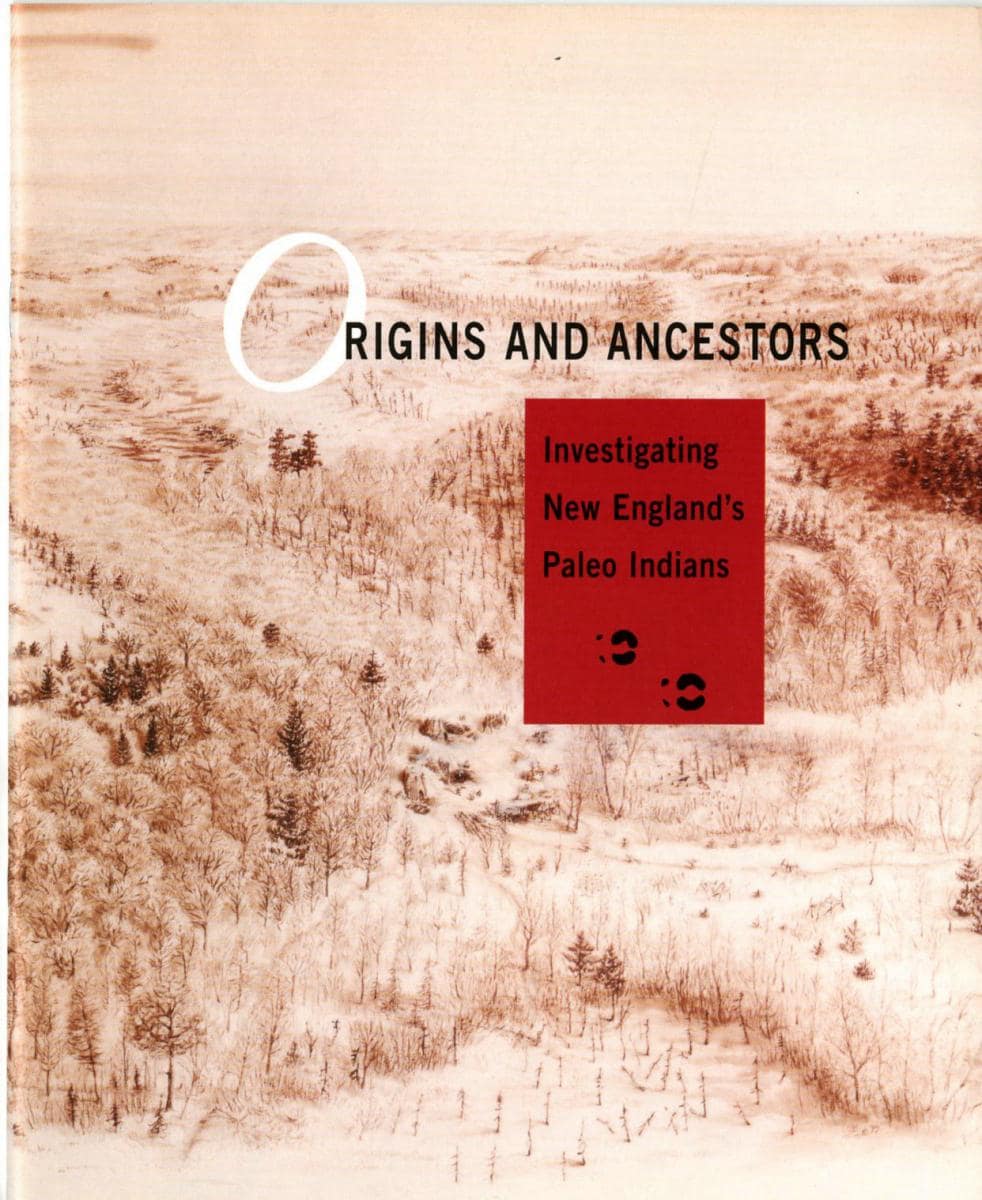
Book Cover: Origins and ancestors : investigating New England's Paleo Indians Andover, Mass.: Robert S. Peabody Museum of Archaeology, 1998.

In 2001, Bradley left Andover to establish ArchLink, a privately owned business that seeks to link archaeology with education and preservation.  As a consultant who has worked with museums, schools, tribes and government agencies, his aim is to “translate” the oftentimes technical and obscure language of archaeology into what his clients need.  The results include museum exhibition scripts and designs, preservation plans, and publications for a wide range of audiences.  This venture has, once again, made him a fixture on the Athenæum’s fifth floor.  “I love the Boston Athenæum for many reasons, but one is because scholarship is taken seriously here.  However, serious does not mean dull and dry.  This is a place where one learns in many ways: from the staff, from the other patrons, from unexpected discoveries.  It is that shared quality of learning that makes the Athenæum such a productive place to work.” 

In January of 2011, Bradley added to our own resources yet again with his lecture: Revisiting Wampum and other Seventeenth Century Shell Games.  Currently, he is completing the manuscript for a new book: Onondaga and Empire: An Iroquoian people in an Imperial Era.  This will be the sequel to his earlier book: The Evolution of the Onondaga Iroquois: Accommodating Change, 1500-1655 (1987) that ended with the arrival of resident French Jesuits in 1654.  The new volume will trace how the Onondaga dealt with their ever more encroaching imperial neighbors during the rest of the seventeenth century, concluding with the signing of successful peace treaties with both the French and English in 1701.  As always, Bradley hopes that his work will bring “a greater interest in and access to the Indian perspectives of our shared history.”

Selected Bibliography:

Archaeology of the Bostonian Hotel Site (1983)
Library of Congress Classification
+ F73.39 .A722

Before Albany: An Archaeology of Native-Dutch Relations in the Capital Region1600-1664 (2007)
Library of Congress Classification
+ F129.A347 B73 2007

Evolution of the Onondaga Iroquois: Accommodating Change, 1500-1655 (1987)
Library of Congress Classification
+ E99.O58 B7 1987

03.22.2013

Elouisa Goose Partridge, or, Auntie Partridge

April 1, 2013

By Chloe Morse-Harding and Tricia Patterson

Elouisa Goose Partridge, Auntie Partridge,  was born in Lowell, Massachusetts on March 3, 1791 to Cumbersome Ernest Partridge and Harriet Abyssinia Goose. Her mother was rumored to be a second cousin to Mary Goose, an alleged identity of the famous Mother Goose, and she instilled in her daughter a great reverence for the Mother Goose canon. In fact, Elouisa’s first words were reportedly, “Honk, honk.”

Growing up, she memorized all of the Mother Goose nursery rhymes and would recite them on command or – often – unprompted. It was around the age of twelve that her father began to encourage the young Elouisa to compose some original works, and she at once began her life’s work of writing nursery rhymes.

She began to study children’s literature at Simmons College, and at the ripe age of nineteen, Partridge had her first rhyme published in the popular quarterly Bib’n Bottle. The nursery rhyme, untitled as it were, was to be her most noted accomplishment.

Tweedle-dee-dee and
Twiddle-doo-dah
Ol’ Broadback Bertha
Has been whittled rawShe picked up some sticks
With a mind to abuse ‘em
And whilst carving the wood
Did she do somethin’ gruesome
Now Ol’ Broadback Bertha,
She only stacks wood
The trees taught her good.

Bathed in the glow of success, she dropped out of her studies to pursue a prospectively brilliant career in writing. It was during these years that she most frequented the Boston Athenaeum, often perusing the collection of children’s literature and always visiting the Mother Goose tombstone in the Granary Burial grounds.

However, she found the competitive world of nursery rhyme composition difficult to make a living in, and in 1822, at age the of 21, she accepted a marriage proposal from Henry Elijah Partridge, a distant relation of her father’s who owned a small but profitable farm in the Massachusetts countryside.

Partridge continued her writing from the farm, and found a small press to print off a few volumes of her nursery rhymes. Over the years she appeared sporadically in Bib’n Bottle and Cursory Rhymes, but she never recaptured the success of her initial publication. She became increasingly involved with work on the farm, taking up loom-weaving with great zeal. After her husband passed away of cholera in 1851, Partridge decided she wanted to run the farm business, and run it she did – into the ground. Less than five years later, she was forced to close the farm and moved back to Boston to be taken care of by her niece. She continued her work with weaving and writing until her death – on November 14, 1888 – from very, very old age.

03.04.2013

Ralph Waldo Emerson

March 2013

By Chloe Morse-Harding

“My book should smell of pines and resound with the hum of insects”–excerpt from Self-Reliance

Ralph Waldo Emerson (1803-1882) was born in Boston to parents William and Ruth Emerson.  Emerson’s name was derived from both sides of the family: Ralph was the name of Ruth’s brother, and Waldo was the maiden name of his great-great grandmother Rebecca.    William Emerson was a Unitarian Minister who preached at the First Church in the Back Bay neighborhood of Boston.  William was also a founder of the Boston Athenæum, and one of its first trustees. 

In May of 1811, just months after his eighth child was born, William passed away.  William was buried at King’s Chapel in the Cotton Tomb, named for John Cotton, a pastor of the First Church.  “Both men would live on in the descendants of William’s son, Ralph Waldo, and his wife Lidian Jackson, whose mother, Lucy Cotton, was a direct descendant of John Cotton.”  Shortly after, Ruth Emerson sold William’s library to the Athenæum.  Left alone to raise the family, Ruth worked as a maid and often took in borders. 

Emerson grew up very close to his mother and siblings.  He also developed a close relationship with his Aunt Mary Moody, his father’s sister; she “was the dominant influence of Emerson’s childhood and youth.”  Aunt Mary had an unbounded interest in theology, and it was she who taught Emerson (or Waldo, as he preferred to be called) “many of the aphorisms he in turn taught his own children,” such as the famous: “Always do what you are afraid to do.”

Emerson was educated at Boston Public Latin School, and then went on to attend Harvard College, passing the entrance exam at the young age of fourteen (although, his father William beat him by a year).  Emerson was thirtieth in his class, and was named Class Poet.  Upon graduation, he decided to delay his entrance to divinity school and taught for a few years at his brother William’s “school for young ladies.”  After about a year, Emerson realized he was “a hopeless school master.”  Perhaps it was that Emerson longed for a different environment.

All his life, “Emerson…found himself pulled repeatedly…into the world of Nature.”  And it was Aunt Mary who “coaxed Emerson into giving Nature’s bounty a try.”  Emerson was not as charmed by nature as his aunt had perhaps hoped, but when his family moved to a wooded area of Roxbury in May of 1823, Emerson was close enough to the school so that he could walk there.  After a few months of trekking through the woods back and forth to school, he quietly changed his ways.  The following month, in a letter to John Boynton Hill, Emerson wrote that “Nature makes a man love his eyes.” 

In 1825, Emerson had made enough money teaching so that he could attend Divinity School at Harvard.  In 1826, Emerson was sanctioned as a Unitarian Minister, and three years later he was ordained as a junior pastor with the Second Church in Boston.  Also that year, in September, he married Ellen Louisa Tucker.  Their marriage was brief, as Ellen passed away less than two years later.  The following year, Emerson resigned from the Second Church and toured Europe.  A month after he returned home, in November of 1833, Emerson delivered his first lecture, “The Uses of Natural History” at the Masonic Temple in Boston.  The following year, in 1834, Emerson met his future wife, Lidian Jackson.  After hearing a sermon he gave at the Twelfth Congregational Church, she remarked “’[t]hat man is certainly my predestined husband.’”  The new couple married shortly after and settled down in Concord, in a home they decided to name “Bush” where they lived for the next 47 years.  In 1836, Emerson published his essay Nature and helped to form the Transcendental club, which later published the journal The Dial.  Emerson continued to lecture and write essays and poetry for the rest of his life, including Self-Reliance in 1841. 

An avid writer, he was also an avid reader (perhaps too much so at some points) and was a lifetime subscriber to the Athenæum: “Ralph Waldo Emerson (serious and dignified) came from Concord every week; he would become absorbed in reading for hours, and then wander about the library asking if anyone had seen his daughter Ellen.”  In regards to the types of books that he read, the “record of books drawn by Emerson is unusually large and heterogeneous.”  He was known to take out authors such as Moore, Dryden, Holmes, Goethe, and George Eliot. 

Although, there were some people who knew Emerson that did not know many details about him.  When Emerson was nearing the end of his life, a reporter came in to the Athenæum to ask questions about him: what he read, what he wore, questions such as that.  Not knowing the gentleman was a reporter, the library attendant answered that “she did not notice his clothes, as she never got beyond his head, which always fascinated her, being bald in some spots.”

Emerson died on April 27, 1882 in his home due to pneumonia, and was buried at the Sleepy Hollow Cemetery in Concord.  He rests now amongst other literary giants like Louisa May Alcott, Nathaniel Hawthorne, and Henry David Thoreau.

Selected Works:

The collected works of Ralph Waldo Emerson (LC PS1600 .F71)

The complete sermons of Ralph Waldo Emerson (LC BX9843.E487 C66 1989)

Emerson’s library (Cutter :XI5 .Em34 .h)

Journals of Ralph Waldo Emerson, with annotations (Cutter 65 .Em37)

One first love; the letters of Ellen Louisa Tucker to Ralph Waldo Emerson (Cutter VE5 .Em295)

Parnassus (Cutter VEP .9Em3)

References:

Buell, L. (2003).  Emerson.  Cambridge, MA: The Belknap Press of Harvard University Press.

McAleer, J. (1984).  Ralph Waldo Emerson: Days of Encounter.  Boston, MA: Little, Brown, and Company.

“Ralph Waldo Emerson”.  Retrieved from http://www.online-literature.com/emerson/

Regan, M.J. (1927).  Echoes from the Past: Reminiscences of the Boston Athenæum.  Boston, MA: The Boston Athenæum.

“Sleepy Hollow Cemetery”.  Retrieved from http://www.concordma.gov/pages/concordma_cemetery/sleepy

Wendell, B. (1907).  The Athenaeum Centenary: The Influence and History of the Boston Athenaeum from 1807 to 1907 with a Records of its Officers and Benefactors and a Complete List of Proprietors.  Boston, MA: The Boston Athenæum.

01.31.2013

Rishi Reddi

February 2013

By Emilia Poppe Mountain

Rishi Reddi was born in Hyderabad, India to “adventurous” parents.  Her father was a physician and his work brought the family across the globe.   As a young girl, they moved to London, Los Angeles, Philadelphia, and many more places in between.  Feeling unsettled by the continual uprooting, particularly as an only child, Reddi remembers turning to books for comfort and calm.  Her mother encouraged her reading and also gave her a notebook where she wrote her first story.  (She vaguely remembers something about a princess and a fairy and a cave).  Works such as The Phantom TollboothMy Friend Flicka and The Outsiders were read and re-read.  She also enjoyed Greek and Norse mythology, as well as the legends of gods and goddesses from her Hindu upbringing.  By the time she was in high school in Wichita, KS, literature was clearly her preferred subject.

Despite her parents’ strong urging to enter medical school, in 1988, Reddi graduated from Swarthmore College with a degree in English. She decided to study law and earned a JD at Northeastern University.  But her creative writing impulse would not be vanquished. She later enrolled in Boston University’s Creative Writing program and in many other workshops, such as courses at Boston’s Grub Street creative writing center, extension school classes at Harvard, and an independent study at MIT. 

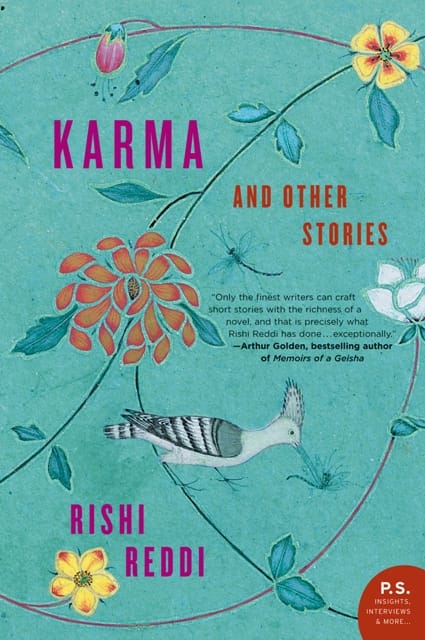
Bookcover for Karma and other stories by Rishi Reddi, 2007

Reddi continues to practice law to this day.  Indeed, many of the unusual cases she studied in law school serve as inspiration for her writing.  Brij Sharma’s 2001 suit against McDonald’s for allegedly putting beef fat in vegetarian French fries sparked “Justice Shiva Ram Murthy.” This title was included in The Best American Short Stories of 2011, edited by Michael Chabon, and broadcast on NPR’s “Selected Stories.”  The continued legal battles of the Fatal Light Awareness Program (FLAP) in Toronto to save the lives of migrating birds gave her the idea for “Karma.”  Similarly, the interracial marriage and citizenship cases of the early twentieth century provide the backdrop for Reddi’s forthcoming novel, West, set in the Imperial Valley of California. 

In Karma and other Stories, which won the PEN New England / L.L. Winship Award for Fiction in 2008, we intimately peer into the lives of Indian-American families.  We meet characters from many generations who are at various levels of comfort and reconciliation with their conservative upbringing and the temptations of American culture.  Reddi states that the relationships she created between these Boston and Lexington Indian-American communities were a way for her to imagine the community she never had growing up—a way  to artistically contend with the disappointment of having felt both different and alone for so many years.

Reddi joined the Boston Athenæum in 2003 at the recommendation of former archivist and friend, Lisa Starzyk.  She wrote much of Karma while sitting in the fifth floor reading room, and enjoyed meeting other authors in the Spiro Members’ Lounge.  The library was also a place where she could turn to Mark Twain, Toni Morrison and Edward P. Jones whenever in need of inspiration.

Reddi will be reading from her collection Karma and Other Stories on February 21st, from 6:30-9:30p.m. at the Peabody Essex Museum, where, in conjunction with the Tannery Authors Series, the Atrium will be transformed into the famous Samovar Café.

01.09.2013

Thomas William Parsons

January 2013

By Tricia Patterson

“O Time! whose verdicts mock our own/ The only righteous judge art thou/ That poor old exile, sad and lone/ Is Latium’s other Virgil now.”- Excerpt from “On a Bust of Dante”, Thomas William Parsons

Dentist, poet, and well-known translator of Dante, Thomas William Parsons, Jr. was born in Boston on August 8, 1819. He was the son of an English dentist of the same name, Dr. Thomas William Parsons. He grew up on nearby Winter Street and attended Trinity Parish and the Boston Latin School as a boy. While in school, he excelled in classical languages and made his first foray into classical translation with an attempt at Horace. However, Parsons dropped out just before he was done in 1834. Although his father had attended Harvard University for his M.D., the young Parsons opted not to study there at first, and in 1836, he and his father took off on a European voyage instead. It was on this journey that he first encountered Italy. Once there, he spent a few months under the roof of Signora Guiseppa Danti, and he recalled that it was “there, in the venerable Borgo Sant’ Apostolo, consecrated in my imagination by a verse of Dante’s… in the home of a learned lady who bore the name of the poet, [that I] became enamored of the Divina Commedia.” He began reading the Paradiso, memorizing stanzas, and translating small pieces of it. He would continue to develop such a passion for Dante that his most notable poetic success was his treatment of a translation of Dante’s Inferno. After returning home to Boston in 1837, he began following in his father’s footsteps and studied medicine at Harvard. Though he never completed his degree, he did practice dentistry and was often referred to as “Dr. Parsons.” Harvard eventually bestowed an honorary M.A. on Parsons in 1853. In 1840, at the age of twenty-one, Parsons became a proprietor of the Boston Athenӕum.  In his introduction to The Athenӕum Centenary, Barrett Wendell claimed that Parsons  “showed insatiable appetite for fiction and biography.” At the age of twenty-two, Parsons published his most famous original poem, “On a Bust of Dante” in the Boston Advertiser. This poem was anthologized in Henry Wadsworth Longfellow’s The Estray: A Collection of Poems and continued to be included in American poetry anthologies thereafter. Two years later, he published a few stanzas of Dante’s Divine Comedy, but although he would consistently work on this project, he would not publish full translations until over twenty years later.In 1857, he married Hannah Maria Allen, whom he often referred to endearingly as Annie. She was a cultured lady from his social circle who had previously printed some small volumes of his verse. In 1872, he published a general collection of poetry, The Shadow of the Obelisk and Other Poems. Other than a few collections of poems, much of his work circulated only within an intimate circle of friends, within which they were treasured. He also published often in leaflets, newspapers such as the Boston Evening Transcript, and magazines such as The Atlantic.

The shadow of the obelisk : and the other poems / Thomas Williams Parsons. London : Hatchards, 1872.

While Parsons was greatly respected by many of his contemporaries, including Ralph Waldo Emerson and Oliver Wendell Holmes, he was often characterized as more in tune with a time and place other than his own, probably resulting from his interest in Dante, the Middle Ages, and his strong Anglophilia. This perhaps contributed to the fact that he was more rigorous in his translations of Dante than he was prolific in the production of his own poetry. In 1863, Henry Wadsworth Longfellow published Tales of Wayside Inn, in which he explained the identity behind some of the key characters including the “Poet”, based on Parsons. Longfellow shared his interest in studying Dante and succeeded in publishing the earliest complete American translation of the Divine Comedy, but Parsons beat him by becoming the first American to issue a translation of the Inferno. Parson’s translation of Purgatorio was published posthumously.  Austin Warren, Professor of English at the University of Iowa, demonstrates Longfellow and Parson’s differences in their approaches to translation when comparing their translations of three stanzas: “Longfellow translates line by line. Parsons, collecting the sense, rearranges it, reducing nine verses to eight. He feels free to alter and to add.” Thomas William Parsons divided his time in  later years between the English countryside and the environs of Boston. In 1881, after twenty-four years of marriage, his wife Hannah passed away. He privately circulated four poems in her honor to his friends. Among them was “Into the Noiseless Country”: 

“Into the noiseless country Annie went,

Among the silent people where no sound

Of wheel or voice or implement – no roar

Of wind or billow moves the tranquil air:

And oft at midnight when my strength is spent

And day’s delirium in the lull is drowned

Of deepening darkness, as I kneel before

Her palm and cross, comes to my soul this prayer,

That partly brings me back to my content,

‘Oh, that hushed forest! – soon may I be there!'”

Eleven years later, on September 3rd of 1892, Parsons died from apoplexy during a stroke. He was found dead in a well in Scituate, Massachusetts, where he had been staying with his sister and being cared for by a nurse.

Selected Works:

The Divine Comedy of Dante Aleghieri. Boston and New York: Houghton, Mifflin and Company, 1893.

(Cutter: VIP .D2 . Ep)

Poems. Boston and New York: Houghton, Mifflin and Company, 1893.

(Cutter: VEP .P25 .2)

The Shadow of the Obelisk and Other Poems. London: Hatchards, Piccadilly, 1872. (Cutter: VEP .P25 .s)

Works Cited:

Boston Athenaeum. The Athenaeum Centenary: The Influence and History of the Boston Athenaeum from 1807-1907. Boston: The Boston Athenaeum, 1907.

Boston Evening Trascript (Boston, MA) Obituary of Thomas W. Parsons. September 6, 1892.

Hovey, Richard. Seaward: An Elegy on the Death of Thomas William Parsons. Boston: D. Lothrop Company, 1893.

Warren, Austin in Letters by T.W. Parsons, edited by Haraszti, Zoltan. Boston: Trustees of the Public Library, 1939.

11.27.2012

Diana Renn

December 2012
By Alice Platt

Talking to Diana Renn, author of the young adult novel Tokyo Heist, one gets a strong sense of how much labor goes into writing a book.

“This started as an adult novel,” Diana said, explaining that the original draft was told in alternating chapters between an adult Violet, the main character, and her teenage counterpart. “But the older character just wasn’t progressing well, and everyone in my writing group was more interested in the younger character. I realized I could hear her voice much better.” Diana sat down for a complete rewrite. “The teenage Violet chapters were set in the ‘80s, but I realized that as a young adult novel, it didn’t need to be set then. So then I put the story in the present time, and it took off from there.”

Tokyo Heist is the story of an art heist that takes Violet from Seattle to Tokyo and Kyoto. The original draft, however, didn’t take place in Japan at all; instead, it all took place in Seattle, Diana’s hometown. While she had visited Japan on her honeymoon in 2004, it would have been difficult to return for a research trip.

“It was kind of tricky, because I knew I couldn’t go back to Japan to research with a baby on the way, so instead I had Violet looking for lost art in old Japantown in Seattle.” But the story fell flat, and Diana decided to send her character to Japan one way or another. “I did a lot of online research, book research, and consulted travel guides, videos, and Japanese films.” A member of the Japan Society of Boston, Diana was able to consult with Japanese friends as well. “Even after the book sold, a Japanese friend and I read the entire book page by page to make sure I had accurately captured Japanese culture.”

Dust Jacket: Diana Renn. Tokyo Heist. New York: Viking, 2012.

Diana remarked that the collections at the Boston Athenæum were particularly useful, not just for her research on Japan, but also for the intricacies of art theft. “I had to understand the different motives for stealing art, for how that might work. I found a lot of those resources at the Boston Athenæum.”

The author engaged in hands-on research at the Museum of Fine Arts, where she volunteered in the paper and conservation department. For two weeks, she measured Japanese prints and entered them into a database. This experience also provided an opportunity to talk to an international expert in Japanese printmaking, as well as the chance to learn terminology unique to conservation departments. “Learning to use phrases like ‘rehousing the prints’ instead of ‘putting the prints in a box’ was important,” Diana explained.

Diana moved to Boston to attend graduate school at Brandeis, and the city has been her home ever since. Most of Tokyo Heist was written in the Writers’ Room of Boston, where she was a member. Currently, she finds it easier to write at home or at a local library near her son’s school, but as he grows older and his school days grow longer, Diana hopes to spend more of her time writing at the Boston Athenæum.

“Right now when we come to the Athenæum, we come as a family for story time,” Diana said. “My favorite room is the children’s room. When I look at the shelves, I see the books I grew up with in their original bindings, and it reminds me of my childhood. It’s a great mix of contemporary and classics. Visiting the children’s room reminds me of why I became a children’s writer. My ultimate goal is to write something that will stay on these shelves.”

Find more information about Diana Renn and her writing on her website.