
05.05.2015

Joyce M. Bowden

June 2015

By Arnold Serapilio

“There are always puzzles that you can never completely resolve. At some point you just have to draw the line, and you have to be comfortable drawing the line.” Joyce M. Bowden is responding to my question of whether she solved every mystery she set out to when she traced the family history on her maternal grandfather’s side. This project—which began in December 2004 in Columbia, South Carolina when she was tracking down her mother’s birth certificate, only to find that her mother’s legal first name was not what she thought it was—would span over nine years and culminate in the publishing of her first book in January 2014,  Four Connor Generations in South Carolina, 1790–1920.

The journey started when Joyce received her mother Rachel’s death certificate and noted that Greenville, South Carolina was the listed birth place. This did not jibe with Joyce’s memories of childhood visits to Rachel’s own childhood home in Shelby, North Carolina, so she decided to find the birth certificate. Joyce recalls sitting in the waiting room of the South Carolina Department of Health and Environmental Control​ in Columbia. “You fill out a form and you give it to somebody who’s going to do the research, and then you’re simply asked to wait. And I waited, and I waited, and I waited. And the researcher came back—she was very nice—I stood up when she walked in the room. She said, ‘I think you ought to sit down.'”

What the researcher found was that Joyce’s mother, the woman everyone knew as Rachel, was legally named Carrie Lou. “I think my mother thought her name was Rachel,” Joyce says. “I came to the conclusion it was a compromise between Mom and Dad. Dad wanted Carrie Lou because that was his mother’s name—turns out he was wrong [it was actually Caroline Lucinda]—and Mom wanted Rachel because that was her mother’s name. So the compromise was, for the official record, we’ll go for Carrie Lou, but when it comes to what we call her, we’re going to call her Rachel.”

It isn’t difficult to imagine how disconcerting this news must have been. “Here I was at the vital records center in Columbia, finding out that I didn’t even know my mother’s name! I remember walking out and sitting on a bench under a tree and saying to myself, ‘Well, Joyce, if you don’t know her name, what else don’t you know?'” And so she had her marching orders. The weight of discovery in the ensuing years was unanticipated; Joyce unearthed information of profound historical import. She writes, in the introduction to her book, “The task evolved from one done to satisfy my own curiosity to one done to provide a source for others with similar interests.”

But let’s back up a bit. Joyce was born in Georgia and, for the most part, was raised there. Between undergraduate and graduate school, in the mid-1960s, she served in the Peace Corps for roughly two and a half years. Her mission: to disseminate information on public heath. She trained in Seattle, Washington, learning Spanish in an immersive environment alongside hospital administrators, med techs, lab techs, visiting nurses, and teachers. She was then deployed to Bolivia. “Public health means something quite different there than it does here,” Joyce says. “We would routinely encounter diphtheria. There was even an outbreak of plague close to where my project was located. And my assignment was a leprosarium.” I hazard that this sounds like an unusual Peace Corps experience, and she confirms it is, though she is quick to add that leprosy is not, in fact, a fatal disease, “despite what has been written about it. It can be treated, and the disease can be arrested, and people can return to normal life.” Even so, pervasive fear of the disease meant that those afflicted with leprosy (or, in some cases, those simply thought to be afflicted) were quarantined far away and effectively forgotten about, making proper treatment challenging to conduct.

“My job while I was there was to start some sort of system of keeping track of who the patients were. Just name, age, sex, what part of the country they came from, what was the diagnosis. Once we had interviewed all of them and recorded all of this data, the medical director then sent me and a lab tech to those places where the patients came from. To make presentations to the medical personnel, if there were any in those places.” Medical personnel could mean one or two doctors, or it could mean a group of midwives. “Really, anybody we could get to listen to us.” Her audiences were not always eager to listen or enact change, though. “We found sometimes just showing up worked better, because that didn’t give them a chance to get their defenses up.” I ask the natural (if not naïve) question, Why such resistance to improvements? “It all comes down to resources,” she says, “and there weren’t any resources.” I think about the obstacles she and her fellow volunteers must have met along the way, and, feeling a bit dizzy, ask whether she left feeling accomplished, or if things just seemed hopeless. “Any small improvement, any little bit of progress, as in the case of leprosy treatment, is huge.”

After the Peace Corps Joyce studied Latin American history in graduate school. Completing her master’s degree, she took a job representing a Washington D.C.-based foundation that ran programs in Central America and the Caribbean. She worked in Guatemala, Honduras, El Salvador, and the Dominican Republic. After about two years she left the foundation looking for a new challenge and decided to move to Boston, taking a fundraising job at Tufts University. She then worked on capital campaigns for M.I.T. and Brandeis. Out of a chance meeting with a Merrill Lynch branch manager while both waited to run a 10K came a job interview. Merrill Lynch was actively trying to hire more women at this time, and Joyce joined the team. She proved a natural for sales, which she surmises is a result of her upbringing during World War II. Her father worked for Bell Aircraft so she and her family frequently traveled. “Trains were filled with soldiers, and sailors, and people, and families like us. To me, as a child, it seemed like the whole world was on the move.” She would walk up and down the aisles of the train, chatting up the people who, just like her, were constantly in motion.

In 2001 Joyce moved to Boston with her husband, whom she had met while training her replacement Peace Corps group. They had lived in Boston in the 1970s but spent most of their married life in the midwest. She read in the news that the Athenæum was undergoing its second renovation at 10½ and tracked its progress, joining when the doors re-opened in 2002. In 2009, she answered the Athenæum’s appeal for docents to lead semi-weekly art and architecture tours (she still does them to this day). By this time she was well-credentialed, as she had several years of experience giving tours for Historic New England. “All I knew was that I just wanted to be involved in history in some way,” Joyce recalls of her mindset when she returned to history-rich Boston. She responded to an ad from HNE in the Boston Globe and was hired as a house museum guide, giving tours of Harrison Gray Otis House on Cambridge Street and Walter Gropius House in Lincoln, working part-time year round at both houses. She served in this capacity through 2007, stopping not out of fatigue or boredom but because she wanted to jump headfirst into her family research, which had been gradually gaining momentum since that game-changing surprise in Columbia, South Carolina in late 2004.

Joyce’s latest work is an article that appears in the spring 2015 issue of American Ancestors. Entitled “Documenting Our Shared Past: Black & White in South Carolina,” the piece is co-authored with Morna Lahnice Hollister, a family historian and geneaologist who lives in Simpsonville, South Carolina. Both researching their family lines, the two met in 2010 after learning “their ancestors’ paths had intersected, and that a tiny detail of one family’s history was central to the other’s story” (42). It turns out that some of Joyce’s ancestors had owned slaves who were Ms. Hollister’s ancestors. Suddenly a solo journey to understand her roots had social resonance—wider ripples in the murky waters of American history. I ask Joyce what the article is to her and she says that “It’s an interesting story of black and white families in South Carolina, and if that’s all the reader gets out of it, it’s fine. But beneath that, is a story about sources, and how, if you’re interested in Southern family history and genealogy​, you have to pursue the unusual, you have to pursue the rare, you have to pursue the difficult. In other words, you need a broad approach to sources.” Indeed, both her article and her book are thoroughly well-sourced—the source list for the book, for instance, is 17 pages long. 

I wrap up my conversation with Joyce by asking what the great joys were of the whole process. “When I’m asked to speak about this topic, I start out by saying, with a smile, to the people in the audience, ‘All of you would like to do your genealogical research in your jammies. I know that—I would too.'” I immediately think about how advertisements pitch the opposite message, that nothing worth doing involves putting on pants and going outside, and I am heartened, and Joyce smiles. “You’re going to have to leave the house,” she says. “You’re going to have to travel. You’re going to have to get out of your comfort zone.” 

References

Bowden, Joyce M. Four Connor Generations in South Carolina, 1790–1920. Amherst: White Poppy Press, 2014.Bowden, Joyce M. and Morna Lahnice Hollister, “Documenting Our Shared Past: Black & White in South Carolina,” American Ancestors, v. 16, no. 2 (Spring 2015): 41–45
03.20.2015

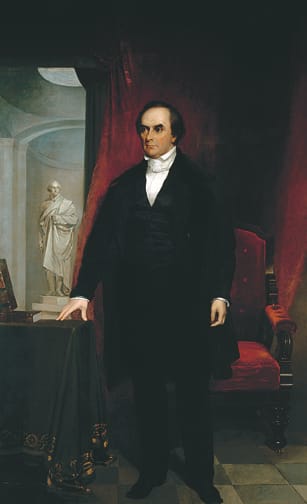
Daniel Webster

By Kristin Cook

May 2015

Daniel Webster has a place amongst America’s second generation of founding fathers, his time in the United States Senate and his famed orations helping to chart the path of the still-young nation in the first half of the nineteenth century. We are familiar with grand portraits of Webster, and five different busts of his likeness can be seen in the current gallery show at the Athenæum. Yet how much do we learn about him after elementary school? Perhaps if we study politics or law we are well-versed in Webster’s influence on the Constitution’s development, but if like many you grew up with Webster only in the periphery, read on for a primer:

Daniel Webster was born on January 18, 1782, in Salisbury, New Hampshire. At the time the small town was part of the exposed northern frontier, and Webster’s modest homestead can still be visited today, though it has been moved multiple times and is now seated in Franklin, New Hampshire. Webster’s father, Ebenezer, had been granted 225 acres of land for his service in the militia during the invasion of Canada in 1759, and was a founder and local leader of Salisbury. He achieved the rank of colonel, though he preferred to retain the title captain. Abigail Eastman was Ebenezer’s second wife and Webster’s mother. Daniel was the ninth of ten children (Abigail’s fourth) and a youth of delicate health. He was precocious and of a passionate nature, which encouraged his father to spare him from physical labor and send him to school—something Captain Webster was never afforded. In 1796, at the age of fourteen, Webster was enrolled at Phillips Exeter Academy. He proved capable in his studies but was shy and found himself incapable of participating in the mandatory public declamations. In December of that year Webster returned home with his father without completing his course, and for a short while taught school. An arrangement was made after a brief period for him to study under the Rev. Samuel Wood of Boscawen, a town not too distant, in preparation for entry to Dartmouth College. In the fall of 1797, with competency in Latin and Greek, Webster entered Dartmouth where he proved much more successful than at Exeter. He contributed to the village newspaper, participated in college debating societies, and earned a reputation as a speaker so great that the citizens of Hanover requested he give the Fourth of July oration. At only eighteen years old the characteristic vigor of his early speeches was already on display in this effort.

After graduating near the top of his class, Webster began to study law at the office of Thomas W. Thompson of Salisbury. He seems to have doubted he was suited for the profession, and after a few months accepted a position as a teacher in the small village of Fryeburg. Webster could have made a good living teaching, which would have allowed him to aid his father and support his elder brother Ezekiel in college. Yet, at the urging of his family and friends, he returned to the tutelage of Thompson in 1802. When Ezekiel began teaching school in Boston he invited Daniel to join him there, and Webster was soon clerking for Christopher Gore. In March 1805 he was admitted to the Boston Bar but was soon recalled to Boscawen due to his father’s failing health. By September 1807, his father had passed and Webster had transferred his practice to Portsmouth, New Hampshire. The following nine years he lived on the New Hampshire seacoast with his wife Grace Fletcher (the daughter of a clergyman), and enjoyed the professional rivalry of Jerimiah Mason, from whom he learned to curtail his ostentatious courtroom style in favor of Mason’s incisive manner.

During this period Webster was drawn into politics; the federalist convictions he inherited from his father were reinforced by his contacts in Boston. Though he was conservative in temperament, remember that Webster had come of age amidst the fear of the French revolutionary ideas of democracy, which were more radicalized than those upon which his own nation was founded. Webster thought these ideas undermined national union and threatened civil war, and he became known for Fourth of July orations and occasional pamphleteering in the name of revived federalism. He championed the shipping interests of New England, and voiced the opposition to the embargo laws of the early nineteenth century. At the famous “Rockingham Memorial” in August of 1812, he condemned the national administration for leading the country into an unjustifiable war, and renounced the idea of New England separating from the Union.

He was nominated for Congress soon after, and upon winning a seat became a member of the committee of foreign relations. Reelected in 1814, he was influential in the attempts to make peacetime economic adjustments. He was well known for his devotion to sound principles of public finance and for his opposition to the high protective duties of the 1816 tariff, which threatened the import and shipbuilding industries in New England. In August of that year Webster moved from New Hampshire back to Boston, where he put aside politics and focused on his law practice. It was not long before he was bringing in high profile cases and high profits. In fact, Webster was the lawyer for the Dartmouth College trustees in the Trustees of Dartmouth College v. Woodward case, a landmark decision from the United States Supreme Court dealing with the application of the Contract Clause of the United States Constitution to private corporations. The case arose when the president of Dartmouth College was deposed by its trustees, and the New Hampshire legislature attempted to force the college to become a public institution and thereby place the ability to appoint trustees in the hands of the governor of New Hampshire. On February 2, 1819, the Supreme Court upheld the sanctity of the original charter of the college, which predated the creation of the state, and Webster became, in the opinion of many, the foremost lawyer of the time. Three weeks after this decision he appeared for the Bank of the United States in McCullough v. Maryland, which concerned the state of Maryland taxing banks that had been chartered by the federal government rather than by the state. The tax was ruled unconstitutional and the case became the legal cornerstone of subsequent expansions of federal power.

As Webster rose in prominence, he was unable to stay out of politics (and the public eye) for long. In December 1819 he publicly opposed the admission of Missouri as a slave state, and the next autumn made the main address in favor of free trade at a meeting of New England importers in Faneuil Hall. On December 22, 1820, he gave a moving speech at Plymouth in celebration of the 200th anniversary of the Pilgrims’ landing. By then, he had made popular the idea of the occasional oratory, a trend that would thrive for decades. He briefly held a seat in the Massachusetts House of Representatives in the spring of 1822 before being elected to represent Boston in Congress, where he was made chairman of the judiciary committee in December 1823. An oration on Greek independence in January signaled his return to the national arena, but his main focus was to be the tariff question and what he could do to challenge Henry Clay’s arguments for protection, beginning in April 1824 with his attack on the proposed tariff bill. Other issues at play during his term were his support for John Quincy Adams’s doctrine of internal improvements; his leading of the (futile) fight for a revision of the federal judicial system; and his appeal for representation in the congress for Panama. In 1827 he was elected to the United States Senate from Massachusetts, but he temporarily lost interest in public life when his wife died around the time he took office. However, once the Tariff Act of 1828 passed, Webster found himself again embroiled in the debate. Now less satisfied with economic theory and more concerned with the realities of life, he believed the federal government had decided on its policy and that the New England states must adapt to a future of protection (later he would become an aggressive champion of this policy). Unfortunately for Webster, more losses followed: Jackson defeated Adams for reelection, and Webster’s favorite brother Ezekiel (who had entered New Hampshire politics) died. Webster’s life took on newfound meaning upon his marriage to the young New York sophisticate Caroline Le Roy in mid-December 1829, and just over a month later he was back in action in the famous Webster-Hayne debate, battling Senator Robert Y. Hayne of South Carolina on the topic of protectionist tariffs. The heated speeches between Webster and Hayne from January 19 to 27 1830 were unplanned, and stemmed from debate over a resolution by Connecticut Senator Samuel A. Foot calling for the temporary suspension of further land surveying until land already on the market was sold (this would effectively stop the introduction of new lands onto the market). Webster’s “Second Reply to Hayne” was generally regarded as the most eloquent speech ever delivered in Congress, and Webster’s description of the U.S. government as “made for the people, made by the people, and answerable to the people,” was later paraphrased by Abraham Lincoln in the Gettysburg Address in the words “government of the people, by the people, for the people.” The debate was considered a victory for federalism over the cause of states’ rights, and over nullification, the legal theory that a state has the right to nullify or invalidate any federal law that the state deems unconstitutional. Known as the Defender of the Constitution, Webster’s fame again reached national scale, and with this turning point in all aspects of his life, dreams of the White House seemed as though they could come true.  

With the formation of the new Whig Party, which opposed Jackson and his war on the Bank of the United States, Webster was nominated as the party’s presidential candidate from Massachusetts for the 1836 election. With other Whig nominees in the field, however, he did not garner much support outside of New England, and following his defeat he gave serious consideration to retiring from politics. His interests turned to the personal, including his seaside home in Marshfield where he entertained lavishly and fell into debt. In 1839, he and his family visited England, hoping to find buyers for lands he owned in the American West, and also to acquaint himself with the issues surrounding the border dispute between Maine and Canada. Not long after his return to Boston, Webster was made secretary of state by the new president, William Henry Harrison; upon Harrison’s death a month later, his successor John Tyler retained the cabinet in office. When Tyler successfully vetoed two measures by the Whigs that sought to reestablish a United States bank, all the members of the cabinet resigned except for Webster, who tried to play a conciliatory role. He was determined not to throw the foreign concerns of the country into disarray over party proceedings, and in fact brought to a successful conclusion the Webster-Ashburton Treaty of 1824, which negotiated the Maine-New Brunswick border and established shared use of the Great Lakes, reaffirming the western frontier of the Rocky Mountains at the 49th parallel, defining seven crimes subject to extradition, and calling for an end to the slave trade on the high seas. Webster’s other successes in the State Department include successful negotiations with Portugal, important discussions with Mexico, and preliminary discussions about the opening of diplomatic relations with China. He was, however, under strong Whig pressure to resign, and with reluctance in May 1843 he did just that. Overwhelmed with debt, Webster returned to his legal practice for a short time, and in the winter of 1845 he returned to the Senate. In the spring of 1846—after the United States annexed Texas—The Mexican-American War began, as Webster feared would happen. He had opposed the annexation and the resulting extension of slavery, and joined the Whig policy of condemning the war. He held, however, that supplies should be voted in an attempt to bring the conflict to a speedy and successful termination. His second son, Major Edward Webster, died on exposure in service near Mexico City.

Not entranced by notions of empire, Webster introduced resolutions repudiating the dismemberment of Mexico, yet the war ended in a treaty that gave the United States a vast domain carved out of their neighboring country. Webster voted consistently for the Wilmot Proviso, which would have banned slavery in territory acquired from Mexico had it ever passed both houses of Congress. Seeking his former glory and the one office he had not attained, Webster made a Southern tour in the spring of 1847, which only drew him further into debt, as well as into poor health and spirits. His daughter Julia had also died fairly young, and coupled with the death of Edward he fell into a depression. He was passed over for the nomination of his party in favor of military hero General Zachary Taylor, but became secretary of state again in 1850 after Taylor’s death, for Millard Fillmore’s cabinet. In 1851 Webster wrote to denounce as revolution the secession of Southern states, and in foreign affairs dealt with diplomatic difficulties with Spain, Mexico, Peru, Great Britain, and with the Hungarian Revolution and the Austrian empire. Webster’s presidential aspirations were revived once more in 1852 (much to the embarrassment of many in his party, as Fillmore was also a candidate). Ultimately neither was chosen to represent the Whigs, and Webster became increasingly ill as the year progressed. By autumn he was diagnosed with cirrhosis of the liver. He died on October 24, 1852. He was survived by his second wife Caroline and his son Fletcher, who was later killed in the Civil War.

A stirring champion of the American Union, Daniel Webster left his mark on American history through his work in the constitutional courts, the House of Representatives, and twice as the secretary of state. His political career spanned four decades and he became nationally renowned for his oratorical skill. Webster is today still a revered figure in New Hampshire and Massachusetts, and is also the subject of a short story by Stephen Vincent Benet, “The Devil and Daniel Webster,” which was made into a 1941 Academy Award-winning film titled All That Money Can Buy. It tells the story a fictional farmer who sells his soul to the devil but is defended by a fictional version of Daniel Webster, who is able to win over the jury of the damned and save the farmer’s soul from hell solely by virtue of his eloquence.

Selected Works

The Devil and Daniel Webster (Library of Congress PZ3.B4292 De) The Life, Speeches, and Memorials of Daniel Webster : Containing his most celebrated orations, a selection from the eulogies delivered on the occasion of his death, and his life and times (Cutter 65 .W395 .sm)

One And Inseparable : Daniel Webster and the Union (Library of Congress CT275.W408 B29)

Daniel Webster (Library of Congress CT275.W408 B27)

Daniel Webster (Cutter 65 .W395 .fu [2 volumes])

References

Baxter, Maurice G. “Daniel Webster.” Encyclopedia of the American Constitution. Gale,
2000.

“Daniel Webster.” Dictionary of American Biography. New York: Charles Scribner’s Sons,
1936.

“Daniel Webster.” Merriam Webster’s Biographical Dictionary. Springfield, Ma: Merriam-
Webster, 1995.

Daniel Webster Homestead. Accessed March 18, 2015. http://www.nhstateparks.org/explore/state-parks/daniel-webster-birthplace-state-historic-site.aspx.

01.26.2015

Scott B. Guthery

March 2015

By Arnold Serapilio

You’ve seen Scott Guthery at the Athenæum before. You know him from the Mathematics, Technology, and Society discussion group, which he leads, as well as the newly-formed Athenæum Encyclopӕdists, which he also leads. You’ve taken one of the art and architecture tours offered every Tuesday and Thursday at 3:00 p.m. and Scott was the docent on duty, enthusiastically expounding upon the many wonderful pieces of art in our collection, peppering his stories with points of mathematical interest. You’ve bumped into him while you’re both getting happily lost in the Lower Pilgrim stacks—which, incidentally, is how the math group was formed. If nothing else, you’ve seen him working in an alcove on the second floor. He’s a fixture. 

As a young man growing up in Cleveland, Ohio, Scott spent much of his time learning about computer programming and discovered it is concentric with mathematics. The designs of both studies are ordered by hierarchy, i.e., the approach to and execution of programming a computer and solving a math problem are essentially the same, so an understanding of mathematics is helpful when programming computers. 

His burgeoning curiosity in technology aside, Scott’s academic goal at first was to become a medical doctor. To that end he began his undergraduate study of medicine at Colgate University in 1959. But a lifelong interest in mathematics proved too integral to be denied. After two years he decided to finish up his undergraduate work at Miami University of Ohio, securing his degree in mathematics. In 1966 he earned his master’s; his Ph.D he acquired soon after at Michigan State. 

Recently Scott and I sat down for a chat in the back nook near Conservation. I wanted to get some basic information about his personal history and his background in math. What I got was a lovely conversation with a smart, spirited, and curious man. Scott was generous enough to share even more thoughts over email. Below is the distilled essence of these talks.

Q: When and how did you wind up in Boston?

SG: I moved from Austin, Texas in 1999 to co-found a mobile network applications business called Mobile-Mind. I moved to Boston since getting a start-up running from two locations is difficult at best. 

[Scott discovered the Athenæum in 2011 when the Ticknor Society organized a special tour for book collectors. Scott signed up for the in-depth tour, which included curator presentations about special features of the collection. Not surprisingly, he was sold with that first look. Within a year of establishing membership he answered the Athenæum’s call for new docents. Any excuse to spend time at 10 1/2 Beacon.]

Q: Toward what area of mathematics are you most compelled

SG: When I worked for technology companies I wrote about interesting mathematics. When I started my own press I wanted to write about interesting mathematicians. “Interesting” here means eclectic and unrecognized; that is, anything but famous. Anybody can write about famous mathematicians. Their papers have been collected and their works bound. I find that it is far more enjoyable and challenging to write about people whose contrail in history is almost invisible. 

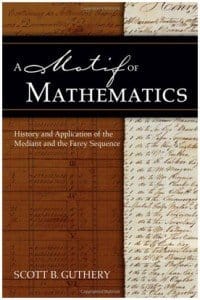
[In line with this approach, Scott published A Motif of Mathematics: History and Application of the Mediant and the Farey Sequence, in 2010.]

Q: What is A Motif about?

SG: A very simple sequence of numbers called the Farey sequence.

[The Farey sequence is the arrangement of irreducible fractions (in order of increasing size) between 0 and 1 with denominators less than or equal to given value n. E.g.: when n= 5, the Farey sequence is 0, ⅕, ¼, ⅓, ⅖, ½, ⅗, ⅔, ¾, ⅘, 1.]

John Farey was a British geologist who published a short letter in the May 1816 issue of Tilloch’s Philosophical Magazine and Journal inquiring about a mathematical property of the sequence. He has ever since been taken to task in the mathematics literature for stealing the insight from “somebody named Haros” so I decided to write a a book about Haros. As it turns out, it was a lion of French mathematics and a colleague of Charles Haros, Augustin-Louis Cauchy, who misnamed the sequence after Farey. See Stigler’s Law of Eponymy: No scientific discovery is named after its original discoverer. By the way, Stigler’s law was first recognized by Robert Merton so it is an example of itself.

[Scott’s not just being funny. Though it’s unclear to me whether Stigler’s Law is truly, serendipitously an example of itself or whether Stigler exercised a little dramatic license—after all, who says math types can’t be creative? More on that later.]

Q: When/how/why did you decide to start your own press? 

SG: Mobile-Mind was acquired by a telecom company in 2006. I stayed with the buyer for a while and then was recruited to build cryptography and digital security products for a global technology company. But once you get the start-up bug and work for yourself it’s really hard to go back to working in a big hierarchical organization. So I left in 2009 and started Docent Press.

Q: Any projects on the horizon? 

SG: The book I’m currently working on, Readers at the Boston Athenæum (1827–1850), is centered on the Athenæum’s books borrowed registers. The first four volumes of the register have been digitized and contain 122,020 charge records of 705 individuals. As my background is mathematics, I started by writing a chapter about all the Athenæum readers who borrowed at least one mathematics book. There were 44 of them. Another chapter is about all the readers that held at least one US patent. There are 15 of them and as a group they held 67 patents with the leader being Erastus Bigelow of Bigelow carpet fame, who held 20. I’m currently working on a chapter about John Guardenier, a four-time Athenæum proprietor and prodigious Boston book binder who bound hundreds of books for the Athenæum and who paid for his shares in kind. Guardenier generated 393 entries in the four registers, borrowing some 227 titles.

One of my favorite stories coming out of my work with the Athenæum’s Books Borrowed registers is about the Josiah Parsons Cookes, Sr. and Jr. Josiah Parsons Cooke, Sr., was an Athenæum proprietor and a widely-respected Boston lawyer. Josiah Parsons Cooke, Jr. was “the first university chemist to do truly distinguished work in the field of chemistry” in the United States. An apocryphal story about Jr. is that his interest in chemistry was sparked by reading Edward Turner’s Elements of Chemistry. Sure enough, consulting the books borrowed register we find that on June 17, 1842, Sr. borrowed “Terners [sic] Chemistry.” Jr. was 15 years old at the time. Not only is Turner’s book still on the shelf at the Athenæum but I like to imagine that it is the very copy that was borrowed by Sr. and started the illustrious career of Jr.”

[Scott’s enthusiasm is contagious. With this anecdote in mind I dashed to the shelves to pull the signature card from Turner’s book; my hopes, in turn, were dashed when the card wasn’t there. However: at the end of that same shelf is Cooke Jr.’s Elements of Chemical Physics. The checking out of one book led to the publishing of a book not ten inches down the row 32 years later. This is the stuff of chills.]

Q: What is the future of mathematics? What avenues are mathematicians exploring today? Where are their discoveries leading us?

SG: The absolute end of mathematics is when the percentage of mathematics in the future is zero everywhere in our concentric circle landscape. The effective end of mathematics is when the rate of change of this value is zero everywhere in the landscape. In either of these senses, how close to the end are we today? Mathematics researchers are the people moving mathematics from the future to the past; i.e., decreasing the percentage of mathematics in the future. I think of those working in the inner circles as pushing the percentage of mathematics in the past upward and I think of those working in the outer circles as pushing the percentage of mathematics in the past outward. I also think that they are both having a harder time. That is, the rate of change both upward and outward is tending to zero. [I]t’s harder to know more about what you already know a lot about and easier to know more about what you don’t know much about.

[Scott stresses more than once (primarily due to my obtuseness) the idea that today’s findings encapsulate everything previously discovered. One finds the sum total of information on a topic to be the most generalized and abstract, which ultimately may prove unhelpful to somebody looking for solutions to a real-world problem. “Mathematics is not a discipline that appreciates its own history,” Scott notes. To a mathematician, today’s findings are the most inclusive, so why bother tracing the history? That Scott rejects this way of thinking is refreshing and heartening. He mentions how great the Athenæum’s de-acquisition policy is: that there is no de-acquisition. Once we’ve obtained a book we hold onto it, ensuring an expansive, alive collection.]

[There is also the notion of creativity in mathematics. Scott asserts there are many very bright people applying mathematics in creative ways in order to solve practical problems; the example he gives is of Oliver Evans, the inventor of the automated grist mill, trying to determine the minimum amount of resources and correct conditions needed to yield the greatest output. Mathematicians who discount yesterday’s techniques (which are simple in presentation and more readily understood) applied today’s findings (abstract, more abstruse) and arrived at an answer mill builders intuited was insufficient. The mill builders themselves applied some more fundamental ideas and yielded more profitable results. If the future of mathematics is uncertain, it’s because we are getting mired in the abstract rather than re-appropriating what we already know in new and innovative ways.]

Suppose then that the rate of change in all directions goes to zero; that despite their best and most strenuous efforts, research mathematicians cannot budge the horizon between past and future; that we know all the mathematics we can know and will ever know. There are certainly mathematical lines of investigation that have reached this impasse. Why not the entire field?

[Our conversation ends because Scott has to run upstairs to the Athenæum Encyclopӕdists meeting that begins in minutes. Before we part ways, though, he takes me down to Lower Pilgrim to show off the math section. Cutter H. I watch him pulling the books down from the shelves and admiring them. There is love and attention and reverence in his fingers and in his voice. Each book is tactile history, weighty but within reach.]

Selected Works:

A Motif of Mathematics: History and Application of the Mediant and the Farey Sequence

Bibliography of Raymond Clare Archibald (Appointment Required)

Calculating Curves: The Mathematics, History, and Aesthetic Appeal of T. H. Gronwall’s Nomographic WorkDeveloping MMS Applications: Multimedia Messaging

Learning C. with Tiny C.

Practical Purposes: Readers in Experimental Philosophy at the Boston Athenæum (1827-1850)

References

Cohen, I. Bernard (1959). “Some Reflections on the State of Science in America During the Nineteenth Century”. 

Proceedings of the National Academy of Sciences 45 (5): 666–677.

Guthery, Scott B. A Motif of Mathematics: History and Application of the Mediant and the Farey Sequence. Boston: Docent Press, 2010.

Jensen, William B. “Physical Chemistry before Ostwald: The Textbooks of Josiah Parsons Cooke,” Bull. Hist. Chem, v. 36, n. 1(2011), pp. 10–21.

12.12.2014

Ellen Louise Chandler Moulton

The snow and the silence came down together,
Through the night so white and so still;
And young folks, housed from the bitter weather,—
Housed from the storm and the chill,—

Heard in their dreams the sleigh-bells jingle,
Coasted the hill-sides under the moon,
Felt their cheeks with the keen air tingle,
Skimmed the ice with their steel-clad shoon.

(Moulton, “Out in the Snow,” 1878, stanzas 1 and 2)

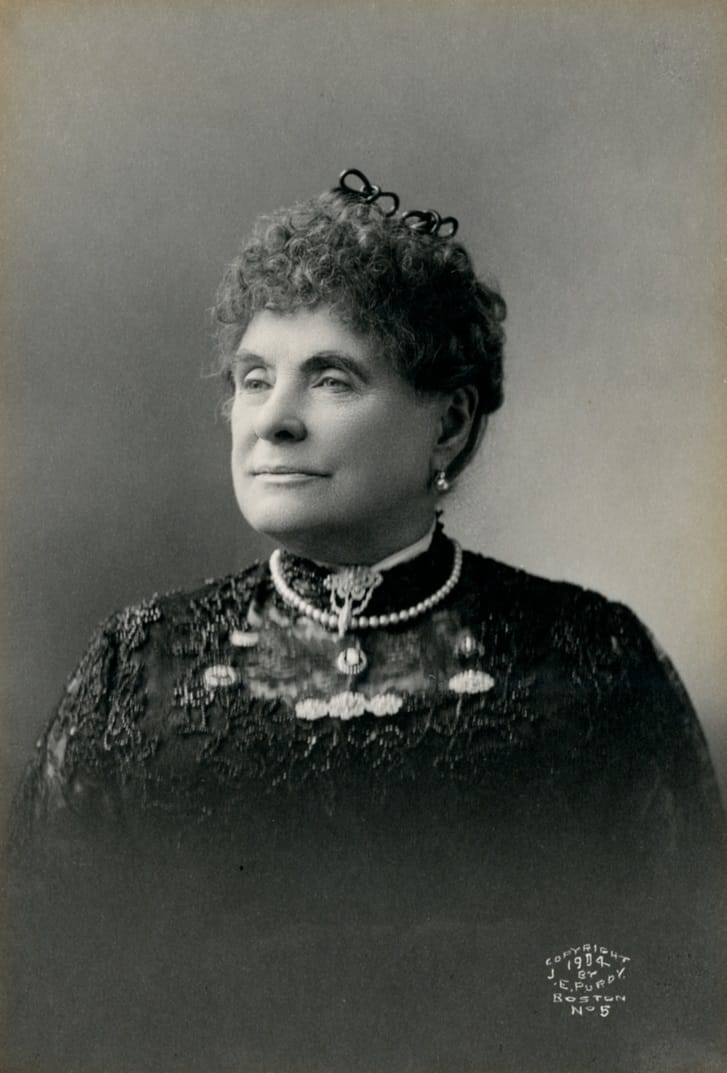
This month’s author is today best known for her myriad friendships with the lettered men and women of her time but was in fact an accomplished poet and writer herself. Louise Chandler Moulton, christened Ellen in 1835, was born in Pomfret, Connecticut, the only child of Lucius Lemel and Rebecca Clarke Chandler. At Christ Church Hall School in Pomfret her classmates included the artist James McNeill Whistler and Edmund Clarence Stedman, one of the first seven men chosen for membership in the American Academy of Arts and Letters. Both Whistler and Stedman remained Moulton’s lifelong friends, and she always kept Whistler’s childhood gift of an “exquisite little painting,” lending it to be part of a Boston exhibition sponsored by the Copley Society after the artist’s death.

In her youth Moulton was a diligent student, as was expected from her stern Calvinist parents but also, it seems, because she enjoyed learning. Her free time was given over to versifying and creating stories of young women with lives more dramatic than her own. She wrote of the heroine of one of her tales that “ideality was the predominant characteristic of her mind.” This could well be said of Moulton herself, who was first published at the age of 14, when one of her poems appeared in a newspaper of Norwich, Connecticut. Encouragement from friends and other authors who had seen her work followed and she went on to contribute poems to gift books. At the age of 17, she edited a gift book of her own verses and short stories along with contributions from other authors, called The Book of the Boudoir. With this publication she came “fully and formally into full-fledged authorship,” according to her friend and biographer Lilian Whiting, and a wider audience saw that “she was deeply tinged with the sentimental fashions which reigned universally in America in the middle of the nineteenth century.”

The melancholy and sensitivity of Moulton’s poems have been attributed to her strict Protestant upbringing, even by herself. The doctrine of election, in which the identity of those who will be saved and admitted to heaven has been preordained by God, haunted Moulton as a child. Despite the fact that her parents were not fanatical, their faith instilled in their child a foreboding of doom and despair and she “imaginatively suffered intensely.” As an adult, Moulton once told a London interviewer, “I can recall waking in the depth of night, cold with horror, and saying to myself, ‘Why, if I’m not one of the elect, I can’t be saved, no matter how hard I try.’” Indeed, if much of Moulton’s poetry seems to have an underlying obsession with death and the departure of loved ones, this might be the answer to the origin of her pathos.

At the age of 18 Moulton published another book, which reportedly sold 20,000 copies: This, That, and the Other, a collection of all her previous submissions to newspapers and magazines. At over 400 pages long, it received glowing criticism; Stedman even compared Moulton to Harriet Beecher Stowe. In hindsight, Whiting considered this review “a matter of private judgment … for although the stories of Ellen Louise were singularly sweet and winsome in their tone, with an unusual grasp of sentiment and glow of fancy for so youthful and inexperienced a writer, they could hardly yet claim to rank with the work of Mrs. Stowe.” Regardless, this publication contributed to the high regard in which Moulton’s peers held her when she joined Mrs. Willard’s Seminary in Troy, New York, when she was 19 years old. At the end of the one-year education she was chosen as the class poet and was asked to write and deliver a fairly standard verse for the commencement ceremony.

During her time at the women’s school, Moulton contributed regularly to literary magazines such as Godey’s Lady’s Book and Peterson’s Magazine, and six weeks after her graduation, on August 27, 1855, she married William Upham Moulton, the publisher of The True Flag, one of the many magazines that had published her poems. The couple moved to Boston, where Moulton settled in as part of a vibrant literary community. The two were members of the Boston Athenæum, and the last time she saw her friend Ralph Waldo Emerson before his death was in fact within those walls; he had just returned from a trip to California and asked if she had ever ventured there to see the big trees. Along with enjoying the historic environs the city had to offer, the new Mrs. Moulton hosted a Friday salon in her home, which was frequented by artists, musicians, and writers, including John Greenleaf Whittier, the poet and abolitionist, poet Henry Wadsworth Longfellow, and poet, physician, and professor Oliver Wendell Holmes, Sr.

Interestingly, Holmes was the inventor of the American stereoscope, consisting of two prismatic lenses and a wooden stand to hold a stereo card, which displayed two copies of the same photograph side by side. Looking through the two lenses rendered the image three-dimensional, and was an enjoyable recreation for those who wanted to view (rather than read about) monuments, nature, and celebrities far before the age of the television, internet, or even radio. One must wonder whether it was Holmes’s influence or her husband’s know-how as a publisher and promoter that prompted the creation of a stereo card featuring Moulton posing in the fashion of the day. Either way, public interest in her works and her person were clearly very high. Indeed, when in 1855 she published the novel Juno Clifford anonymously, it received high praise even without her name attached to it; surely her earnestness of spirit shone through in all her works, whether attributed or not. And it was a spirit fitting with the times, for as Whiting noted, “the fiction of the day was . . . largely occupied with a certain didactic embodiment of ideas of conduct,” and Moulton’s heroines always acted as a good woman should.

Moulton’s third book, another collection of her stories and poems previously published in magazines, aptly titled My Third Book, appeared under her name in 1859. From this point and for the following 10 years Moulton’s extensive notes on her reading are extant, a practice she had picked up in school along with a taste that was “catholic” and an “attitude toward literature … of genuine seriousness.” She found The Scarlet Letter profoundly impressive, for example, but thought Sense & Sensibility “interesting but deficient in earnestness.” There are also notes for many projected but unwritten stories, though in 1873 she published Bedtime Stories, dedicated to her young daughter Florence. Florence became an only child as Ellen Louise had been, for a son born not long after died within a few days. Meanwhile, Moulton contributed to newly-launched magazines, including such titles as Atlantic MonthlyHarper’s and Scribner’s, and also some children’s publications. She also served as the Boston literary correspondent for the New York Tribune from 1870 to 1876, and contributed a weekly letter on books for the Boston Sunday Herald from 1886 to 1892.

In this mature stage of her life Moulton’s salons were frequented by the Sargents, the Howes, and the Higginsons, and she began to travel abroad to London and Paris. Eventually, she spent six months of the year in London and presided over a salon there, where she knew Browning, Eliot, and Hardy. She also met Swinburne, through whom she came to know the Pre-Raphaelites, including its leaders, the Rossettis, and important followers like William Morris, William Holman Hunt and Edmund Burne-Jones. Her successful effort to win recognition in America for these artists and writers, considered “late Romantics,” was one of her major achievements. Yet three more of her own books were still to come, all of them travel sketches and cultural “appreciations”: 1881’s Random Rambles; 1887’s Ourselves and Our Neighbors; and 1896’s Lazy Tours in Spain and Elsewhere. In 1888 her husband William passed away, and though “no faith or philosophy could ease her fear of death,” Moulton reportedly found some solace in Christian Science in her own last months. She died of Bright’s disease in her Boston home in 1908, and is buried beside her husband in Mount Auburn Cemetery, Cambridge.

Ellen Louise Chandler Moulton was never domestic in her tastes, nor involved in the social questions of her day. She corresponded with a Mrs. Eliot who along with her husband was a constant supporter of the Booker T. Washington School in Tuskegee, but there is no evidence that Moulton ever supported those less fortunate. Instead, she gave to the world a number of stories, some pleasant, some heart-rending. Aside from her fostering of others’ talents and the introduction of Pre-Raphaelite and French symbolist poetry to an American readership, Moulton’s most enduring legacy is her poetry, in which “she recorded her deepest convictions and her most intimate perceptions of the facts of life.” Moulton herself once called her work “the rhymes into which, from the first, I put more of myself than any other form of expression.” Unfortunately, like many women, she is today remembered for the men she knew and cultivated rather than in her own right. Yet the evidence of many professional portraits taken over the course of her lifetime and the fact that many photographs from her youth were reissued the year after her death suggests that her contributions to Boston literary life were appreciated by her contemporaries.

Selected Works:

Random Rambles(Cutter Classification, AA .M86)
Lazy Tours in Spain and Elsewhere (Cutter Classification, AA . M86.1)
Ourselves and Our Neighbors (Cutter Classification, 1S . M86)
The Poems and Sonnets of Louise Chandler Moulton (Cutter Classification VEP. M86)
In the Garden of Dreams: lyrics and sonnets (Cutter Classification VEP .M86 .i)

References:

“Ellen Louise Chandler Moulton.” Dictionary of American Biography. New York: Charles    Scribner’s Sons, 1936. Biography in Context. Accessed 30 May 2014.  
James, Edward T, Janet Wilson James, and Paul S. Boyer, eds. Notable American Women 1607-    1950: a biographical dictionaryCambridge, MA: The Belknap Press of Harvard    University Press, 1971. 
Moulton, Louise Chandler. Swallow-FlightsLondon: Macmillan and Co., 1878. 
Whiting, Lilian. Louise Chandler Moulton, Poet and Friend. Boston: Little, Brown, and    Company, 1910. p. 10, p. 19, p. 21, p. 22, p. 23, p.24, p.31, pp. 44–45, p.46, p. 52, p.57

11.25.2014

James Conroy

December 2014

by Emilia Mountain

James Bernard Conroy was born in Bridgeport, Connecticut in 1949 to Bernard and Marguerite Johnson Conroy. Bernard was a 17-year-old medic in the WWII invasion of France and later became a hematologist. Marguerite took care of the home and encouraged Conroy’s reading, especially history. As a very young boy, Conroy remembers being disappointed to learn that he couldn’t become a Sioux Indian when he grew up. He read Anne Terry White’s All About Archaeology (1959) until the binding started to fall apart. Indeed, nothing trumped his boyhood love of archeology until he read Jim Bishop’s The Day Lincoln Was Shot (1955) as a teenager. He was utterly fascinated by Bishop’s methodology: searching for fact after fact, recording them on index cards, putting them in order by the minute and the hour, then writing a history of a single day’s events. Conroy has been drawn to historical research and writing ever since.

In 1967, Conroy enrolled at the University of Connecticut to study political science and history. He admits with good humor that his favorite college locations were not the classrooms. And yet he can still remember that fateful day on a patio, deep in thought, when he made the difficult decision between going to graduate school for history and moving to Washington D.C. to pursue a life in politics—an attractive prospect for many of his generation who were inspired by John F. Kennedy. He eventually served as Press Secretary for the United States Senate Committee on the Budget, Administrative Assistant to Congressman James Scheuer (D.N.Y.), and in the United States Navy Reserve as a photographer and journalist. After his daughter was born, however, he sought a profession that was not so dependent upon elections. Conroy earned his J.D. at Georgetown University and became a commercial litigation attorney, transitioning to semi-retirement only recently.

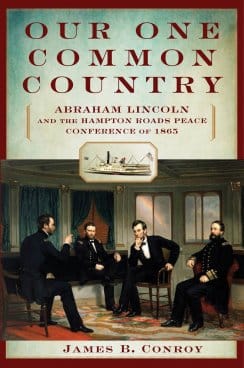
Throughout the years, writing history was always “in the middle,” as opposed to “in the back,” of Conroy’s mind. The trick was finding a topic. One day, while reading from Shelby Foote’s The Civil War: A Narrative (1986), he came across a reference to peace negotiations between Lincoln and three senior Confederate officials that took place on a riverboat in Virginia. He’d never heard of the Hampton Roads Peace Conference and found that very little had been written about it. “Never before had a sitting US president engaged in peace talks with the enemy in the midst of a shooting war, and never has it happened since.” Our One Common Country: Abraham Lincoln and the Hampton Roads Peace Conference of 1865 (2014) is Conroy’s attempt to address this gap in the Civil War narrative and help readers understand the underlying issues behind the tragic failure of the peace talks.Conroy, James. Our One Common Country. Lyons Press: Guilford, CT, 2014.

Conroy visited many libraries while researching Our One Common Country, including the Museum of the Confederacy in Richmond, the Library of Virginia, Duke University Library, the University of North Carolina Library, and the Library of Congress. However, he actually completed most of his research at the Boston Athenæum, where primary and secondary sources for both the Union and the Confederacy are extensive. Even while he was still working at his law firm at One Beacon Street, he could walk over on a lunch break to pick up books at Circulation or Interlibrary Loan and ask a question or two of the “uniformly pleasant and helpful” reference librarians and interns. The fifth floor reading room was also a relaxing place to complete most of his writing, and he found the nineteenth-century margin notes in some of the older donated volumes on the Civil War both amusing and illuminating. In February 2014 he enjoyed giving a lecture to an Athenæum audience where he felt there was a true intellectual and sentimental “resonance” with his subject (As our Civil War Discussion Group attended in full, this is no surprise).

In his spare time, Conroy enjoys family history research. His great-grandfather, born in Ireland and also named James Conroy, was in the fortieth New York Infantry in the Civil War. The Civil War veteran’s wife, born Bridget Burns, was a dressmaker for high society—Mrs. Lincoln included. At the moment, Conroy is hard at work, with the help of our reference librarians, choosing another mysterious, little-known, historical topic to research. That would be his favorite kind.Works Cited: Conroy, James. Our One Common Country: Abraham Lincoln and the Hampton Roads Peace Conference of 1865. Lyons Press: Guilford, CT, 2014. 

10.23.2014

Nathaniel Hawthorne

November 2014

by Deborah F. Vernon

Nathaniel Hawthorne (1804–1864) was born in Salem, Massachusetts. He was the descendant of one of the first families to settle in Salem, the Hathornes. By the time he was born, the family name had fallen from its place of distinction. This was due to his great-great-grandfather, William Hathorne, and his great-grandfather, Colonel John Hathorne. The former claimed Quakers were heretics and persecuted them as such, including the notorious flogging of a Quaker woman as she was dragged half naked through the streets of Salem. The latter was a judge during the Salem Witch Trials. The Colonel found over a hundred women guilty of witchcraft and would ride out to Gallows Hill to witness the hangings. Legend has it that one of the “witches” cursed the Colonel and his family before her death. Nathaniel Hawthorne never escaped a sense of guilt for his family’s deeds, and in that sense, the curse was real. The burden of the past manifested in his writing, perhaps most directly in the short story “Young Goodman Brown” (1835) and The Scarlet Letter(1850). Hawthorne wryly summarized, “Let us thank God for having given us such ancestors and let each successive generation thank him, not less fervently, for being one step further from them in the march of ages” (Wineapple,15).

A discredited name was paired with a steady decline in the Hathornes’ financial standing. Matters were made worse when Hawthorne’s father died at sea. With his death, Hawthorne’s mother was unable to care for her four-year-old son and two daughters. His uncles, Richard and Robert Manning, supported the family. Thus, Hawthorne traveled from one Manning household in Maine to another in Salem for much of his youth. He graduated from Bowdoin College in 1825. As a student he was undistinguished, but what set him apart from his peers was his determination to be a writer. He moved home to Salem with the express purpose of writing the next great American novel. It was during this time that he changed his name from Hathorne to Hawthorne to distance himself from his family history.

The novel Hawthorne dreamed of writing during this time never came to fruition, but he did write several short stories that brought him some acclaim. “Young Goodman Brown” (1835) is a story concerning witchcraft—bearing allusions to William Hathorne and Colonel John Hathorne—that continues to be a staple of high school English classes. The story reflects a preoccupation with the past and a doubting self and is also indicative of the solitude and darkness that Hawthorne associated with these years after college. He may have continued in Salem, writing, lonely, publishing a piece of literature that would bring him some mention but little financial success, if he had not fallen in love. Sophia Peabody claimed, “I never intend any one shall have me for a wife” (Wineapple, 112)—obviously, Hawthorne convinced her otherwise, but this did not mean he had the means to support a wife and family. He left Salem for Boston where he worked at the Boston Custom House in the hopes of saving enough capital to marry his intended.

It was during these years in Boston that Hawthorne frequented the “noble hall” of the Boston Athenӕum, which at the time was located on Pearl Street. He particularly enjoyed spending a quiet hour in the Reading Room and it was there that he came into contact with one of the Athenӕum’s resident ghosts—Reverend Thaddeus Mason Harris. In April of 1842, Hawthorne entered the Athenӕum’s Reading Room to find the Reverend in his usual chair, newspaper in hand. Hawthorne did not think there was anything untoward until later that evening, when a friend told him the Reverend had died. Hawthorne explained that this was impossible as he had seen the Reverend at the Athenӕum earlier that day. Hawthorne was eventually convinced of the Reverend’s death but went to the Reading Room the next day only to see the apparition of the Reverend again. Hawthorne speculated that the ghost could have been reading his own obituary. He wrote of the encounter:

Chester Harding (1792-1886), Thaddeus Mason Harris, ca. 1820, Oil on canvas, 75.6 x 62.2 cm, Athenӕum purchase, 1993 (UR253).

“I remember—once at least, and I know not but oftener—a sad, wistful, disappointed gaze, which the ghost fixed upon me from beneath his spectacles; a melancholy look of helplessness, which, if my heart had been as hard as a paving-stone, I could hardly have withstood. But I did withstand it; and I think I saw him no more after this last, appealing look.” (The Athenæum Centenary, 34)

Given the witch’s curse from Hawthorne’s past, it isn’t surprising that he would be the one to espy Mason’s ghost. Indeed, Hawthorne was more intrigued by the phantom than distressed.

By the time Hawthorne raised enough funds to marry Sophia in 1842, he decided he and his wife would not settle in Salem. He was tired of living in a landscape where his family’s and town’s painful history were inextricable. Instead, he shrugged off hauntings and relocated with Sophia to Concord, Massachusetts. There they socialized with the Transcendentalists of the time, including Ralph Waldo Emerson and Henry David Thoreau. Hawthorne never considered himself a Transcendentalist but he appreciated their company. The time he and Sophia spent in their Concord home, The Old Manse, was marked by the sense of contentment he had hoped the move would bring. Thus, it made their move back to Salem in 1845 all the more difficult.

Hawthorne’s return to Salem was an embittered one. He did not want to go back to the setting of his family’s misdeed and only did so because he had produced little in the way of writing in the five years spent at The Old Manse and was unable to financially support Sophia and himself. A few years after the return to Salem, he lost his job at the Boston Custom House. However, his unrest was also a motivator. Shortly after losing his position, he wrote The Scarlet Letter(1850). The book made him famous in his own time and continues to be the primary tome associated with his name. The book brought with it the literary success he had desired since adolescence. In short succession, he wrote The House of Seven Gables(1851) and The Blithedale Romance(1852).

In 1853, the Hawthorne family experienced a change. Hawthorne was friends with statesmen Franklin Pierce. When Pierce was elected President of the United States, he appointed Hawthorne to the position of the United States Consul in Liverpool, England. The position was a prestigious one and brought Hawthorne the financial security he sought but rarely possessed. His family and he moved to England in 1853 and lived there until 1857. After his term, they traveled to Italy for a year. This year abroad was the inspiration for his last novel, The Marble Faun(1860), which he wrote upon his settling in Wayside, Massachusetts.

Hawthorne’s death is as mysterious as his vision of Reverend Thaddeus Mason Harris in the Athenӕum all those years ago. In 1862, Hawthorne’s body began to fail. He lost the good looks that people had ascribed to him since childhood. He aged suddenly, his hair turning a shock of white. In two years he transformed from an able-bodied man to a feeble one. He died on a trip with his friend Pierce to New Hampshire. There has been speculation but no certainty regarding what stole him from the world of the living. Considering his haunted life, it is not surprising that Hawthorne’s death had the same air of mystery. At least his ghost can be at peace knowing his legacy is quite different from that of his ancestors.

Selected Works:

The Complete Writings of Nathaniel Hawthorne(Cutter Classification, VE .H313 .2)

The Ghost of Dr. Harris(Cutter Classification, $XL5 .B65 .h—apt. required)

The Heart of Hawthorne’s Journals(Library of Congress, PS1881 .A25)

The House of the Seven Gables(Library of Congress, + PZ3.H318 Ho 1970)

The Marble Faun(Library of Congress, PZ3.H318 Ma 1931)

Novels(Library of Congress, PZ3.H318 No)

The Old Manse(Library of Congress, PZ3.H318 Ol)

The Scarlet Letter(Library of Congress, PZ3.H318 Sc 2003)

Tales and Sketches(Library of Congress, PZ3.H318 Ta)

Tanglewood Tales for Girls and Boys(Library of Congress, + PZ8.1.H318 Ta 1887)

Twice Told Tales(Library of Congress, PZ3.H318 Tw 1893)

A Wonder-Book for Girls and Boys(Library of Congress, PZ8.1.H318 Wo)

Works Cited:

The Athenӕum Centenary—The Influence and History of the Boston Athenӕum from 1807 to 1907 with a Record of its Officers and Benefactors and a Complete List of Proprietors.Boston: The Boston Athenӕum, 1907.

Mays, James O’Donald. Mr. Hawthorne Goes to England.Burley, Hampshire: New Forest Leaves, 1983.

Mellow, James. Nathaniel Hawthorne in His Times.Boston: Houghton Mifflin, 1980.

Miller, Edwin Haviland. Salem Is My Dwelling Place: A Life of Nathaniel Hawthorne

“Nathaniel Hawthorne.” Encyclopedia Brittanica Online. Chicago: Illinois. 1 Oct., 2014. http://library.eb.com/levels/referencecenter/article/39629

Wineapple, Brenda. Hawthorne: a Life.New York: Alfred A. Knopf, 2003. Print.

10.01.2014

Beverly Hector-Smith

October 2014

By Mary Warnement

Not all who find a congenial space to write at the Athenӕum are professional authors earning a living from their intellect and imaginations, their pens and keyboards. Beverly Hector-Smith is one of the many amateurs who find what they need at 10½, and she recently was surprised to be asked to write for a publication. She never thought she could or would write anything that anyone outside her family would be interested in, but at an event, Brenton Simons, president of the New England Historic Genealogical Society, brought the editor of American Ancestors over to meet her and encouraged them to talk. Beverly had been considering sharing her research with her family, but she had never dreamed of publishing anything. To use her grandmother’s favorite expression, that would have been “too much pork for a shilling,” or as she understood it, “way too much to expect.” Why her grandmother used to say this is just one of the many questions about small, intimate details that inspired her to research her family history.

Beverly was born March 5, 1937 in Boston. Her mother and father, both born in Massachusetts, were in a long line of ancestors from the New England area. A graduate of Boston City Hospital Nursing, Simmons College, and Boston College, Beverly was a nurse for over fifty years and a nurse practitioner, qualified to offer certain treatments without a doctor’s supervision, from 1980. Working at Children’s Hospital, her hectic schedule often made her miss her train at Back Bay station, and she started visiting the public library to pass the time. According to family lore, her second great grandfather had lived on Stanhope Street in the Back Bay area. She thought she would start with the Boston Directories to confirm his home, but the sources did not support what she had heard all her life. She realized she loved researching; she enjoyed looking, even when answers could not be found, and she learned a lot she had not originally been seeking.

“What else don’t I know?” That question led her to the library stacks and brought her back, again and again, as she gleaned more information from both libraries and family members. One cousin gave her a sheaf of documents; another relative, a proprietor, introduced her to the Athenӕum and sponsored her for a couple years, but then Beverly decided to join on her own. After her retirement in 2006, she finally had ample time to focus on her many unanswered questions.

Most of her research has benefitted from the specialized resources at the New England Historic Genealogical Society, but she has found some at the Athenӕum. (For instance, the Boston Directories are in the reference stacks on the second floor and their worn condition reflects their usefulness to many members over the years, and members will soon be able to access them online as part of the Athenӕum’s digital collections.) What she has especially valued is a quiet place to write where she can ask for help when she needs it. As she finished her article, she was a fixture at the end of the table in the reference department where she could easily access the directories and the reference librarians. She learned that being published includes, in an ideal world, being edited. She had learned so much more than could be included in the article, which focused on one ancestor. Beverly continues her research and is writing a larger document for her family to enjoy. Members will no doubt see her in the stacks of the Athenӕum.

09.02.2014

Daniel Berkeley Updike

September 2014

By Daniel Ness

Daniel Berkeley Updike was born in Providence, Rhode Island, on February 24, 1860 to a well-to-do Episcopalian family that placed great importance in culture, education, and religion. He was the only child born to Caesar Augustus Updike and Elisabeth Bigelow Adams, which resulted in significant pressure being placed on him to continue the success and prestige of the family name. Despite his father’s occupation as a lawyer and politician, Daniel Berkeley was destined to follow his own calling, which led him to Boston to pursue his interest in typography, book design, and printing. “In the early stages of the Arts and Crafts movement Updike’s Boston relatives had taken an active part and it was through them that his typographical interest sprouted” (Winship, 11).

Updike worked his way up from an errand boy at Houghton and Mifflin Publishing Company, to printer and book designer at the Riverside Press in Cambridge, Massachusetts before founding Merrymount Press in 1896. The press initially focused on typographical design, but later expanded to encompass all aspects of printing. Updike staffed his new endeavor with many of his former co-workers whose abilities had met his satisfaction while working with them at the Riverside Press. None was more important to the press than John Bianchi, who was quickly put in charge of the other workers and became his business partner in 1915. Early on, Updike was heavily influenced by William Morris of the Kelmscott Press which prided itself on “doing common work uncommonly well.” This principle remained with Updike throughout the course of his life.

The Merrymount Press catered deliberately and by preference to a limited, superior public, which supported its efforts to supply a superior quality of ordinary output. This enabled it to establish a reputation for delivering only the very best obtainable typography, impression, illustrations, and binding regardless of the costs. Updike’s book designs combine the functional and the beautiful; they are noteworthy for their clarity of organization, easy readability, and excellent workmanship. One of his finest examples of early printing was the Altar Book, which was launched at Easter in 1896. The book’s exquisite typography and design placed Updike in high regard as a well-respected liturgical printer for those of the Episcopalian faith. Later in 1928, he was commissioned by J. P. Morgan to design the prototype for the revision of the Book of Common Prayer. “No piece of printing went through the Press that was watched over more attentively, with more unremitting thought for each line and page, in itself and in its setting” (Winship, 124). 

Aside from founding the Merrymount Press, Updike was also a highly respected historian of typography and in 1922 authored Printing Types, Their History, Forms, and Use: A study in survivals, which became an authoritative source on typography. The book was published by Harvard University Press and coincided with a series of lectures he was asked to give for the School of Business Administration at Harvard University. After Updike’s death in 1941, John Bianchi purchased the press and along with his son, Daniel Berkeley Bianchi (named after Updike), continued the press for eight more years until it was officially closed in 1949. Merrymount Press was one of the finest American presses of the time and served as an exemplary model for others to follow. The press provided proof that beauty can be attained through dignity and simplicity. 

Bibliography:

Hutner, Martin. The Merrymount Press : an exhibition on the occasion of the 100th anniversary of the founding of the press. Cambridge, MA : Houghton Library Harvard University, 1993.

Winsor, George Parker. Daniel Berkeley Updike and the Merrymount Press of Boston Massachusetts, 1860, 1894, 1941. Rochester, NY: The Printing House of Leo Hart, 1947.

Updike, Daniel Berkeley. Notes on the Merrymount Press & its Work. With a Bibliographic List of Books printed at the Press, 1893-1933 by Julian Pearce Smith. San Francisco : A. Wofsy Fine Arts, 1975.

Updike, Daniel Berkeley. Printing Types Their History Forms & Use: A study in survivals. Cambridge, MA : Harvard University Press, 1922.

07.29.2014

Marjan Kamali

August 2014

By Emilia Poppe Mountain

Marjan Kamali was born in Turkey to Iranian parents.  Her father was a diplomat who traveled extensively. The family accompanied him to Germany and then Kenya where the Kamali children consumed Enid Blyton novels by the dozens in grade school. They eventually arrived in post-Revolution Iran in 1980 when Kamali was only nine years old.  While English books had become less common in schools, shops and libraries in Iran after the revolution, the family still had classics in their home.  Kamali’s older sister was adamant that her sister’s English language skills not falter, so she precociously took upon herself the role of tutor—even going so far as to assign book reports. So as Saddam Hussein’s bombs rained down on Tehran during the Iran-Iraq war, the Kamali children would hide in the basement, emotionally and intellectually “escaping” as best they could into the worlds of Jane Austen, Charles Dickens and the Brontё sisters.

In 1982, Kamali’s family moved to Forest Hills, Queens, where she continued to enjoy reading, discovering American classics in middle and high school. In 1993, she graduated from U.C. Berkeley with a B.A. in English Literature and married soon after. She and her husband moved to Basel, Switzerland, where she obtained work as a scientific publications editor. Basel’s location was pleasantly convenient for extensive sight-seeing through Germany and France. In these years, Kamali began writing “little stories,” and dreamed of one day writing for a living.

When she and her husband moved back to New York in the late 1990s, Kamali enrolled at Columbia Business School.  The MBA program was an attempt to be practical, but the entire time, she felt like “a fish out of water.” It was actually at Columbia’s “math camp” that she got the idea for the short story that would become the first chapter of her debut novel, Together Tea (2013).  She was taking a class on spreadsheets and suddenly couldn’t stop imagining bizarre potential uses for them, such as rating one’s eligibility for marriage. It wasn’t long before she was drafting the tale of an Iranian mother who—to the great dismay of her daughter—uses spreadsheets to rate potential sons-in-law. While still working on her business degree, Kamali met with one of her old professors from Berkeley, the late Leonard Michaels. After teasing her for being a business school “sell out,” he read the short story she’d just written about the spreadsheet-loving matchmaker, and replied, “You know what this is, don’t you? It’s the first chapter to your first novel.”

Inspired by Michael’s words, Kamali enrolled in the M.F.A. for Creative Writing Program at N.Y.U.  Thus began her “crazy double life,” where she would commute from New Jersey to her uptown business school, surrounded by all of her “preppy republican friends” by day, then commute down to Greenwich Village and attend writing classes with all of her “artsy liberal friends” by night.  It was an overwhelming schedule to keep, and yet, she kept thinking of all of the girlfriends she had left behind in Iran, whose opportunities had been restricted.  She admitted to suffering from a sense of “immigrant guilt,” knowing that she was lucky to have escaped to a place where she had so many more options. Therefore, she persevered.  The birth of her first child required a short break from the universities, but by the end of 2002, just before her second child was born, she had completed both degrees and handed in a creative writing thesis entitled Together Tea.

In 2004, Kamali moved from New York to Australia. As seems to be the case with many mother-authors, creative writing continually took a backseat to work and caring for children. She recalls being so tired when her children were young that she could hardly string a sentence together, never mind write stories.  Finally one day, after moving back to Boston and dropping off her youngest child at his first day of kindergarten, she returned to her strangely quiet home and found herself pacing.  She had no idea what to do.  That night, her husband reminded her of the manuscript she had stashed away.  After a time, she went back to it and was shocked to realize, “Oh my goodness, this is about a daughter who is so hard on her poor mother!” Parenthood had given her a new sense of sympathy for the story’s meddlesome matriarch, so she began heavily editing the manuscript. She first changed the tense from present (popular in Y.A. fiction) to past.  Next, she decided to tell the stories from the perspectives of both the daughter and the mother, alternating between chapters. In the second half of the novel, mother and daughter (Darya and Mina), often at odds, seek to heal their relationship and address their own existential crises in a way that shocks family and friends—by taking a vacation to Iran.  Now a Massachusetts Center for the Book “Must-Read,” Together Tea travels between decades and continents, sharing the impressions and experiences of Iranian-Americans who find themselves perpetually “living on the hyphen.”

Kamali requires quiet in order to immerse herself in the world of her characters. As both a mother and an adjunct business writing professor at Boston University, quiet is hard to come by.  With the gift of a membership, her friend Jay Buchta introduced her to the silence of the Boston Athenæum, which has given her a tranquil place to think about the characters in the manuscript she affectionately refers to as “number two.” It’s a love story that takes place during the summer of the 1953 Iranian coup d’état and in present-day Massachusetts. 

Kamali believes her work is timely, given the political relations between the United States and Iran, and she sincerely hopes that her American readers will gain a greater understanding of life for both Iranians and Iranian-Americans. Indeed, her work echoes with the firm belief that governments should never be confused with people.  And yet, regardless of the national or ethnic affiliations of her characters, she hopes to tell universal stories of family and friends, lovingly crafted meals, fine art and the creative impulse, and most importantly, the transformative power of empathy.

Bibliography:

Kamali, Marjan. Together Tea. New York: Ecco, 2013

07.01.2014

Franklin Benjamin Sanborn

July 2014

By Alexandra Winzeler

This month, we feature an Athenæum Author often at the fringes of many other famous lives and stories, from the Transcendentalists of Concord to the wildest abolitionists of the Civil War. He led a life of literature, tragedy, controversy, and passion, this “dark celebrity” of Boston: Mr. Franklin Benjamin Sanborn. 

Sanborn was born on December 15th, 1831 in Hampton Falls, New Hampshire, the fourth of what would later become six children. Later known for as an avid abolitionist, Sanborn reflected that even as a child he thought himself “already capable of making some stir in the world.” In his young life, Sanborn was close with his brother Charles, ten years his senior, with whom he did much reading and studying of various languages including Latin and French. 

Both brothers had a passion for politics and after the 1840 election, older brother, Charles became more heavily involved in local journalism and social policy; younger brother Franklin “sympathized entirely with him and his views.” Both were young to be so swept up in the issues of the age: Charles in his early twenties and Franklin in his teens. 

Sanborn lost some direction during his later teenage years: “I had formed no scheme of my life,” beyond declining the suggestion that he should become a cadet in West Point. Around 1850 he says he “drifted along” visiting friends and even “joining a cooking club.” He had also joined a local literary society for reading and writing several years before and kept up his presence in the club.  His writings from one of these meetings were passed along by mutual friends to his future wife Ariana Smith Walker. After this initial spark, they were close companions, writing many letters and poems and exchanging ideas on literature and life. 

After much encouragement from Miss Walker, Sanborn eventually enrolled in Phillips Exeter academy in New Hampshire to continue his education. During his studies at Phillips Exeter and later at Harvard, Sanborn was inspired by (and befriended some) of the great writers and thinkers of the age and area. His time at Harvard associated him with the likes of Henry David Thoreau, Walt Whitman, Bret Harte, and Henry James, all “still unrisen stars in our firmament.” Others he sought out in Concord also included Ralph Waldo Emerson, Nathaniel Hawthorne, and Louisa May Alcott. 

In 1853 while Sanborn studied at Exeter, he confessed his love to Miss Walker and they were engaged to be married as soon as he finished his term. However, their engagement rushed to marriage at the return of a recurring “mysterious illness” which had bothered Miss Walker for many years. They had been married only eight days before the illness took her life and she passed away August 31, 1854. Sanborn, deeply affected by the loss, was often seen in the cemetery, “the epitome of romantic Victorian mourning.” Despite a failed proposal to Emerson’s daughter and Sanborn’s marriage to his cousin, Louisa Augusta Leavitt in 1862, he wrote decades later that “Never in a long life—now half a century since her death—have I found another so truly a woman” as Ariana Walker.   

However, he also acknowledged that the sad passing of Miss Walker helped propel him into the next phase of his life. Indeed, his then brother-in-law, George Walker, forged a connection between Sanborn and the civil war revolutionary John Brown. Mr. Walker wrote a letter of recommendation on behalf of Brown who had come to New England seeking funds for his cause. Brown was a fiery addition to Sanborn’s life and the author took a leading role in raising financial support for Brown, bringing in over $17,000 in 1855. That summer, as secretary of the Massachusetts Kansas Committee (which worked to make Kansas an independent, slave-free state), Sanborn traveled through the prairie states and territories on a tumultuous tour of “inspection and consultation.” For the New England scholar, the high tempers of citizens and the ever-present border skirmishes were outside of his usual activities. He carried a revolver for the trip, though was loathe to use it, and he returned to Massachusetts “without further adventure.” 

During this escalation of national tension, Sanborn was a critical member of the Secret Six, an organization of six men who financially supported John Brown in his abolitionist campaign and in the greater cause of a free state of Kansas. In addition to Sanborn, its members included: Thomas Wentworth Higginson, Samuel Gridley Howe, Theodore Parker, Gerrit Smith, and George Luther Stearns. Without open acknowledgment, their funds also supported Brown’s iconic raid on Harper’s Ferry. The six did not know the full details of Brown’s plan, though Sanborn knew the most, serving frequently as Brown’s contact for the rest of the group.  He says “although Brown had casually asked me…what I should think of an attack on the arsenal at Harper’s Ferry, it did not give me the impression that he meant to begin there.” Though the Secret Six sought to fund and support the freedom of Kansas, they purposely kept themselves unaware of Brown’s full intentions. This would prove a helpful strategy in the controversy that followed. 

A nation-wide fervor exploded after the infamous conflict at Harper’s Ferry arsenal on October 16th, 1859. After the raid, southern officials seized an “indefinite number” of Sanborn’s letters to Brown and others at Brown’s headquarters at Kennedy Farm in Maryland. As soon as the news of the lost letters reached Sanborn in Massachusetts, he searched through his own papers, destroying any that might compromise others involved. He met with other members of the secret society who feared they “might be suddenly and secretly arrested and hurried out of the protection of Massachusetts law.” Sanborn quickly left the area and settled briefly in Quebec.  Along the way he “did not testify anywhere, silence being the best protection my implicated friends could have.” 

However, after a week away, letters from his sister and from friend Ralph Waldo Emerson urged him to travel back to Concord. Upon his return Sanborn conducted his life in Massachusetts as usual, continuing his support for Brown’s cause and family. He learned of the ongoing fates of his co-conspirators: one of the Secret six fled to England, and another to upstate New York. Others in the area outside of the Secret Six were arrested for their connections to Brown. Sanborn’s anxiety increased. 

Sanborn proposed to Virginia senator James Mason that he testify regarding the case in Massachusetts, rather than the south, but the request was promptly denied. Fearing his safety, Sanborn again retreated to Canada in January of 1860. He waited several weeks without remarkable news and returned to Concord, thinking officials had given up their chase of him.  But on April 3, 1860, he was put under arrest, handcuffed in his home. Sanborn reflects that he was “young and strong and resented this indignity,” fighting his captors all the way to the carriage. He “braced [his] feet against the posts” of every door and fence to slow their progress.  Meanwhile, his sister raised the alarm in the neighborhood, sending church bells ringing and dozens of Concord’s occupant’s rushing to his aid. Sanborn was held in confinement overnight, but his arrest was deemed illegal by a local judge and he was released.

Enough evidence could not be pieced together from the letters that had been seized at Brown’s headquarters in Maryland and the mob that came to Sanborn’s rescue in Concord showed it would be a difficult task to lay a charge to Sanborn’s involvement. Eventually the legal focus faded and Sanborn lived freely.  In the aftermath of Harper’s Ferry he wrote many letters to newspapers speaking on behalf of the other Secret Six members and later for John Brown himself. Sanborn had only admiration and praise for Brown: “From the first I honored him and the more I learned of his life the more I honored him…John Brown and Abraham Lincoln were the two most illustrious martyr-heroes of their time.” 

Sanborn quickly published a glowing biography of his revolutionary friend. Sanborn spent the intervening years continuing to teach young scholars in Concord, as well as editing and working with publications such as Boston Commonwealth and The Springfield Republican. He wrote many additional biographies of his lively and famous friends including Emerson, Thoreau, and Hawthorne. 

Though Sanborn “never the least regretted my small share in Brown’s enterprise” he did feel responsible for his execution and the strain that placed on his remaining family. Throughout his elder years, Sanborn made numerous efforts to raise funds for the Brown family. Many years later, in 1910, he was appalled when another biography on Brown was published by Osward Garrison Villard. This version was more critical of controversial acts throughout Brown’s life, expanding on topics that Sanborn’s hero-admiration of this “icon of liberty” did not touch. 

In 1917, when traveling to visit his son in New Jersey, Sanborn sustained a broken leg when he collided with a railroad baggage car. The wound did not heal well, and he contracted a fever, subsequently passing away at the age of 86. To honor him, Massachusetts’ House of Representatives adopted a bill celebrating the social work he had accomplished, giving particular mention to his role as “confidential adviser to John Brown of Harper’s Ferry, for whose sake he was ostracized, maltreated and subjected to the indignity of false arrest, having been saved from deportation from Massachusetts by only mob violence.” 

Sanborn lived a long and inspired life, always seeking to help a worthy cause. He maintained deep and unwavering friendships with a ranging cast of characters and only had proud and glorious words with which to describe them. 

Image Credit:

Franklin Benjamin Sanborn, 1882.  Albumen print.  Alcott, A. Bronson.  Sonnets and Canzonets.  Boston: Roberts Brothers.  

Bibliography:

Renehan, Edward J. jr..  The Secret Six.  New York: Crown Publishers Inc.  1995. 
Library of Congress: E451 .R44 1995 

Sanborn, F.B. Recollections of Seventy Years.  Boston: The Gorham Press.  1909. 
Cutter Classification: 65 .Sa53 

Sanborn, F. B.  New Hampshire Biography and Autobiography (1831-1860).  Privately Printed: Concord, New Hampshire.  1905. 
Cutter Classification: 65 .Sa53 .a 

Swift, Lindsay. (1917, Mar). Tribute to F.B. Sanborn.  Massachusetts Historical Society Proceedings.  50, 209-213. 
Cutter Classification: 65 .Sa53 .s 

Selected Works by Sanborn:

Collected Poems of Franklin Benjamin Sanborn of Transcendental Concord
Cutter Classification: VEP +Sa472 

Dr. S. G. Howe, the Philanthropist
Cutter Classification: 65 .H832 .s 

Emerson and His Friends in Concord
Cutter Classification: 964C7 +S 

Henry D. Thoreau
Cutter Classification: 65 .T395 .sa 

The Life and Letters of John Brown, Liberator of Kansas, and Martyr of Virginia
Cutter Classification: 65 .B814 .sa